This isn't worth taking any pictures of but today was so nice out I decided to mow my little meadow today. The overgrown grass and plant stems were so thick it had been creating a dense mat hiding the bare ground. I was surprised how many times I had to empty the lawn mower.
The two schools of thought here are to remove organic matter or to keep it.
Removing the grass and added plant stems is always advisable over the winter. But when mowing we're given the option of letting the organic matter chop up and lay on the ground as a mulch. This doesn't remove the organic matter but does aid in soil building (which is not needed for most prairie plants). This favors plants who's seeds might be tasty for birds and rodents. The organic matter hides them so they can germinate freely. However, this also encourages the existing plant community to come back and shade things out.
Removing organic matter entails controlled burns, and bagged mowing. The exposure to bare earth encourages germination to species that normally do so with more sun light. These tend to be plants with seeds the size of grains of sand or there abouts. Burning has the same effect but favors species that like the ashy (sulfur?) added into the soil. This burns off seed coats to some plants while destroying the seeds to others.
A sort of third option with removing organic matter would be grazing but I'm not a farm. This is normally done during the growing season. For a fascinating take on the benefits of grazing and the manure, I turn you to the Prairie Ecologist. Apparently the added fertilizer creates a noticeable healthier and greener plants. This encourages the grazing animal (in this case a Bison) to favor that plant when grazing for most of the year. To me, this could explain why deer favor certain plants in one's garden and overlook others, that is all things being equal with "deer resistance."
Not mowing at all eventually leads to shrubs and trees taking over.
So you see there are ways to encourage and sway a plant community over time. The trouble is everything you do will effect 1 to 3 years down the road.
Showing posts with label journal. Show all posts
Showing posts with label journal. Show all posts
Wednesday, February 1, 2012
Saturday, May 21, 2011
Formica pergandei Give a Head Start
I have two Formica colonies started from queens last year. One is Formica pallidefulva and she started laying eggs maybe a month and a half to two months ago. She's already got some fresh workers born for the year and it looks like the colony will continue to grow well into the autumn. The other colony I have is interesting though, Formica pergandei.
Formica pergandei is a social parasite of other Formica species. That is F. pergandei queens can't start a colony on their own. They have to invade established colonies of hosts and replace it's resident queen, usually by assassination and stealing the colony odor by rolling in the queen's juices, etc... so the host workers don't turn on here.
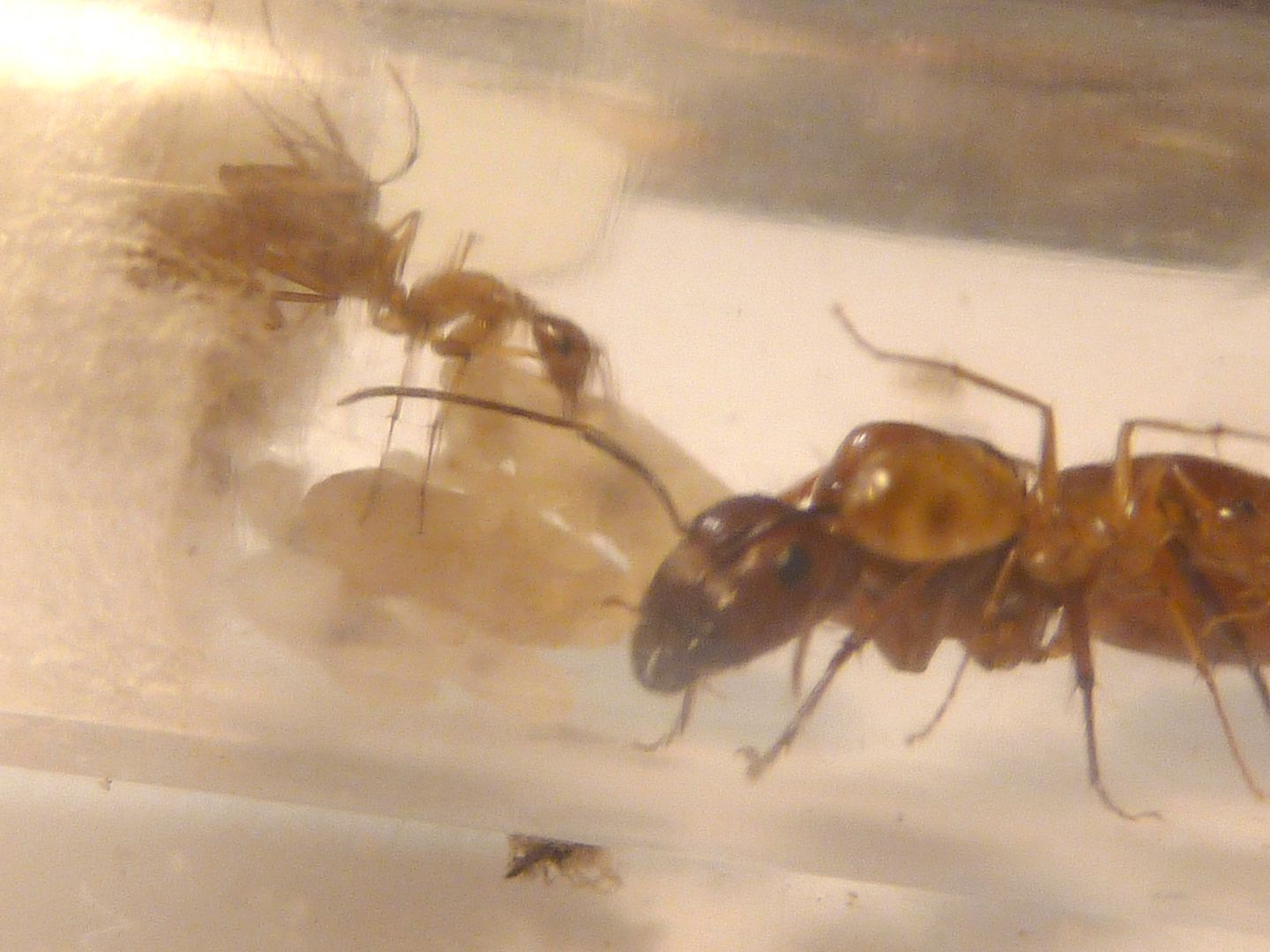
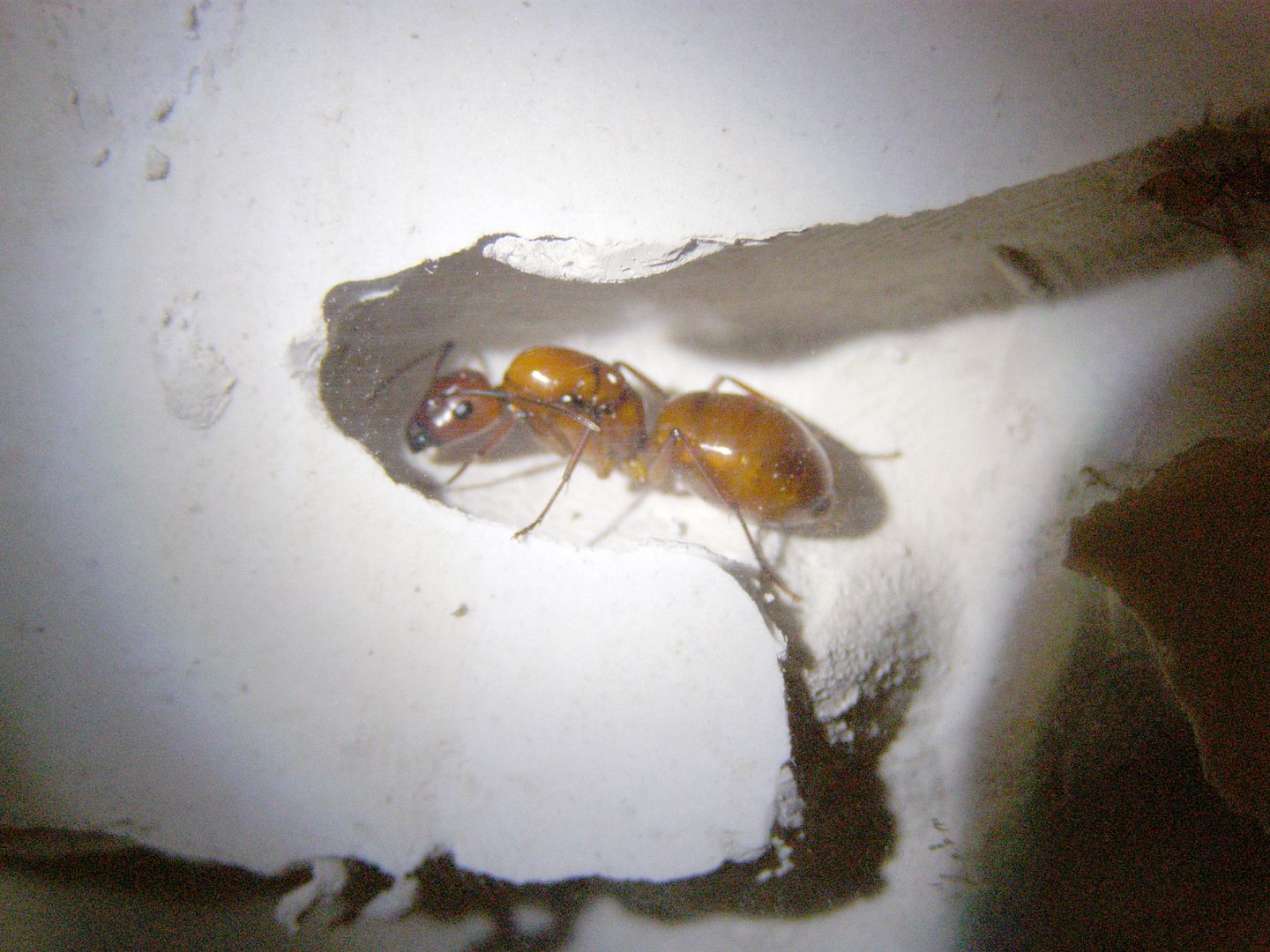
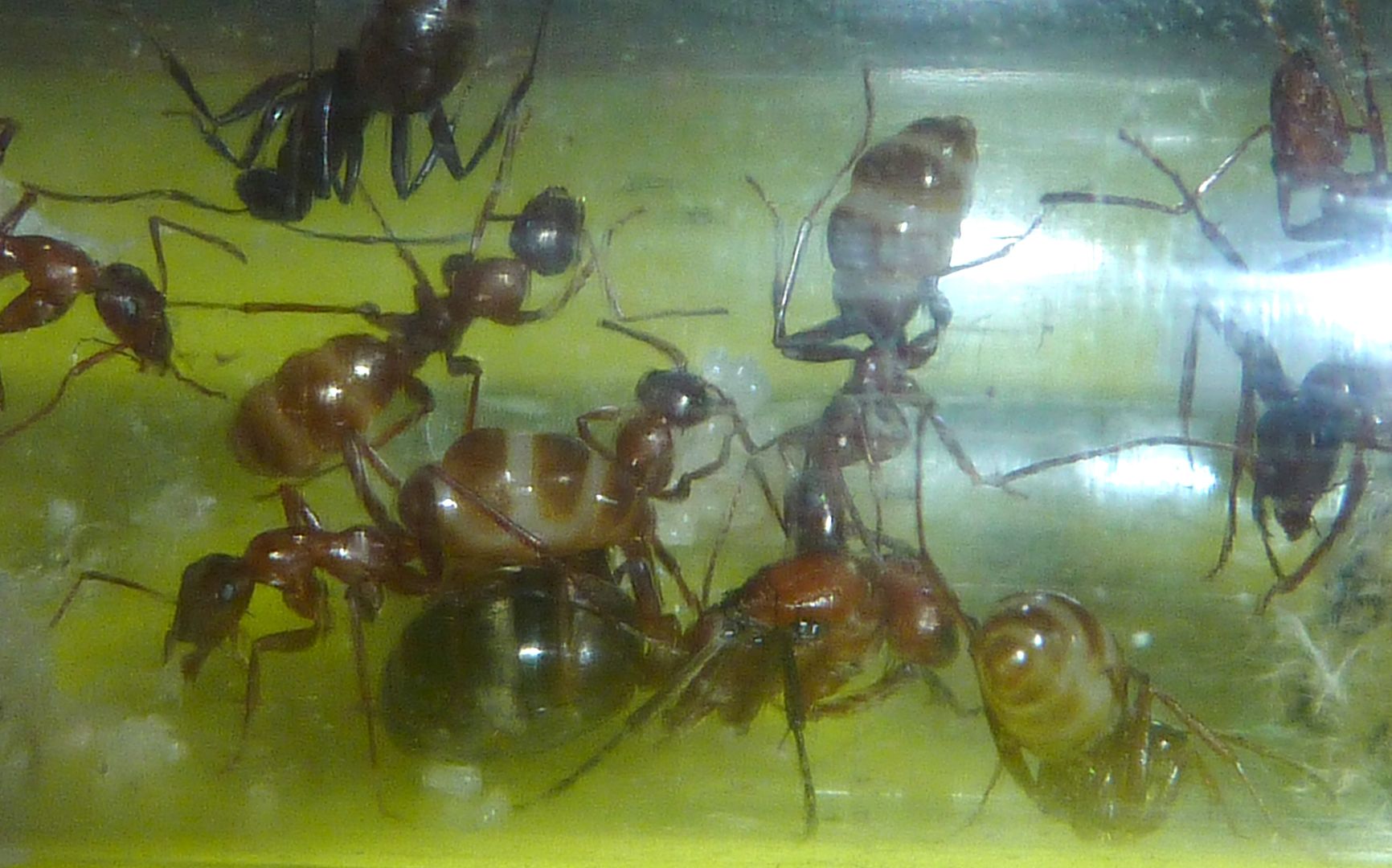 This picture was taken yesterday. Note the eggs scattered about as well the large clutch the worker in the middle is holding. As a social parasite she started laying eggs about a month later than the host species.
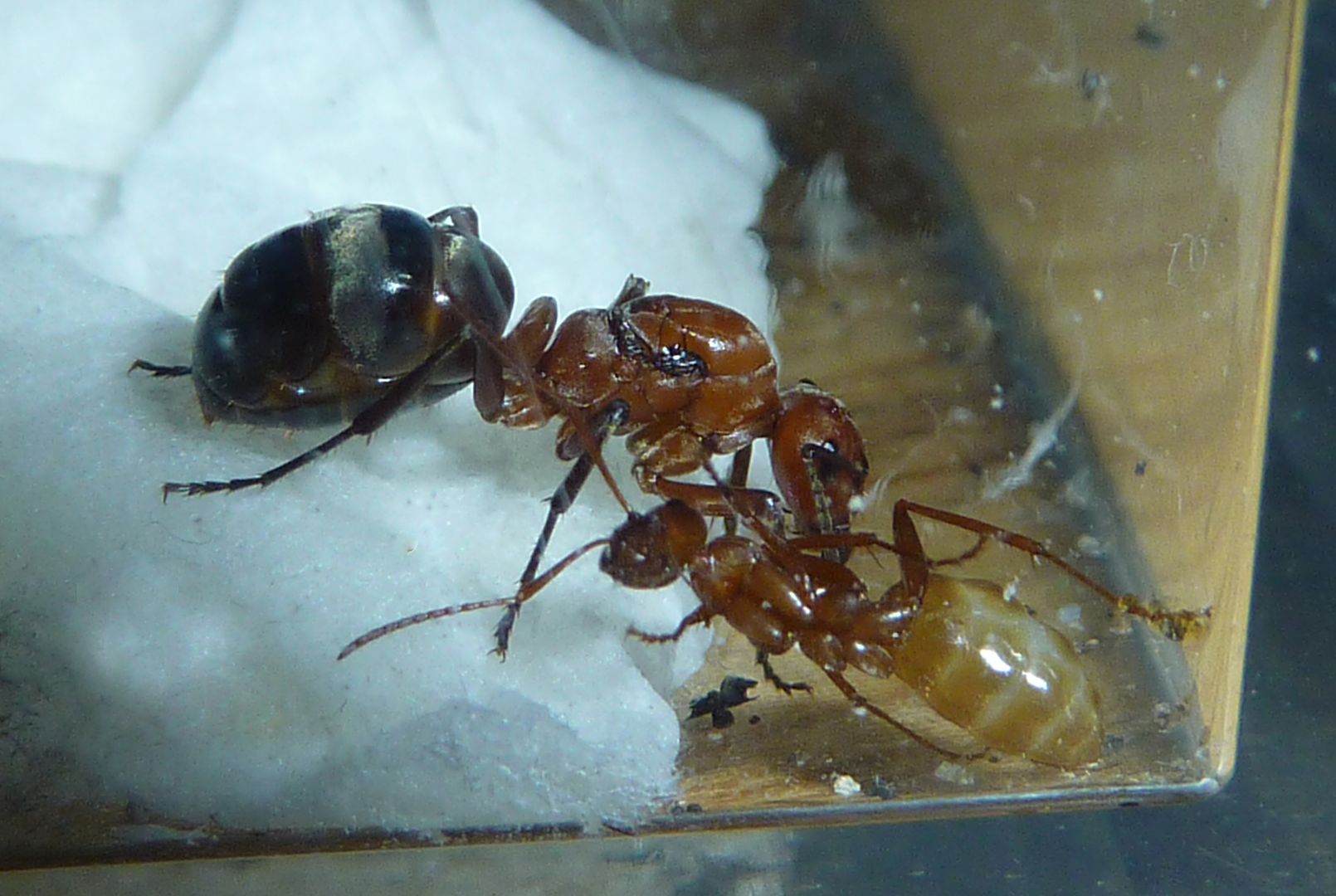 She may produce workers but sometimes social parasites are so dependent to their host species that they're required for their survival. The trouble is the F. pergandei queen had to replace the F. pallidefulva queen in order to start her colony, so they're eventually going to run out of host workers.
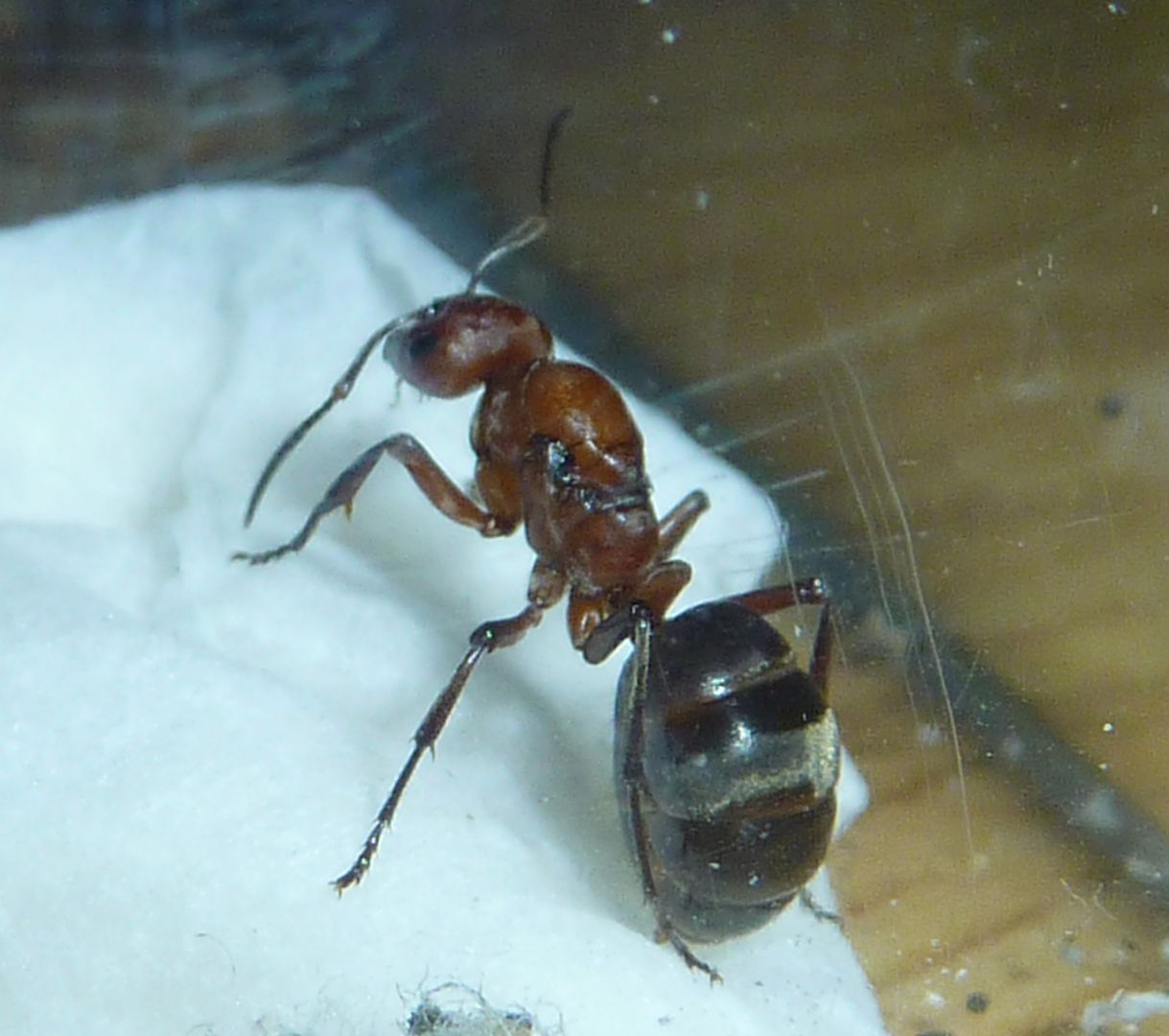 F. pergandei colonies get around this by raiding established host colonies for brood. Occasionally I believe host colonies are out right overrun by the F. pergandei as they move their entire nest into the new location. It's a vicious cycle but at least the F. pergandei are giving their hosts a chance to get a head start. Come summer though the F. pergandei will be born and raids will begin.
Formica pergandei is a social parasite of other Formica species. That is F. pergandei queens can't start a colony on their own. They have to invade established colonies of hosts and replace it's resident queen, usually by assassination and stealing the colony odor by rolling in the queen's juices, etc... so the host workers don't turn on here.
Tuesday, April 13, 2010
Camponotus castaneus Journal 04/13/10
I believe it was on March 20th that I noticed the colonies of Camponotus castaneus were once again awake. The clusters of brood to both colonies started developing.
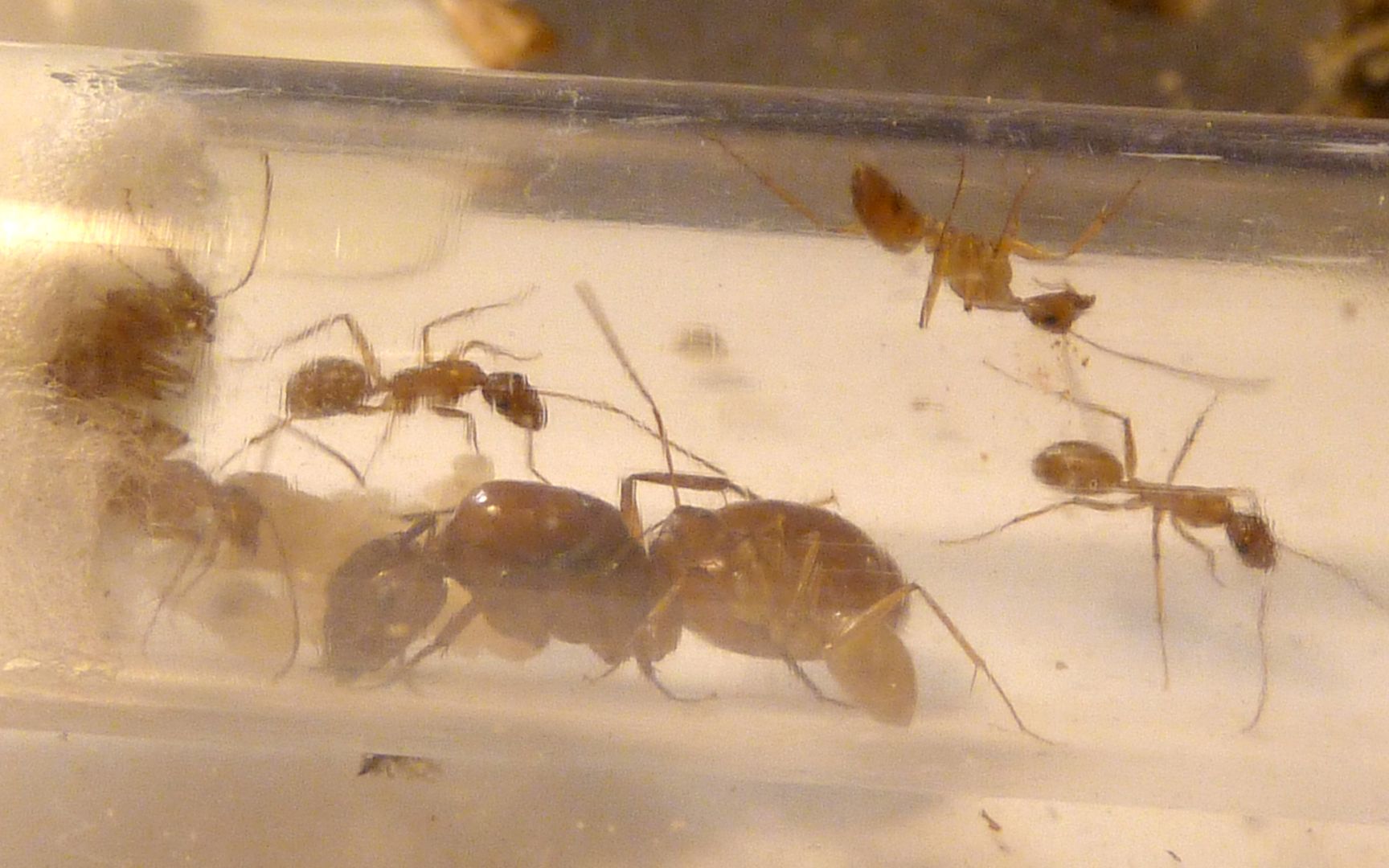 What's neat though is the colony still in the test tube setup is farther along than the one in the plaster tank setup. They already have a larvae that's spun a cocoon.
 And I want to say the queens to both colonies have started laying again.
As a little nuptial flight update I've been reading reports of Camponotus pennsylvanicus, americanus, and chromaiodes (3 fairly abundant species in North America) have started flying. Time of day is something of an issue though. I believe most species fly in the late afternoon and continue on into the night. Come 11:00pm though and they've stopped flying completely. Queens wonder around for upwards of 24 hours after flying. They're not horribly common in most places but because of their lumbering size (13 to 20mm long) they're easy to spot.
As a little nuptial flight update I've been reading reports of Camponotus pennsylvanicus, americanus, and chromaiodes (3 fairly abundant species in North America) have started flying. Time of day is something of an issue though. I believe most species fly in the late afternoon and continue on into the night. Come 11:00pm though and they've stopped flying completely. Queens wonder around for upwards of 24 hours after flying. They're not horribly common in most places but because of their lumbering size (13 to 20mm long) they're easy to spot.
Monday, December 14, 2009
How to Build a Tank Setup (Part 2)
This is a continuation from yesterday's post, Here.
After roughly a day of having built your Tank Setup it should be ready to house a colony of ants. Hold back on decorating it until after the ants have established themselves. This will ensure they "set up shop" and nest in the plaster setup and dont' try building little huts out of bark and stones... the fools. (I once had a colony of Aphaenogaster that decided to stack tiny stones in order to make a nest rather then move into the plaster setup, so hold off on that stuff for now.)
Also it's time to apply the Fluon or 3 in One Oil. A little bit of both goes a long way. So add a few drops to a large cotton ball or crumbled up paper towel. Coat the corners first as best you can. Then go along the top inch of the tank. If you don't...

... this can happen. Actually it's bound to happen sooner or later. An escape proof setup is one that's surrounded by a moat and locked in an air tight chamber. Even scientists have trouble with this. Thankfully ants are more than reasonable, and can easily be swayed back into the setup.
NOTE: Ants that are ill tempered and aggressive are best swayed around with something other then your hand. The same applies for ants that have painful stings.
Ants that spray formic acid were not meant for captivity and can actually die from the putrid odor of the formic acid they spray, besides you don't want that in your room either.
Now onto Adding Ants! Before we begin you should only add Colonies, not queens still working on their first batch of brood. Colonies have workers and presumably a foraging force. Loan queens are a stage behind this step.
Take one colony, in this case Camponotus castaneus...
... say hello to guard ant...

... Then dump colony directly in the entrance of the setup! The end.
Well that wasn't hard at all... okay maybe I should elaborate some.
Once removed from the tube they called home since last June, the ants will scatter looking for cover. Because I dumped them right inside the plaster setup they mostly explored all the tunnels and galleries that are each ideal for a small colony to setup shop. Two things are vital though.
1: The Queen. While only 2 of the 9 workers actually bothered to explore outside the plaster setup, they would have been no significant lose had the queen escaped. The queen is safely doing nothing in one of the chambers. Now that I know that I can focus on getting the 2 workers that were running around back into the nesting area.
(I actually didn't apply the 3 in One Oil until after the ants were in the setup. Oops)

2: The Brood! Camponotus in general tend to lay eggs in batches. Currently they only have 2ed and 3rd instar larva in the nest. And they all fell out of the tube in one big clump. This is great! Usually what happens is some eggs are left in their old test tube setup and I end up either crushing them in an attempt to get them out. Or I have to put the test tube setup back in where the ants can find it. The issue here is their old test tube setup has the colony odor and all the ants will move right back inside the thing regardless of how bright it now is. It smells like home and that's all the ants are interested in. You really don't want either of these things to happen.
The brood is the next generation of workers. Because Camponotus lay eggs in batches this is vital to the colonies survival. When the queen's current work force dies off she's not going to bother foraging for food to build the next one. So it's important the current workers successfully rear new workers before they're die. At the same time allowing them to continue living in their test tube setup isn't good. You may as well have not built a new setup at all.
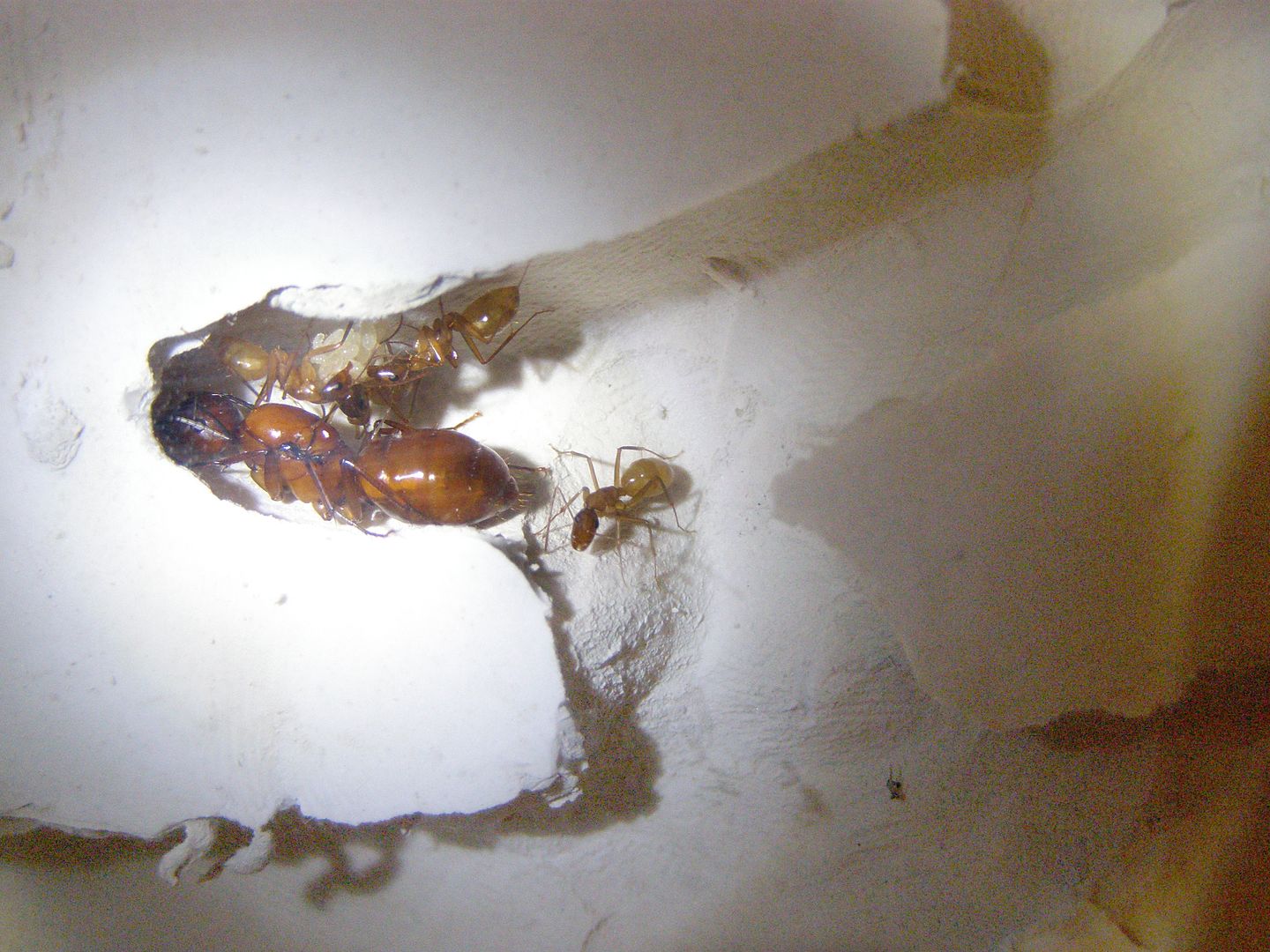
Just hours after the colony has been dumped they've already found a temporary nesting site. Right now the queen is the closest thing the workers have to a colony odor so they all tend to cluster around her and places that she's been to.
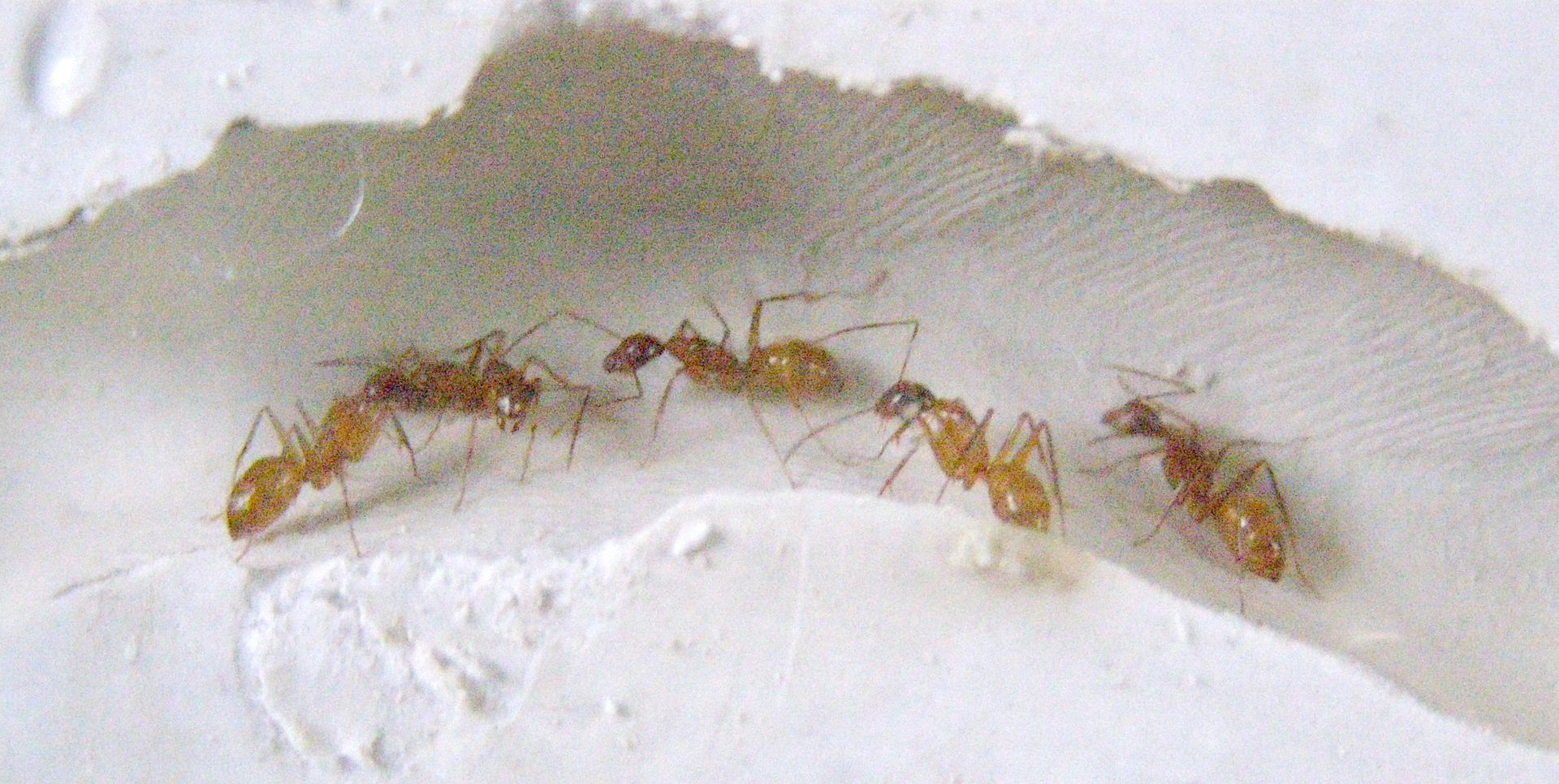
You may notice small groups of workers hanging our randomly too. They eventually disband and rejoin the group that has the queen.

You may see some ants carrying other ants, or in the case of the queen, dragging her. This is a worker that has found a chamber she thinks will be a great nest site. The trouble is convincing the colony. One by one she grabbed each of the workers and brought them to this chamber. The trouble is they disagreed with her and simply left after being let go. A noble effort but the colony said no. Had they liked the new space then the workers she brought here would have joined in the effort to bring the colony here.
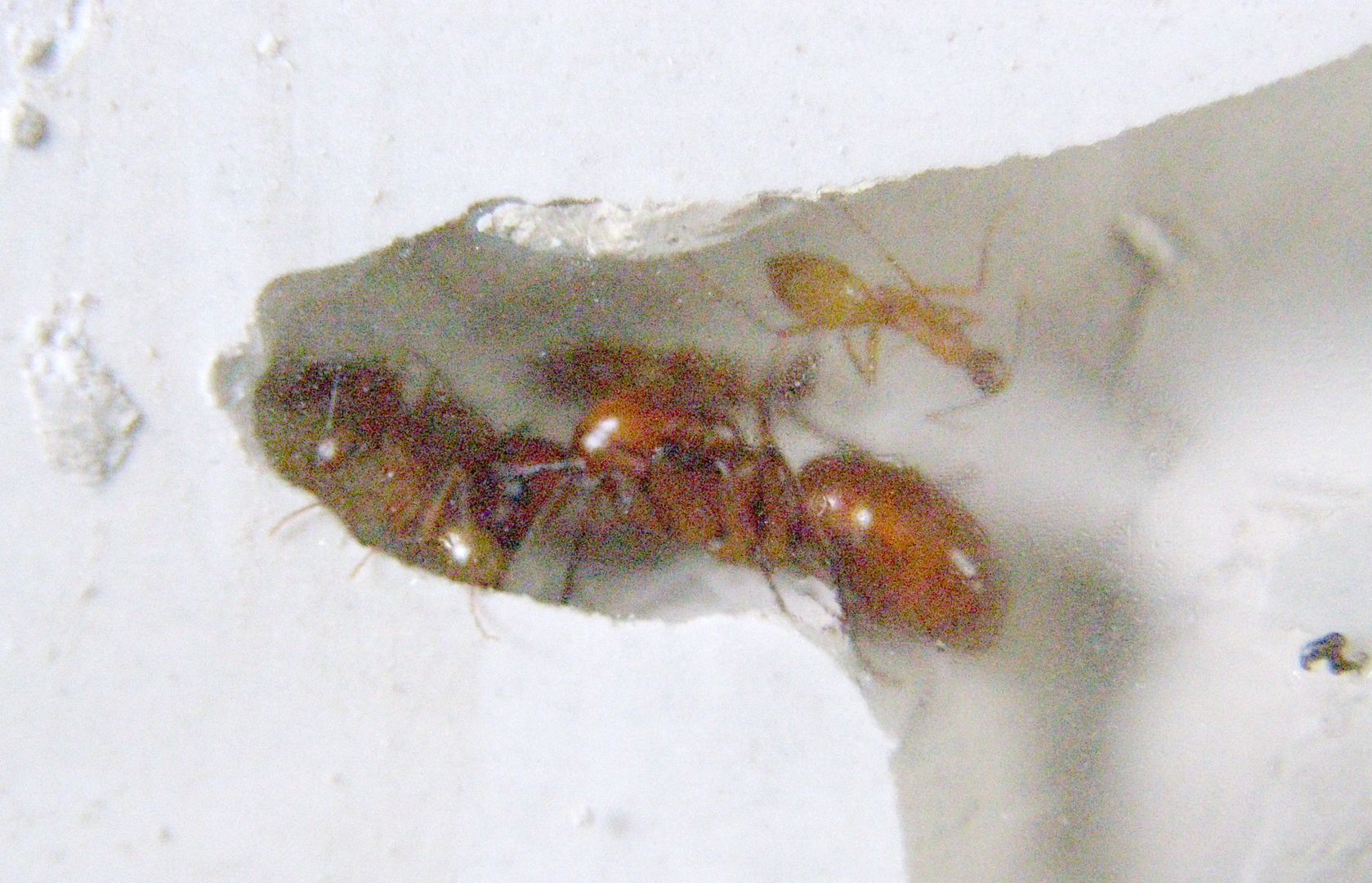
Back to their stoop they went. To be honest though I wish they had gone to that chamber instead, but what do I know.
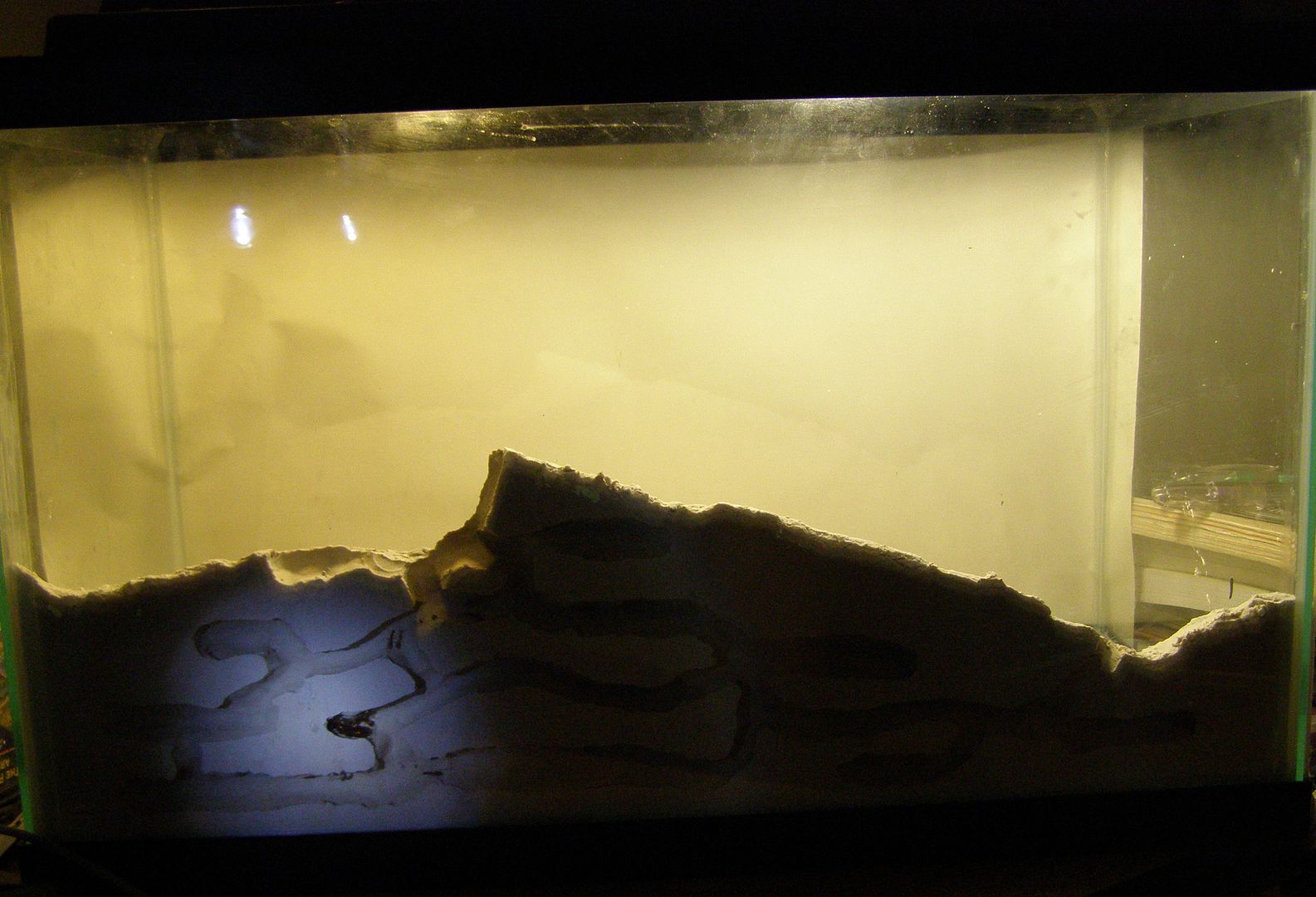
For the first few days don't bother feeding the ants. Stuffing your face when the family tree has been chopped down is considered poor form among ants. Foraging simply isn't done until they have established a nesting site to take the food.
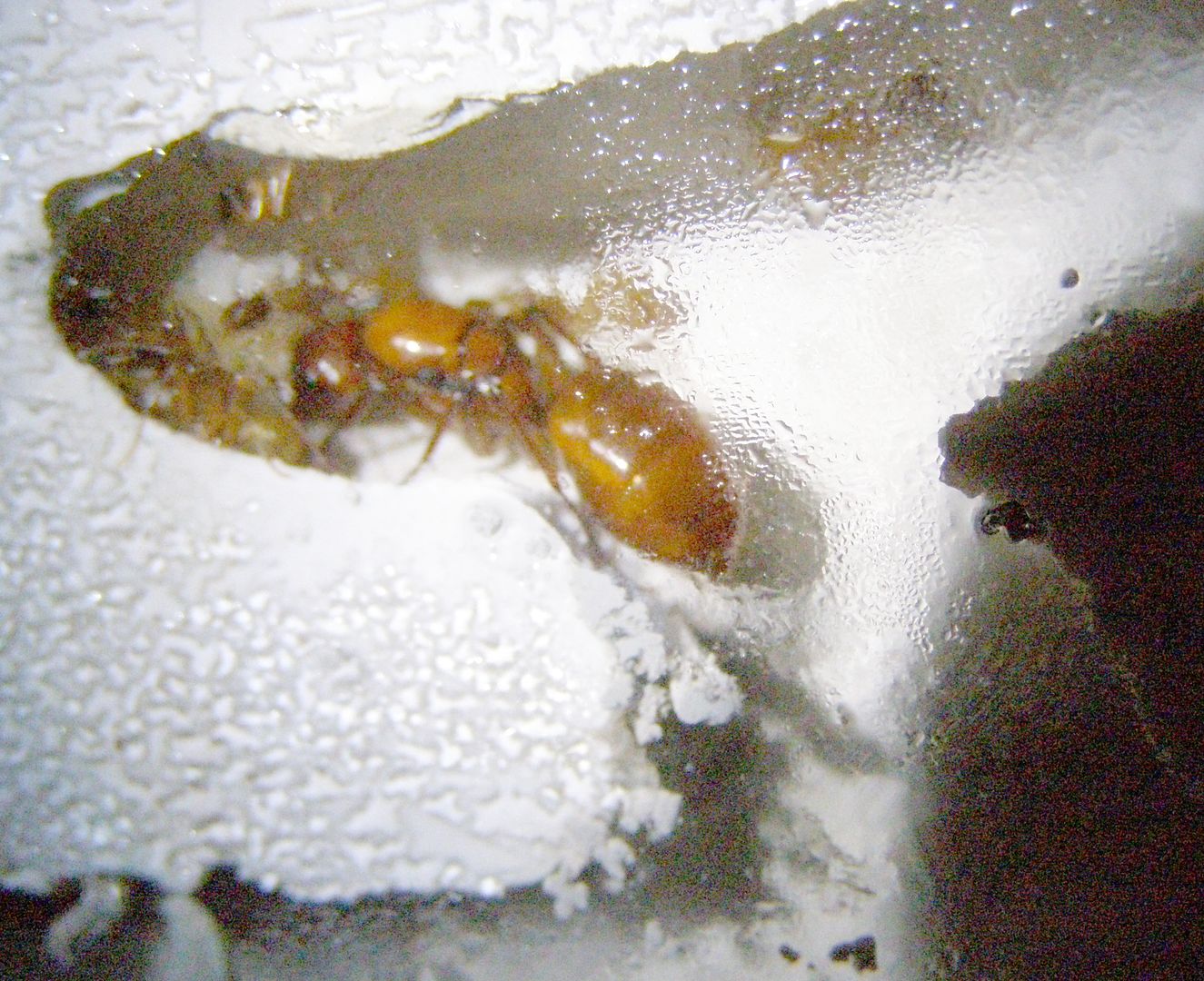
The following day: Condensation can be an issue in plaster setup. It is easily controlled by opening the lid to the setup, but may take time. The temperature of the glass and the plaster, having the light on or off, and how much moisture is in the plaster are all factors. It's not a problem for ants of their size but smaller species can have issues with it sometimes.

Still in the second day the ants begin making edits to the room they've choses to take over. Here an ant gathers some modeling clay I forgot to remove. When you start seeing this behavior it's safe to start decorating. (I added a thing layer of Repti Bark outside to act as the floor to the setup. Feeding should be done on trays so insect corpses don't build up.)
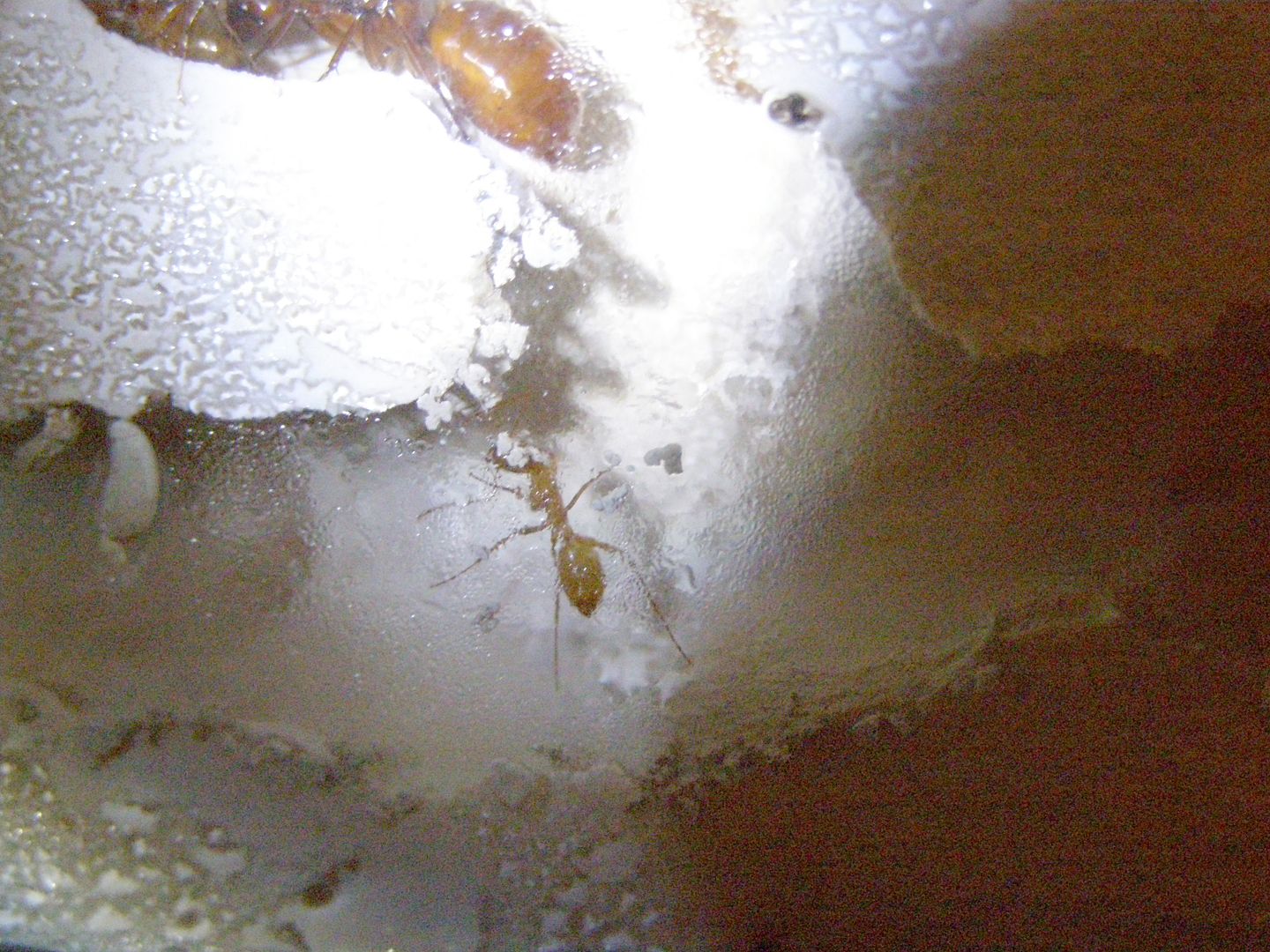
Slowly she builds out the stoop and gets the nest more floor space. Eventually (as I see today) they'll bring in the wood chips I place in as a floor medium. I love seeing ant engineering at it's finest.

The other behavior I see is scouting. I tried feeding them but she wasn't interested. I think she was trying to locate the old nest to be honest. The 3 in One Oil holds, actually she has lots of trouble just climbing the glass now, I'm not sure what that's about. When they were first introduced they had no issue with climbing glass. Before leaving the nest I notice she gives all her stored food to another worker.
And now I would like to address something. The last time I tried keeping a journal like this I had a colony of Camponotus chromaiodes. The thing is though for the longest time I had them misidentified as C. novaeboracensis. So this time I want to get it right. Unfortunately until I see a wider range of workers Color is the only thing I have to go on.
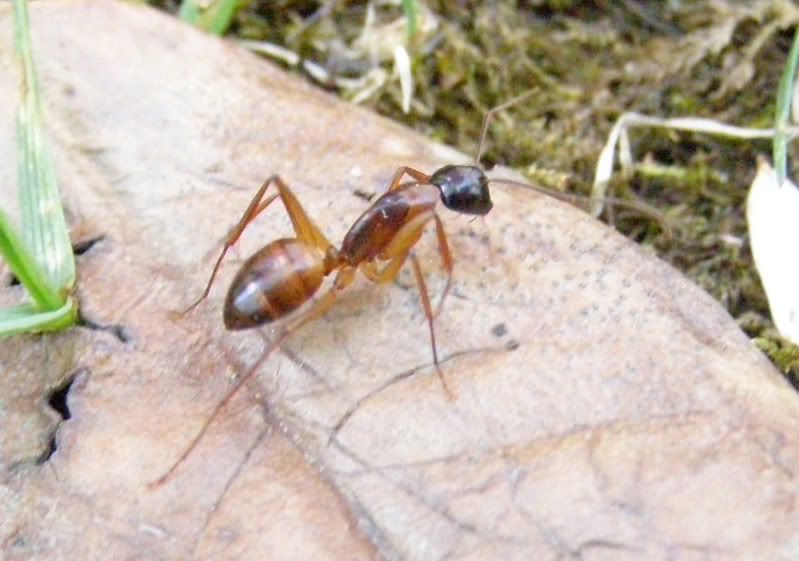
C. americanus tends to have darker traits (as seen above,) it can also be as light as C. castaneus. I don't know of any C. americanus colonies in the area though. I took this picture in Delaware, about an hour away from where I live in New Jersey.
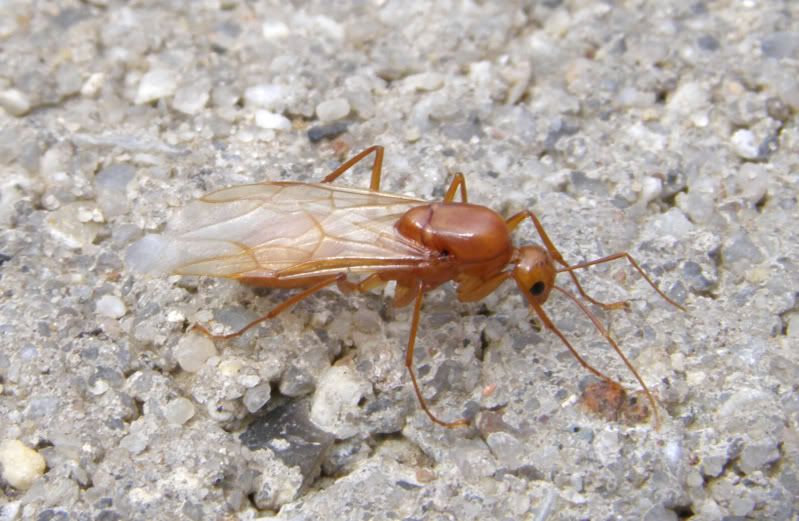
A main difference between the two species is C. castaneus has orange males, (seen above). But no males are present in the colony I have.
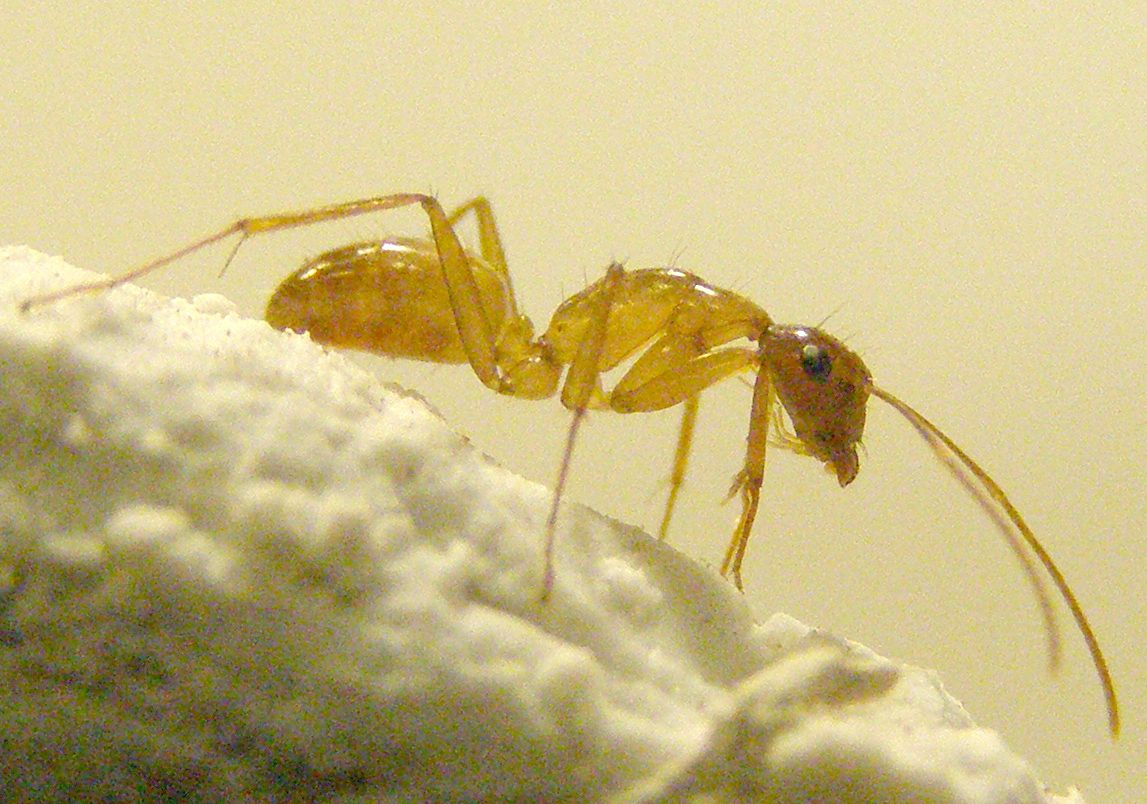
This lighter color and more brilliant oranges is more in line with Camponotus castaneus which is locally abundant. I probably have three colonies in my yard I know of and that's where I caught both queens. But as I look on Ant Web I see things like placement of hairs, length of the maxillary palp, and head shape (currently) are all similar. Actually this worker is hairy enough to be a C. americanus worker but I'm not willing to accept that yet until I start seeing some darker workers.
Even if I'm wrong a second time though C. americanus is just as pretty.
After roughly a day of having built your Tank Setup it should be ready to house a colony of ants. Hold back on decorating it until after the ants have established themselves. This will ensure they "set up shop" and nest in the plaster setup and dont' try building little huts out of bark and stones... the fools. (I once had a colony of Aphaenogaster that decided to stack tiny stones in order to make a nest rather then move into the plaster setup, so hold off on that stuff for now.)
Also it's time to apply the Fluon or 3 in One Oil. A little bit of both goes a long way. So add a few drops to a large cotton ball or crumbled up paper towel. Coat the corners first as best you can. Then go along the top inch of the tank. If you don't...
... this can happen. Actually it's bound to happen sooner or later. An escape proof setup is one that's surrounded by a moat and locked in an air tight chamber. Even scientists have trouble with this. Thankfully ants are more than reasonable, and can easily be swayed back into the setup.
NOTE: Ants that are ill tempered and aggressive are best swayed around with something other then your hand. The same applies for ants that have painful stings.
Ants that spray formic acid were not meant for captivity and can actually die from the putrid odor of the formic acid they spray, besides you don't want that in your room either.
Now onto Adding Ants! Before we begin you should only add Colonies, not queens still working on their first batch of brood. Colonies have workers and presumably a foraging force. Loan queens are a stage behind this step.
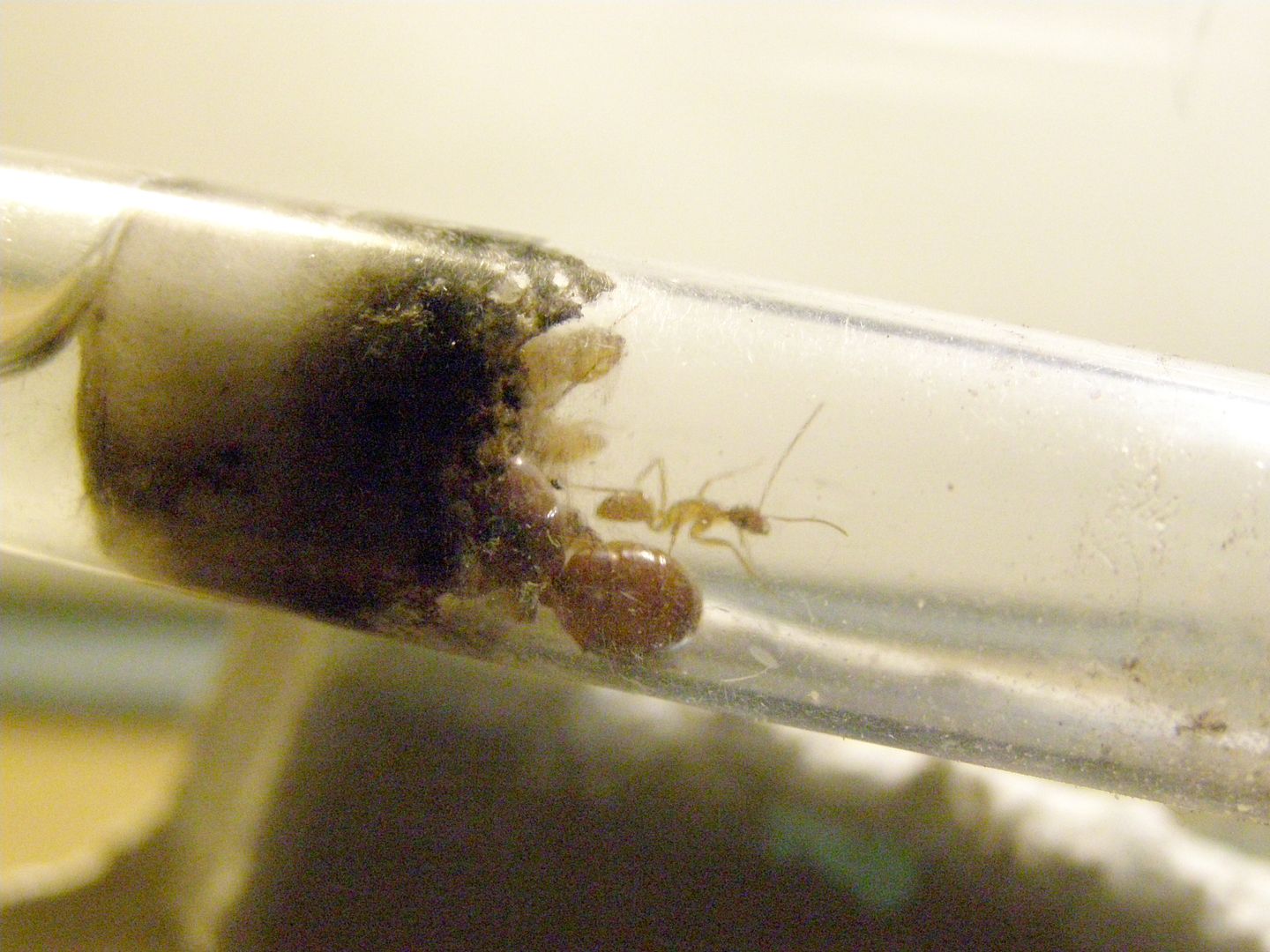
Take one colony, in this case Camponotus castaneus...
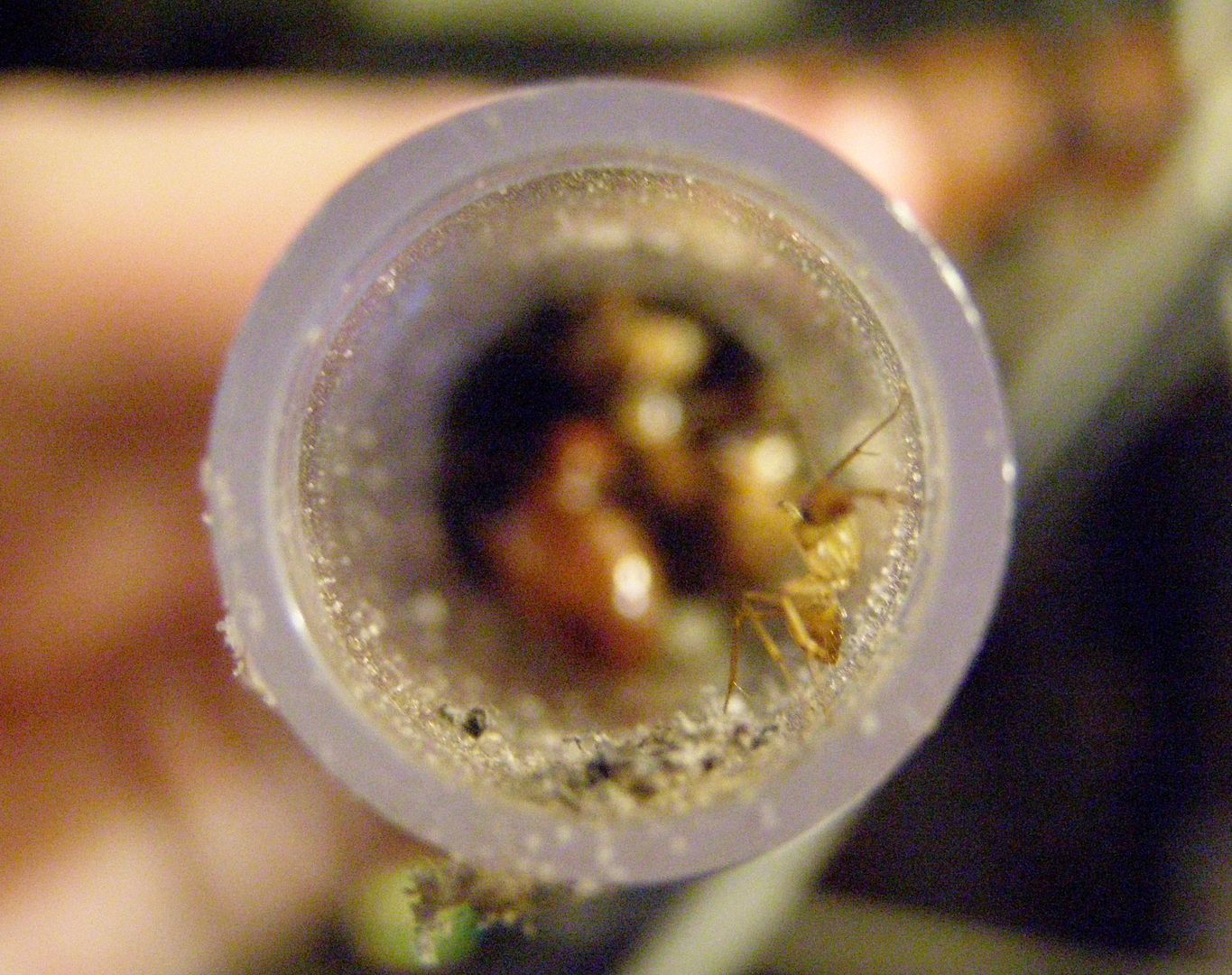
... say hello to guard ant...
... Then dump colony directly in the entrance of the setup! The end.
Well that wasn't hard at all... okay maybe I should elaborate some.
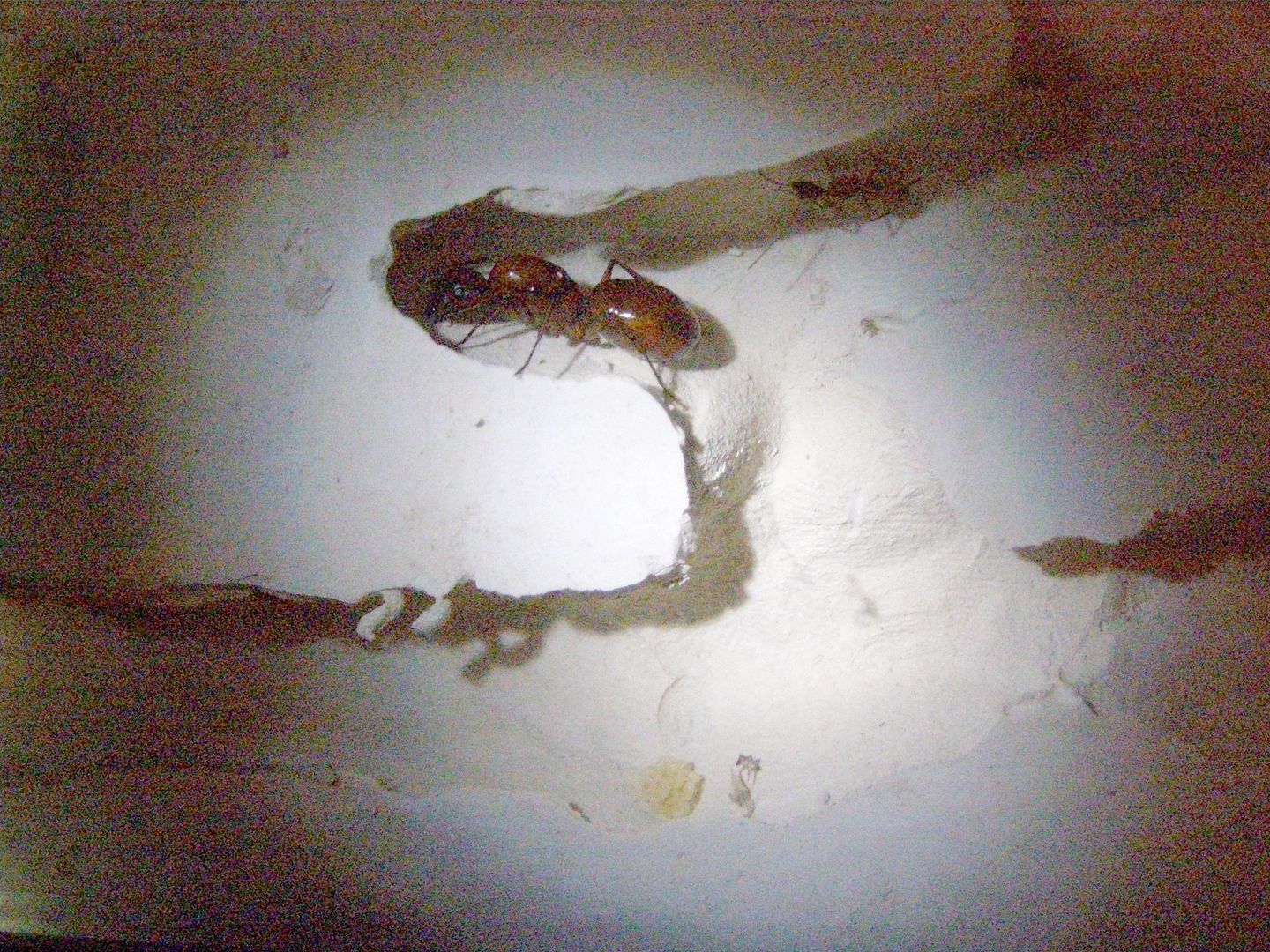
Once removed from the tube they called home since last June, the ants will scatter looking for cover. Because I dumped them right inside the plaster setup they mostly explored all the tunnels and galleries that are each ideal for a small colony to setup shop. Two things are vital though.
1: The Queen. While only 2 of the 9 workers actually bothered to explore outside the plaster setup, they would have been no significant lose had the queen escaped. The queen is safely doing nothing in one of the chambers. Now that I know that I can focus on getting the 2 workers that were running around back into the nesting area.
(I actually didn't apply the 3 in One Oil until after the ants were in the setup. Oops)
2: The Brood! Camponotus in general tend to lay eggs in batches. Currently they only have 2ed and 3rd instar larva in the nest. And they all fell out of the tube in one big clump. This is great! Usually what happens is some eggs are left in their old test tube setup and I end up either crushing them in an attempt to get them out. Or I have to put the test tube setup back in where the ants can find it. The issue here is their old test tube setup has the colony odor and all the ants will move right back inside the thing regardless of how bright it now is. It smells like home and that's all the ants are interested in. You really don't want either of these things to happen.
The brood is the next generation of workers. Because Camponotus lay eggs in batches this is vital to the colonies survival. When the queen's current work force dies off she's not going to bother foraging for food to build the next one. So it's important the current workers successfully rear new workers before they're die. At the same time allowing them to continue living in their test tube setup isn't good. You may as well have not built a new setup at all.
Just hours after the colony has been dumped they've already found a temporary nesting site. Right now the queen is the closest thing the workers have to a colony odor so they all tend to cluster around her and places that she's been to.
You may notice small groups of workers hanging our randomly too. They eventually disband and rejoin the group that has the queen.
You may see some ants carrying other ants, or in the case of the queen, dragging her. This is a worker that has found a chamber she thinks will be a great nest site. The trouble is convincing the colony. One by one she grabbed each of the workers and brought them to this chamber. The trouble is they disagreed with her and simply left after being let go. A noble effort but the colony said no. Had they liked the new space then the workers she brought here would have joined in the effort to bring the colony here.
Back to their stoop they went. To be honest though I wish they had gone to that chamber instead, but what do I know.
For the first few days don't bother feeding the ants. Stuffing your face when the family tree has been chopped down is considered poor form among ants. Foraging simply isn't done until they have established a nesting site to take the food.
The following day: Condensation can be an issue in plaster setup. It is easily controlled by opening the lid to the setup, but may take time. The temperature of the glass and the plaster, having the light on or off, and how much moisture is in the plaster are all factors. It's not a problem for ants of their size but smaller species can have issues with it sometimes.
Still in the second day the ants begin making edits to the room they've choses to take over. Here an ant gathers some modeling clay I forgot to remove. When you start seeing this behavior it's safe to start decorating. (I added a thing layer of Repti Bark outside to act as the floor to the setup. Feeding should be done on trays so insect corpses don't build up.)
Slowly she builds out the stoop and gets the nest more floor space. Eventually (as I see today) they'll bring in the wood chips I place in as a floor medium. I love seeing ant engineering at it's finest.
The other behavior I see is scouting. I tried feeding them but she wasn't interested. I think she was trying to locate the old nest to be honest. The 3 in One Oil holds, actually she has lots of trouble just climbing the glass now, I'm not sure what that's about. When they were first introduced they had no issue with climbing glass. Before leaving the nest I notice she gives all her stored food to another worker.
And now I would like to address something. The last time I tried keeping a journal like this I had a colony of Camponotus chromaiodes. The thing is though for the longest time I had them misidentified as C. novaeboracensis. So this time I want to get it right. Unfortunately until I see a wider range of workers Color is the only thing I have to go on.
C. americanus tends to have darker traits (as seen above,) it can also be as light as C. castaneus. I don't know of any C. americanus colonies in the area though. I took this picture in Delaware, about an hour away from where I live in New Jersey.
A main difference between the two species is C. castaneus has orange males, (seen above). But no males are present in the colony I have.
This lighter color and more brilliant oranges is more in line with Camponotus castaneus which is locally abundant. I probably have three colonies in my yard I know of and that's where I caught both queens. But as I look on Ant Web I see things like placement of hairs, length of the maxillary palp, and head shape (currently) are all similar. Actually this worker is hairy enough to be a C. americanus worker but I'm not willing to accept that yet until I start seeing some darker workers.
Even if I'm wrong a second time though C. americanus is just as pretty.
Monday, November 23, 2009
Pheidole pilifera (journal)
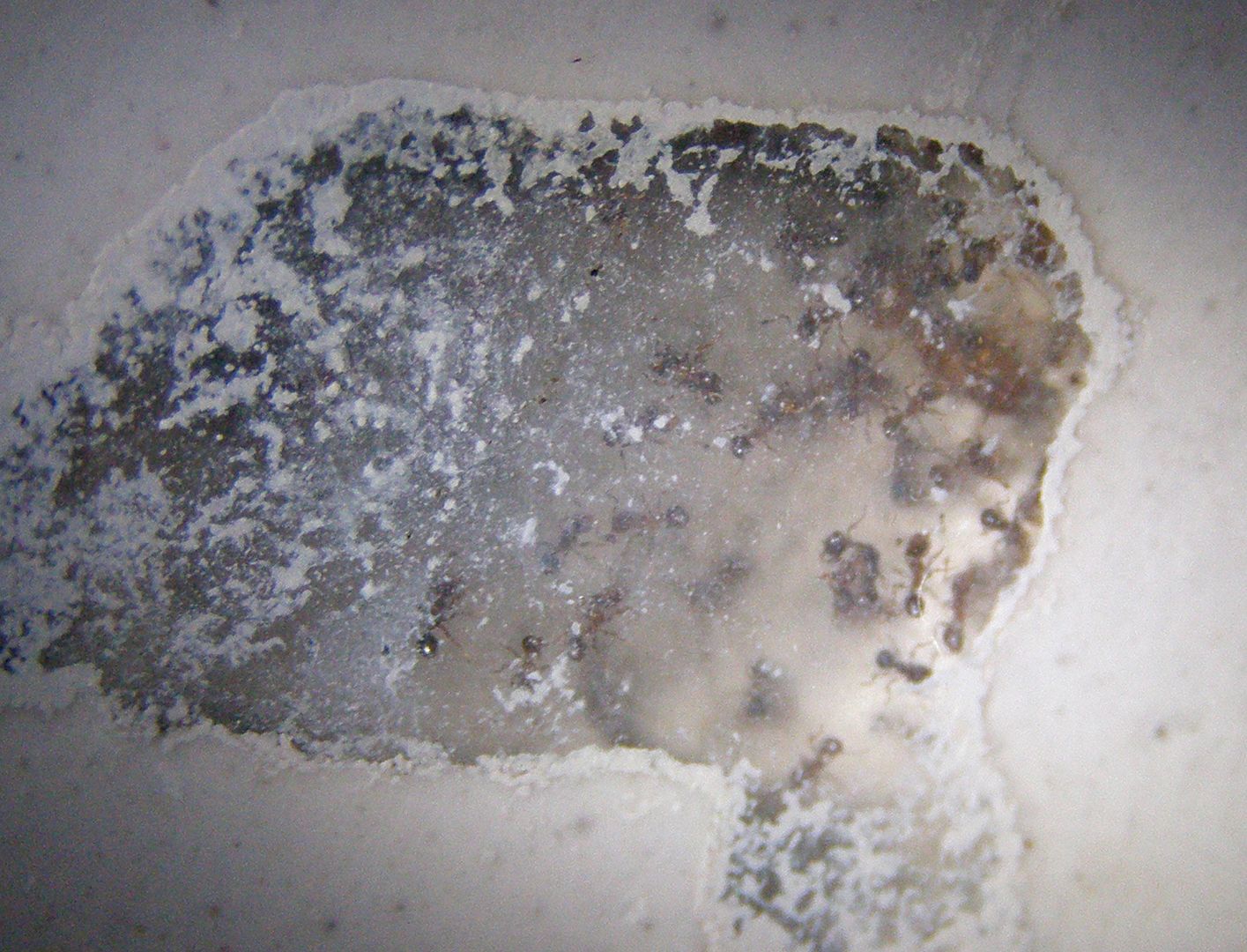
My Pheidole pilifera colony. Not that you can tell what they are though from this photo. These ants are incredibly small and normally nest in sand. This is the whole colony and they could all easily fit on the tip of my thumb. They're not digging into the plaster but are able to nibble at it. They do this mostly as a reaction to water, or in this case condensation that sometimes forms on the side. They probably won't dig tunnels into the plaster until they've expanded into the other chambers. That's a long ways off though.

They're in the middle chamber to the far right. The Test Tube is no longer in there of course, this is an old pic from the summer. I keep the surface area clean as best as I can. Black patches of mold grow if food is left there. It scrapes off easily though. I don't think I'm damaging the plaster at all. I'm really surprised that that's the only place where mold is growing. The whole setup is basically a sponge and only the parts with open access to air are really growing. Plaster setups really only last 2 years anyhow and it will be easy enough to move the colony.
Sunday, November 22, 2009
Camponotus castaneus (journal)

Both colonies are still alive and to my surprise none of the workers have died yet. They're not in the most photo friendly setup and I haven't really been trying either. Both colonies have fair sized piles of brood too, comprised of probably all 2ed or 3rd instar larva. The winter brood, laid in August or September, develops much slower then past broods, sometimes stopping all together. This is to help remove stress on the colony to forage over the winter time. To many hungry larva and the ants will simply start eating them.
The room they're currently in is among the coldest in our hour. My hands are freezing just typing this and it's supposidly 56F outside. Lighting the fireplace down in the living room doesn't help much and hopefully my colonies do well because of it. I feed them a cricket once a week or whenever I see workers foraging. They don't so much forage as, I'll see a worker standing around in the foraging area.
I've wintered colonies in our refrigerator before but supposidly it's to dry an environment. This is okay for some ants as winter time usually doesn't offer any humidity at all. Certainly nothing far above 20% or 30%. They should still have access to humidity though to be safe. I've seen other people who remove Camponotus colonies and assume their queen didn't survive. The workers all wake up but the queen remains motionless and apparently dead. In actuality Camponotus queens tend actually go into a deeper hibernation and it may take some 2 or 4 more weeks of warm temperatures to bring her out of it. Filtering may help speed this up, a process I developed where the expired ant is placed on a damp tissue or towel and left there for some time. I normally use it to revive drown ants or those who've "died" from to much carbon-dioxide poisoning, usually from rotting insects in a closed space.
The other option with hibernating colonies is a cold basement or garage. The issue here is the ants need to be kept in above freezing temps. So they need to be in a well insulated container that still offers ventilation. They need ventilation because condensation can kill the ants. The other issue is mold. Basements with musky odors and especially ones that feel damp are teaming with mold spores. This is a sign that the basement itself has poor ventilation and isn't ideal for keeping a colony.
Subscribe to:
Posts (Atom)