Showing posts with label Mason. Show all posts
Wednesday, March 13, 2013
Mason Bees Waking Up
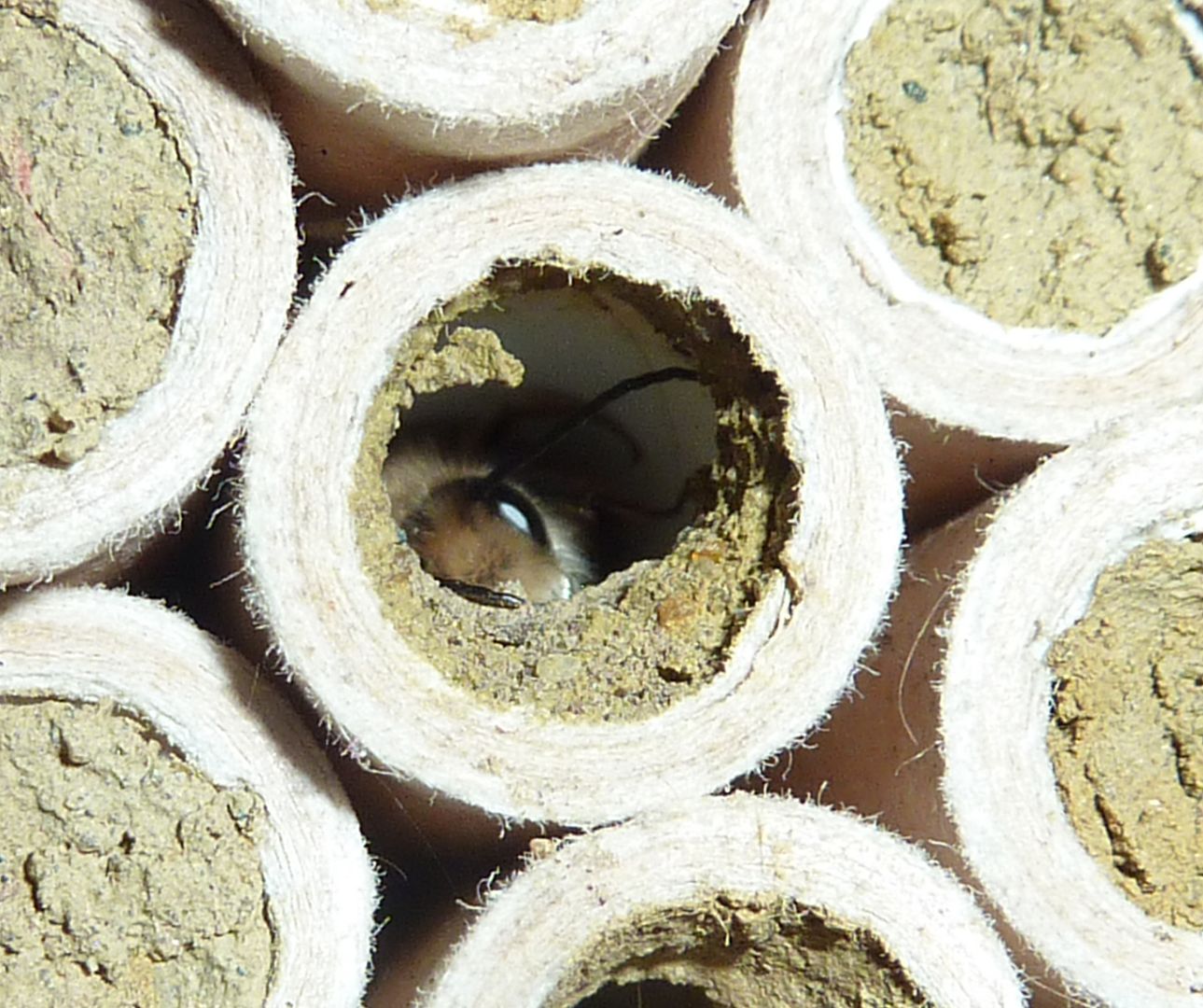
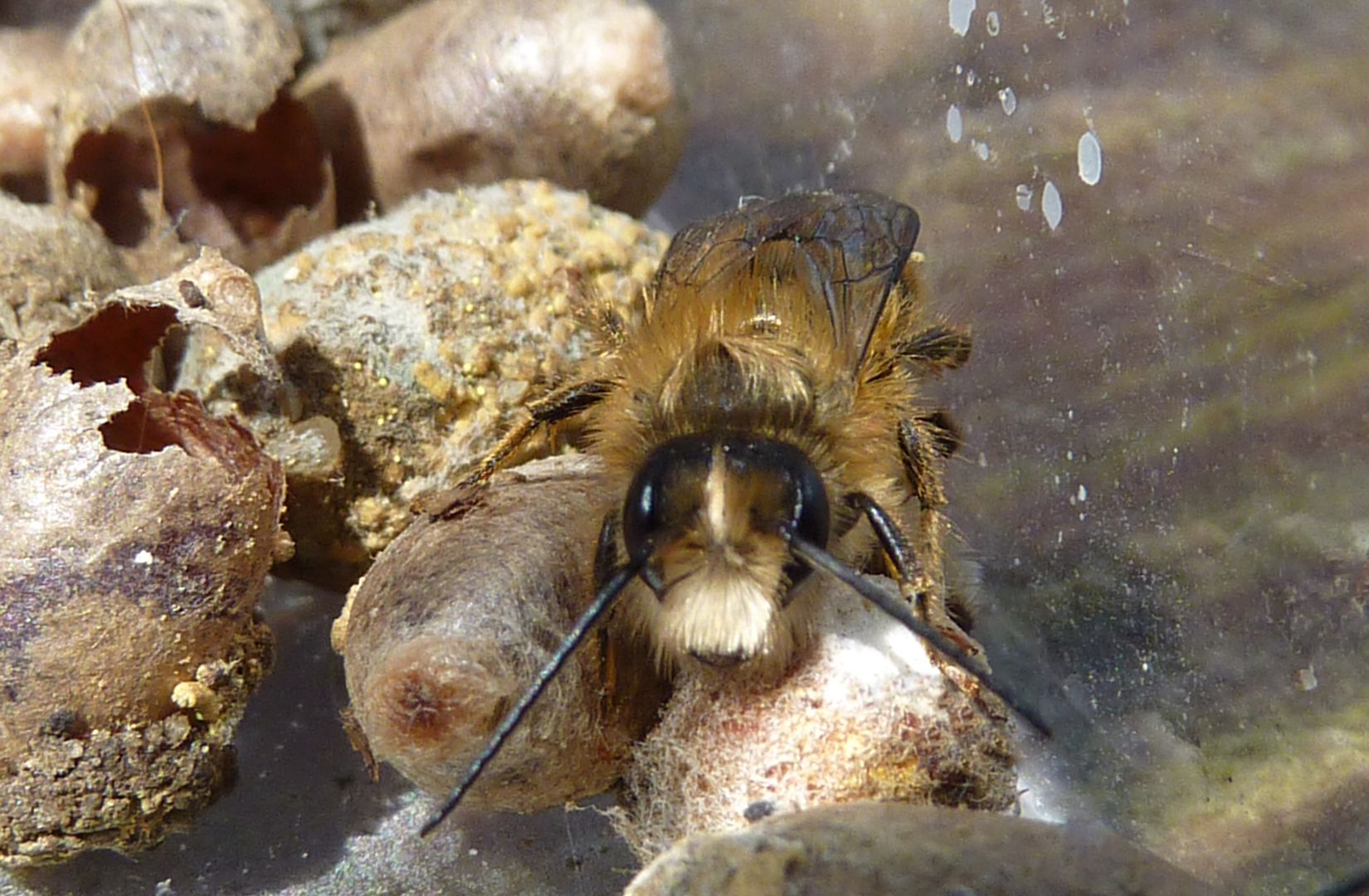
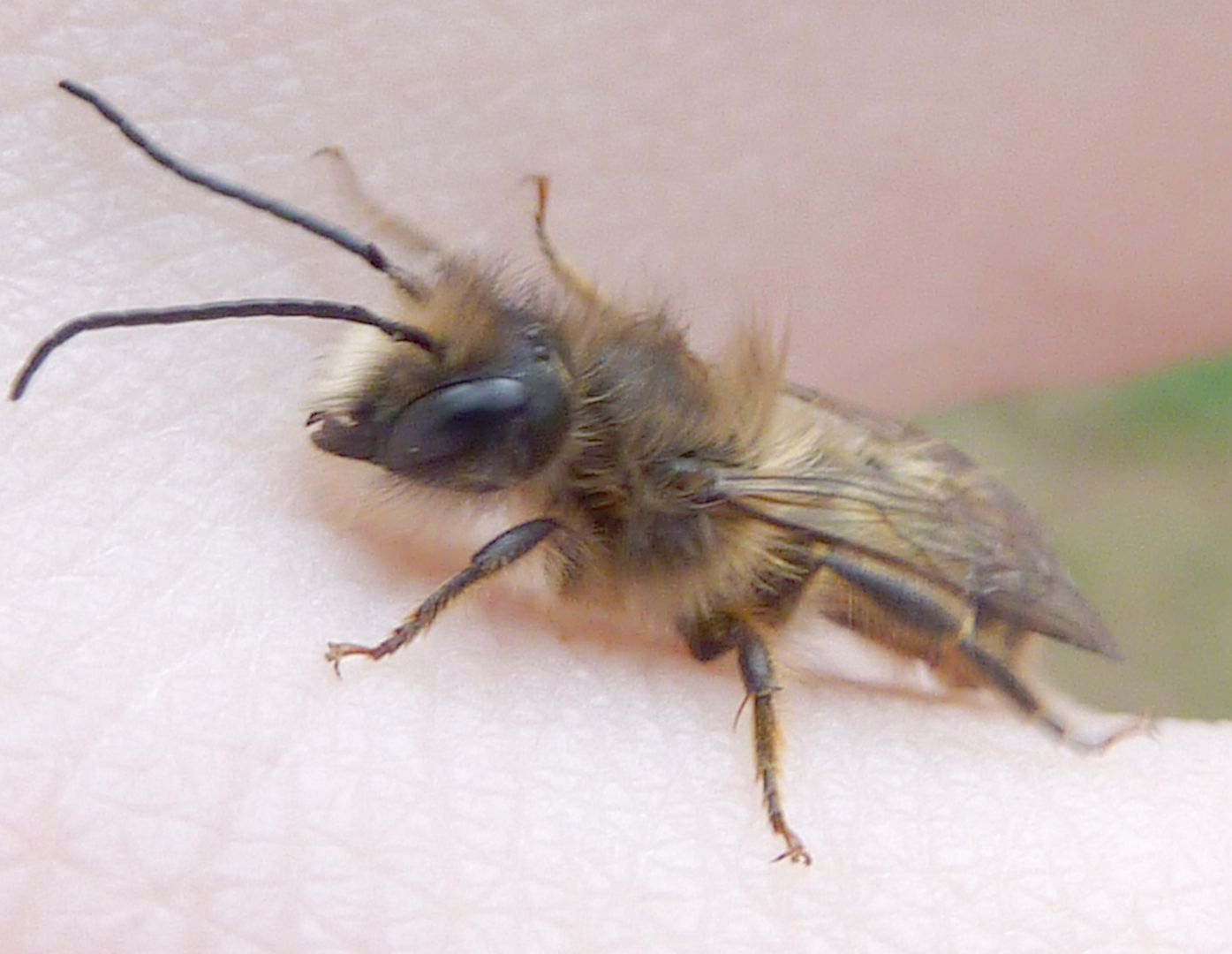
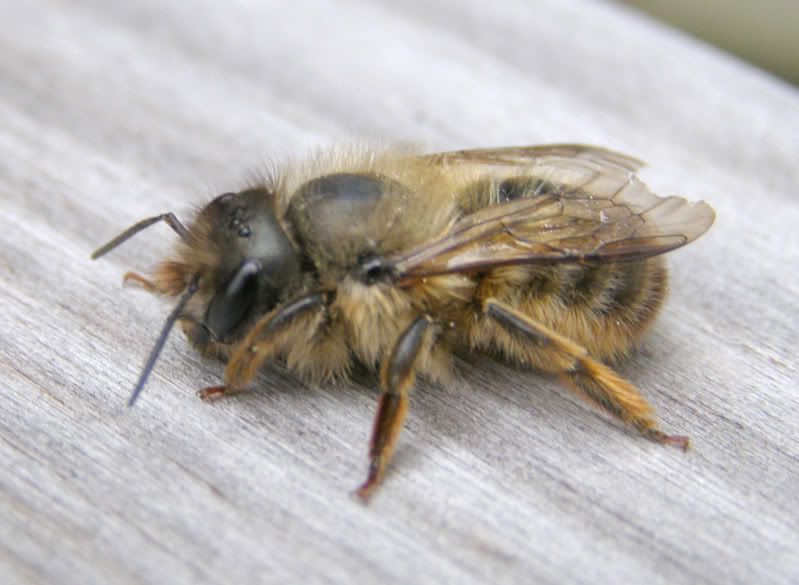
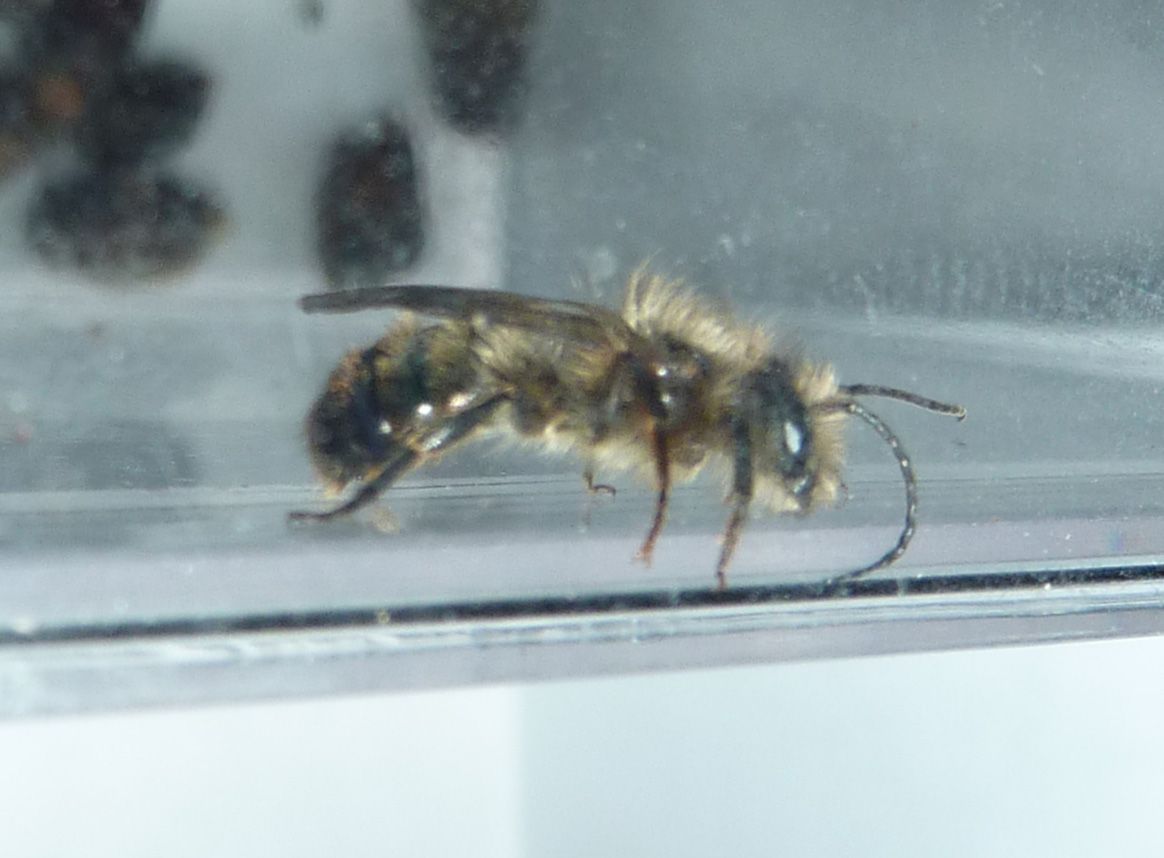
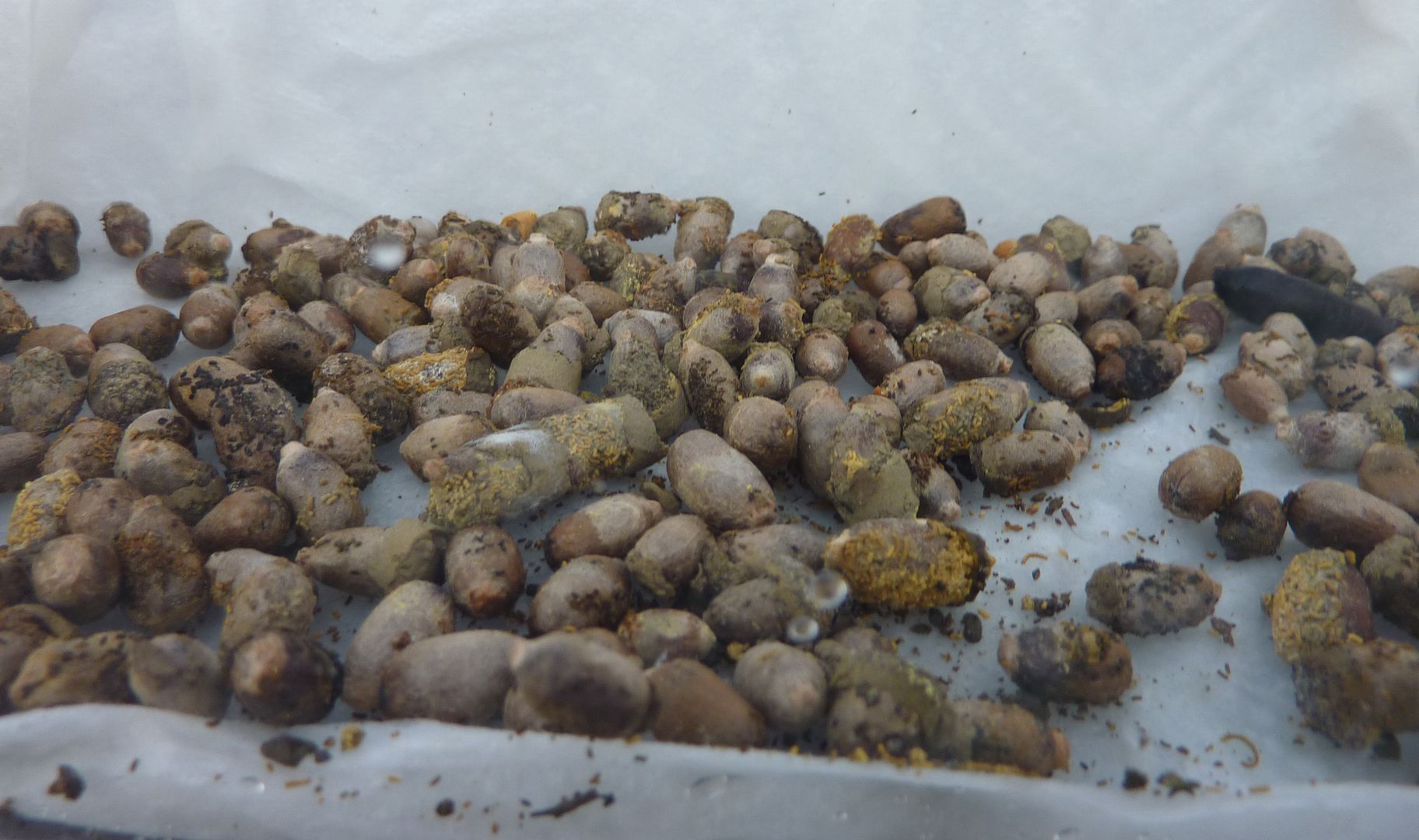
My mason bees started waking up. Normally you remove the cocoons from the tubes and wash them off in water with a slight amount of bleach to kill off mites and things. The cocoons are waterproof so it doesn't kill the bees.
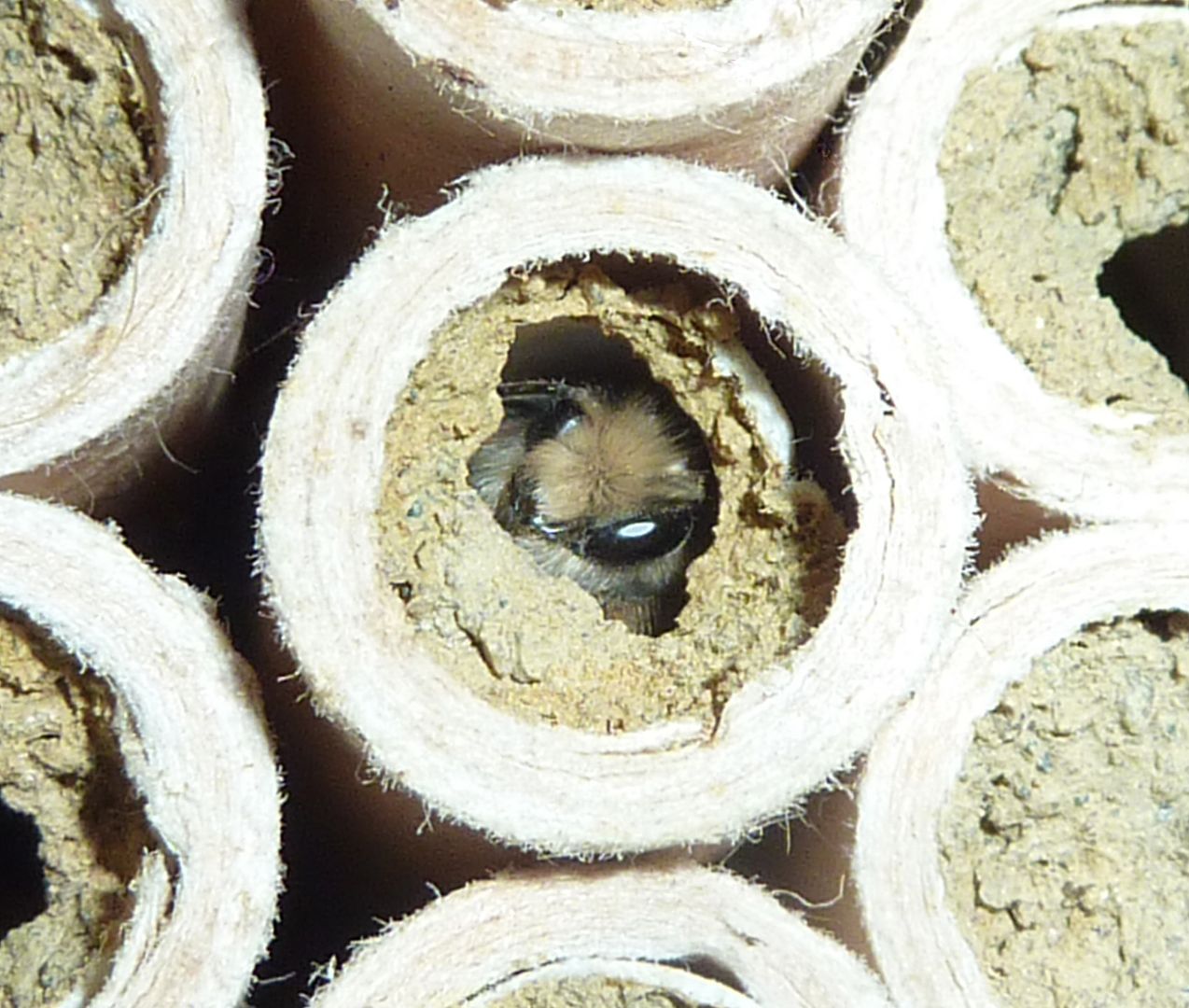
Look how cute they are.
Saturday, June 16, 2012
Mason Bee Parasite
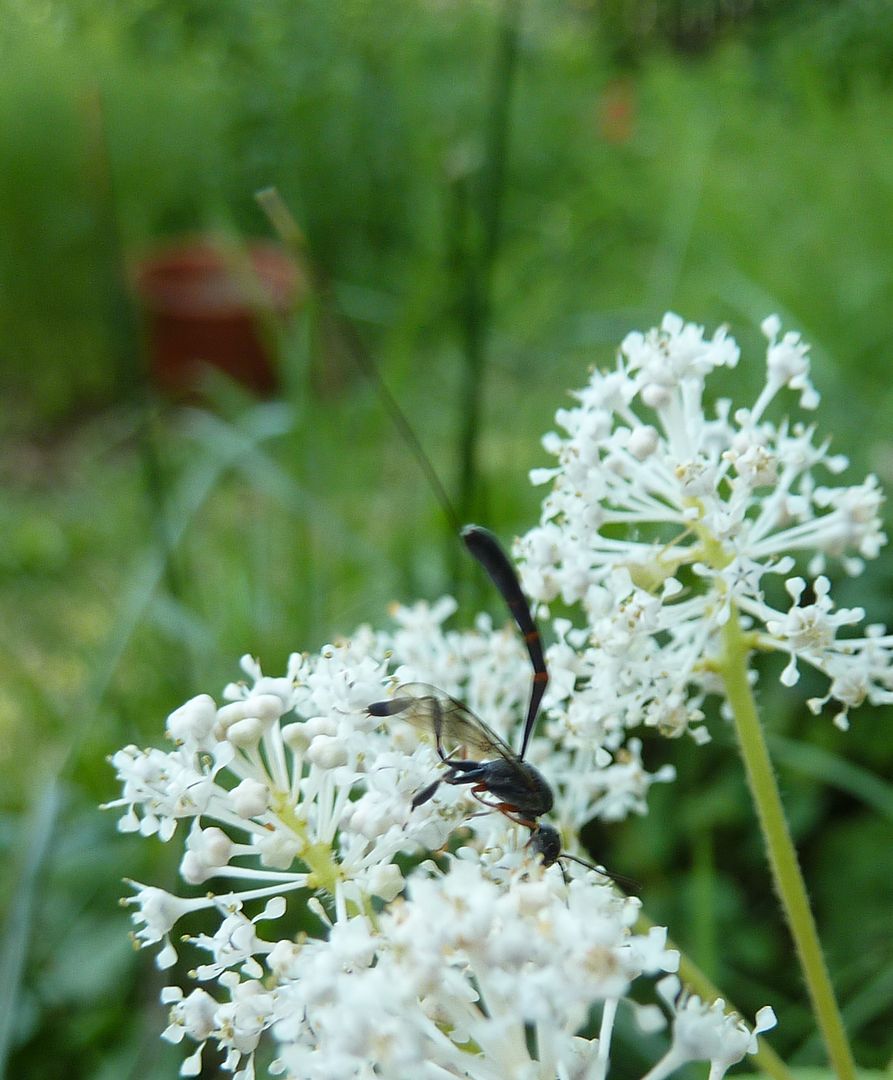
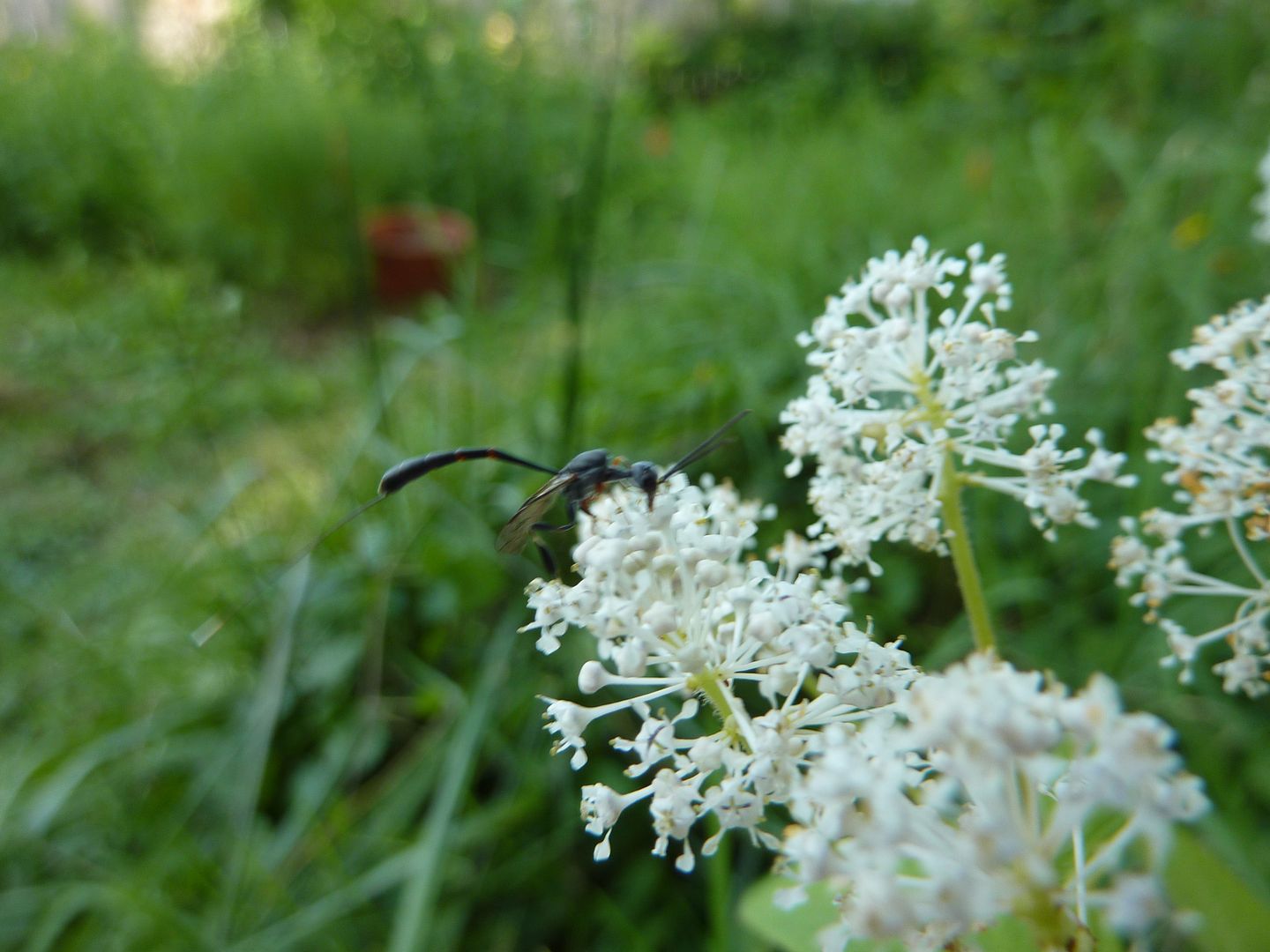
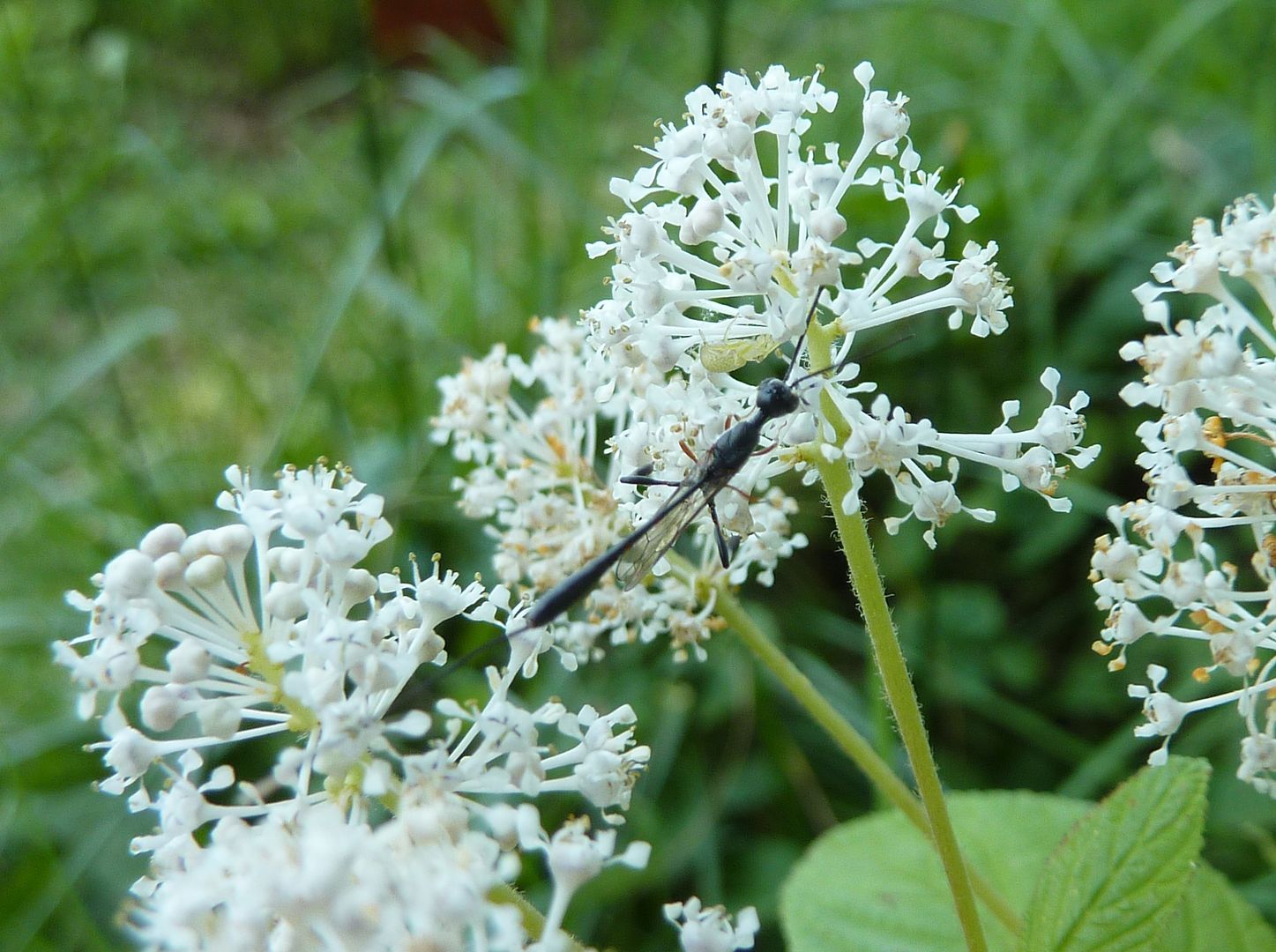
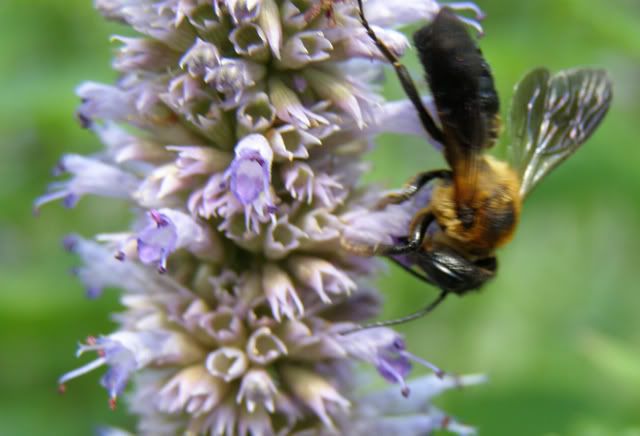
Wasps in the genus Gasteruption are social parasites other Hymenoptera. In this case that means Mason Bees. They inject their egg into the mason bee tunnel where larva of the host species are developing. Next year, instead of hatching as a mason bee, a parasitic wasp will emerge.
I'm amazed at how pencil thin they are. They even look tiny among the blooms of New Jersey Tea, Ceanothus americanus.
The fact that I'm seeing these in the garden should probably be a red flag to bring the mason bee nest blocks inside or at least screen them in somehow. My mason bees are an invasive species though, Osmia taurus, so I'm not really inclined to do that. In the interest of diversity I think I'll let nature takes its course, assuming they are the host that is.
I'm amazed at how pencil thin they are. They even look tiny among the blooms of New Jersey Tea, Ceanothus americanus.
Labels:
Bees,
Mason,
New Jersey Tea,
Parasitic,
Wasp
Thursday, April 12, 2012
Some Wild Bees
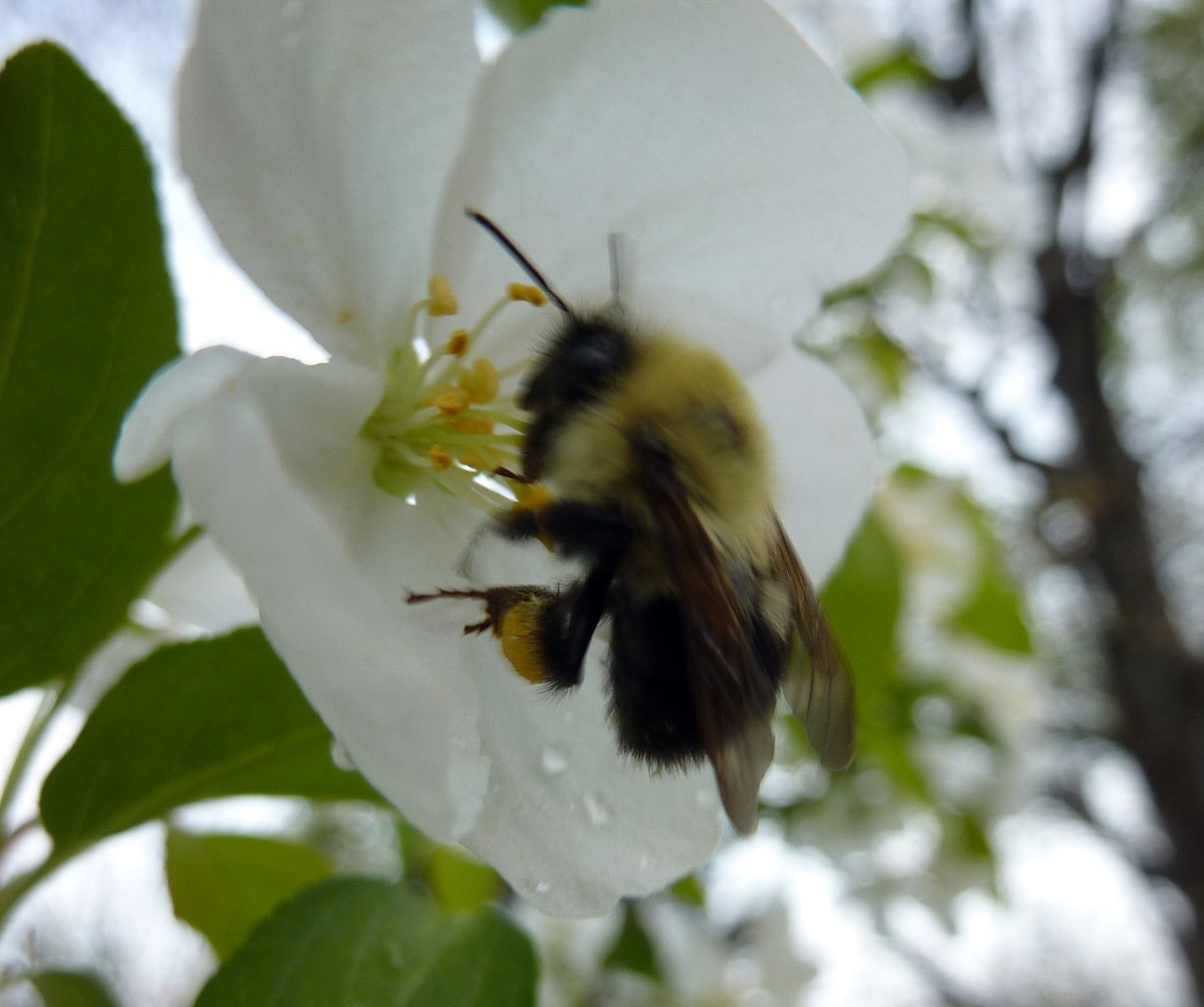
My friend tells me this is a worker bumblebee, most likely Bombus bimaculatus. This warm year seems to have sped up their cycle somewhat so it's a little early to see workers flying about in April. Even so, this is one of the shorter lived species, with hives normally petering out in July. They make their reproductives and the colony soon falls apart for the year leaving loan males and young queens out in the wild waiting until the end of summer, all of autumn and most of winter to pass before starting a hive of the own. I'd be curious to know if this year's hives grow larger than usual or perhaps makes reproductives sooner than normal.
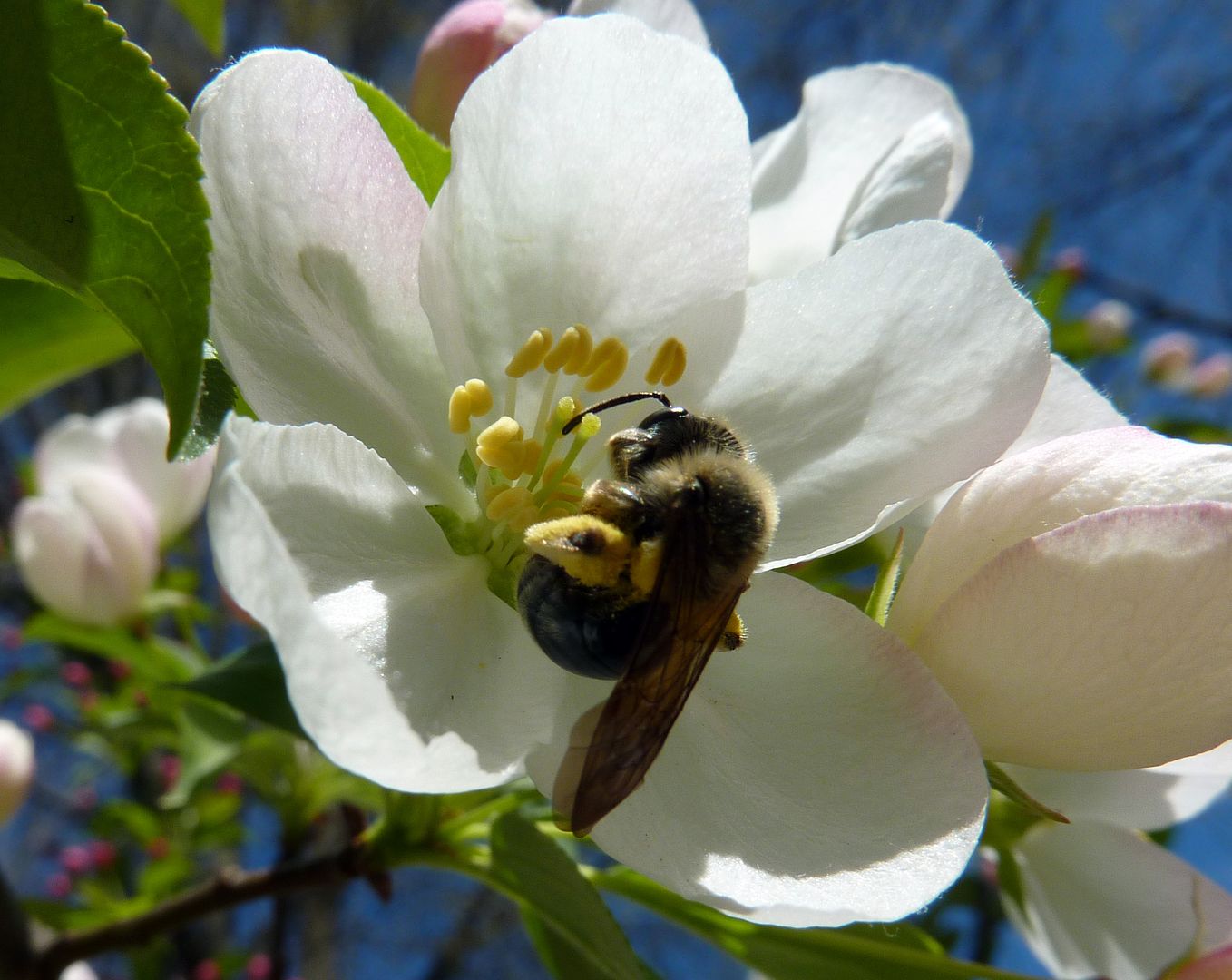
Osmia lignaria, The Blue Orchard Mason Bee, is one of the few bees I can identify on my own. I believe the reason might be because it's somewhat unique looking. This is a type of Mason bee which lives in preexisting, tube shaped, cavities that only have one entrance. That sounds like a long list of requirements but the structure occurs naturally in nature all the time: wood boring beetle grubs emerging from a tree, or last year's hollow stemmed herbaceous perennials for example.
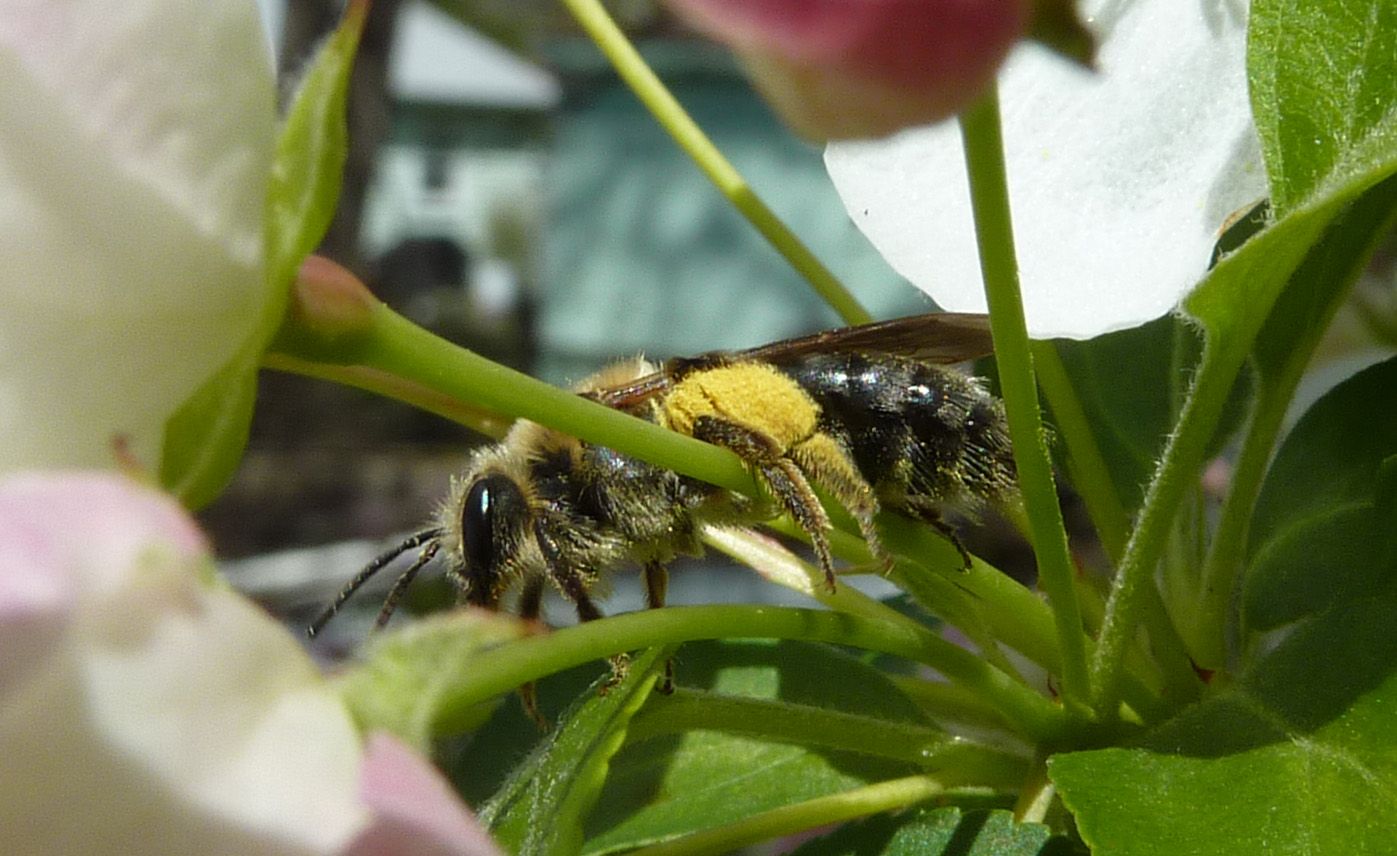
This Andrena sp. is a type of mining or digger bee. Both common names work as they nest underground no matter what you call them. Unlike Mason bees they collect pollen on their legs, while Masons store it under the abdomen. I'm not sure why this is though perhaps it has something to do with digging requires thick sturdy legs with hairs to aid in moving the soil. These same hairs likely double as pollen collectors.
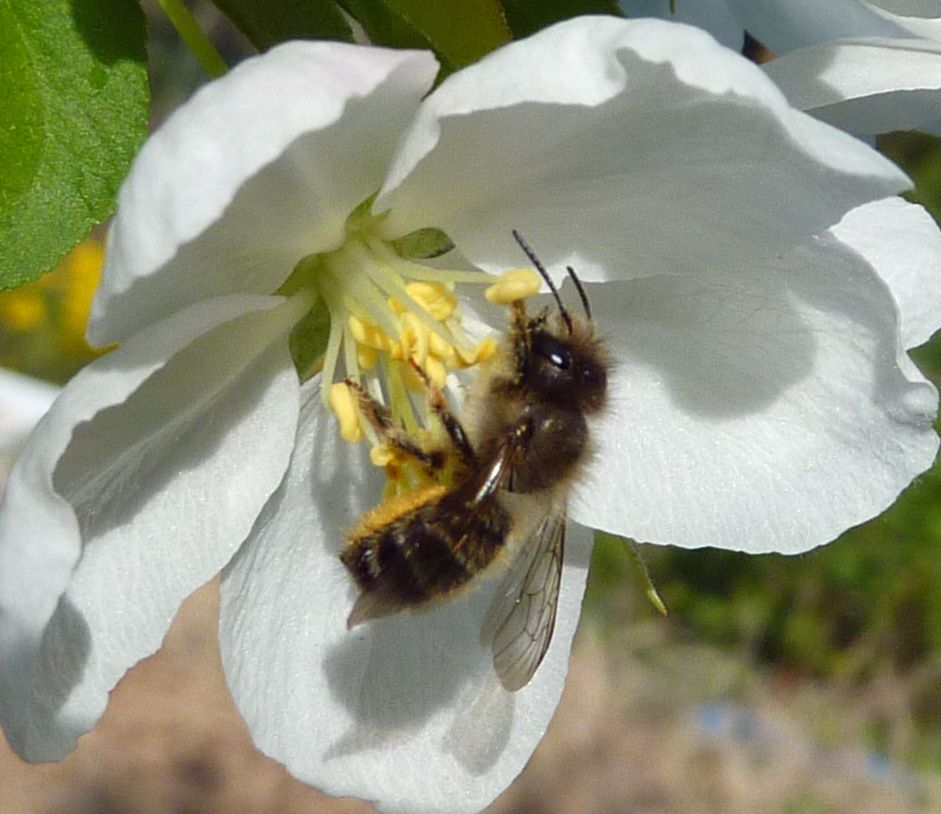
Osmia taurus, an introduced species that's displacing some of our natives. Because of this and other introduced mason bees, most experts seem to be on the fence about recommending Mason Bee Tubes (such as those sold by Knox Cellars Native Pollinators). The idea being such sites would allow the nonnatives to gain access to other locations they haven't reached. At the same time though they provide nesting for natives as well. Unfortunately this is a topic that needs more study. O. taurus is abundant in my area but I still have native species, and presumably 2 other species nesting alongside them.
A major reason to discourage nonnative bees is they sometimes specialize in pollinating noxious weeds. The Giant Resin Bee, Megachile sculpturalis, is an introduced species from Asia. It's basically an overgrown leaf cutter bee that goes right for plant resin instead of cutting leaves. It's also a more suited pollinator of the dreaded Kudzu, Pueraria montana. Kudzu used to rarely produce seeds as very few of our native pollinators were managing to pollinate the flowers, though I'm sure many were able to steal nectar from it.
As things leaf out we'll start to see real leaf cutter bees flying around. These nest in both underground holes and in preexisting tubes. They're set apart from digger and mason bees in that they cut slices out of leaves to make chambers, instead of using mud or simply burying their young. Over the summer I'll also be keeping an eye out for Squash Bees, Sunflower Bees, and Rose Mallow Bees. Also buzzing about now should be Blueberry Bees; all of whom specialize in flower shapes that their common names suggest.
Osmia lignaria, The Blue Orchard Mason Bee, is one of the few bees I can identify on my own. I believe the reason might be because it's somewhat unique looking. This is a type of Mason bee which lives in preexisting, tube shaped, cavities that only have one entrance. That sounds like a long list of requirements but the structure occurs naturally in nature all the time: wood boring beetle grubs emerging from a tree, or last year's hollow stemmed herbaceous perennials for example.
Osmia taurus, an introduced species that's displacing some of our natives. Because of this and other introduced mason bees, most experts seem to be on the fence about recommending Mason Bee Tubes (such as those sold by Knox Cellars Native Pollinators). The idea being such sites would allow the nonnatives to gain access to other locations they haven't reached. At the same time though they provide nesting for natives as well. Unfortunately this is a topic that needs more study. O. taurus is abundant in my area but I still have native species, and presumably 2 other species nesting alongside them.
A major reason to discourage nonnative bees is they sometimes specialize in pollinating noxious weeds. The Giant Resin Bee, Megachile sculpturalis, is an introduced species from Asia. It's basically an overgrown leaf cutter bee that goes right for plant resin instead of cutting leaves. It's also a more suited pollinator of the dreaded Kudzu, Pueraria montana. Kudzu used to rarely produce seeds as very few of our native pollinators were managing to pollinate the flowers, though I'm sure many were able to steal nectar from it.
As things leaf out we'll start to see real leaf cutter bees flying around. These nest in both underground holes and in preexisting tubes. They're set apart from digger and mason bees in that they cut slices out of leaves to make chambers, instead of using mud or simply burying their young. Over the summer I'll also be keeping an eye out for Squash Bees, Sunflower Bees, and Rose Mallow Bees. Also buzzing about now should be Blueberry Bees; all of whom specialize in flower shapes that their common names suggest.
Friday, April 6, 2012
Native Bees and Flowering Trees
Knox Cellars Native Pollinators
https://www.knoxcellars.com/Merchant5/merchant.mvc?Screen=SFNT&Store_Code...
Osmia taurus - an introduced species crowding out some native species.
The Arbor Day Foundation
http://www.arborday.org/shopping/memberships/memberships.cfm?trackingid=528
Sunday, April 24, 2011
An Apple Tree Buzzing
While spending Easter at my grandparents house I noticed their apple tree was in bloom. The fruit is a small green crabapple of some sort, not very edible at all. The flowers were being swarmed by bees though. Assorted Mason Bees were the main pollinator here. I hardly saw any Honeybees on it at all but they were there. I think they were more interested in my grandparent's flowering quinces (an Asian plant that can produce edible fruit farther south). Bumblebees were there too but they're not in as great of numbers at this time of year.
Saturday, April 24, 2010
Mason Bees and Flower Flies
The mason bees have been making some real progress. Each capped tube is full and contains upwards of 10 bees give or take for next year. I started with about 100 of the little guys, though I suspect most were males or found nesting elsewhere. There's almost always a bee or two flying in or out filling the tubes. They'll only be around for another few weeks and I'll start taking the full tubes inside. Over the summer parasitic wasps lay their eggs inside the first chamber or two of brood and I don't want that.
Having these bees around is a great way to ensure pollination of fruit trees and blueberry bushes (heath family in general). But pollination is but one issue to getting a good crop. Aphids are already waking up and breeding on some of the trees here. Usually they aren't a problem but every little bit helps make a good harvest.
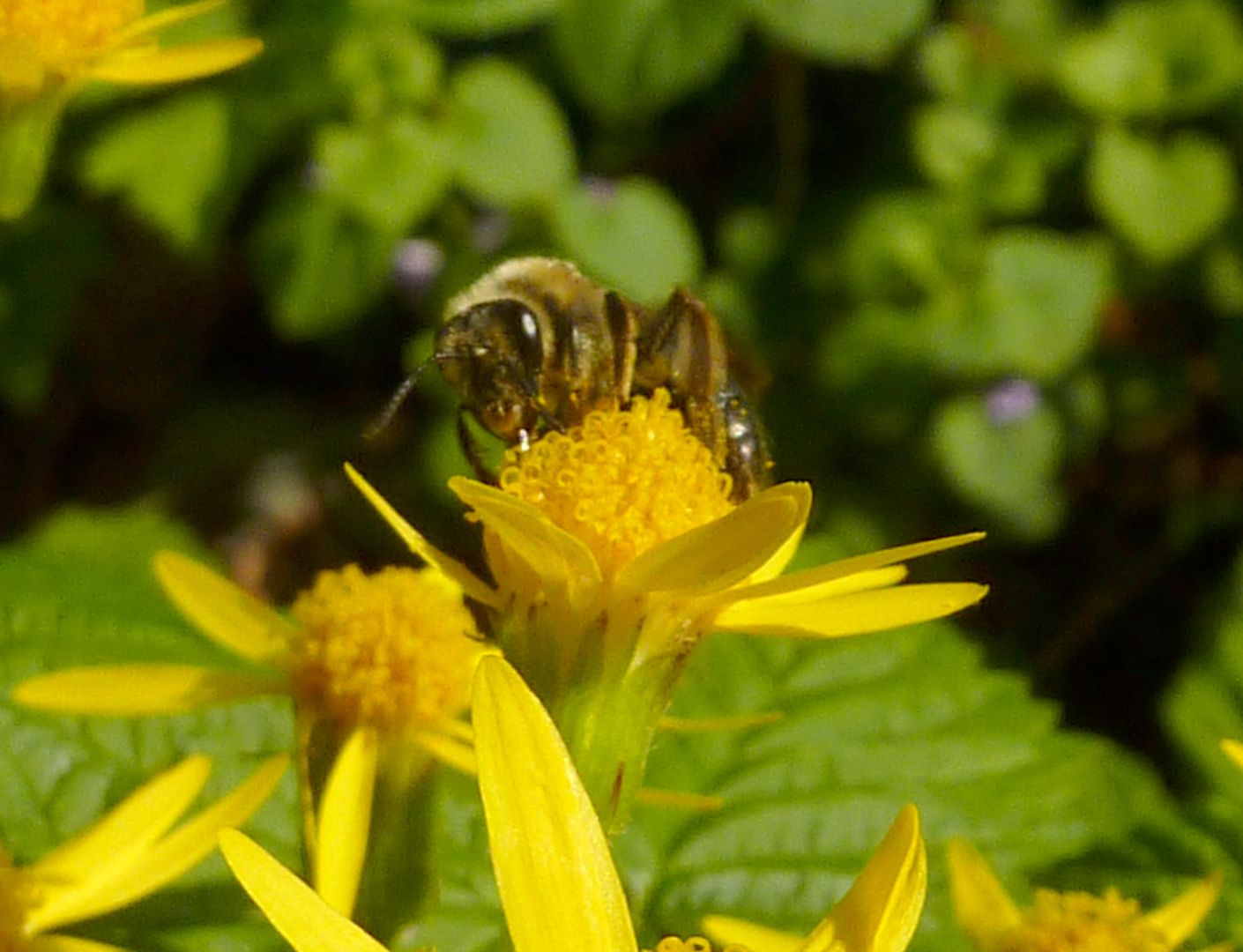
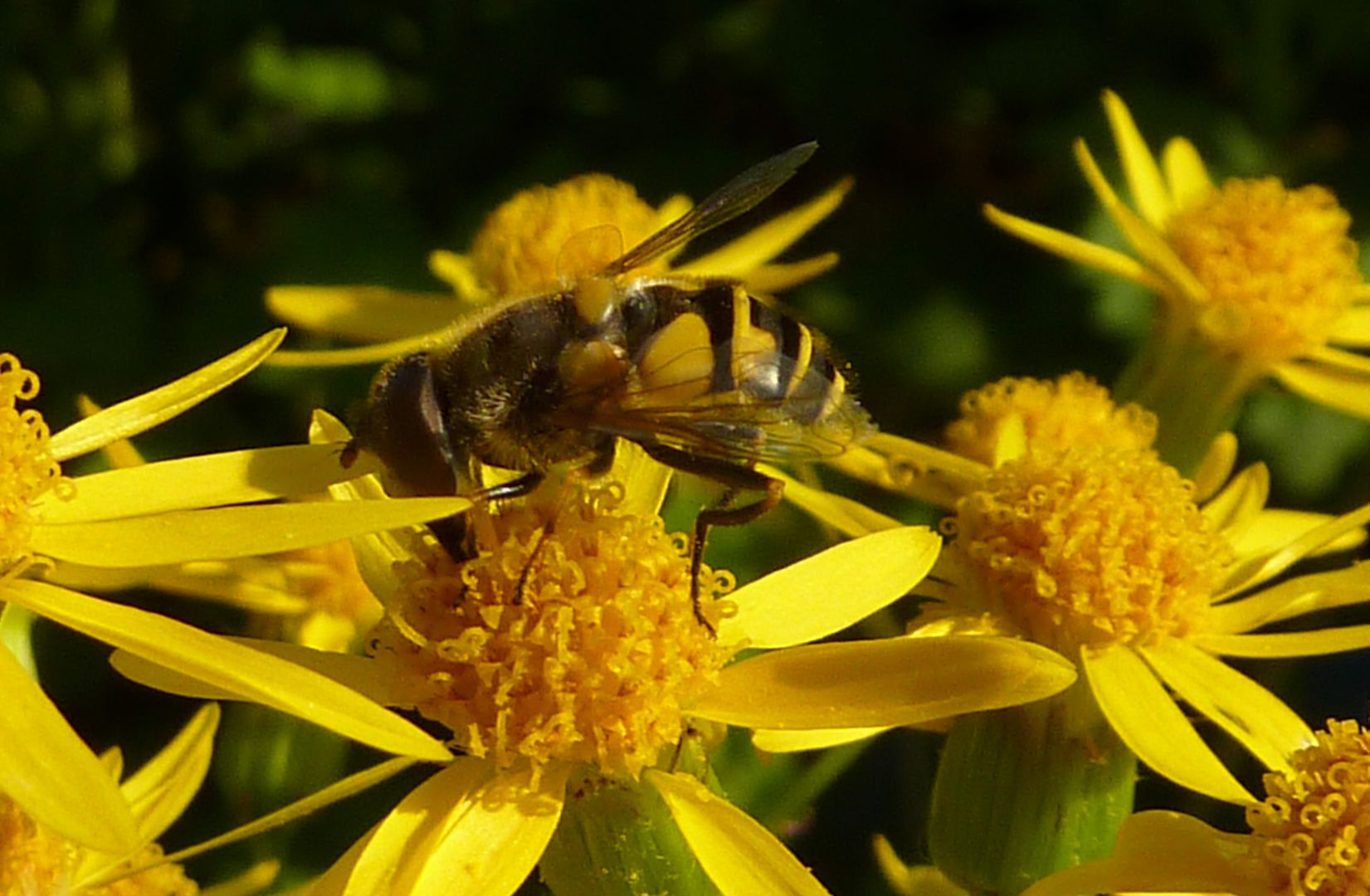
Thankfully the mason bees also help pollinate spring wildflowers like Roundleaf Ragwort, Packera obovata. I never understood where the name ragwort came from. Golden Flower would be just as good for this plant. It's a round leaved ground cover that moves like a carpet through the forest and in early spring they produce thousands of yellow and gold flowers above them.
Ragwort is one of the few plants also pollinated by Flower Flies. They're also called Hover Flies for their flying habits. Members of the Syrphini tribe, these beneficial insects are colorful flies that lay eggs in patches of aphids. The resulting grubs (maggots) take care of your aphid problem and aren't bothered by ants that may be guarding them.
They are a much better solution to the aphid problem than lady bugs in my opinion. Lady bugs stand out in a crowd and ants are quick to harass them away. Meanwhile flower fly grubs munch away on the aphid herd. A benefit for sure.
When the ragwort stops blooming they turn to Yarrow but we're not there yet in the year. Small flowers seems to be the key to attracting Syrphini to your yard. There are a few exceptions of course but they're pollinators all the same.
Having these bees around is a great way to ensure pollination of fruit trees and blueberry bushes (heath family in general). But pollination is but one issue to getting a good crop. Aphids are already waking up and breeding on some of the trees here. Usually they aren't a problem but every little bit helps make a good harvest.
Thankfully the mason bees also help pollinate spring wildflowers like Roundleaf Ragwort, Packera obovata. I never understood where the name ragwort came from. Golden Flower would be just as good for this plant. It's a round leaved ground cover that moves like a carpet through the forest and in early spring they produce thousands of yellow and gold flowers above them.
Ragwort is one of the few plants also pollinated by Flower Flies. They're also called Hover Flies for their flying habits. Members of the Syrphini tribe, these beneficial insects are colorful flies that lay eggs in patches of aphids. The resulting grubs (maggots) take care of your aphid problem and aren't bothered by ants that may be guarding them.
They are a much better solution to the aphid problem than lady bugs in my opinion. Lady bugs stand out in a crowd and ants are quick to harass them away. Meanwhile flower fly grubs munch away on the aphid herd. A benefit for sure.
When the ragwort stops blooming they turn to Yarrow but we're not there yet in the year. Small flowers seems to be the key to attracting Syrphini to your yard. There are a few exceptions of course but they're pollinators all the same.
Labels:
Bees,
hover flies,
Mason
Thursday, April 15, 2010
Native Bees and Apple Trees
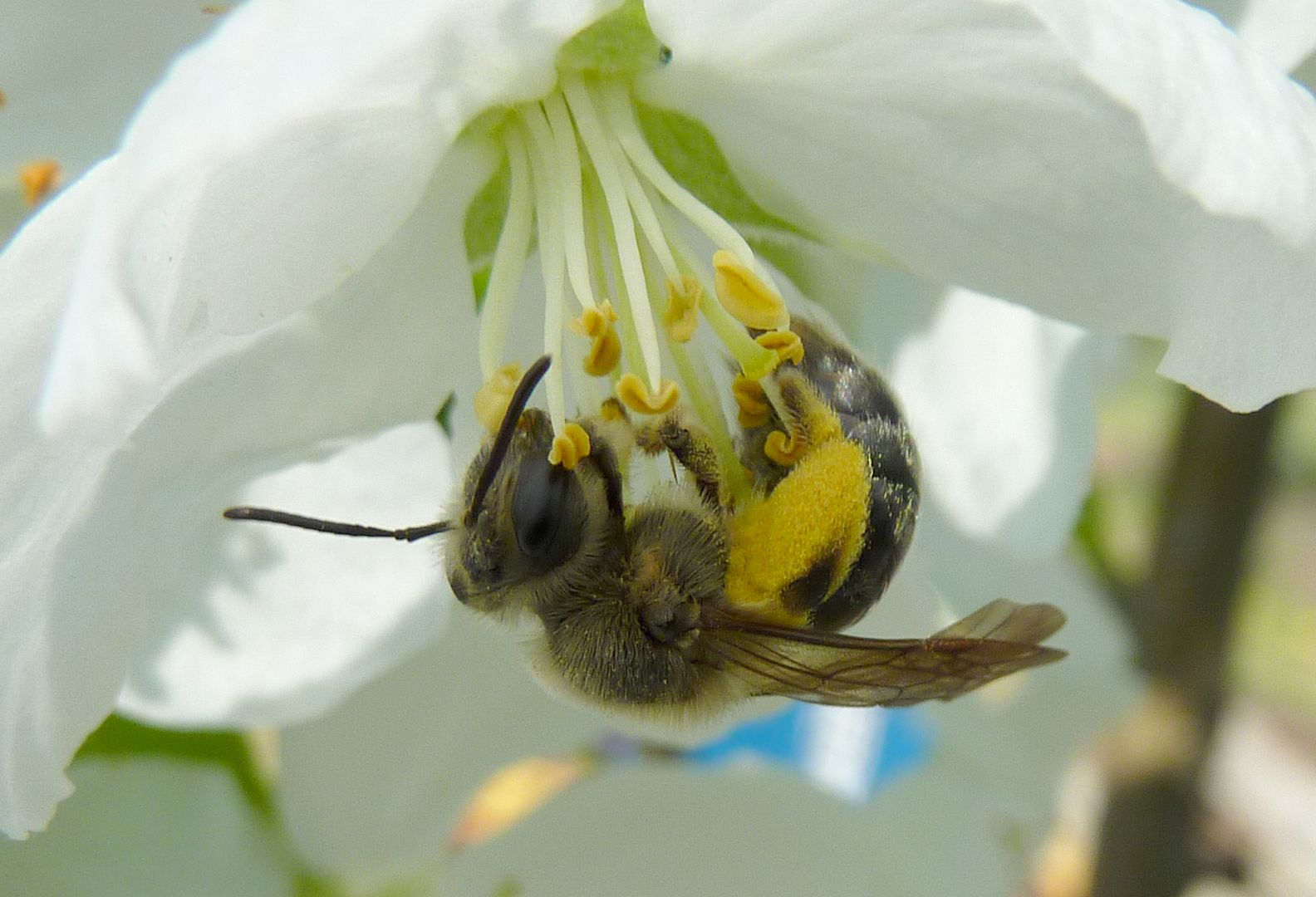
My apple trees have started blooming and there is an array of pollinators on them. This one in particular I believe is some type of digger bee. Though it looks a lot like a honey bee the proportions aren't quite right, the abdomen looks to thin, and the pollen on the legs isn't collecting as it would on a honey bee.
I was only able to get close ups of this one type of bee. There were several species working both of them that looked just like this but varied in size. Some where about as big as this bee's pollen sac. A bee fly or two was also buzzing around the flowers but all these other bees were so shy. All of them fly away. I'll try harder next time.
Fruiting apple trees seem to have larger flowers than crabapple trees. I encourage people to buy both for different situations. Both look pretty when flowering. Fruiting trees produce fruit (once you get past the laundry list of things that can go wrong with apples) and probably shouldn't be above a driveway, or near the street. Big falling apples can hurt and inspire ludicrous theories about gravity. Crabapple trees have lots of ornamental potential, especially in the winter. Many crabapple trees become loaded with red-orange berries that birds will eventually eat, but in the meantime they look pretty when the snow falls.
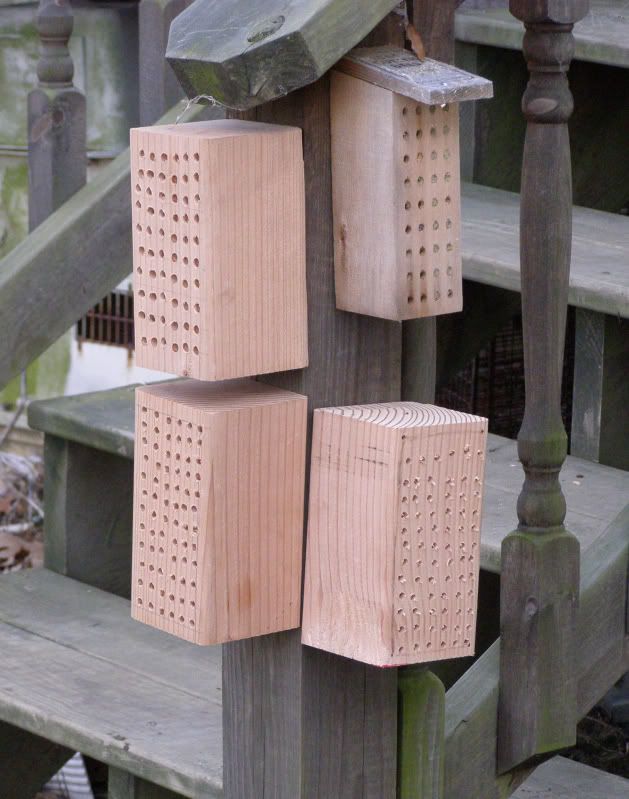
Remember though, a health population of bees are needed to get the fruit. Mason Bees are probably the easiest to house and I strongly recommend buying a product rather than making your own. Those Mason Bee blocks I made (the ones lacking a roof) took an hour to drill all the holes out, and 45 minutes once I got going. The bees mostly didn't use them and favored a system I bought from Knox Cellars. There are other providers on the web of course and a number of systems available on Amazon too.
Search Amazon.com for mason bee
I haven't tried them all of course but I can say this one here didn't work for me. It's made by an Asian company that uses bamboo sticks as tubes. It's likely intended to attract the Giant Resin Bee, Megachile sculpturalis, another import from Asia. Like the smaller mason bee they use tubes, usually the former nests to the Giant Carpenter Bees that they resemble.
I've seen them at a friend's house up the street a few minutes but have never found them on anything in my yard. Note the big eyes compared to the head and the elongated abdomen. These bees are huge like our Giant Carpenter Bees but they have the sliming qualities of a Mason Bee.
Our surveys indicate that native bees may outnumber honey bees in many orchards and we are trying to determine what orchard management practices promote native bee abundance and diversity. Many local apple growers no longer bring honey bees into their orchards - they are relying increasingly on the naturally occurring native bees for apple pollination.Holy Cow! Farmers that don't use honey bees for pollination. It really is the future, and of course this supports my saying that honey bee hives should be viewed more as a crop, especially for the backyard beekeeper. They're still useful as pollinators for some crops. And where native bees aren't abundant they can easily be used for quick pollination services. One thing I've found that's needed to build a good native bee population is a healthy environment. Usually this would be the hedge, or forested water shed area surrounding the farm. Mainly an abundance of soil types, slopes, hallow stemmed plants, dead wood, with an abundance of native plants that flower when the bees are active are needed for these other pollinators to show up and establish themselves. This can be tricky though for farmers because they want the bees to focus on their crop most of all. Maintaining a patch of wildflowers and mowing it over when the crop starts blooming would solve this problem.
My apple trees have started blooming and there is an array of pollinators on them. This one in particular I believe is some type of digger bee. Though it looks a lot like a honey bee the proportions aren't quite right, the abdomen looks to thin, and the pollen on the legs isn't collecting as it would on a honey bee.
I was only able to get close ups of this one type of bee. There were several species working both of them that looked just like this but varied in size. Some where about as big as this bee's pollen sac. A bee fly or two was also buzzing around the flowers but all these other bees were so shy. All of them fly away. I'll try harder next time.
Fruiting apple trees seem to have larger flowers than crabapple trees. I encourage people to buy both for different situations. Both look pretty when flowering. Fruiting trees produce fruit (once you get past the laundry list of things that can go wrong with apples) and probably shouldn't be above a driveway, or near the street. Big falling apples can hurt and inspire ludicrous theories about gravity. Crabapple trees have lots of ornamental potential, especially in the winter. Many crabapple trees become loaded with red-orange berries that birds will eventually eat, but in the meantime they look pretty when the snow falls.
Remember though, a health population of bees are needed to get the fruit. Mason Bees are probably the easiest to house and I strongly recommend buying a product rather than making your own. Those Mason Bee blocks I made (the ones lacking a roof) took an hour to drill all the holes out, and 45 minutes once I got going. The bees mostly didn't use them and favored a system I bought from Knox Cellars. There are other providers on the web of course and a number of systems available on Amazon too.
Search Amazon.com for mason bee
I've seen them at a friend's house up the street a few minutes but have never found them on anything in my yard. Note the big eyes compared to the head and the elongated abdomen. These bees are huge like our Giant Carpenter Bees but they have the sliming qualities of a Mason Bee.
Labels:
Apple,
Bees,
flowers,
Mason,
Pollinators
Friday, April 2, 2010
Down to Business
Oh My!
Mine!
Ok I don't think they're doing it right but then again I'm not a bee. Considering they're only a few days old they're pretty advanced.
Females started hatching today. (though I think this one pictured is a larger male.) And they were immediately courted by males who ... well, two pictures up. None of them fly very far from the container of cocoons. I see them buzzing all around the perimeter of the house and our fence, probably my neighbors yards' too. A few were checking out a hole to a giant carpenter bee. I watched a few enter, in search of females probably, but they were quickly shewed out by a very large and angry carpenter bee. All of this happens at the perfect time of year, as my blueberry bushes and assorted fruit trees begin to flower. Yay Bees.
Saturday, March 27, 2010
Mason Bees and Bloodroot
Well the mason bees I set free have been hanging around the yard. They're so timid and curious. I swear one even recognized me. It flew around me in a curious manner. I'm still not sure releasing them was the right thing to do now that I know they're an invasive species. We have an awful lot of mason bee species in the US and they're so friendly too. The only way I could see one of them becoming invasive is if they hatched out earlier than all the rest to get prime hole reinstate for a nest. Perhaps parasitic wasps and sawflies don't use them as hosts or are somehow overlooked by woodpeckers which would eat the natives. I haven't found a clear answer yet.
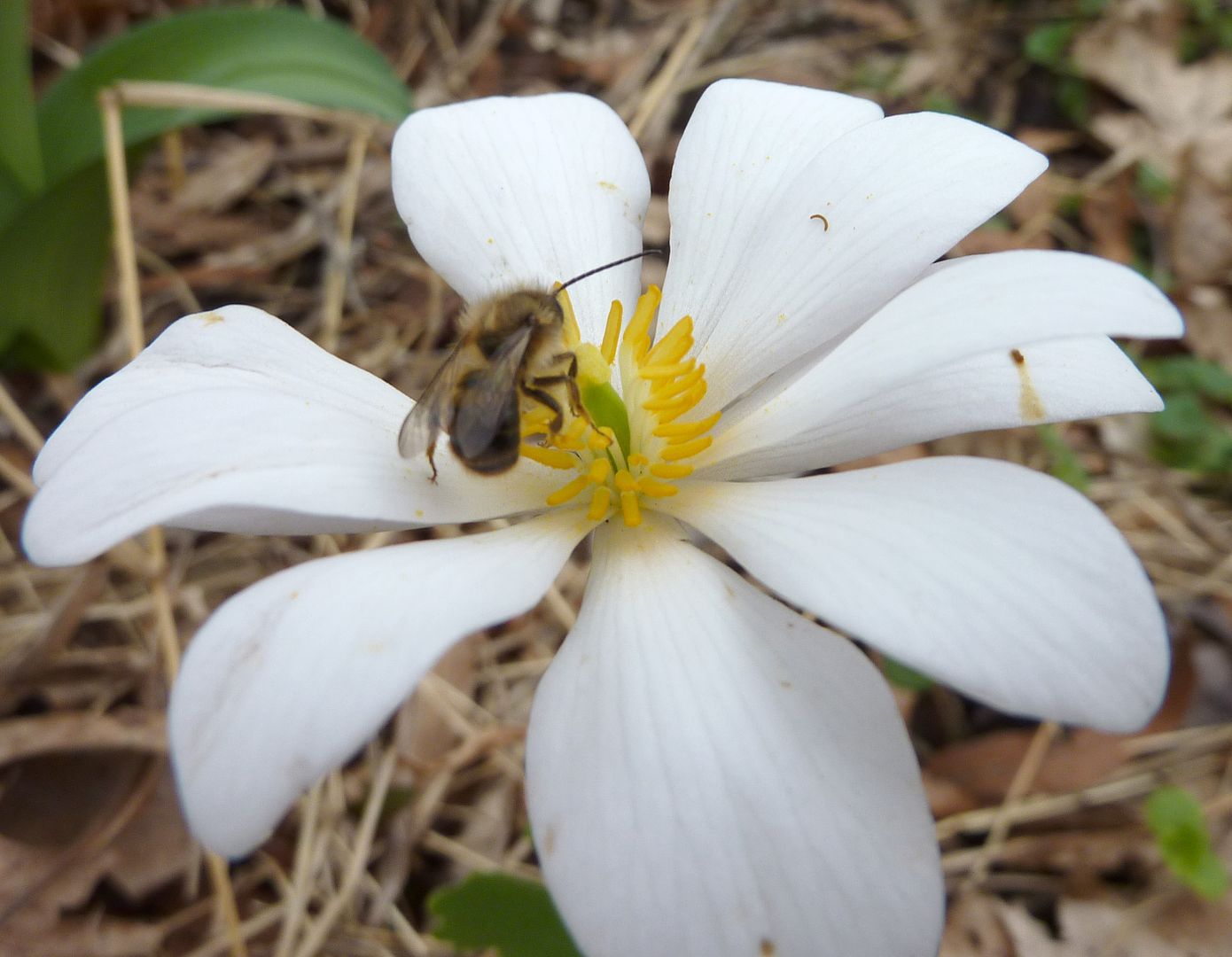
Whatever the case they're bees and thus beneficial pollinators. As I said they're hanging around the house and even with their small size they're easy to spot. They mostly hang around the nesting holes, undoubtedly waiting for females to arrive. The brilliant thing about all mason bees though is they're not bias against certain nectar sources, they just go for the nearest flower source. I'm happy to see in this case one of those sources was the bloodroot I planted.
Friday, March 26, 2010
Adorable Mason Bees
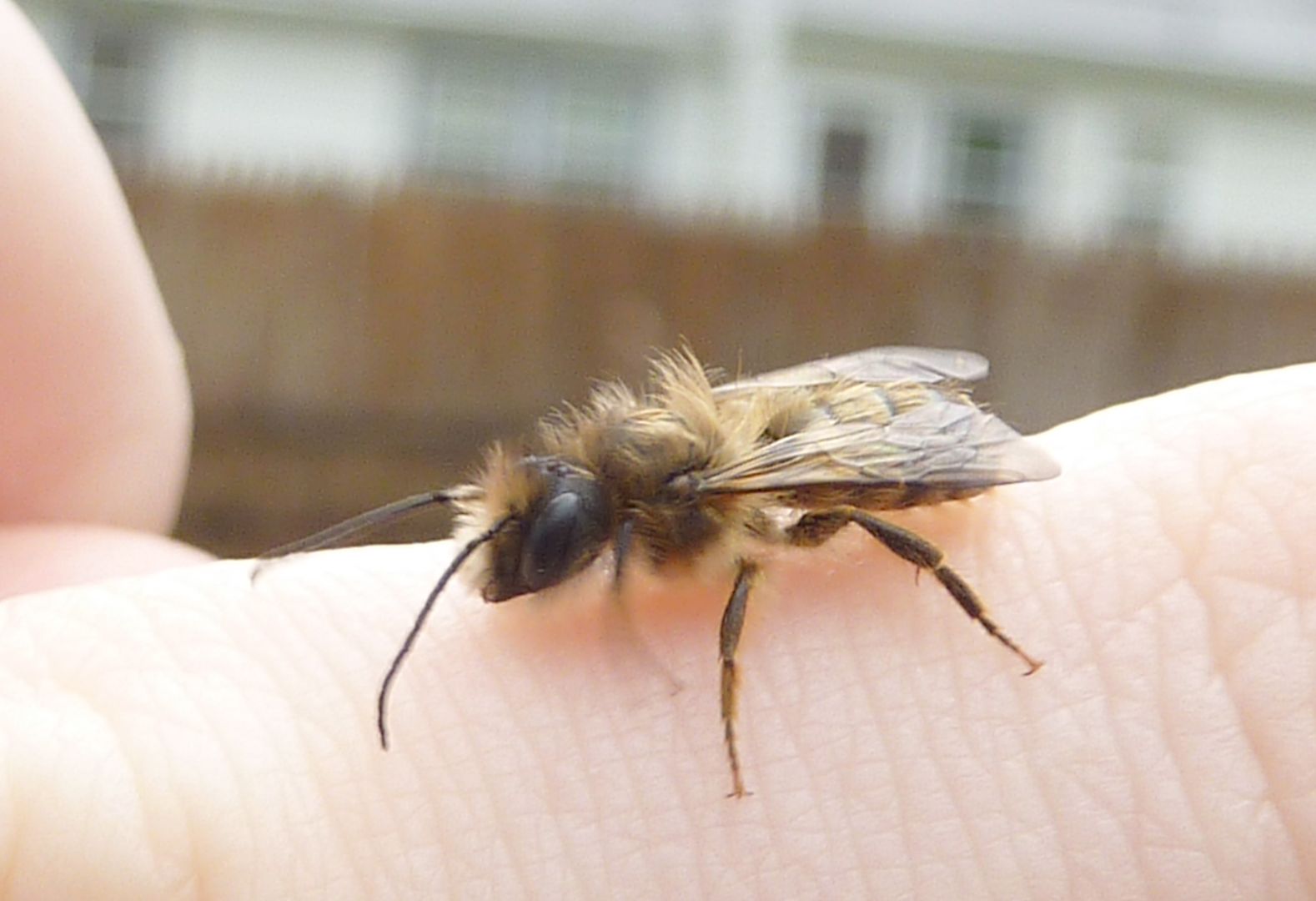
I tried freeing them a day ago, but it was to cold. The only one to try flying immediately landed on my pant leg and refused to let go. This gave me the opportunity to take pictures of these adorable bees.
After posting these at bugguide.net the ID came back as probably the first sighting of Osmia taurus, imported from Asia and considered invasive. However, there is some question if that ID is correct. Despite this, I'm not about to back their cute little brains in just yet. I noticed these hatched out of the smallest cocoons so we'll see what comes from the larger ones. Unfortunately they probably house the females of the invasive Osmia taurus. Here's a picture I took last year.
Wednesday, March 24, 2010
They're Alive
They are alive! Or at least one is. It's raining outside so I can't release it/them yet. I have my big box of Knox Cellars Mason Bee Tubes set outside and I want to make sure it's the first thing they see. An issue though is the things I want them to pollinate aren't flowering yet, but I'm sure that will change over the course of this bee's 4 to 6 week lifespan.
Maple trees are the most abundant plant blooming now. What's odd is people always sound surprised to learn that "Maple trees bloom?" It's as if no one realizes what those puffy things covering the branches are, and two weeks later, what that stuff is they're cleaning off their car.
There are a few species of maple tree out there. And I don't know how to tell one from the other. I would assume the Red Maple though has the all red flower. If anyone can explain it in so many words please feel free to comment. Thank you.
Maple trees are the most abundant plant blooming now. What's odd is people always sound surprised to learn that "Maple trees bloom?" It's as if no one realizes what those puffy things covering the branches are, and two weeks later, what that stuff is they're cleaning off their car.
There are a few species of maple tree out there. And I don't know how to tell one from the other. I would assume the Red Maple though has the all red flower. If anyone can explain it in so many words please feel free to comment. Thank you.
Sunday, March 21, 2010
Mason Bee Cocoons
I could have cleaned these off a little better. These are Mason Bee Cocoons. Last year I had all the mason bee nesting blocks and these are all the cocoons I got from them. As well as some type of moth in the upper right. Anyhow lots of wildflowers started blooming here and that means it's about time to pull these out of the fridge. Yes they were in my fridge, don't worry though they were well sealed and insulated with paper towel in a coffee can. (Nothing like accidentally drinking a cup of hot bug juice in the morning to wake you up.)
I wasn't sure if they survived though so I attempted to remove one from it's cocoon. While holding it between my fingers I scratched at it with a needle. Scared the hell out of me when it started buzzing, vibrating, and then after I'd dropped it, rolled around on the table some. Yep they're alive.
So I'll keep them in this plastic container until I see some fruit trees blooming. Then it's out they go. They're active for about the time when blueberries start blooming.
I wasn't sure if they survived though so I attempted to remove one from it's cocoon. While holding it between my fingers I scratched at it with a needle. Scared the hell out of me when it started buzzing, vibrating, and then after I'd dropped it, rolled around on the table some. Yep they're alive.
So I'll keep them in this plastic container until I see some fruit trees blooming. Then it's out they go. They're active for about the time when blueberries start blooming.
Subscribe to:
Posts (Atom)