Showing posts with label Prenolepis imparis. Show all posts
Monday, April 1, 2019
This Week in Anting 04/01/2019 Winter Ants Flying
Sorry about the wind in some scenes. These ants don't mind flying on days with 60mph gusts. Indeed it's probably part of why their swarms gather around trees with large trunks, or shrubs or fences and so on. The males gather around these wind breaks to better establish a swarm that attracts the queens.
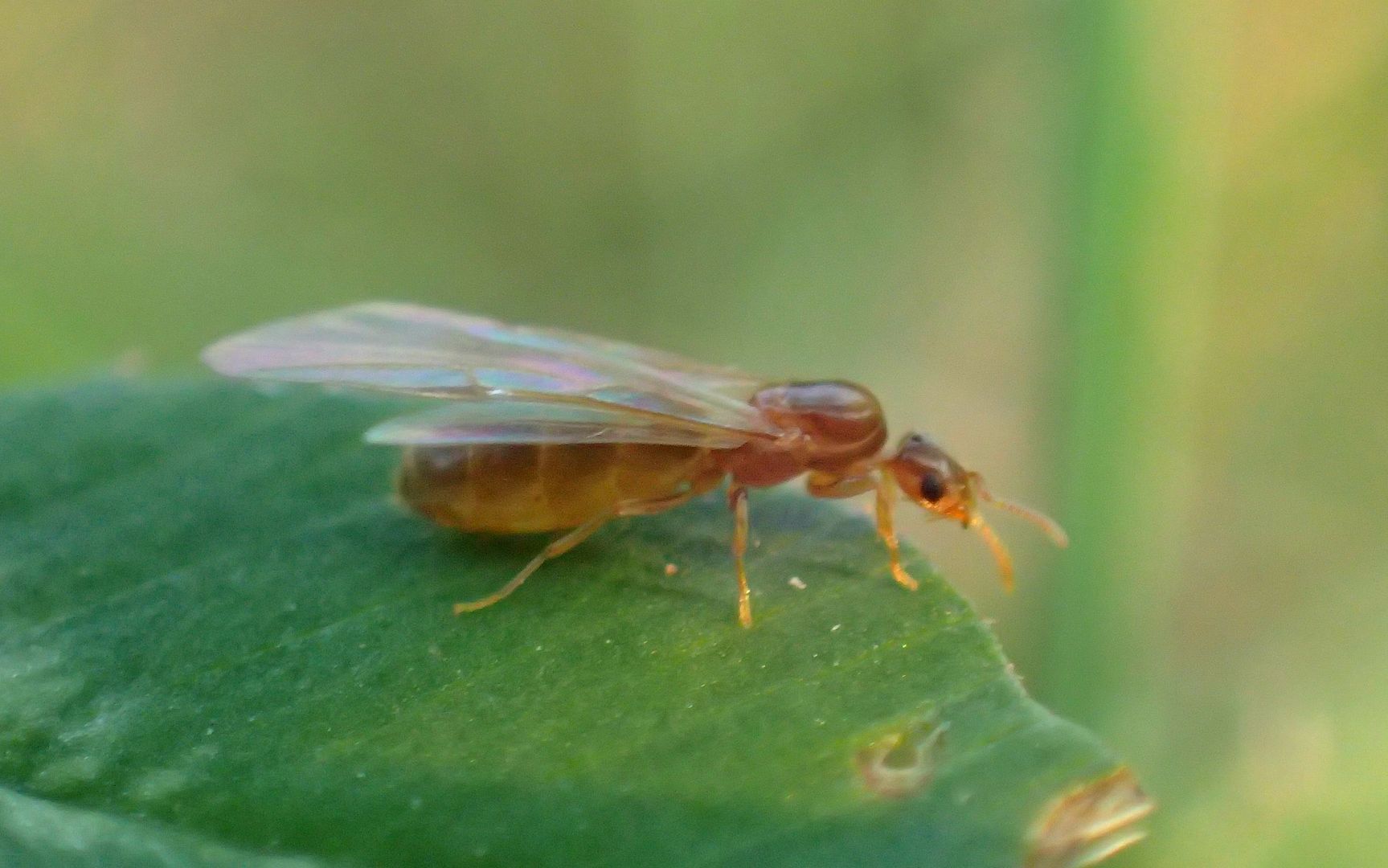
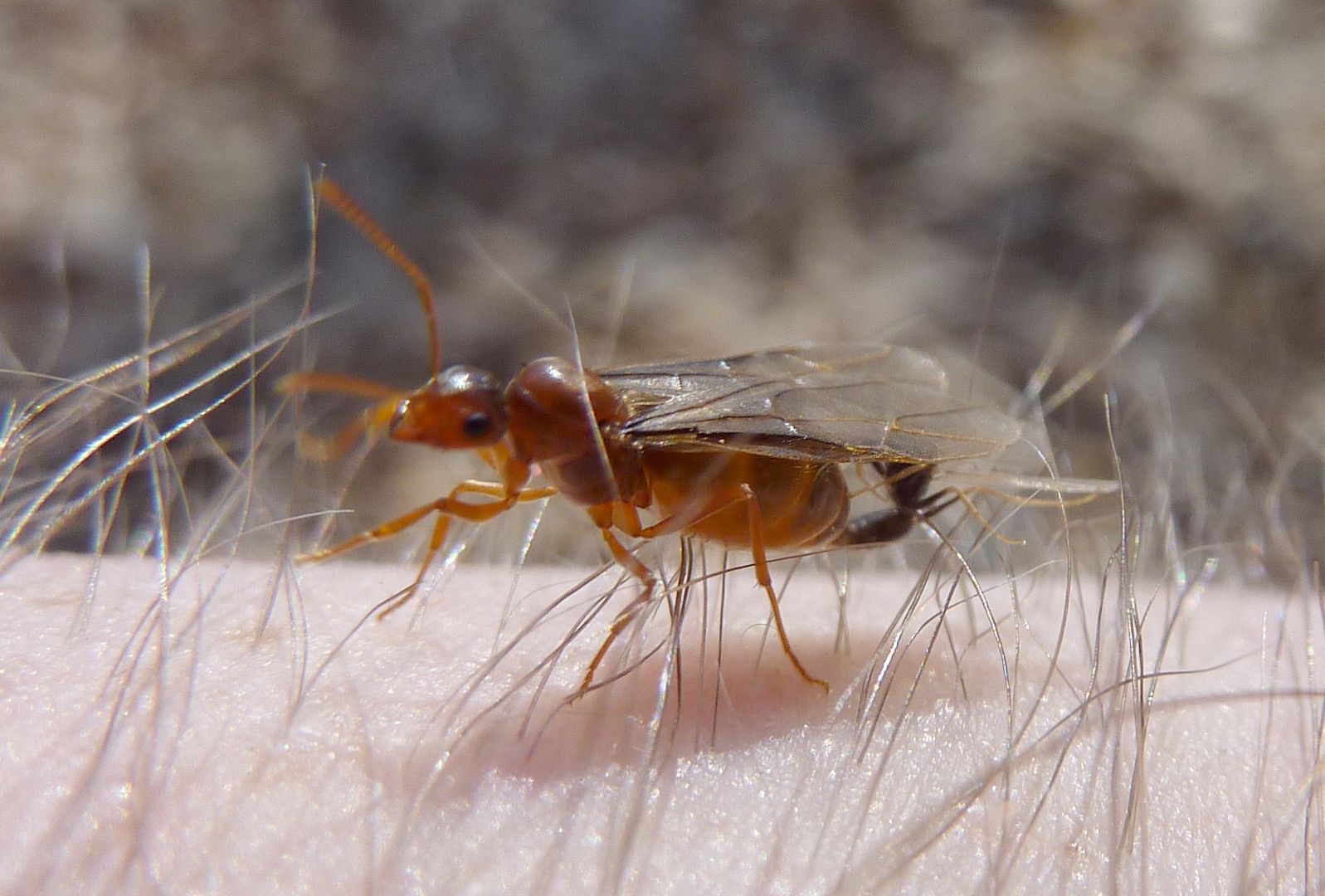
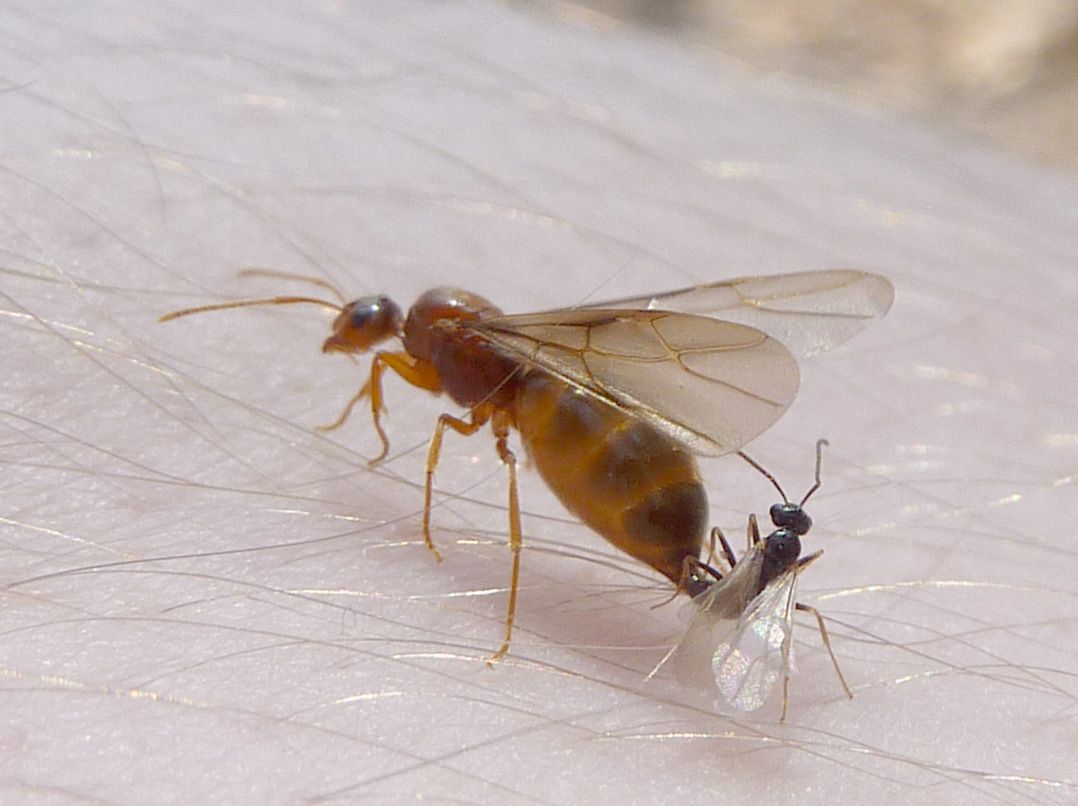
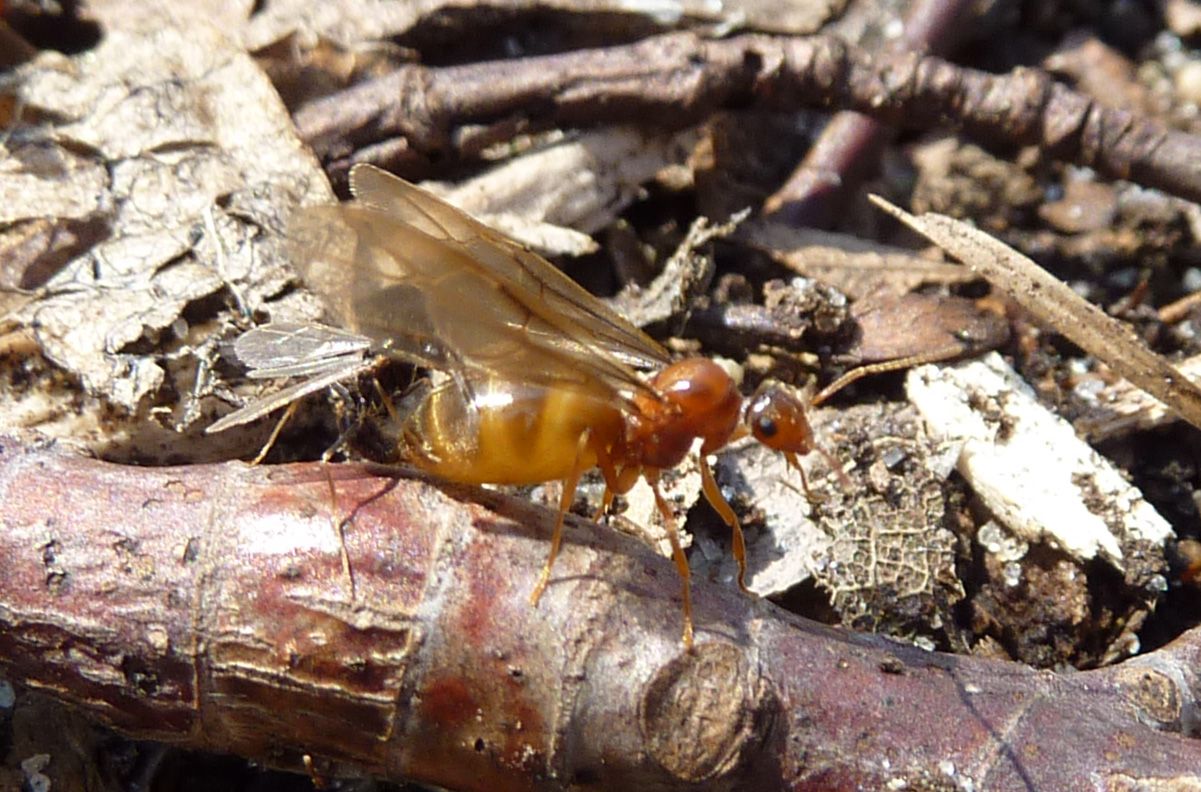
I was fortunate enough to get one queen to pose for me quite gracefully for a short while.
I was able to get some great shots of the head and body.
And she couldn't have picked a better perch to stand on.
The colors of the log and the green of the background really help show just how pretty this ant is.
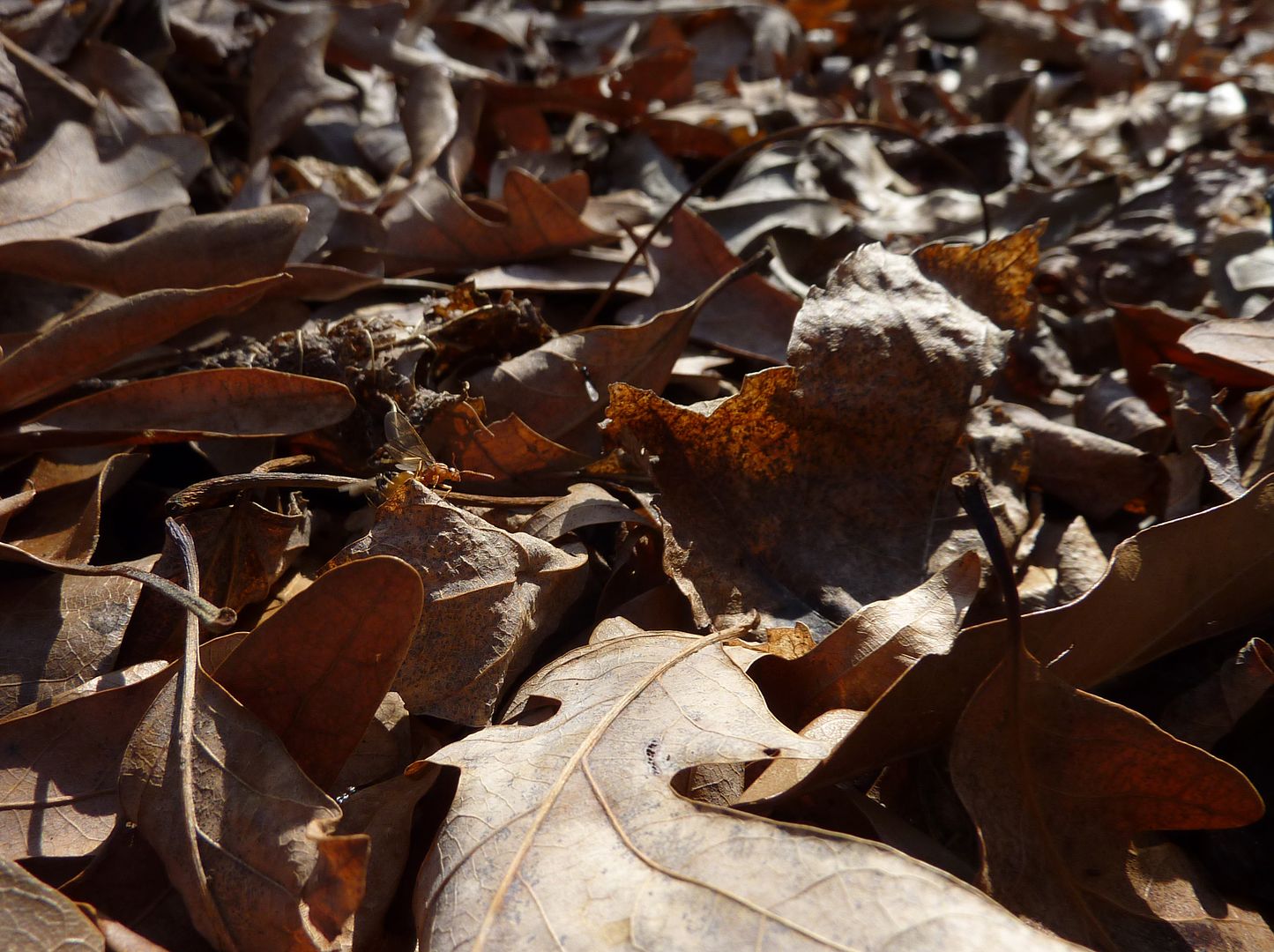
Also surprising was finding this Camponotus subbarbatus queen. It's much to early for them to fly and she looks malnourished. Usually the gaster is twice the size and with more of the yellow bands of color (common in this species) showing! I suspect she must have flown last May and failed to found a colony but managed to survive the winter. I'm going to try and feed her to see if I can get her to rebound.
Saturday, September 16, 2017
This Week in Anting 09/16/2017
This week I got to try PawPaws for the first time ever and Lasius neoniger flew!
Asimina triloba is the northern most member of the custard apple family which is largely tropical. This is the only species native to the United States and one of the few host plants to the Zebra Swallowtail Butterfly. The flowers are pollinated by small vinegar flies and are supposed to require a second cultivar or genetically different tree of the same species in order to produce fruit.... but this is the only tree in my yard and probably the only tree in the whole county. It would seem this cultivar is semi-self fertile. The tree is roughly 12' tall and produced 12 sizable fruits though not on every branch that flowered. Presumably had there been a genetically different tree nearby it would have made even more fruit. (It's either 'Sunflower' or 'Pennsylvania Gold')
The smell is amazing when ripe or slightly damaged. The fruits perfume the air with a fragrance that leaves one assuming some sort of Banana and Orange factory has exploded somewhere. It's very potent and alerts the homeowners, hikers, and wildlife that the fruit is ready.
The inside texture is somewhat gooey verging on vanilla pudding except for the fairly large and flat seeds with are like skipping stones or pebbles. The taste of a slightly unripe one is that of bananas with hints of cantaloupe (or musk melon as it's known in most of the world). A fully ripe one tastes more like a really sweet banana with a candy-like quality to them. It's a shame this fruit has such a short shelf life of about a day and a half because that's been the main reason it hasn't become main stream. (When they are for sale they can sometimes go for $15 a pound!)
Fruit such as this is intended to be eaten by animals and carried away from the tree in the wild. If it just falls to the ground though it falls on other creatures to then remove the fruit and free the seeds within. Fungus and mold will do the job otherwise but may also destroy the seeds within.
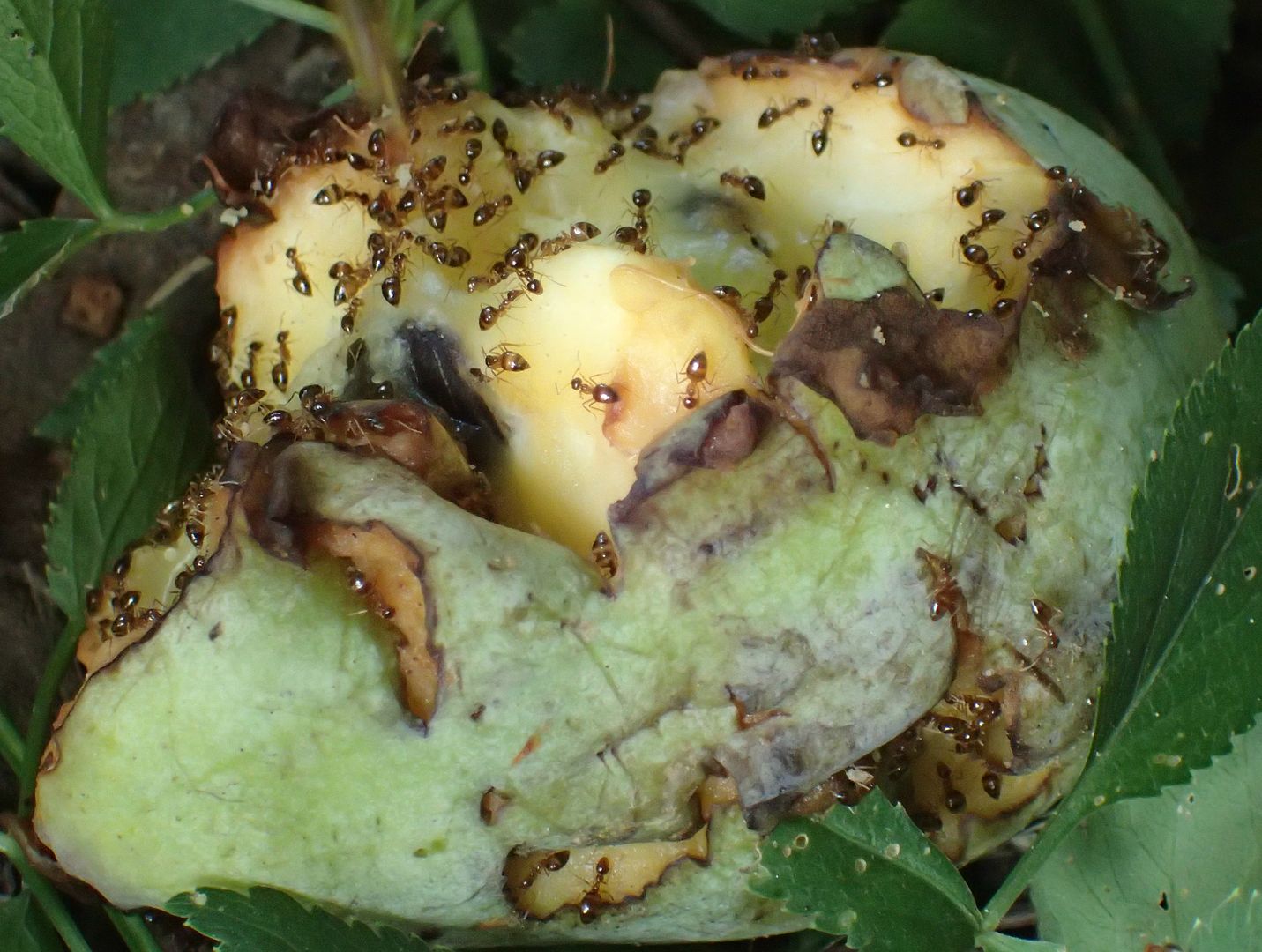
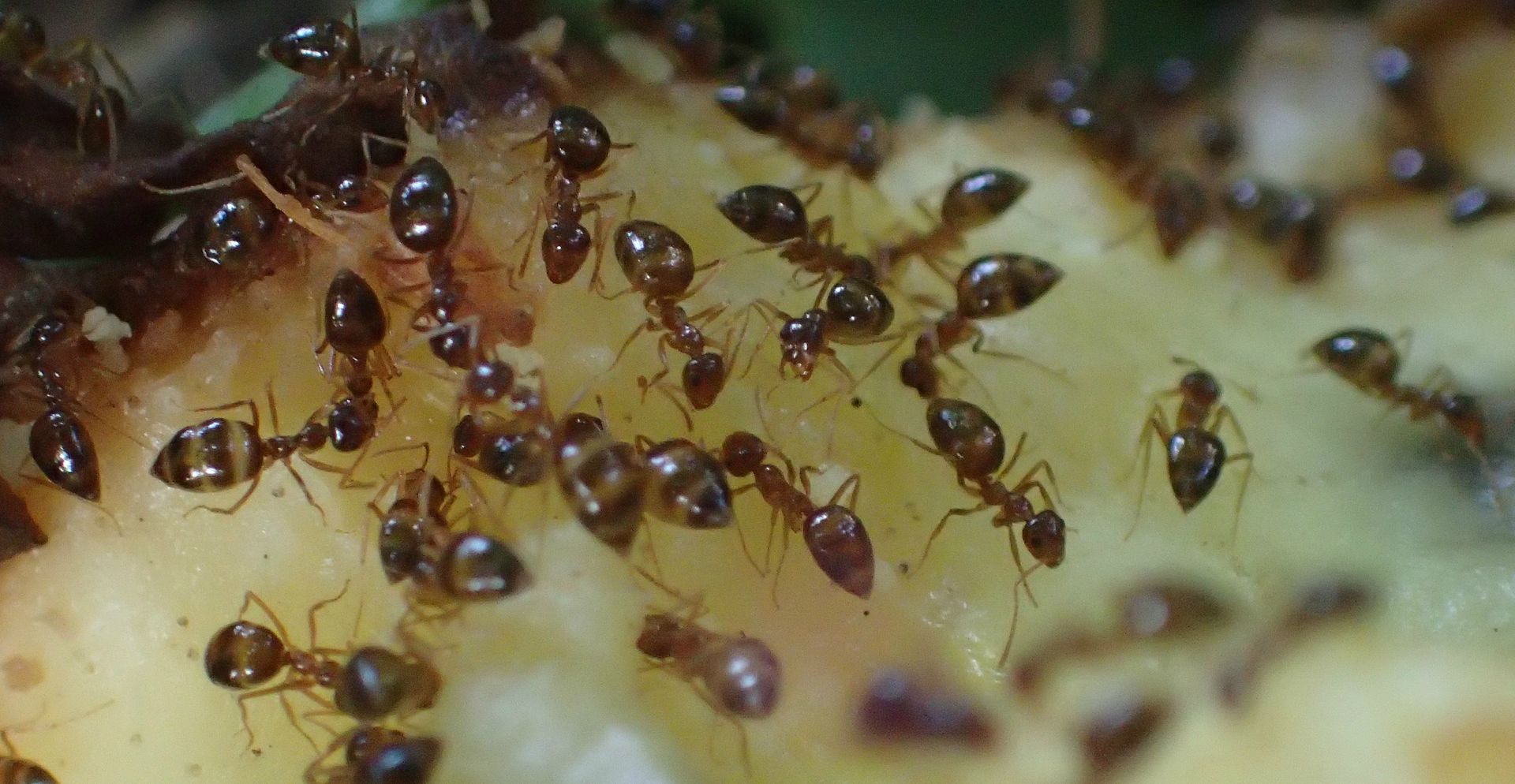
Members of what must be a very happy Prenolepis imparis colony spent the day cutting up the fruit and hauling it home after most of the workers had engorged themselves on it.
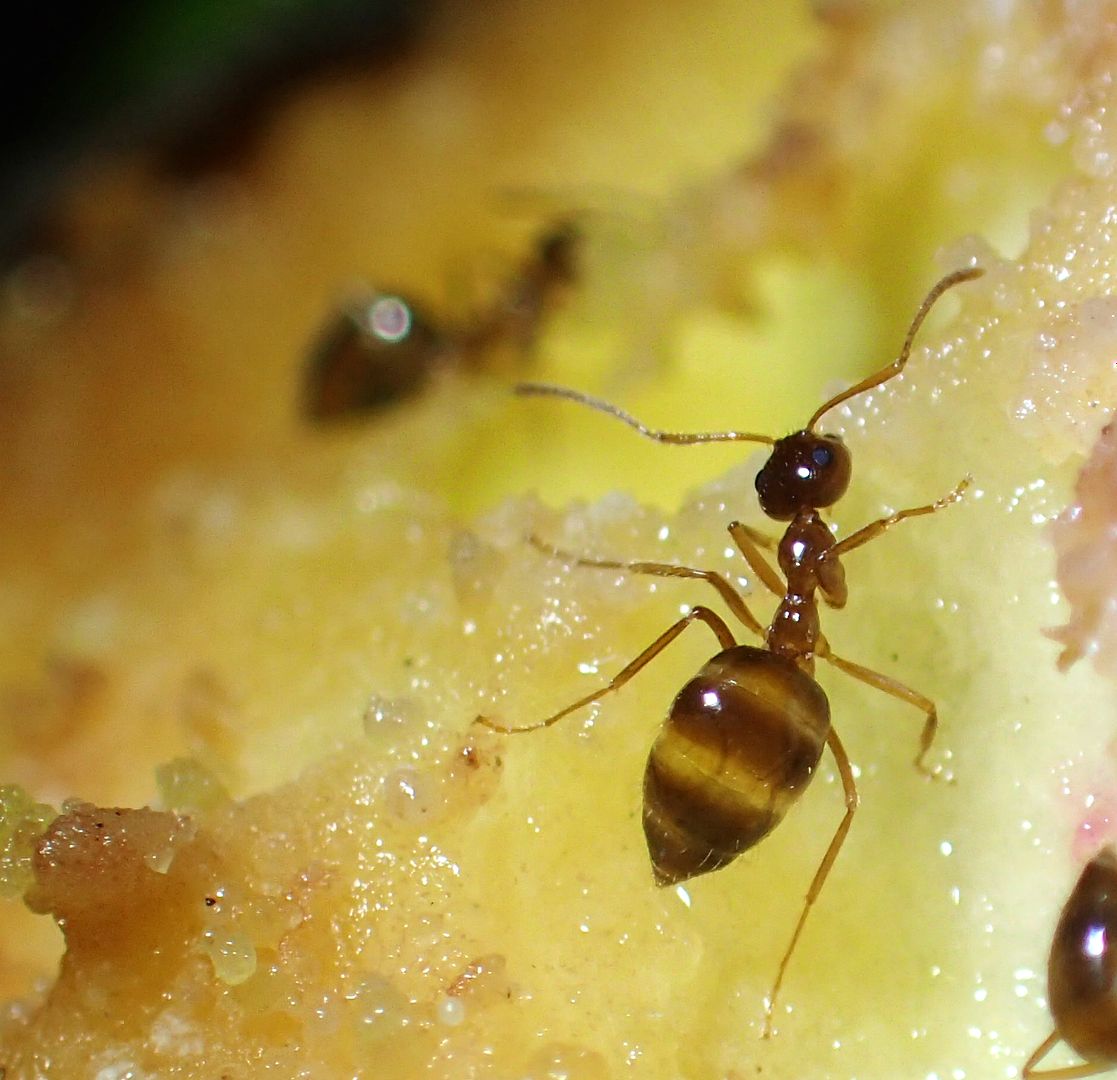
A fairly decent anatomy pic showing off the acidopore, a slightly tuft of hairs at the tip of the gaster/abdomen. This is a key trait when identifying ants in the subfamily Formicinae and a conclusive way to tell them apart from members of Dolichoderinae.
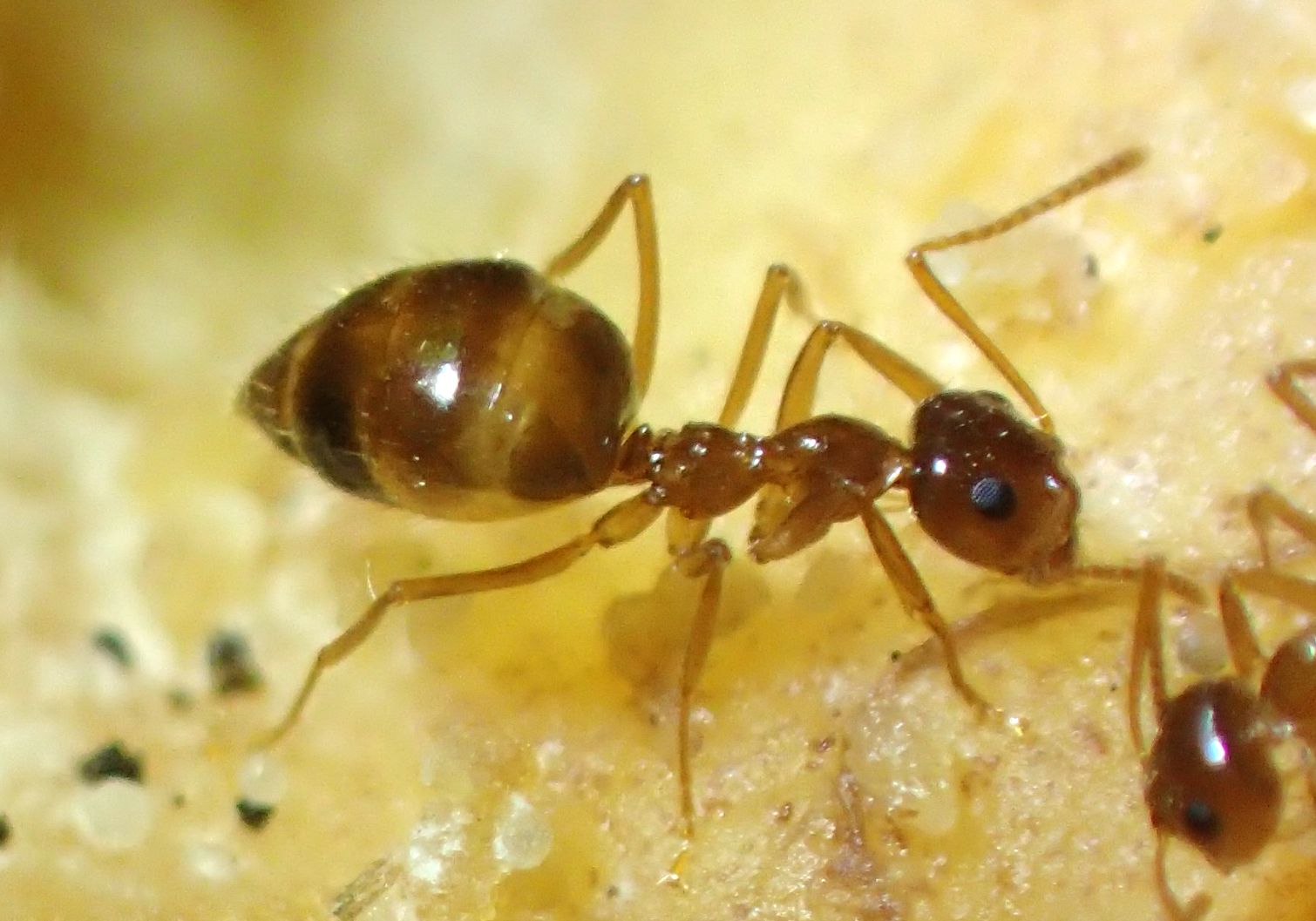
Another good anatomy shot. Here the tiny waist segment is clearly visible separating the gaster from the mesosoma.
Brachymyrmex dipilis was also flying that day. This is one of the smallest ants in the U.S.
Monday, April 13, 2015
Insects Take Flight
I went to the local woods last week.
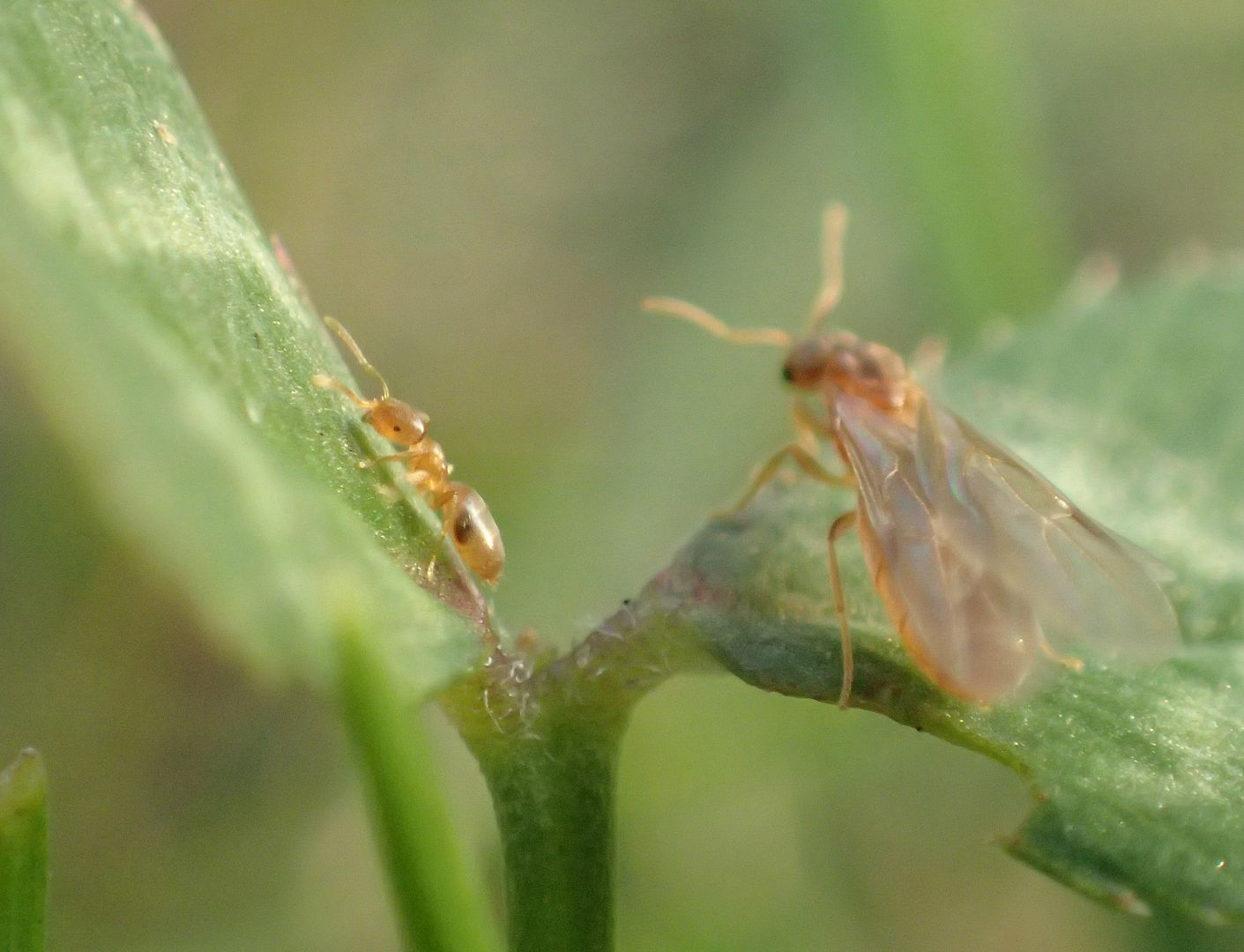
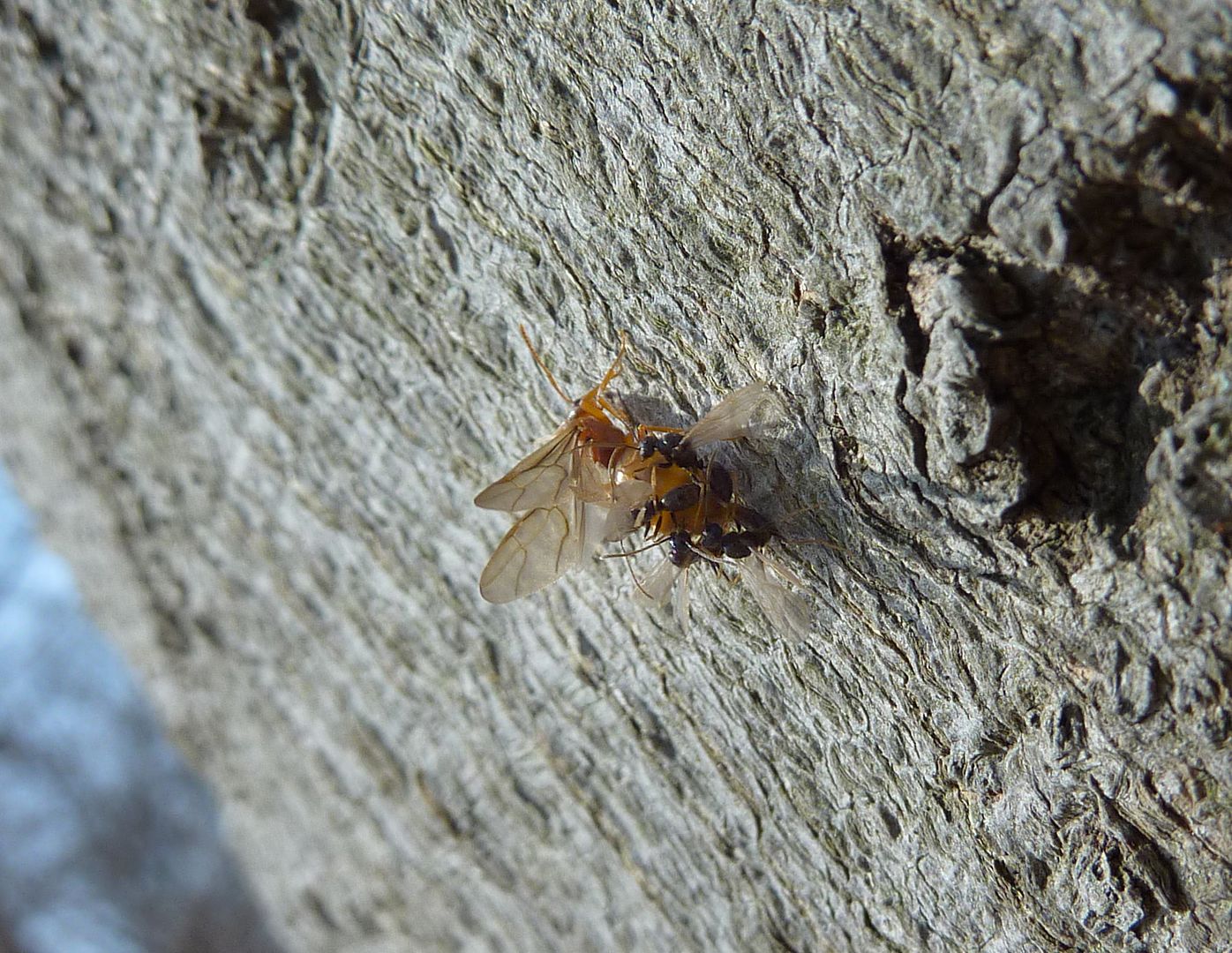
Winters Ants were flying though I didn't notice any queens. It was nothing but males (pictured here caught in a spider web). The species is Prenolepis imparis and in general they produce around 200 males for every new queen. In years past I was able to find them in abundance but not so much this year. Queens arrive and are quickly taken by a few dozen males. It's unclear if more than one gets to mate with her but they certainly try.
Workers to established colonies were also out foraging. Whole lines of these ants were streaming up and down trees, collecting the earliest bits of sap pushed out by newly forming buds.
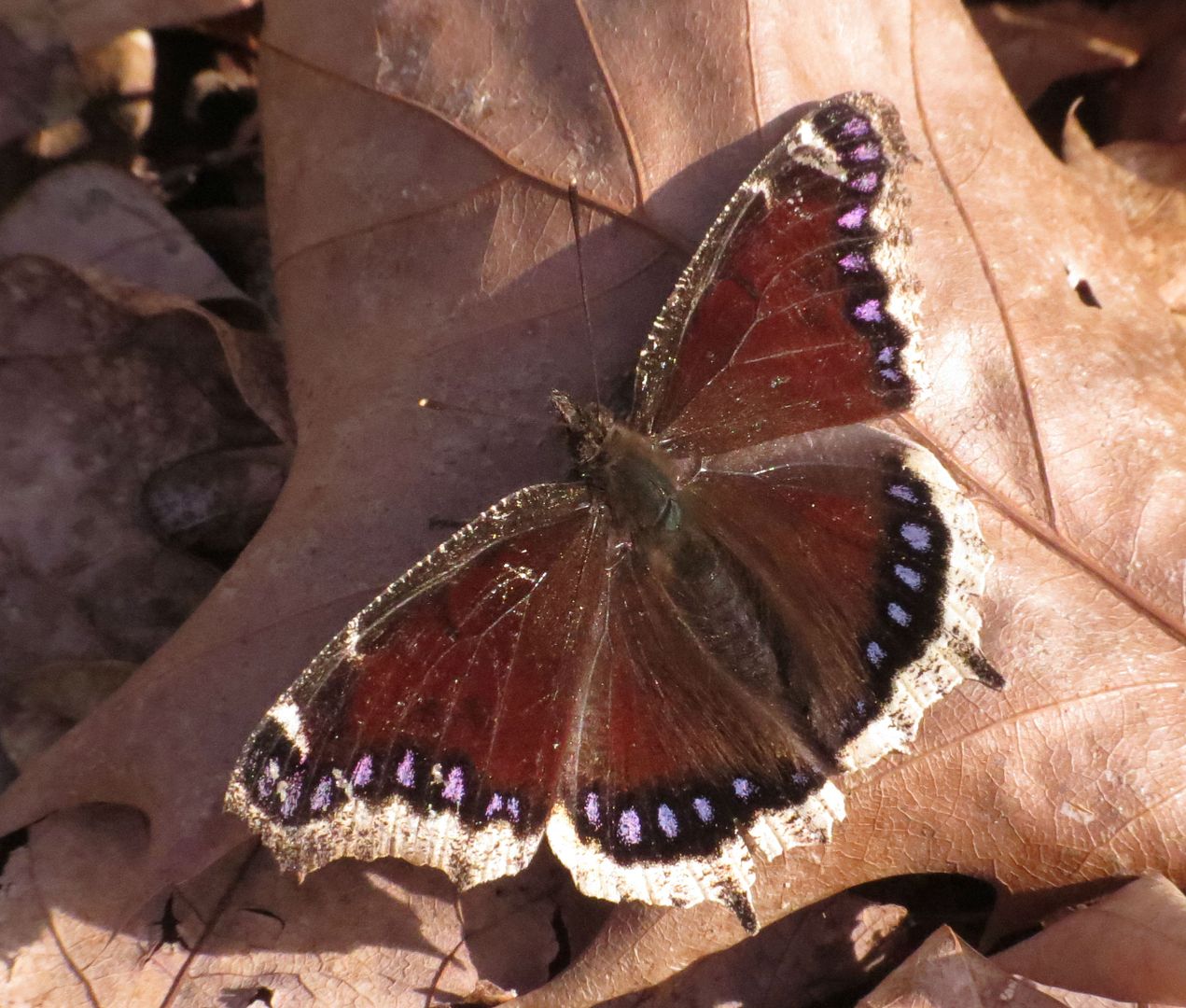
The Mourning Cloaks were also fluttering about occasionally landing to sunbath. I believe they over winter in the adult stage and mate around this time of year, just before their host plants push out the first flush of flowers and leaves. They host on Willows, Birch, Elm, Cottonwood, a few others too; generally trees you find in a mature forest.
Despite their color here, they turn almost invisible when laying among the leaves. The rich rosy copper tone seen here is more like a black when viewed from afar. The spots along the edge of the wing change from blue, to white, to pink depending on the angle they're viewed. Often the wings are closed up when resting, making them blend in with the leaves perfectly.
This one was sun bathing and didn't seem to mind me getting up close. It did flutter away when I blocked the sun though.
Winters Ants were flying though I didn't notice any queens. It was nothing but males (pictured here caught in a spider web). The species is Prenolepis imparis and in general they produce around 200 males for every new queen. In years past I was able to find them in abundance but not so much this year. Queens arrive and are quickly taken by a few dozen males. It's unclear if more than one gets to mate with her but they certainly try.
Workers to established colonies were also out foraging. Whole lines of these ants were streaming up and down trees, collecting the earliest bits of sap pushed out by newly forming buds.
The Mourning Cloaks were also fluttering about occasionally landing to sunbath. I believe they over winter in the adult stage and mate around this time of year, just before their host plants push out the first flush of flowers and leaves. They host on Willows, Birch, Elm, Cottonwood, a few others too; generally trees you find in a mature forest.
This one was sun bathing and didn't seem to mind me getting up close. It did flutter away when I blocked the sun though.
Tuesday, April 9, 2013
Nature and Some Ants
It's been warm for the past two days in a row, but I've had to work so I
haven't been able to get out there and do much. Today I went for a
short walk to see if I could find any Prenolepis imparis flying,
but it seems I've missed the flight. There were a few males here and
there, but nothing that impressed me enough to hang around and wait for
queens to show up. (They may fly again after a brief rainfall in the
coming weeks.)

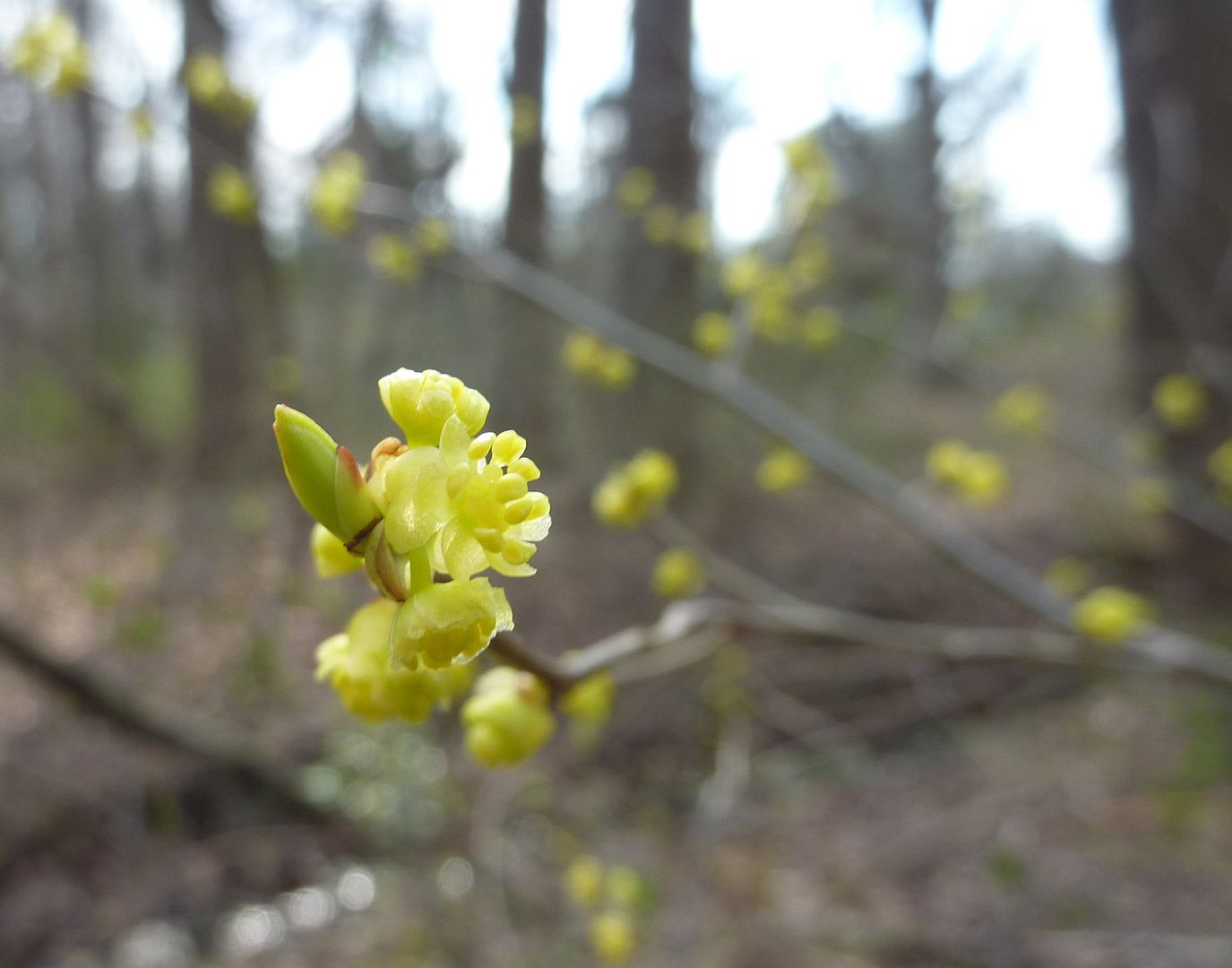
I did notice some Spice Bush, Lindera benzoin, flowering which I can now add to my collection of wildflowers photographed. This is the host plant to the Spicebush Swallowtail Butterfly who's caterpillar mimics a snake. I'll try and visit them later in the year to see if I can find any.

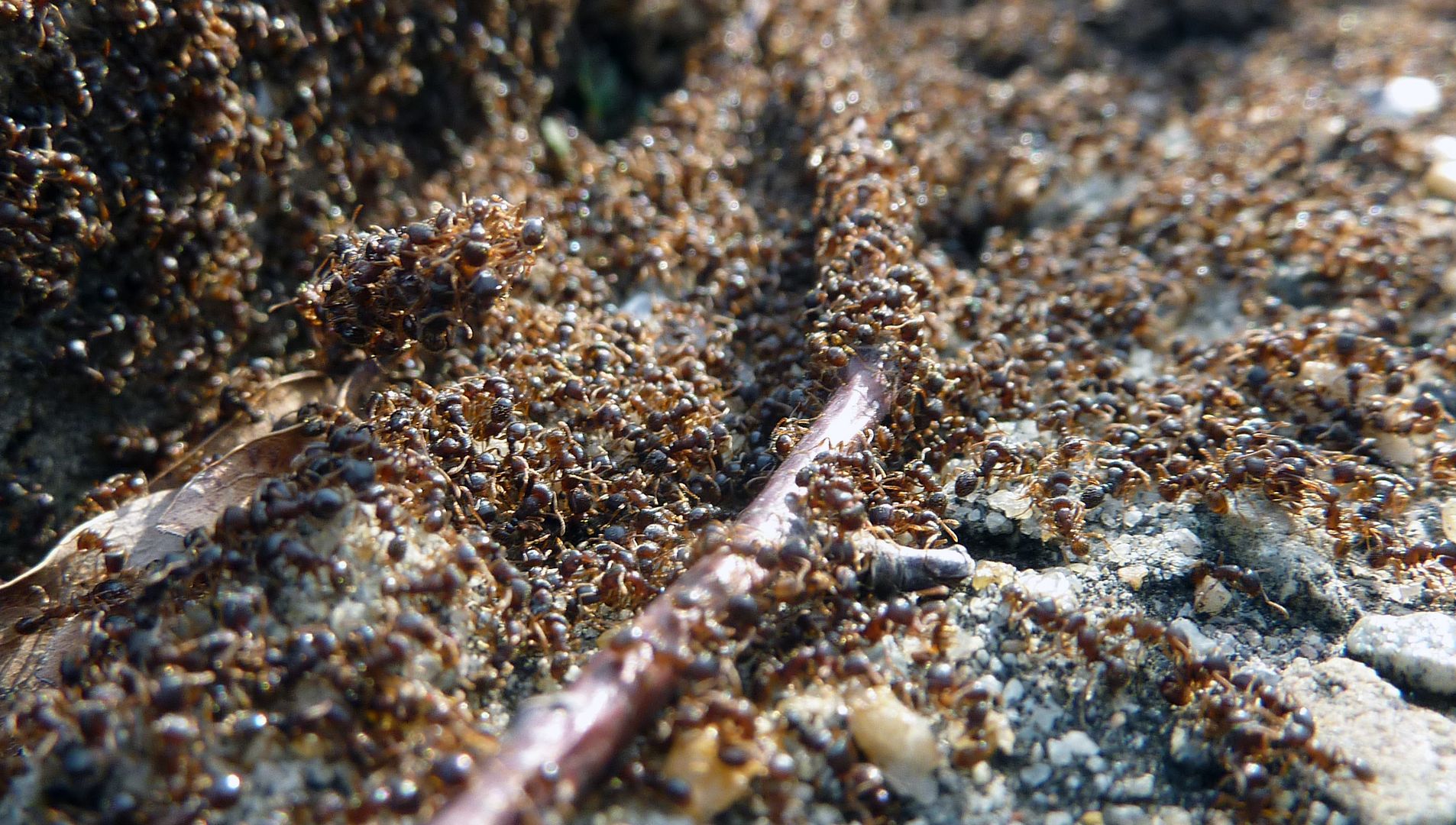
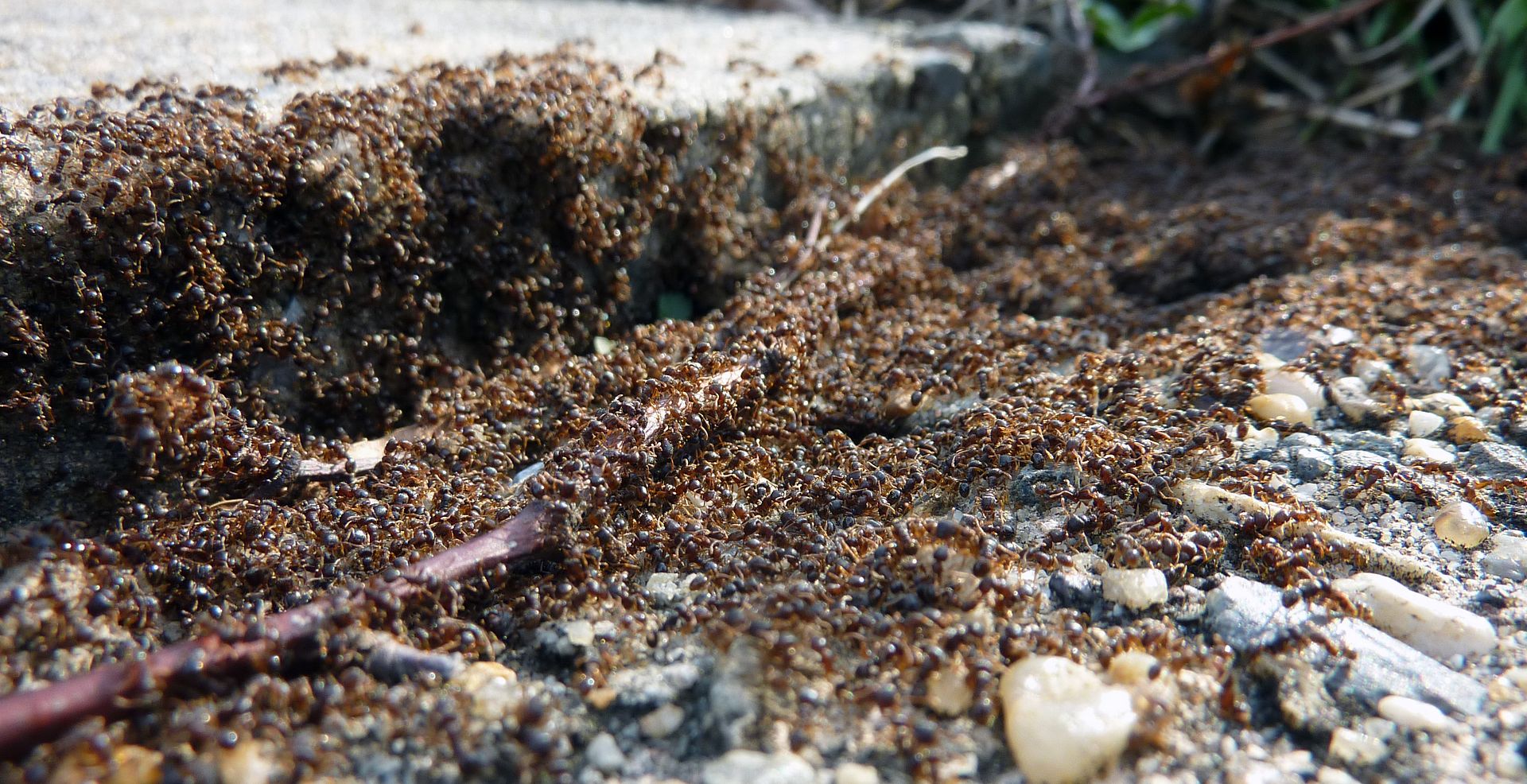
Along the way to the woods and back I came across a pavement ant war, where two colonies of Tetramorium cf. species E.were battling it out. A women thought I was recording this and commented "I'm sure that video will get like five million hits on youtube."


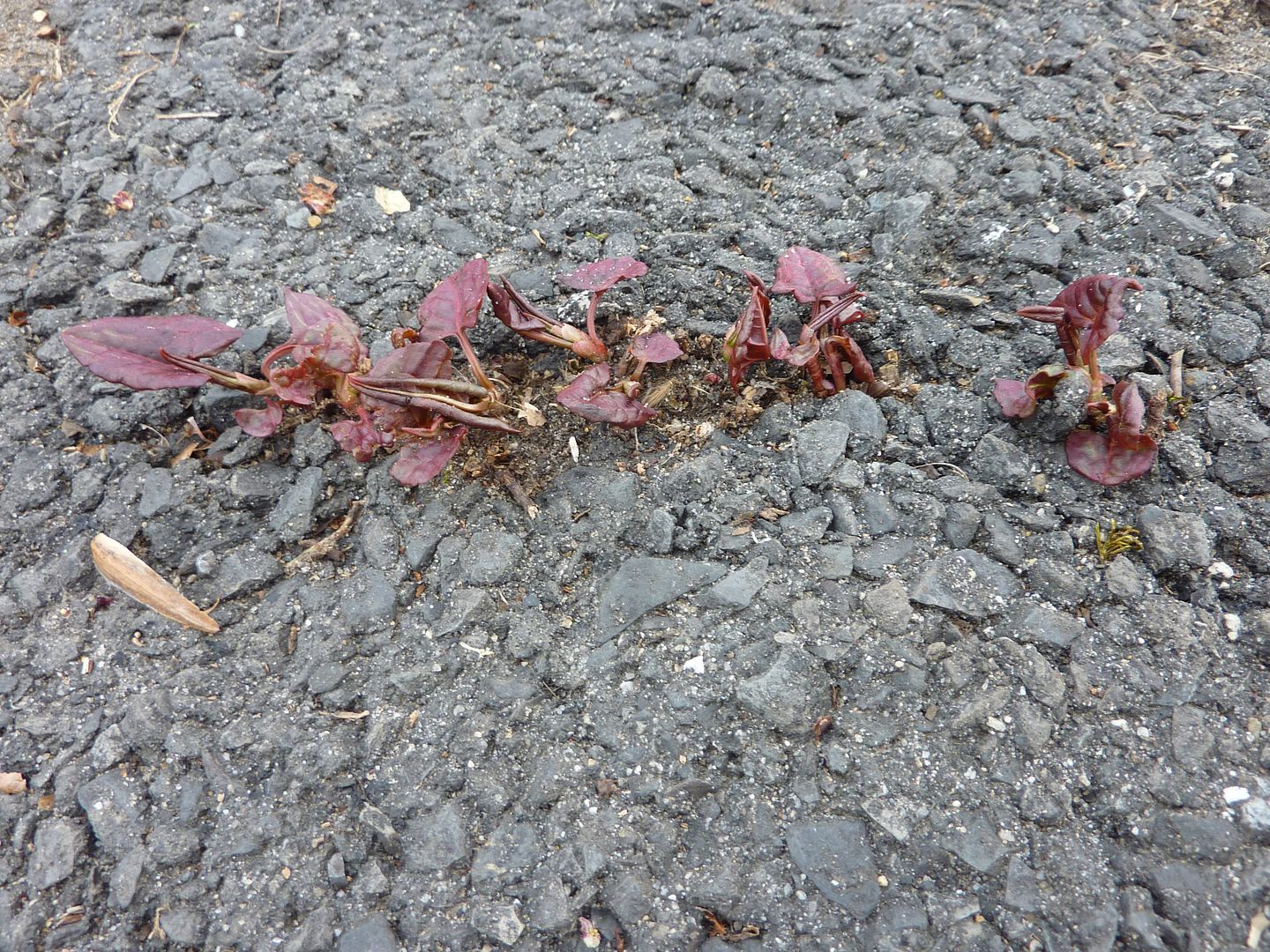
Also by the park there's a patch of Japanese Knotweed. This nonnative plant is so invasive that stems can actually push up through the road.

I did notice some Spice Bush, Lindera benzoin, flowering which I can now add to my collection of wildflowers photographed. This is the host plant to the Spicebush Swallowtail Butterfly who's caterpillar mimics a snake. I'll try and visit them later in the year to see if I can find any.

Along the way to the woods and back I came across a pavement ant war, where two colonies of Tetramorium cf. species E.were battling it out. A women thought I was recording this and commented "I'm sure that video will get like five million hits on youtube."


Also by the park there's a patch of Japanese Knotweed. This nonnative plant is so invasive that stems can actually push up through the road.
Friday, March 16, 2012
Ant Chat 37: Flight of the Winter Ant
In summary, the earliest days of the year where it's 70F out are typically when this ant flies. They may be found flying as late as April but that tends to be the most northern part of their range, where as groups farther south can fly as early as February. Swarms gather around trees and shrubs, but aren't picky. The same day as this video I found males swarming around telephone poles and even specimen trees in my back yard. Forests tend to be abundant with swarming males which typically means more queens will show up. Queens are greatly out numbered and show up one at a time, every 5 minutes to a half hour.
Males are quick to locate them as they arrive. Once the queen has, we'll call it "tagged in," she'll try to climb up high and fly away, often a male or two will still be with her. As the day progresses wingless queens can be found wondering around looking for places to make nests, though in my experience these are harder to find than queens are arriving to the swarm to mate.
Can you find the queen ant? I think the bright oranges, blonds, and browns are intended as a sort of camouflage against birds. (At the same time though I believe males are drawn to her flashy colors. I recall in my youth finding a hot yellow toy shovel that was covered in male ants and I couldn't explain why. I didn't care about ants then as much as I do now. )
Colonies are easy to start in test tubes, however this is one of the more boring species to keep. Queens only lay eggs at one time of the year and if the batch fails that's it for the year. Even so they're a fun ant to come across and learn about.
Tuesday, July 5, 2011
Combining Winter Ant Colonies
This is an experiment that I did with my colonies of Prenolpis imparis I was able to rear this year. (See here, but be warned there's some suggestive language towards the end.) In North America there are 10 accepted varieties of this one species, and it's hard to believe some of them don't deserve species status. I'm not here to set the record straight though so that's just something to bare in mind should you try this with your own colonies of Prenolepis imparis.
In years past, locally, I have noticed Prenolepis imparis queens come in at least 2 sizes, and workers have at least 3 or 4 color patterns. I have tried this in years past with a slightly larger variety (the true species?) and it did not end well at all. On contact workers started fighting and killing one another, they stole the brood and out right murdered the queen to the weaker colony.
This is a bad reaction in captivity because it lowers the number of queens and colonies. Out in the wild though it's successful because it allows one colony to take over a nice patch of land where they don't need to fear much competition from their own species unless a larger colony already has claim to the territory.
Abstract
Nuptial flights usually result in queens scattering areas looking for potential nesting sites. Occasionally ideal sites are limited and more than one queen may start a nest there. When workers emerge these become delicate situations. Populations are low and every worker is important to a young colony. How species handle this situation is key to the colonies' survival. Here I decided to recreate what happens with this species, at least one variety, in captivity.
Experiment
Of 5 queens caught in March, only 4 successfully reared workers. (The last one died) Given how young the colonies are it is hard to say which variety I have, but given the options I'd say the closest variety they fit in with is the rare Prenolepis imparis var. minuta which is colored the same as the true species but overall smaller by about 2mm. I did not take this into consideration at the time of this experiment, if I had, I would have done this in two groups. Life is full of regrets.
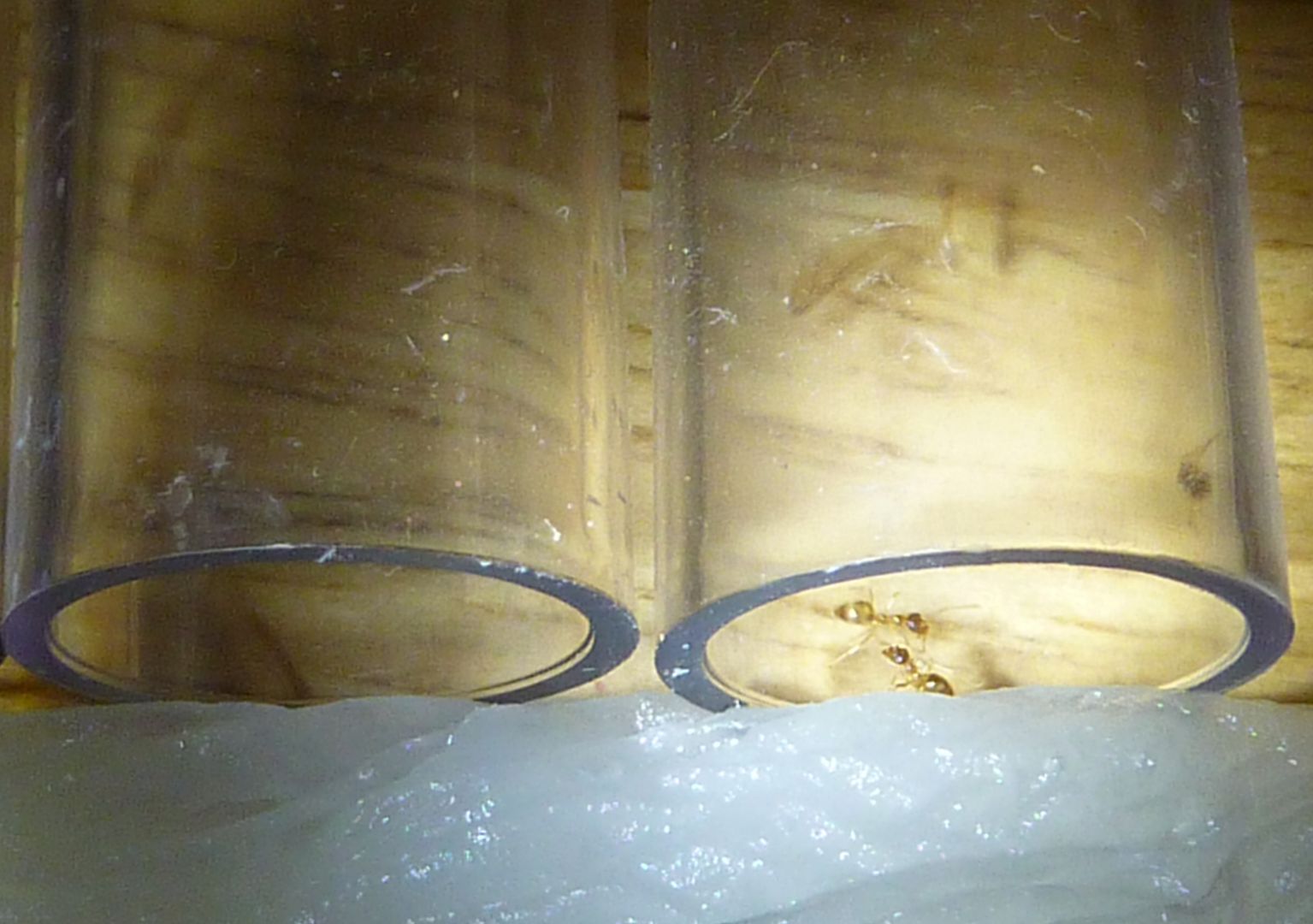
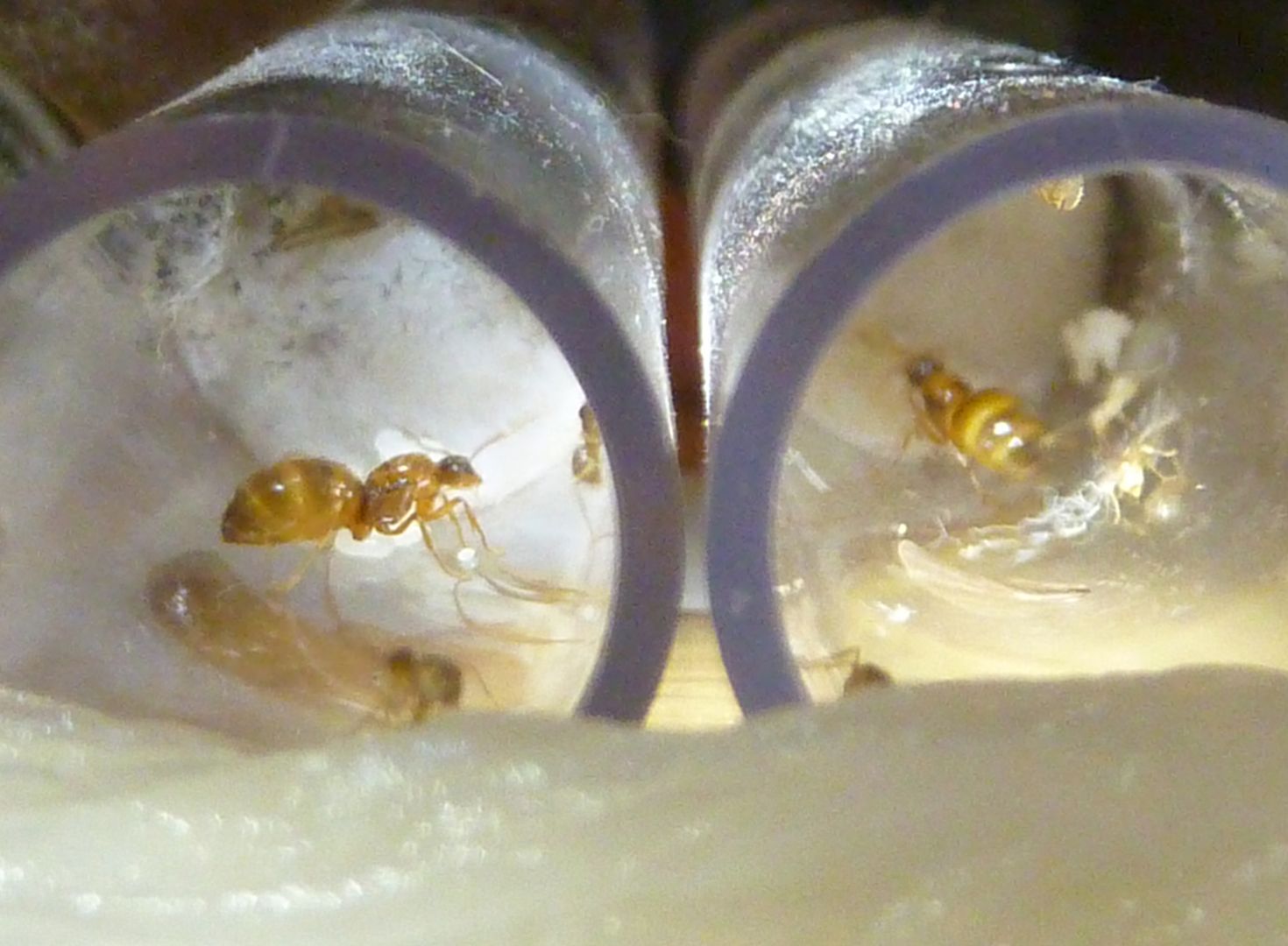
Anyhow, considering I did this last year with poor results I decided that feeding them might help the colonies merge. Pictured above are 2 of 4 colonies (all four were laid out next to each other inside a container,) where the open ends touch a rolled up tissue sliver soaked in 1:1 sugar water. Workers quickly found the sugar water and began bringing it back to the nest. Exploring soon followed with interesting results.
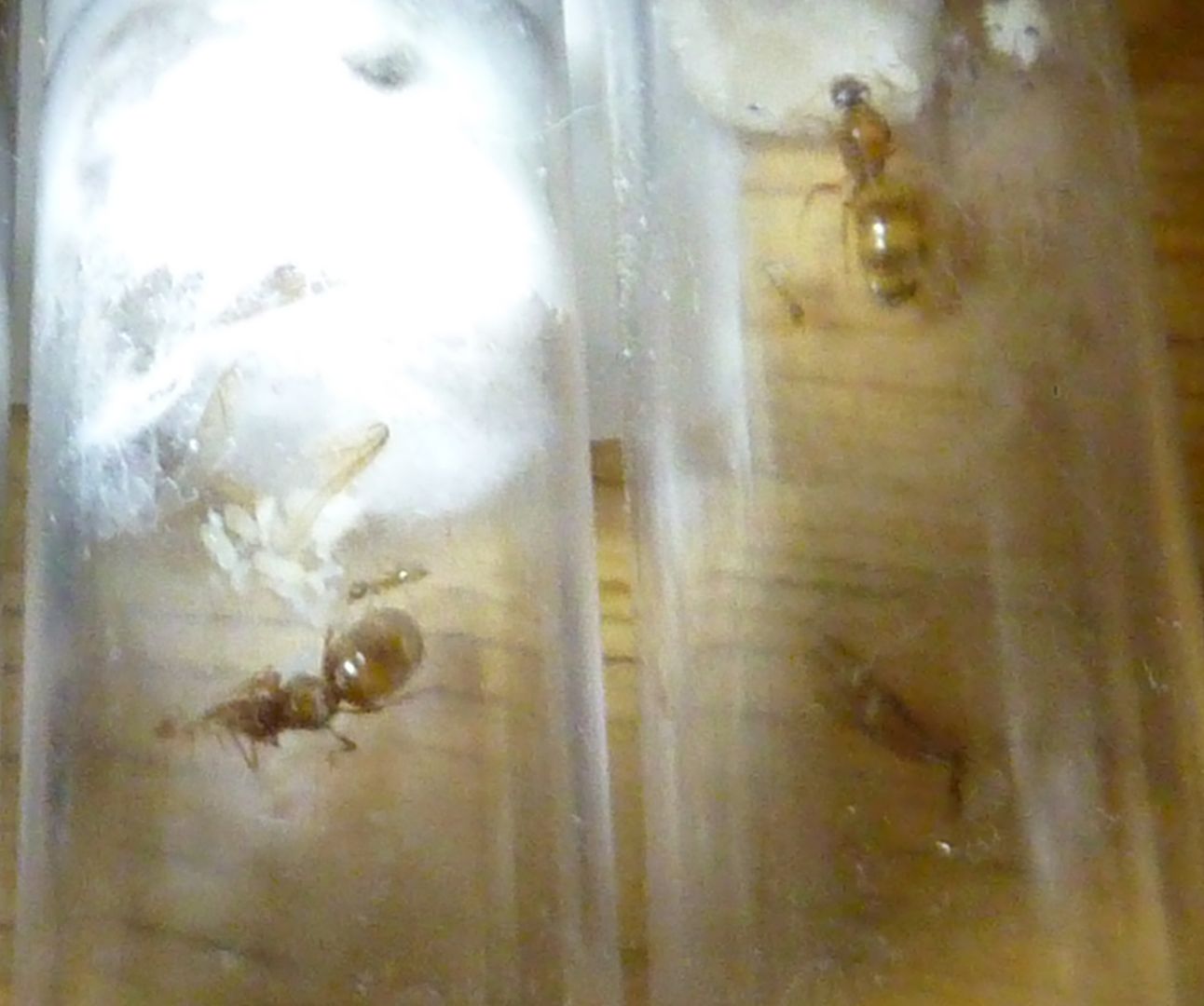
It's hard to tell here but both workers are from different colonies. I didn't get good pictures of it but generally one worker would assume an aggressive stance, mandibles open and gaster turned ready to fire off some chemical. Rather than return the aggression, the threatened worker started feeding the other. The aggressor would lower their guard. The two workers eventually went their separate ways.
Here on the lower left a worker from the colony on the right has located the other's queen. The worker preformed the aggressive stance like before only to have the queen start feeding it to lower it's guard. After this is done the worker continues to wonder around freely in the other colony, eventually wondering back home.
This is either a series of muggings or from the other view, some kind of weaponized liposuction. I don't know how else to describe it. As with Honey Bees that swarm many of the individuals are to fat with honey to sting. Could the same be true for Prenolepis imparis repletes? Could making the other ant to fat to attack be the key to peace?
Workers between both colonies slowly become more and more indistinguishable as they roam freely between each colony. Mugging for food eventually stops all together. Of the two colonies that started doing this first, the one pictured on the right had more adult workers (those that had gained their full color).
Eventually the dominant colony, or at least the one with more adult workers, started transporting brood from the other colony to their own.
The queen to the colony on the left was curious where all her workers had gone and started roaming about. Upon finding brood scattered in her tube this left her wandering in confusion for a bit.
Eventually she got the idea and followed the thin trail of workers moving all her eggs into the other tube.
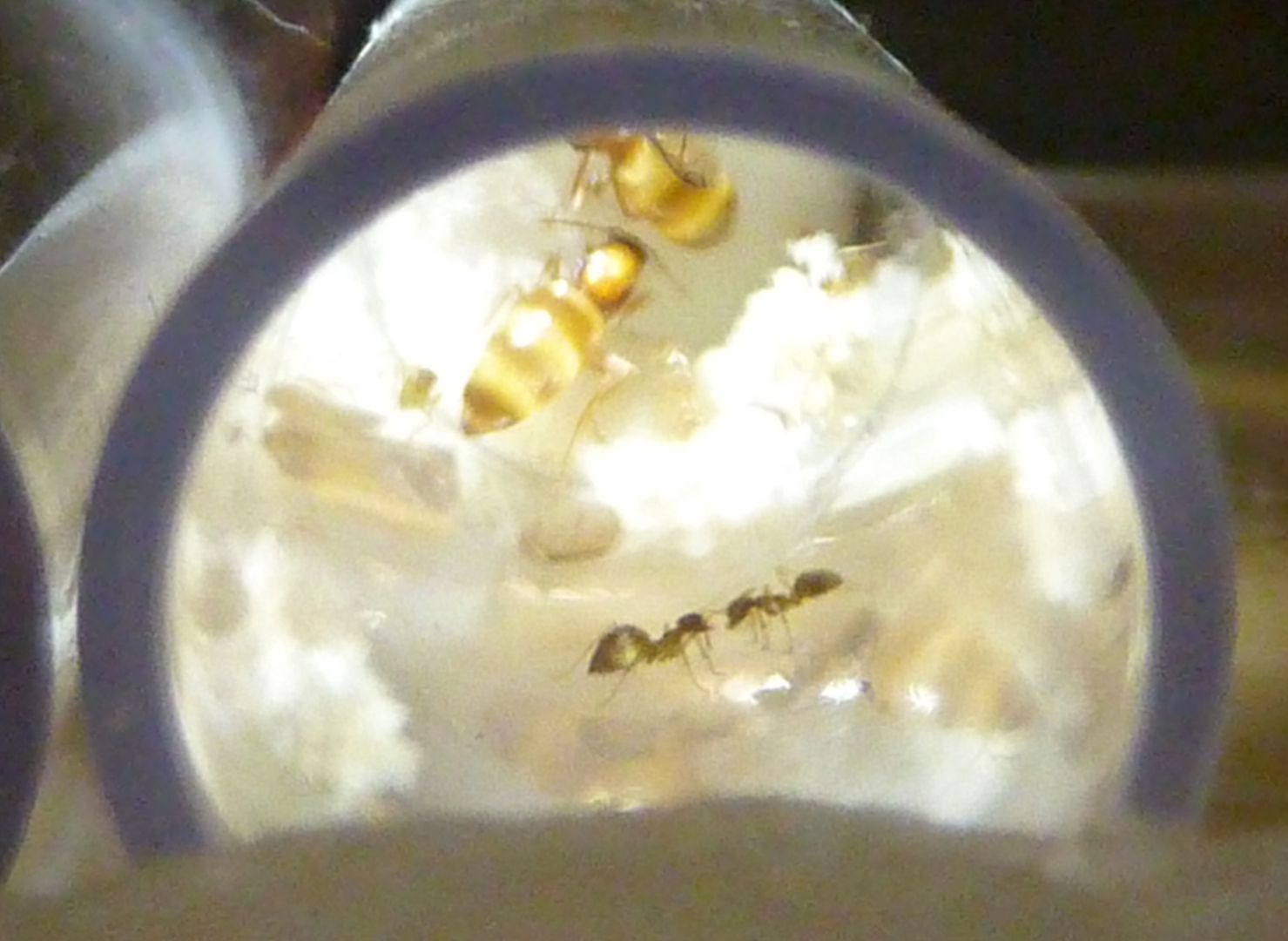
The two queens met one another without incident. The brood pile doubled in size thanks to the two colonies combining.
Over night this process was repeated with the other colonies in this setup and the result was one colony with four queens.
If I could do this experiment again I would repeat the same as above with 2 colonies. But with the other 2 I would try not feeding them at all. I'm curious to know weather or not exchanging food is important for a peaceful colony merging. What's more I'm curious to know if this is important with other P. imparis varieties as well other species. When the colonies are starving is it possible for two colonies to still find piece and not look at one another as food items?
In years past, locally, I have noticed Prenolepis imparis queens come in at least 2 sizes, and workers have at least 3 or 4 color patterns. I have tried this in years past with a slightly larger variety (the true species?) and it did not end well at all. On contact workers started fighting and killing one another, they stole the brood and out right murdered the queen to the weaker colony.
This is a bad reaction in captivity because it lowers the number of queens and colonies. Out in the wild though it's successful because it allows one colony to take over a nice patch of land where they don't need to fear much competition from their own species unless a larger colony already has claim to the territory.
Abstract
Nuptial flights usually result in queens scattering areas looking for potential nesting sites. Occasionally ideal sites are limited and more than one queen may start a nest there. When workers emerge these become delicate situations. Populations are low and every worker is important to a young colony. How species handle this situation is key to the colonies' survival. Here I decided to recreate what happens with this species, at least one variety, in captivity.
Experiment
Of 5 queens caught in March, only 4 successfully reared workers. (The last one died) Given how young the colonies are it is hard to say which variety I have, but given the options I'd say the closest variety they fit in with is the rare Prenolepis imparis var. minuta which is colored the same as the true species but overall smaller by about 2mm. I did not take this into consideration at the time of this experiment, if I had, I would have done this in two groups. Life is full of regrets.
Anyhow, considering I did this last year with poor results I decided that feeding them might help the colonies merge. Pictured above are 2 of 4 colonies (all four were laid out next to each other inside a container,) where the open ends touch a rolled up tissue sliver soaked in 1:1 sugar water. Workers quickly found the sugar water and began bringing it back to the nest. Exploring soon followed with interesting results.
It's hard to tell here but both workers are from different colonies. I didn't get good pictures of it but generally one worker would assume an aggressive stance, mandibles open and gaster turned ready to fire off some chemical. Rather than return the aggression, the threatened worker started feeding the other. The aggressor would lower their guard. The two workers eventually went their separate ways.
Here on the lower left a worker from the colony on the right has located the other's queen. The worker preformed the aggressive stance like before only to have the queen start feeding it to lower it's guard. After this is done the worker continues to wonder around freely in the other colony, eventually wondering back home.
This is either a series of muggings or from the other view, some kind of weaponized liposuction. I don't know how else to describe it. As with Honey Bees that swarm many of the individuals are to fat with honey to sting. Could the same be true for Prenolepis imparis repletes? Could making the other ant to fat to attack be the key to peace?
Workers between both colonies slowly become more and more indistinguishable as they roam freely between each colony. Mugging for food eventually stops all together. Of the two colonies that started doing this first, the one pictured on the right had more adult workers (those that had gained their full color).
Eventually the dominant colony, or at least the one with more adult workers, started transporting brood from the other colony to their own.
The queen to the colony on the left was curious where all her workers had gone and started roaming about. Upon finding brood scattered in her tube this left her wandering in confusion for a bit.
Eventually she got the idea and followed the thin trail of workers moving all her eggs into the other tube.
The two queens met one another without incident. The brood pile doubled in size thanks to the two colonies combining.
Over night this process was repeated with the other colonies in this setup and the result was one colony with four queens.
If I could do this experiment again I would repeat the same as above with 2 colonies. But with the other 2 I would try not feeding them at all. I'm curious to know weather or not exchanging food is important for a peaceful colony merging. What's more I'm curious to know if this is important with other P. imparis varieties as well other species. When the colonies are starving is it possible for two colonies to still find piece and not look at one another as food items?
Friday, July 1, 2011
Identification and Distribution of Prenolepis
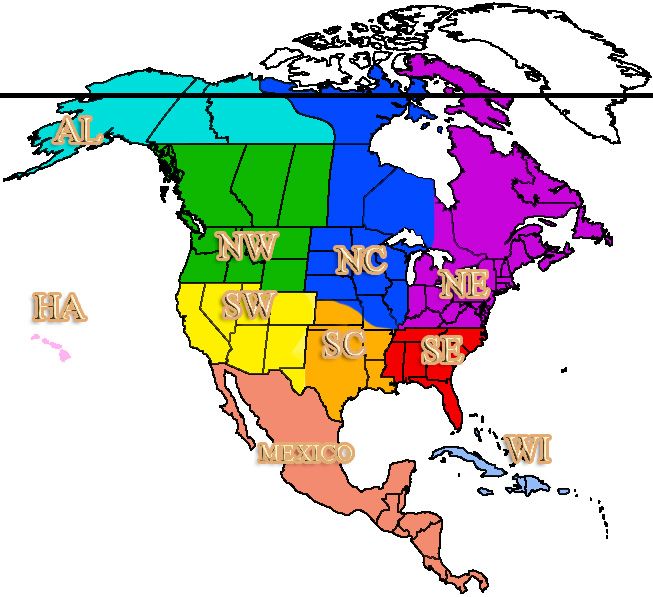
Prenolepis imparis (2) SW, SC, SE, NW, NC, NE, Southern Canada, Temperate Regions of Mexico
Well that was easy. As there is only one recognized species in all of North America, and because it is so common, I feel the need to delve a little deeper. But first note that varieties don't make much difference. They're just common combinations of morphological traits that represent but a fraction of the genetic diversity within a single species. In theory there should be hybrids to every one of these found somewhere.
There are no less than 10 described varieties of this one species. And after reviewing what's written about them below it seems clear that some of these may well be elevated to species status. Of the 10 I feel only 5 are really distinct. These are Prenolepis imparis itself, var. testacea, var. coloradensis, var. arizonica, and var. californica. I say they're worth mentioning because there are a reasonable amount of pictures online to link to, to get a general idea of them. The others (var. minuta, var. pumila, var. veracruzensis, var. colimana, and var. nitens) are considered rare and some seem to be smaller versions of the before mentioned.
The genus as a whole is associated with oak trees. They're found as far north as Nova Scotia and as south to Guatemala. They're not common in the Rocky Mountains at all and down south in Mexico they seem to only be found at high elevations where it remains cool for a period of months. While they'll accept dead insects as food their main food source seems to be assorted carbohydrates. They forage mainly for nectar in flowers, extra floral nectar from plant pores, honey dew from aphids and scales etc..., galls (but these can be the result of an aphid anyhow) and they'll even go for elaiosome from seeds when they can get it. Despite this affinity for sweets it's strange that they do not take advantage of underground aphids as subterranean Lasius do.
While collecting food workers often balloon up with food and are technically considered repletes similar to Honey Pot Ants, Myrmecocystus. Unlike Honey Pot Ants, Prenolepis imparis repletes are still able to move and are frequently seen in foraging trails wobbling about. Also unlike Honey Pot Ants rather than leaving it as a sugar within their social stomach the food is converted into a fat body. This is where they get the common name False Honey Ant. Personally I'm not a fan of this common name though and believe it implies a certain image of the species promoted by the pest control industry. I feel the name Winter Ant is a bit more appropriate because of their extreme tolerance to cold. Not only have they been reported foraging when it's only 6 degrees Fahrenheit out! but also hold their nuptial flights sooner than any other species in temperate areas, where they're found.
In the study listed below the earliest date for a nuptial flight is mentioned in March, but I've seen them out as early as February 11th. They did not fly again until March 11th, and then not after that until the end of March where they continued to mid April. Up north they may continue flying as late as early May but certainly not any longer. This happens typically on the earliest day of the year where temperatures are in the 60's or above. Wind conditions don't seem to matter as long as the gusts aren't dropping the temperature below favorable conditions. I've seen them out flying on days with gusts were blowing 60mph. The only other condition is the soil must be somewhat moist, either by melting snow, or from rains earlier in the week. Flights take place in the afternoon at first but as good days happen these become sooner and sooner to slightly before 12:00 noon. Swarms of males gather around trees and foliage, often at eye level, where they mysteriously appear to be marking the foliage. Queens are far fewer in number and quickly pounced upon by males where mating then typically takes place on the ground. Bugguide.net has several pictures of mating couples. (1) (2) (3) The larger the gathering of males the more queens that seem to arrive. I've found swarms that took up several meters of forest land, as well as ones consisting of fewer than 6 males swarming around a tree in my own back yard.
Nests are underground, and I want to say not far from where swarms typically gather. From keeping them in captivity, new queens will produce their first workers over the first summer. In just about every study I've read though they all seem to agree that adult colonies don't keep brood over the summer months. So it's unknown where the transition takes place. Brood was only ever found from September to the following March. Over the summer colony activity typically dies down verging on going completely dormant sometimes as long as 8 months. Nests go very deep into the earth, probably deeper than 10' down. See here. Often there is only one entrance, or a second opening close by, certainly not much more. I've also found colonies moving or perhaps combining.
Prenolepis imparis (2) SC, SE, NC, NE
3-4mm long, queen 7.5-8.5mm, male 3.5-4mm. This species has a preference for nesting in moist clay. The head and mesosoma are typically medium brown to solid black. The gaster is always either dark brown or black. The legs, and antenna yellow to yellowish brown.
*Here is what I believe is a typical queen coloration to the true species. (1) (2) This should probably be backed up with coloration of the workers too. Notice how they're reddish brown but not to bright, or "pale" as it's described.
P. imparis var. minuta. SC, SE, NC, NE
2-2.5mm long, queen 6.5mm, male 2.5. This species is described as Prenolepis imparis itself but smaller. Queens are described as slightly paler but still darker than var. testacea. (Also has markings on the mesosoma but honestly I think they all do!) This is described as being rare.
*The only reason I'm not dismissing this as someone just finding a young colony of P. imparis that only has nantics is the fact they give a measurement for the queen and male. So this does sound legitimate, rare as it may be.
P. imparis var. testacea. SC, SE, NC, NE
(Presumably the same lengths as P. imparis itself) Prefers nesting in sandy soil or pure sand, though it may also occasionally be found in clay. Workers are much paler in color ranging from yellow to brownish red. The gaster and posterior portions of the head are darker than the body, ranging from pale to dark brown. Legs are always yellow. Queens are much paler too with more vibrant yellows and reds, ranging from an almost solid blond color to a brighter form of P. imparis itself as with this one.
*Queens might be slightly smaller than true P. imparis. I believe I have a picture of the two together here. They failed to produce any workers, or even rear any of the eggs into larva, and died shortly after.
P. imparis var. pumila. SC, SE, NC, NE
2.2-2.5mm long, queen ?, male 2.3-2.5mm. This is described as a smaller version of var. testacea. Legs and antenna were noticeably pale yellow. This variety is said to be rare.
P. imparis var. californica. SW, NW
2.3-2.5mm long, queen 6-6.5mm, male 2.8-3.2mm. Same color as P. imparis but overall darker and perhaps less color variation, usually a glossy brown. They differ also in having longer pubescence on the scape and legs. Queens are also darker, very much more brown looking to almost terracotta and lack the more vibrant reds and yellows of eastern forms.
P. imparis var. coloradensis. SW, SC, NW, NC (Colorado)
2.5-3mm long. This variety has only been collected in mountainous areas of Colorado, I'm listing it with a wider distribution becuase these varieties are not well studied and may be found elsewhere. Slightly darker than var. pumila. Body color is brown with the posterior of the head darker. The gaster, antennae, and legs are yellow.
P. imparis var. arizonica. SW, Mexico
3-3.5mm long, queen 6.5mm, male 2.8-3.2mm. Same color as the darkest form of var. testacea but erect hairs are longer and more abundant on the gaster. Legs and antennae are brownish yellow. Queen colors is pale/blond as in var. testacea but "no mesosomal markings" (as I said earlier, I think every queen has these, so I'll believe that when I see it).
P. imparis var. veracruzensis. Mexico
3mm long. Uniformly brownish red. Tarsi and knee area are yellow. Longer pubescence than var. californica. Erect hairs are longer and more abundant. Pubescence is slightly longer.
*Nothing else is known for this variety.
P. imparis var. colimana. Mexico
3-3.5mm long. Body is brownish with the posterior of the head and gaster darker. Antennae, tarsi, and tips of femera are paler and more yellow. Erect hairs are longer and more abundant. Pubescence is slightly longer.
*Nothing else is known for this variety.
Prenolepis ca01 SW (California)
This is also worth noting. This is not var. californica as it's much smaller in size, and apparently flies in the fall time. Comparison. Read More.
Also P. imparis var. nitens isn't found in North America at all from what I read, and in fact has been elevated to species status. Prenolepis nitens.
Sources
Wheeler, W. M. 1930. The ant Prenolepis imparis Say. Annals of the Entomological Society of America 23: 1-26.
A work in progress.
Well that was easy. As there is only one recognized species in all of North America, and because it is so common, I feel the need to delve a little deeper. But first note that varieties don't make much difference. They're just common combinations of morphological traits that represent but a fraction of the genetic diversity within a single species. In theory there should be hybrids to every one of these found somewhere.
There are no less than 10 described varieties of this one species. And after reviewing what's written about them below it seems clear that some of these may well be elevated to species status. Of the 10 I feel only 5 are really distinct. These are Prenolepis imparis itself, var. testacea, var. coloradensis, var. arizonica, and var. californica. I say they're worth mentioning because there are a reasonable amount of pictures online to link to, to get a general idea of them. The others (var. minuta, var. pumila, var. veracruzensis, var. colimana, and var. nitens) are considered rare and some seem to be smaller versions of the before mentioned.
The genus as a whole is associated with oak trees. They're found as far north as Nova Scotia and as south to Guatemala. They're not common in the Rocky Mountains at all and down south in Mexico they seem to only be found at high elevations where it remains cool for a period of months. While they'll accept dead insects as food their main food source seems to be assorted carbohydrates. They forage mainly for nectar in flowers, extra floral nectar from plant pores, honey dew from aphids and scales etc..., galls (but these can be the result of an aphid anyhow) and they'll even go for elaiosome from seeds when they can get it. Despite this affinity for sweets it's strange that they do not take advantage of underground aphids as subterranean Lasius do.
While collecting food workers often balloon up with food and are technically considered repletes similar to Honey Pot Ants, Myrmecocystus. Unlike Honey Pot Ants, Prenolepis imparis repletes are still able to move and are frequently seen in foraging trails wobbling about. Also unlike Honey Pot Ants rather than leaving it as a sugar within their social stomach the food is converted into a fat body. This is where they get the common name False Honey Ant. Personally I'm not a fan of this common name though and believe it implies a certain image of the species promoted by the pest control industry. I feel the name Winter Ant is a bit more appropriate because of their extreme tolerance to cold. Not only have they been reported foraging when it's only 6 degrees Fahrenheit out! but also hold their nuptial flights sooner than any other species in temperate areas, where they're found.
In the study listed below the earliest date for a nuptial flight is mentioned in March, but I've seen them out as early as February 11th. They did not fly again until March 11th, and then not after that until the end of March where they continued to mid April. Up north they may continue flying as late as early May but certainly not any longer. This happens typically on the earliest day of the year where temperatures are in the 60's or above. Wind conditions don't seem to matter as long as the gusts aren't dropping the temperature below favorable conditions. I've seen them out flying on days with gusts were blowing 60mph. The only other condition is the soil must be somewhat moist, either by melting snow, or from rains earlier in the week. Flights take place in the afternoon at first but as good days happen these become sooner and sooner to slightly before 12:00 noon. Swarms of males gather around trees and foliage, often at eye level, where they mysteriously appear to be marking the foliage. Queens are far fewer in number and quickly pounced upon by males where mating then typically takes place on the ground. Bugguide.net has several pictures of mating couples. (1) (2) (3) The larger the gathering of males the more queens that seem to arrive. I've found swarms that took up several meters of forest land, as well as ones consisting of fewer than 6 males swarming around a tree in my own back yard.
Nests are underground, and I want to say not far from where swarms typically gather. From keeping them in captivity, new queens will produce their first workers over the first summer. In just about every study I've read though they all seem to agree that adult colonies don't keep brood over the summer months. So it's unknown where the transition takes place. Brood was only ever found from September to the following March. Over the summer colony activity typically dies down verging on going completely dormant sometimes as long as 8 months. Nests go very deep into the earth, probably deeper than 10' down. See here. Often there is only one entrance, or a second opening close by, certainly not much more. I've also found colonies moving or perhaps combining.
Prenolepis imparis (2) SC, SE, NC, NE
3-4mm long, queen 7.5-8.5mm, male 3.5-4mm. This species has a preference for nesting in moist clay. The head and mesosoma are typically medium brown to solid black. The gaster is always either dark brown or black. The legs, and antenna yellow to yellowish brown.
*Here is what I believe is a typical queen coloration to the true species. (1) (2) This should probably be backed up with coloration of the workers too. Notice how they're reddish brown but not to bright, or "pale" as it's described.
P. imparis var. minuta. SC, SE, NC, NE
2-2.5mm long, queen 6.5mm, male 2.5. This species is described as Prenolepis imparis itself but smaller. Queens are described as slightly paler but still darker than var. testacea. (Also has markings on the mesosoma but honestly I think they all do!) This is described as being rare.
*The only reason I'm not dismissing this as someone just finding a young colony of P. imparis that only has nantics is the fact they give a measurement for the queen and male. So this does sound legitimate, rare as it may be.
P. imparis var. testacea. SC, SE, NC, NE
(Presumably the same lengths as P. imparis itself) Prefers nesting in sandy soil or pure sand, though it may also occasionally be found in clay. Workers are much paler in color ranging from yellow to brownish red. The gaster and posterior portions of the head are darker than the body, ranging from pale to dark brown. Legs are always yellow. Queens are much paler too with more vibrant yellows and reds, ranging from an almost solid blond color to a brighter form of P. imparis itself as with this one.
*Queens might be slightly smaller than true P. imparis. I believe I have a picture of the two together here. They failed to produce any workers, or even rear any of the eggs into larva, and died shortly after.
P. imparis var. pumila. SC, SE, NC, NE
2.2-2.5mm long, queen ?, male 2.3-2.5mm. This is described as a smaller version of var. testacea. Legs and antenna were noticeably pale yellow. This variety is said to be rare.
P. imparis var. californica. SW, NW
2.3-2.5mm long, queen 6-6.5mm, male 2.8-3.2mm. Same color as P. imparis but overall darker and perhaps less color variation, usually a glossy brown. They differ also in having longer pubescence on the scape and legs. Queens are also darker, very much more brown looking to almost terracotta and lack the more vibrant reds and yellows of eastern forms.
P. imparis var. coloradensis. SW, SC, NW, NC (Colorado)
2.5-3mm long. This variety has only been collected in mountainous areas of Colorado, I'm listing it with a wider distribution becuase these varieties are not well studied and may be found elsewhere. Slightly darker than var. pumila. Body color is brown with the posterior of the head darker. The gaster, antennae, and legs are yellow.
P. imparis var. arizonica. SW, Mexico
3-3.5mm long, queen 6.5mm, male 2.8-3.2mm. Same color as the darkest form of var. testacea but erect hairs are longer and more abundant on the gaster. Legs and antennae are brownish yellow. Queen colors is pale/blond as in var. testacea but "no mesosomal markings" (as I said earlier, I think every queen has these, so I'll believe that when I see it).
P. imparis var. veracruzensis. Mexico
3mm long. Uniformly brownish red. Tarsi and knee area are yellow. Longer pubescence than var. californica. Erect hairs are longer and more abundant. Pubescence is slightly longer.
*Nothing else is known for this variety.
P. imparis var. colimana. Mexico
3-3.5mm long. Body is brownish with the posterior of the head and gaster darker. Antennae, tarsi, and tips of femera are paler and more yellow. Erect hairs are longer and more abundant. Pubescence is slightly longer.
*Nothing else is known for this variety.
Prenolepis ca01 SW (California)
This is also worth noting. This is not var. californica as it's much smaller in size, and apparently flies in the fall time. Comparison. Read More.
Also P. imparis var. nitens isn't found in North America at all from what I read, and in fact has been elevated to species status. Prenolepis nitens.
Sources
Wheeler, W. M. 1930. The ant Prenolepis imparis Say. Annals of the Entomological Society of America 23: 1-26.
A work in progress.
Saturday, March 19, 2011
Ant Chat Episode 25 Prenolepis imparis Nuptial Flight
Wow, I come off as a total pervert toward the end of this. But it's all in good fun despite not sounding very scientific. But hay that's nature.
Prenolepis imparis, The Winter Ant, holds it's nuptial flights sooner than most other species in North America, with the exception of a few ants in the south west and tropical regions. This is just a video showing what their nuptial flight looks like.
Monday, February 28, 2011
Prenolepis imparis on a Bee Hive
I noticed some winter ants, Prenolepis imparis, scurrying about one of our beehives today and decided to film a brief inspection. Beekeepers I talk to always seem annoyed with ant entering the hive. To be honest I'd say almost all of the ant species in the US don't do any harm. Most of them just enjoy the environment in the hive attic and use it to incubate their brood. A few of the wood nesting species though can do some damage to the hive but it's nothing compared to normal ware and tear of the wood from prying it open constantly. There are a few tropical species of ants that will kill a beehive but nothing for the local beekeeper to be concerned with.
In this case the P. imparis workers were merely interested in nibbling at the propolis and bits of wax along the side. Ants use tree sap (propolis) as an antibacterial agent. They also have a fondness for the smell of honey I'm sure. I have never found P. imparis colonies to be more than a slight nuisance to my bee hives.
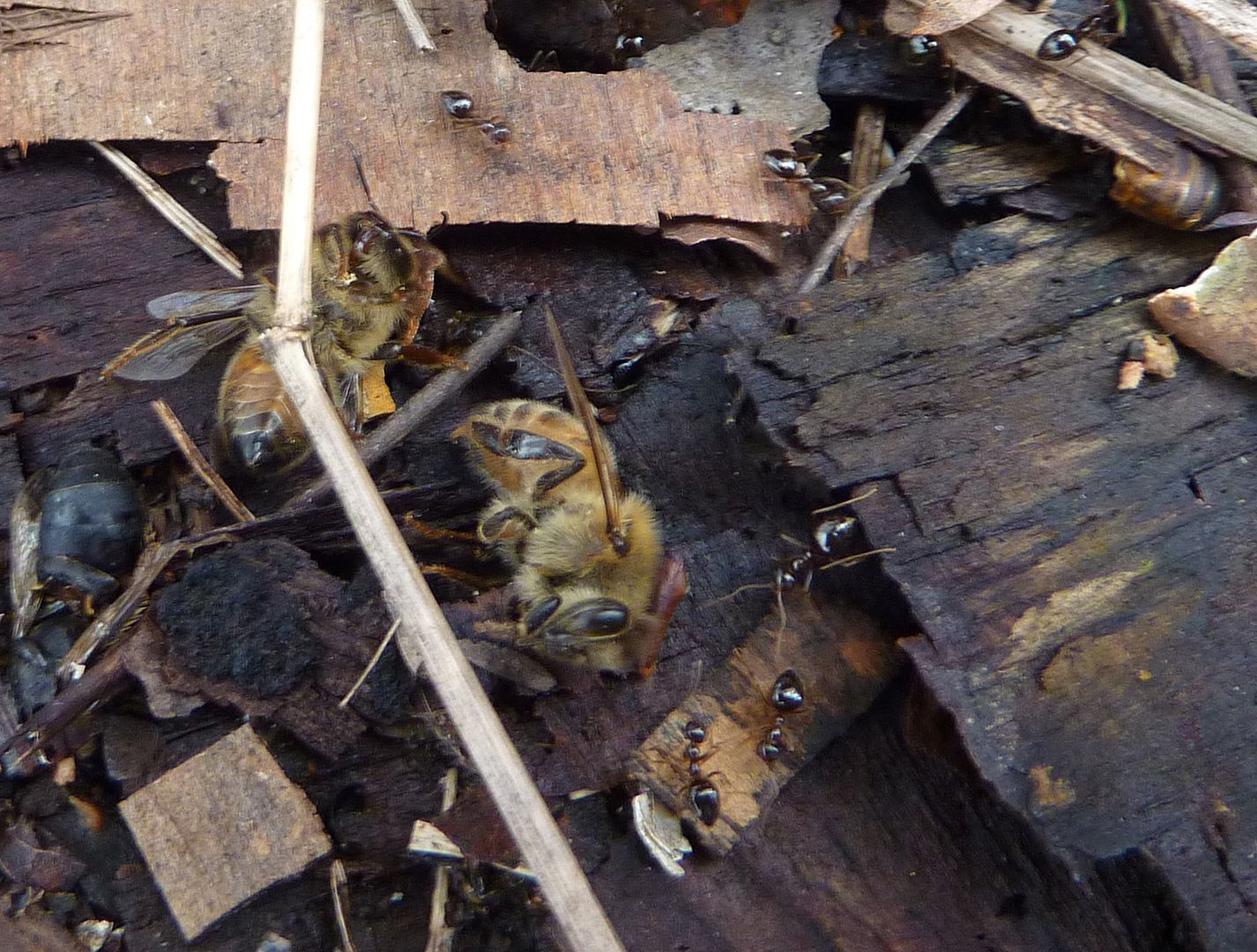
Below the entrance to another hive the ants were inspecting dead bees the hive was tossing out. A lot of worker bees die over the year and it's natural to remove them from the hive where they're cleaned up by an assortment of ants each spring.
I'm happy to say both my hives are alive and collecting pollen, probably from the maple trees that have just started blooming.
Labels:
Ants,
Bees,
Honey Bees,
Prenolepis imparis,
Video
Thursday, October 28, 2010
Aphids, Grass, and Ants
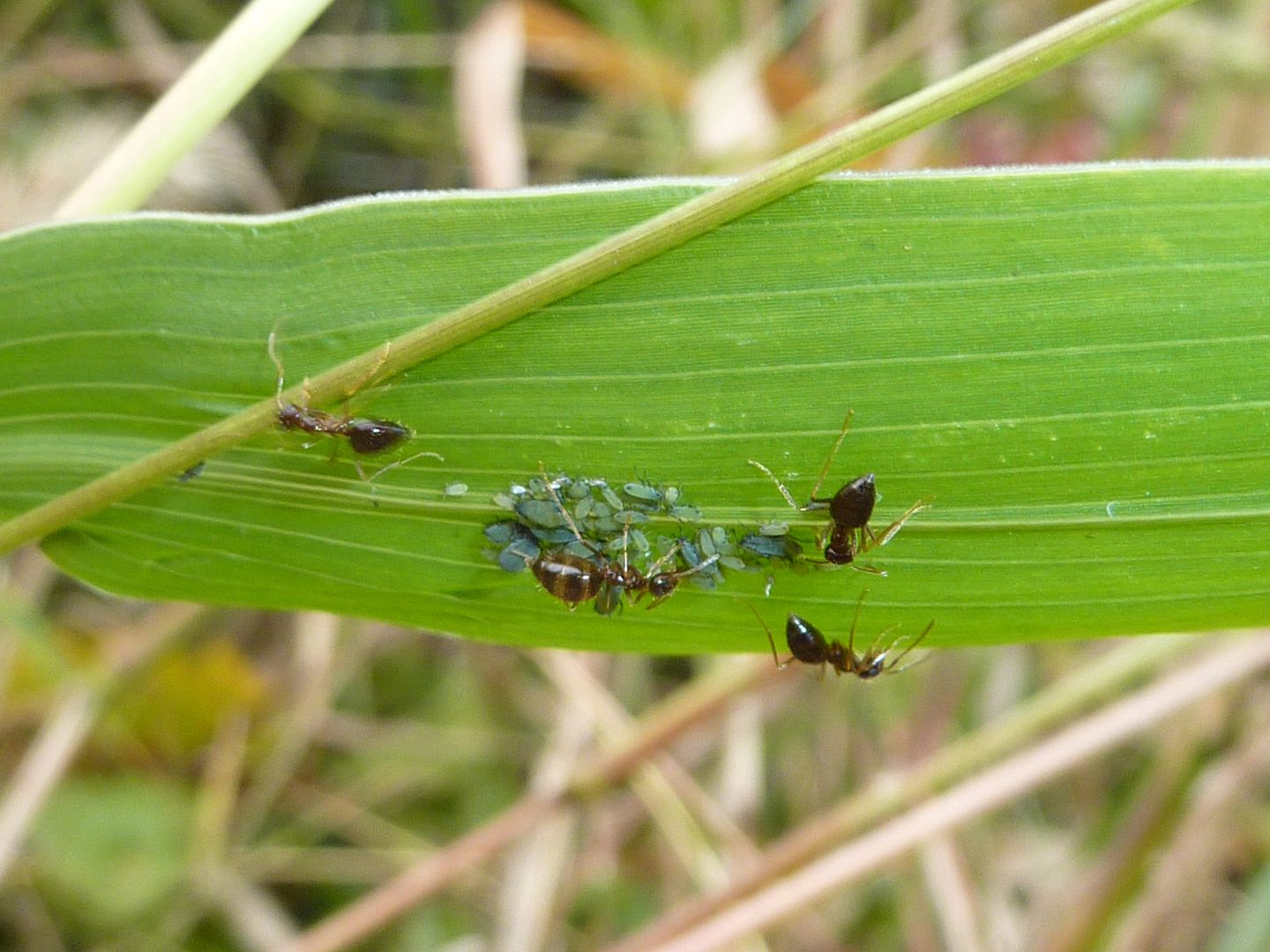
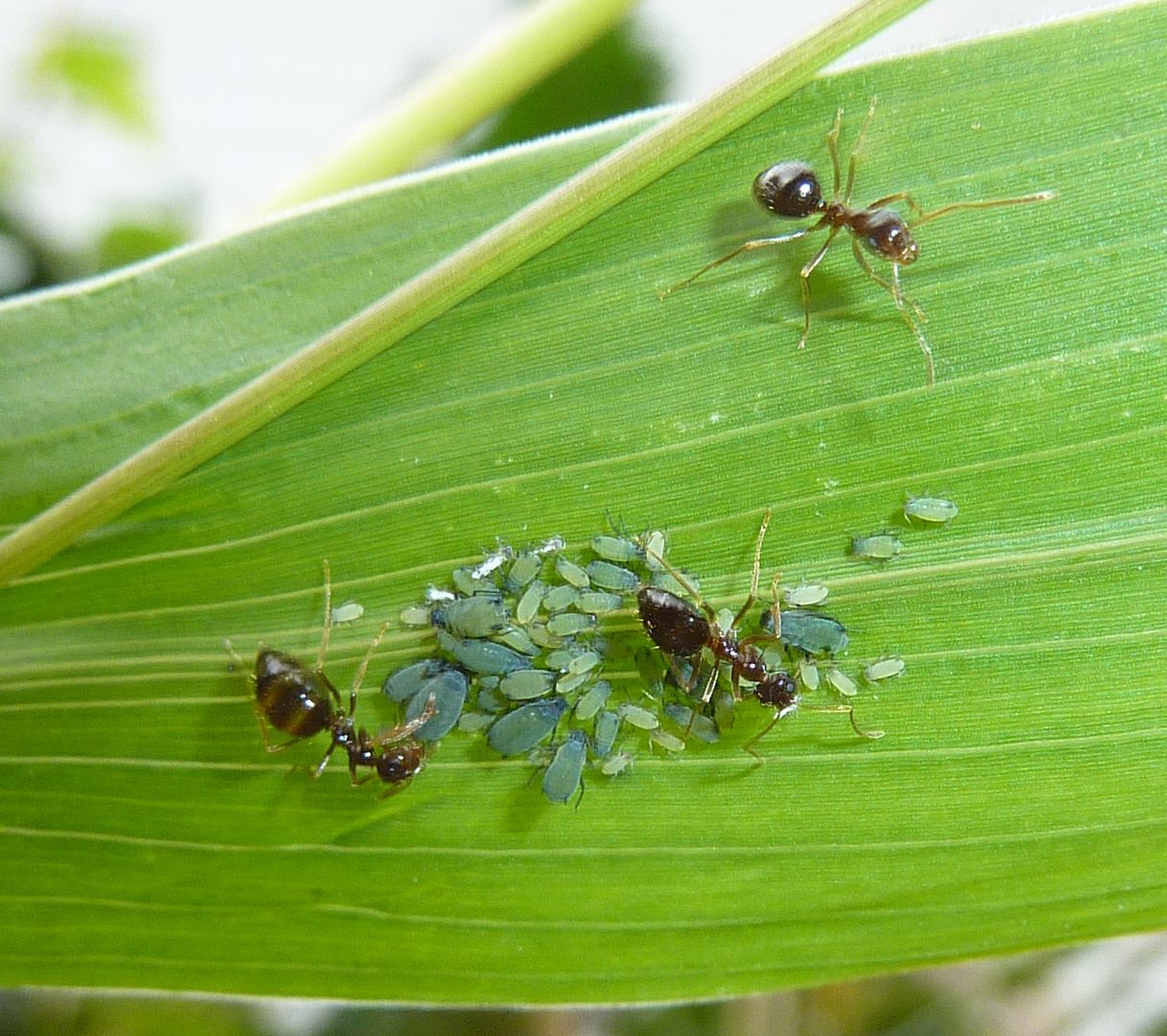
While cleaning up the yard some I discovered this patch of aphids under a blade of grass. There was a steady line of Prenolepis imparis, Winter Ants, visiting them. As temperatures drop down this will become one of the few species of ant out and about.
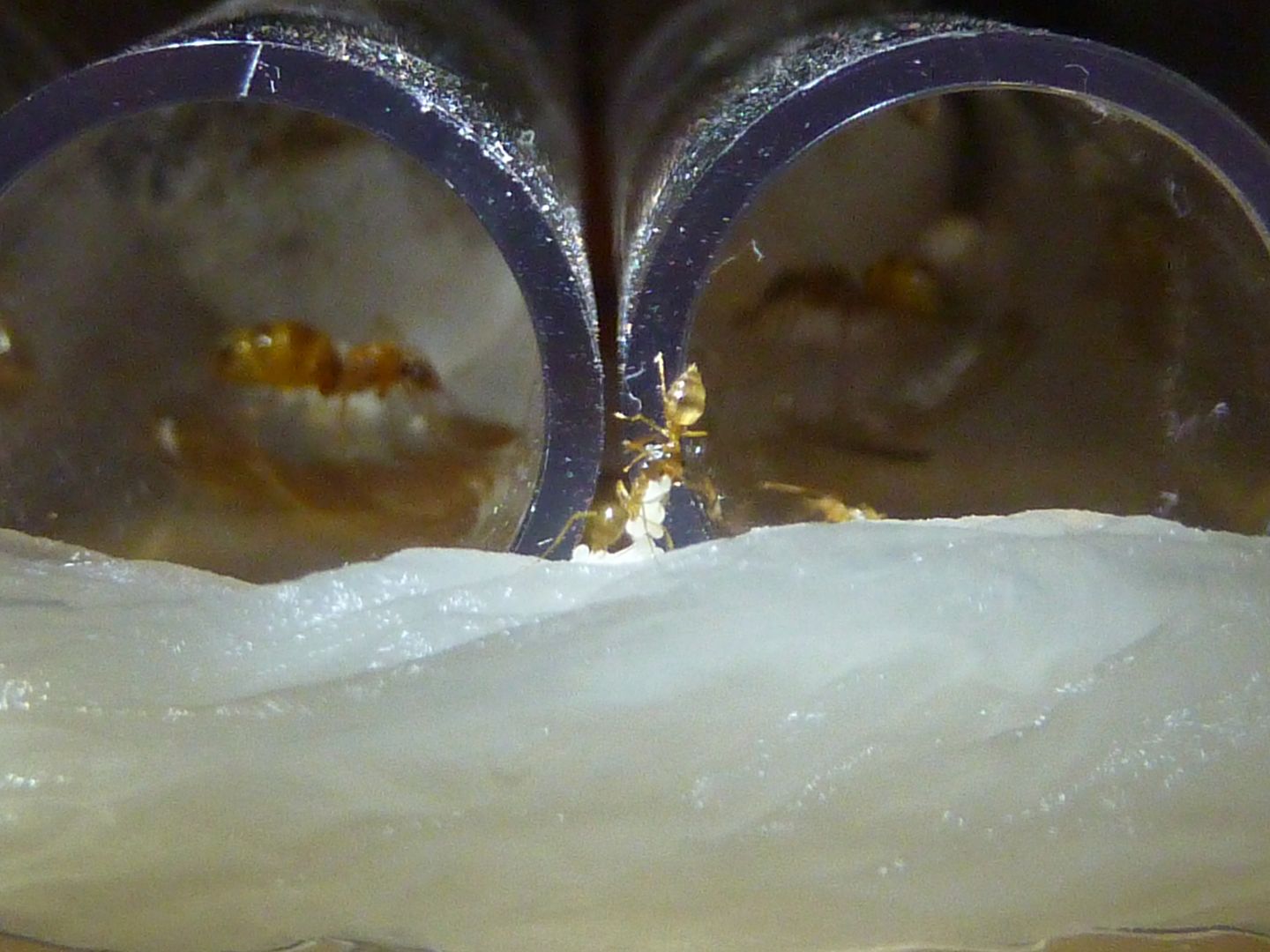
This is the first time I've seen aphids on grass.
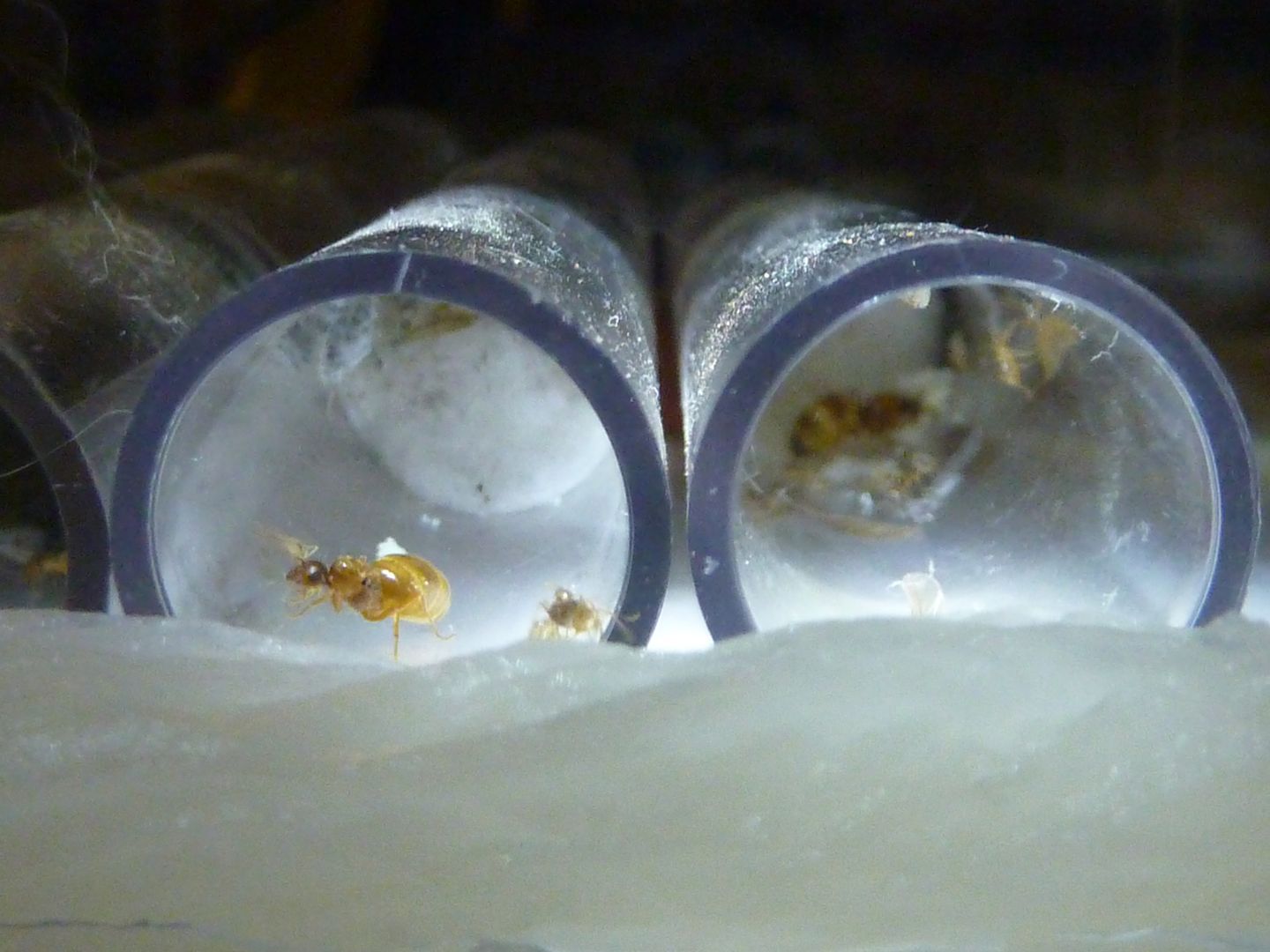
They have a neat blue-green color to them.
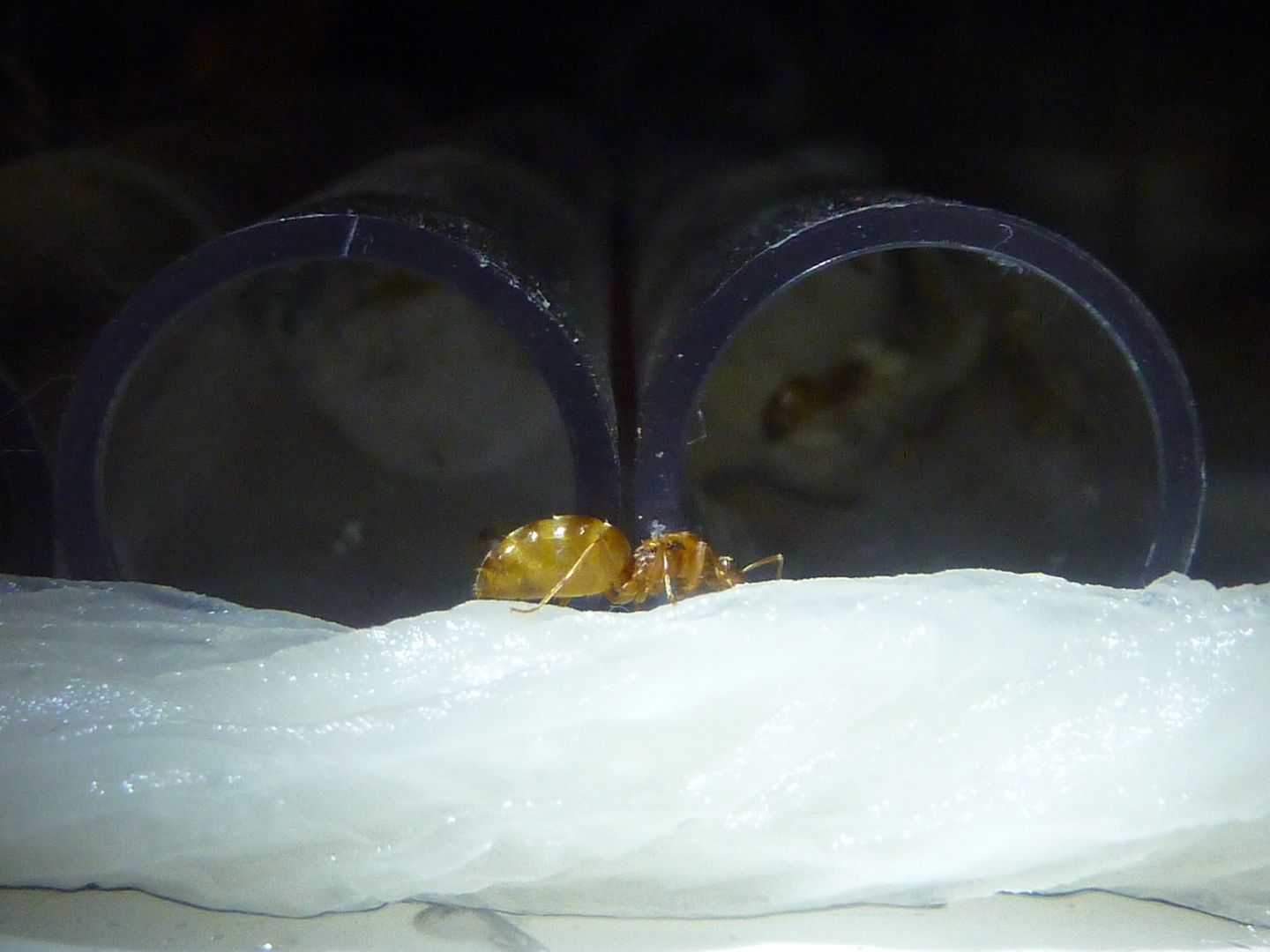
This is the first time I've seen aphids on grass.
They have a neat blue-green color to them.
Labels:
Ants,
Aphids,
Grass,
Prenolepis imparis
Saturday, November 21, 2009
Prenolepis imparis still working

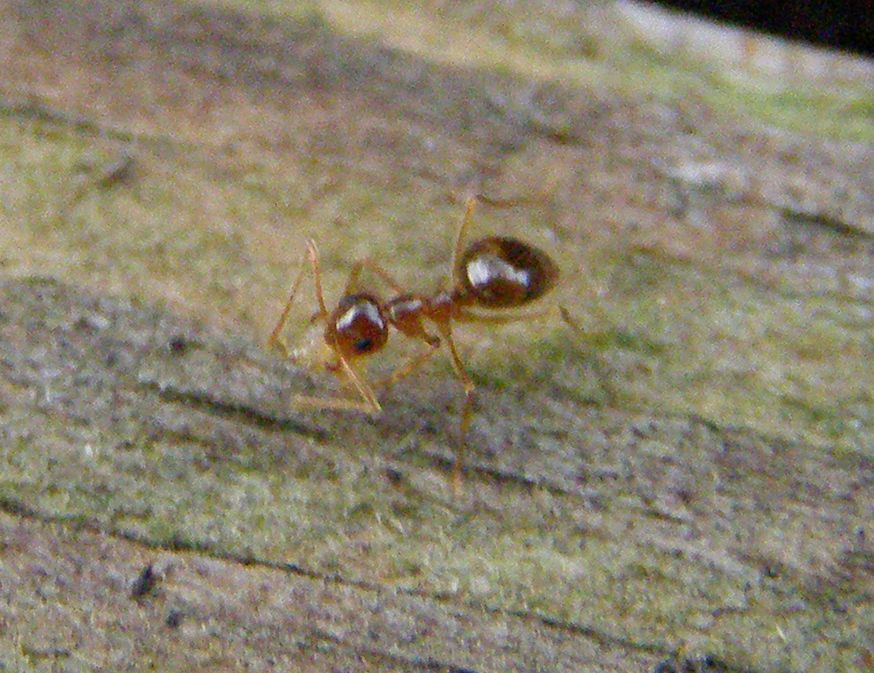
Prenolepis imparis workers (The Winter Ant) foraging along a shady flower bed. The one is carrying something I can't identify though.

It's either sap from the nearby pine tree or elaiosome from the violet seeds growing in the garden bed.
Whatever the case, P. imparis is just about the only ant we're going to see on cool days. They can forage in temperatures just above freezing out which is more then a lot of other species can say.
This ant is so recognizable that I was able to make it out in The Green House's latest episode on Beekeeping. Knowing that this is one of those ants small enough and in love with sugar enough that they regularly feed on beehive feeders helped with the ID too. You can occasionally make the ants out walking along the side of his hive. It's also a neat video, enjoy!
Subscribe to:
Posts (Atom)