Showing posts with label News. Show all posts

Sunday, October 11, 2015

Native Plant Reserach

There are a couple of studies being done in the native plant world that have peaked my interest.

Native Cultivars vs. Native True Species
Kim Eierman interviews Doug Tallamy in his project to see if Native Cultivars hold up to their True Species counterparts. Basically they plant a cultivar in the middle of a ring of the true species specimens. This way it would unlikely for the insects to miss their host unless they were actively avoiding the cultivar.

Overall I don't think this will show any surprising results. Cultivars are often just clones of a particular species with the desirable traits. There may be one or two cases where one or two insects have lost a taste for a particular cultivar but I doubt there will be anything shocking to report from this.


Mt. Cuba Center tests out Reforestation Methods

Delaware Online is reporting the Mt. Cuba Center is starting a 20 year long study to compare different reforestation methods.
Mt. Cuba Center staff designed each test plot with a different reforestation technique, including two plots which serve as controls for the experiment: one left to natural forces to reforest itself, called natural succession, and one planted with a commonly used technique, orchard-style planting where trees are placed 10 feet away from each other and the grass between them is mown regularly.

Other plots have different combinations of planting densities and planting types: an orchard-style planting with no mowing between trees; densely planted canopy trees; orchard-style canopy trees and understory trees; and densely planted canopy trees and understory trees.
It's an interesting question for sure, and I really hope their study goes without any acts of god. The article doesn't mention them using any evergreens or species that jump out at me as being fire resistant for example. Also wind storms and hurricanes seem to be becoming more common for the area, so here's hoping nothing like that happens. For a study that's going to take 20 years to complete it would be an awful shame if a Deer screwed it up.

I wonder with the plots that are not being mowed, whether they're planting into lawn or something more wild such as a meadow, and whether or not it would be beneficial to also have a plot with a meadow seed mix thrown down before hand to see if the tall grasses and wildflowers does anything to help or hinder the trees and shrubs. 

Thursday, February 6, 2014

Monarch Butterfly Updates

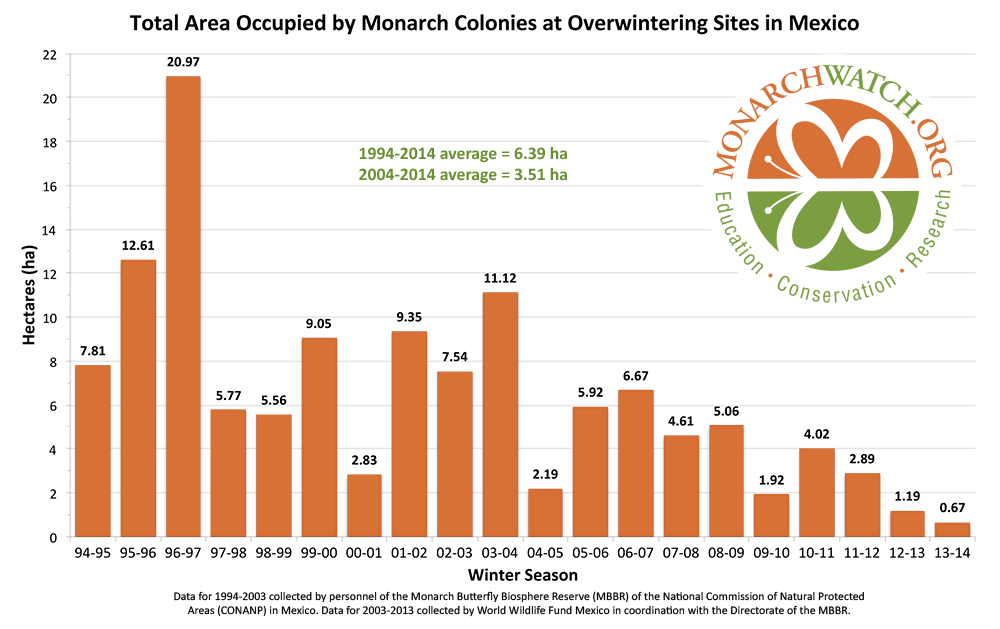
Alright so Monarch numbers are in for the year thanks to the folks over at Monarch Watch.... and they are dreadful looking.

It's uncommon to see winged insects fall off a cliff, but there you have it.

So with this news I've been seeing a lot of "How You Can Help The Monarch Butterfly" lists out there. One of which is from Journey North which I'd like to run through right now.


#1. Plant Native Milkweed. This goes without saying. Although, the jury is still out on planting Tropical Milkweed which some say causes the migrating females to lay eggs when they should be heading to Mexico. That being said I sure see a lot of conservationists including the folks at Monarch Watch growing that species. It's a fast growing annul that's good for the spring and summer, but come August they should probably be torn down. 

#2 Provide Nectar Plants. I highly recommend Meadow Blazingstar, Liatris ligulistylis, and New England Asters, Symphyotrichum novae-angliae and generally any of the late flowering Goldenrod species, Solidago. On the nonnative front I've seen them on Zinnias and Mexican Sunflowers. Butterfly Bush is also a hotspot but should not be grown near wetland ares! They can shade out whole communities of carnivorous plants and orchids when they escape into the wild.

#3 Avoid Pesticides.... Duh... Though to this point, a lot of people are confused on the issue of neonicotinoids. I personally believe they're safer because farmers don't have to spray every week and/or after it rains. That being said, it has been found that the pesticide does end up in the nectar and pollen more than previously thought. However, I don't think it's being used on anything that the Monarchs are feeding from, nor should it. Corn and Soy aren't exactly on top of that list. The real issue here is the fact that you can buy these chemicals at just about any hardware store. This class of pesticides is far too powerful to trust the general public and landscaping companies with. Continued in #5 below.

#4 Report your Monarch Observations. There are a number of apps and social groups you can do this with. Journey North has one that covers more than just Monarchs.

#5 Limit Mowing. There is a 1 to 1 ratio with number of species vs. habitat. So when you eliminate dead zones such as lawns you increase the carrying capacity of the number of species. Milkweed though is an exception because it's host more than just Monarch Butterflies. Milkweed Beetles, two types of true bugs, Oleander aphids, and if you're farther south in the US you get the Queen and Soldier Butterfly too. Not to mention they're rich with nectar.

Going back to elaborate the point in #3, A big problem with carrying capacity is the use of monoculture whether it's grass in your lawn, or corn in your field. The folks at Monarch Watch keep talking about Round-Up Ready crops that eliminate common milkweed from fields... but I think the bigger issue is that they've greatly expanded the fields! Gone are the hedgerows that used to separate the property lines of family farms. Even if you were to plant nothing but milkweed eventually the parasites and diseases would eliminate most of the species the rely on that plant. Diverse communities of crops and flowering plants are best. There should be emphasis on native plants where applicable, though of course food crops don't have to be native so long as they're not invasive.

But more to the point of just Not Mowing in General. Uncut lawns look awful unless they're uniformly planted with particular types of grasses and wildflowers, which your average lawn does not have. Rather than not mow, consider installing a meadow, or planting a garden. Even if you are using the store bought perennials from Asia you can buy at any nursery, you're still providing more food in the way of pollen and nectar and potentially seeds and fruit for the environment. Native plants are always best because they're 40 times more likely to host the 11,000 plus species of Lepidoptera (moths and butterflies) we have in North America.

#6 Avoid Pesticides... again. They list this twice but on a community basis now. Lots of landscaping companies will use a generic "weed & feed" and other chemicals that might not be necessary.

#7 Support Beneficial Farming Practices. As I said above, diversity is key. I'm not a huge fan of "organic" but more power to you if you do. A lot of crops, even when planted in diverse fields still get pests, and a lot of invasive plants and insects simply can not be controlled without chemicals. 

#8 Build Community Support. Get the neighbors involved... or start a blog like I did. I'm a member of the New Jersey Native Plant Society and I'm a strong advocator of pretty much everything the Mt. Cuba Center does. Chances are your state has a native plant society of its own, or space in a public library that's just itching for you to start one.

#9 Contribute to Conservation Efforts. This is self explanatory.
Monday, November 4, 2013

Phoenix dactylifera Back From Extinction

Wow 2,000 year old seeds still viable.
Extinct tree grows anew from ancient jar of seeds unearthed by archaeologists.
Something for the religious minded to read up on. Apparently the Roman Empire tried destroying this plant before they'd accepted Christianity as the one true religion of the empire. 

This is actually a cultivar of the true species which still exists today. But the real headline here is that the seeds are still viable after 2,000 years! This reminds me of the school down in Texas where a professor burred seeds in jars with instructions to dig them up at certain intervals. The findings thus far show that seeds to many plants can still be viable 50 or even 200 years later but I'd never heard of anything 2,000 years old before. Neat.


Saturday, April 27, 2013

Going to Mt. Cuba Tomorrow!

Tomorrow is suppose to be a beautiful day, which makes going to the Mt. Cuba Center's 9th Annual Wildflower Celebration all the better. While it's not written anywhere, they usually give the first ~500 people a free native plant for attending. And they're doing the Raptor Bird demonstration again this year too.

There's also a native plant sale just down the street the same day. From previous years I know there will be signs all over to lead you to the right direction.

I'm going to try and focus on plants that I don't have, or combinations that I think look pretty. A fair amount of the photos I used for my book "Native Plants for Honeybees" were taken there, and I used them with their permission of course.


Thursday, April 25, 2013

Keeping Up With The Conversation

I'm a regular reader of the Native Plant & Wildlife Gardens Blog and was delighted that Doug Tallamy did a guest post there recently. But he's responding to this article over at Transatlantic Gardener which was a neat read in it's own right, especially down in the comments.

So second paragraph:
She grew well over 400 different plant species - garden plants and weeds, natives and non-natives - in her garden (below, click to enlarge) which measures just 741square meters (8000 square feet). And she counted 23 species of butterflies, 375 species of moths, 94 species of hoverflies, 121 species of bees and wasps, 305 species of bugs, sawflies, lacewings and related creatures; 21 species of beetles, 122 species of other insects including two ants – all in her suburban garden.
Umm... if you're only finding 2 species of ants then you either didn't care about ants in your study or you're doing something wrong. Though I don't think it's worth me getting into here, I've even spoken with Doug Tallamy himself as to why ants are the most abundant insects one earth and yet he only mentions them in "Bringing Nature Home" once and it's more in referent to aphids. Ants are more dependent on soil type and resources available than any special relationship with plants native or non, fair enough. But to only find two species is kind of alarming in my mind.

So in the next few paragraphs Dr. Owen looked into what all the moths were eating and (either her or the blogger) found they favored nonnative plants, but I wonder exactly what her definition of native was. First and foremost, let me explain that Lepidoptera (and insects in general) don't follow the boundaries or dotted lines drawn on maps. The Black Swallowtail is native to the US and Canada, and it's native host plant is Golden Alexander, Zizia aurea. However it's only restricted to eating plants in the Carrot Family, so when Parsley, Fennel, Queen Anna's Lace, Hemlock and the others were imported, suddenly the Black Swallowtail found the abundance of all these nonnative host plant beneficial and has since spread its range some.

In reading through the comments on that post it's clear that almost none of them understand the argument at all. Bamboo is beneficial becuase lady bugs over winter in it??? But then a few people come in and say the same thought that I had. Is Dr. Owen (or the blogger) also counting the use of nectar plants and host plants? Because you can't really do that and compare it to the work of Doug Tallamy. Host plants, native or non, are the plants the butterflies and moths look for to lay their eggs on and thus generate more butterflies and moths. Whereas nectar plants are useless kind of useless in this study; you can get the same results by spilling a soda or enlarging the holes in your hummingbird feeder. 

Nectar is also a temporary resource, where as the foliage of the plant tends to be around for several more month of the year regardless of what plant we're talking about.

Going back to the Native Plant & Wildlife Gardens Blog Doug Tallamy even points this out (in so many words).
She found that 46 species of moths fed on 40 native plants in the garden, while 75 alien plants provided food for 38 species of moth.  That is, if she had planted a garden of only the 40 native plants, she would have supported 46 species of moths. If she had planted only aliens, she would have supported 38 species of moths.
So it takes almost twice the number of alien plants to feed less than half the same number of moths. I swear sometimes it feels like Doug Tallamy is the only one able to do math.
Dr Owens found that non-native species were better as food plants for moth larvae than native species. Moth larvae used 27% of the native species in the garden as food plants, and 35% of the alien plants. And 46 species of moth fed on 40 native plants in the garden, while 75 alien plants provided food for 38 species of moth.
I read this paragraph and didn't pick up that the numbers didn't make any sense. The second sentance doesn't support the last sentance. And it's a coin toss what he means by Food Plants, and Fed On.

I live in North America and since I've been gardening with native plants, I'm seeing a lot more Lepidoptera species diversity, and more caterpillars overall.


Friday, April 19, 2013

Prairie Nursery

Prairie Nursery is donating 5% on the on select items to the Xerces Society in celebration of Earth Day next week, April 22. As well as 5% of milkweed purchases to Monarch Watch.


Wednesday, April 17, 2013

What are Bees?

Un-bee-lievable: One in five kids has never seen a bee


‘I am shocked by the number of children who have never seen a wild bee,’ said Adopt-a-Hive founder Tony Gray....

 ... It’s not just kids in the dark either, with the poll of 2,000 parents showing around half of respondents did not know bees helped to pollinate crops, while around 20 per cent said summer would be better if there were no bees around.


Yikes! Looks like someone needs to sit down with these people and tell them about the birds and the bees, instead of "the birds and the bees."

Thursday, August 23, 2012

Confusing News Articles report 3,000,000 Bees Removed from Driveway in Queens

There's a news article going around today about 45 honeybee hives in one man's driveway having to be removed. None of them seem to seem to say clearly enough as to why, but BEES!!!
 
New York Post
Yahoo
CBS New York

I gather that he's selling his house, maybe? And the real estate agent freaked out, I think? And this man helped with the removal of his hives... where he might get fined an outrageous amount of money. 

The Tone of the Article
Ewww these bees are awful! OMG there's 45 hives being kept like Dogs! Neighbors complained about the constant buzzing and being attacked by "swarms" of bees. 

But...

This man thought of them like his faithful companions. Imagine 45 dogs living in a 20' by 20' area. For just pennies a day you too can donate to make sure this man's bee yard doesn't look like a shanty town in Rwanda.  

The articles read to touch on both stories here and I don't understand. The Dog analogy does not work for either case. Maybe these people should visit a bee yard sometime. I mean they might be spaced out a bit more than 20' by 20' but we might as well compare humans on a farm vs. in the city. 

How Many Hives?
45? Where? I'm looking at the pictures and I count and with estimating I count about 23. Some of those are nucs too, that is they're 5 frame boxes that make up the whole hive, instead of the traditional 10 frame boxes which one can continue to put boxes on top of. Maybe they just counted the boxes? 

The bottom line is the headline is all you needed to read with any of these articles.


Saturday, February 4, 2012

Up Coming Philadelphia International Flower Show

Once again we're getting close to the Philadelphia International Flower Show, the largest indoor garden show of it's kind. Last year was a complete bore. The theme was "Spring Time in Paris" which basically meant metal lawn furniture sitting among bulbs and rhododendrons for god knows why. Lavender? Herbs? Grape Vines? Poppies? No sir, not in the Paris they're talking about!

Last year's show was a complete insult. In years past I'd walk in through the doors and get bombarded by the fragrance of pollen. The air had a strange dampness to it. This feeling just wasn't there that year.

There weren't any crazy plants there either. The first year we went the theme was Moss Gardens of Ireland, or something like that, and they had common every day snap dragons with flower stalks 5' tall! These are those same snap dragons you can buy in a flat at any garden center. I have never seen them so big anywhere else before in my life! Another year they had ferns from Australia which were 8' tall! The leaves cam up to form arch ways. There were carnivorous plants from around the glob being used in landscapes like wildflowers. There were orchids (the common type you see in hardware garden center) of assorted color. Virtually everything was a hybrid or cultivar, or being used in a creative way not just in gardens, but as living walls, and as living pieces of art, with varying functionality... All "Spring Time in Paris," had was a Mary-go-round no one was allowed to ride. And that brings us to this year's theme.

Hawaii: The Next Wave

Yes beautiful Hawaii, a land with less than 5% of it's native ecosystem in tact thanks to loose importation laws and active volcanoes. If I see something that's NOT invasive at this show I'm going to be very upset.

Normally I complain about the lack of native plants and over use of bulbs and rhododendrons at these things but this year seems like a way for them to get out of the norm. This is the year for them to go nuts with water features, bold colors, and expensive tropical landscaping that will freeze to death planted anywhere above the zone 8.

Friday, February 3, 2012

Dr. Art Evens on Cocoons

Egg Case in Winter

He talks about Polyphemus Moth cocoons and Praying Mantis Eggs. He's also on Facebook.

Without doing to much exploring of the yard this year I've already managed to find two egg cases of Praying Mantises. One year I found a hatched Polypheumus Cocoon on the ground, so I know they're out there. I know other giant silk moths certainly make cocoons such as the Cecropia silkmoth, Hyalophora cecropia.

Other species such as the Imperial Moth, Eacles imperialis, burrow in the ground before forming a chrysalis. I had a friend call me over the summer because she kept finding these "things" emerging from the ground. When they first emerge their wings are as limp as a silk swatch used to clean eye glasses, so they don't look much like a moth at all. Thankfully she sent me some pictures and I told her not to kill them. They turn into something quite pretty.

So the cocoons and eggs are out there. Time to start looking. Should you find a giant silk moth cocoon, perhaps a sheltered cage placed just outside the window or inside a shed, or unheated garage would work best. Praying mantis eggs are fairly common along forest edges and among tall grasses in sunny locations. 

Friday, January 27, 2012

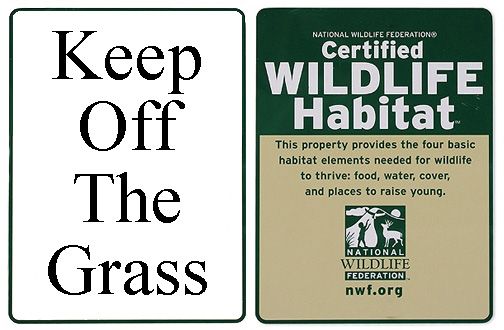
Keep Off the Certified Wildlife Habitat

How am I supposed to do both?

Okay I guess you could use stepping stones to get around but a lot of the chemicals used to keep grass looking golf course green year round aren't very environmentally friendly. Which is why it comes as something of a shock to find out the National Wildlife Federation has partnered with Scott/Monsanto.

For whatever reason most of the Wildlife Gardening community seems to be outraged. Normally these two signs above would be featured on two different lawns. Typically both are used to explain the madness in landscaping aesthetic. The Wildlife Habitat sign is ideal for explaining why there's a tall-grass meadow in the front yard, and the Keep Off Grass sign is ideal for explaining why the home owner's water bill is so high. Now we can have both!

To be honest though, I think some of the best landscapes are when these two elements work best together. Lawns look nice, they typically hold up to foot traffic, we're getting Eco friendly no mow varieties now, and the green tends to look better than bare ground. Prairies and small Meadow plantings are ideal garden plants whether they're in a wild densely planted patch, or each plant is spread out to have its own individual space around it. The "sins" of applying chemicals, mowing, and over watering lawns are on the home owner, not the Scott/Monsanto.

To talk about the National Wildlife Federation now, I've never been a huge fan of them. Just looking through their website and catalogs clearly their ideal customer is a female over the age of 35, who likes to wear nature sweaters, collects plush toys, and probably shops at the Hallmark once a month. They could really stand to widen their audience a little with the products they sell. Does anyone honestly want to Adopt a Moose or buy a Horseshoe Crab Plush Toy?

There was even a TV show at one point where they'd landscape a home to make it a Certified Wildlife Habitat. My memory of the show was them doing the bare minimum to satisfy their criteria. I get they were trying to show how easy it is, but at the same time I got the feeling they were just trying to sell signs. Planting butterfly weed, including a bird's bath, and making a pile of stones is hardly saving anything. In the episode they devoted around 5 minutes about the 1 butterfly weed plant they put in the garden and kept emphasizing "ALL THOSE BUTTERFLIES THAT ARE GOING TO GO NUTS FOR THIS!" which comes off being really stupid, and even more so that I can't recall there being any butterflies in the episode. Do these people know what they're doing at all? Imagen if the show was all like "Move That Bus!" and there was just one milkweed plant there. I feel like there was more effort put into hanging the Certified Wildlife Habitat sign than actually building the habitat itself. Canceling this show was the right thing to do becuase it sure wasn't doing them any favors.

Saturday, November 12, 2011

Illegal Ant Smuggling?

Yesterday the news started circulating about Gerhard Kalytta getting caught for "Ant Smuggling." The headlines read German fined for Aussie smuggling ants from Perth.


On September 7th Kalytta tried to smuggle some 3000 ants of 50 different species in about 153 plastic containers out of Australia. While the news article points out these included Bulldog ants which have a violently painful, sometimes lethal, sting, I can't help but wonder if this was the real issue.

About a year ago it seems they started offering plants on their website. "Now Offering Plants" dated August 22, 2010. That's more than a year old but has now became part of their regular inventory.

Native plants such as lichen, native moss, hornworts, liverworts and an orchid species listed under the Convention on International Trade in Endangered Species of Wild Fauna and Flora (CITES) were also seized.
That orchid to me is the red flag of the story. And the fact he only got a $3,000 fine when the maximum is 10 years in jail and or a fine of $110,000, just screams how lucky he is.  It's safe to say he got off easy.

It is really easy to just ship ants through the mail. The only downside is if they pass through an X-Ray it will cause spontaneous abortion. In other words queen ants who fertile and able to produce female workers lose this ability! They can only produce males. The other issue is constant shaking will cause water to leak through materials. Typically ants need to be kept in high humidity, which means they need a water basin. This works okay locally but I don't trust it. If they live that close, I'd rather go to their house or meet them halfway. But if we live that close, then why don't we just go anting and help each other find our own?
As you may have guessed, I've shipped ants before. I've never done it for money, and I don't do it anymore. I've found the kind of person who needs ants that badly that they want you to send them a colony is an idiot. Plane and simple. Catching queen ants is easy, but takes time and patience and efforts to explore locations need to be made. The person (customer?) who wants to get (pay?) someone for a colony of ants has no patience and isn't willing to learn. On the few occasions that I've mailed colonies to friends the always report back how much they screwed up and the colony died. Maybe it's more a sign of how young or uncommon the hobby is.

International shipping typically takes 3 weeks for anything to arrive anywhere and that's a long time and a lot of stress to put on a colony. 

Sensitive plants can be a different issue and I don't know too much about their care, especially tropical species. When I've bought native bare root plants though they're typically wrapped in damp newspaper or medium, and tightly bound in a plastic bag. Three weeks worth of shipping would be murder on some species, especially tropical plants which are more sensitive about temperature.

Going back to our topic. I feel like "Ant Smuggling" just made a catchy headline. Granted he had 153 containers of them. I don't understand how someone shows up to an air port with that and doesn't expect someone to raise an eyebrow. In fact when I first read the story I assumed the ant containers were hidden among the plants, but then we read about the endangered species of orchid which would raise several eyebrows on it's own.

Assuming I'm wrong though and it was the ants initially that got this man fined, then that's just a sign of how rampant the ant keeping hobby has become.

Monday, April 4, 2011

I Apparently Hate Mexicans?

On April 2ed the New York Times released an article titled Mother Nature’s Melting Pot.

For whatever reason Hugh Raffles, the articles author, has taken the opinions of conservationists and spun them so they are in support of the governor of Arizona's No Mexicans agenda. There's so much wrong here and I wonder why it's even brought up as it's not even the focus of the article. Humans are all one species so his analogy doesn't make sense.  

I've been a native plant gardener and conservationist for a number of years now and I have yet to meet anyone who is 100% against nonnative anything. The genuine consensus is "We hate invasive species!" Not "we must only use species that are native to within 10 miles of our home." 

It’s true that some non-native species have brought with them expensive and well-publicized problems; zebra mussels, nutria and kudzu are prime examples. But even these notorious villains have ecological or economic benefits. Zebra mussels, for example, significantly improve water quality, which increases populations of small fish, invertebrates and seaweeds — and that, in turn, has helped expand the number of larger fish and birds.
Well who cares about more fish and birds? Our native mussels filter water as good as the best of them. And they're not growing prolifically in city plumbing system causing millions in repairs each year. I don't see anyone making Nutria skin coats anymore. Kudzu beneficial!? This man is an idiot! That fucking plant turns forests into topiary graveyards! I don't care how many sheep it feeds. The dam livestock isn't eating enough of it! We need to import Giraffes to get it off our trees and power lines!

Indeed, non-native plants and animals have transformed the American landscape in unmistakably positive ways. Honeybees were introduced from Europe in the 1600s, and new stocks from elsewhere in the world have landed at least eight times since. They succeeded in making themselves indispensable, economically and symbolically. In the process, they made us grateful that they arrived, stayed and found their place.
But the honeybee is a lucky exception. Today, a species’s immigration status often makes it a target for eradication, no matter its effect on the environment. Eucalyptus trees, charged with everything from suffocating birds with their resin to elevating fire risk with their peeling bark, are the targets of large-scale felling.
Honeybees are pollinating the fucking Kudzu!
Yet eucalyptuses are not only majestic trees popular with picnickers, they are one of the few sources of nectar available to northern Californian bees in winter and a vital destination for migrating monarch butterflies.
Monarchs on Eucalyptus trees!? How many Eucalyptus trees does California have? What about our native Asters, Goldenrod, Iron Weed, and late flowering Eupatoriums (boneset and joe pye weed)? What about what's native to California!? Yah know; the stuff that was growing there before humans ever arrived. How on earth did the Monarch butterfly ever take care of itself before the Eucalyptus tree was imported? Maybe if they didn't have to compete with the Honey Bee for nectar it wouldn't be a problem.

Or take ice plant, a much-vilified Old World succulent that spreads its thick, candy-colored carpet along the California coast. Concerned that it is crowding out native wildflowers, legions of environmental volunteers rip it from the sandy soil and pile it in slowly moldering heaps along the cliffs.
Yet ice plant, introduced to the West Coast at the beginning of the 20th century to stabilize railroad tracks, is an attractive plant that can also deter erosion of the sandstone bluffs on which it grows.
A creeping succulent to stabilize rail roads, what is this man smoking? How the hell does that work? Here in New Jersey we use rocks along our road sides and they seem to work great!

The rest of the article is crap. He's talking about nonnatives making habitat ... thanks to climate change killing off what used to be there. And how climate change has opened the range to some natives that have become pests. He makes a point or two about some natives no longer being suited to their environment but this is all due to climate change.

I don't understand the over all point of this article. Should we stop conservation efforts? Lower our standards on importation perhaps? Hell let's just legalize pot and opium while we're at it.

On and that picture they used for the article sucks. It's clearly a 6th grader's interpretation of Dr. Seuss and it only makes the article that much more confusing to read. Fuck him.

Friday, February 25, 2011

Justin Bieber's Hair = Money ... What?

Earlier this week on the Ellen Show, Justin Bieber was a guest and announced he was donating a lock of his hair to be auctioned off on E-Bay. 100% of the procedures go to fund a charity called "The Gentle Barn Foundation."

As of posting this the bids Here were up to $7,200.

Now I don't mean to criticize this, as I'm a fan of charity work. But, The Gentle Barn Foundation is self described as "Teaching people kindness and compassion to animals, each other and our planet," and their logo is a person feeding a cow by hand. So basically they're like a petting zoo. And I've found nothing on their website to suggest anything else.

Maybe they do work with special needs or something but I'm used to charities doing a little bit more than what this one does. Again that's not to say this is a bad thing, I'm just having trouble understanding how they're incapable of turning their own prophet. Do petting zoos turn a prophet?

"Our goal is to make 100,000 hugs possible within the next year," said Jay Weiner, president of The Gentle Barn. "We want everyone in our community to feel the healing effects of hugging a cow."

So ... Justin Bieber's hair is raising money for this organization to ... help people hug cows? or something ... What?

Wednesday, January 26, 2011

Co-Inventor of the Ant Farm, Milton Levine, Dies at 97

I've just come home to read about the tragic news. As reported by the Huffington Post, Milton Levine, Co-Inventor of the Uncle Milton Ant Farm has died at the age of 97. See Article Here.

There is also a video on him a friend located a few weeks ago, here. It's dated somewhat but a nice video. Everyone seems quirky, almost in disbelief that they'd made so much money off of ants.

I can't say that I'm personally sad that he's dead. Ant Farms are novelty items at best. The air holes allow any species that's 1mm - 4mm long to get out which are about a third of the ants in the US. Most Camponotus and some of the larger Formica queens can't fit in theim either. They dry out really easy, which might not be a problem for species in the south west but is certainly an issue everywhere else. The lids are awful, heaven help you if you drop one in, in their Giant Ant Farm. There is no way to get it out that doesn't involved disturbing the ants and potentially destroying their tunnels. The ants you're sent in the mail, while not dangerous, are Pogonomyrmex, Harvester Ants, which have a more painful sting that Solenopsis species, Fire Ants. To they're credit, at least they're industrious. The list of problems goes on. And yet I can honestly say if we never had Ant Farms I wouldn't be fascinated by ants like I am today.

Despite basically being a death trap, the ants don't seem to care. Regardless of the colony being sustainable or not they live out their lives. Society doesn't break down just because the queen isn't around. They go right ahead and do what they need to do. It's during this time that puts everyone in a sense of child-like wonder. Enough so that people have live web cams of their ant farms and short videos of their ants on youtube. I think the one featured below captures the magic best.


I think the greatest tragedy is that Milton Levine never tried to improve the ant farm design very much. Granted his original patten was a clear cigar holder full of dirt, glued to a plank of wood, the ant farm hasn't changed over the years. A few years ago they painted it Gold, and there are a few round ones but these fail to address problems I've already mentioned. Whenever I saw Milton Levine in interviews he always struck me as a "by the books" kind of business man. It if isn't broke don't fix it. The trouble though is that the ant farm was broken from the start and that is why it will never be more than a novelty item.