Yet again I spontaneously signed up for a class at the Mt. Cuba Center and drove to Delaware at the last minute. This time the class was on starting native plants from seed, a class I wanted to take and thankfully my schedule allowed.
In the past I have been able to get milkweed seeds to germinate simply by keeping them damp. I'd always wondered why though after about two months I'd find them already germinated, and poking out some shoots. Well this class answered my questions and more and I'd like to share what I learned.
Bare in mind, a three hour course is anything but comprehensive. It was very instructive and inspirational enough that I'd like to explore the topic more seriously. Until then, here's the basics of what I learned.
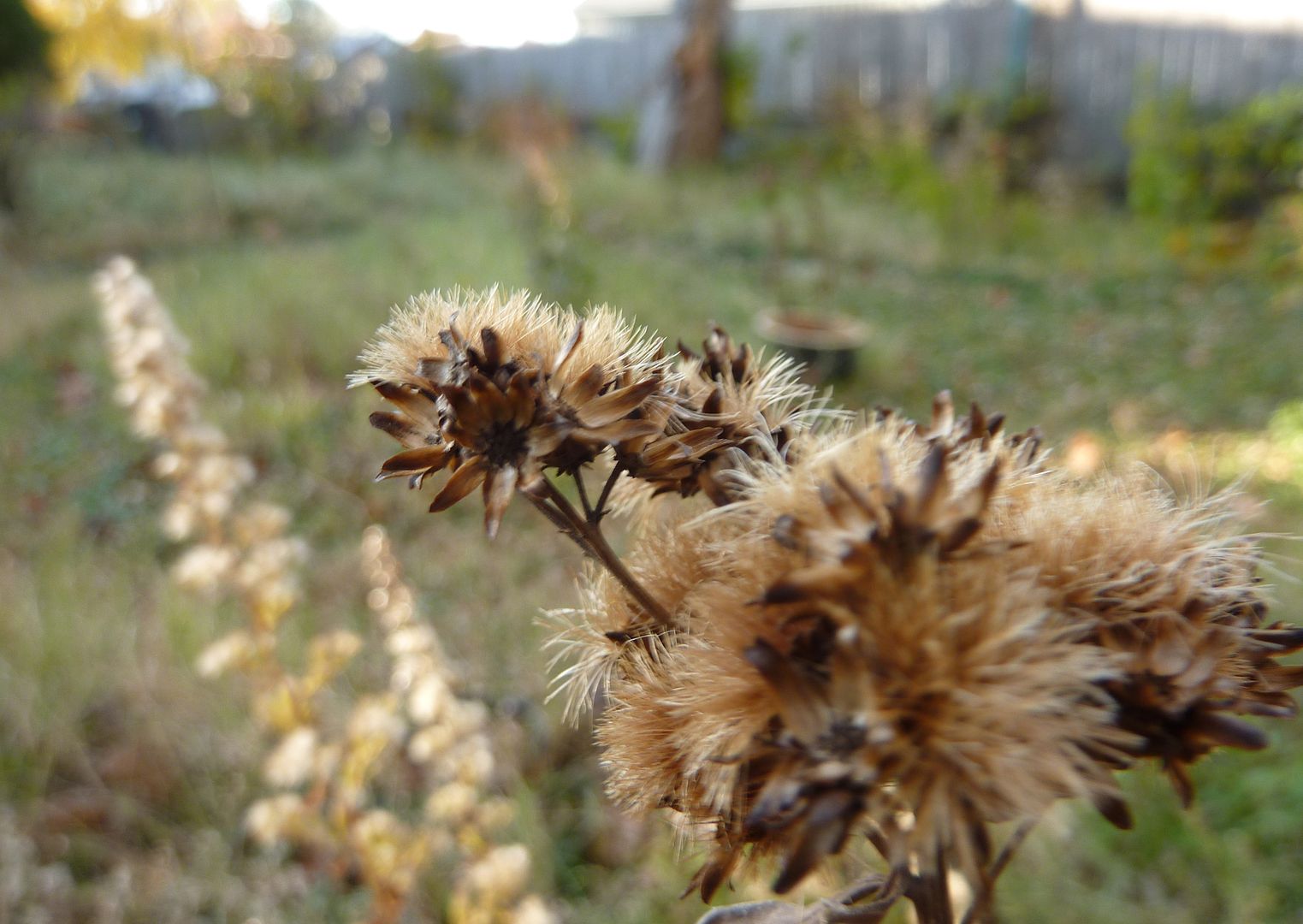
When to Collect
Collecting seeds should be done on a dry day. Seed heads can otherwise be mushy and plants that produce compartments full of seeds don't release them when it's wet. The water gets everywhere and collecting is so much easier when things are dry.
While collecting it's important to sort and label out in the field. Use paper or plastic bag and label everything. Plants that have tiny dots for seeds all look the same.
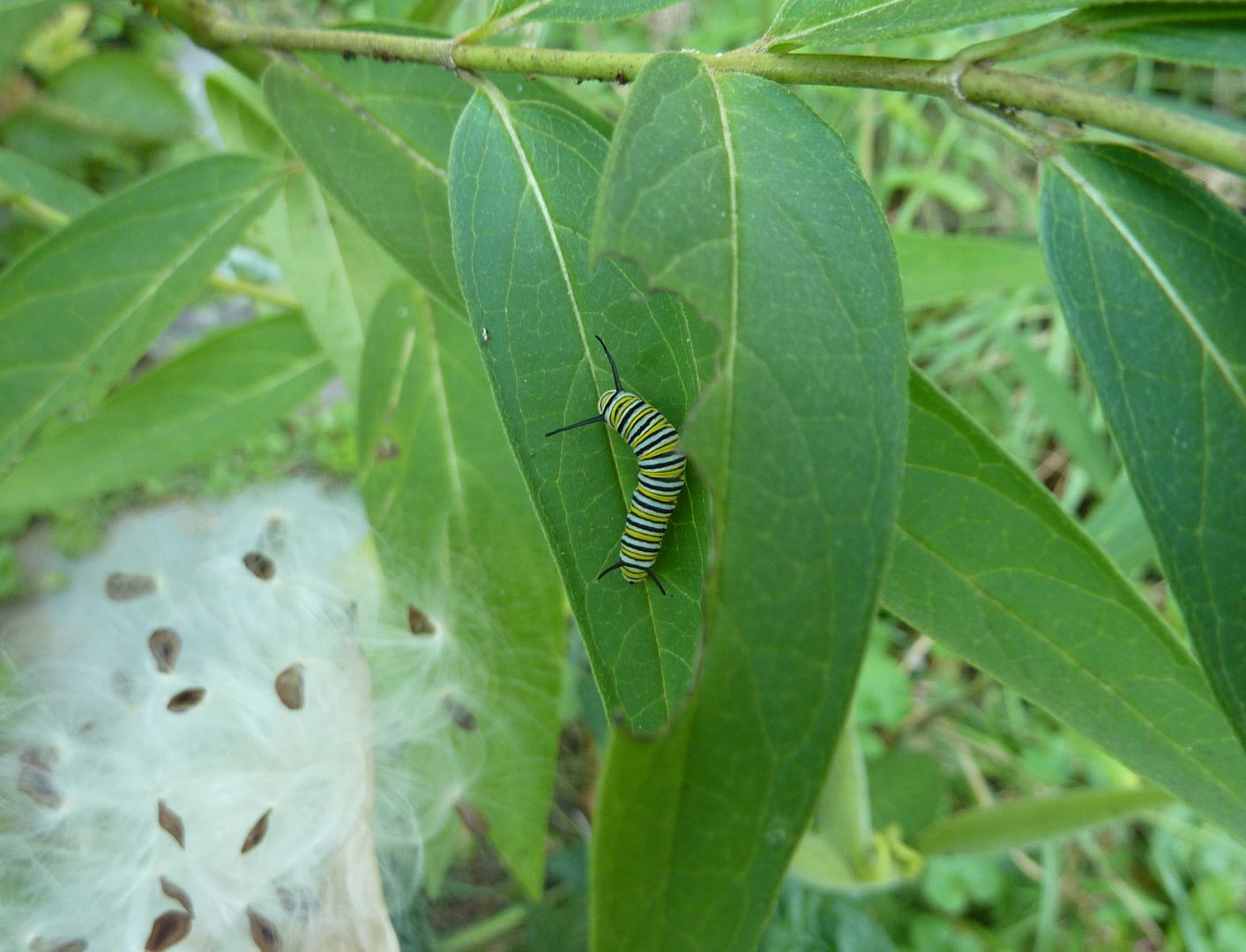
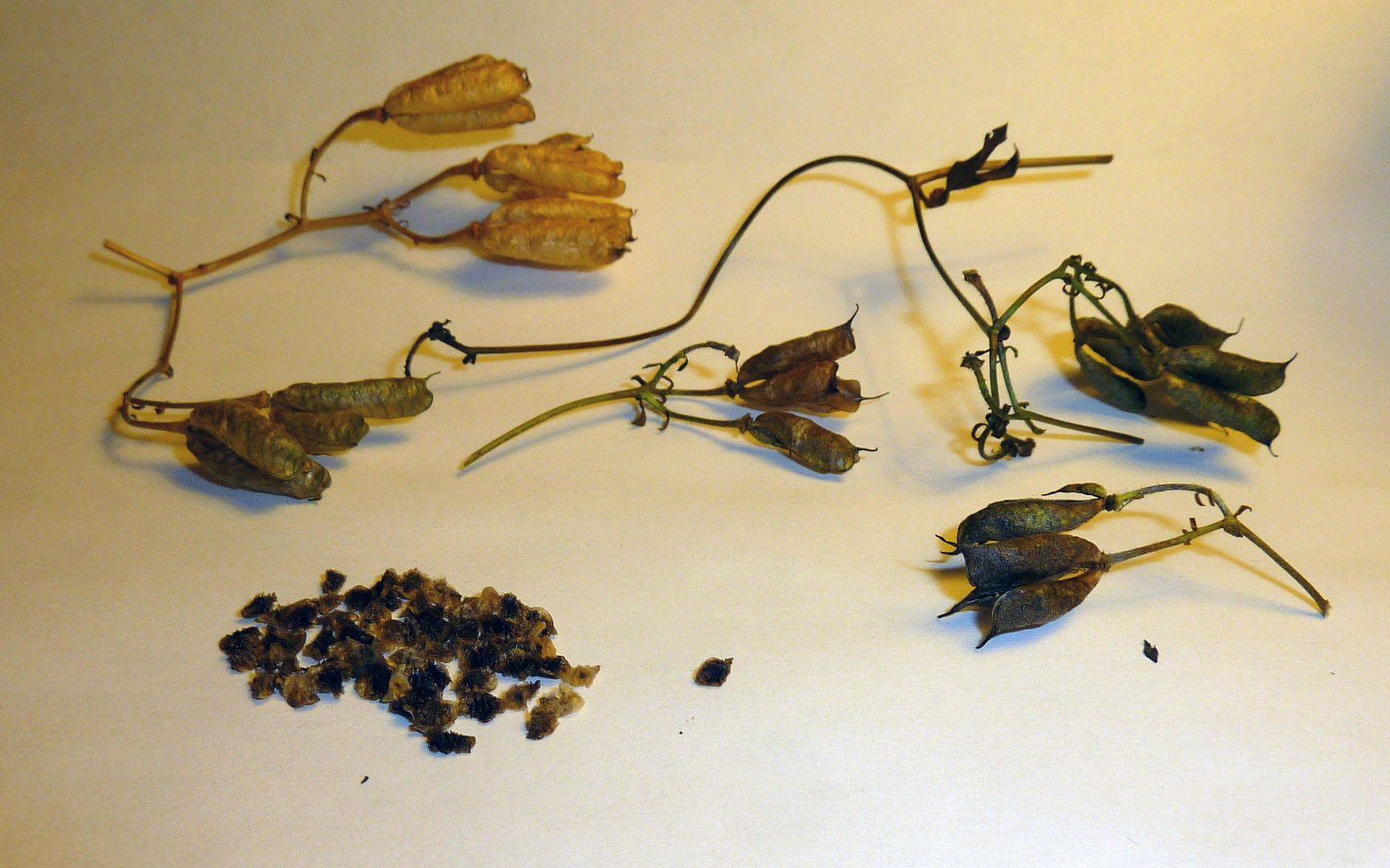
Seeds that are spread by the wind typically have fluff or down attached to them. Here you can see milkweed seeds in the lower left. There is no need to wait until they've all fluffed out to collect. If the pod has opened it's perfectly fine to pull them all out while they're neat and orderly. This also makes cleaning them easier. A fun fact about milkweed: their seeds will tolerate being burned, but this is not needed for germination. So even if they do puff out you can take a lighter to them in a controlled space and burn off the fluff.
Here we have Wild Monkshood, Aconitum uncinatum. The seed heads form hollow pods with the seeds hanging freely inside. Columbines, Rhododendrons, and many other plants produce seed pods like this. Collecting and sorting is a simple matter of shaking the seeds out.
By sifting seeds on sheets of paper and or shaking them over screens and filters they can eventually be separated by from the more annoying bits of debris.
How to Clean
There are "Dry Seeds" and there are "Wet Seeds." Dry seeds are seeds that have developed without any sort of exterior edible parts to them. I use the word edible loosely as many seeds are themselves edible. Generally Wet seeds differ from dry because they developed inside a fruit or otherwise have external food pockets attached to them such as elaiosome.
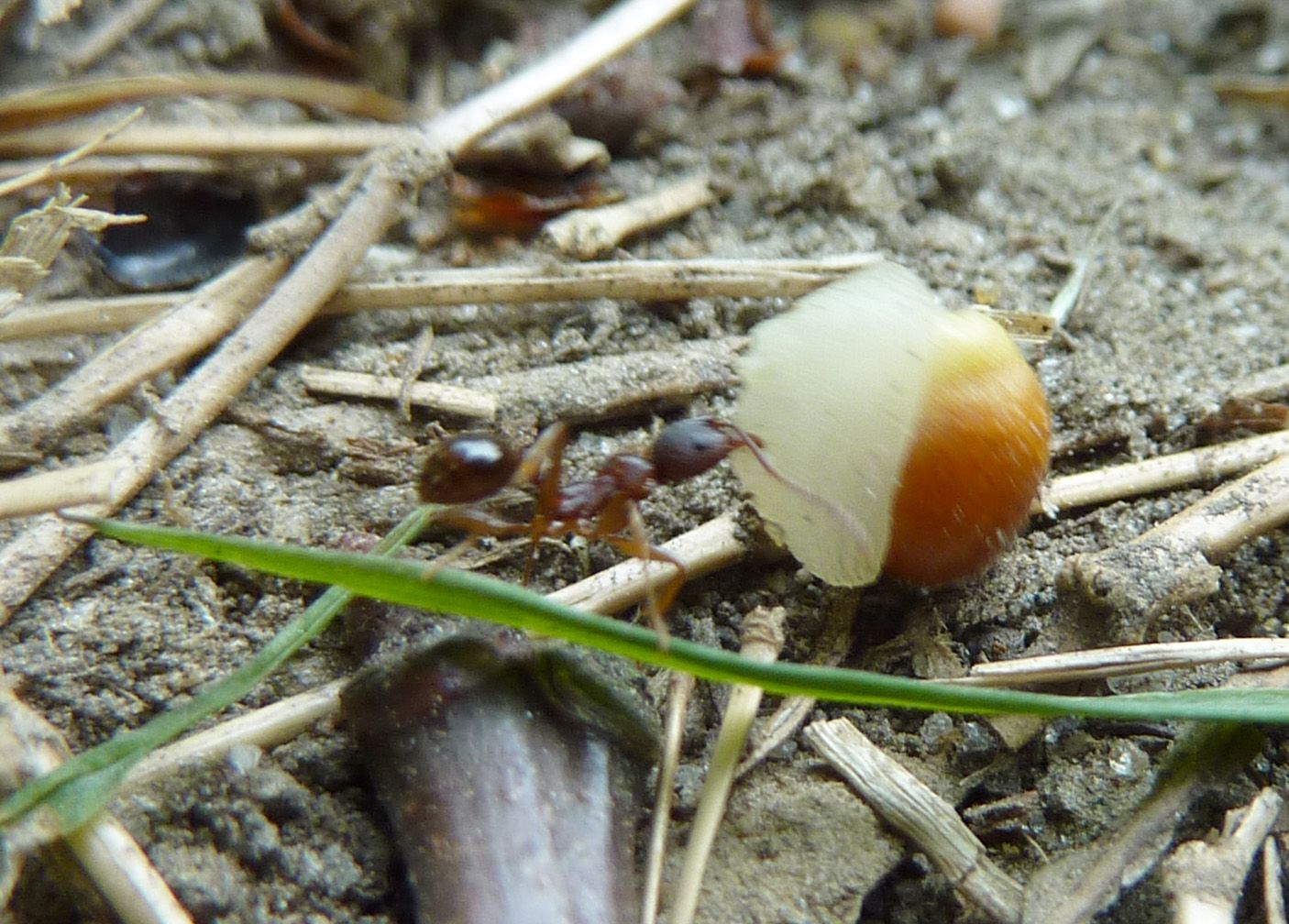
Trillium seeds don't need to be removed from their elaiosome packet. However there is always a slight risk of mold feeding growing around it and eventually killing off the seed. Thankfully ants are great about finding such seeds and more than willing to eat the elaiosome food right off.
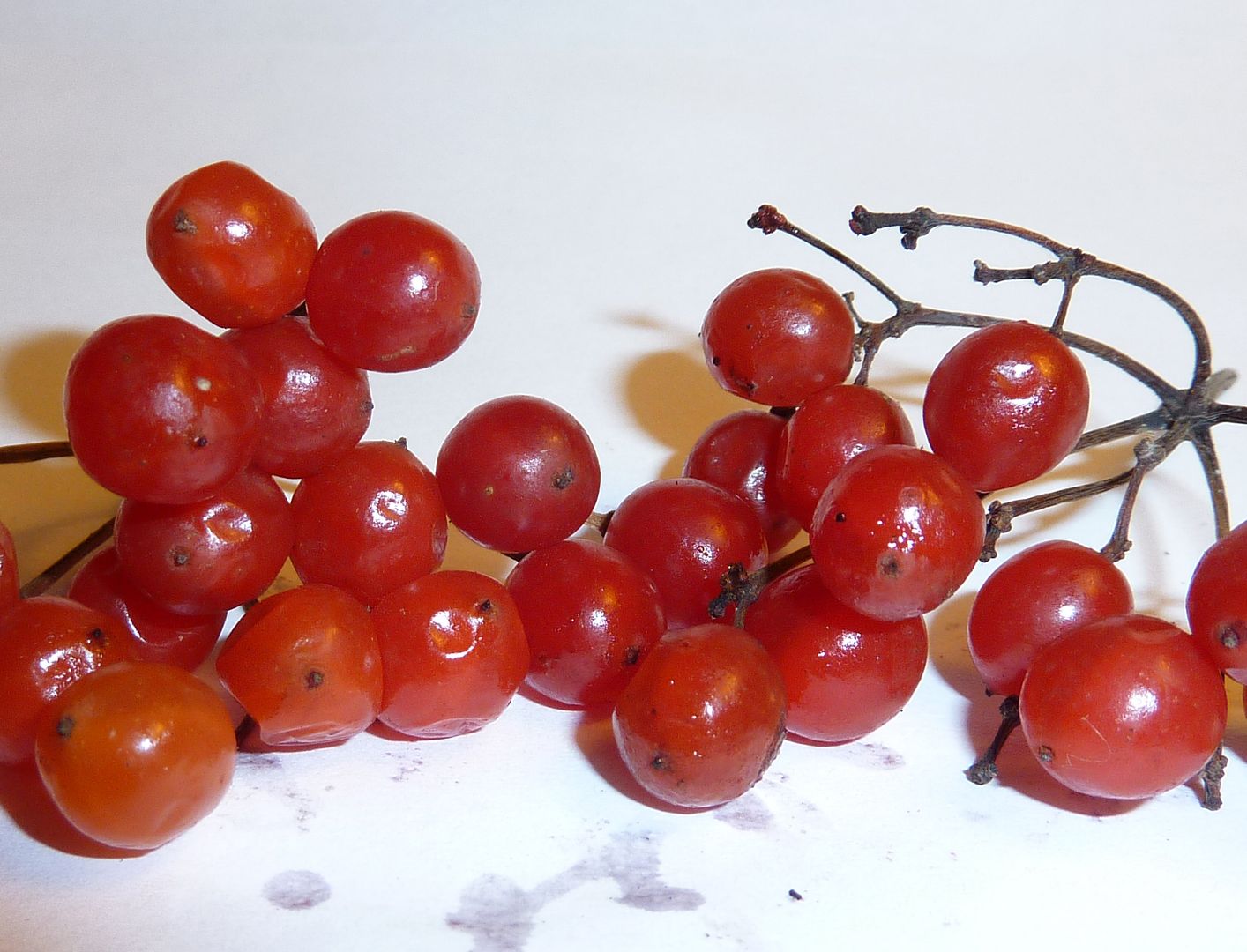
Highbush Cranberry, Viburnum opulus, is another example of a "wet seed." The berries are edible to humans, and birds find them tasty too. In nature the outer coating of flesh would be digested off after being eaten and eventually leave the seed in a nice clump of fertilizer.
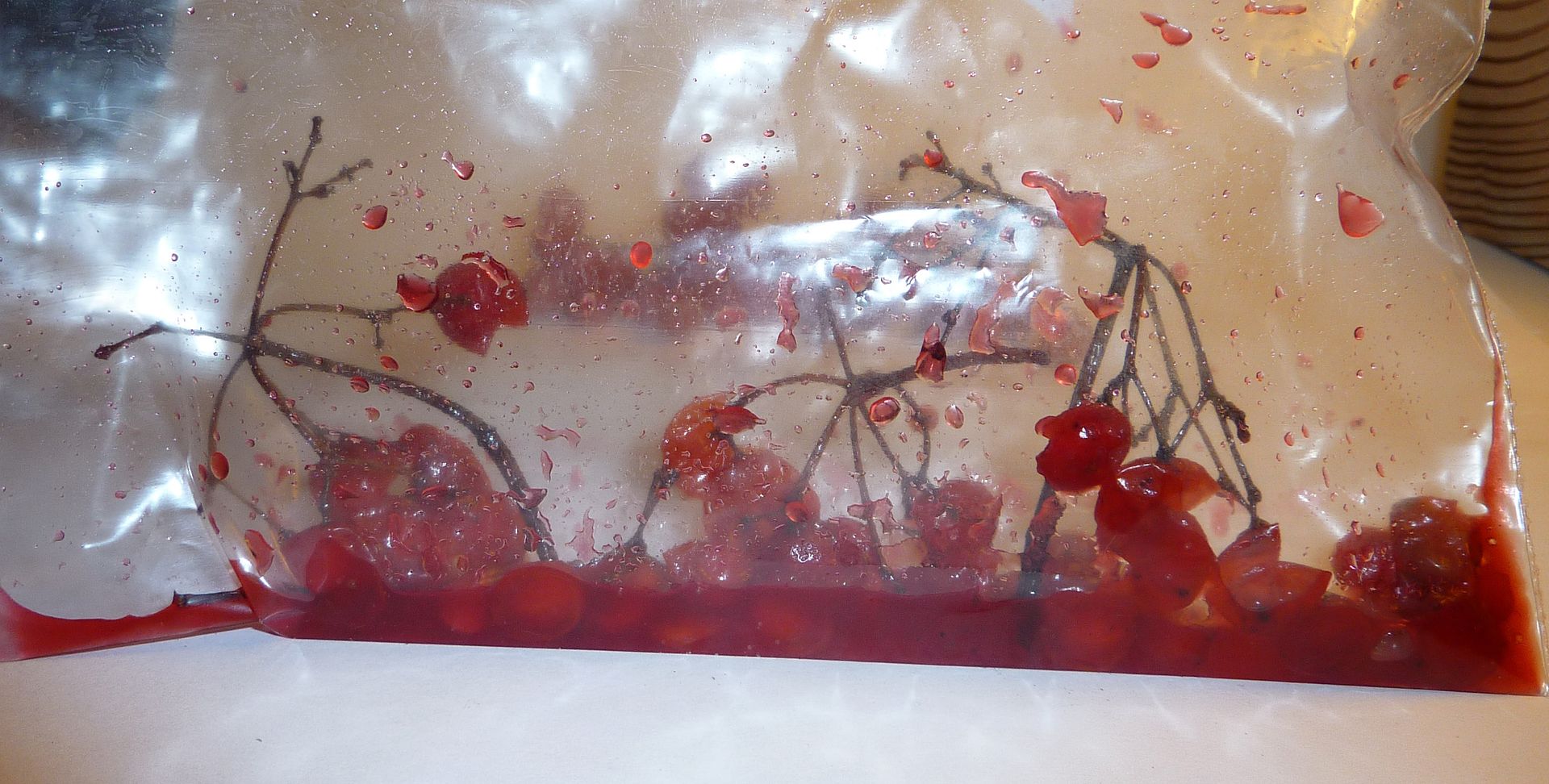
Removing the seed from the flesh is best done by putting all the berries in plastic bags and popping them individually. This frees the fairly large seeds from each berry. From there water can be added and removed and repeated to help rinse away excess material. The whole process can take a day to a week. It's okay to let it ferment but you really want to get that stuff off of the seeds, especially if it starts rotting. Should mold appear you can still remove it and it should be find as long as the mold hasn't totally consumed the seed.
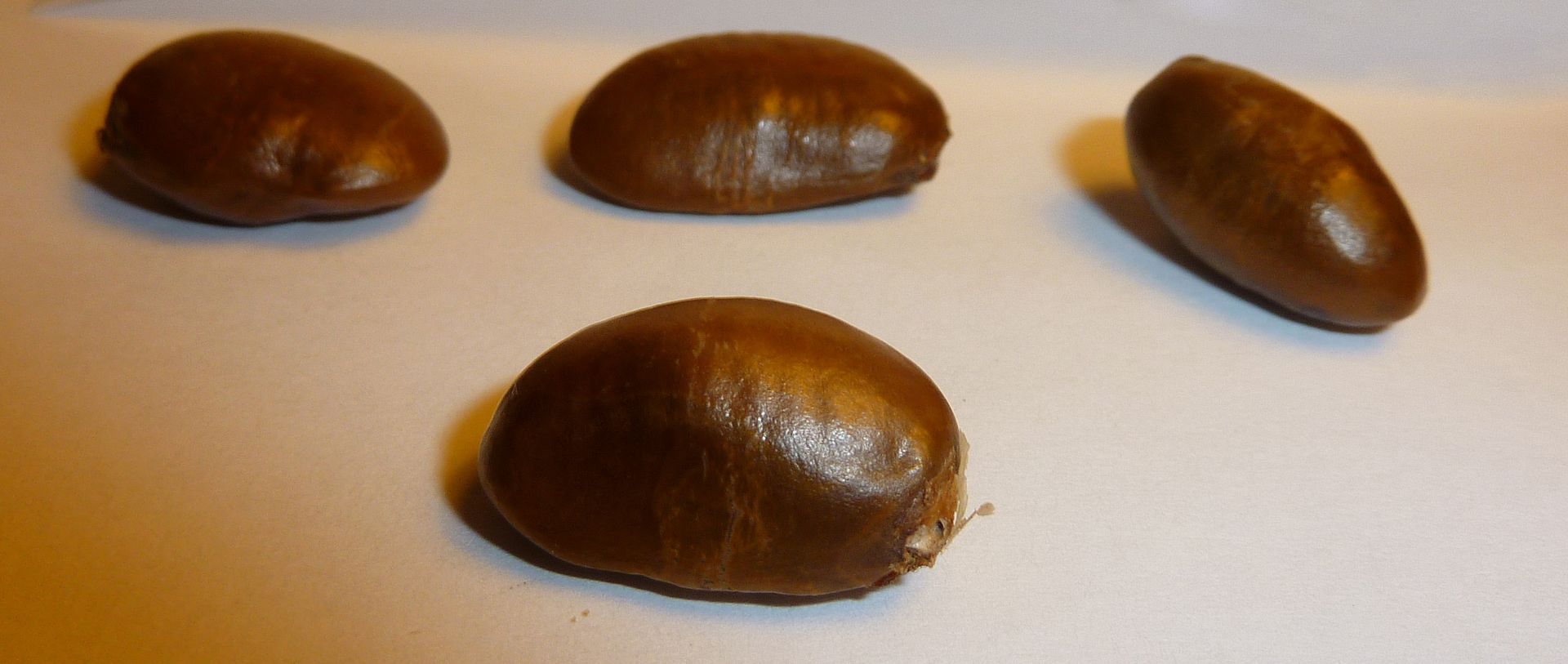
The massive seeds the Pawpaw, Asimina triloba, developed inside of larger fruits. I think they're technically considered wet seed because of this, but seed removal and clean up is as easy as removing those of an apple, pumpkin or watermelon. Clean off and allow to dry before storage.
Checking for Viability
The easiest method is to place the seeds in a bowl of water and maybe shake out all the air bubbles for a few minutes. Room temp is fine, nothing to hot or cold though. Bad seed typically floats, unless you're dealing with a wetland species who's seeds are intended to float. In that case this test is unreliable. For everything else though, bad seeds float because they are hollow. And yes seeds that look good can in fact be bad. It's one of those things you'll never know for sure unless you crack one open or do this test. Good seed typically sinks or is otherwise botany just under the surface.
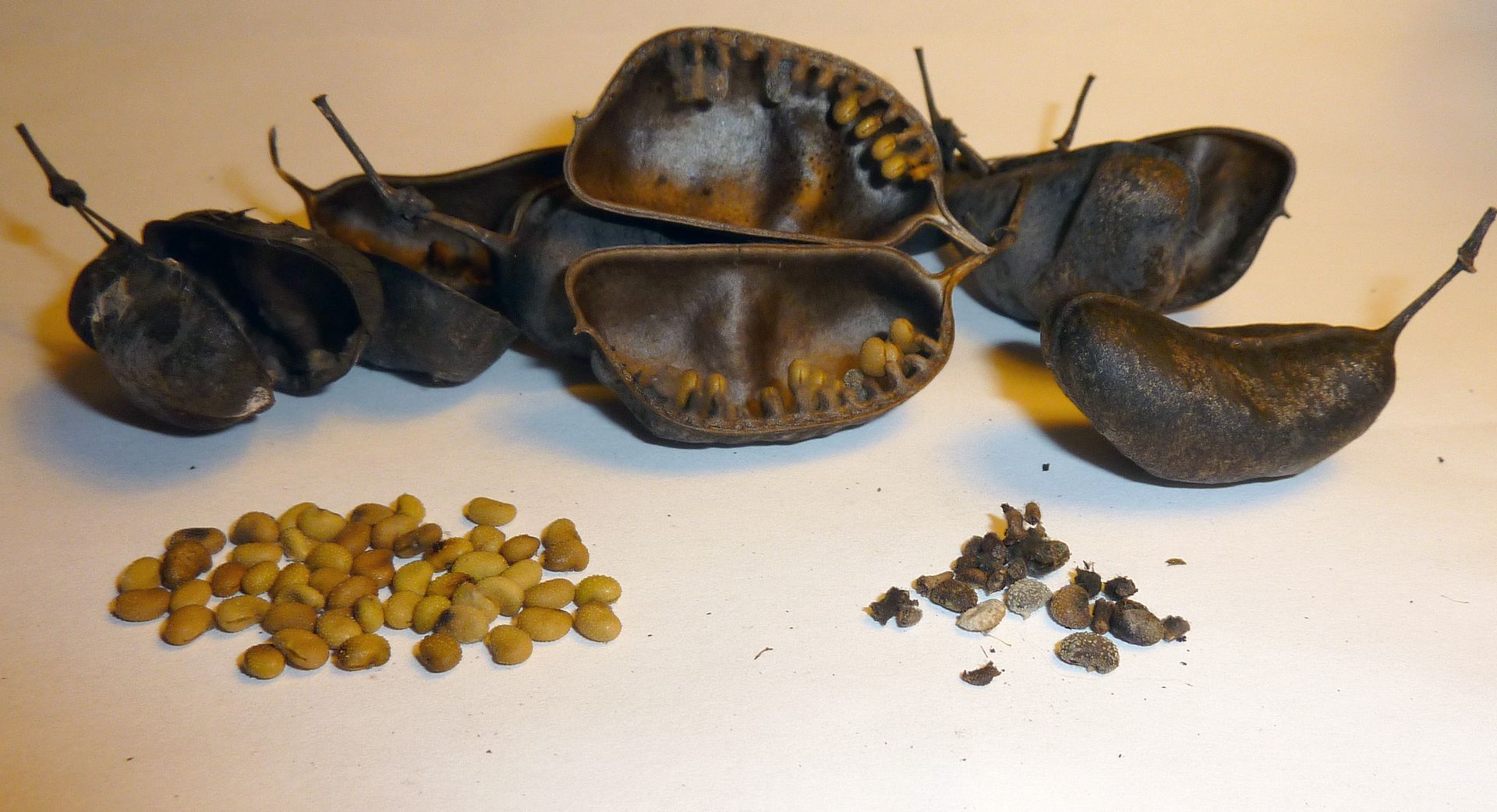
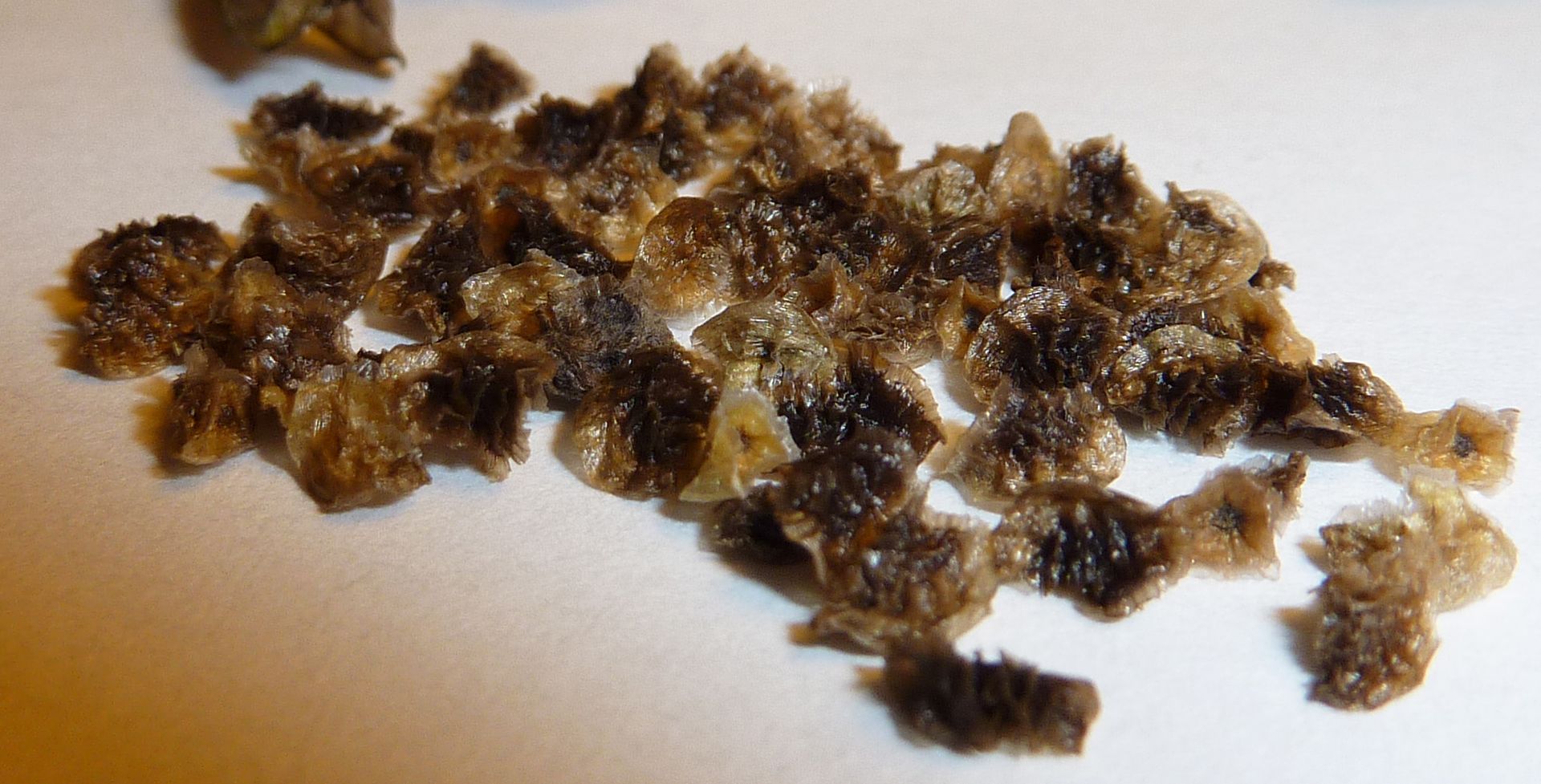
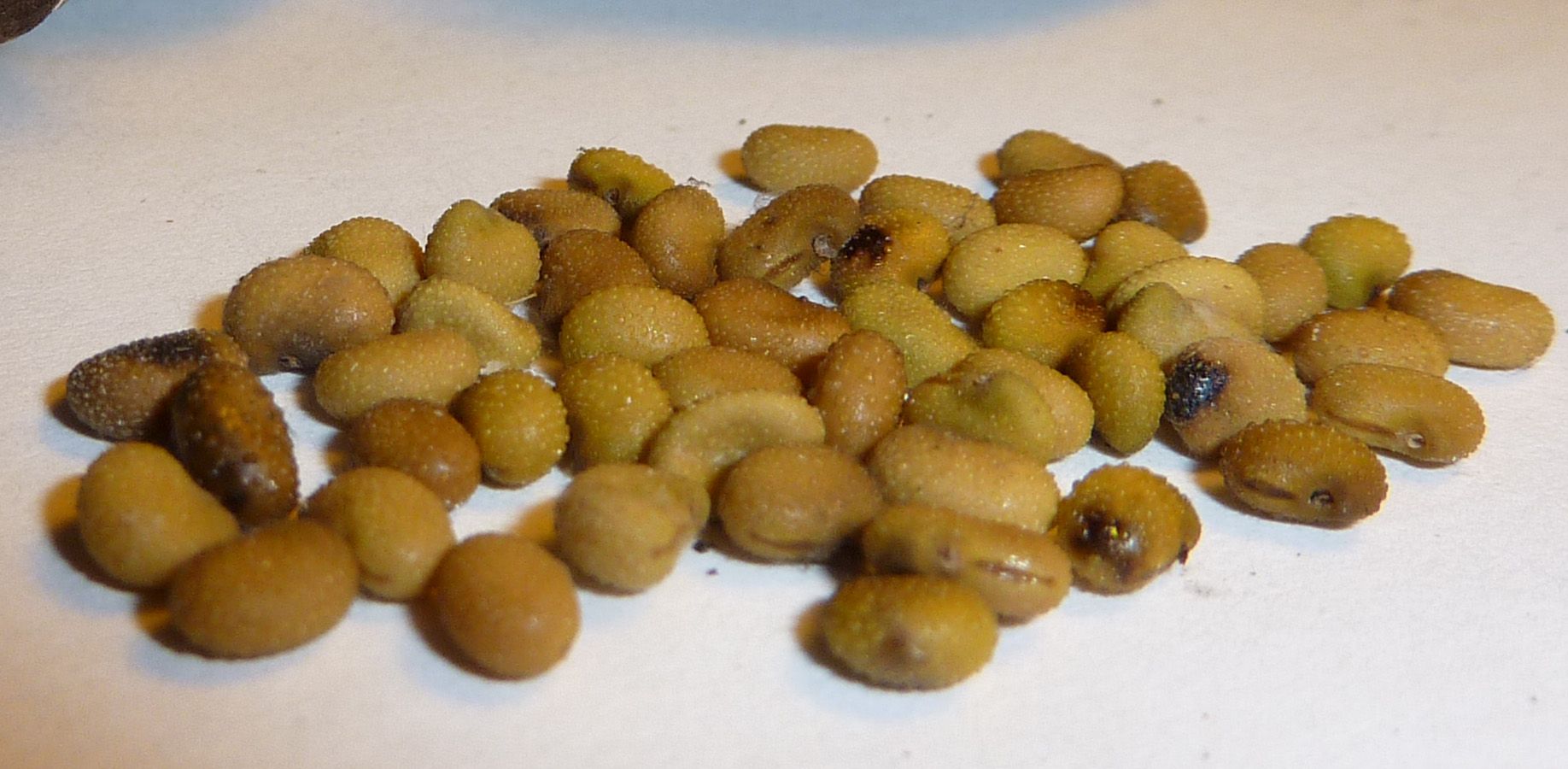
Here we have seed heads to White False Indigo, Baptisia alba.
Bad seeds are obvious looking. Even here though some of these could potentially be salvaged by removing the mold. Even then though the smaller ones might not be savable.
Good seeds are obvious looking too, but even some of these may have developed hollow.
An issue with the soaking test and member of the pea family is that the seeds need to expand in order to germinate. When checking for viability don't leave these seeds in the water for more than a half hour or so. Maybe don't risk doing it at all even.
For storage leaving them this way is fine. When it comes time to germinate though, this species needs to be soaked in very warm (not scolding) water for 24 hours. They should expand about 3 times bigger and look more pea-like. They can be planted immediately from there and germinate with warmer weather.
How to Store
Moisture is the factors here. Some seed needs to be stored dry or else risk early germination. Others benefit in mortality rate by being kept moist and are triggered to germinate more from periods of hot and cold. For seeds that need to be stored wet, the absolute bare minimum of water is all that's required.
An example the instructor gave was when you take a paper towel and drench it in water, then squeeze out every last drop... that is still too wet! They recommend placing the seeds in a dry paper towel and spraying it twice with a squirt bottle. From there they can be placed in a cheap zip lock bag. Cheap as in nothing fancy, you're not worried about freezer burn, you want the air to circulate and breath somewhat. Leaving the bag open can make them dry out quickly.
Storage can be done at room temperature and in a dark place, however, it's recommended they be kept cool. Once the seed gets the trigger to germinate, some won't hesitate to do so.
How to Germinate
There are many triggers for germination. Just add water being the most common, and most important. Many species require at least a 90 day period of being Cold and Moist as the trigger. For species that don't germinate on cue, being exposed to warmer temps is all that's needed to germinate. More touchy species will require multiple cycles of 90 days of cold, and 90 days of warm to trigger.
Feel free to experiment with methods but also remember to collect enough seeds to experiment with. There are a fair amount of books on the topic of seed germination. Some of them contradict one another. But also some seeds don't care if they're stored in dry or wet conditions. And likewise the need for multiple cycles of hot and cold might not be true for 100% of a population, even if all the seeds came from one plant.
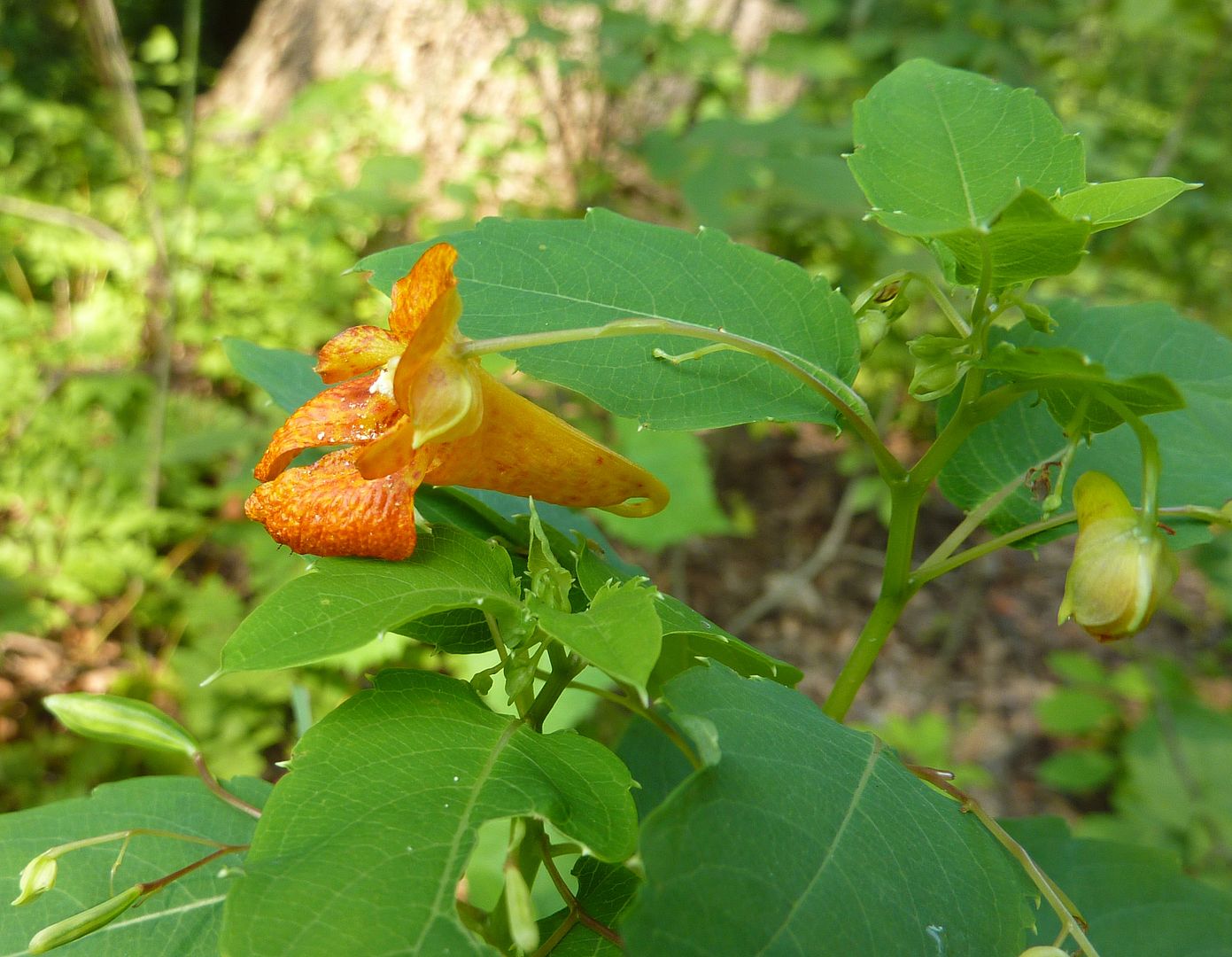
Jewelweed, Impatiens capensis, is an annual who's seeds require multiple hot and cold cycles before they germinate. The result of planting them by seed is they'll reappear once every 3 years. In nature though not every seed gets the memo and a small percent will germinate a year or two later! For a more consistent population in one spot you can put them through periods of hot and cold over the summer and get some to germinate prematurely.
There are a few cases where seeds need Scarification in order to germinate. In nature this would mostly be frozen then thawed, or burned. Gardeners sometimes use acid, sandpaper, or lightly scoring the seed coat to break dormancy.
Once the method of germination has been figured out they recommend placing them in a plastic bag with equal parts medium to seeds. So a light airy seed starting mix is what's required. Mix to combine, then give them just a squirt of water. When they germinate they can carefully be moved to a flat. The idea of adding the soil is to maximize moisture contact.
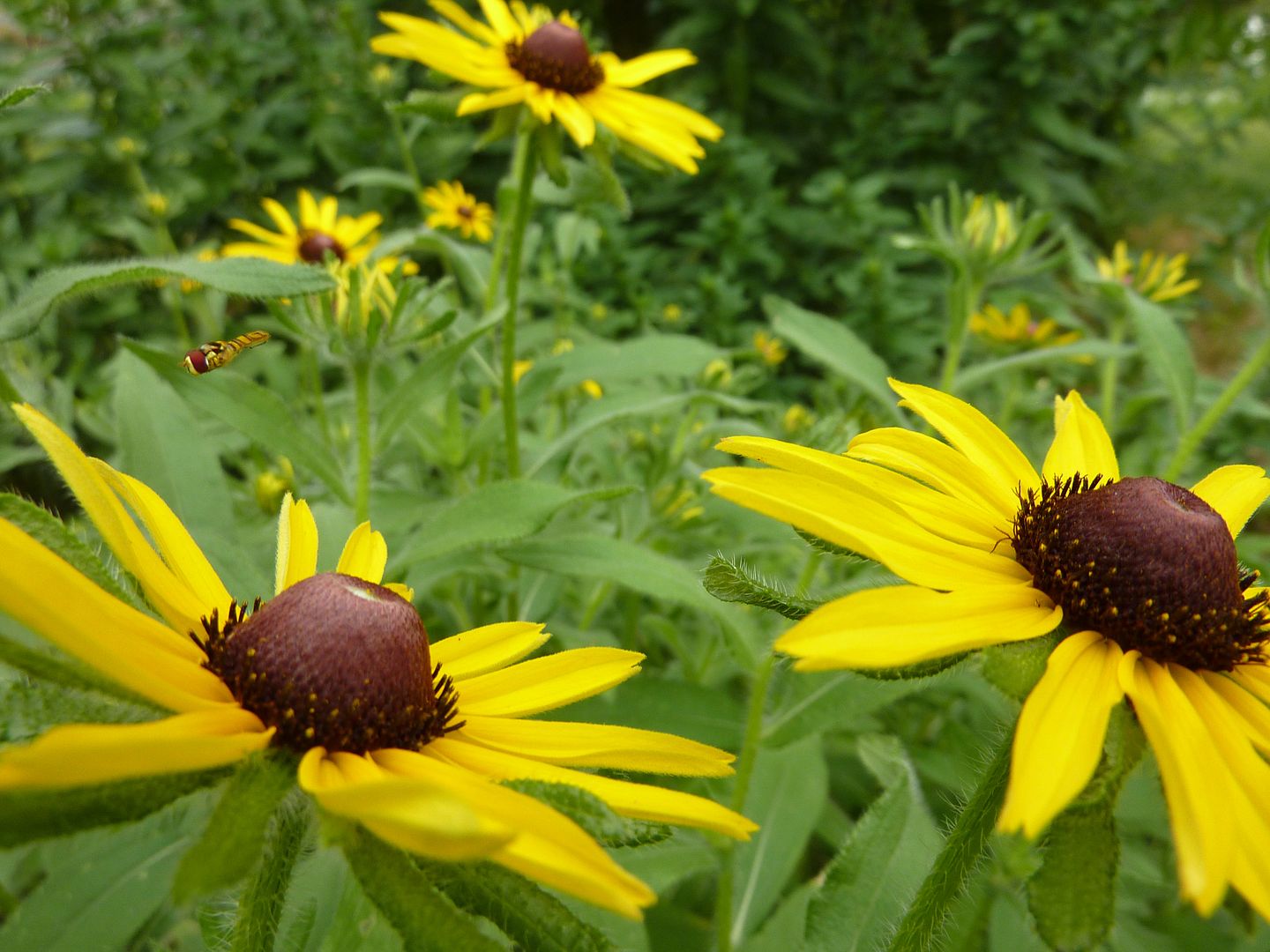
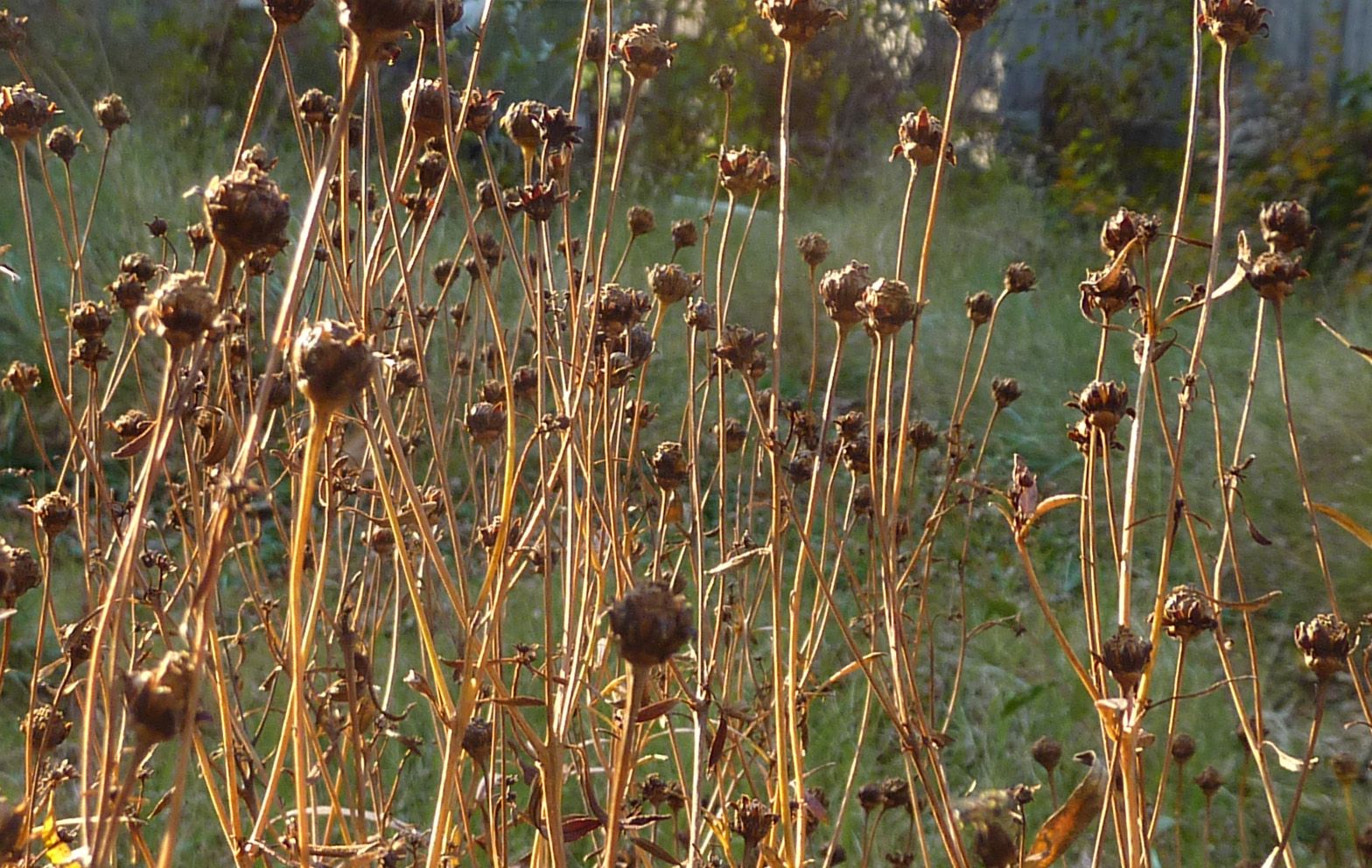
At this point a small minority of seeds demand sunlight in order to germinate. Such is the case for Black Eyed Susans, Rudbecia fulgida. In nature, If there's too much organic matter laying around, their seeds won't germinate. Instead they go dormant and wait for sunlight to finally reach them. Plants like this are known to appear in great numbers after disturbances such as fires, or trees falling over in the woods. Species like this tend to be annuals, biannual, or short lived perennials at most. Their populations booms until once again the amount of organic matter prevents their spread. Ungerminated seeds lay dormant in the seed bank below the leaves.
You can skip the soil in bag method and just plant seeds directly into flats. When you do, make sure soil is up to the rim of each chamber. Lightly water before you plant the seeds. NOTE: it is physically imposable for a plant to absorb more than it's mass in water in one day. Watering with an eye dropper is perfectly fine! Adding too much water is the easiest way to kill all of your plants. Over watering causes the soil in each compartment to form a dense layer on top which is ideal for mold and fungi to cling onto and eventually nibble the narrow shoot of each seedling. Also don't pat the soil down! You want nice even airflow but some mild tampering is okay.
Seeds that demand sunlight to germinate can be sprinkled on the surface. There are special tools sold for this purpose and some mail order places even provide them with orders. Otherwise the general rule is to plant each seed 3 to 4 times deep as the seed is wide.
Heating pads and seed germinating products are also okay to use. In the case of heating pads though they really aren't needed after germination. Especially in a green house setting you can end up cooking your plants. They do benefit some plants such as tomatoes though which don't grow until the soil is over 60F. As your plants grow bigger and bigger their water demands will be greater and greater.
Mold Gnats will be a problem. These are those annoying flies that always seem to show up around potted plants. They are slow moving compared to the typical house fly and fairly easy to swat. The trouble is by the time you see the adults they've more than likely laid eggs for the next generation. These are typically an indoor problem and quickly disperse in an opened green house or outdoor setting. Pesticides can kill them easy but are also harsh on young seedlings, so don't use them! Nematodes are an easy solution but have to be reapplied every few weeks.
Showing posts with label How To. Show all posts
Saturday, November 19, 2011
Sunday, June 13, 2010
Some Camera Work
I attended a quick meeting at the beekeepers association yesterday... our president of the club called and said "Good news. Instead of showing up at 1pm like everyone else, you've been selected to get special training at 8am with 5 or so other people." Personally I'm an 11am kind of guy but this was good. The emphases was on insect photography, and I got a quick crash course from someone who trains scientists and field workers at the USDA.
The camera I'm using (featured left) has excellent macro and is probably the best thing you can buy without upgrading to a real camera you have to worry about lenses with. I was kind of the black sheep though as I was the only person who had one. Everyone else was using an expensive Nikon SLR with a fancy macro lens.
Search Amazon.com for nikon slr digital camera
Basically with an SLR you can stand 1 to 2 feet away from the subject. With my camera I'm usually 1 to 2 inches, depending on the size of the subject. Focus on SLR's can be set manually. Auto focus is awful with macro images. More often than not it focuses on the background and turns the ant or whatever into a blurry image in the foreground. Putting your hand infront or just behind the subject and letting it focus on that is a way to get around this but not ideal for most subjects. Shifting toward or away from the subject can then be done.
The Instructor is a huge fan of Flash. Before today I typically hated flash. I'd only use it at night and or when lighting conditions are not ideal. It seemed like using a flash with macro, especially when you have to stand 1 inch from the subject, was overkill lighting. She showed me a trick though with my camera. Simply placing paper over the flash (but not the sensor) to diffuse it makes all the difference.
So after the crash course was over it was time to hit the field and start taking pictures. As much as I wanted to use one of the Nikons I stuck with my camera because I wanted to take the photos home with me. Afterward we went over the pictures we took, and while I was clearly the only one having focus issues she was impressed with the pictures I took. She even said I have "The Eye" for this sort of thing. So here are some images I was able to take in the 2 hours we had.
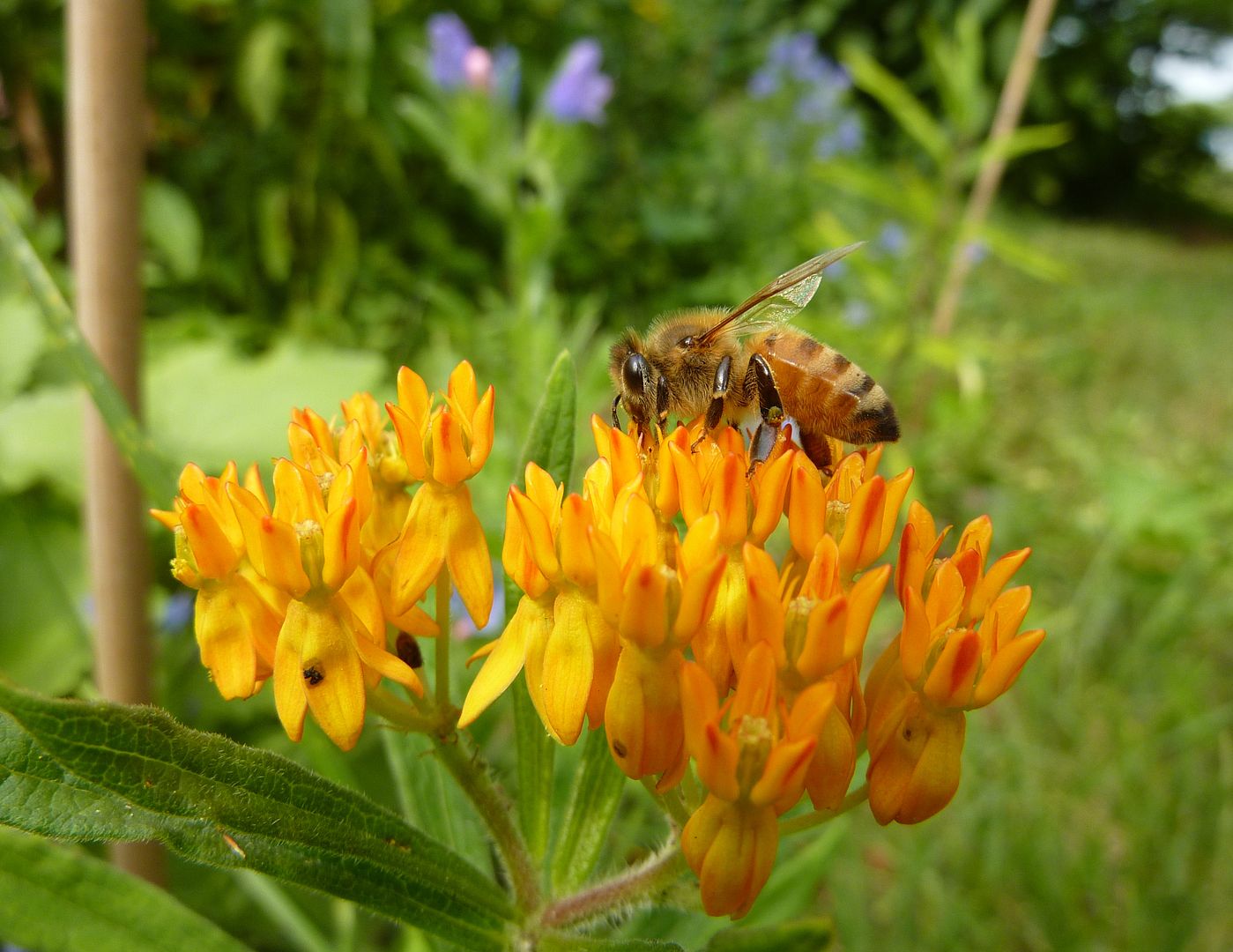
You can barely tell I used a flash but it's there. I didn't color correct anything to this image in photoshop. The most I did was crop it down some. Had I not used the flash basically the right half of the flower and bee would have been much darker, but here (partly thanks to the intensity of the flower color) it's almost glowing.
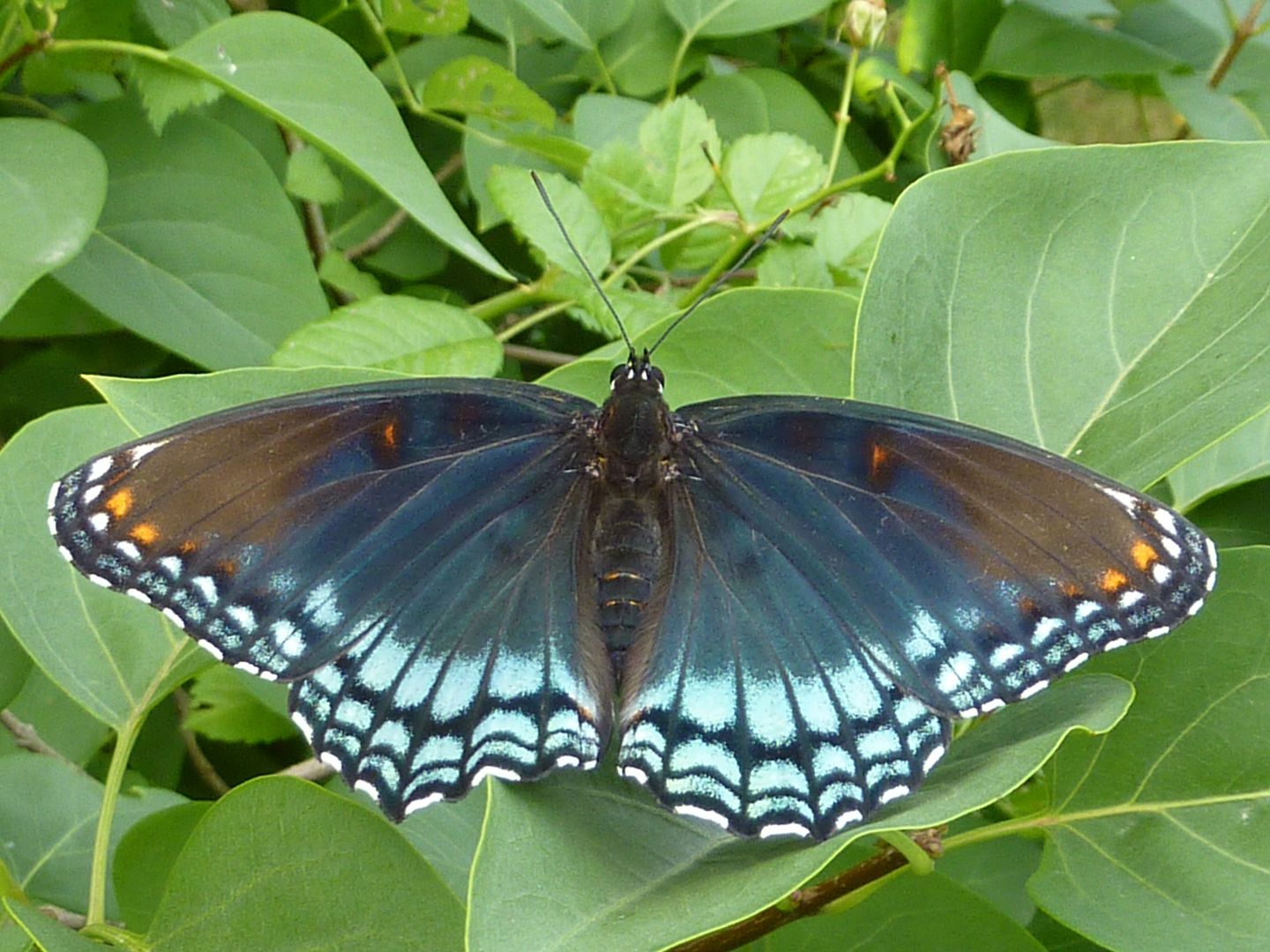
The colorful wings to a Red-Spotted Purple, Limenitis arthemis, are illustrated beautify. The spots in the middle of the wings don't always come out in photos. The turquoise hue can also appear quite black from what I've seen. But here there's just enough flash that all the pigments show up beautify. I've been looking at images around the web, such as BugGuide and I'd say I did well for myself... at least with the color form of this butterfly. One color form is called the White Admiral for it's white stripes, and with others the turquoise isn't as pronounced up the wing, some lack the orange spots entirely. Had I not diffused the flash the leaves would have become very glossy and the effect on the wings would likely have been lost.
(As a side note this butterfly was being unusually cooperative. I suspect it was freshly hatched.)
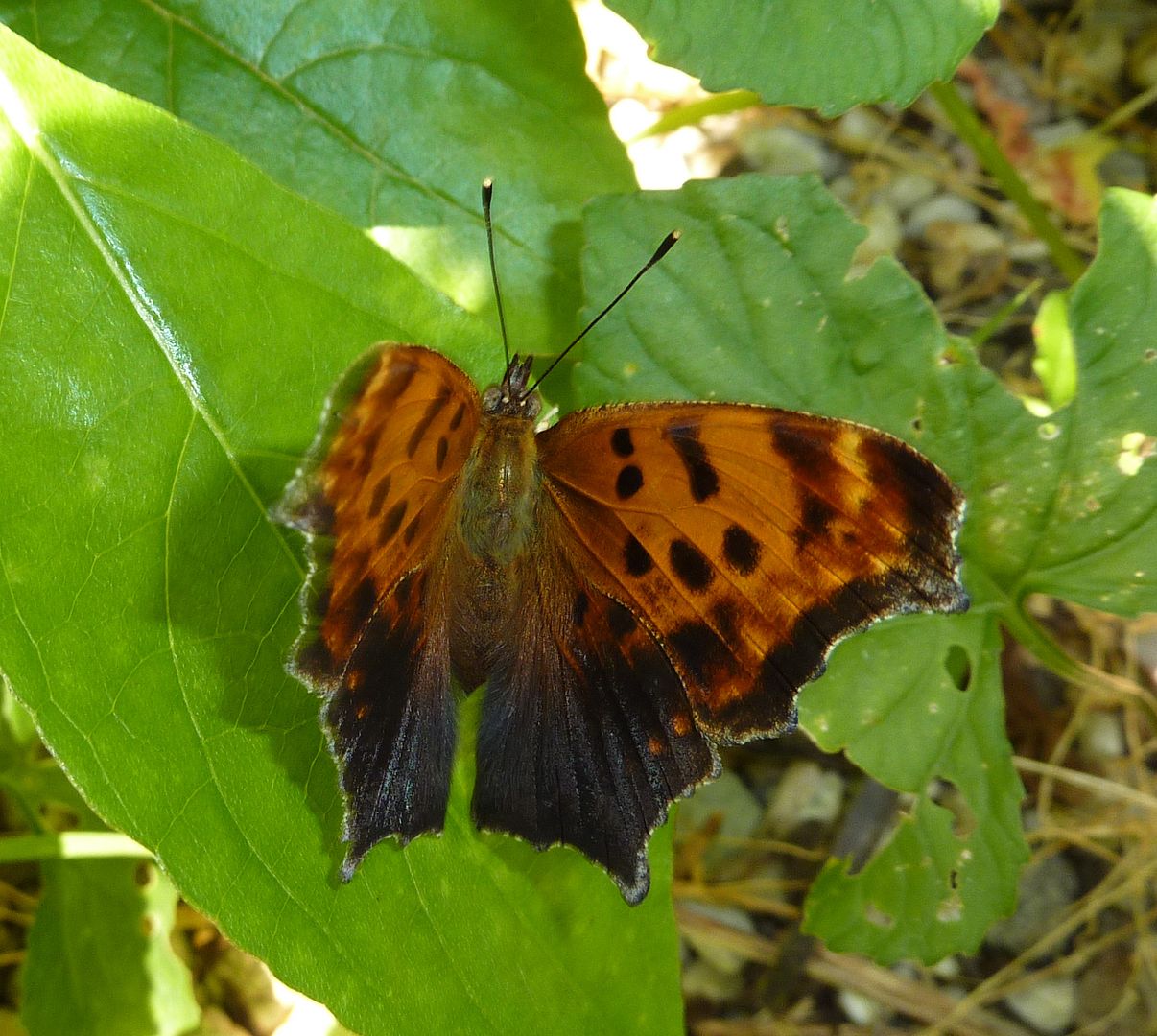
What I believe to be a Question Mark, Polygonia interrogationis was sunbathing in her flower bed. I still don't understand the common name. The instructor was amazed at this. Not because it's a good photo but because she had no idea such pretty things were in her garden.
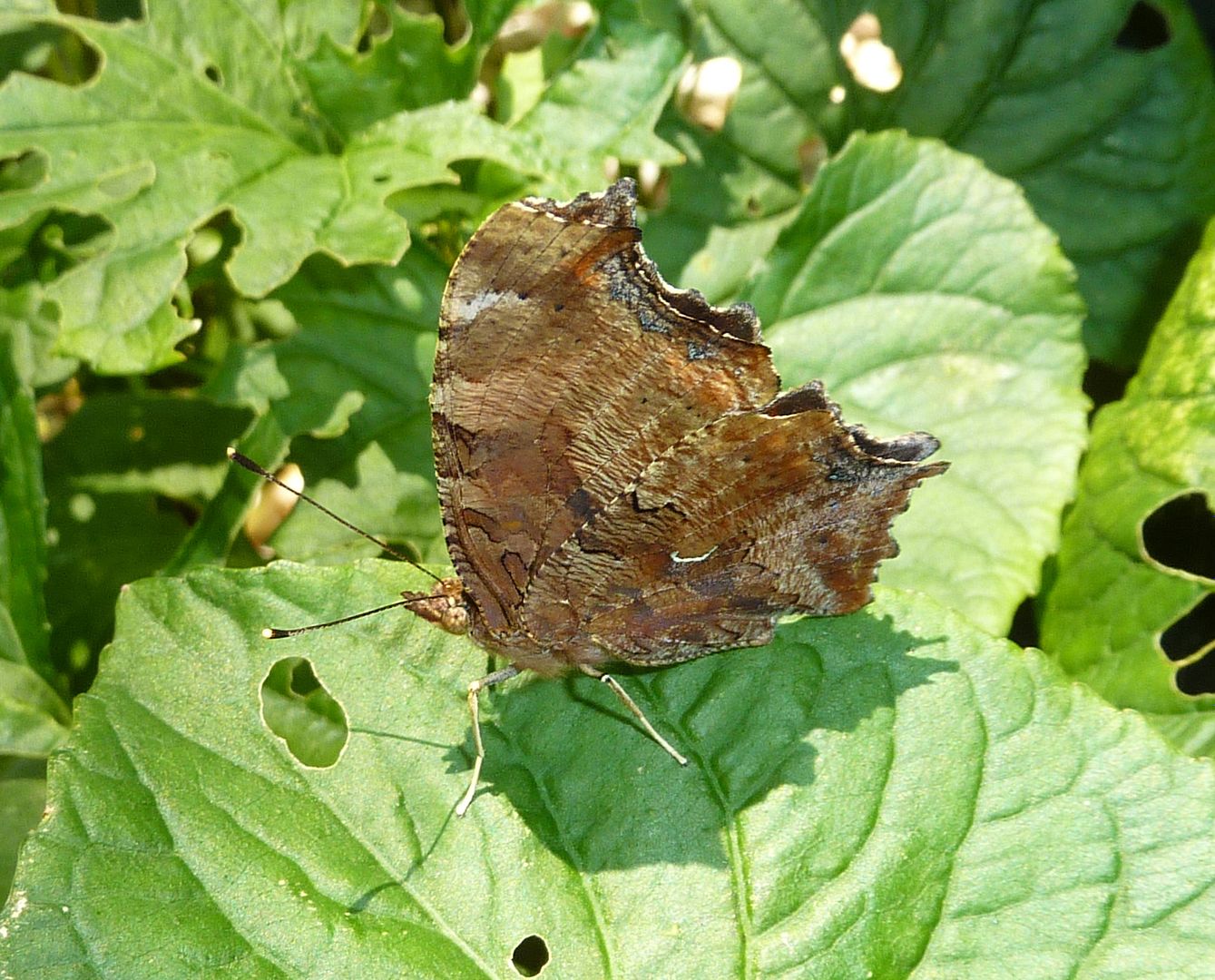
Here is the same Question Mark on a Violet leaf. I didn't cover the flash this time so the butterfly seems unnaturally illuminated. The leaf is also shining to much to seem right. The afternoon sun also created a bit of a shadow underneath. I kept the picture though to show off what the butterfly looks like when it's wings are closed. It goes from a jewel in the sky to a ratty looking leaf in an instant.
Here is the same butterfly in more natural lighting, without a flash. The vibrant colors aren't brought out, I can barely make out the white rim of the wings, and texture to the dark parts are lost. It's still the afternoon but the harsh sun is being filtered by leaves to the plant above.
A lot of these issues can be cleared up in photoshop. But frankly I looked at everyone else's pictures and I think mine were in the most desperate need of touch up work. I can only dream of the day when I upload 200 images from my camera and don't have to spend at least a half hour deleting the bad ones and working on the good ones. There have been days when I've spent hours just working on a dozen images. The best images I've taken though are the ones I don't need to touch at all.
The camera I'm using (featured left) has excellent macro and is probably the best thing you can buy without upgrading to a real camera you have to worry about lenses with. I was kind of the black sheep though as I was the only person who had one. Everyone else was using an expensive Nikon SLR with a fancy macro lens.
Search Amazon.com for nikon slr digital camera
Basically with an SLR you can stand 1 to 2 feet away from the subject. With my camera I'm usually 1 to 2 inches, depending on the size of the subject. Focus on SLR's can be set manually. Auto focus is awful with macro images. More often than not it focuses on the background and turns the ant or whatever into a blurry image in the foreground. Putting your hand infront or just behind the subject and letting it focus on that is a way to get around this but not ideal for most subjects. Shifting toward or away from the subject can then be done.
The Instructor is a huge fan of Flash. Before today I typically hated flash. I'd only use it at night and or when lighting conditions are not ideal. It seemed like using a flash with macro, especially when you have to stand 1 inch from the subject, was overkill lighting. She showed me a trick though with my camera. Simply placing paper over the flash (but not the sensor) to diffuse it makes all the difference.
So after the crash course was over it was time to hit the field and start taking pictures. As much as I wanted to use one of the Nikons I stuck with my camera because I wanted to take the photos home with me. Afterward we went over the pictures we took, and while I was clearly the only one having focus issues she was impressed with the pictures I took. She even said I have "The Eye" for this sort of thing. So here are some images I was able to take in the 2 hours we had.
You can barely tell I used a flash but it's there. I didn't color correct anything to this image in photoshop. The most I did was crop it down some. Had I not used the flash basically the right half of the flower and bee would have been much darker, but here (partly thanks to the intensity of the flower color) it's almost glowing.
The colorful wings to a Red-Spotted Purple, Limenitis arthemis, are illustrated beautify. The spots in the middle of the wings don't always come out in photos. The turquoise hue can also appear quite black from what I've seen. But here there's just enough flash that all the pigments show up beautify. I've been looking at images around the web, such as BugGuide and I'd say I did well for myself... at least with the color form of this butterfly. One color form is called the White Admiral for it's white stripes, and with others the turquoise isn't as pronounced up the wing, some lack the orange spots entirely. Had I not diffused the flash the leaves would have become very glossy and the effect on the wings would likely have been lost.
(As a side note this butterfly was being unusually cooperative. I suspect it was freshly hatched.)
What I believe to be a Question Mark, Polygonia interrogationis was sunbathing in her flower bed. I still don't understand the common name. The instructor was amazed at this. Not because it's a good photo but because she had no idea such pretty things were in her garden.
Here is the same Question Mark on a Violet leaf. I didn't cover the flash this time so the butterfly seems unnaturally illuminated. The leaf is also shining to much to seem right. The afternoon sun also created a bit of a shadow underneath. I kept the picture though to show off what the butterfly looks like when it's wings are closed. It goes from a jewel in the sky to a ratty looking leaf in an instant.
Here is the same butterfly in more natural lighting, without a flash. The vibrant colors aren't brought out, I can barely make out the white rim of the wings, and texture to the dark parts are lost. It's still the afternoon but the harsh sun is being filtered by leaves to the plant above.
A lot of these issues can be cleared up in photoshop. But frankly I looked at everyone else's pictures and I think mine were in the most desperate need of touch up work. I can only dream of the day when I upload 200 images from my camera and don't have to spend at least a half hour deleting the bad ones and working on the good ones. There have been days when I've spent hours just working on a dozen images. The best images I've taken though are the ones I don't need to touch at all.
Labels:
Bees,
Butterflies,
Camera,
flowers,
How To
Monday, December 14, 2009
Ant Chat: How to Build a Tank Setup
And for those of you who didn't read the last two posts, Here's the episode of Ant Chat explaining them.
Labels:
Ant Chat,
How To,
Tank Setup
How to Build a Tank Setup (Part 2)
This is a continuation from yesterday's post, Here.
After roughly a day of having built your Tank Setup it should be ready to house a colony of ants. Hold back on decorating it until after the ants have established themselves. This will ensure they "set up shop" and nest in the plaster setup and dont' try building little huts out of bark and stones... the fools. (I once had a colony of Aphaenogaster that decided to stack tiny stones in order to make a nest rather then move into the plaster setup, so hold off on that stuff for now.)
Also it's time to apply the Fluon or 3 in One Oil. A little bit of both goes a long way. So add a few drops to a large cotton ball or crumbled up paper towel. Coat the corners first as best you can. Then go along the top inch of the tank. If you don't...

... this can happen. Actually it's bound to happen sooner or later. An escape proof setup is one that's surrounded by a moat and locked in an air tight chamber. Even scientists have trouble with this. Thankfully ants are more than reasonable, and can easily be swayed back into the setup.
NOTE: Ants that are ill tempered and aggressive are best swayed around with something other then your hand. The same applies for ants that have painful stings.
Ants that spray formic acid were not meant for captivity and can actually die from the putrid odor of the formic acid they spray, besides you don't want that in your room either.
Now onto Adding Ants! Before we begin you should only add Colonies, not queens still working on their first batch of brood. Colonies have workers and presumably a foraging force. Loan queens are a stage behind this step.

Take one colony, in this case Camponotus castaneus...

... say hello to guard ant...

... Then dump colony directly in the entrance of the setup! The end.
Well that wasn't hard at all... okay maybe I should elaborate some.

Once removed from the tube they called home since last June, the ants will scatter looking for cover. Because I dumped them right inside the plaster setup they mostly explored all the tunnels and galleries that are each ideal for a small colony to setup shop. Two things are vital though.

1: The Queen. While only 2 of the 9 workers actually bothered to explore outside the plaster setup, they would have been no significant lose had the queen escaped. The queen is safely doing nothing in one of the chambers. Now that I know that I can focus on getting the 2 workers that were running around back into the nesting area.
(I actually didn't apply the 3 in One Oil until after the ants were in the setup. Oops)

2: The Brood! Camponotus in general tend to lay eggs in batches. Currently they only have 2ed and 3rd instar larva in the nest. And they all fell out of the tube in one big clump. This is great! Usually what happens is some eggs are left in their old test tube setup and I end up either crushing them in an attempt to get them out. Or I have to put the test tube setup back in where the ants can find it. The issue here is their old test tube setup has the colony odor and all the ants will move right back inside the thing regardless of how bright it now is. It smells like home and that's all the ants are interested in. You really don't want either of these things to happen.
The brood is the next generation of workers. Because Camponotus lay eggs in batches this is vital to the colonies survival. When the queen's current work force dies off she's not going to bother foraging for food to build the next one. So it's important the current workers successfully rear new workers before they're die. At the same time allowing them to continue living in their test tube setup isn't good. You may as well have not built a new setup at all.

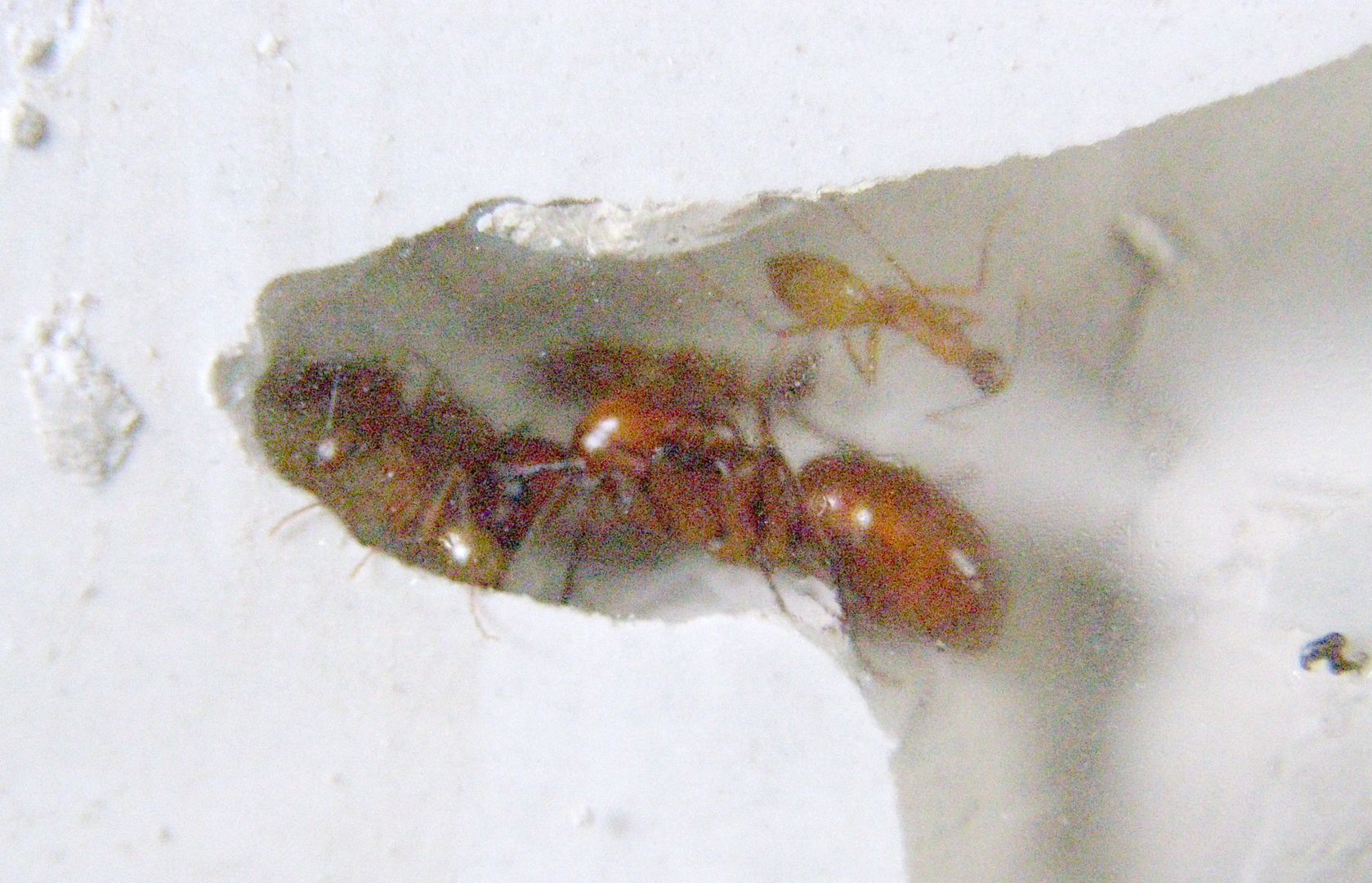
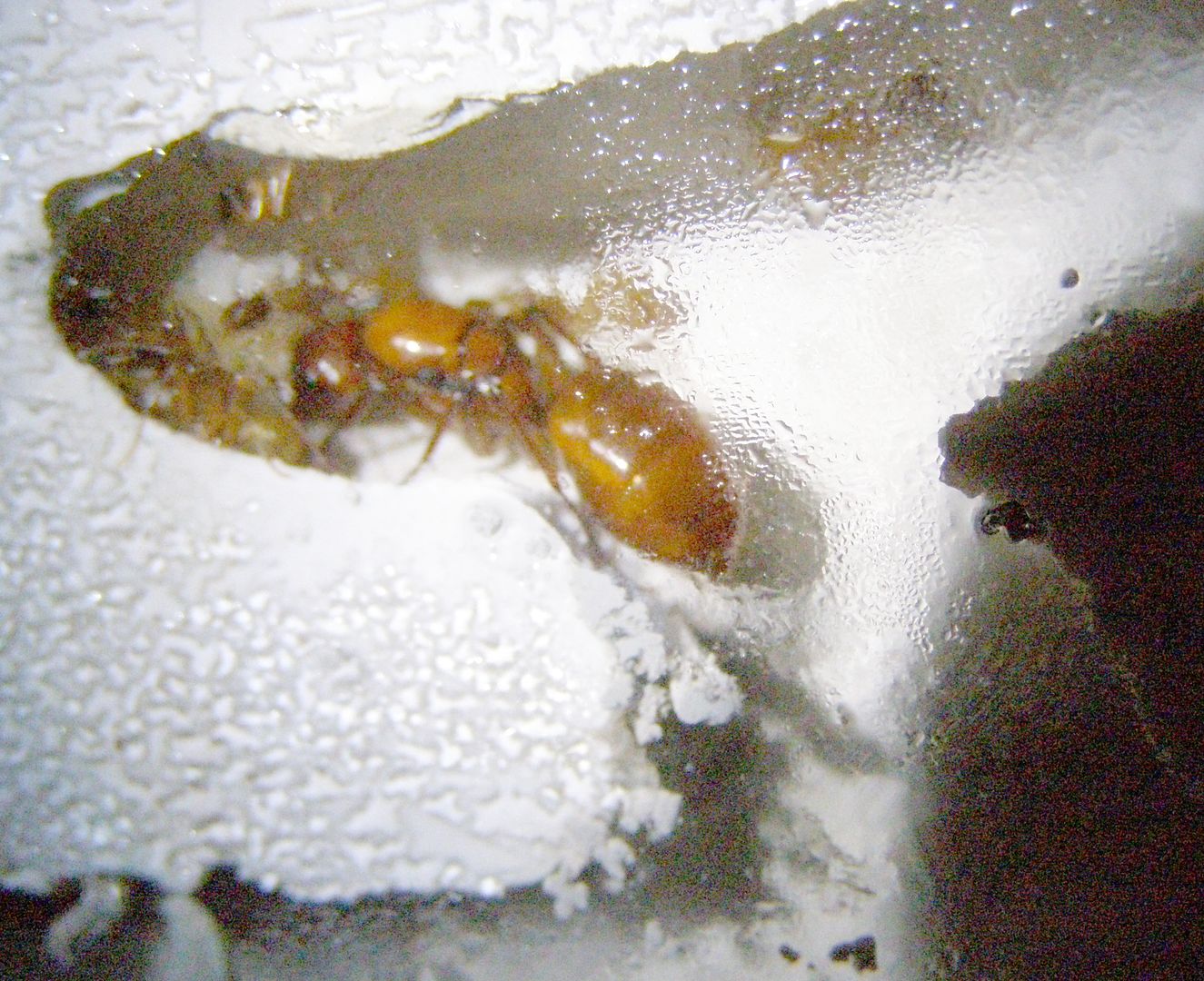
Just hours after the colony has been dumped they've already found a temporary nesting site. Right now the queen is the closest thing the workers have to a colony odor so they all tend to cluster around her and places that she's been to.

You may notice small groups of workers hanging our randomly too. They eventually disband and rejoin the group that has the queen.

You may see some ants carrying other ants, or in the case of the queen, dragging her. This is a worker that has found a chamber she thinks will be a great nest site. The trouble is convincing the colony. One by one she grabbed each of the workers and brought them to this chamber. The trouble is they disagreed with her and simply left after being let go. A noble effort but the colony said no. Had they liked the new space then the workers she brought here would have joined in the effort to bring the colony here.

Back to their stoop they went. To be honest though I wish they had gone to that chamber instead, but what do I know.

For the first few days don't bother feeding the ants. Stuffing your face when the family tree has been chopped down is considered poor form among ants. Foraging simply isn't done until they have established a nesting site to take the food.

The following day: Condensation can be an issue in plaster setup. It is easily controlled by opening the lid to the setup, but may take time. The temperature of the glass and the plaster, having the light on or off, and how much moisture is in the plaster are all factors. It's not a problem for ants of their size but smaller species can have issues with it sometimes.

Still in the second day the ants begin making edits to the room they've choses to take over. Here an ant gathers some modeling clay I forgot to remove. When you start seeing this behavior it's safe to start decorating. (I added a thing layer of Repti Bark outside to act as the floor to the setup. Feeding should be done on trays so insect corpses don't build up.)

Slowly she builds out the stoop and gets the nest more floor space. Eventually (as I see today) they'll bring in the wood chips I place in as a floor medium. I love seeing ant engineering at it's finest.

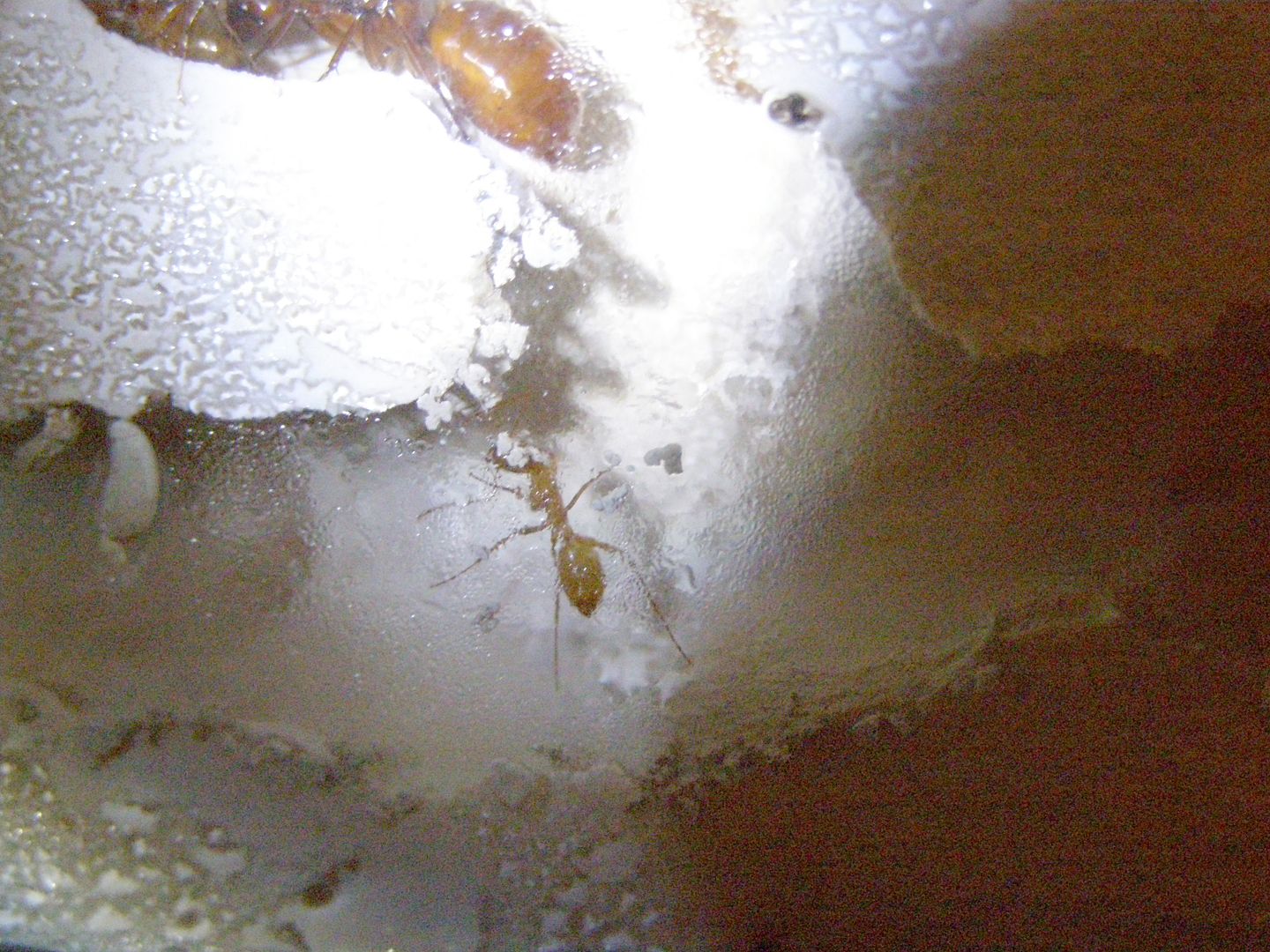
The other behavior I see is scouting. I tried feeding them but she wasn't interested. I think she was trying to locate the old nest to be honest. The 3 in One Oil holds, actually she has lots of trouble just climbing the glass now, I'm not sure what that's about. When they were first introduced they had no issue with climbing glass. Before leaving the nest I notice she gives all her stored food to another worker.
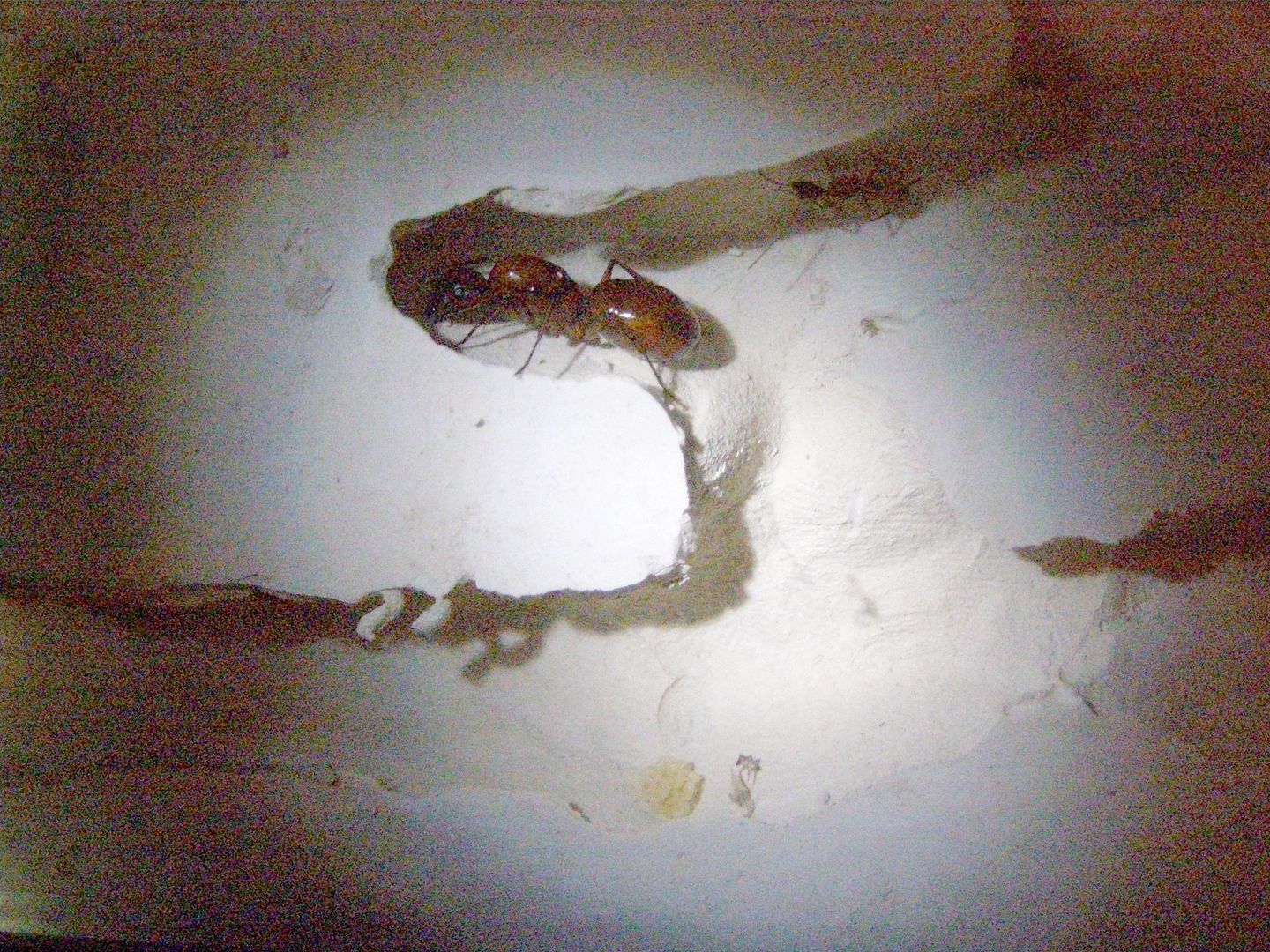
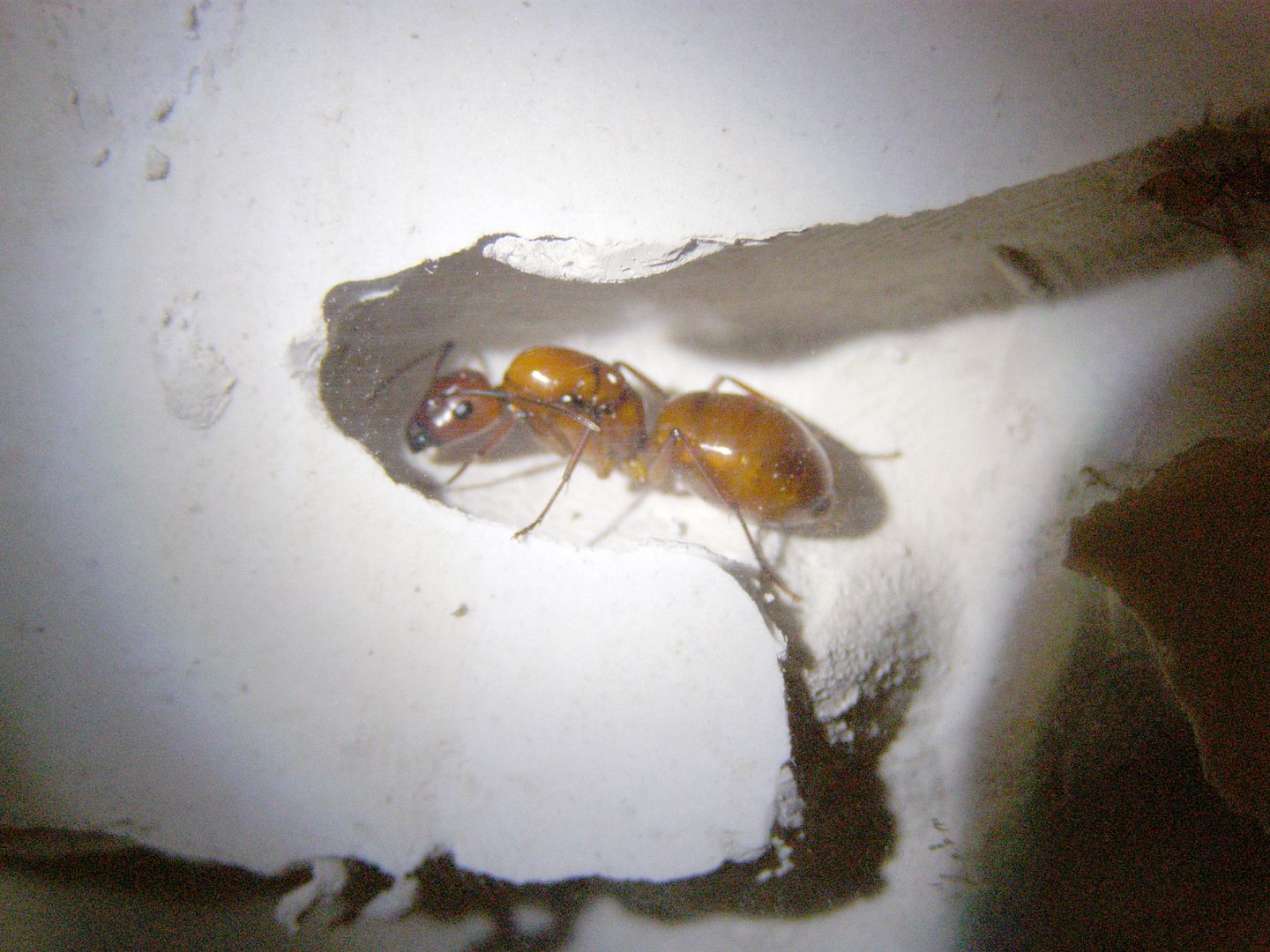
And now I would like to address something. The last time I tried keeping a journal like this I had a colony of Camponotus chromaiodes. The thing is though for the longest time I had them misidentified as C. novaeboracensis. So this time I want to get it right. Unfortunately until I see a wider range of workers Color is the only thing I have to go on.

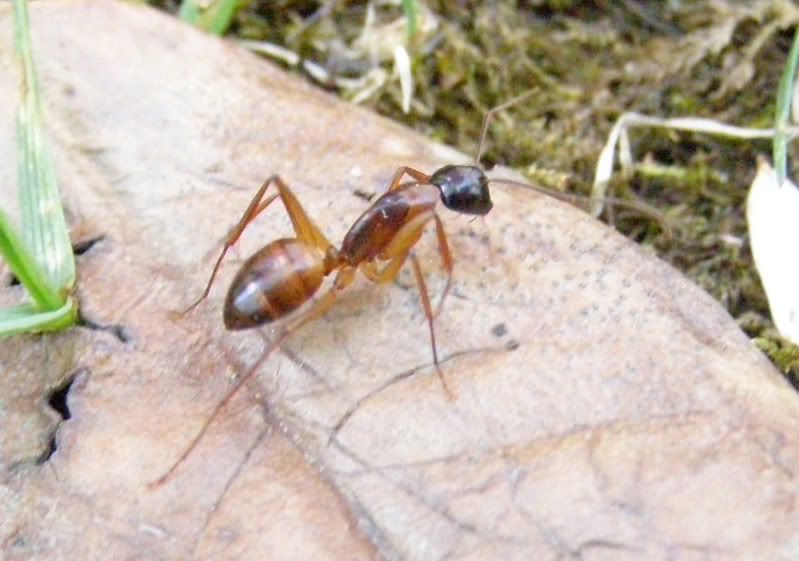
C. americanus tends to have darker traits (as seen above,) it can also be as light as C. castaneus. I don't know of any C. americanus colonies in the area though. I took this picture in Delaware, about an hour away from where I live in New Jersey.

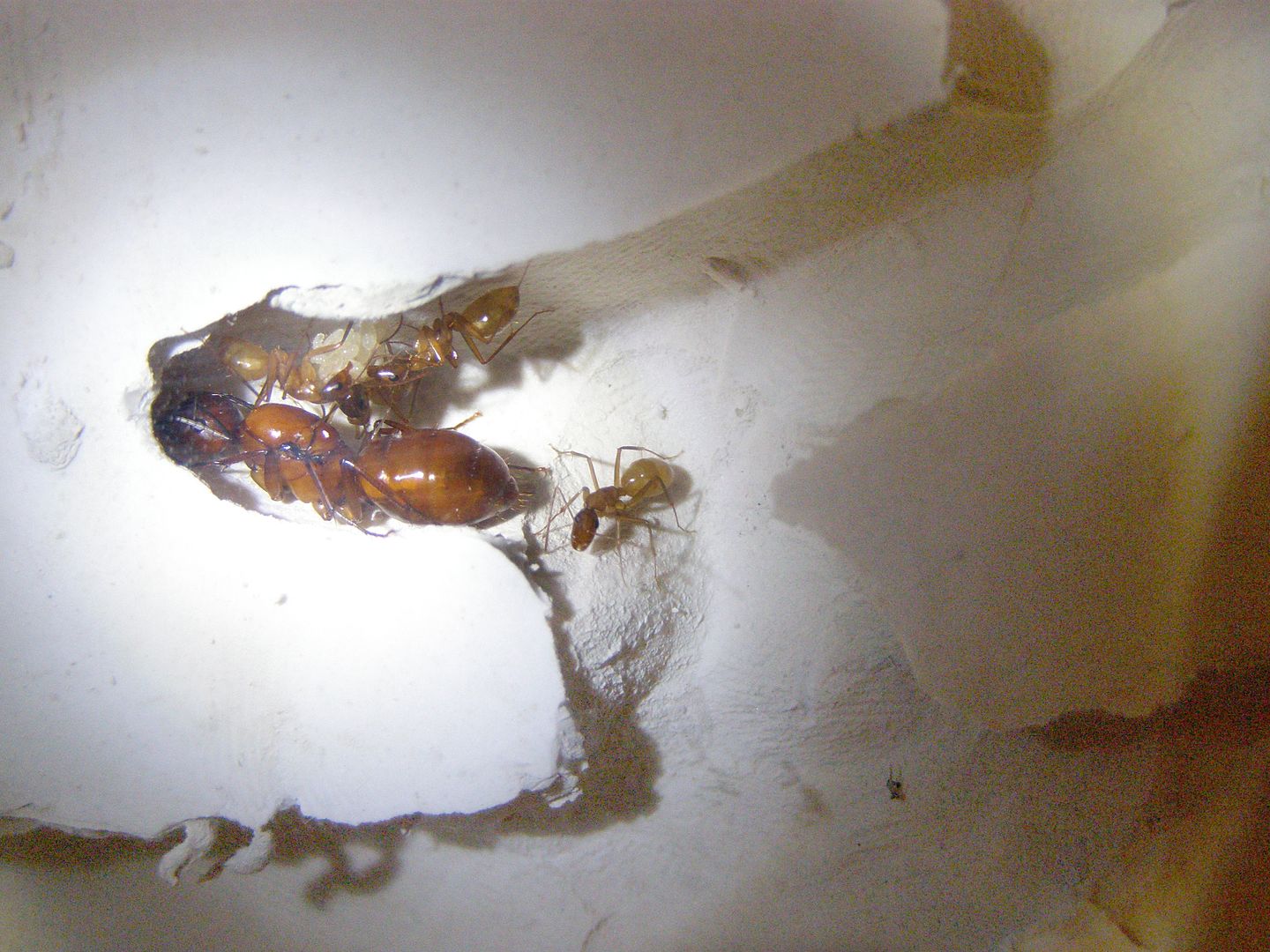
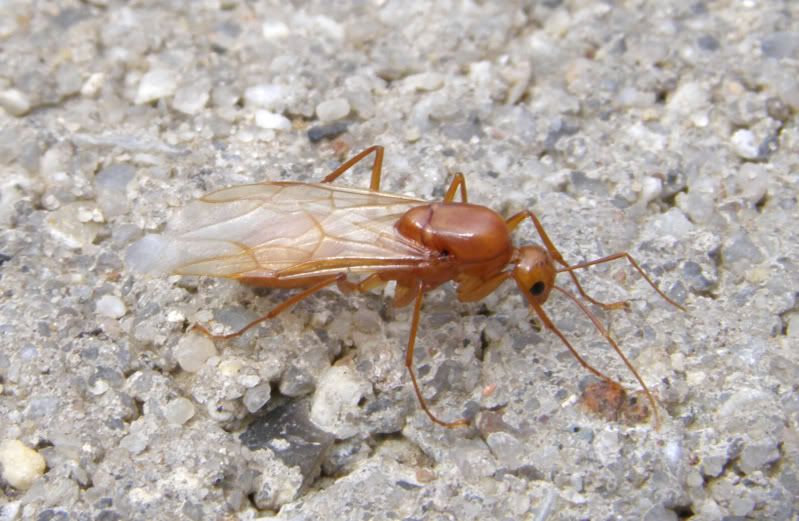
A main difference between the two species is C. castaneus has orange males, (seen above). But no males are present in the colony I have.

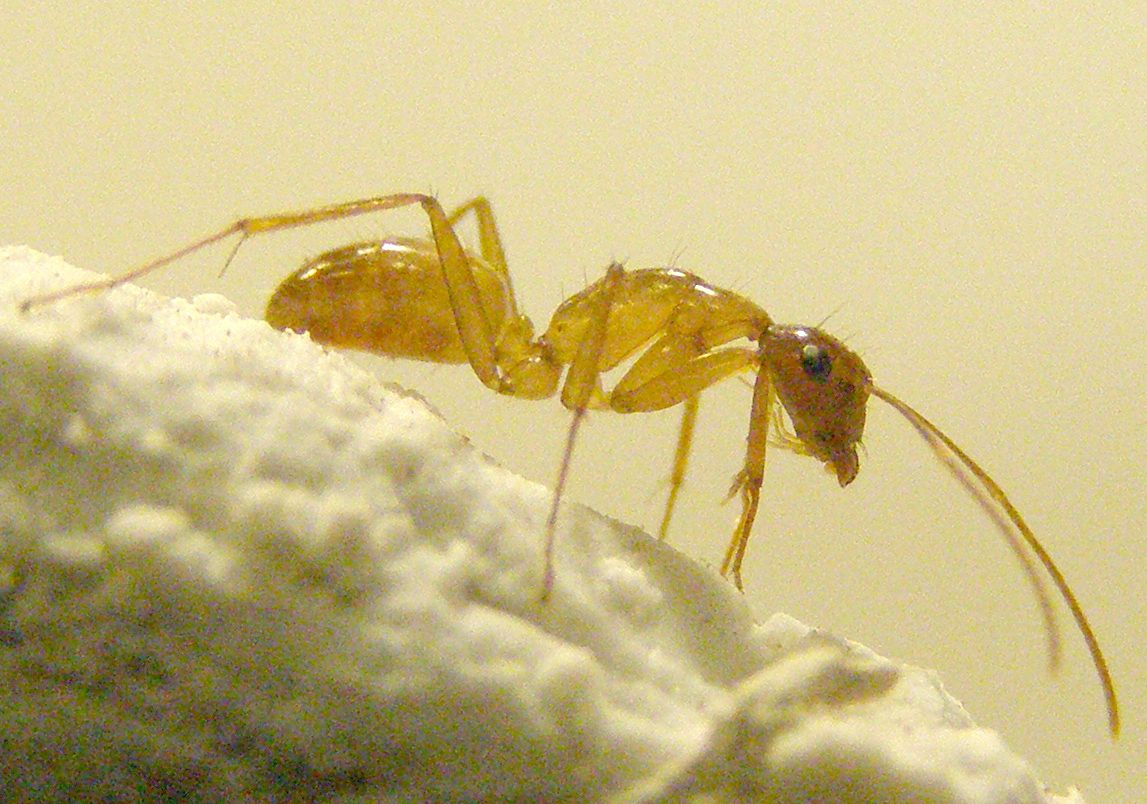
This lighter color and more brilliant oranges is more in line with Camponotus castaneus which is locally abundant. I probably have three colonies in my yard I know of and that's where I caught both queens. But as I look on Ant Web I see things like placement of hairs, length of the maxillary palp, and head shape (currently) are all similar. Actually this worker is hairy enough to be a C. americanus worker but I'm not willing to accept that yet until I start seeing some darker workers.
Even if I'm wrong a second time though C. americanus is just as pretty.
After roughly a day of having built your Tank Setup it should be ready to house a colony of ants. Hold back on decorating it until after the ants have established themselves. This will ensure they "set up shop" and nest in the plaster setup and dont' try building little huts out of bark and stones... the fools. (I once had a colony of Aphaenogaster that decided to stack tiny stones in order to make a nest rather then move into the plaster setup, so hold off on that stuff for now.)
Also it's time to apply the Fluon or 3 in One Oil. A little bit of both goes a long way. So add a few drops to a large cotton ball or crumbled up paper towel. Coat the corners first as best you can. Then go along the top inch of the tank. If you don't...

... this can happen. Actually it's bound to happen sooner or later. An escape proof setup is one that's surrounded by a moat and locked in an air tight chamber. Even scientists have trouble with this. Thankfully ants are more than reasonable, and can easily be swayed back into the setup.
NOTE: Ants that are ill tempered and aggressive are best swayed around with something other then your hand. The same applies for ants that have painful stings.
Ants that spray formic acid were not meant for captivity and can actually die from the putrid odor of the formic acid they spray, besides you don't want that in your room either.
Now onto Adding Ants! Before we begin you should only add Colonies, not queens still working on their first batch of brood. Colonies have workers and presumably a foraging force. Loan queens are a stage behind this step.

Take one colony, in this case Camponotus castaneus...

... say hello to guard ant...

... Then dump colony directly in the entrance of the setup! The end.
Well that wasn't hard at all... okay maybe I should elaborate some.

Once removed from the tube they called home since last June, the ants will scatter looking for cover. Because I dumped them right inside the plaster setup they mostly explored all the tunnels and galleries that are each ideal for a small colony to setup shop. Two things are vital though.

1: The Queen. While only 2 of the 9 workers actually bothered to explore outside the plaster setup, they would have been no significant lose had the queen escaped. The queen is safely doing nothing in one of the chambers. Now that I know that I can focus on getting the 2 workers that were running around back into the nesting area.
(I actually didn't apply the 3 in One Oil until after the ants were in the setup. Oops)

2: The Brood! Camponotus in general tend to lay eggs in batches. Currently they only have 2ed and 3rd instar larva in the nest. And they all fell out of the tube in one big clump. This is great! Usually what happens is some eggs are left in their old test tube setup and I end up either crushing them in an attempt to get them out. Or I have to put the test tube setup back in where the ants can find it. The issue here is their old test tube setup has the colony odor and all the ants will move right back inside the thing regardless of how bright it now is. It smells like home and that's all the ants are interested in. You really don't want either of these things to happen.
The brood is the next generation of workers. Because Camponotus lay eggs in batches this is vital to the colonies survival. When the queen's current work force dies off she's not going to bother foraging for food to build the next one. So it's important the current workers successfully rear new workers before they're die. At the same time allowing them to continue living in their test tube setup isn't good. You may as well have not built a new setup at all.

Just hours after the colony has been dumped they've already found a temporary nesting site. Right now the queen is the closest thing the workers have to a colony odor so they all tend to cluster around her and places that she's been to.

You may notice small groups of workers hanging our randomly too. They eventually disband and rejoin the group that has the queen.

You may see some ants carrying other ants, or in the case of the queen, dragging her. This is a worker that has found a chamber she thinks will be a great nest site. The trouble is convincing the colony. One by one she grabbed each of the workers and brought them to this chamber. The trouble is they disagreed with her and simply left after being let go. A noble effort but the colony said no. Had they liked the new space then the workers she brought here would have joined in the effort to bring the colony here.

Back to their stoop they went. To be honest though I wish they had gone to that chamber instead, but what do I know.

For the first few days don't bother feeding the ants. Stuffing your face when the family tree has been chopped down is considered poor form among ants. Foraging simply isn't done until they have established a nesting site to take the food.

The following day: Condensation can be an issue in plaster setup. It is easily controlled by opening the lid to the setup, but may take time. The temperature of the glass and the plaster, having the light on or off, and how much moisture is in the plaster are all factors. It's not a problem for ants of their size but smaller species can have issues with it sometimes.

Still in the second day the ants begin making edits to the room they've choses to take over. Here an ant gathers some modeling clay I forgot to remove. When you start seeing this behavior it's safe to start decorating. (I added a thing layer of Repti Bark outside to act as the floor to the setup. Feeding should be done on trays so insect corpses don't build up.)

Slowly she builds out the stoop and gets the nest more floor space. Eventually (as I see today) they'll bring in the wood chips I place in as a floor medium. I love seeing ant engineering at it's finest.

The other behavior I see is scouting. I tried feeding them but she wasn't interested. I think she was trying to locate the old nest to be honest. The 3 in One Oil holds, actually she has lots of trouble just climbing the glass now, I'm not sure what that's about. When they were first introduced they had no issue with climbing glass. Before leaving the nest I notice she gives all her stored food to another worker.
And now I would like to address something. The last time I tried keeping a journal like this I had a colony of Camponotus chromaiodes. The thing is though for the longest time I had them misidentified as C. novaeboracensis. So this time I want to get it right. Unfortunately until I see a wider range of workers Color is the only thing I have to go on.

C. americanus tends to have darker traits (as seen above,) it can also be as light as C. castaneus. I don't know of any C. americanus colonies in the area though. I took this picture in Delaware, about an hour away from where I live in New Jersey.

A main difference between the two species is C. castaneus has orange males, (seen above). But no males are present in the colony I have.

This lighter color and more brilliant oranges is more in line with Camponotus castaneus which is locally abundant. I probably have three colonies in my yard I know of and that's where I caught both queens. But as I look on Ant Web I see things like placement of hairs, length of the maxillary palp, and head shape (currently) are all similar. Actually this worker is hairy enough to be a C. americanus worker but I'm not willing to accept that yet until I start seeing some darker workers.
Even if I'm wrong a second time though C. americanus is just as pretty.
Labels:
Ants,
Camponotus,
castaneus,
How To,
journal,
Tank Setup
Sunday, December 13, 2009
How to Build a Tank Setup (Part 1)
Alright because editing the podcast is taking a while I'll post the instructions here first. In this first part I'll explain how to build it. The second part is simple adding ants.

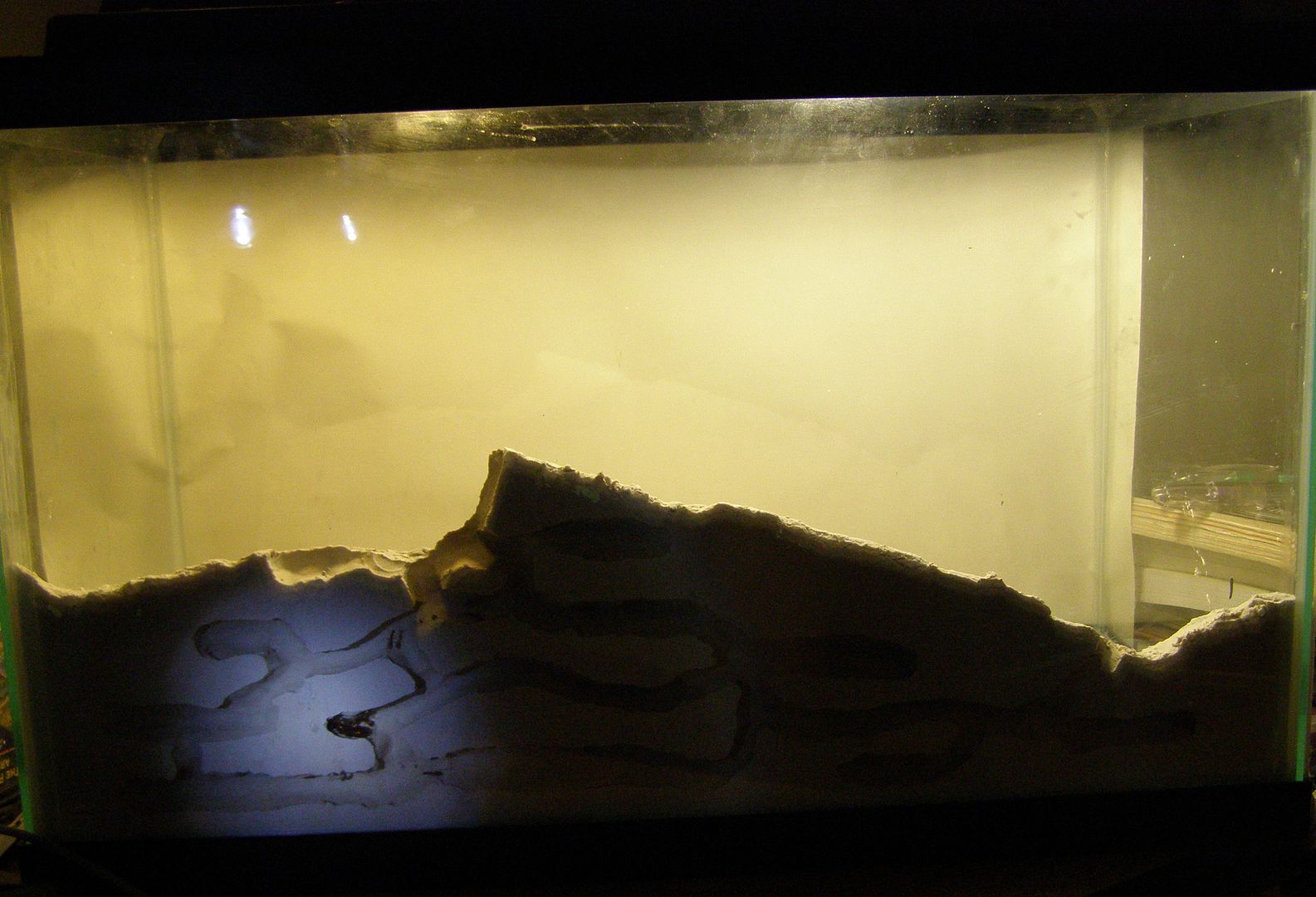
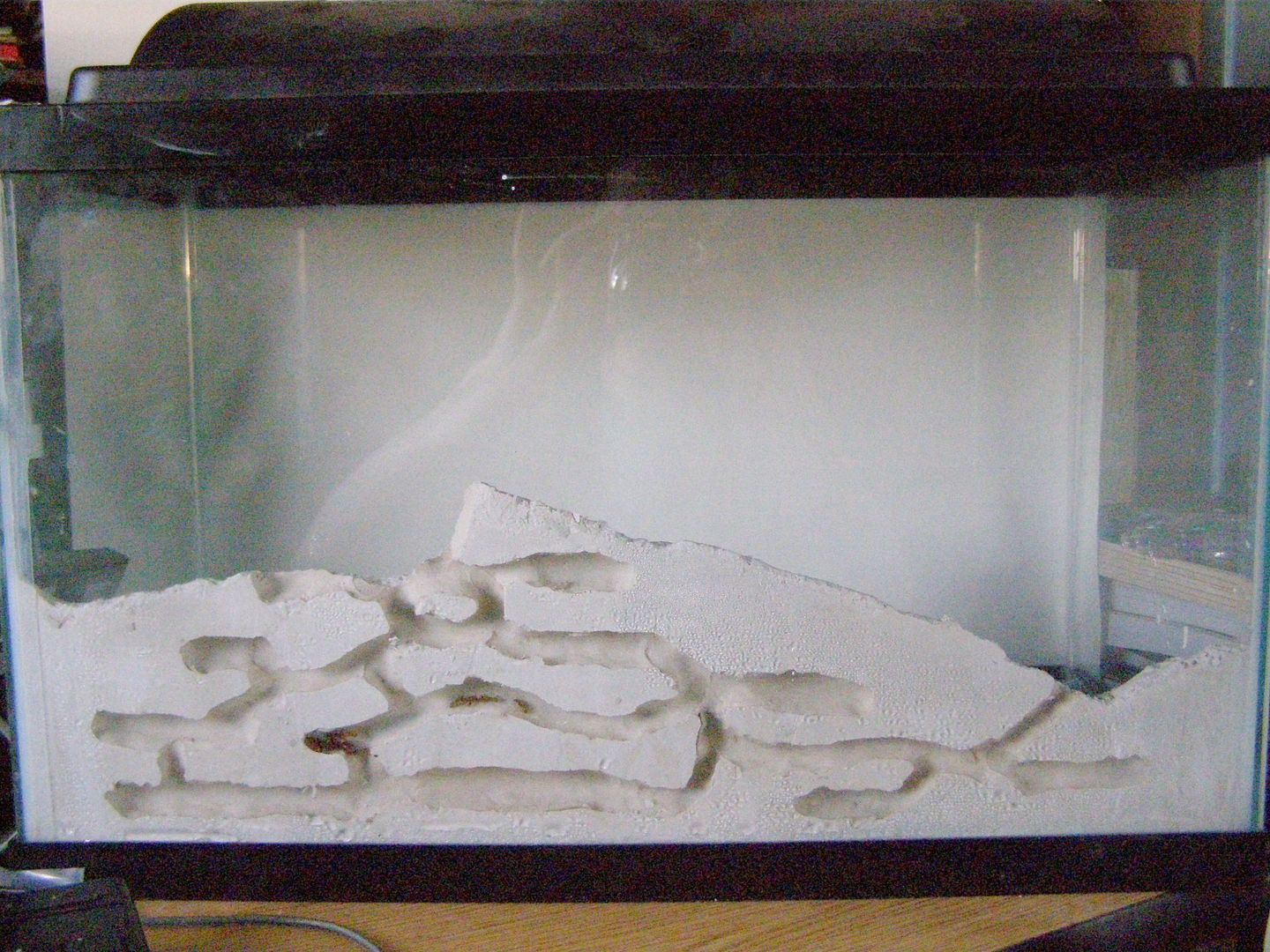
Here is the finished product so you know what you're building.
You'll need:
Wooden Blocks, or space fillers that can be used to both hole the terrarium up and prevent "plaster" from going to unwanted places.
A Terrarium, I think 20 Gallons is what I'm using but I don't know for sure.
A Lid, that should fit as well as possible. It should be solid and not a screen, lights help also.
Modeling Clay, both for making the chambers and to fill in holes in the lid.
3 in One Oil, normally used to lubricate saw blades. There are other brands of course, it's simply a light oil to detour ants away from the edge of the glass. Fluon is the official product you're supposed to use to keep insects inside their setup but it's darn expensive.
An Optional Floor Medium, I used Repti Bark sold in the lizard isle at most pet stores. It's basically large chunks of bark. You can use the colored sands they sell but my experience is that ants don't like walking on sand. Your experience may vary though. I like the bark because the ants will eventually "play" with it and bring some inside the nest to add walls and floors where they like.
And most importantly your choice of either Plaster of Paris, Ytong, Aerated Concrete, or Gypsum, aka Hydrostone. I use Plaster of Paris because it's by far the most widely available. From you local hobby store to the mega-mart hardware chain, chances are you don't need the internet to find Plaster of Paris.
Please Note! Measurements, preparation, safety hazards, and rate of causing cancer may vary! Read the labels! Plaster of Paris is safe to use but contains crystaline silica which can cause cancer. This means don't ingest it! Use gloves and or limit your contact with it, don't build a plaster setup every day, wear a safety mask and or don't breath in the dust when mixing or sanding. Don't mix it in anything you plan to later eat from. This is probably good advice for whatever medium you decide to use because they can all cause skin irritation and so on... Plaster of Paris is also nice because it gives off relatively low heat as it hardens. Some of the other products will actually produce steam as they dry!
This setup requires you to work the plaster as it hardens. You will need the use of "instruments." I suggest the following: a Pointed Stick, a few Large Cotton Balls, a Crumbled up Paper Towel, a Small Piece of Cardboard and possibly a length of plastic tube for blowing but I didn't find this useful that much.
So with all that out of the way let's begin.

Because we want the tunnels to be on the side of the glass, place the terrarium on it's side. Pick a spot about half way down the side (now closest to the table). With the modeling clay roll out an entrance tunnel. Note that the largest ants in North America can fit happily thorough a 1/2 inch tunnel, so they don't need to be that big.

Continue building the nest. It's a good idea to start with hallways that flow to other parts of the nest before going back and adding galleries (rooms) to them.
To the right I've decided to add a second entrance. I've also decided I want the plaster to form an Ant Hill shape. This will require either a wall of modeling clay or some wooden blocks to hold back the plaster. If you don't want the Ant Hill effect it's fine to have it as a Wall instead. Had I gone with a Wall design the second entrance to the right would have to come up much farther.
When you're ready prop the tank at an angle on a wooden block, (a heavy book will also work.) If you're going for a simple Wall look then you're ready to mix and pour the plaster. If you're going for what I did and want an Ant Hill effect then you'll need to sway where the plaster goes as you pour. More wooden blocks at appropriate angles or building walls/dams out of modeling clay should be added.

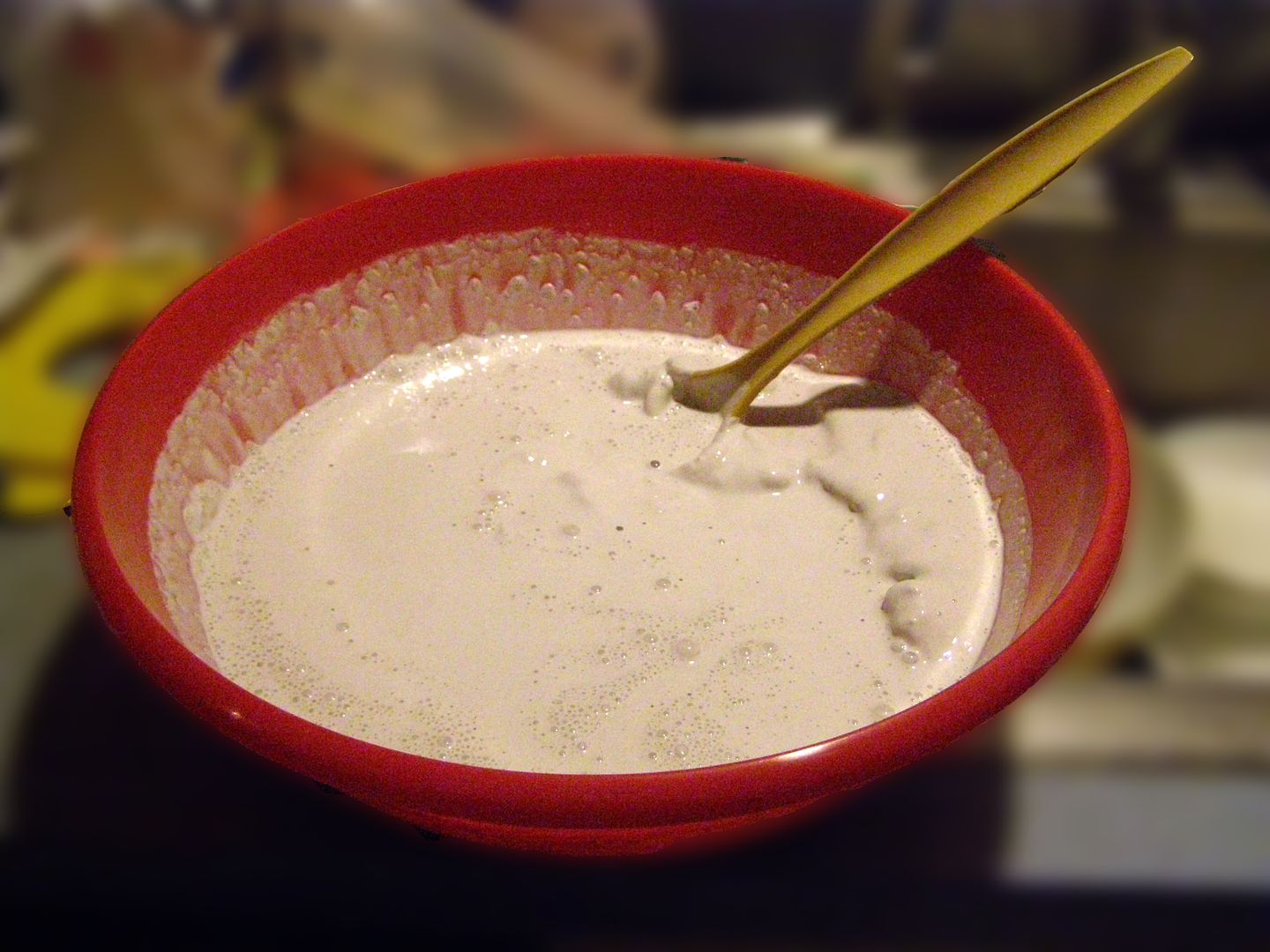
Plaster of Paris mixes at a 2:1 ratio. Meaning for ever 2 cups Plaster I have to mix in 1 cup water. If you're not using Plaster of Paris this ratio might be different. Consult directions.
Plaster of Paris should be mixed for at least 5 minutes. After 10 minutes it's started hardening and you need to get it in the Tank.

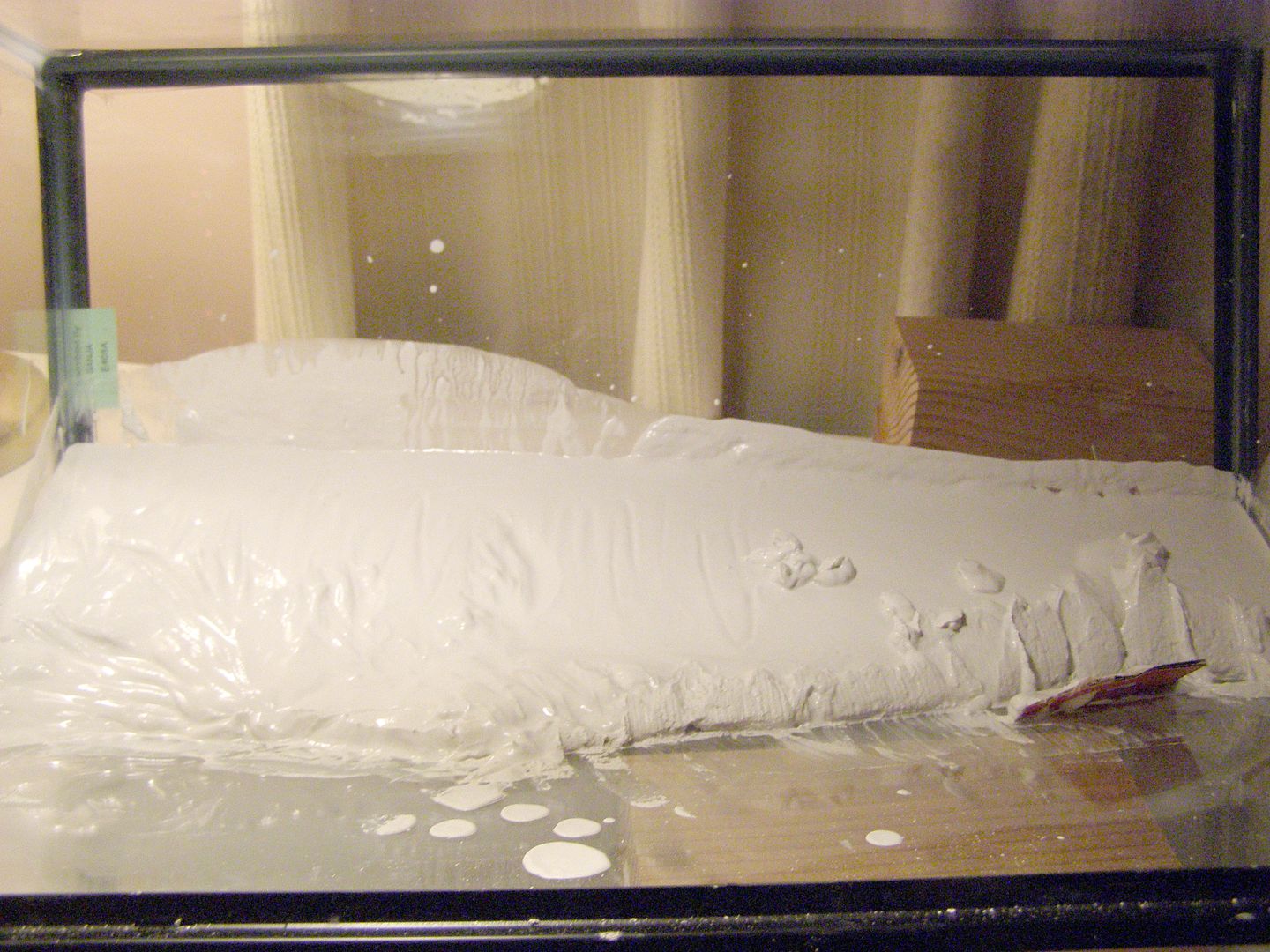
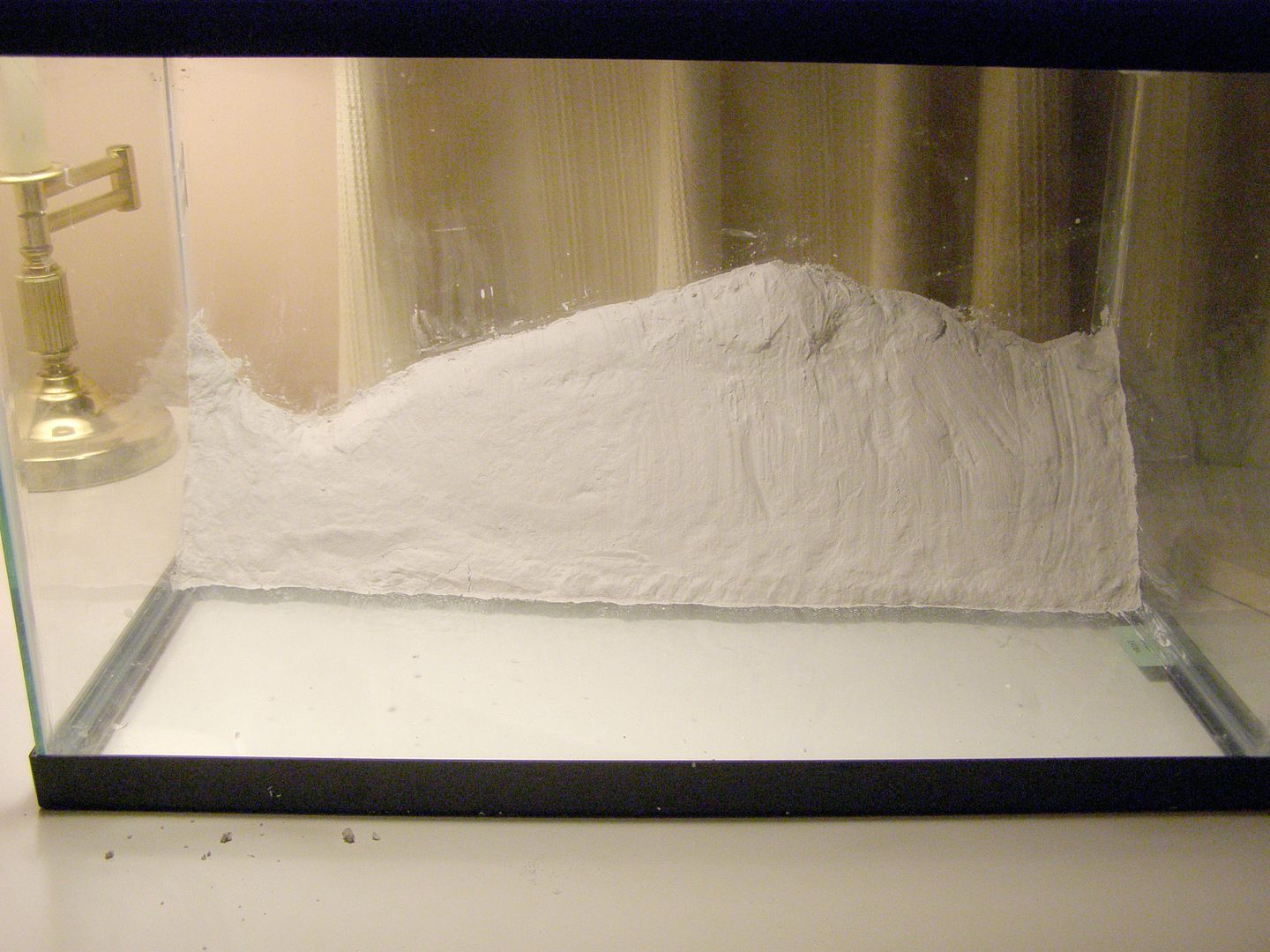
It's hard to tell from this photo but the Terrarium is tilted forward now and being held up by the wooden block under it (lower right). There were also wooden blocks in the tank to sway the plaster into it's current shape. The plaster was poured in here and allowed 10 minutes to set up.

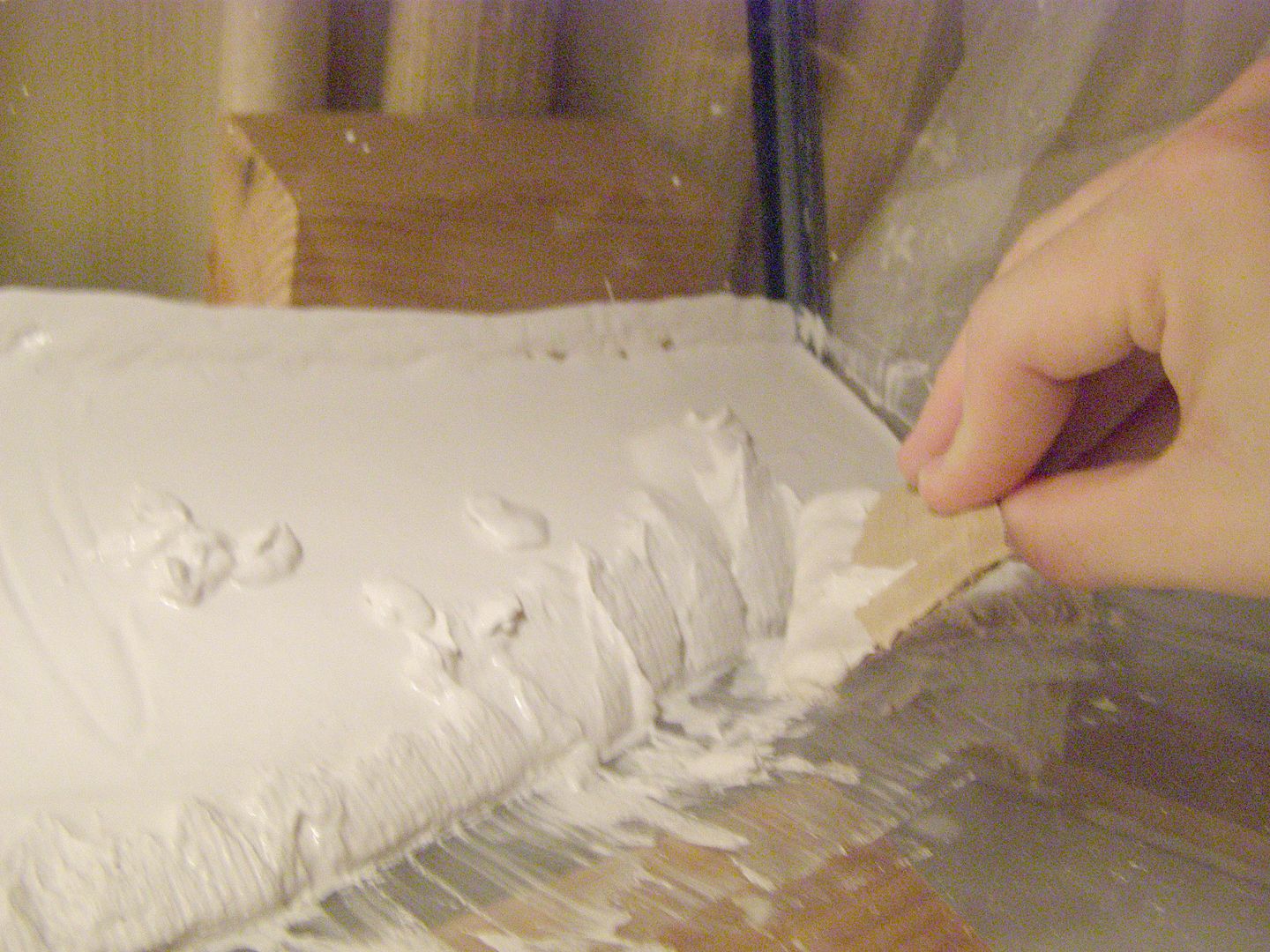
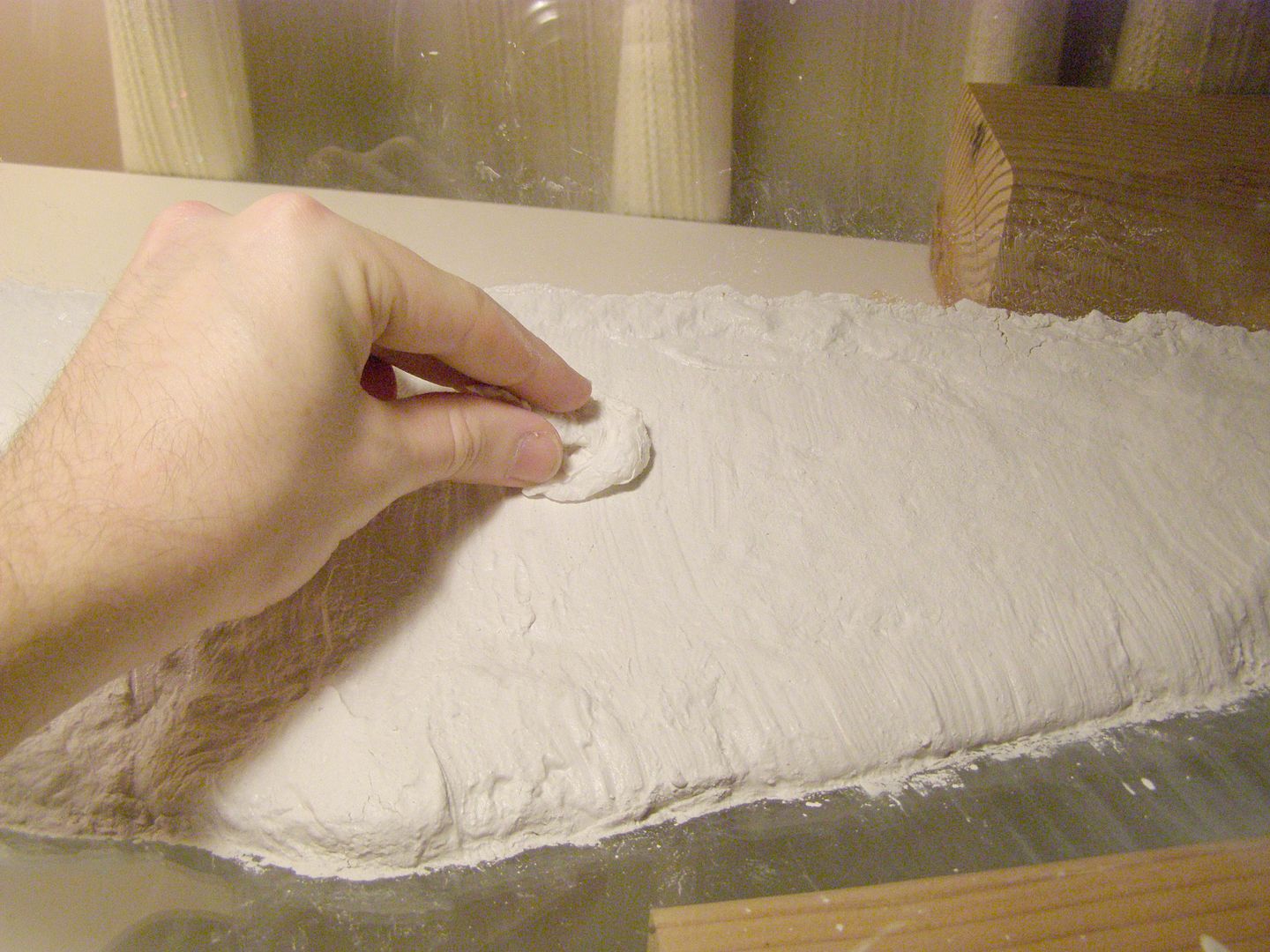
After 10 minutes (give or take) you're ready to start shaping the plaster. It should be hard enough now that it's turning from a gooey slime to a paste. Add texture with piece of cardboard to push the plaster back as needed.

There is a line effect from the ridges in the cardboard that looks nice but we can do better.

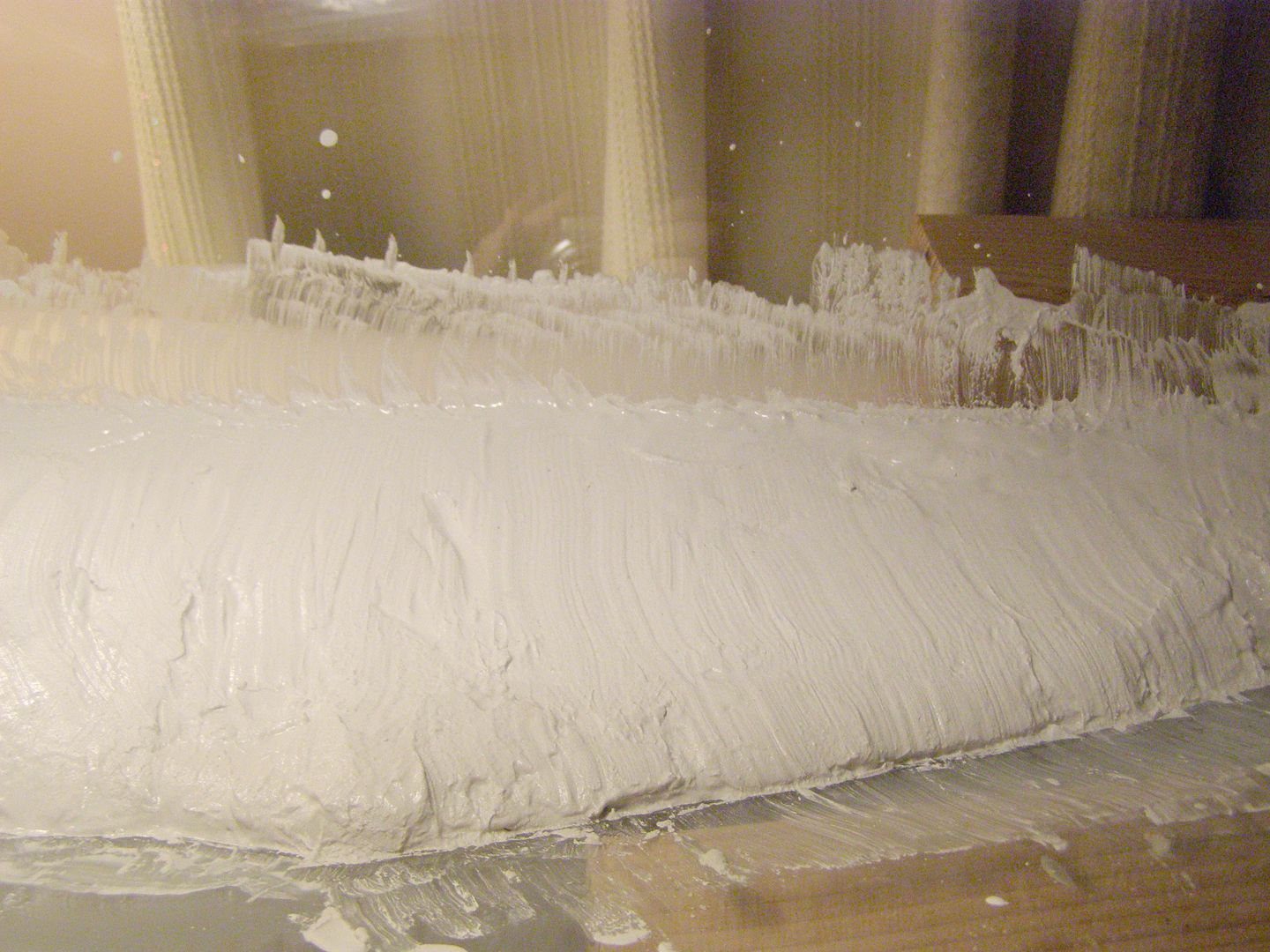
Dabbing with a large cotton ball or crumbled up paper towel will soften the lines and add a rock like texture. Feel free to clean up the glass too. If you don't you'll have tons of tiny flakes of plaster in your setup. It's best to work those in while they're still wet.

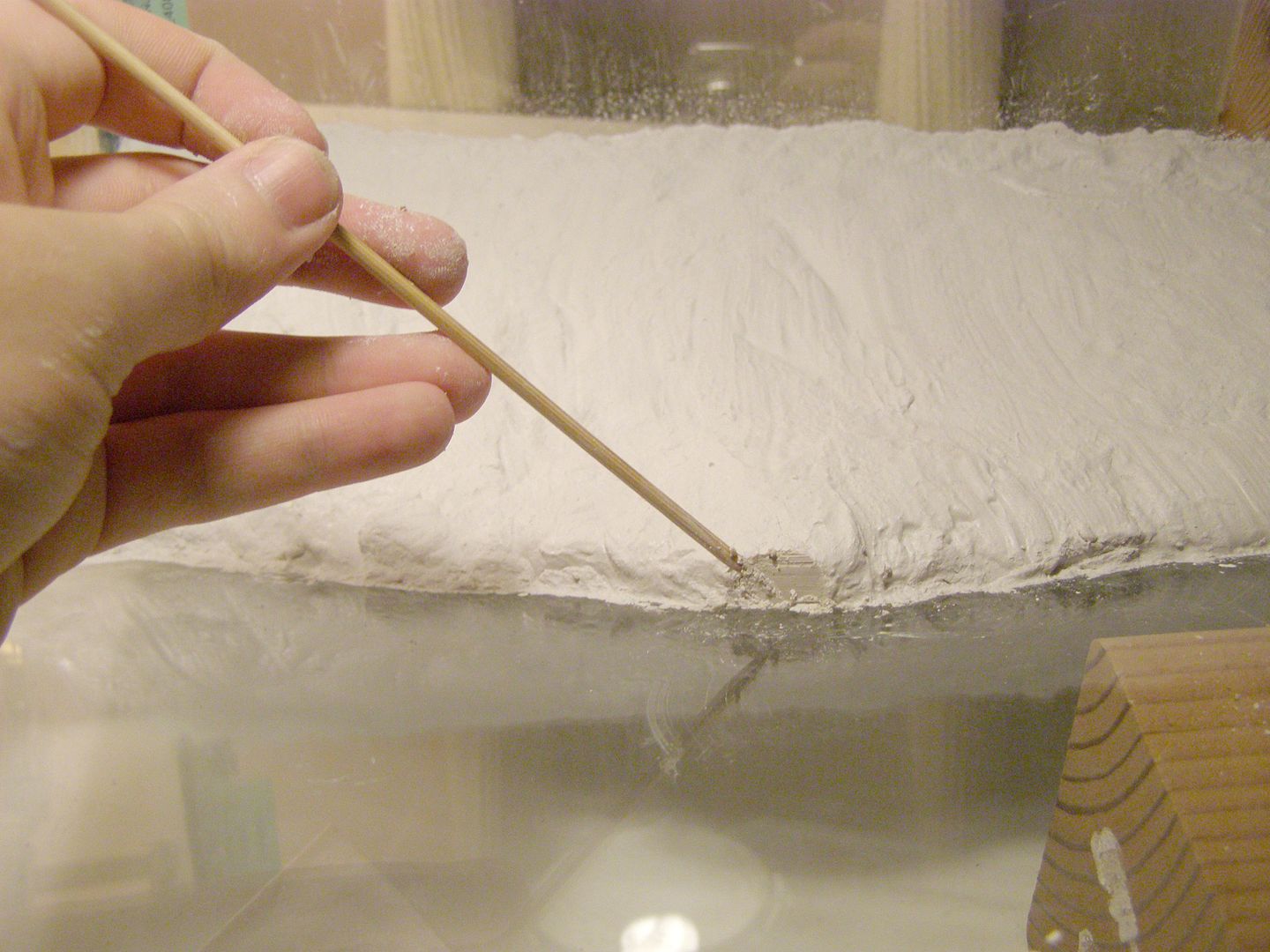
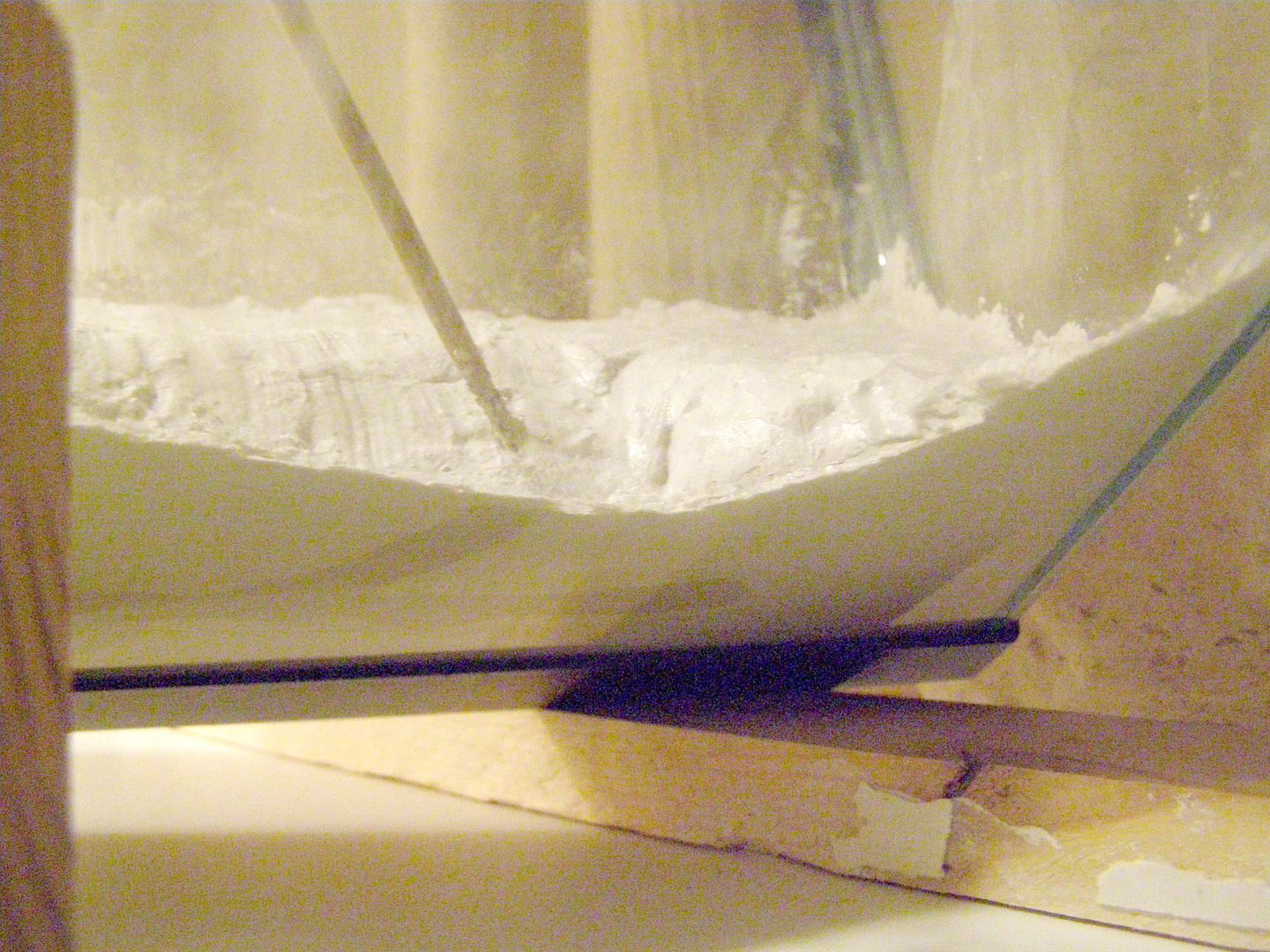
Before it hardens completely it's important to find the entrance(s). They are easily seen by looking under the setup. The pointed stick can be used to neatly scrape off a clean line.

Don't forget the other entrance if you made one.

After 20 minutes of fine poking you should be reasonably pleased with the exterior look.

Allow another hour for it to get good and hard. This will reduce massive damage thanks to actions for the following step.

Now that it's ready we can continue. All that's really needed is to remove the clay. The trouble is we've made a setup that's perfectly flush with the sides of the glass. And even when the tank is turned completely upside down it won't budge. (I tried)
The easy solution would have been to put a wooden block to one side of the tunnels before we started pouring the plaster. After allowing it to set we could have simply removed the wooden block at this stage and had ample room to move the setup. The only thing holding it in place would be the clay on the glass, but that has to come out of there anyhow. The space the block of wood filled could later be filled in with more plaster.
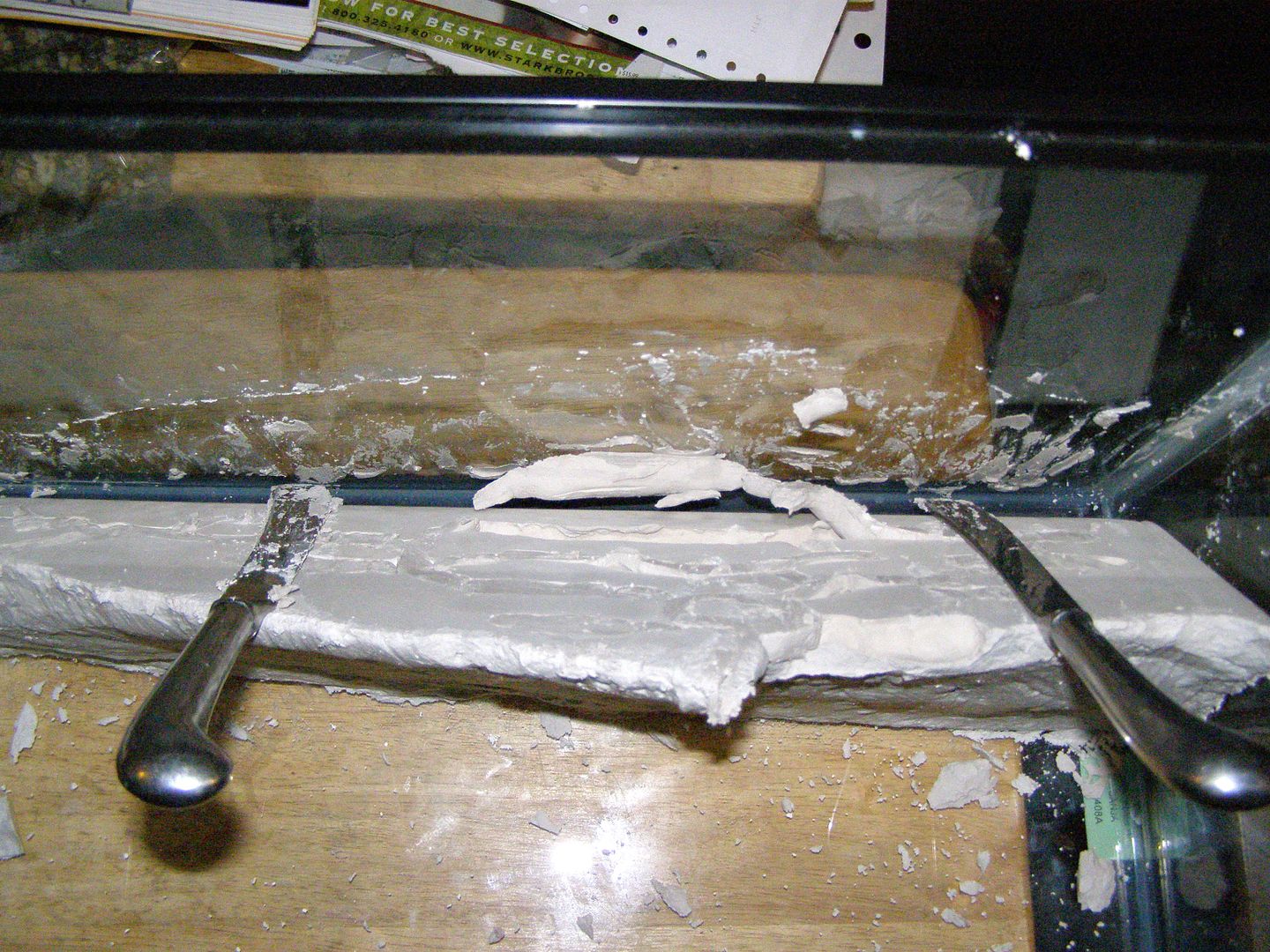
I didn't do that so we're stuck using a thin piece of metal to pry it back. In this case I used two very odd looking long butter knives. It's not their proper name but they're a solid piece of metal, meaning the dull blade doesn't bend easily.

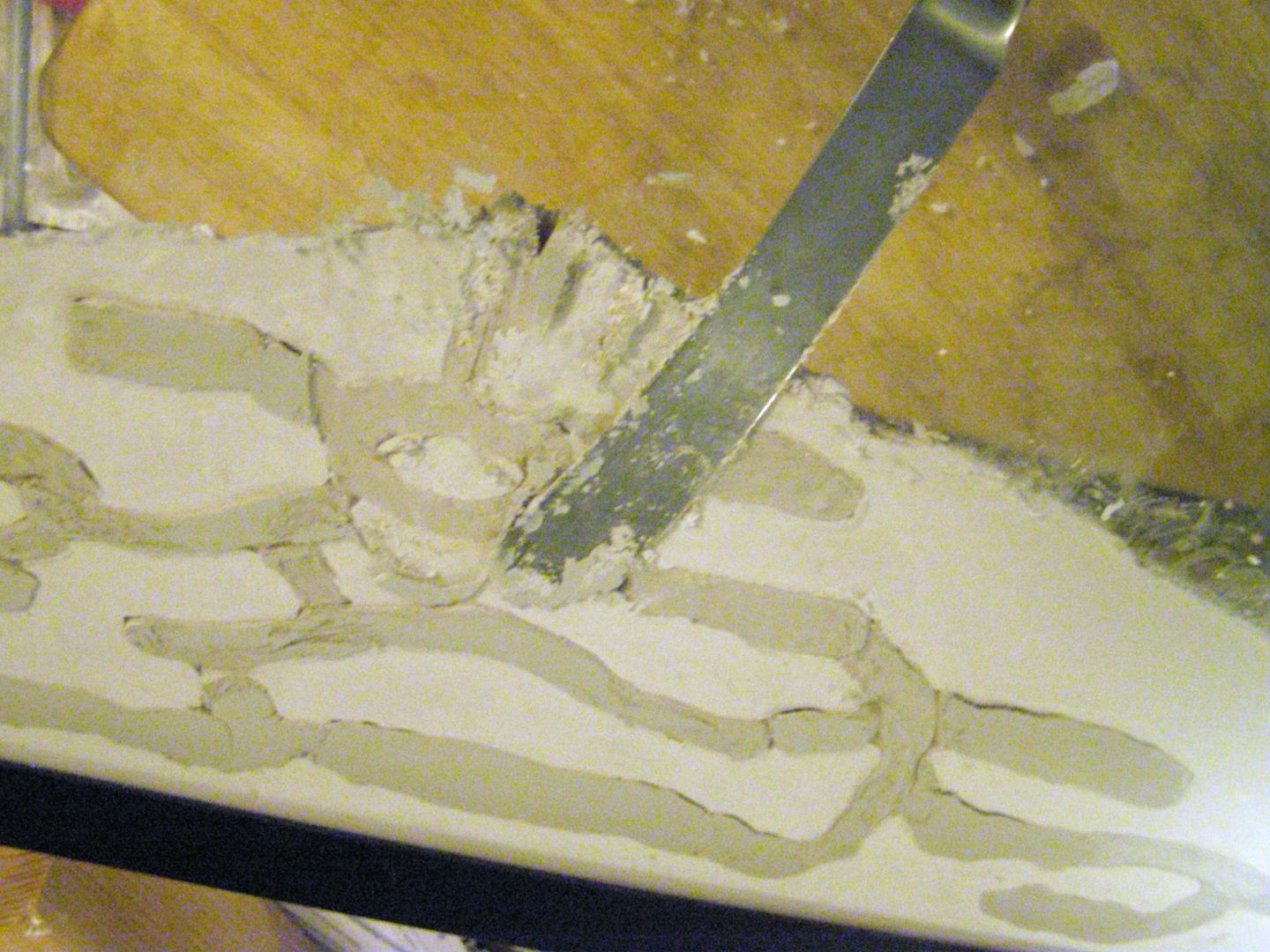
For the most part the plaster is a now a solid chunk of rock. But remember it's weakest at the edges. So you need to work the knife/piece of metal down several inches before attempting to pry it from the side. The Modeling Clay is still very soft so I suggest starting from the entrance(s) and working your way out from there.

Success! It doesn't move so much as turn away from the glass. Also note that half the main entrance tunnel and the top of a room chipped off. A small price to pay in my opinion.

Remove the clay from the setup, and clean the glass as best you can. Modeling clay will dissolve when rubbed with a wet paper towel. You'll still need to go back and dry it up of course, but it cleans almost perfectly.
Notice that the setup is still viable inside the tank at this time. Because it was molded to be flush with the sides there's no way of getting it out of the tank. So leave it there for now.

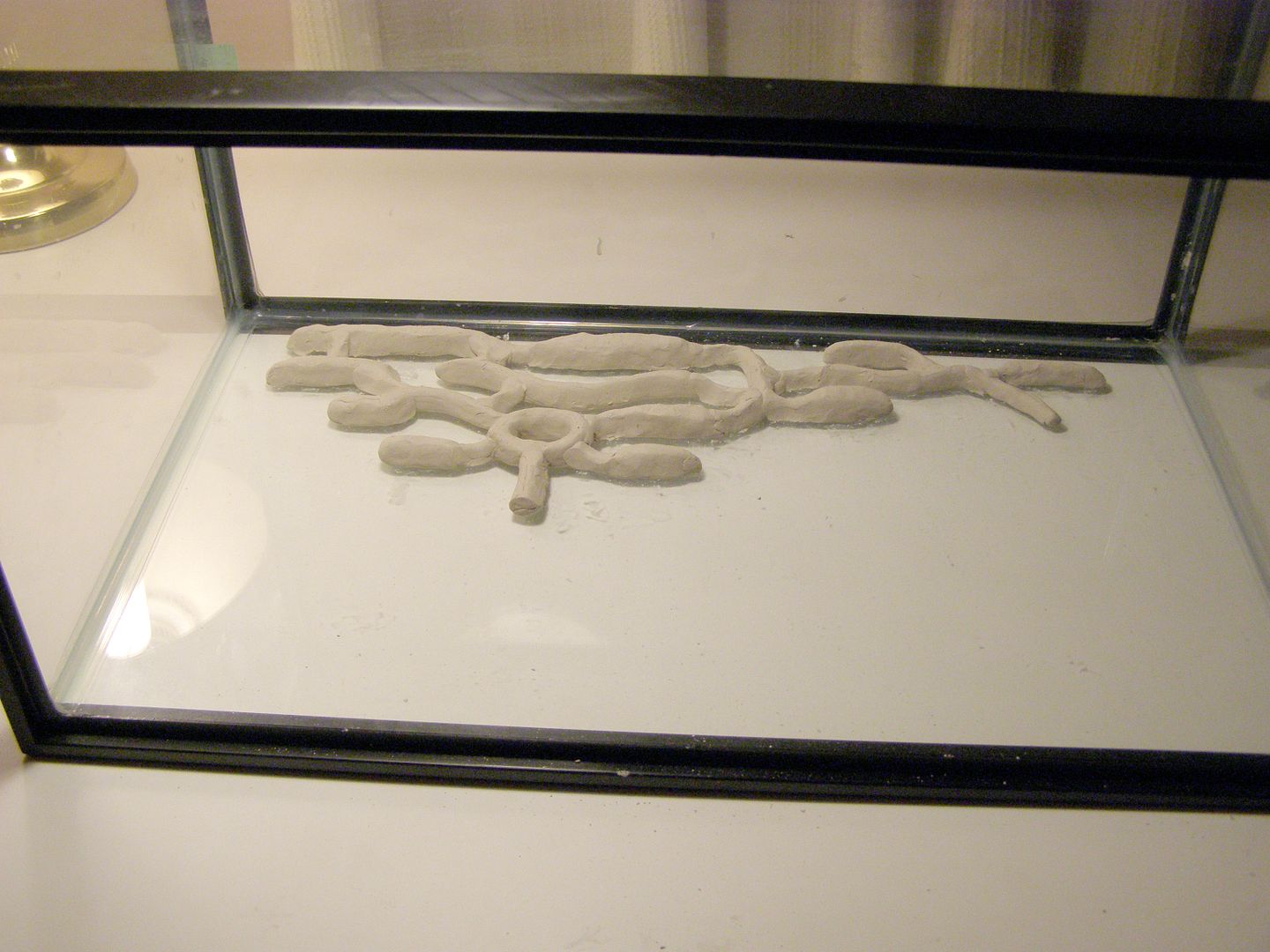
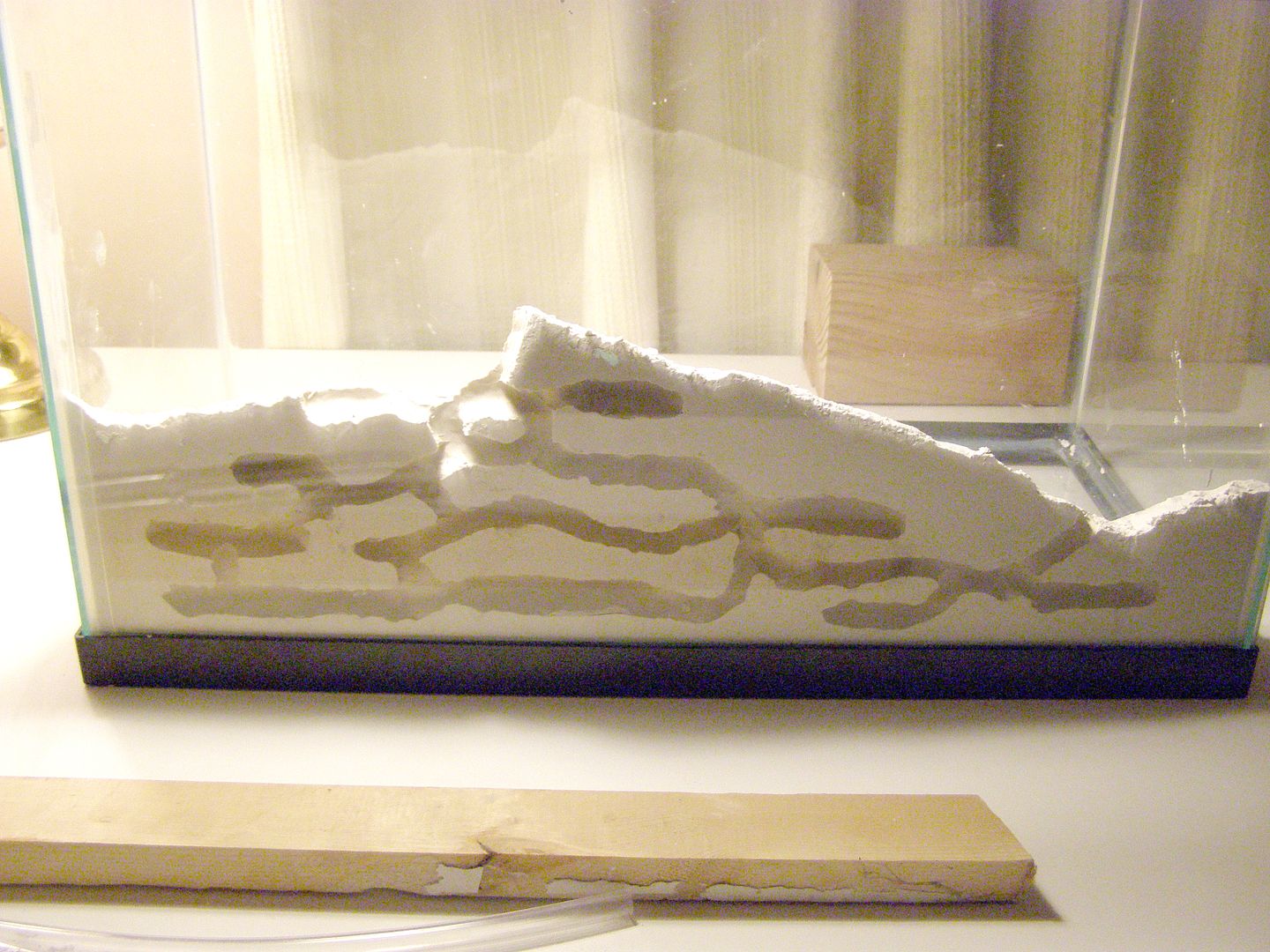
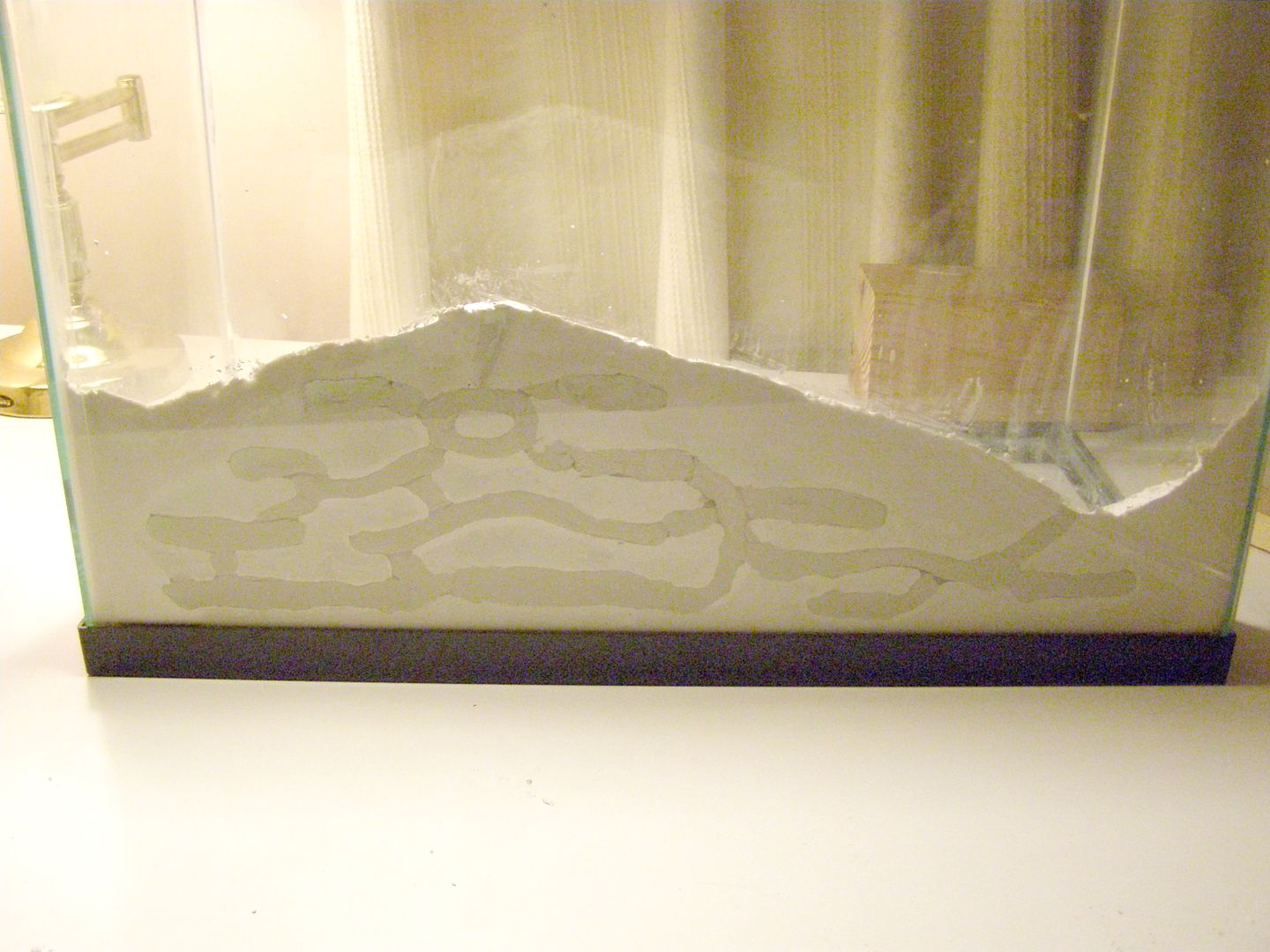
Now that everything is cleaned up you can see what we're left with. The damaged top room and entrance area is hardly noticeable.
I also used a small hand held dust vac to get pieces of plaster out of there but they could have been swept out easy enough.

I did attempt to fix it with some plaster but found this to be impossible. The wet plaster immediately dries when it touches the dry plaster. Rather than living with a cracked setup I simply threw the pieces away and moved on.

In the next post I will discuss adding ants.

Here is the finished product so you know what you're building.
You'll need:
Wooden Blocks, or space fillers that can be used to both hole the terrarium up and prevent "plaster" from going to unwanted places.
A Terrarium, I think 20 Gallons is what I'm using but I don't know for sure.
A Lid, that should fit as well as possible. It should be solid and not a screen, lights help also.
Modeling Clay, both for making the chambers and to fill in holes in the lid.
3 in One Oil, normally used to lubricate saw blades. There are other brands of course, it's simply a light oil to detour ants away from the edge of the glass. Fluon is the official product you're supposed to use to keep insects inside their setup but it's darn expensive.
An Optional Floor Medium, I used Repti Bark sold in the lizard isle at most pet stores. It's basically large chunks of bark. You can use the colored sands they sell but my experience is that ants don't like walking on sand. Your experience may vary though. I like the bark because the ants will eventually "play" with it and bring some inside the nest to add walls and floors where they like.
And most importantly your choice of either Plaster of Paris, Ytong, Aerated Concrete, or Gypsum, aka Hydrostone. I use Plaster of Paris because it's by far the most widely available. From you local hobby store to the mega-mart hardware chain, chances are you don't need the internet to find Plaster of Paris.
Please Note! Measurements, preparation, safety hazards, and rate of causing cancer may vary! Read the labels! Plaster of Paris is safe to use but contains crystaline silica which can cause cancer. This means don't ingest it! Use gloves and or limit your contact with it, don't build a plaster setup every day, wear a safety mask and or don't breath in the dust when mixing or sanding. Don't mix it in anything you plan to later eat from. This is probably good advice for whatever medium you decide to use because they can all cause skin irritation and so on... Plaster of Paris is also nice because it gives off relatively low heat as it hardens. Some of the other products will actually produce steam as they dry!
This setup requires you to work the plaster as it hardens. You will need the use of "instruments." I suggest the following: a Pointed Stick, a few Large Cotton Balls, a Crumbled up Paper Towel, a Small Piece of Cardboard and possibly a length of plastic tube for blowing but I didn't find this useful that much.
So with all that out of the way let's begin.

Because we want the tunnels to be on the side of the glass, place the terrarium on it's side. Pick a spot about half way down the side (now closest to the table). With the modeling clay roll out an entrance tunnel. Note that the largest ants in North America can fit happily thorough a 1/2 inch tunnel, so they don't need to be that big.

Continue building the nest. It's a good idea to start with hallways that flow to other parts of the nest before going back and adding galleries (rooms) to them.
To the right I've decided to add a second entrance. I've also decided I want the plaster to form an Ant Hill shape. This will require either a wall of modeling clay or some wooden blocks to hold back the plaster. If you don't want the Ant Hill effect it's fine to have it as a Wall instead. Had I gone with a Wall design the second entrance to the right would have to come up much farther.
When you're ready prop the tank at an angle on a wooden block, (a heavy book will also work.) If you're going for a simple Wall look then you're ready to mix and pour the plaster. If you're going for what I did and want an Ant Hill effect then you'll need to sway where the plaster goes as you pour. More wooden blocks at appropriate angles or building walls/dams out of modeling clay should be added.

Plaster of Paris mixes at a 2:1 ratio. Meaning for ever 2 cups Plaster I have to mix in 1 cup water. If you're not using Plaster of Paris this ratio might be different. Consult directions.
Plaster of Paris should be mixed for at least 5 minutes. After 10 minutes it's started hardening and you need to get it in the Tank.

It's hard to tell from this photo but the Terrarium is tilted forward now and being held up by the wooden block under it (lower right). There were also wooden blocks in the tank to sway the plaster into it's current shape. The plaster was poured in here and allowed 10 minutes to set up.

After 10 minutes (give or take) you're ready to start shaping the plaster. It should be hard enough now that it's turning from a gooey slime to a paste. Add texture with piece of cardboard to push the plaster back as needed.

There is a line effect from the ridges in the cardboard that looks nice but we can do better.

Dabbing with a large cotton ball or crumbled up paper towel will soften the lines and add a rock like texture. Feel free to clean up the glass too. If you don't you'll have tons of tiny flakes of plaster in your setup. It's best to work those in while they're still wet.

Before it hardens completely it's important to find the entrance(s). They are easily seen by looking under the setup. The pointed stick can be used to neatly scrape off a clean line.

Don't forget the other entrance if you made one.

After 20 minutes of fine poking you should be reasonably pleased with the exterior look.

Allow another hour for it to get good and hard. This will reduce massive damage thanks to actions for the following step.

Now that it's ready we can continue. All that's really needed is to remove the clay. The trouble is we've made a setup that's perfectly flush with the sides of the glass. And even when the tank is turned completely upside down it won't budge. (I tried)
The easy solution would have been to put a wooden block to one side of the tunnels before we started pouring the plaster. After allowing it to set we could have simply removed the wooden block at this stage and had ample room to move the setup. The only thing holding it in place would be the clay on the glass, but that has to come out of there anyhow. The space the block of wood filled could later be filled in with more plaster.
I didn't do that so we're stuck using a thin piece of metal to pry it back. In this case I used two very odd looking long butter knives. It's not their proper name but they're a solid piece of metal, meaning the dull blade doesn't bend easily.

For the most part the plaster is a now a solid chunk of rock. But remember it's weakest at the edges. So you need to work the knife/piece of metal down several inches before attempting to pry it from the side. The Modeling Clay is still very soft so I suggest starting from the entrance(s) and working your way out from there.

Success! It doesn't move so much as turn away from the glass. Also note that half the main entrance tunnel and the top of a room chipped off. A small price to pay in my opinion.

Remove the clay from the setup, and clean the glass as best you can. Modeling clay will dissolve when rubbed with a wet paper towel. You'll still need to go back and dry it up of course, but it cleans almost perfectly.
Notice that the setup is still viable inside the tank at this time. Because it was molded to be flush with the sides there's no way of getting it out of the tank. So leave it there for now.

Now that everything is cleaned up you can see what we're left with. The damaged top room and entrance area is hardly noticeable.
I also used a small hand held dust vac to get pieces of plaster out of there but they could have been swept out easy enough.

I did attempt to fix it with some plaster but found this to be impossible. The wet plaster immediately dries when it touches the dry plaster. Rather than living with a cracked setup I simply threw the pieces away and moved on.

In the next post I will discuss adding ants.
Labels:
Ants,
How To,
Tank Setup
Subscribe to:
Posts (Atom)