For the past several years now, there has been this one hive in my yard that would not die! They had all the hardiness traits that bee breeders look for with the exception of their mean temperament. There were some years where I didn't feed them at all before winter and they survived all on their own. But I'd noticed their guard bees would forgo the usual buzz warning other hives typically give, and move right on to stinging. So part of me is sad they're gone, but the other half is glad so I can finally setup the area to have hives there.
On one occasion I recall standing between the hive and our raspberry patch and witnessing a guard bee fly right at me as I knelt to pick some raspberries; thankfully a leaf to the plant was in the way and the bee started attacking it instead of me! Yikes! On another occasion I had a friend over who was interested in becoming a beekeeper. So we opened two hives, and the first I don't think I needed to smoke at all. They were calm and docile. Pandora's box on the other hand was up in arms the moment I lifted the lid. In recent years the hive had cooled down a bit, and I wasn't getting as many randoms tings (which at its worse was 4 for the whole year), and they'd become more tolerable. But bees really aren't supposed to bee that in your face.
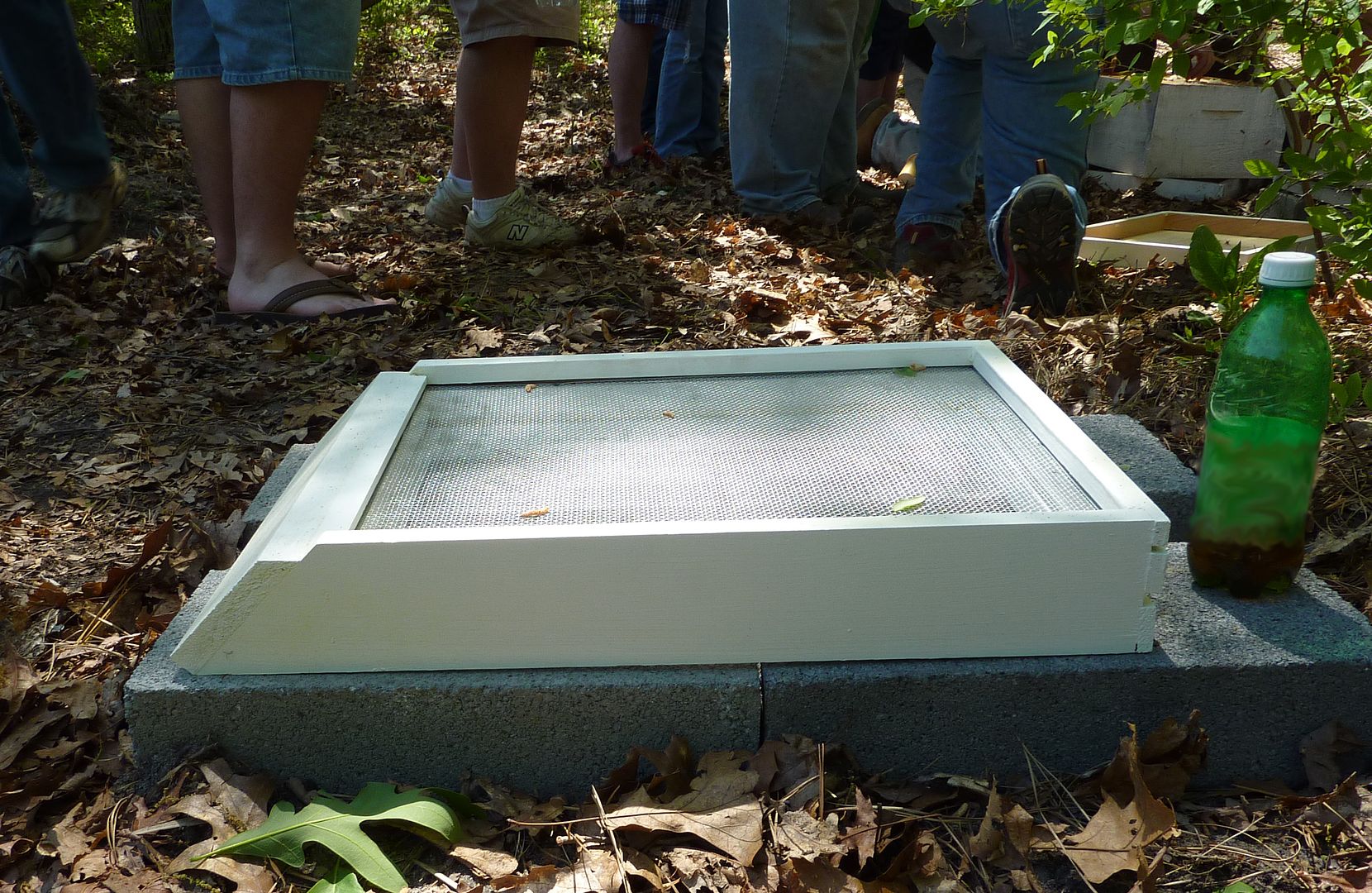
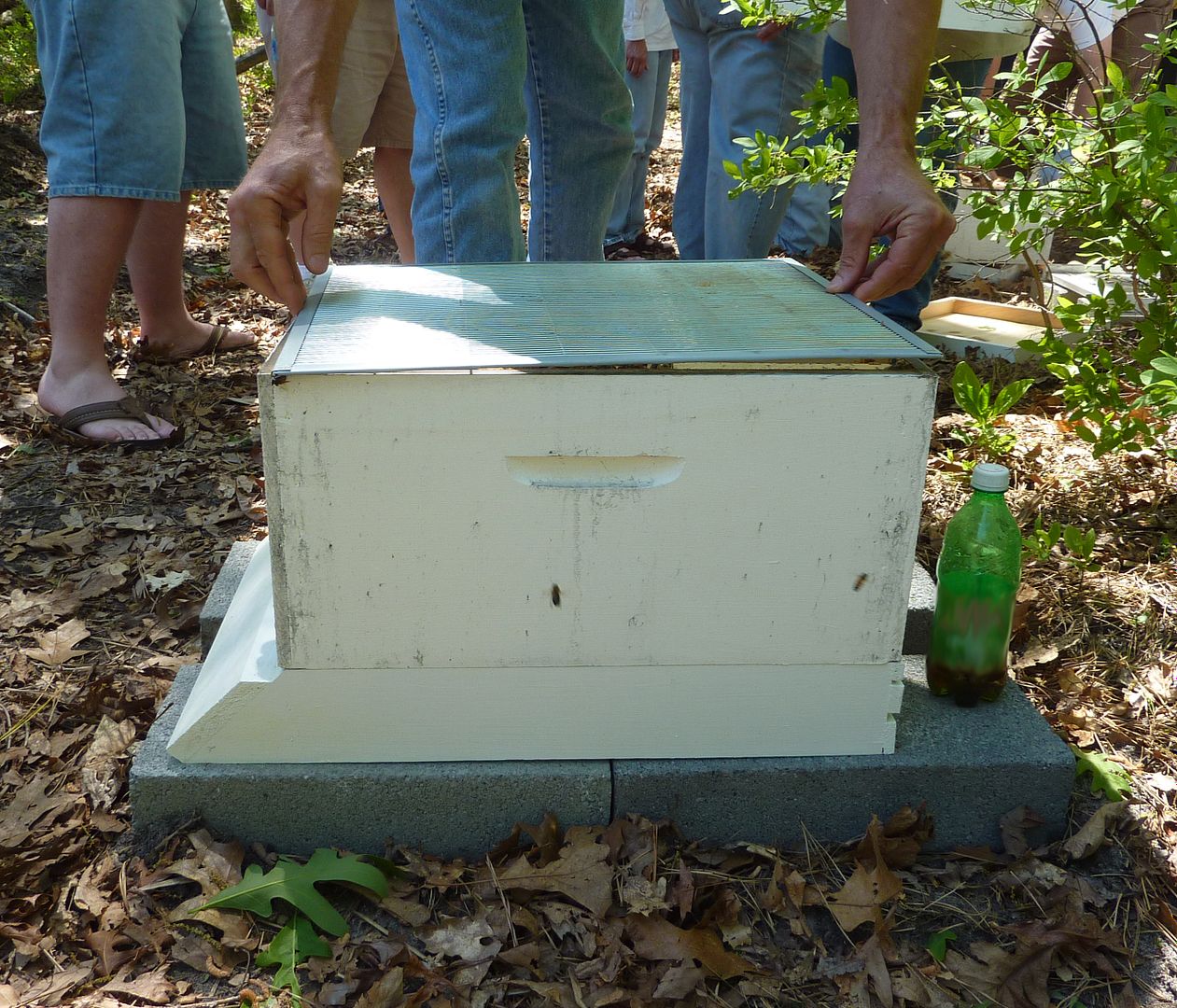
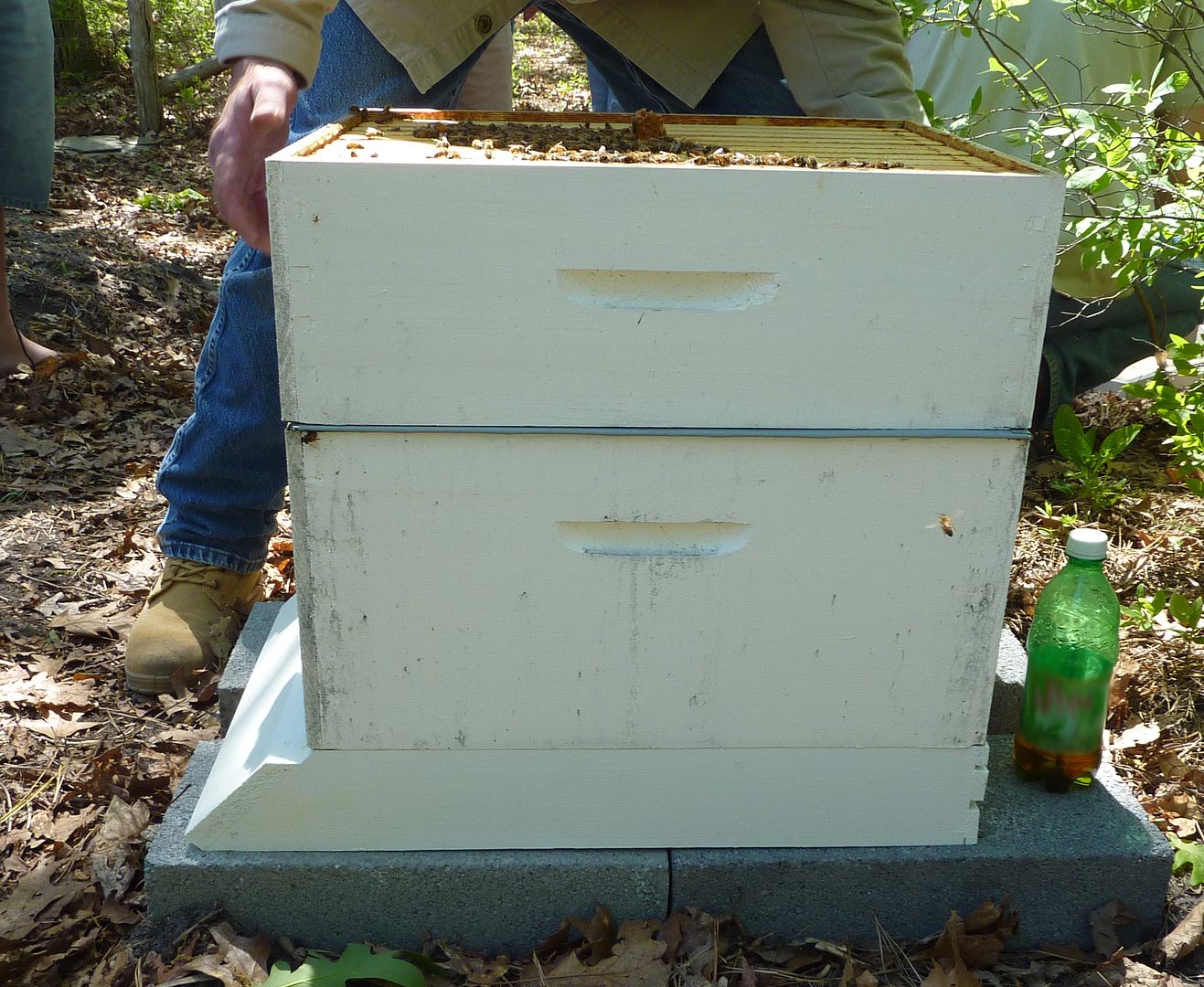
This hive dates back to when I first took over beekeeping for my dad (maybe 8 or 10 years ago). In all honestly he wasn't that good at it, and I wasn't much better. We rarely looked into the bottom boxes and this is what happens when you don't do that. They'd built so much "bur" comb that you can't see the frames below! Their temperament had nothing to do with this of course, even calm hives can go nuts with wax production. But because they'd connected the frames to both boxes together I wasn't able to solve the temperament issue by replacing the queen, or splitting them, or anything else that would have solved the problem. Beekeepers are supposed to remove bur comb as they find it during each inspection every 2 to 6 weeks or so.
There was about an inch of bur comb, and you can tell from how black it is that it's very old. While it was easy to get the boxes separated in winter, over the summer it's virtually impossible short of a lumberjack's crosscut saw. The wax turns soft and gummy, holding everything together. I had attempted to do it one year, and I'd never seen them so angry. They don't like it when you tear apart the nursery.
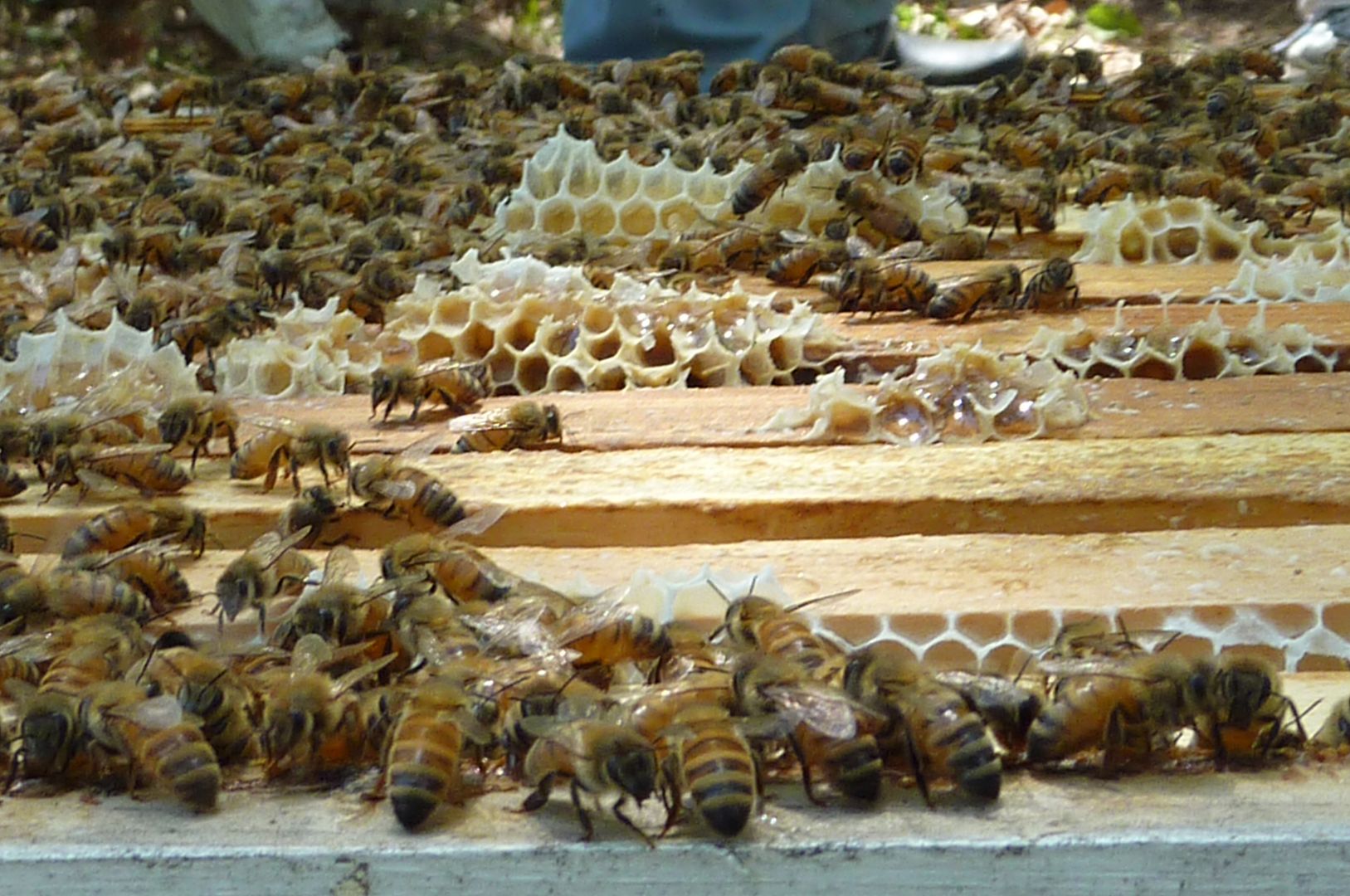
When I went into the hive, I discovered they were honey bound which explains why I only harvested 18 jars last year, whereas 60+ had been the norm in previous years. They must have hated the plastic frames in their supers that much. They also had two frames devoted to drone production which was a bit much. Drones take up the attention of about three nurse bees, which is a drain on the hive overall.
Cause of Death: Not enough workers to keep them warm in the winter. The queen didn't have enough cells to lay and maintain a good amount of bees to keep them warm over the winter. In previous years I'd left a drawn out super on top. This is a box used to for the bees to fill with honey, that's normally removed after harvesting each summer. They probably used this extra space to move their stores up there and give the queen more room to lay. (Though a long list of problems over the years certainly didn't help things.)
This is a different hive that also didn't make it through the winter. I suspect they may have been robbed out in the autumn and all the bees starved back in January. Starvation is easy to see: there's no honey next to the cluster, and all the dead bees have their heads shoved into cells in an effort to keep warm.
Note the queen here in the middle. It's a real shame this hive failed. We'd caught the swarm last spring as just a hand full of bees. Most of the swarm had died to cold weather before we were called about getting it. This queen went on to rebound and produced an amazing hive. I'd never seen such a small amount of bees turn into such a strong hive in one year.
As I cleaned up the two hives I lost, I started getting robber bees. Their primary target was for the capped honey, but also I found a few robbing the pollen which I'd never seen before. Pandora's box had two frames of pollen and I don't mind them taking it. It was mostly golds, browns, and yellows, and nothing unique, typical autumn sources I'm sure. (Some plants produce blue, white, pink, green, or red pollen but bees rarely work them enough to find it in the hive for long.)
"Overall, elevated expression of pesticide response genes was not observed."
This little sentance is all I would have needed to read. You see, I've been a firm believer that CCD was simply a pesticide issue for years now and no one was caring because it was likely happening on crops that don't use honey bee pollination, however the bees were still using the crop for food or water anyhow. When you have a pesticide like neonicotinoides out on the market that stay active for 9 months inside the plant, that sounds strong enough to wipe out a few hives to me.
So what that one sentance means is, insecticides are a separate problem and CCD has some other elusive cause. Those genes should have been active if pesticides were present. Seriously, you'd think a company like Bayer would be propagandizing the hell out of that study! Do they like being the bad guys?
Going back to the study linking viruses and fungi to CCD I still have trouble understanding the findings in that lower chart. And my concerns still stand. Without knowing more it really does seem like something got to their samples and the virus fungi invasion is a result. Maybe they weren't feeding their samples and thats why so many of their control bees died? How great would it be if online studies included videos detailing their work? I need to start YouTube for scientific studies or something.
I would like to thank Alex Wild for setting the me straight. His blog at Myrmecos.net is where I found the study explaining the pesticide thing.
And another thing! Why did 40% of their control die after 14 days. Each group was comprised of young worker bees 3 days old or younger (they can't fly at that age and are easy to handle). Honey bee workers normally live 30 to 60 days. Why did 40% of their control die after 14 days! Why is the difference between having one infestation over both at the same time only 10% after a 14 day period.
The article claims a hive can survive if they only have one of either the fungi or the virus. Their control should have had a survival rate above or around 90%, the virus and fungi separately should have been higher as well. It's hard to bounce back when more than half of the hive dies off after 14 days, worker bees aren't even foraging until day 12. What we're seeing here is clearly all of the groups have been contaminated with what ever causes CCD and the presence of the virus and or fungi just make it worse.
A friend sent this article to me earlier today.
What a Scientist Didn't Tell the New York Times About His Study on Bee Deaths
The Times reporter who authored the recent article, Kirk Johnson, responded in an e-mail that Dr. Bromenshenk "did not volunteer his funding sources." Johnson's e-mail notes that he found the peer-reviewed scientific paper cautious and that he "tried to convey that caution in my story." Adds Johnson: The study "doesn't say pesticides aren't a cause of the underlying vulnerability that the virus-fungus combo then exploits...."
...
Underlying cause of bee deaths still unclear
Dr. Jennifer Sass, a senior scientist with the health group at the Natural Resources Defense Council, says that while the Bromenshenk/Army study is interesting, it fails to ask the underlying question "Why are colonies dying? Is it because they're getting weak? People who have HIV don't die of HIV. They die of other diseases they get because their immune systems are knocked off, making them more susceptible." In other words, pesticides could weaken the bees -- and then the virus/fungus combination finishes them off. That notion, however, is not explored in the new study.
...
The EPA has based its approval of neonicotinoids on the fact that the amounts found in pollen and nectar were low enough to not be lethal to the bees -- the only metric they have to measure whether to approve a pesticide or not. But studies have shown that at low doses, the neonicotinoids have sublethal effects that impair bees' learning and memory. The USDA's chief researcher, Jeff Pettis, told me in 2008 that pesticides were definitely "on the list" as a primary stressor that could make bees more vulnerable to other factors, like pests and bacteria.
Iridovirus and Microsporidian Linked to Honey Bee Colony Decline
Alright so it's been a few days since this came out. I have been reading it and have come to the conclusion that it's nothing too special. In short they took samples of bees from 2006 to 2009 (2010?) from CCD effected hives, and they've listed all the correlating combinations of viruses and fungi that seem to cause CCD.
I'd be interested to know what the bees were pollinating? How were they coming into contact with these viruses and fungi spores? But unfortunately we probably don't know that much about the ones killing the bees in this case.
We also observed Varroa mites in some, but not all of the CCD colonies.
Excuse me? You didn't find mites in all of the beehives? Okay either you're not looking hard enough or those hives recently re-queened or something. There are Varroa mites in every beehive! Drones which move freely from hive to hive (just droning on with their lives of one day mating or not) are just one way that Varroa mites enter the hive. Enlarged drone cells are often targeted by the mites too.
These results support the correlation observed by the MSP data that suggests than an interaction between N. ceranae and an IIV-6-like virus may be involved in bee mortality.
Why isn't the bees immune system fighting back?
I can see a definite drop here... but what is the correlation again? This chart seems to show that the Virus and the Nosema don't have to be together to cause CCD. It looks like they can kill bees well enough on their own.
Jerry Bromenshenk is my new hero for the moment. A New York Times article today talked about the findings that a new study has found a link between a virus and fungi combination that is causing CCD. The article also mentions his using of honey bees to help detect land mines. Which shockingly enough has evidence to back it up. Read here! Detecting explosives with honey bees aside, here is the abstract to the scientific study linking viruses and fungi to CCD that the article is based on.
Abstract
Background
In 2010 Colony Collapse Disorder (CCD), again devastated honey bee colonies in the USA, indicating that the problem is neither diminishing nor has it been resolved. Many CCD investigations, using sensitive genome-based methods, have found small RNA bee viruses and the microsporidia, Nosema apis and N. ceranae in healthy and collapsing colonies alike with no single pathogen firmly linked to honey bee losses.
Methodology/Principal Findings
We used Mass spectrometry-based proteomics (MSP) to identify and quantify thousands of proteins from healthy and collapsing bee colonies. MSP revealed two unreported RNA viruses in North American honey bees, Varroa destructor-1 virus and Kakugo virus, and identified an invertebrate iridescent virus (IIV) (Iridoviridae) associated with CCD colonies. Prevalence of IIV significantly discriminated among strong, failing, and collapsed colonies. In addition, bees in failing colonies contained not only IIV, but also Nosema. Co-occurrence of these microbes consistently marked CCD in (1) bees from commercial apiaries sampled across the U.S. in 2006–2007, (2) bees sequentially sampled as the disorder progressed in an observation hive colony in 2008, and (3) bees from a recurrence of CCD in Florida in 2009. The pathogen pairing was not observed in samples from colonies with no history of CCD, namely bees from Australia and a large, non-migratory beekeeping business in Montana. Laboratory cage trials with a strain of IIV type 6 and Nosema ceranae confirmed that co-infection with these two pathogens was more lethal to bees than either pathogen alone.
Conclusions/Significance
These findings implicate co-infection by IIV and Nosema with honey bee colony decline, giving credence to older research pointing to IIV, interacting with Nosema and mites, as probable cause of bee losses in the USA, Europe, and Asia. We next need to characterize the IIV and Nosema that we detected and develop management practices to reduce honey bee losses.
So basically the viruses got on their cell phones and called the fungi, and were all like, "Yo, I'm inside a Bee! Why don't you come join me?" And the scientists (the stupid ones anyhow) were all like ... Cell Phones cause CCD!
Granted I had my own little theory, or at least I sided with the people saying it was neonicotinoid sprayed crops that sweat out the chemical in their sap. That has proven incorrect but at least it was more plausible a theory than putting a cell phone in a bee hive and calling them up.
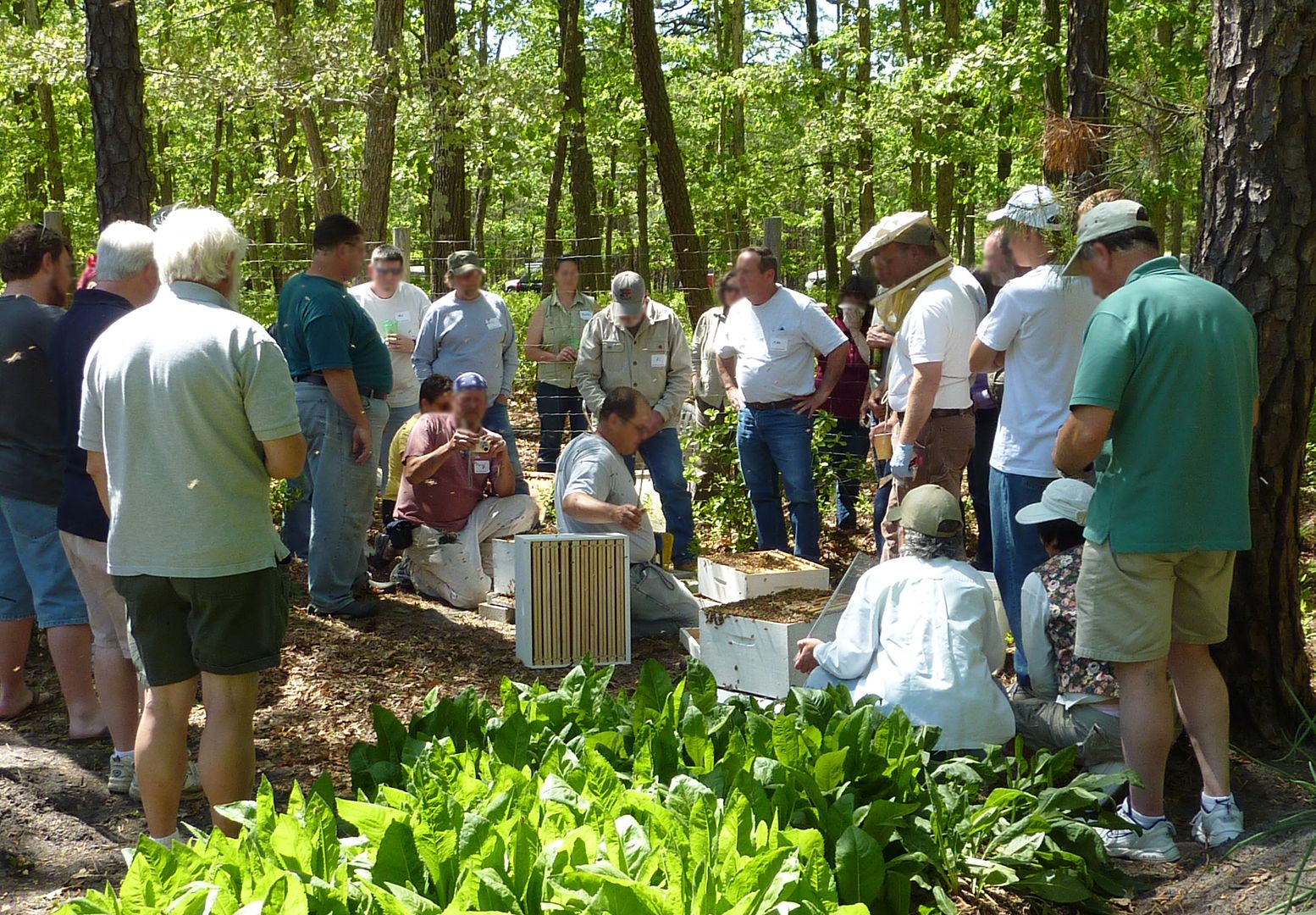
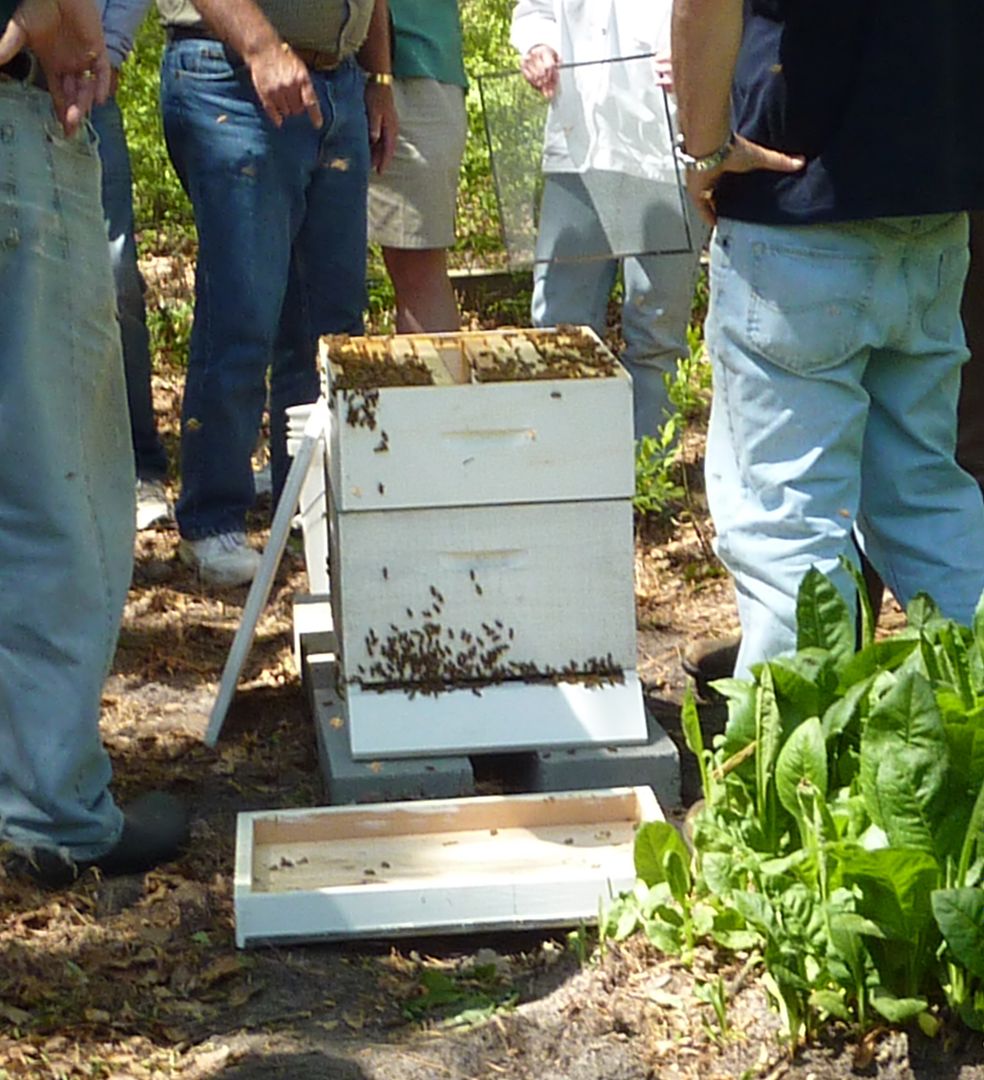
Earlier this weekend I attended a beekeepers meeting out in the New Jersey Pine Barrens. There was an awful wind storm that's still going on now, two days later. That day though was the worst by far. I was watching trees bend 45 degrees as clouds of dust, leaves, pollen and such fly with the wind. Certainly not the best day to open a bee hive. I was having particularly bad allergies on the day so I didn't get very close. Don't want to sneeze on the bees much.
Disclaimer: As I said I was suffering allergies on the day this was done. To combat that I had to spend brief periods in the house and out of the pollen storm. So the information provided here might not be 100% accurate. I have done splits with my own hives though and I feel that this is one of those things everyone has their own way of doing. It is a simple idea of taking some frames out of one hive and putting them in the other with some workers. It's best if The Queen go to the new location with a good portion of the hive and swarm cells be left in the old location or in a nearby split. That said, here is my take on the events of that day.
As with all our meetings almost no one is waring protective clothing even while multiple hives are open and the bees are flying around us. Smokes calms them down but the heavy winds dull the effect. A few people did get stung but this is strangely uncommon with our meetings.
This meeting in particular focused on splitting a hive. At this time of year the bees are planning to swarm. This is the natural process of the hive dividing to start a new hive.
What happens is the workers build Queen Cells, as shown in this video. From these will hatch The Queen's successor. The Queen gets along with all her daughters but sister queens will fight and duke it out. The Queen (the mother of the entire hive) will fly off with the "Swarm" which is comprised of as much as 60% of the workers.
The new queen takes over the old hive and her mother's legacy. She mates usually within 5 days of taking over, weather permitting. Her flying away from the nest is no big event. She is a bee like any other, has her own wings, has a stinger to defend herself, and the workers don't really care as long as someone's laying eggs. The males absolutely adore her though and will fly after her in droves from miles around. The average queen bee mates with 8 to 16 males before returning to work. (Usually 5 years later she runs out of sperm and can produce nothing but males, and should be replaced immediately.)
(Again though all this is "how it's supposed to happen" weather permitting. Issues like the hive swarming multiple times, two queens leaving with the same swarm, the new queen didn't have a nice day of weather all week so she couldn't mate all happen more often than one would expect.)
So we open a hive to locate "Swarm Cells" a.k.a. Queen Cells. A good hive can have as many as 50 or more developing queens. You can't split a good hive that many times but doing it 1 or 2 times is fine though. Anything more and you won't get much out of it unless they all survive a few years.
Dividing a hive so there are 25 queen cells in each half is also crazy. Feel free to rip a few out or save the queens in a Nuc (tiny hive) or "Queen Castle" (special box that holds 4 hives), The idea being either to chuck em or save em. But you want at least 1 queen cell in each box, keeping the number below 10 give or take is what you want. Or just let them duke it out. The more queen cells though and the more likely they are to swarm multiple times. New Queens take to much competition as the hive is still to big and this causes another swarm. This can continue upwards of 5 times from a single hive which like watch your money fly away, and should be stopped with good beekeeping. Otherwise you'll be supporting the feral bee population of your area.
While looking through frames for sighs of The Queen try and keep track of how many queen cells there are on each frame. Get rid of as many queen cells as needed but remember to keep a few. The queen cells need to stay in the old location. Try and get The Queen and her half of the hive to the new location.
Sort of knowing where The Queen is, matters because the half of the hive that still has The Queen might still try and swarm if new queen cells start hatching. I say "Sort Of" because finding a queen bee is hard to do, even among beekeepers. Finding eggs in cells is a good indicator of where she is though. Knowing where she isn't can be just as good.
While looking through frames we created loads of traffic at the entrance.
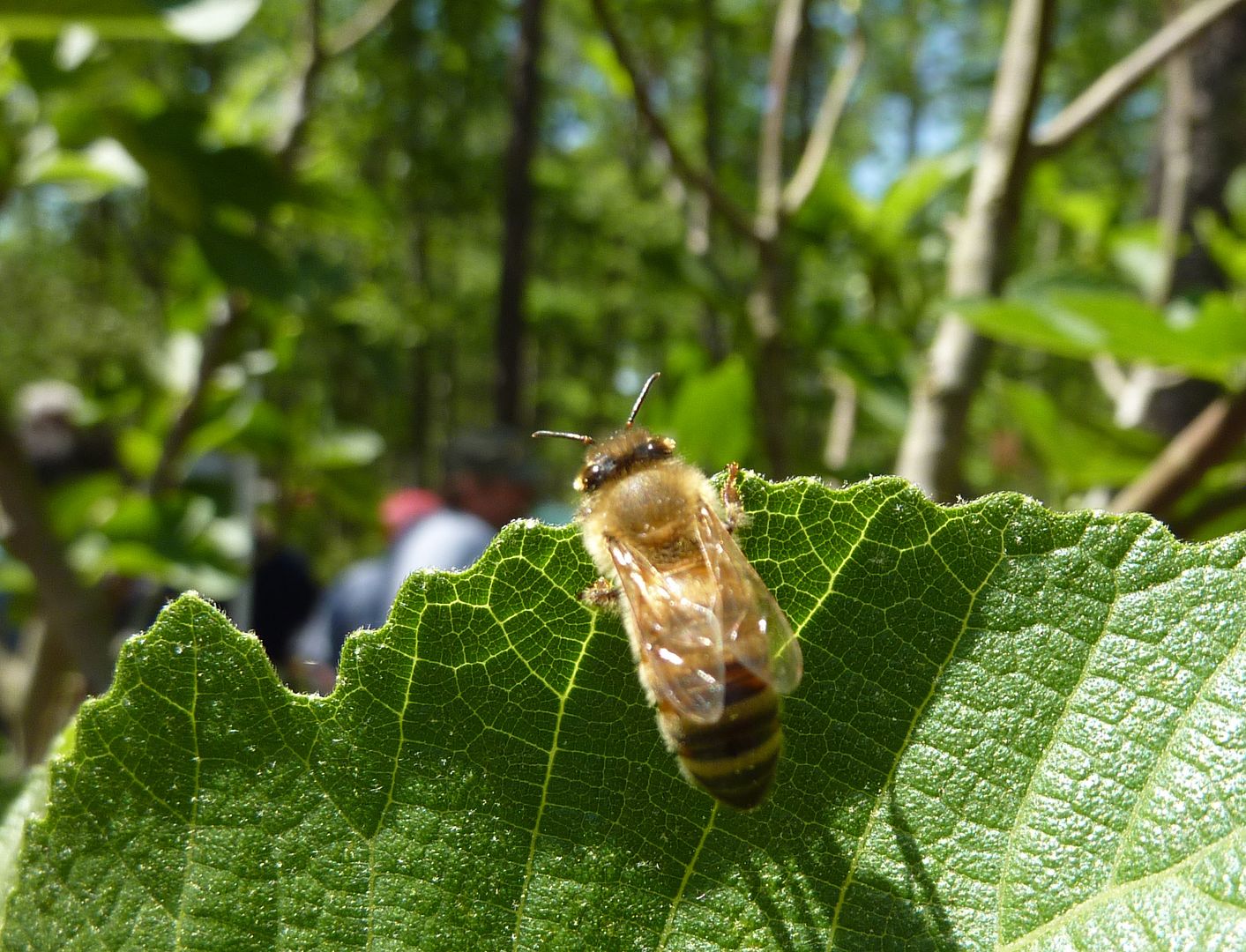
Many of the foraging bees sat back and watched, unsure of what's going on. Probably confused why there wasn't any alarm pheromone in the air too.
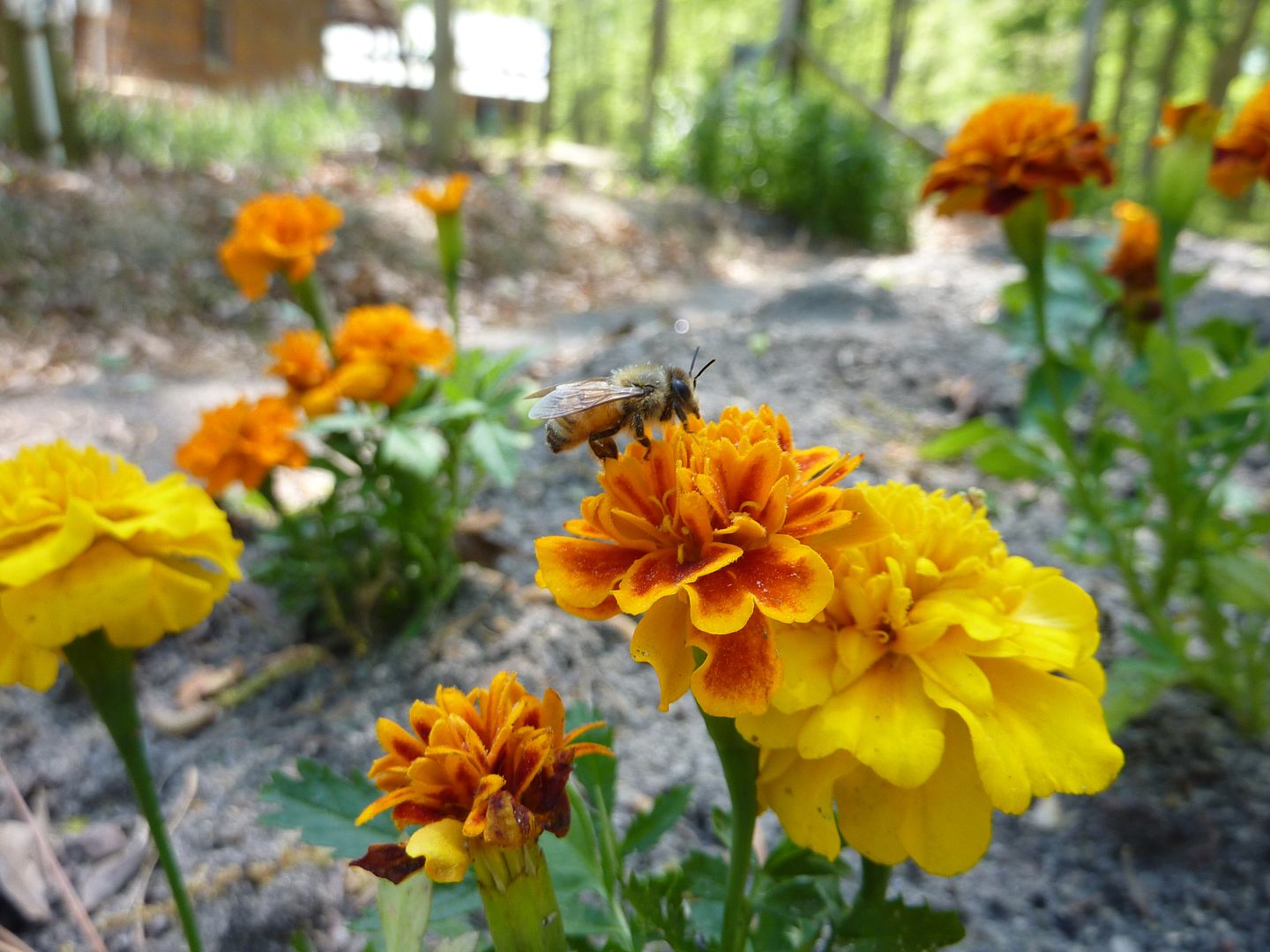
This poor bee decided to wait it out on a marigold. Easily the only time I've ever seen a bee on this kind of marigold.
The location of the new hive should be prepared and read before splitting.
The box or group of frames believed to have The Queen on them should go to the new location. Both hives should have a frame or two of empty cells, uncapped larvae, and capped pupae cells, and 1 or 2 of honey as well. Bare in mind that swarming queens have usually stopped laying eggs for a day or two, and this is enough to have disrupted the life cycle of the Varroa Mite population. Swarming is very healthy for a hive to do.
A queen excluder is optional. Beekeepers use this to make sure the eggs are only laid below this point in the hive.
A Honey Super (usually a smaller box) is placed on top of that, and boxes are added as they become 80% filled. If you don't give the bees enough room they'll likely try and swarm again.
With all this drastic rearrangement of the hive it's usually a good idea to do some regular maintenance. As you saw in the queen cell video they don't always build their nest inside the frame. "Bur Comb" as it is called should be removed. This is the comb that is built between boxes, usually connecting to the frame above it.
Bur comb storing honey can give you an early taste of what's to come. Careful you don't get a mouth full of brood though.
Now that all is said and done, there's nothing to do but close up the hive and let everything go back to normal. They'll soon adjust to having their new queen or new location.
The new hive up front with the old hive in the back. Both have a good population and because they don't have to swarm we've saved them the trouble of building all new comb. And that means more stored honey.
AOL News is reporting New York City lifted it's ban on keeping honeybee hives earlier this week. I've already voiced my opinions on how stupid this is. My argument boils down to central park not providing a year long succession of blooms. Especially when you consider what's said at the end of the article.
There reportedly are about 600 beekeepers in the city.
WOW! That number sounds so exaggerated it's hard to believe. To put that in perspective, all of New Jersey has roughly 2,000 registered beekeepers, (give or take 100). Even with our lush underdeveloped areas with assorted blooming flora, we have to rinse out everything that goes into our recycling bin or our hives start dumpster diving for old soda and cat food. I can only imagen what the 600 or so hives are bringing in as "nectar" in the city. A good hive can bring in 100lbs of honey in a year, and foragers travel up to 6 miles away from the hive. I've driven through New York before and there's virtually nothing in the city besides central park.
Beekeepers who live along the edge might get nectar from the vast suburban area that is as far as the eye can see but there can't be that much there. Homes in this suburban areas are tiny 1 story, probably 3 rooms, with a patch of lawn smaller than the family car. There seemed to be a ban on trees too. While I'm sure some of these homes have flowers, it's hard to imagen them supporting 600 hives.
The article tags something on the end about city beekeepers doing this to be environmentally friendly. They want to help fight CCD.
The world is not all bright for North American bees, however, as researchers still struggle with finding the cause of colony collapse disorder, a mysterious syndrome that has been eviscerating bee populations since it was first identified in 2006.
My god it's like no one has YouTube or something!
The environmentally friendly thing for people in the city would be to "green" the city with native plants. This doesn't include lawns. Having to mow the lawn someone planted on top of an 8 story building is stupid and making more pollution than clean air! Lawns are places for people to play, walk, and enjoy the sport of golf; they're well groomed achievements of controlling a highly invasive plant and don't have anything to do with environmentalism other than composting. Lush prairie plants, flowering trees, native shrubs and living walls are what they should be going for. Food crops for humans, and even berry plants for passing birds, would have to be done in raised beds. City soil tends to be teaming with heavy metals.
In a world where Google Maps is taking satellite images of everything, I never understood why companies don't advertise on the roof of their building. A rooftop garden with flowers to form the company logo is an excellent idea in todays world.
If nothing else comes from this I hope that beekeepers of New York demand stricter standards on recycling and help green the city up more with excellent nectar sources. Sadly though beekeepers tend to be part of the problem when it comes to planting invasive like Purple Loosestrife, which are an excellent source of nectar but do awful things to the environments they infest.