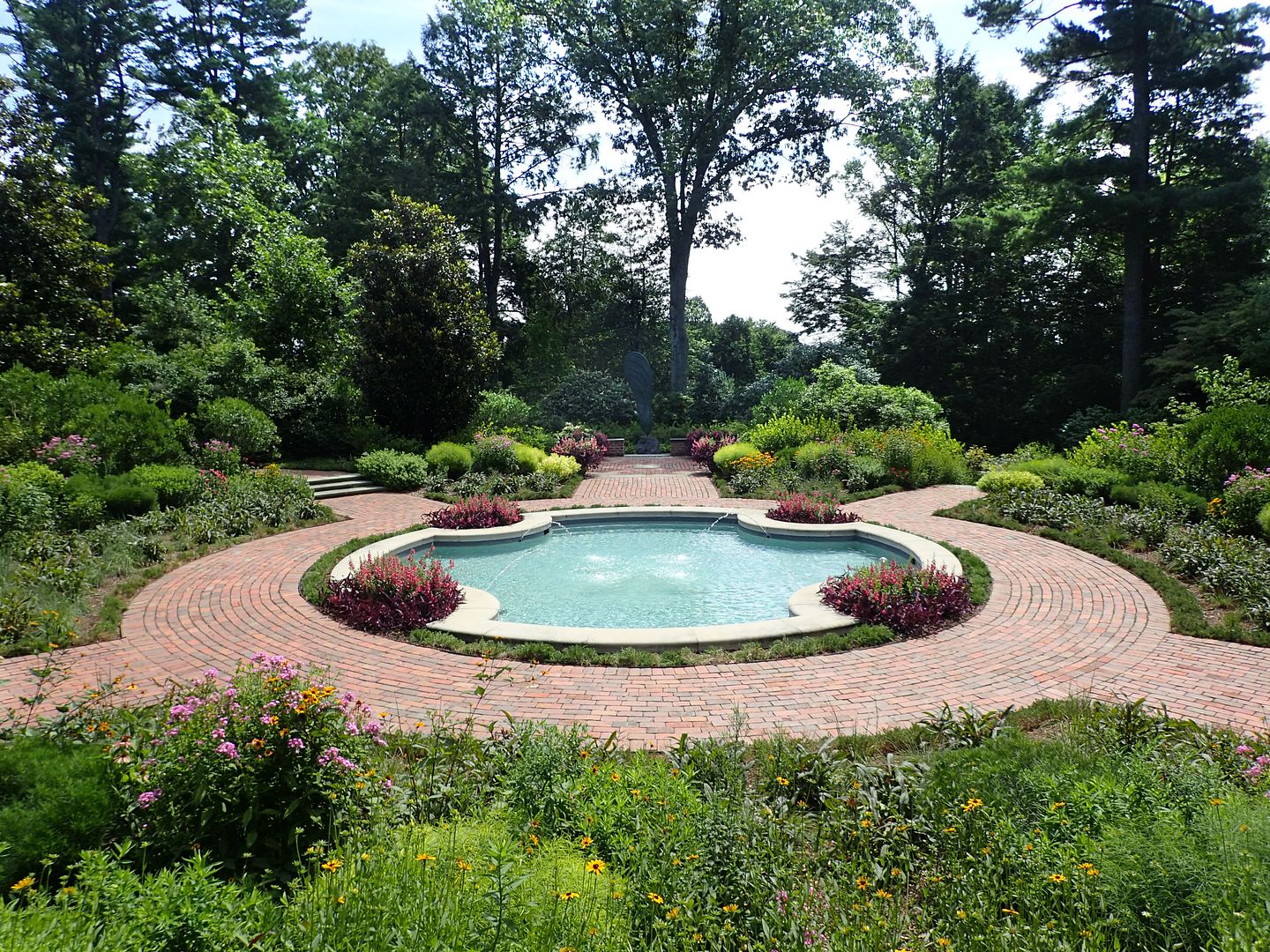
I was at the Mt. Cuba Center a few weeks ago and was glad to see all the different plants in bloom. Some of these I had never seen flowering before and was quite amazed to realized I'd been walking past shrubs and plants at the Mt. Cuba Center I'd never seen flowering all because I'd never visited on a certain week.
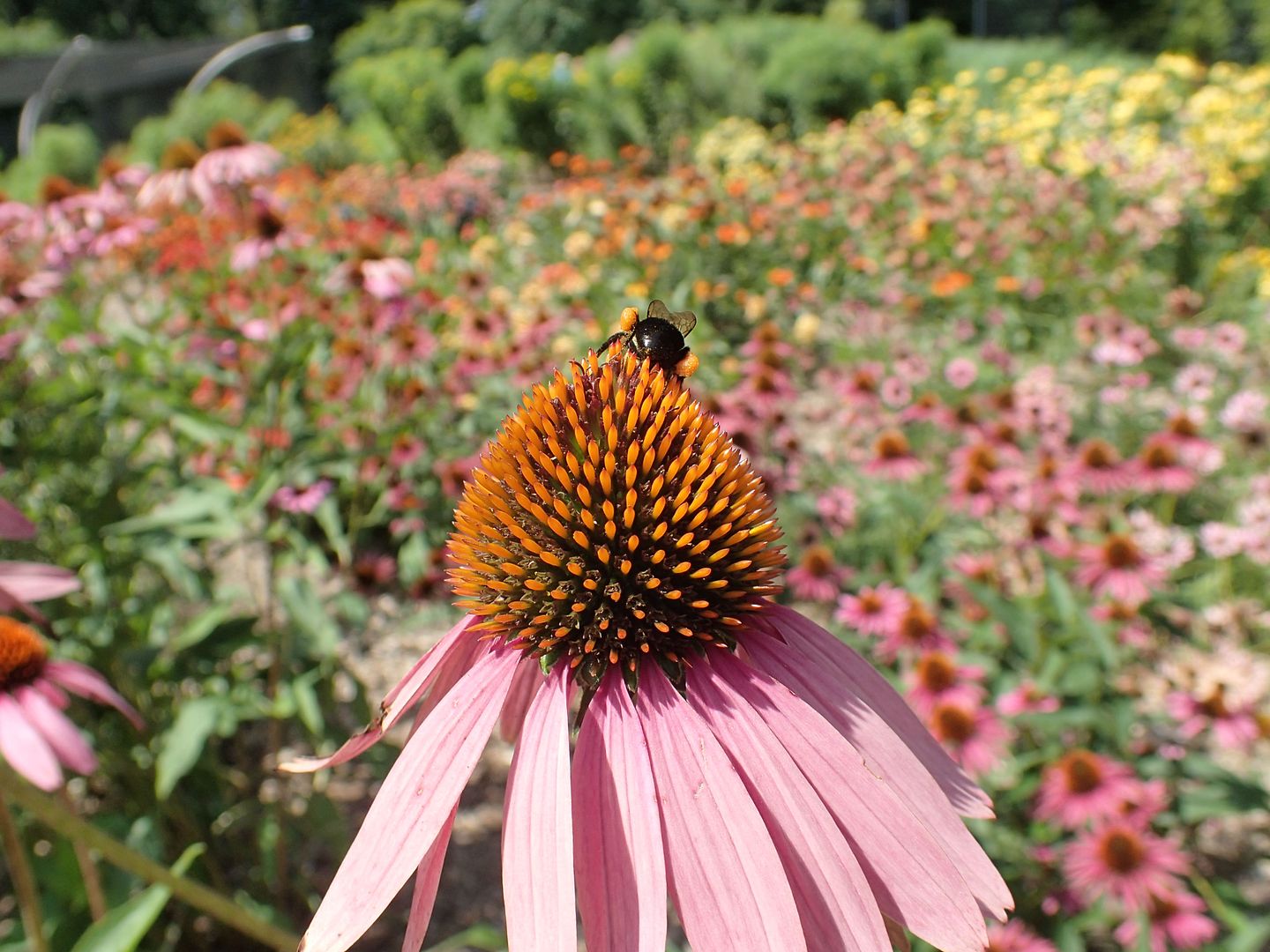
First though, while around the Round Garden, I paid a visit to the adjacent Trial Garden where they seem to be revisiting Coneflowers. They had already done these a few years back but I think they had different criteria back then. I know in recent trials with Monarda, and Phlox, they mention which ones Hummingbirds, Butterflies, and Bees favor so that would be a nice thing to know when deciding which of the hundreds of different Coneflower varieties they like.
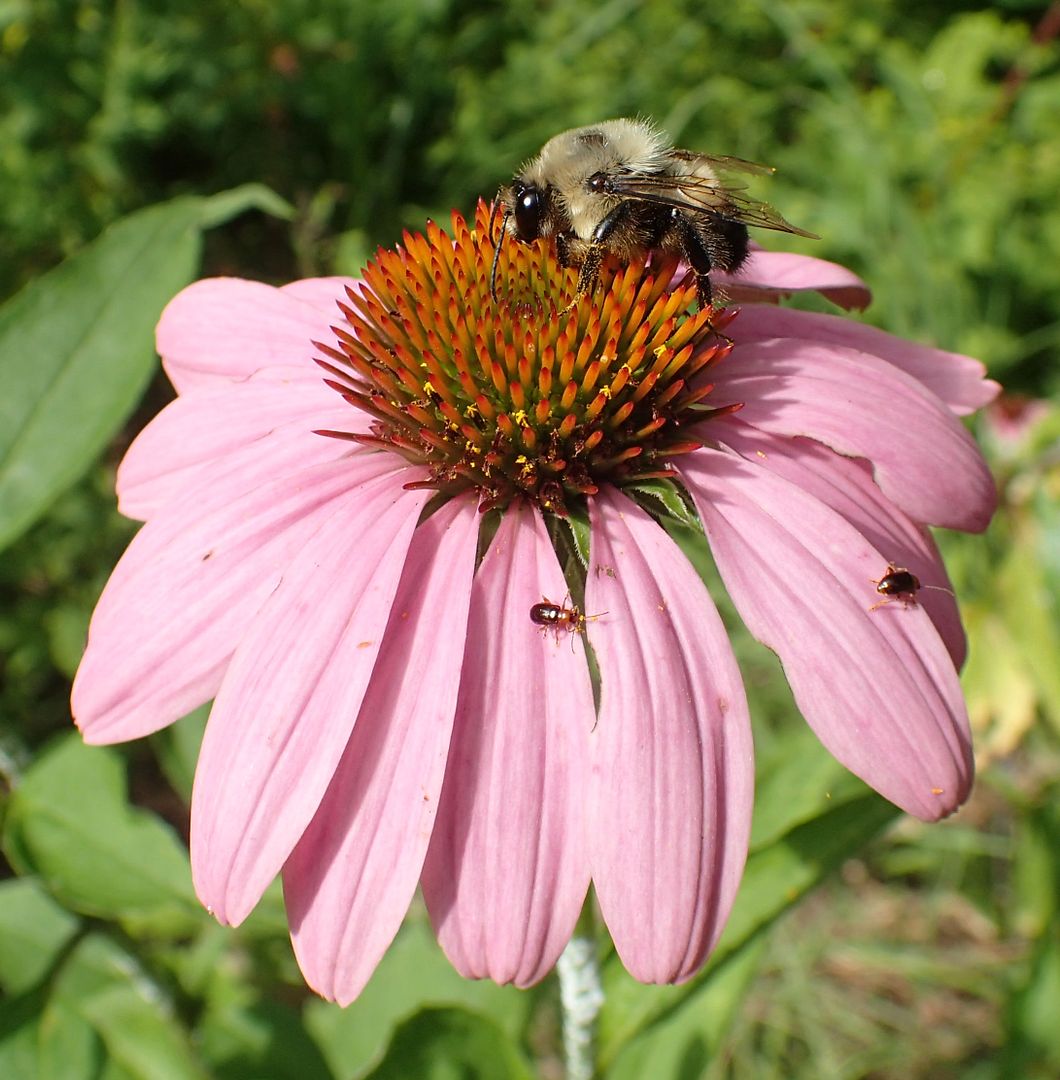
So this is a fairly standard coneflower. I don't know if it's the true species or a cultivar but it's close enough. I recall looking around at all the colorful and wondering why they hadn't included 'Rainbow Marcella' which I bought this past spring.
This is a plant back in my garden and the flower which the squirrels damaged but I was otherwise pleased with them. Now of 6 plants only 4 have flowers but only 1 of them has the cultivar color as advertised. I'd been thinking I was ripped off.
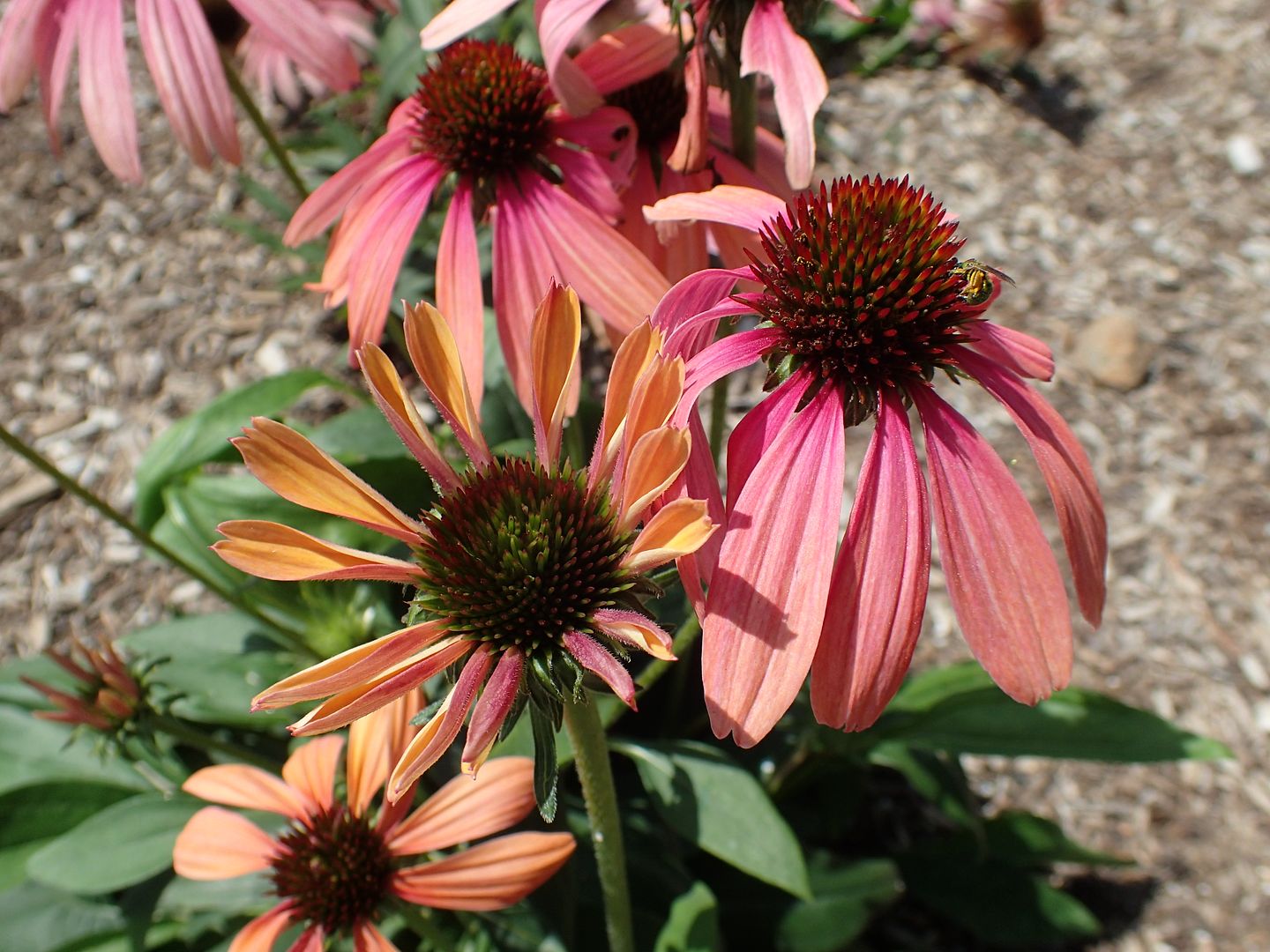
Well then I found it in the Mt. Cuba Center trial garden and realized the orange in the petals quickly fades out of the flowers. Also of all the cultivars in their trial it was among the shortest and I believe 1 of the 5 plants they had was already dead. :(
But once their trial ends, I'll be sure to read over the results carefully and if there's a particular cultivar or true species that does well I'll be sure to add it.
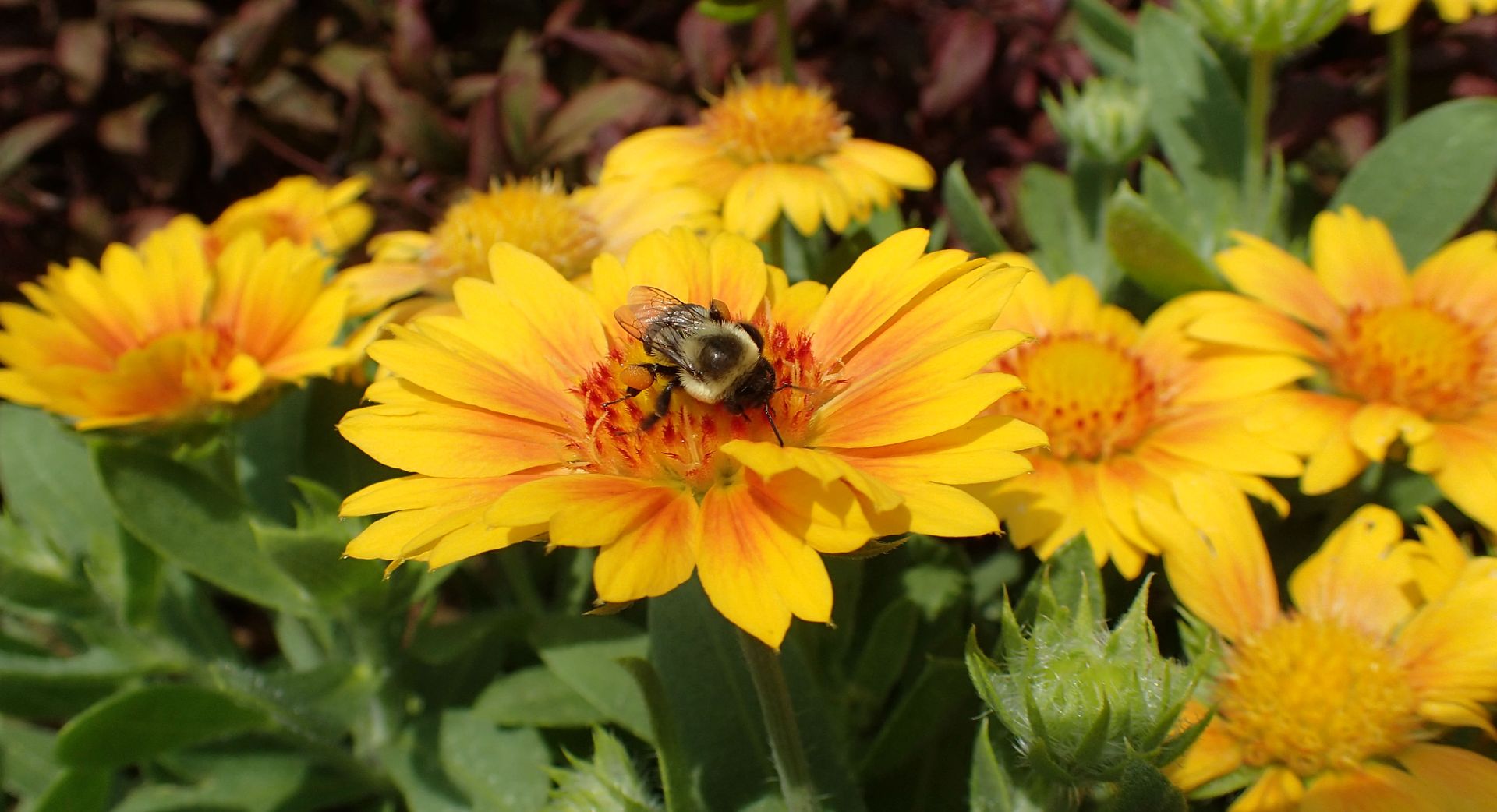
Two natives I've overlooked in my perennial garden are Blanket Flower (seen above) and Stokes' Aster which I wasn't able to photograph well. I installed a perennial garden in the front yard this year, right up against the side walk so people walking by can admire the flowers. If it were just a little bit longer I would fill it in these two plants for sure.
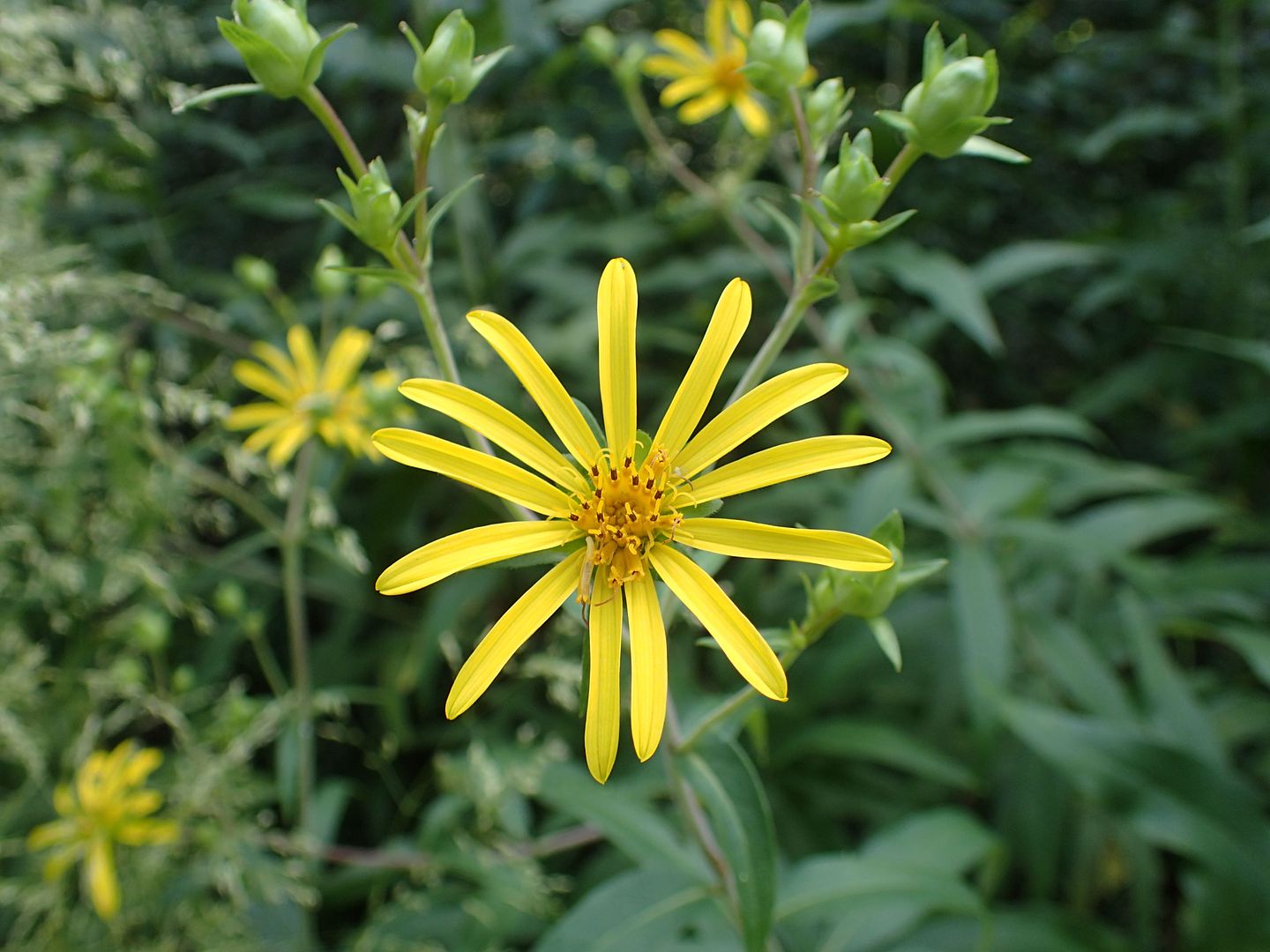
There were lots of different Silpheum species flowering there. Many of which I can't identify off hand, and actually I was surprised to learn there were more than 4.
Mohr's Rosinweed I did recognize though. Silphium mohrii has lighter yellow flowers and the foliage has white hairs too, giving the stem and leaves a pale appearance. This was also the first place I ever encountered the plant. On previous visits with actual classes the gardener, David, had been reluctant to point this very obvious plant out. It's not exactly native to Delaware nor commercially available. It was a gift from someone which they planted and grow in the meadow. Considering the norther most range for the species is a population in Tennessee I imagine they were surprised to discover it's cold hardy.
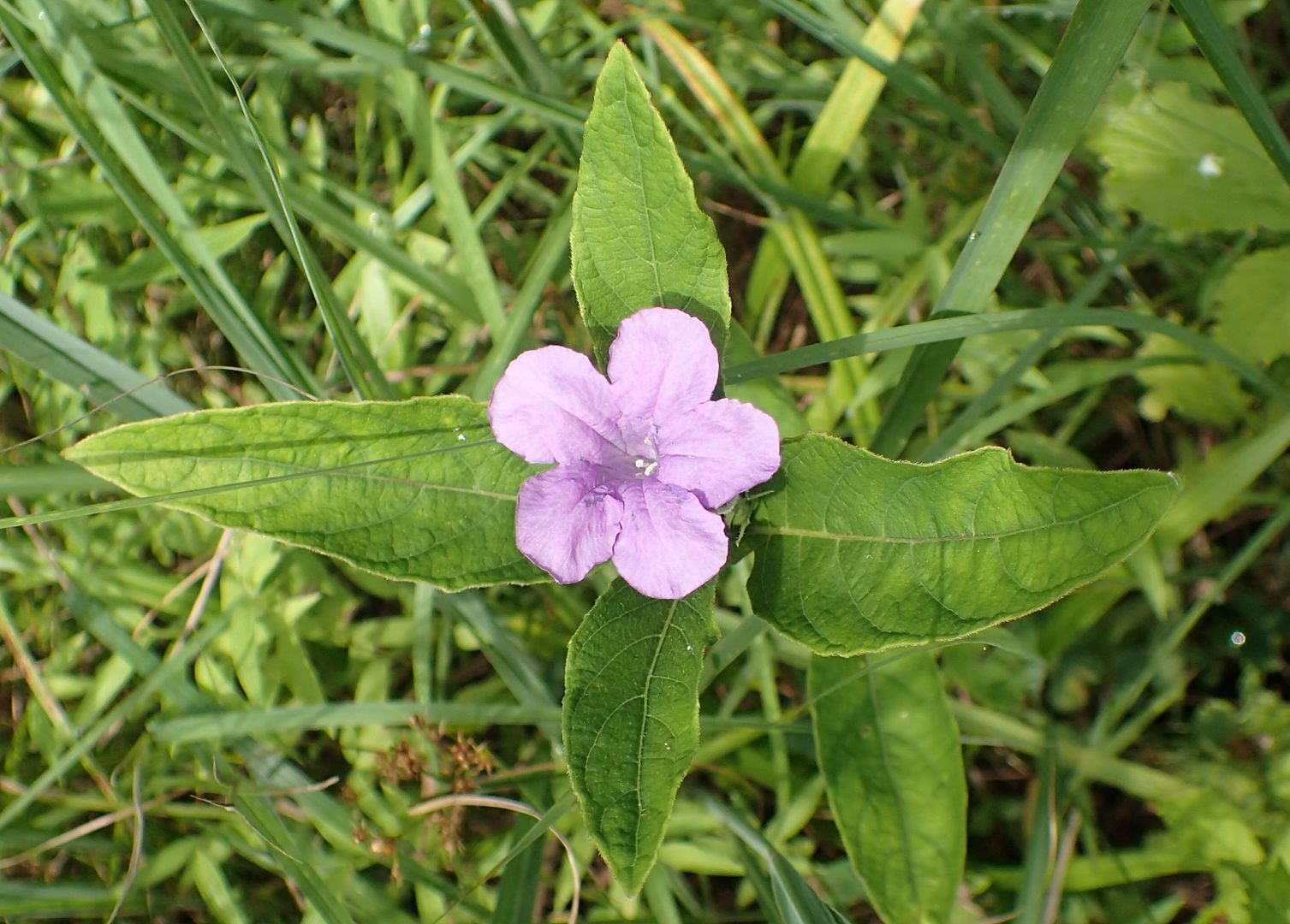
Wild Petunia, Ruellia humilis. To be perfectly honest, if this wasn't flowering I'd have never even noticed it. This is one of those native plants that you have to plant ~25 of right next to one another to form any sort of an impact because each individual plant on it's own is kind of pathetic. Sometimes they'll have a cluster of 4 flowers on them but that's about the most they'll ever have at one time. So when grown as if it were a clumping aster the impact is easier to appreciate. This one may have been a seedling that came up on its own.
Meadow Beauty, Rhexia virginica. I wish I could say more about this one because the flower is interesting. It's a pond plant, or maybe riparian plant that has a wonderful pink flower.
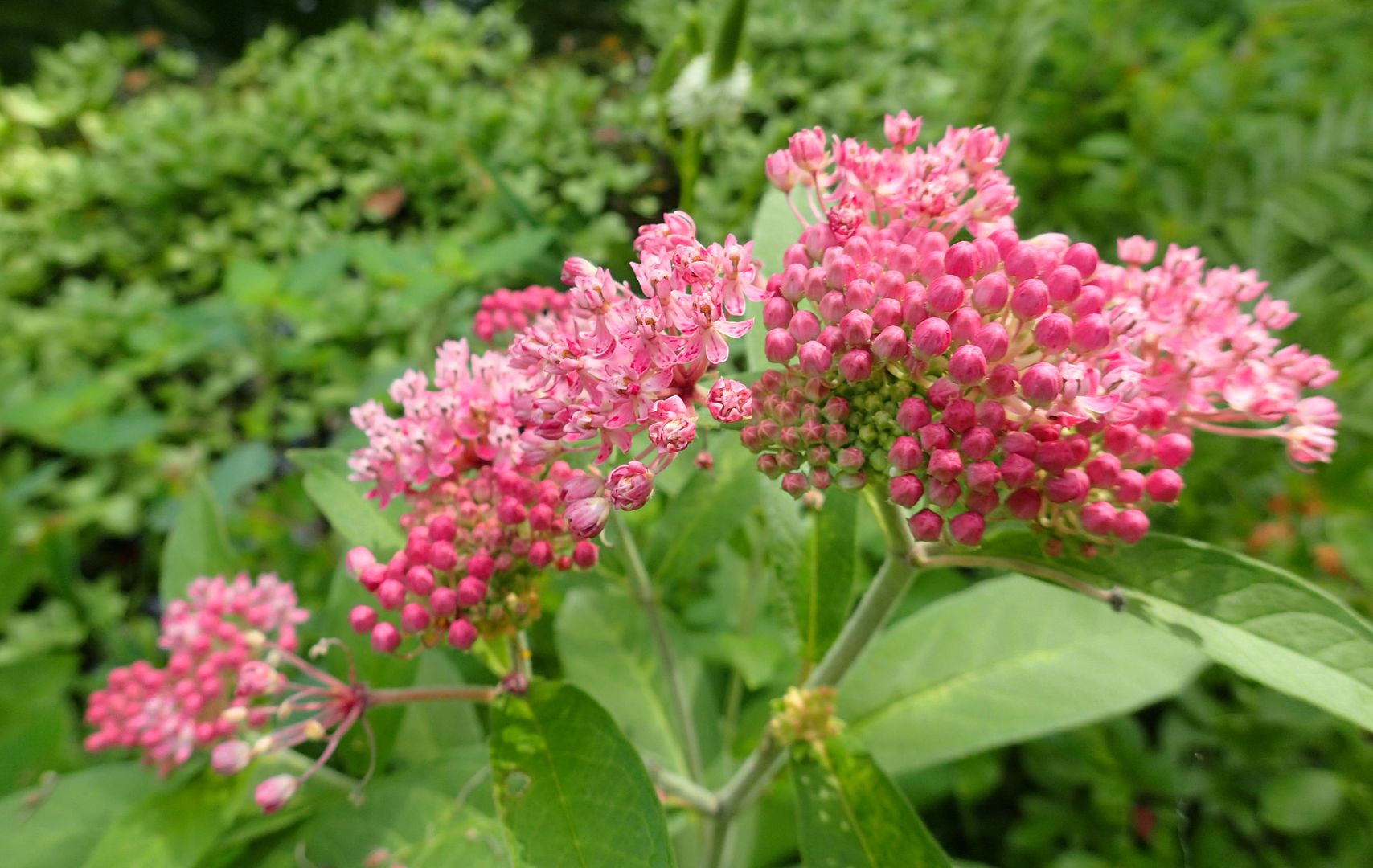
Asclepias incarnata. I always love wild strains of Swamp Milkweed. They seem to grow more vigorously and branch out more at the top of the plant than traditional plants sold in stores. Also the flower color is more wild. Some of this one even has pink spots on the flowers while other parts of it are more uniformly patterned.
And of course there were Monarchs swooping about along with Tiger Swallowtails, Red Admirals, and a few other butterflies. I found a Monarch Caterpillar chomping away on a plant of milkweed.
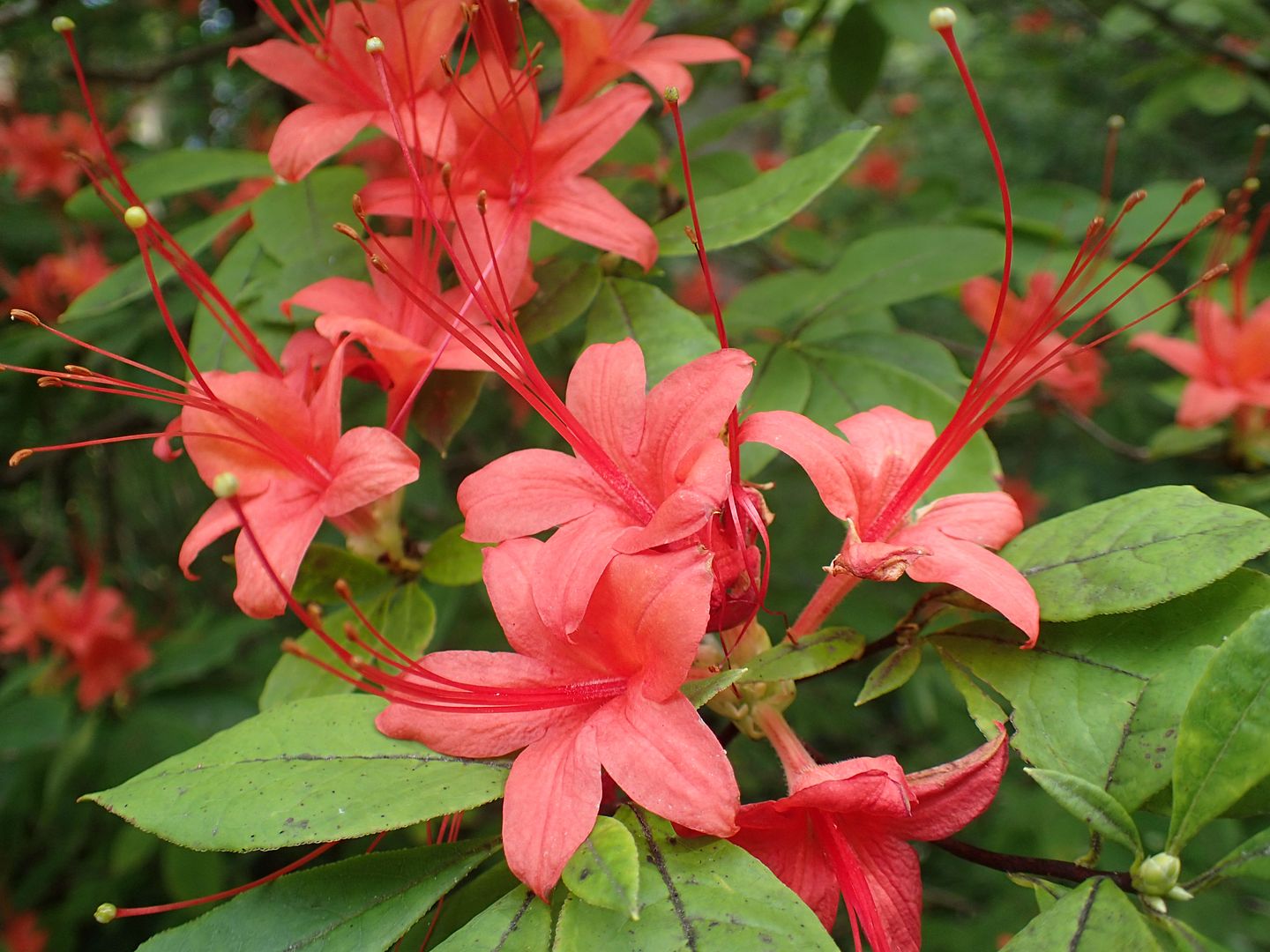
Plum Leaf Rhododendron, R. prunifolium, was a real stand out at the gardens. Partly because of their size and partly because of the display they were putting on. This is a species native to a very narrow strip between Georgia and Alabama and yet they still manage to achieve 10' tall growing in Delaware. (I've purchased two of these via an online dealer to see if they're hardy in zone 7).
The Mt. Cuba Center has about a dozen shrubs planted around its property and each one was covered in large clusters of orange/salmon-colored flowers. Some hued more red while others were orange but salmon-ish was the norm.
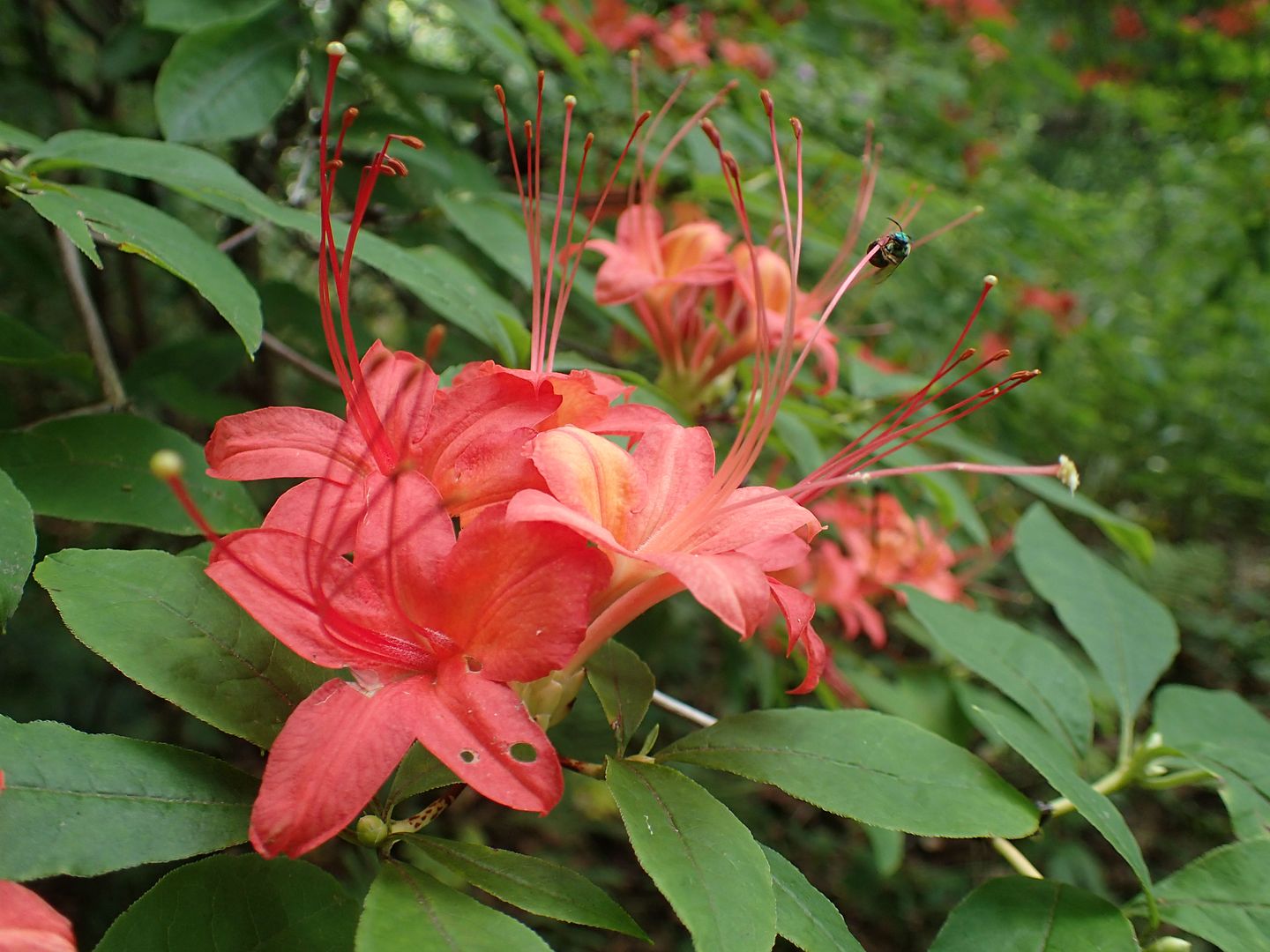
There wasn't a whole lot of pollinator activity with them but that's generally the case with Rhododendrons. They're ideally pollinated by large swallowtail butterflies who's wings rub against the pollen anthers and then the stigma to ensure pollination. Hummingbirds might also do something similar but I don't think this has been scientifically proven (though it likely happens).
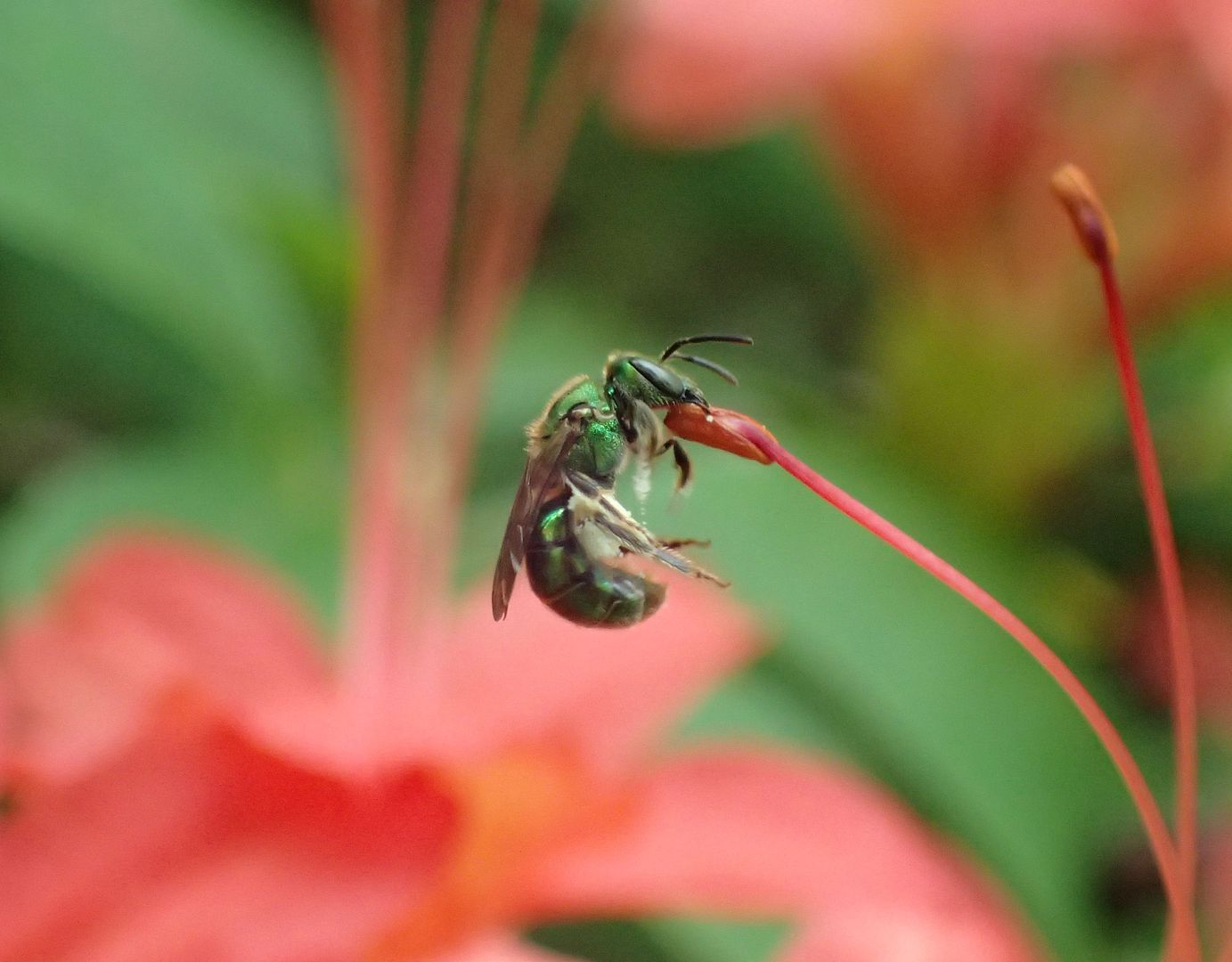
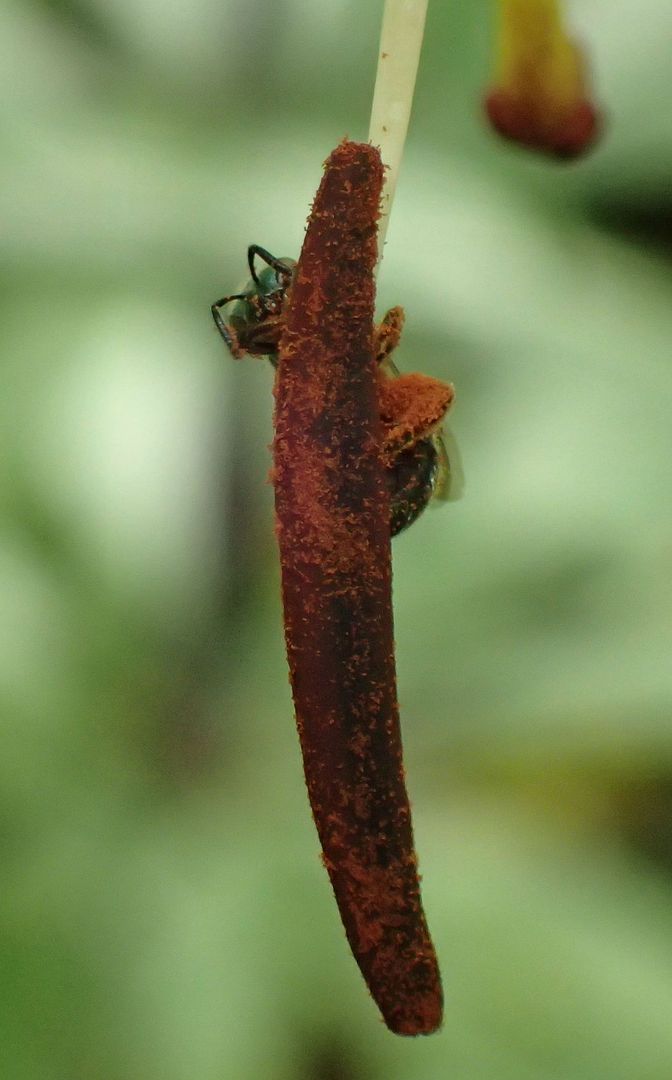
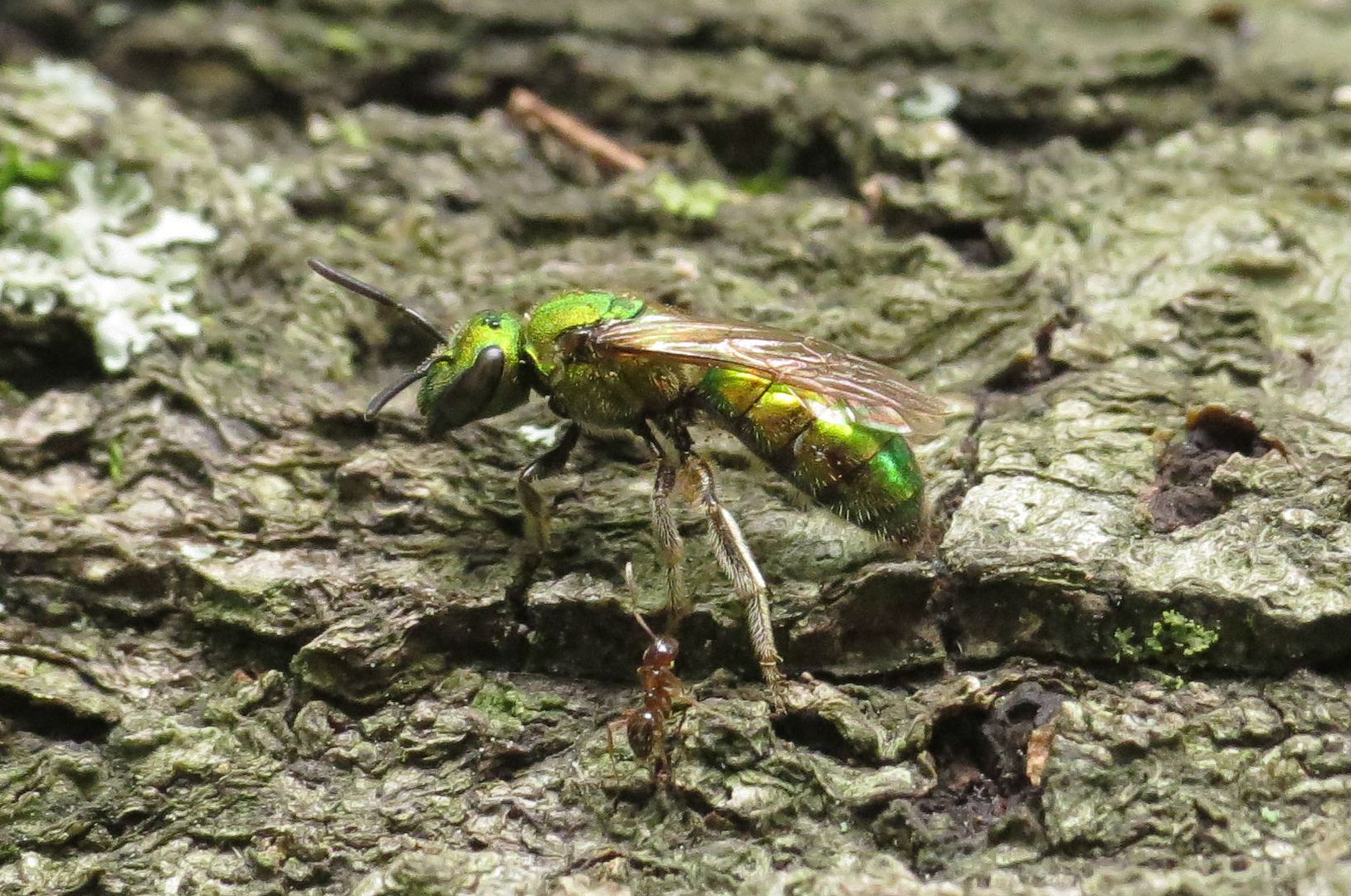
The only bees I saw taking an interest in the flowers were these tiny sweat bees who couldn't help but take advantage of all the pollen being offered.
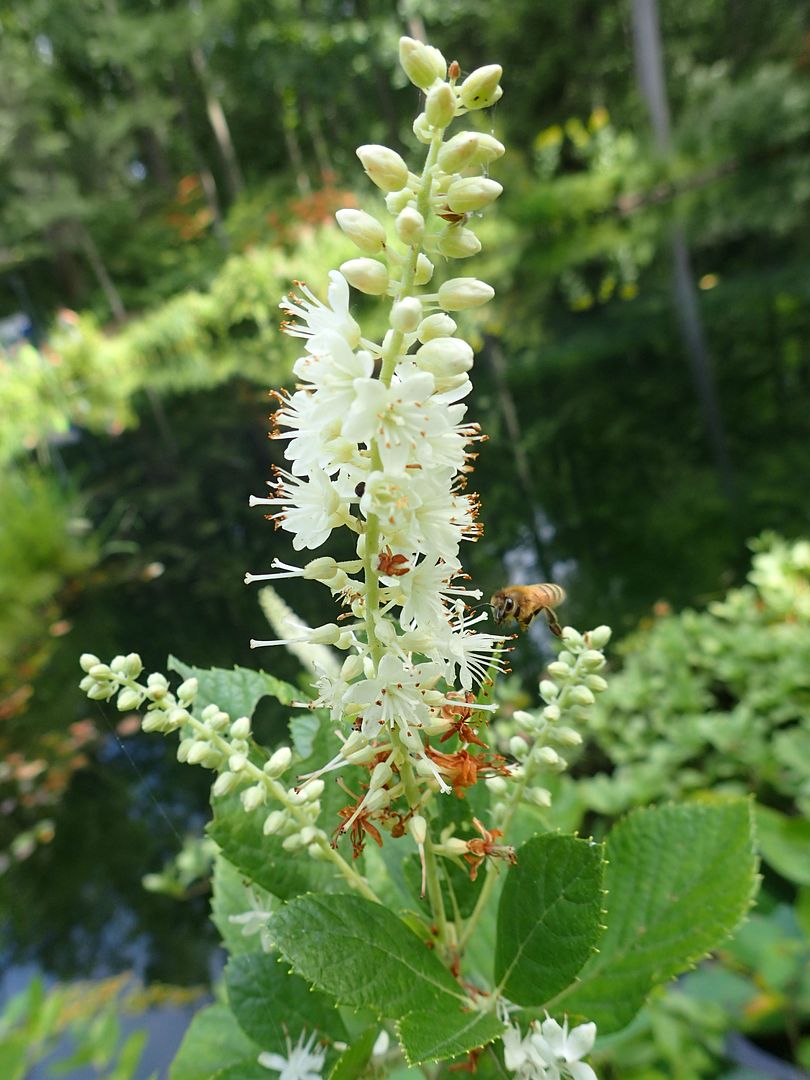
Another large shrub that was flowering heavily was Summer Sweet, Clethra alnifolia which is seen here on the background with all the white flowers.
Summer Sweet is sometimes called Sweet Pepper Bush because of the seed heads looking like peppercorns waiting to be ground, though you'd never want to do that with Clethra. It's not poisonous but isn't pepper either.
Another name it goes by is Sailor's Delight referring to it's sweet
fragrance which is know to travel a great distance in the right
conditions. This plant is at home in a damp forest understory or along
water ways and like filtered to full sun.
I couldn't tell if this was Bugbane or Doll's Eyes. Both are fairly similar-looking and I think in the same genus, Actaea. Some of these used to be in Cimicifuga but I believe they've been consolidated.
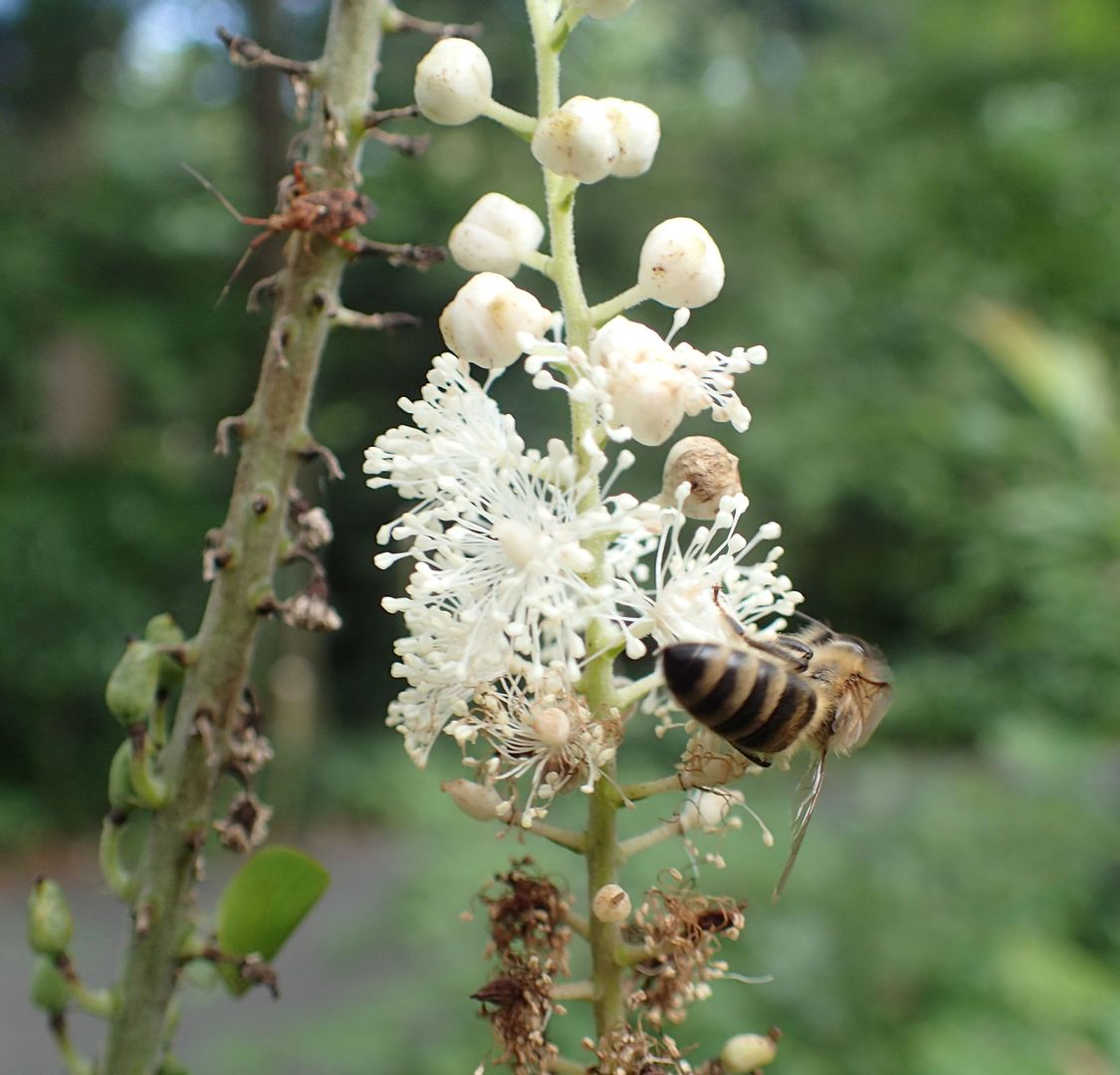
Honeybees work both Clethra and Actaea but I don't think they're very happy about Actaea. Likely something about the irritating smell of Actaea seems to make them angry while working this plant. They are obviously more on edge and seem to fly directly into other bees working the flowers. Things are more calm and easy going around Clethra.
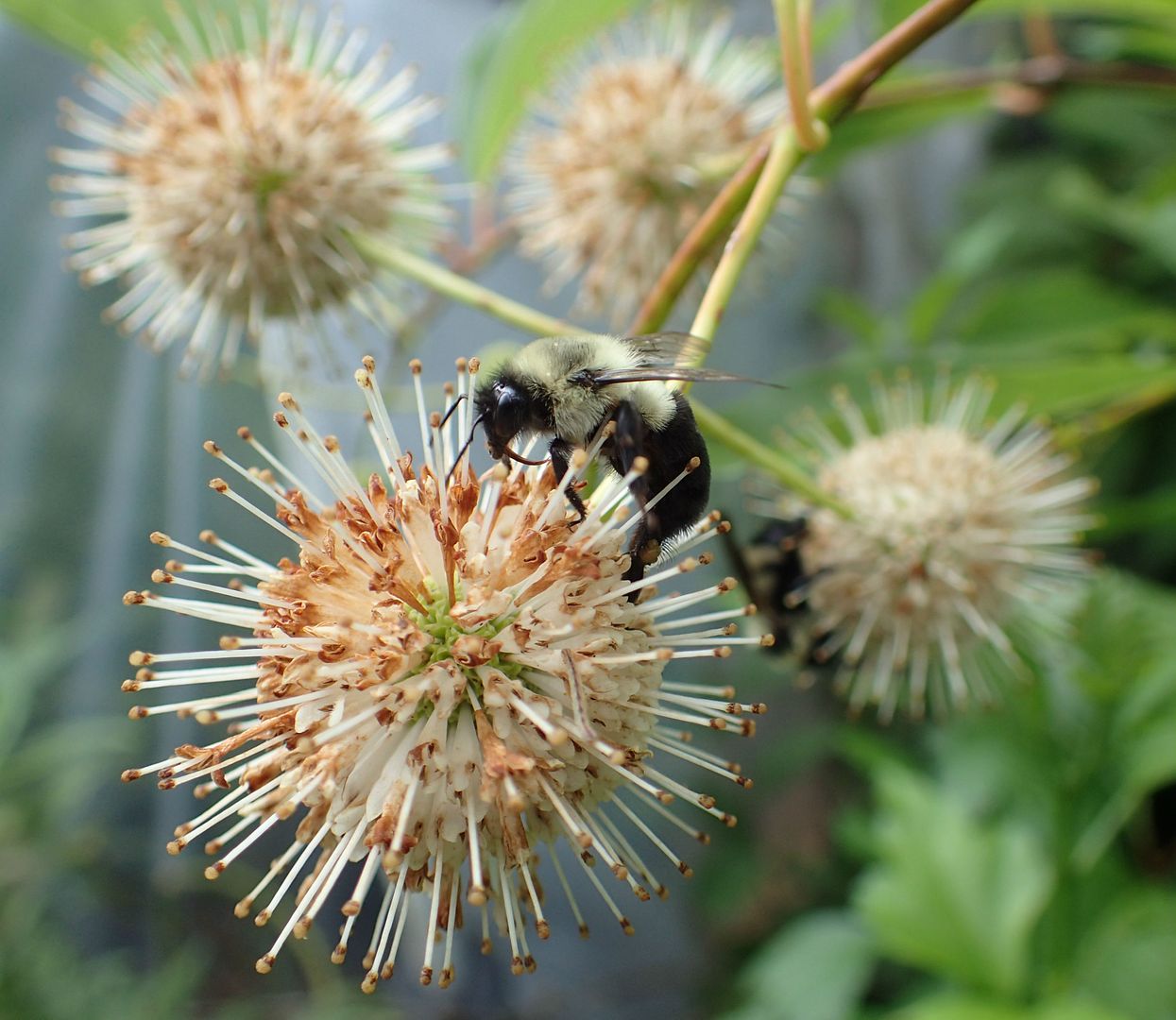
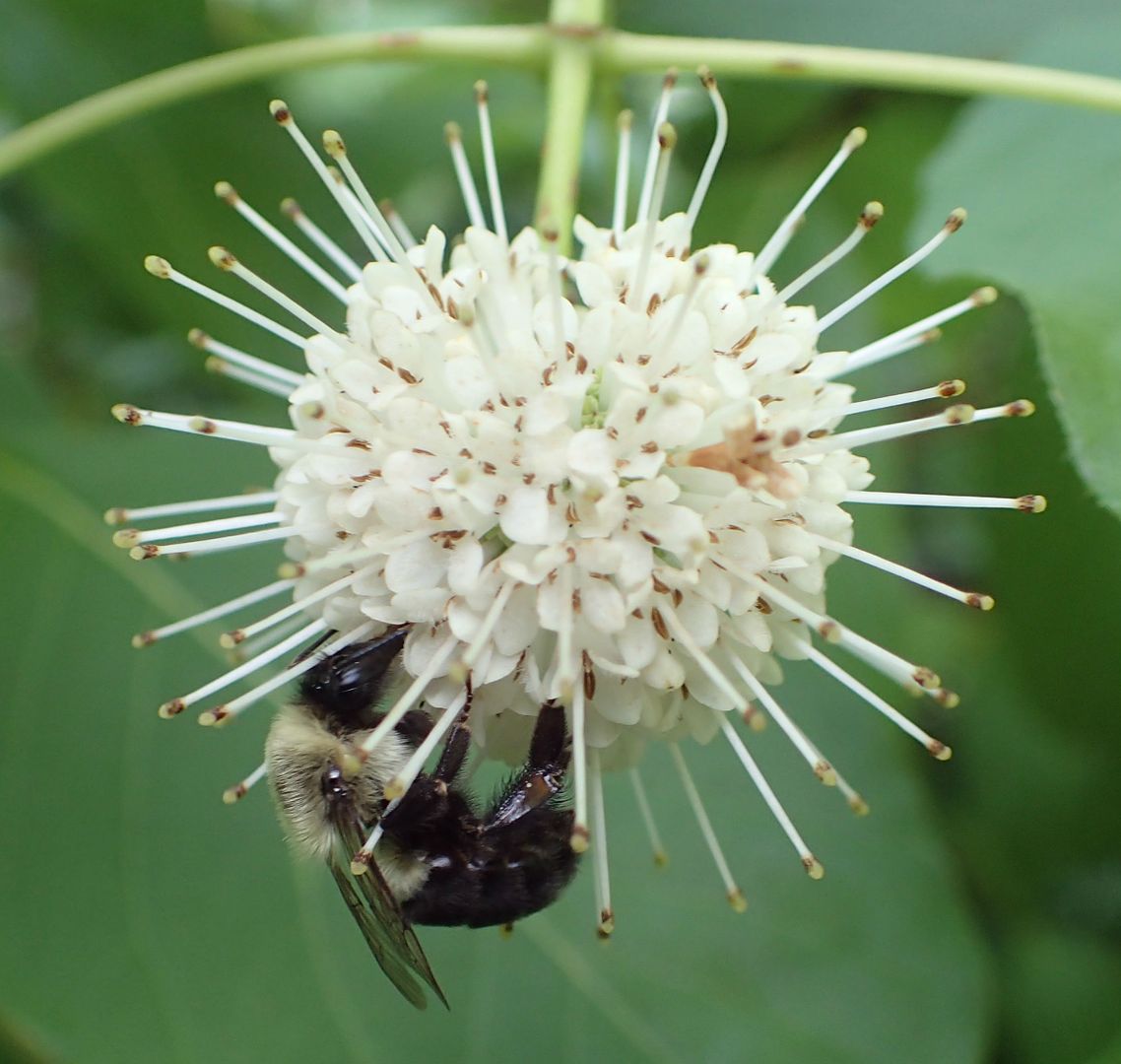
Buttonbush, Cephalanthus occidentalis, was another bustling hub of bees. These photos were actually taken at my house where I grow 3 of these wonderful shrubs. In talking with the gardeners at the Mt. Cuba Center I often ask them why they don't have certain things. And walking the gardens this past weekend I was happy to see they have added this one!
I took pictures of the flowers from the shrubs in my yard in New Jersey though because curiously enough they weren't flowering there in Delaware... So next weekend I'm sure their button bush plants will be blooming.
Although I have to say they weren't planted where I would have planted them. They're at the top of their meadow garden. (top of a hill that is.) Whereas in nature they usually occur growing along the banks of lakes and streams. Where they have them isn't a bad location, just not where they'd be found in the wild. Their meadow garden, I believe because of the slope, allows them to grow things that like water along it. For example they have Joe Pye Weed at the top too as well as by the ponds and it does fine in both locations.
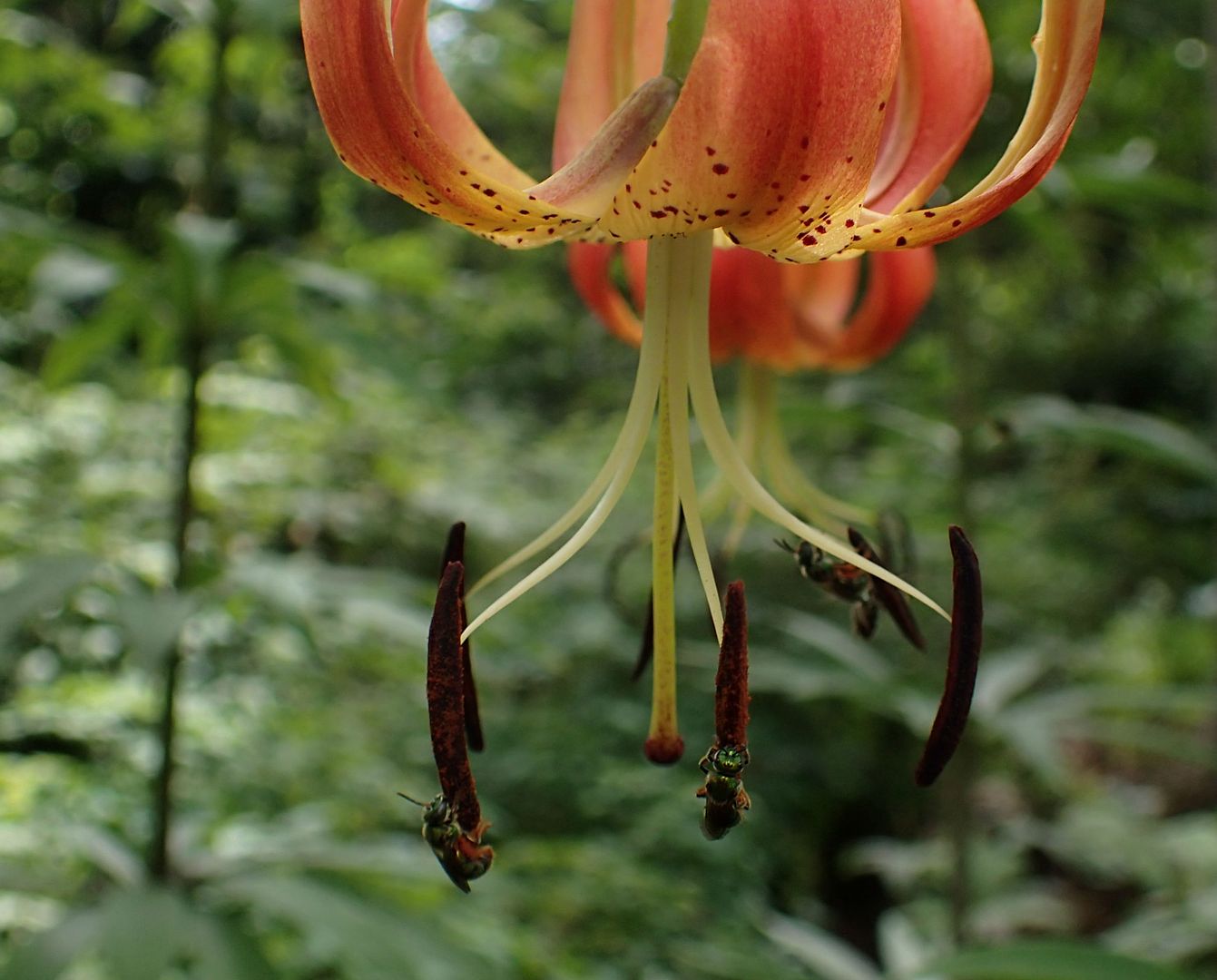
Along their forest path they had some native Lilies growing. And these are some of the harder ones to grow in my experience. The Mt. Cuba Center makes it look easy as they have several nice big plants, each with lots of blooms to them. In general the plant opens one flower at a time, but because a plant might have 15 flower buds on it, this prolongs the bloom.
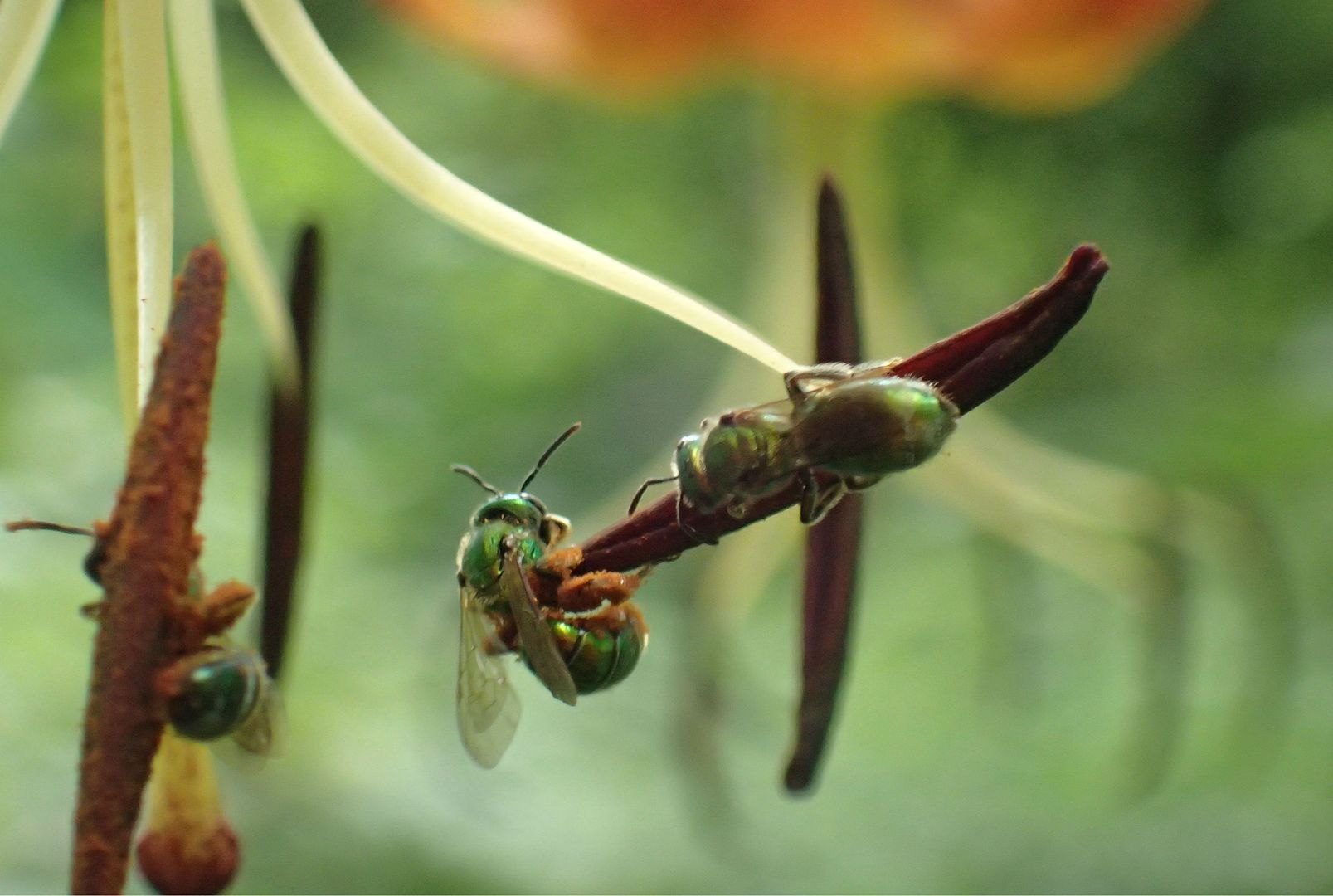
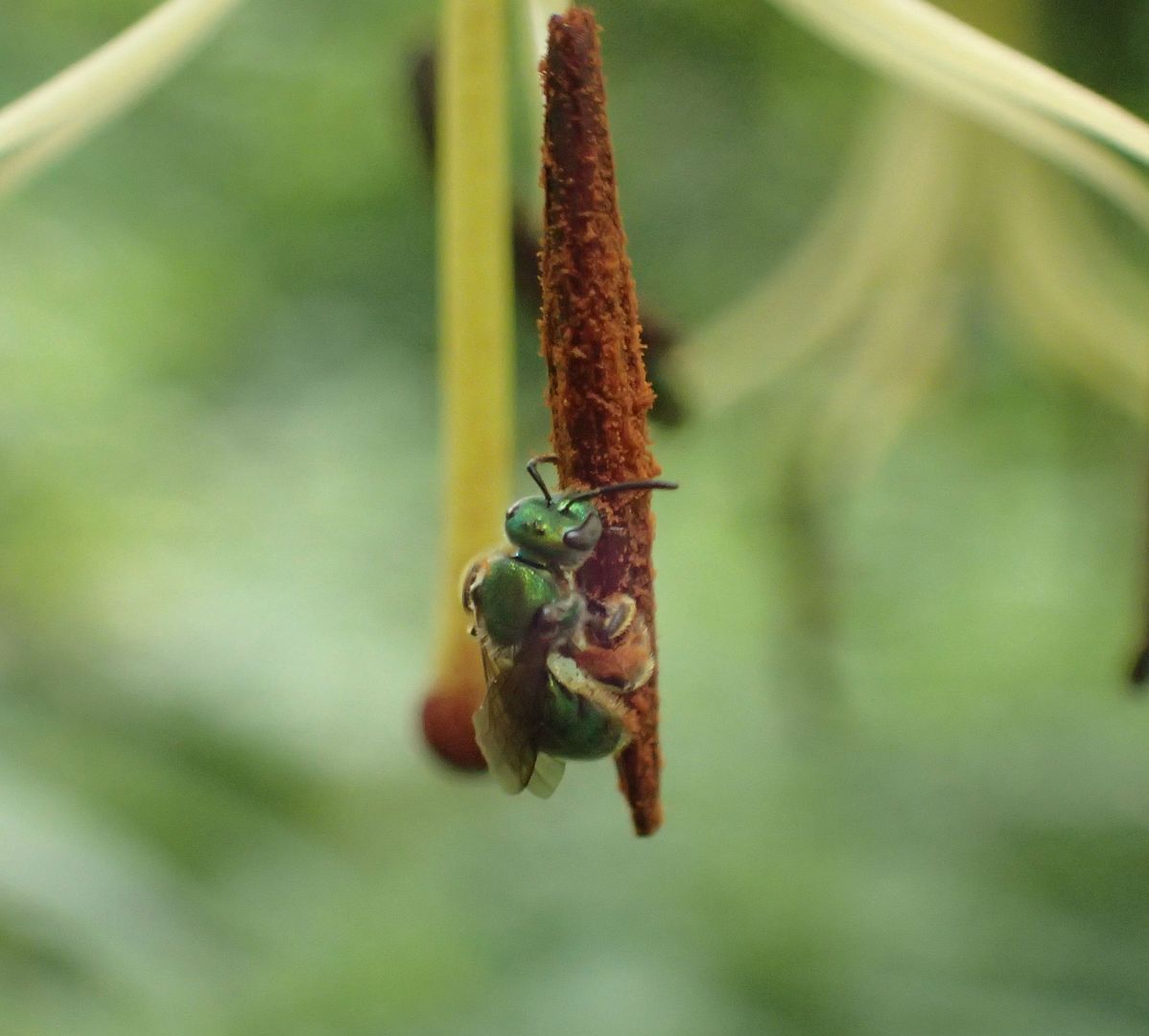
Ideally they're pollinated by large swallowtail butterflies and possibly hummingbirds whose' wings and feathers brush up against the pollen anthers and make contact with the stamen. While I didn't witness that I did see loads of little sweat bees stealing the pollen. What were clearly females were becoming covered in pollen and what were likely males kept pouncing upon them to mate.
These actually aren't pollinating the flowers because they're not making any contact with the stamens.
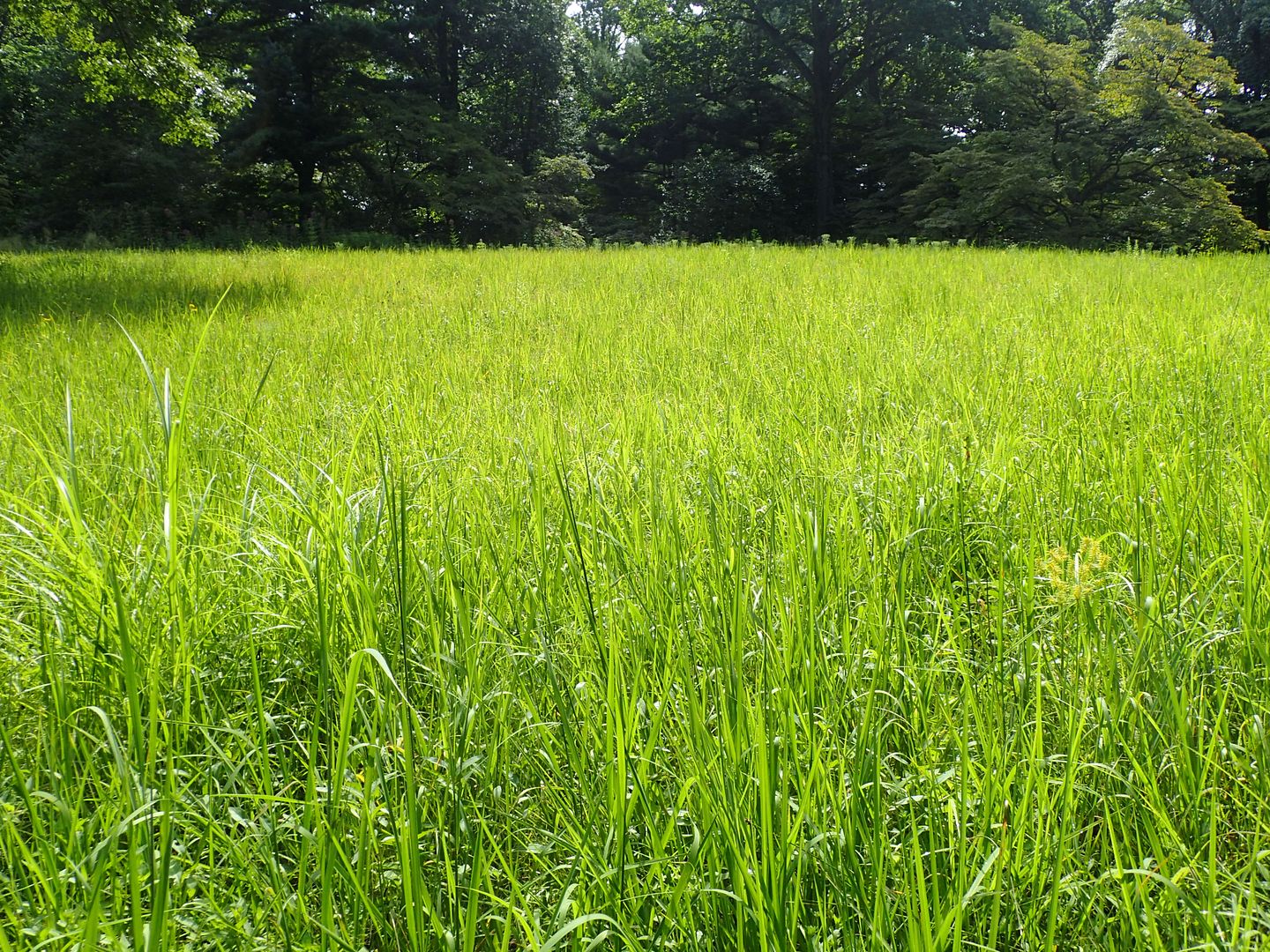
Their meadow garden was growing nicely. This is a combination of Little Blue Stem, Big Blue Stem, Indian Grass, and a few dozen others. This main section is mainly comprised of grasses though. Flowering plants were kept to a minimum on purpose because the late Mrs. Copeland felt there were few things as calming as seeing the wind casting waves across a grassy meadow. And honestly I think she was right.
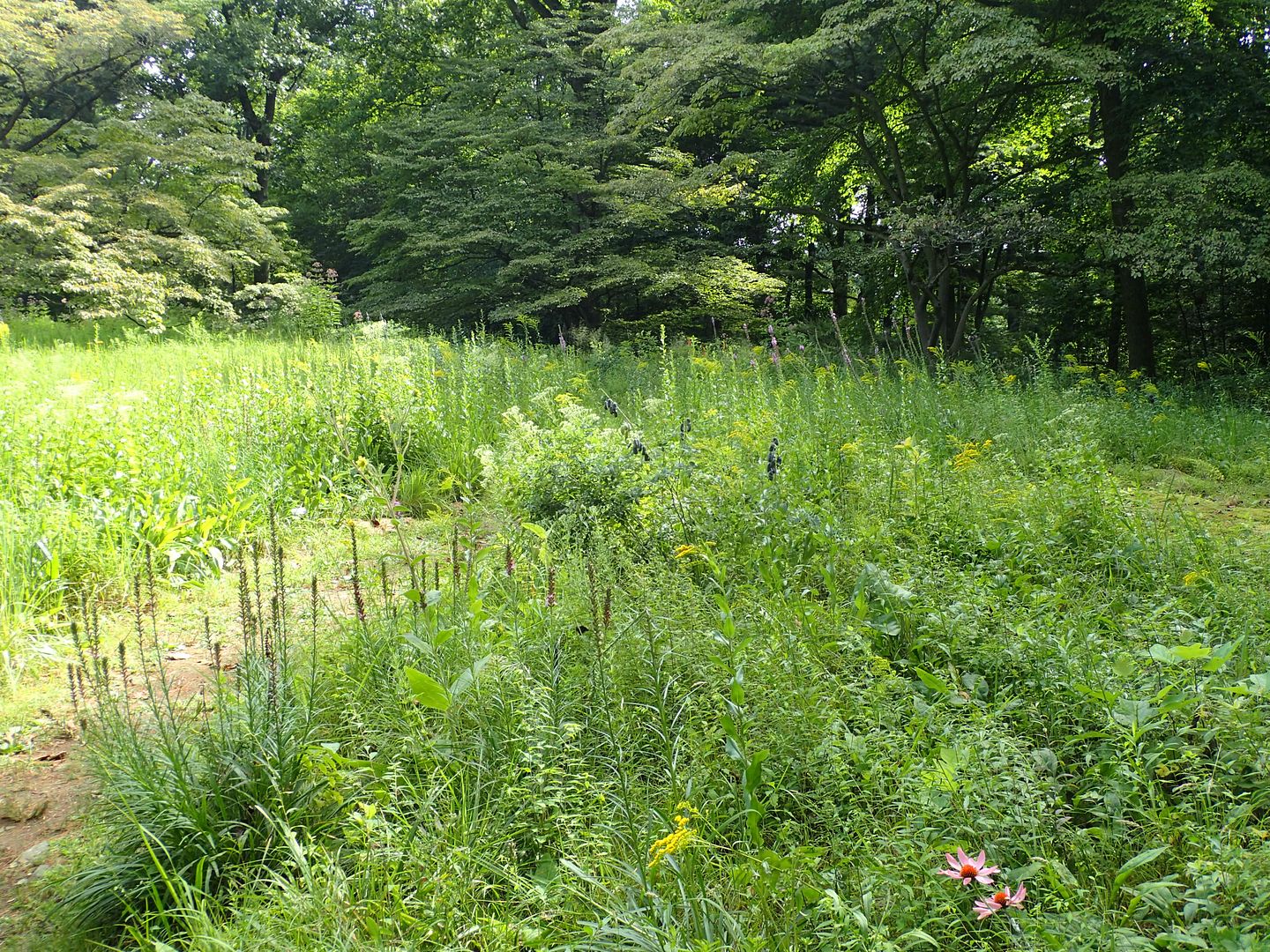
Becasue flowering plants are obviously a big part of a meadow they're grown mostly at the top of the hill, out of view from the lower areas. They have a great collection here but early summer isn't the best time to view them. Goldenrods, Liatris, Perennial Sunflowers, Wild Senna, Black-eyed Susans, Joe Pye Weed, Milkweeds and loads of Asters all grow among the grasses.
Showing posts with label Bees. Show all posts
Wednesday, August 29, 2018
Monday, June 26, 2017
Wednesday, July 20, 2016
Myrmecochory: Ant Plant Seed Dispersal
It's that time of the year again. This is probably my favorite part about native plant gardening because it combines so many of our loved spring ephemerals with ants.
Ants are largely overlooked by gardeners despite being the most common insect (by number). Part of the reason gardeners don't appreciate ants is likely because they are generalist foragers. So it doesn't matter a whole lot what plants are growing in a garden, native or non; if you have soil and dead wood, chances are ants live in your yard.
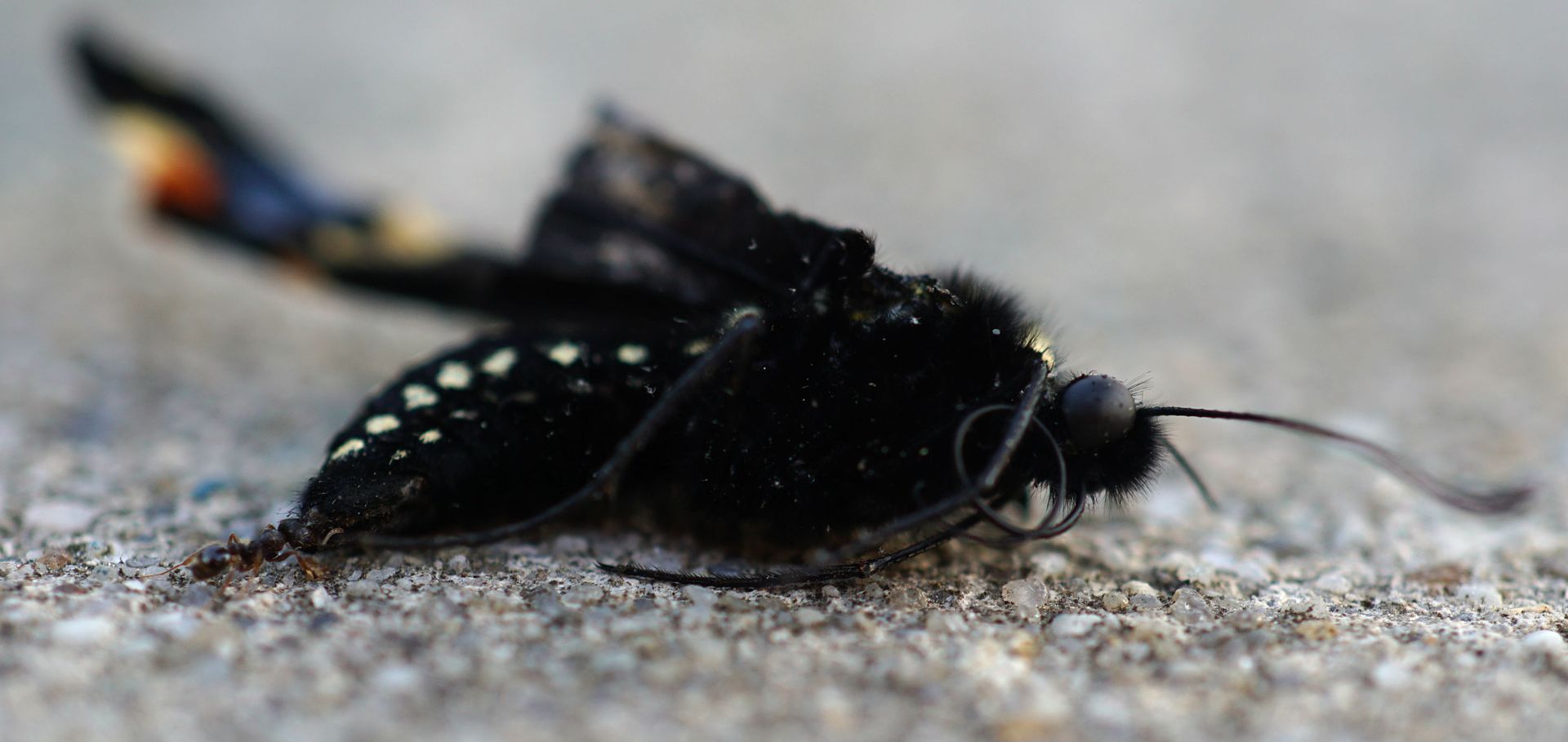
They play a vital role in removing dead insects. So after those big pretty swallowtail butterflies are done laying their eggs and visiting the flowers in your garden, ants are more than happy to collect, dissect, and consume their expired carcass. Though on the other hand, ants are also happy to remove butterfly eggs from host plants and often kill early instars to a lot of species. Ants don't forage equally on certain plants though, so it can depend on what's nesting near the tree/plant. Many caterpillars have defenses against ants too, but they're not always effective.
I have a Hackberry sapling that's about as tall as me right now. My dream is to someday see some Hackberry Emperors using it as a host plant. Every year though I got out there and find ants (Lasius alienus, Camponotus pennsylvanicus, C. chromaiodes, C. nearcticus, C. subarbatus, Temnothorax curvispinosus and Nylanderia faisonensis) foraging on the tree. They're mostly doing what's called nectar scraping where they wonder the plant licking and scraping the surface of the leaves to collect the small amounts of sweet sap that bleeds out of the leaves with the changing temperature of the day. The foraging power of 1 ant colony is enough to put a dent in the number of Lepidoptera eggs on a sapling; this one has 7 different species and likely multiple colonies of each constantly foraging on it, so I won't likely be seeing any Hackberry Emperors for several years.
To a lesser degree, ants also think pollinators are delicious. They're mostly an issue with solitary bees, usually ground nesting or mason bee nests when discovered by ants. Ants typically don't dig into structures in search of food though, so as long as the burrows or tubes are properly secured with mud the developing bee larva should be safe.
My favorite thing ants do in the garden is called Myrmecochory, or ant plant seed dispersal. Even here though ants can be considered annoying. Let's say you paid $20 for a rare Trillium species, looking to start a clump of them over the next decade, which is how long many Trilliums take to flower from seed. Often though Trillium seeds have the annoying habit of walking away from the plant thanks to packets of "Elaiosome," a lipid rich substance on the seed, attracting ants to come and carry them home.
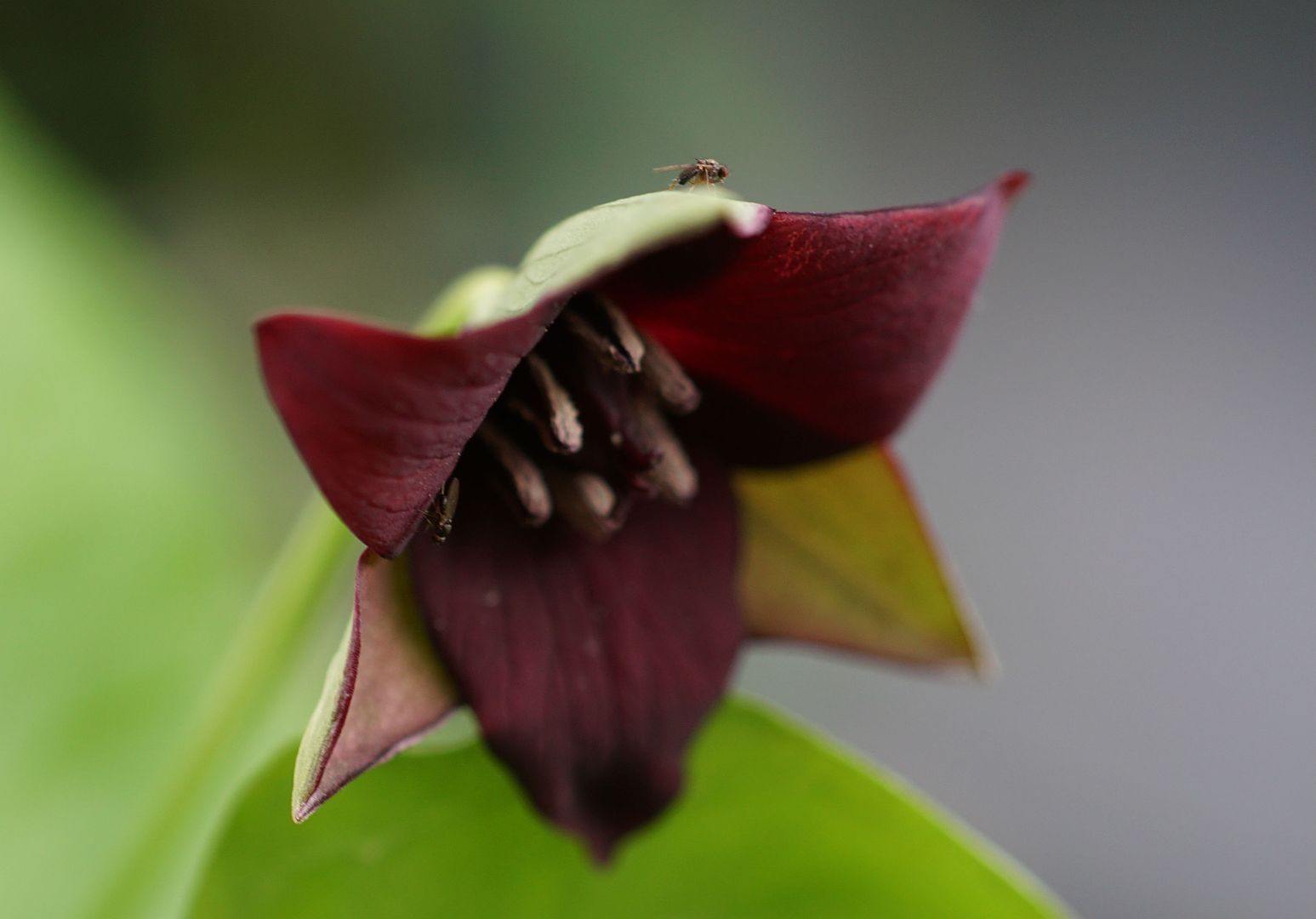
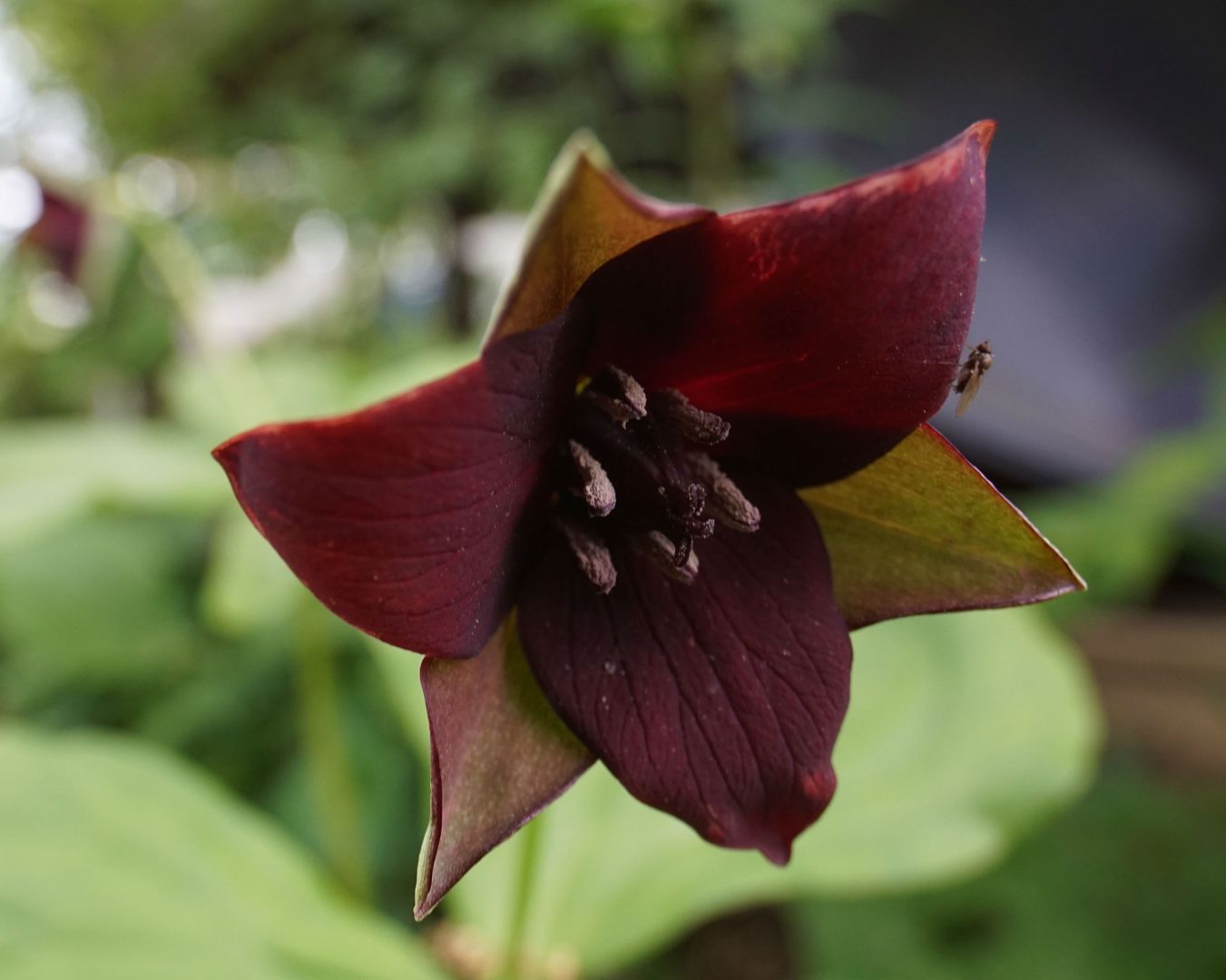
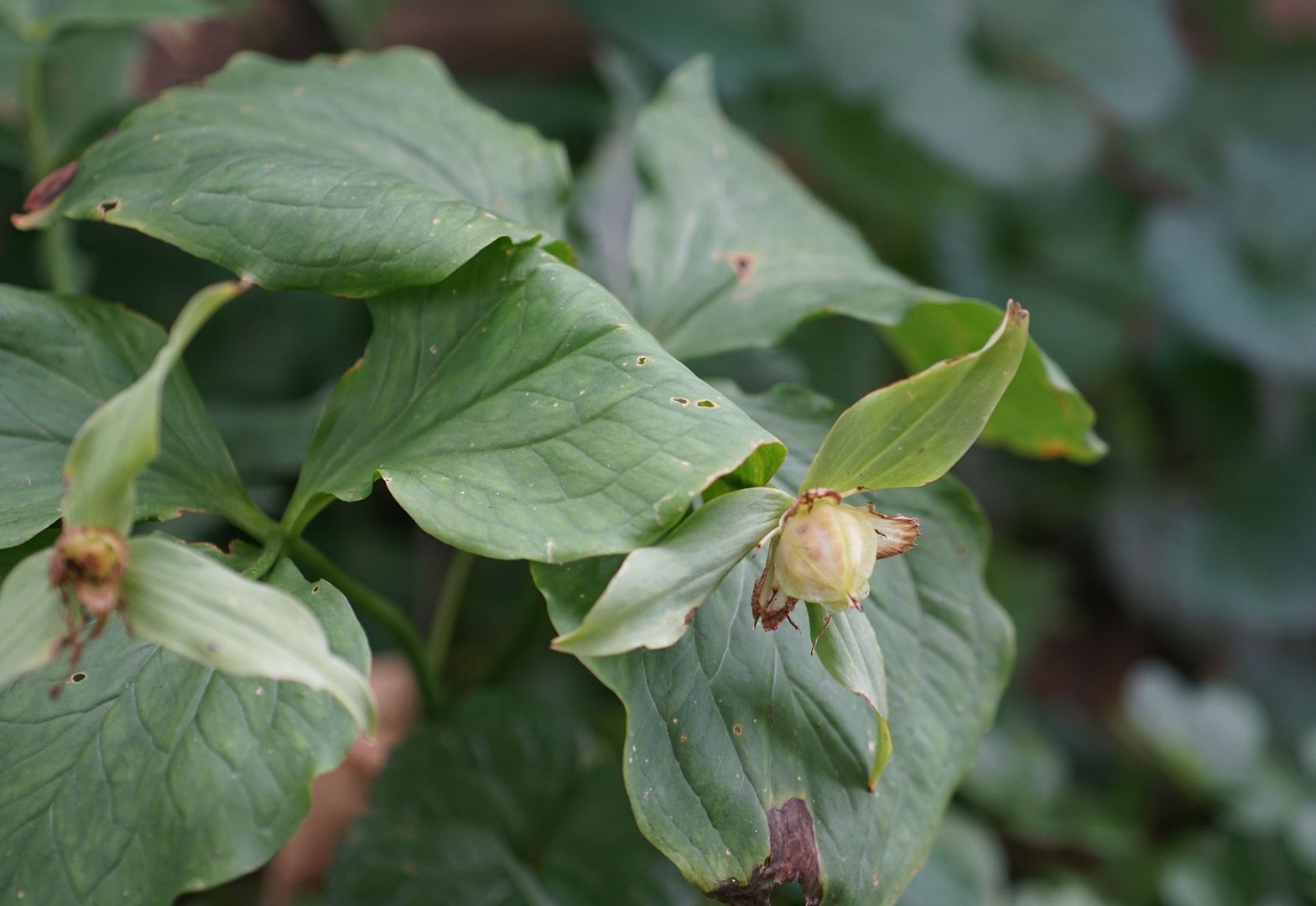
This is Trillium vaseyi, (I believe), which is pollinated by Vinegar Flies and other sorts of carrion insects. Note Vinegar Flies are sold in pet stores as "Fruit Flies" because that sounds better than Vinegar Flies. True Fruit Flies consume fresh fruit and tune delicious apples and berries into balls of maggots. Vinegar Flies target foods that have already spoiled, drawn in by the fermenting smell of yest, cider and dead fish, which is what this flower smell like.
Lots of Trilliums are either pollinated by carrion insects or bees. In my garden this particular Trillium species isn't quite ready to produce seeds yet, though they flower every year. A rabbit or some other critter trampled through the Trillium garden and snapped the stems to the two plants of this species so I've yet to get photograph them. Fortunately I have 8 other Trillium species in my garden!
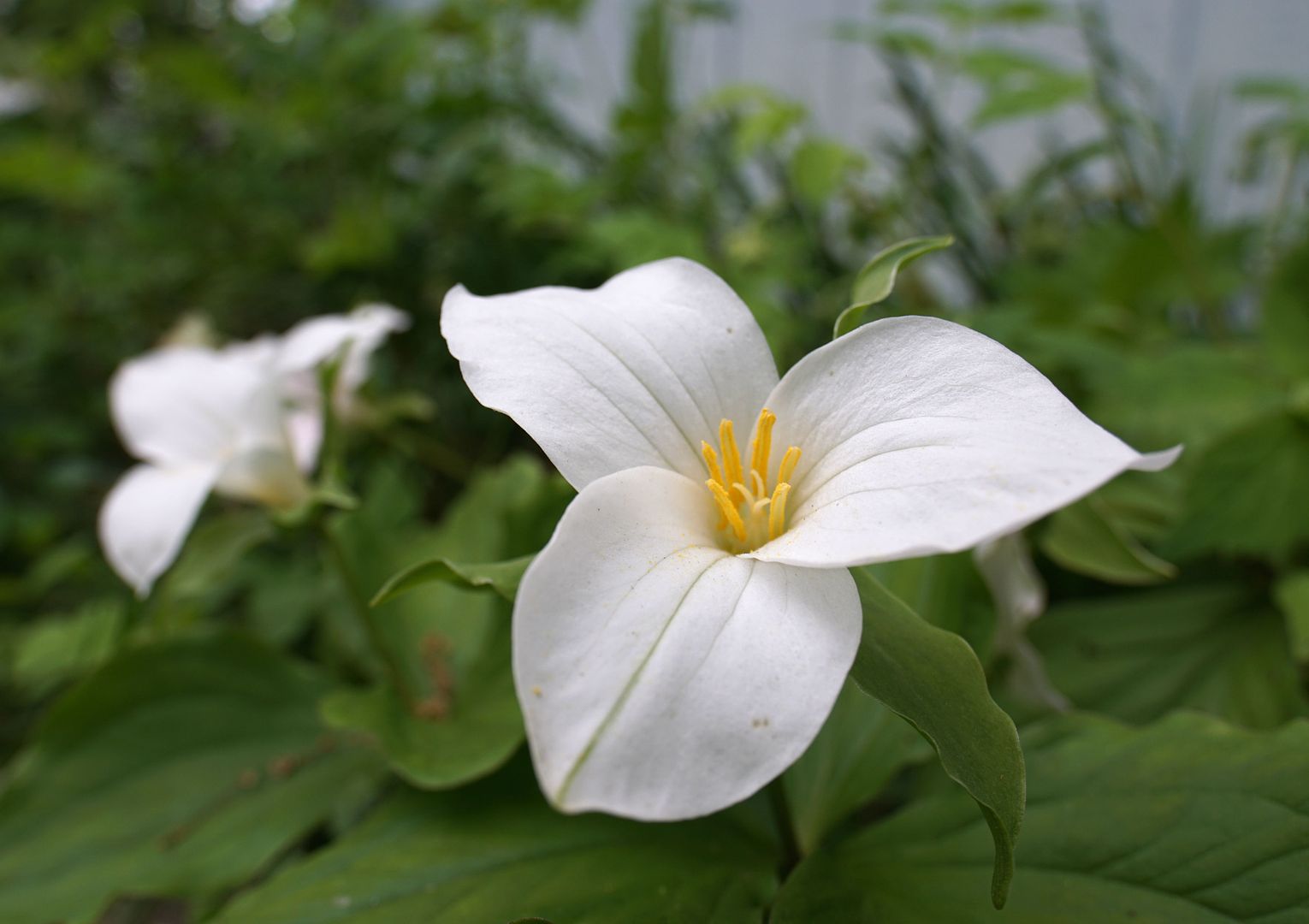
Trillium grandiflorum! This is by far the most common and easily recognized Trillium species. It's pollinated by bees and while I never witnessed any bees visiting my flowers I have seen honeybees visiting them in other gardens when planted in sufficient numbers. I'm certain Bumblebees and others must visit them on occasion too. Currently I have a clump of about 9 plants of flowering age. Each of which has a few off shoots underneath that will reach flowering age in years to come. I may even need to divide a few in a year or two.
Admittedly things like Twinleaf, Violets, Blood Root, Hepatica, Woodland Poppy, and Bleeding Hearts have already dropped their seeds for ants to disperse. Trilliums are latest ephemeral plant in North America to drop their seeds as many of the ones I've mentioned are already dormant.
Note how the leaves to the plants photoed above are singed at the tips. If you don't water your plants, they will fry right up and abort the seedpod entirely. You can plant Trilliums in full sun and they'll grow happily but probably won't produce seeds because of how much sun they get. You can compensate for this by adding water but there's only so much watering can do. It's best to plant them in the shade with a small amount of mulch and a low ground cover growing underneath such as Hepatica or Stone Crop. I like to water the roots to mine basically every time I walk past with the hose, or once every other day. Just put the water to the stem and count to 10 for each plant. Even doing this though won't guarantee success. Note the plant to the left didn't bother producing a seedpod at all. Of 9 plants only 2 didn't make seedpods, lack of pollination is likely the issue. Some that did make seedpods made smaller than average ones.
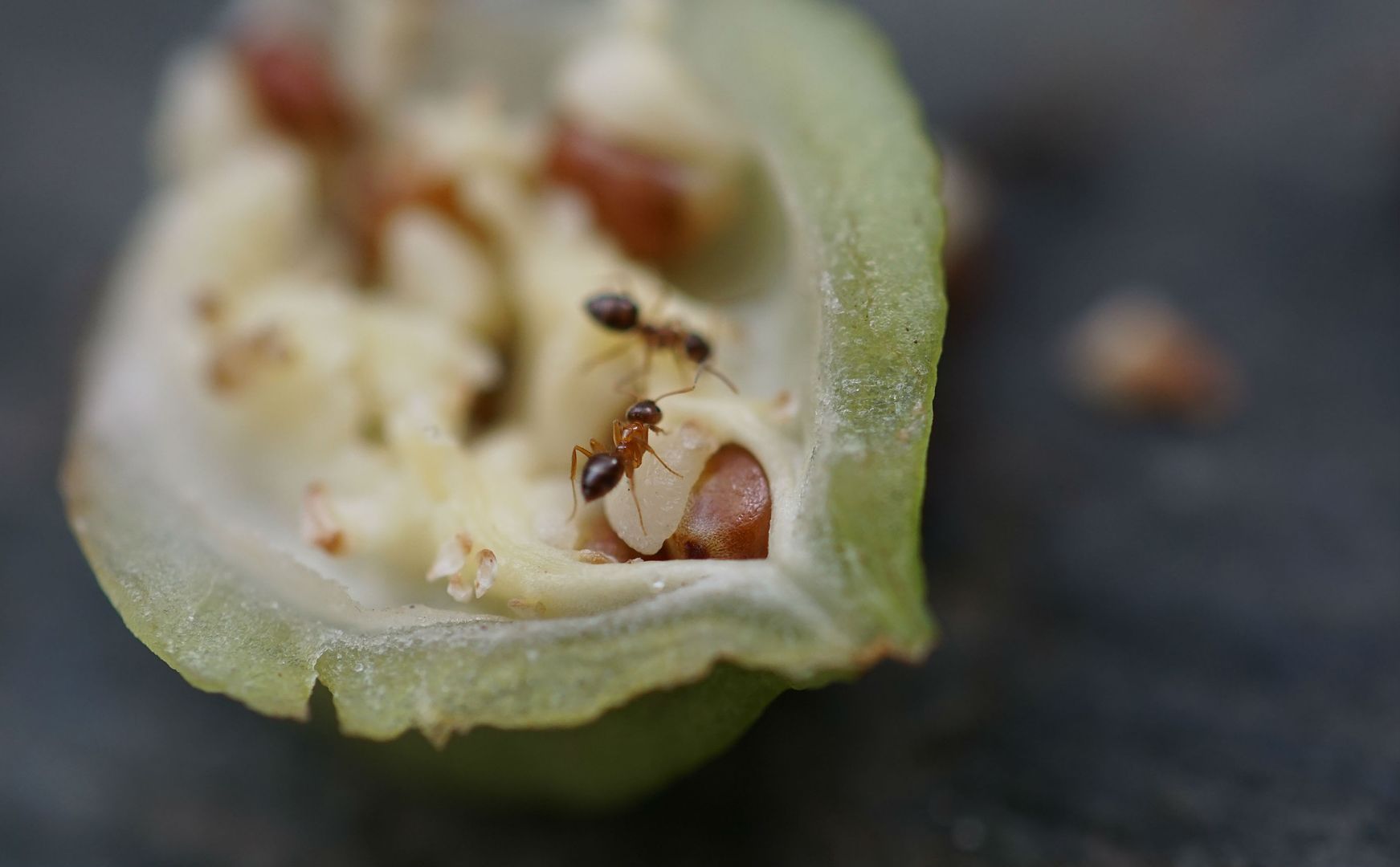
You can tell a Trillium pod is ripe when you can see the seeds right through the pod. Another thing to look for is a change in color. Some go from green to purple, others go from purple to green, some ends up as bright red, depending on the species. Seeing these changes, and especially seeing the seeds within, mean you're within 2 weeks of the seeds being ripe. Seeds should be hard, like unpopped popcorn. The longer you wait the more likely the pod will become damaged, where ants, wasps, birds, and rodents will make off with the seeds. I've found seedpods completely hollow inside thanks to a small puncture hole allowing ants to gain entry.
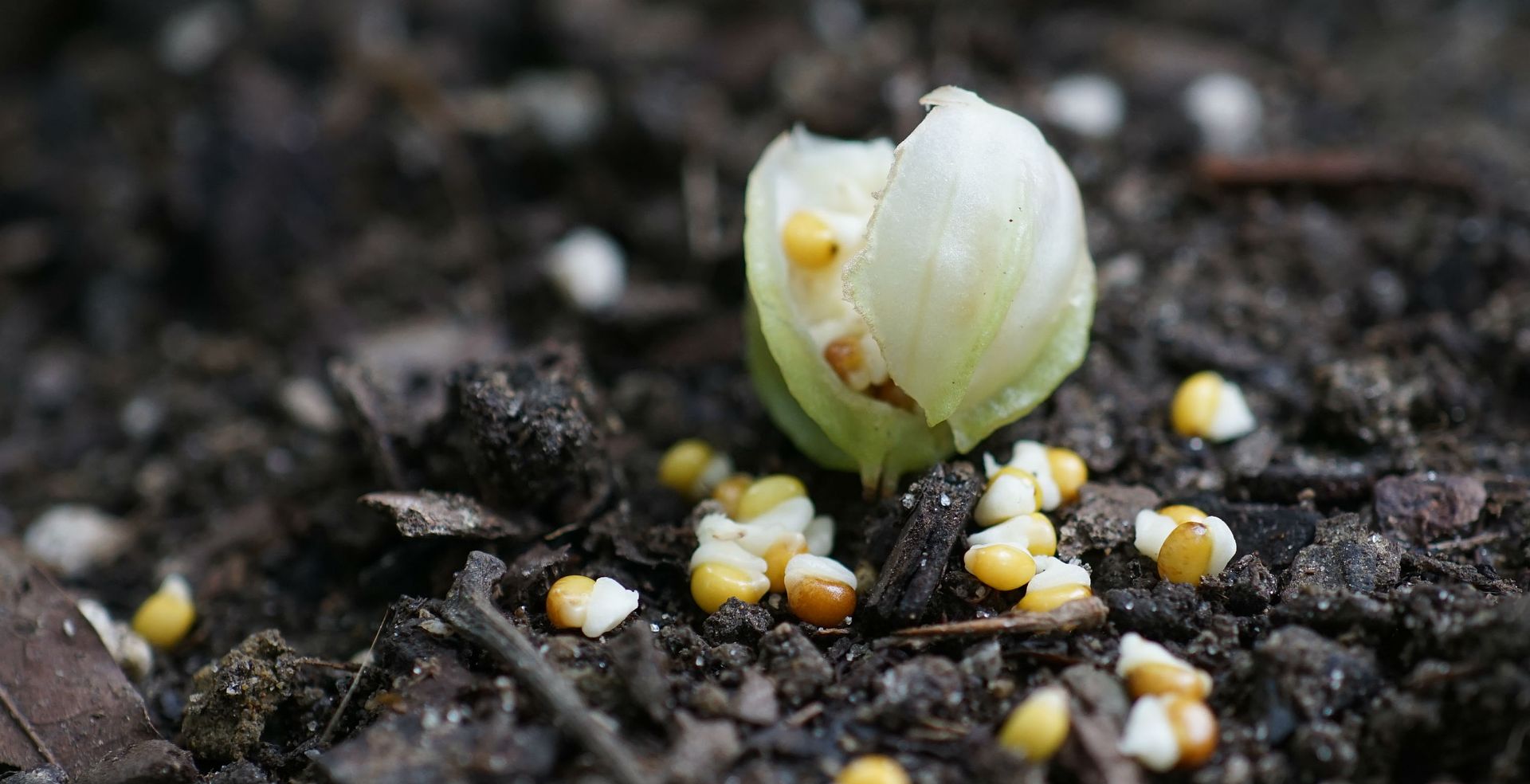
Ants planting the seeds is not necessary for germination! This is just how the plants disperse their seeds in the wild. For gardeners looking to start a bed of these, I'd say go ahead and crack open a pod or two and just dump the seeds out in a shallow ditch and plant them yourself. Ideally the elaiosome should be removed before doing this, however that stuff is really effing on there!!! You can't just cut it off or take your finger nail to it. The risk is sometimes a kind of mold or fungus grows on the elaiosome and may kill the seed... I've never seen this happen to an extreme degree though. Maybe let the seeds dry out for two hours before planting.
Personally I like letting the ants carry the seeds off. The consequence here is that I get Trillium seedlings coming up in the lawn and in unwanted places. These are easy enough to transplant when I notice them, but determining what species they are can't be done for many more years!
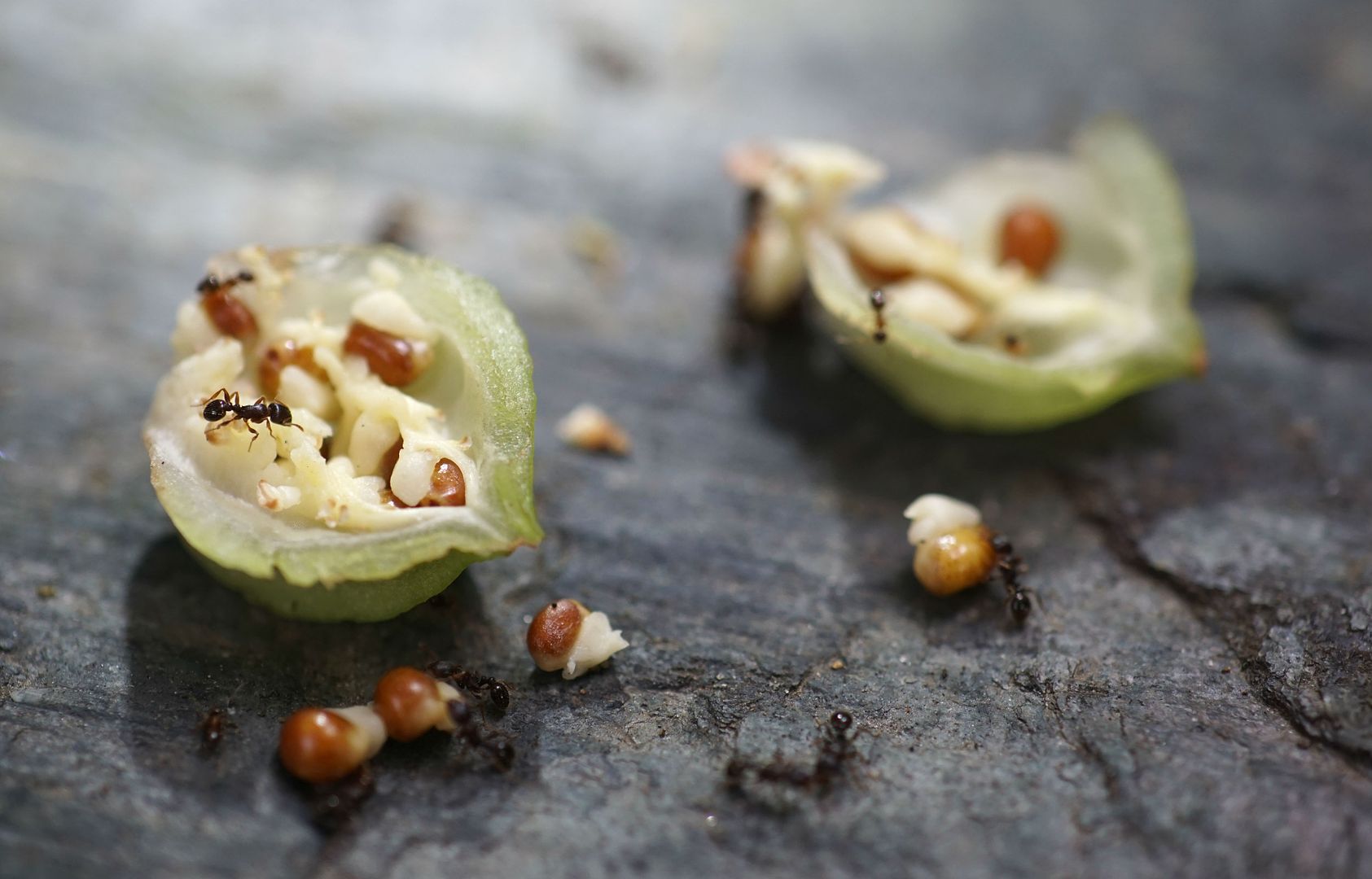
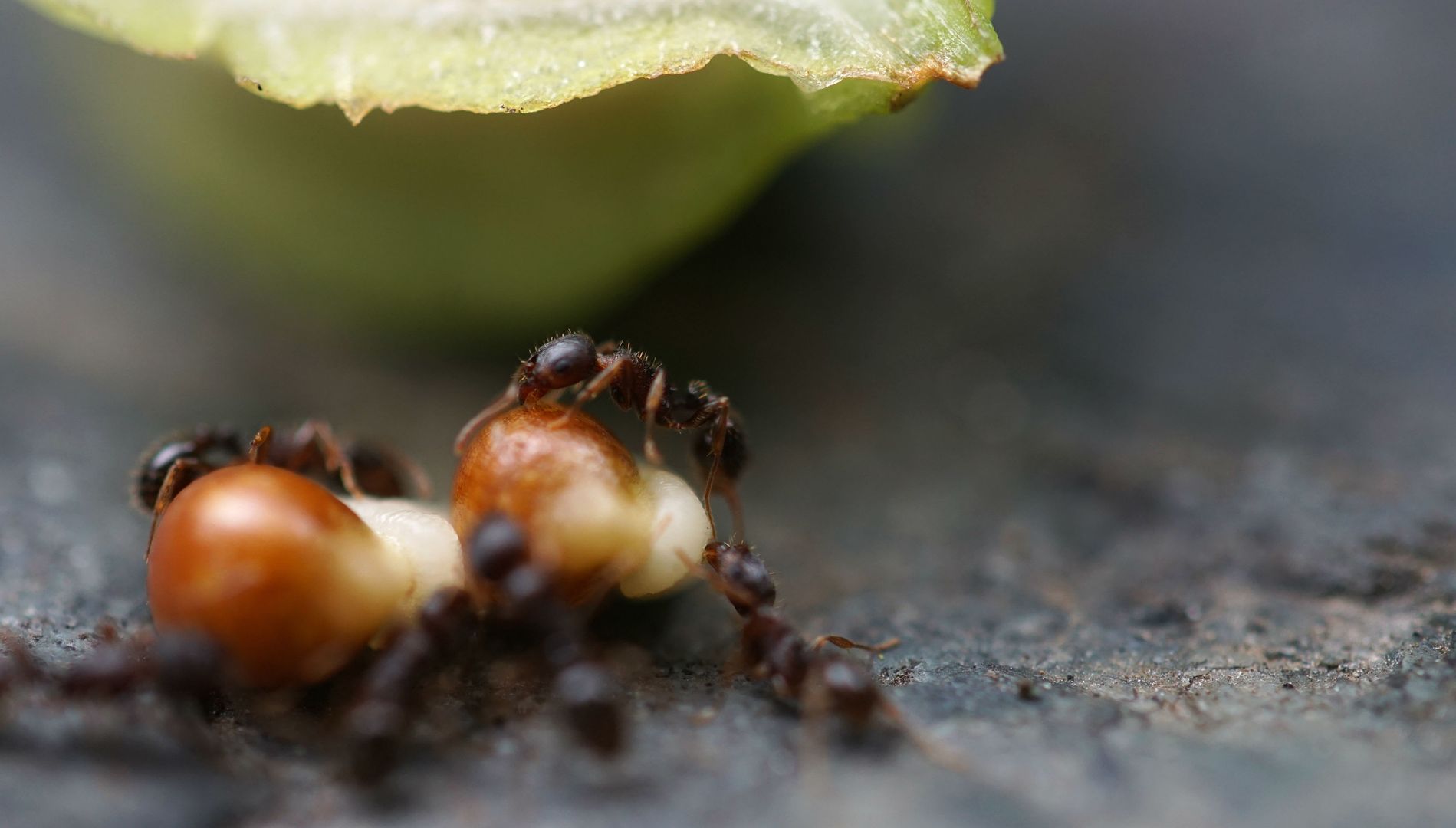
Shortly after a pod has become damaged, ants will more than likely find the seeds. Here a pavement ant, Tetramorium caespitum, has chanced upon the mother load.
Because dirt doesn't make for a thrilling background, I took the liberty of placing a seedpod on one of the stepping stones of my garden.
Nylanderia faisonensis is a nonnative woodland species that's slowly been invading areas rich in leaf litter. Nylanderia is a genus of tramp ants which are accidentally imported all over the world. Not all ants are ideal at planting seeds, and this is one of them. The ants are too small to carry the seeds anywhere, so instead of dispersing them as the plant wanted, the ants simply feed on the elaiosome where they found the seed.
Tetramorium caespitum, Pavement Ants, do a better job but also are not native. Studies have been coming out finding that Nonnative Ants tend to favor the seeds to Nonnative Plants. In this case the Tetramorium were more than happy to disperse these seeds for me. (My yard also lacks any nonnative plant that has elaiosome on the seeds.)
Another risk facing Trillium seeds is the ants eating the seed along with the elaiosome. Trillium seeds tend to be rock hard for the first two years then soften up as they go to germinate. They are said to produce a fowl smell which is probably meant to encourage ants to move their nest elsewhere!
The ideal ant genus to be doing this seems to be Aphaenogaster which form abundant colonies of ~2000 ants throughout woodland settings. They're also very much in the habit of changing their nest location, so as the colonies move around they leave seed banks behind where plants like Trilliums tend to grow. There used to be a colony of Aphaenogaster rudis under this stepping stone which is why I picked it, sadly it seems the colony has moved on.
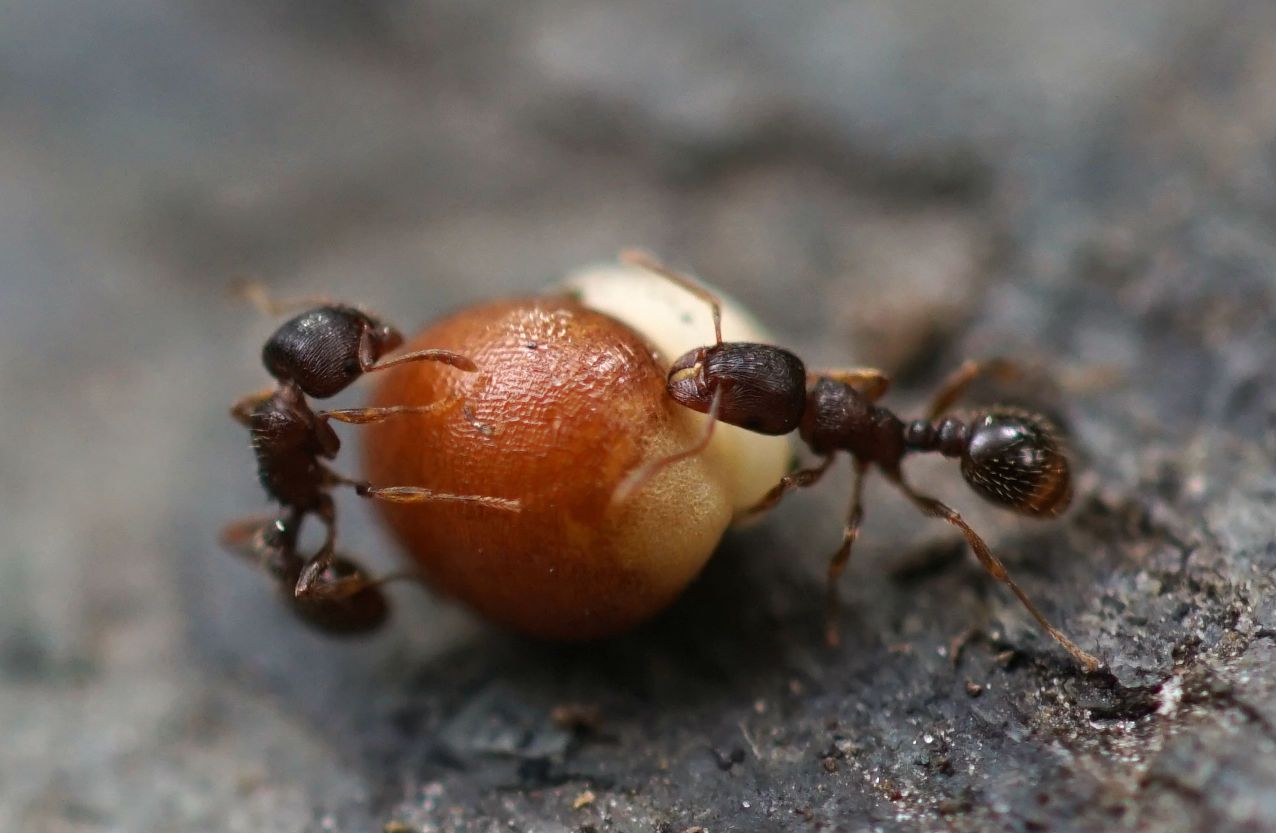
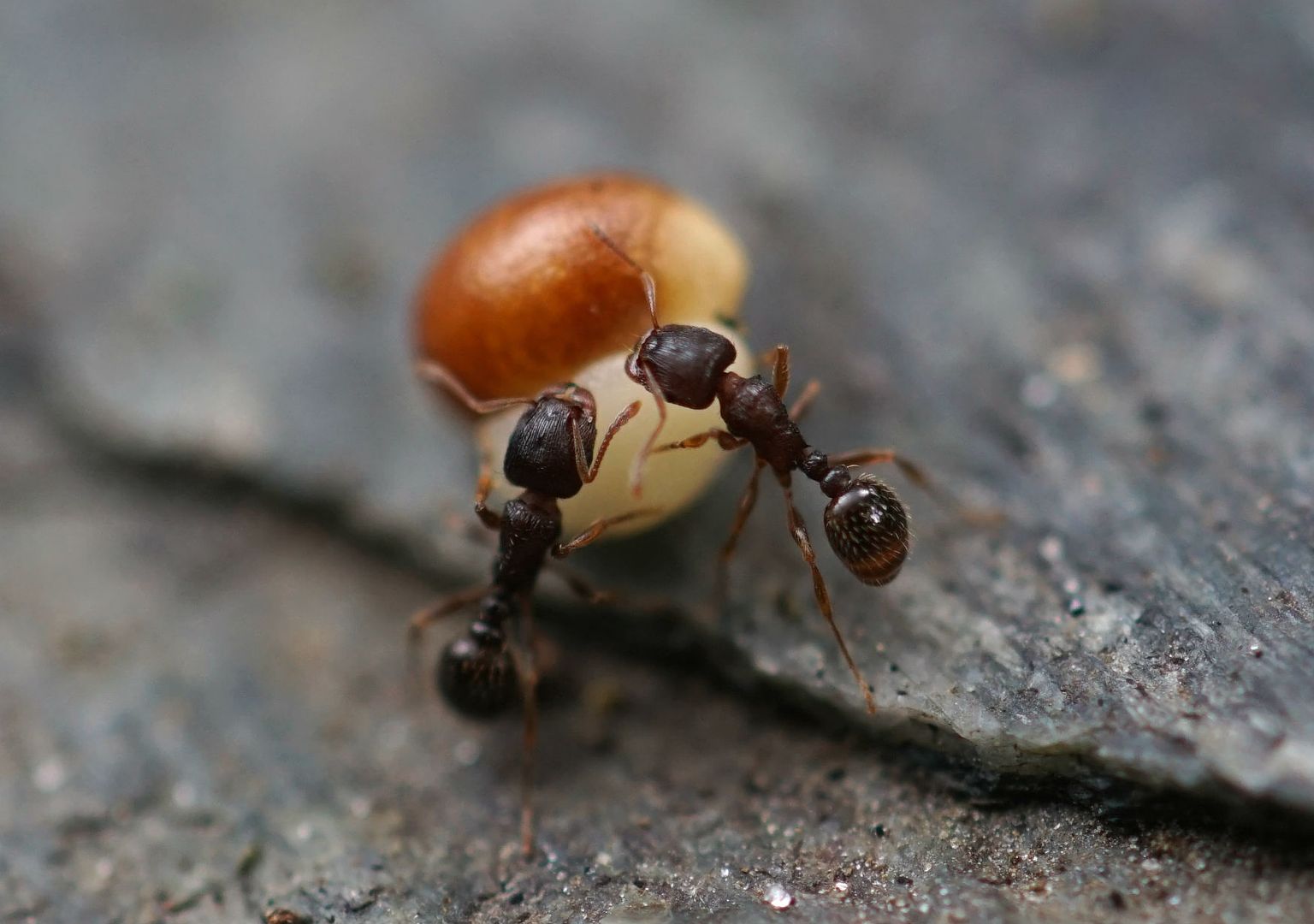
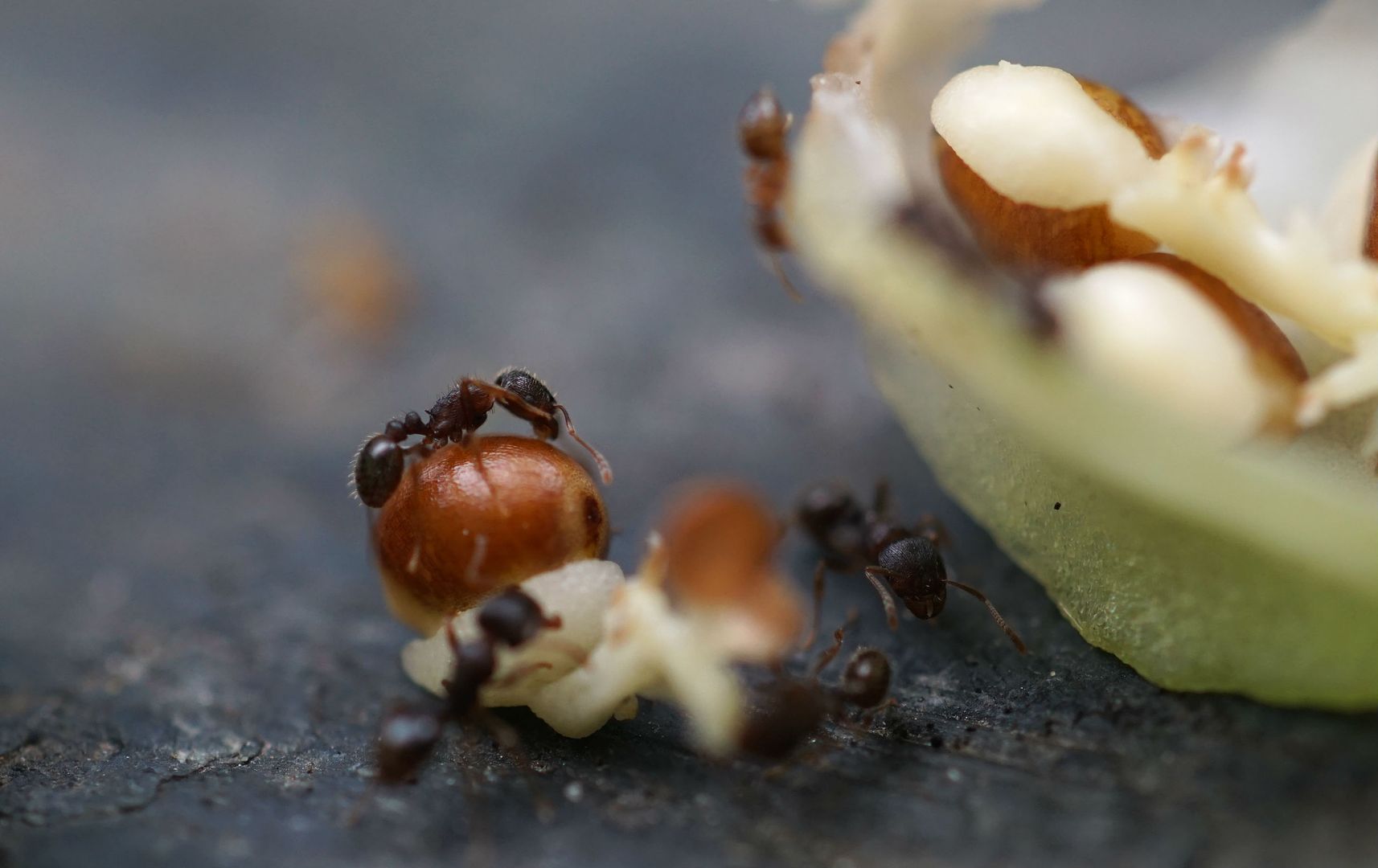
Two Pavement Ants trying to carry a Trillium seed home.
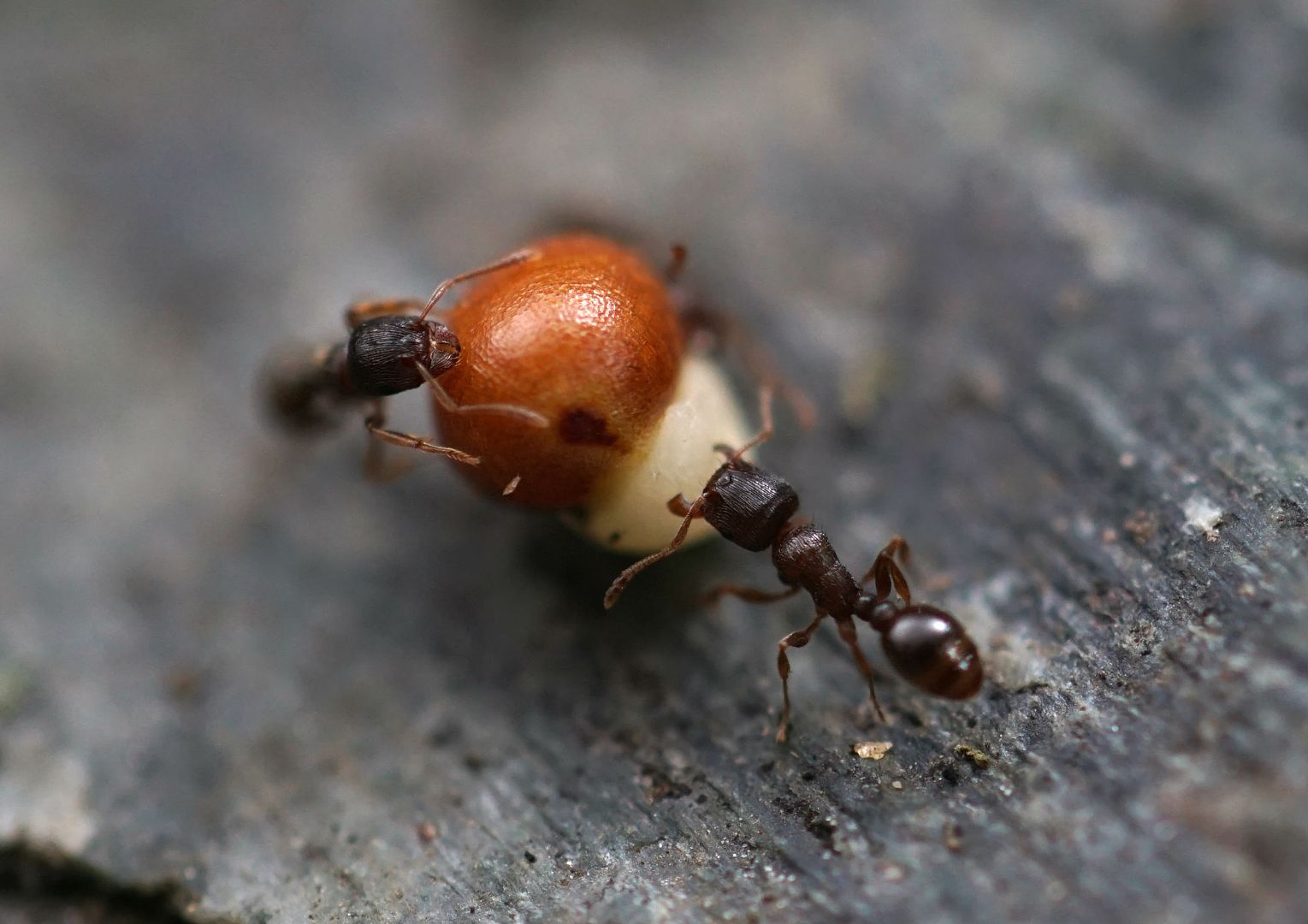
These ants are just big enough to handle the seed, though it still takes two of them to move it. Sometimes ants will actually give up after carrying the seeds a few feet. The seed is still dispersed from the parent plant but slightly at risk of being eaten by a rodent. Trilliums naturally grow best where there is plenty of leaf litter decomposing, and it's likely in these kinds of settings such discarded seeds are still successful.
I love this shot.
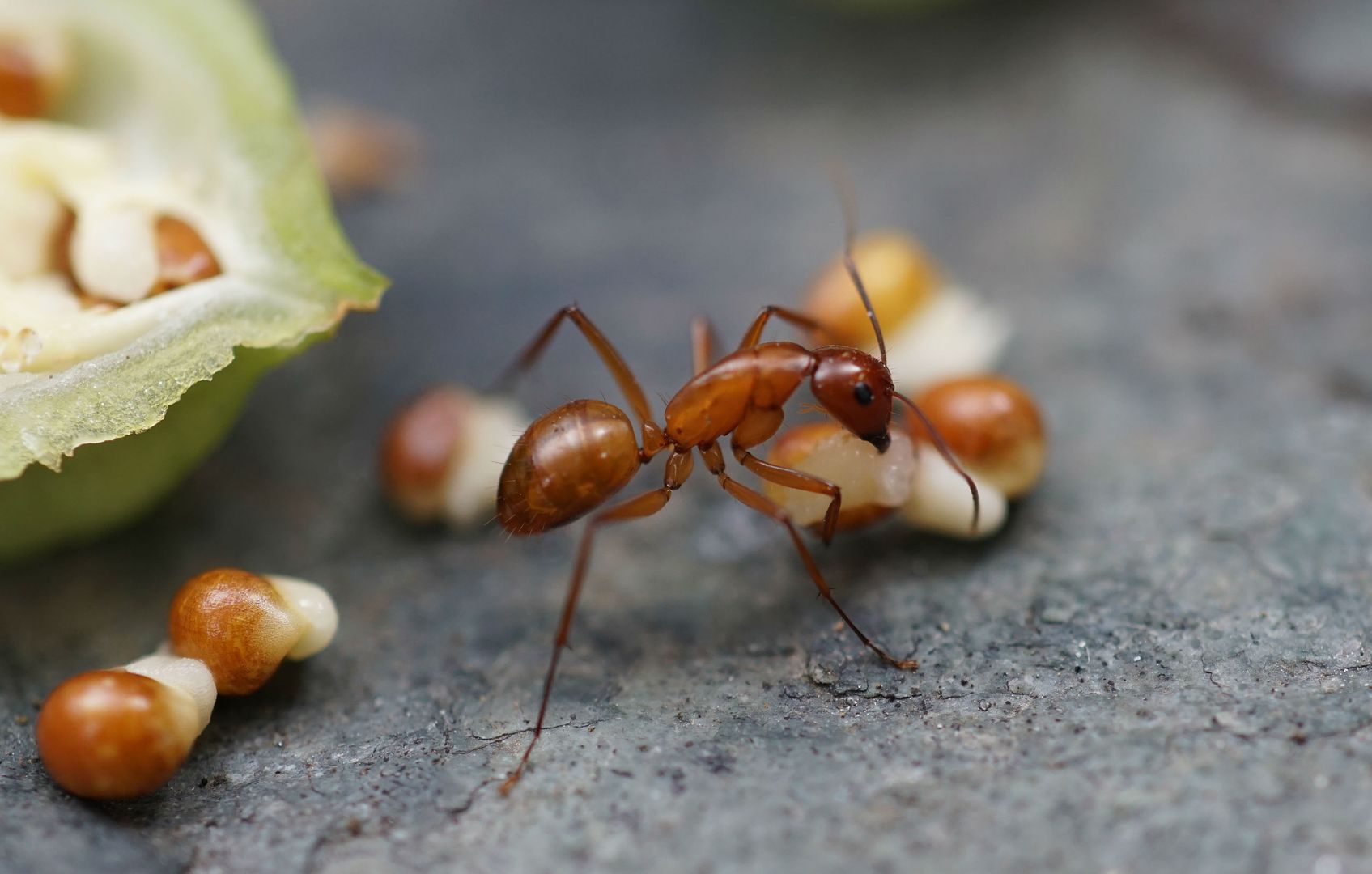
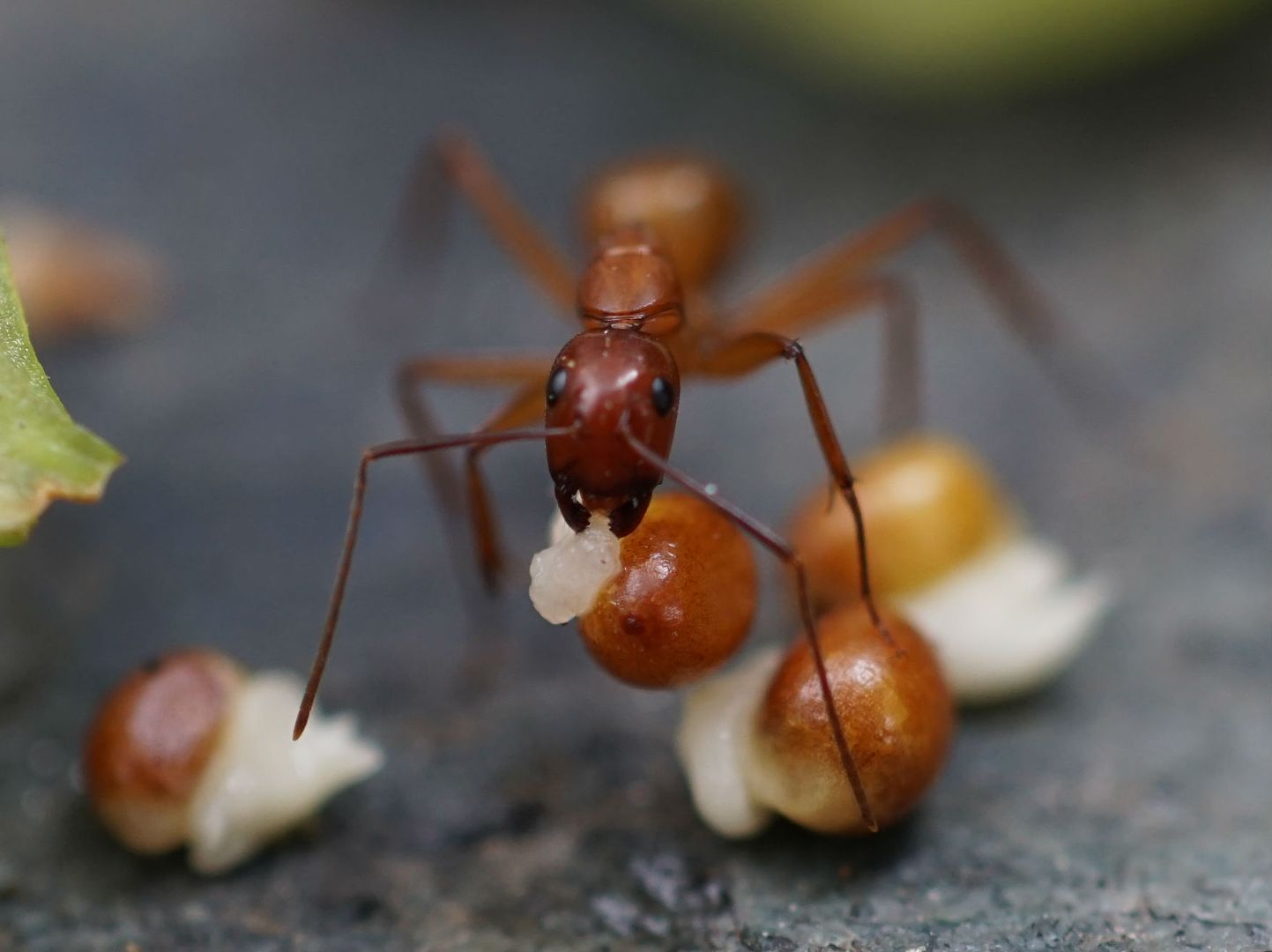
The larger, ground nesting, Camponotus castaneus does a great job of dispersing seeds too. In the past I had assumed the seeds might get lost 4' underground where these ants like to nest. As it turns out though after bringing the seeds home, they're discarded a short while later, once the elaiosome has dried up typically. While the seeds may not be planted, they are dispersed and left in the colony midden pile (trash heap) which is still better than nothing.
These are one of the most elegant ants in my opinion and I love their chestnut brown and orange color tone.
Ants are largely overlooked by gardeners despite being the most common insect (by number). Part of the reason gardeners don't appreciate ants is likely because they are generalist foragers. So it doesn't matter a whole lot what plants are growing in a garden, native or non; if you have soil and dead wood, chances are ants live in your yard.
They play a vital role in removing dead insects. So after those big pretty swallowtail butterflies are done laying their eggs and visiting the flowers in your garden, ants are more than happy to collect, dissect, and consume their expired carcass. Though on the other hand, ants are also happy to remove butterfly eggs from host plants and often kill early instars to a lot of species. Ants don't forage equally on certain plants though, so it can depend on what's nesting near the tree/plant. Many caterpillars have defenses against ants too, but they're not always effective.
I have a Hackberry sapling that's about as tall as me right now. My dream is to someday see some Hackberry Emperors using it as a host plant. Every year though I got out there and find ants (Lasius alienus, Camponotus pennsylvanicus, C. chromaiodes, C. nearcticus, C. subarbatus, Temnothorax curvispinosus and Nylanderia faisonensis) foraging on the tree. They're mostly doing what's called nectar scraping where they wonder the plant licking and scraping the surface of the leaves to collect the small amounts of sweet sap that bleeds out of the leaves with the changing temperature of the day. The foraging power of 1 ant colony is enough to put a dent in the number of Lepidoptera eggs on a sapling; this one has 7 different species and likely multiple colonies of each constantly foraging on it, so I won't likely be seeing any Hackberry Emperors for several years.
To a lesser degree, ants also think pollinators are delicious. They're mostly an issue with solitary bees, usually ground nesting or mason bee nests when discovered by ants. Ants typically don't dig into structures in search of food though, so as long as the burrows or tubes are properly secured with mud the developing bee larva should be safe.
My favorite thing ants do in the garden is called Myrmecochory, or ant plant seed dispersal. Even here though ants can be considered annoying. Let's say you paid $20 for a rare Trillium species, looking to start a clump of them over the next decade, which is how long many Trilliums take to flower from seed. Often though Trillium seeds have the annoying habit of walking away from the plant thanks to packets of "Elaiosome," a lipid rich substance on the seed, attracting ants to come and carry them home.
This is Trillium vaseyi, (I believe), which is pollinated by Vinegar Flies and other sorts of carrion insects. Note Vinegar Flies are sold in pet stores as "Fruit Flies" because that sounds better than Vinegar Flies. True Fruit Flies consume fresh fruit and tune delicious apples and berries into balls of maggots. Vinegar Flies target foods that have already spoiled, drawn in by the fermenting smell of yest, cider and dead fish, which is what this flower smell like.
Trillium grandiflorum! This is by far the most common and easily recognized Trillium species. It's pollinated by bees and while I never witnessed any bees visiting my flowers I have seen honeybees visiting them in other gardens when planted in sufficient numbers. I'm certain Bumblebees and others must visit them on occasion too. Currently I have a clump of about 9 plants of flowering age. Each of which has a few off shoots underneath that will reach flowering age in years to come. I may even need to divide a few in a year or two.
Admittedly things like Twinleaf, Violets, Blood Root, Hepatica, Woodland Poppy, and Bleeding Hearts have already dropped their seeds for ants to disperse. Trilliums are latest ephemeral plant in North America to drop their seeds as many of the ones I've mentioned are already dormant.
Note how the leaves to the plants photoed above are singed at the tips. If you don't water your plants, they will fry right up and abort the seedpod entirely. You can plant Trilliums in full sun and they'll grow happily but probably won't produce seeds because of how much sun they get. You can compensate for this by adding water but there's only so much watering can do. It's best to plant them in the shade with a small amount of mulch and a low ground cover growing underneath such as Hepatica or Stone Crop. I like to water the roots to mine basically every time I walk past with the hose, or once every other day. Just put the water to the stem and count to 10 for each plant. Even doing this though won't guarantee success. Note the plant to the left didn't bother producing a seedpod at all. Of 9 plants only 2 didn't make seedpods, lack of pollination is likely the issue. Some that did make seedpods made smaller than average ones.
You can tell a Trillium pod is ripe when you can see the seeds right through the pod. Another thing to look for is a change in color. Some go from green to purple, others go from purple to green, some ends up as bright red, depending on the species. Seeing these changes, and especially seeing the seeds within, mean you're within 2 weeks of the seeds being ripe. Seeds should be hard, like unpopped popcorn. The longer you wait the more likely the pod will become damaged, where ants, wasps, birds, and rodents will make off with the seeds. I've found seedpods completely hollow inside thanks to a small puncture hole allowing ants to gain entry.
Ants planting the seeds is not necessary for germination! This is just how the plants disperse their seeds in the wild. For gardeners looking to start a bed of these, I'd say go ahead and crack open a pod or two and just dump the seeds out in a shallow ditch and plant them yourself. Ideally the elaiosome should be removed before doing this, however that stuff is really effing on there!!! You can't just cut it off or take your finger nail to it. The risk is sometimes a kind of mold or fungus grows on the elaiosome and may kill the seed... I've never seen this happen to an extreme degree though. Maybe let the seeds dry out for two hours before planting.
Personally I like letting the ants carry the seeds off. The consequence here is that I get Trillium seedlings coming up in the lawn and in unwanted places. These are easy enough to transplant when I notice them, but determining what species they are can't be done for many more years!
Because dirt doesn't make for a thrilling background, I took the liberty of placing a seedpod on one of the stepping stones of my garden.
Nylanderia faisonensis is a nonnative woodland species that's slowly been invading areas rich in leaf litter. Nylanderia is a genus of tramp ants which are accidentally imported all over the world. Not all ants are ideal at planting seeds, and this is one of them. The ants are too small to carry the seeds anywhere, so instead of dispersing them as the plant wanted, the ants simply feed on the elaiosome where they found the seed.
Tetramorium caespitum, Pavement Ants, do a better job but also are not native. Studies have been coming out finding that Nonnative Ants tend to favor the seeds to Nonnative Plants. In this case the Tetramorium were more than happy to disperse these seeds for me. (My yard also lacks any nonnative plant that has elaiosome on the seeds.)
Another risk facing Trillium seeds is the ants eating the seed along with the elaiosome. Trillium seeds tend to be rock hard for the first two years then soften up as they go to germinate. They are said to produce a fowl smell which is probably meant to encourage ants to move their nest elsewhere!
The ideal ant genus to be doing this seems to be Aphaenogaster which form abundant colonies of ~2000 ants throughout woodland settings. They're also very much in the habit of changing their nest location, so as the colonies move around they leave seed banks behind where plants like Trilliums tend to grow. There used to be a colony of Aphaenogaster rudis under this stepping stone which is why I picked it, sadly it seems the colony has moved on.
Two Pavement Ants trying to carry a Trillium seed home.
These ants are just big enough to handle the seed, though it still takes two of them to move it. Sometimes ants will actually give up after carrying the seeds a few feet. The seed is still dispersed from the parent plant but slightly at risk of being eaten by a rodent. Trilliums naturally grow best where there is plenty of leaf litter decomposing, and it's likely in these kinds of settings such discarded seeds are still successful.
I love this shot.
The larger, ground nesting, Camponotus castaneus does a great job of dispersing seeds too. In the past I had assumed the seeds might get lost 4' underground where these ants like to nest. As it turns out though after bringing the seeds home, they're discarded a short while later, once the elaiosome has dried up typically. While the seeds may not be planted, they are dispersed and left in the colony midden pile (trash heap) which is still better than nothing.
These are one of the most elegant ants in my opinion and I love their chestnut brown and orange color tone.
Saturday, June 6, 2015
New Jersey Tea: Honeybees, and Holly Blues
Years ago I planted a New Jersey Tea sapling, Ceanothus americanus. It's such a shame most of the mail order nurseries sell this shrub as a 4inch plug. It would really be nice to get it as a quart or gallon size pot instead of treating this like something you'd install in a meadow garden, to be mowed or burned at a later date. NJ Tea is a nice little shrub with a 2' to 3' round habit. It's touted as a hummingbird plant, not because of the flowers, but because of the droves of tiny insects that come to pollinate it. When flowering, these plants are absolutely swarming with little bees and solitary hunting wasps that are overall beneficial to have in the garden. Sadly, despite distribution charts showing how common this species is all across the eastern US, it's in something of a dramatic decline and becoming very hard to find in the wild.
Part of the problem was that farmers used to believe this plant was a sign of good soil and bulldozed whatever habitats it grew in for farm land. Where it still grows today, it's easily shaded out by tall perennials and encroaching forest land.
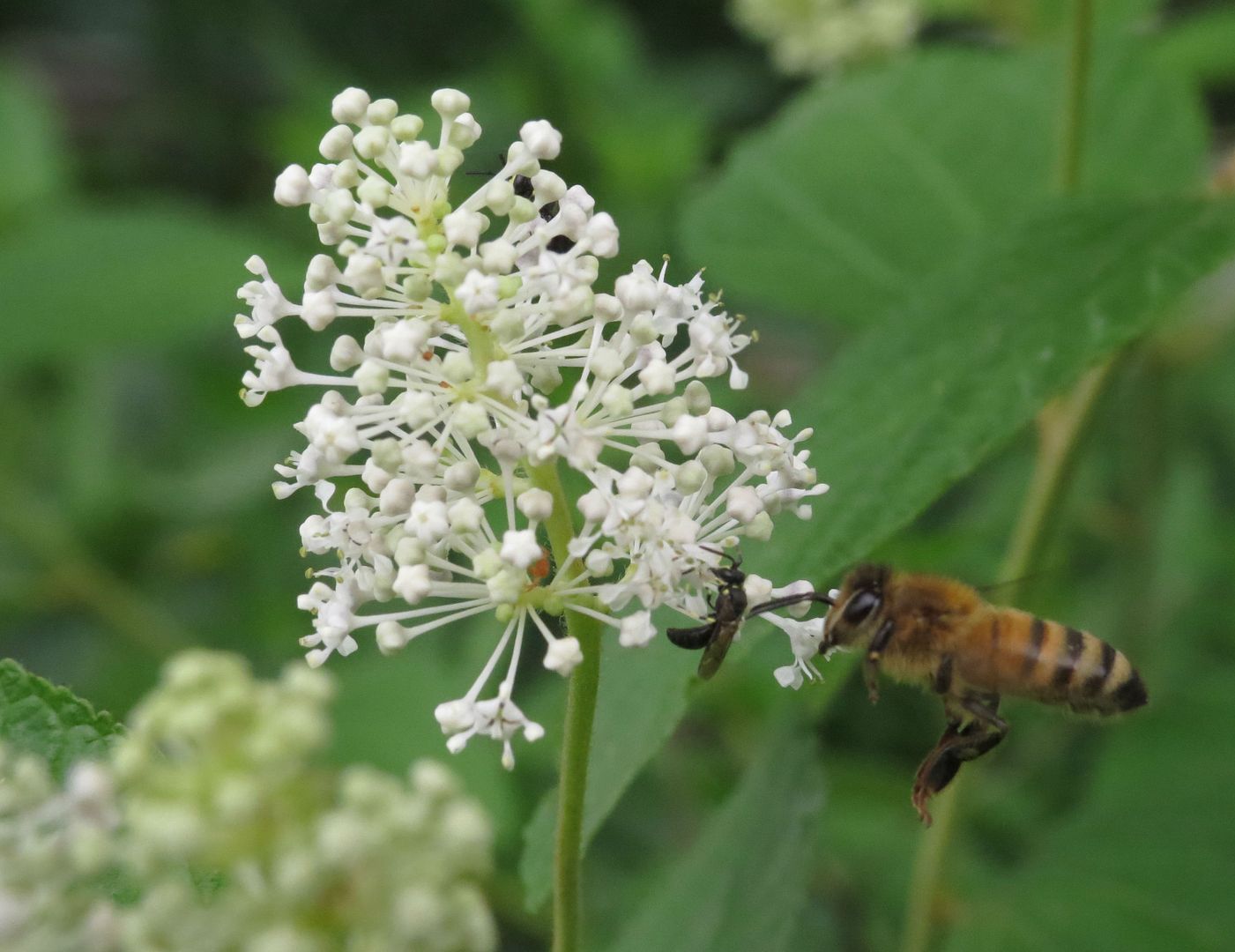
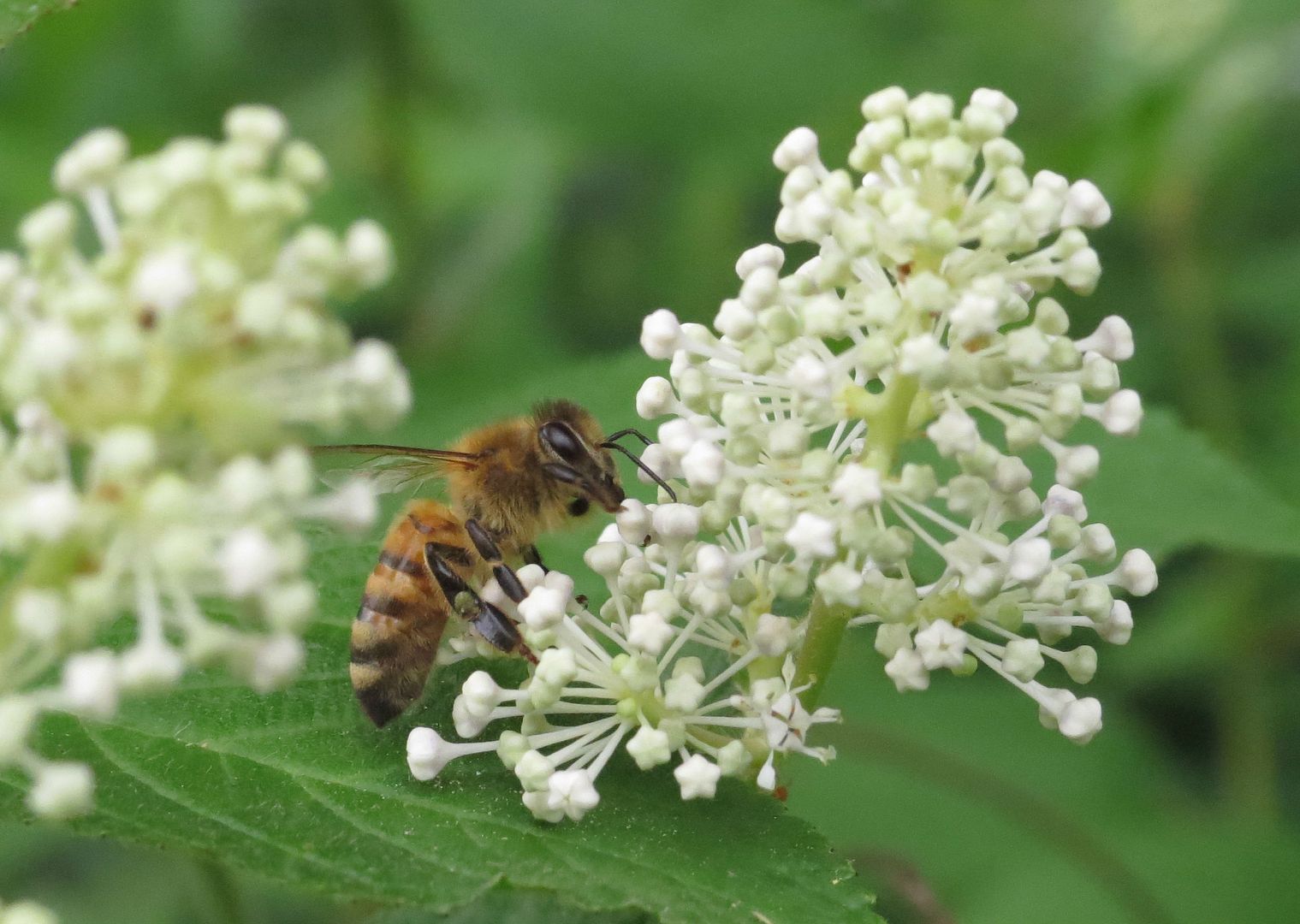
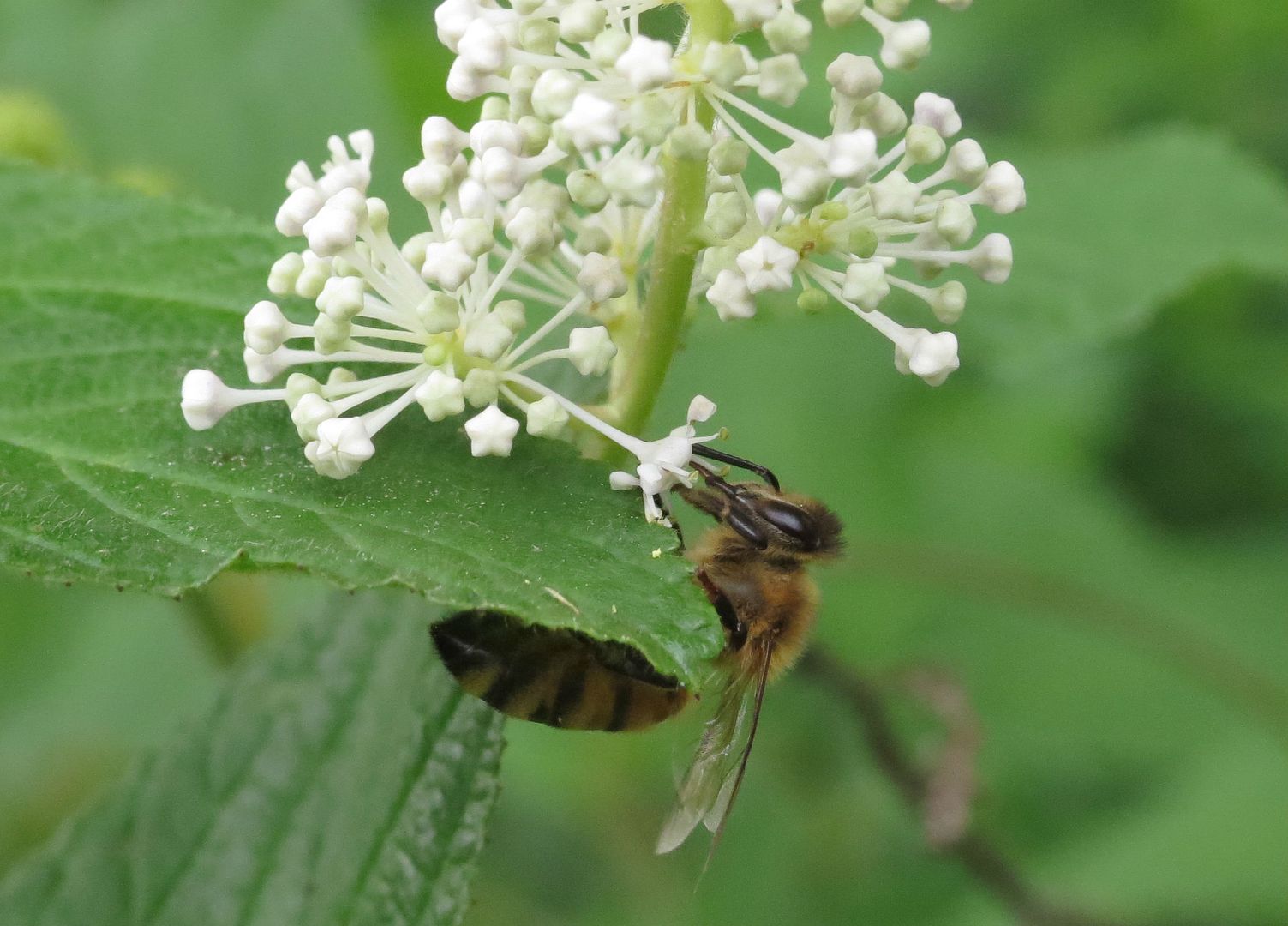
What makes it worth blogging about today for me is the fact that my honeybees started working it. This is odd because I almost never see honeybees bothering with plants who's flower shape and nectar is gear more towards wasps and smaller bees (as seen above).
Most of the flowers aren't open yet so it's not bustling with swarms of other pollinators just yet, (and I've never seen a hummingbird go near the thing,) so I'll see if this wasn't just a curious couple of foragers or if the honeybees really do want to work this plant.
Honeybees working a native plant isn't always a good thing for nature. Many conservationist view this as stealing food from the native bees. I'm not sure of any specialists pollinators of this plant though.
Western Ceanothus species and their bright blue flowers tend to get a lot more honeybee attention so I guess this isn't entirely unexpected. Sadly I don't know of any western Ceanothus that's hardy in New Jersey or I'd have tried growing it by now.
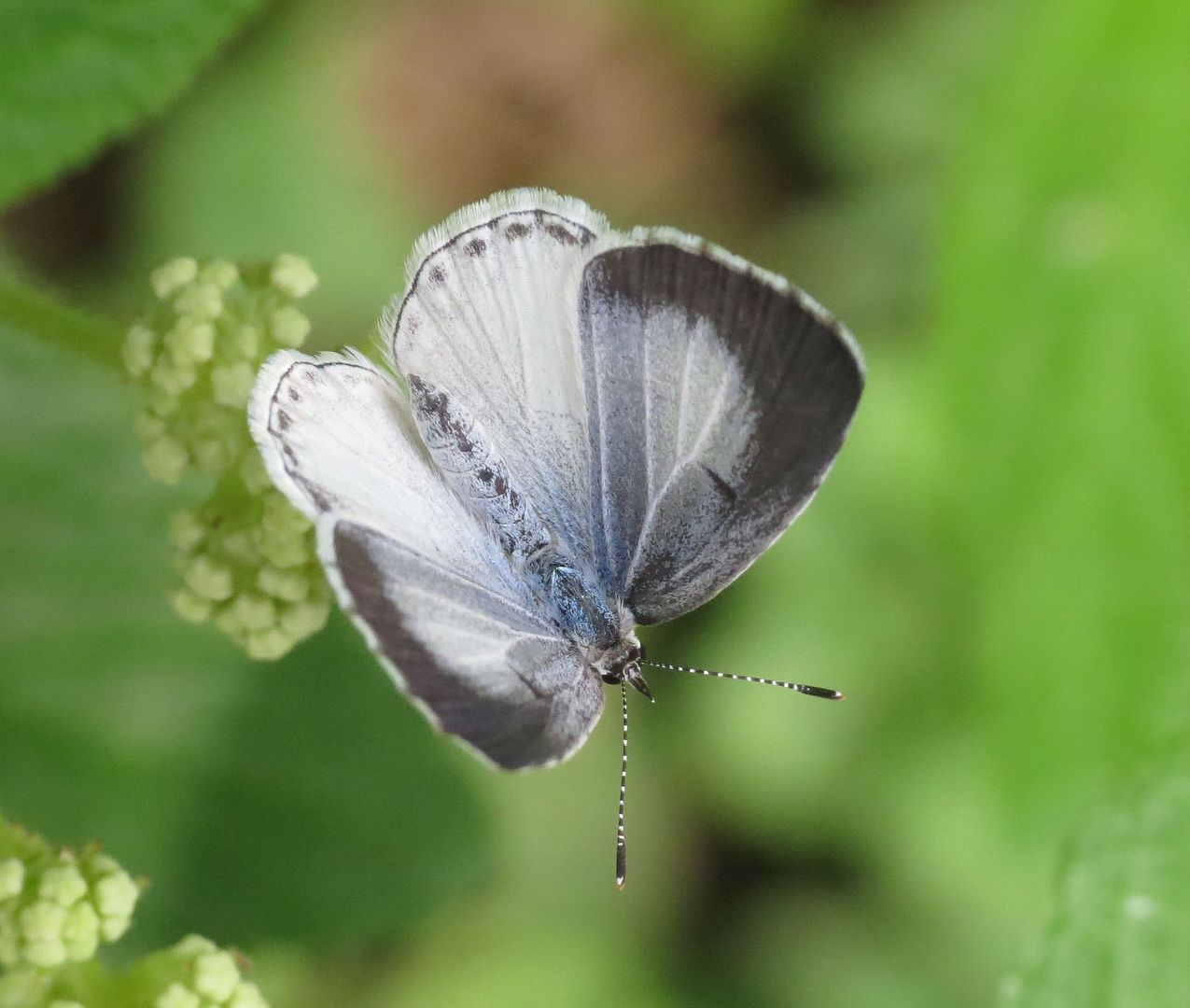
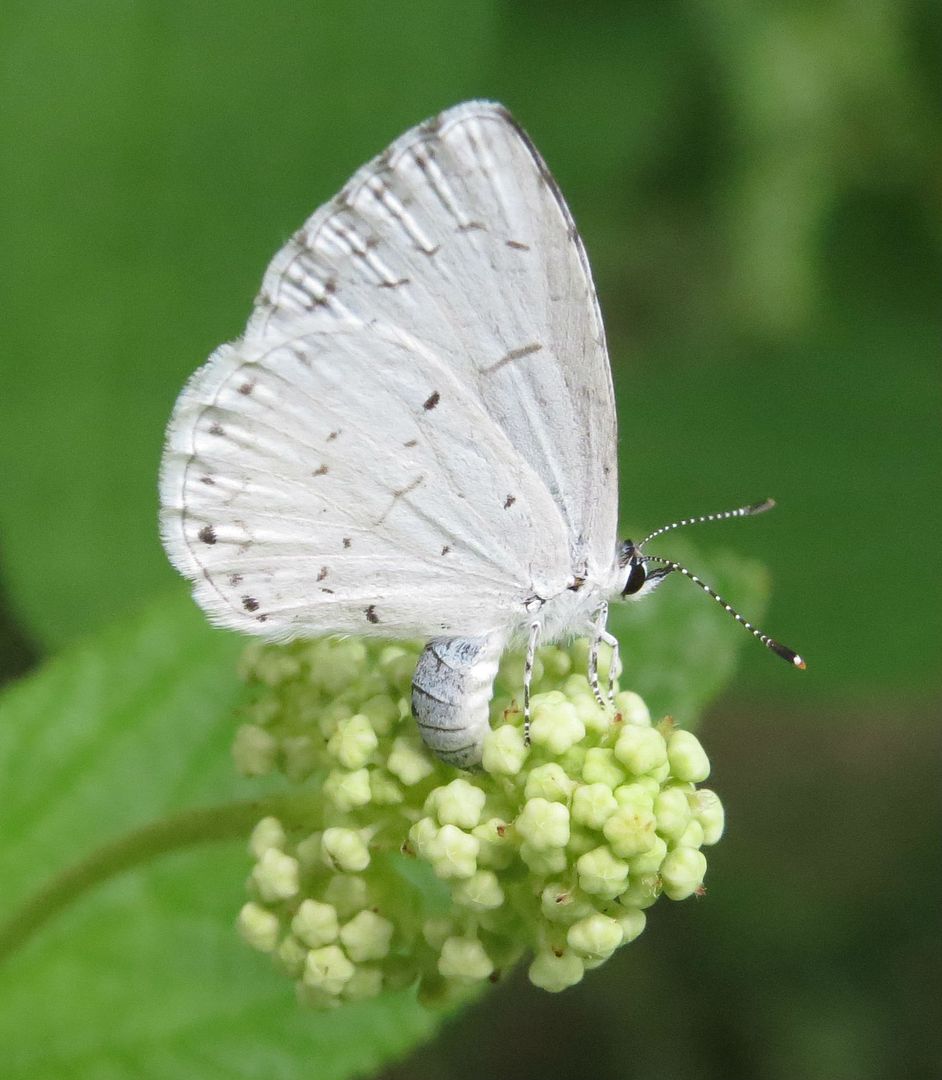
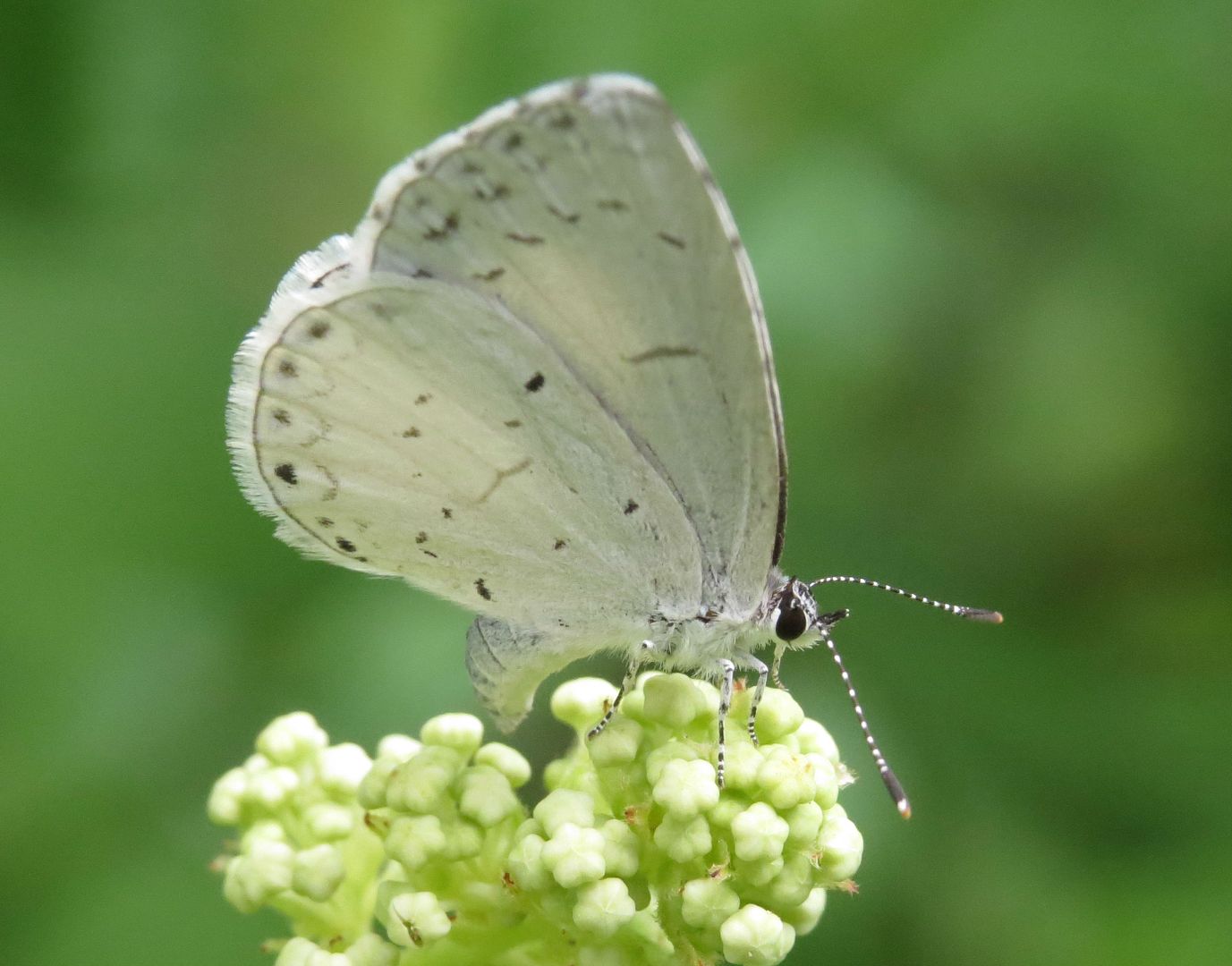
Also while photographing the honeybees I noticed what I believe to be a Holly Blue butterfly, and she was laying eggs!
Blue's and Azures are neat butterflies because the caterpillars have special relationships with ants. A failing of most butterfly species is they fall prey to ants all too often. They'll strip the eggs right off the host plant before they hatch, young instars which haven't developed a defense strategy or adaptation yet are an easy meal. I've seen whole clutches of hatching giant silk moth caterpillars get chewed up into a gooey pulp by a single carpenter ant which then carried the mess of caterpillar goo back to the nest.
This genus (family?) has a different strategy though. For starters they lay their eggs among the unopened blooms on the plant, which is good enough camouflage. Early instars need to eat a little but quickly start to secrete a sugary substance to feed the ants. The caterpillar also "sings" to the ants, making sounds and vibrations like a queen ant might produce. The ants will hang around the caterpillar as it feeds and helps protect it against other predators. Some species will actually overwinter inside ant's nest, either mimicking the larva or a queen ant, which then pupates over the winter and emerges from the colony next spring.
It's a complex life style for sure. I theorize that not all species of ants are ideal to overwinter inside of. Some of the species that are more finicky about their host plants are uncommon or endangered, such as the Karner Blue Butterfly, which only lays eggs on Lupinus perennis.
So if I get a chance to I'll try and photograph the caterpillars, ideally with ants tending them but I can't promise anything. The eggs she laid were almost microscopic and the caterpillars are absurdly small. Also later instars might prefer consuming ant eggs once they're inside a nest so I may have to setup a fragment colony.
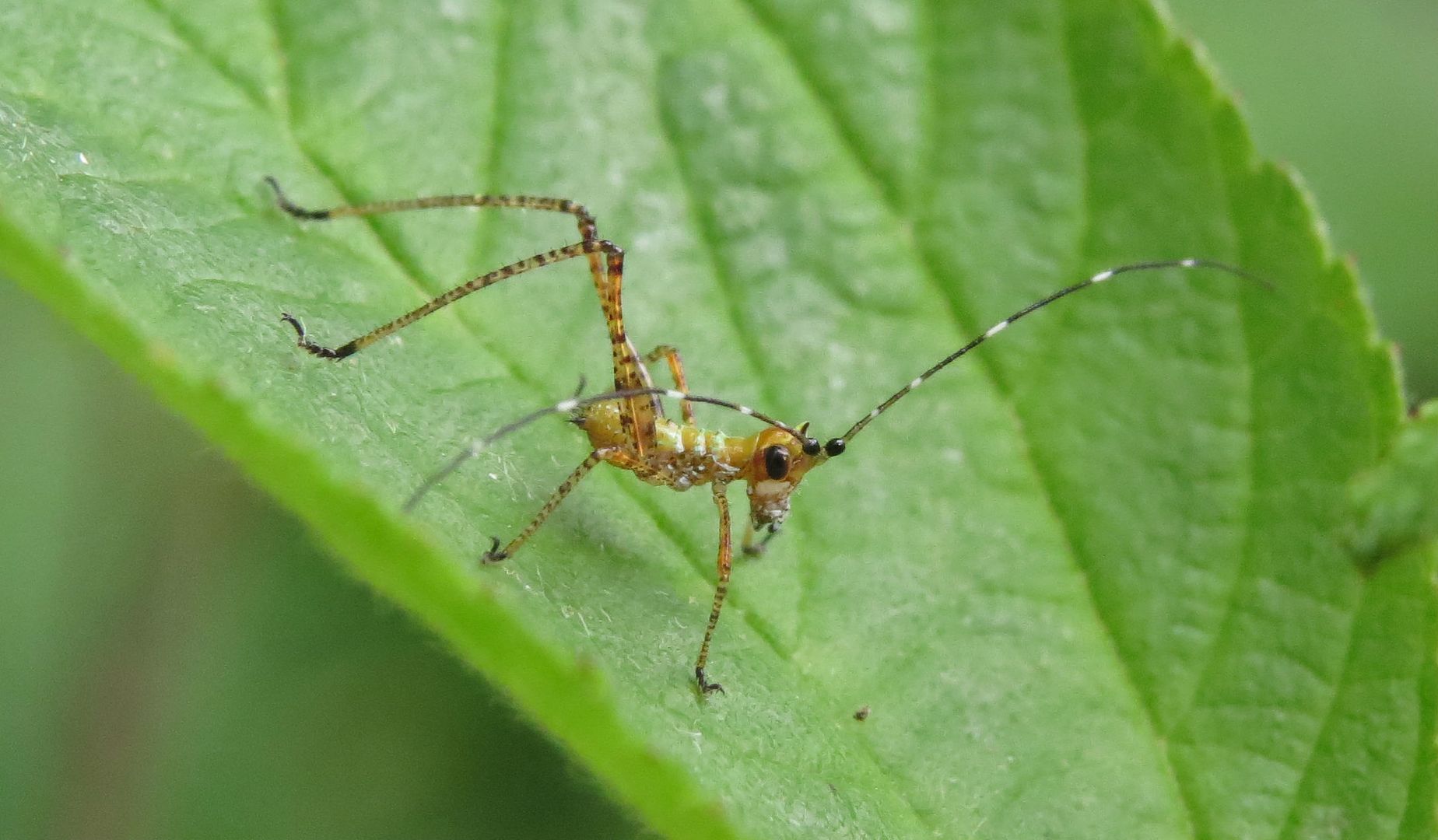
Keeping an eye out for chewed up foliage can help home in on where the caterpillars are. Though finding a Katydid nymph on the plant suggests that might not be the best strategy. I'm tempted to go out and snip off a few flower heads where I know eggs were laid and put them in the outdoor butterfly cage to raise myself. I've never kept a species so small though.
Part of the problem was that farmers used to believe this plant was a sign of good soil and bulldozed whatever habitats it grew in for farm land. Where it still grows today, it's easily shaded out by tall perennials and encroaching forest land.
What makes it worth blogging about today for me is the fact that my honeybees started working it. This is odd because I almost never see honeybees bothering with plants who's flower shape and nectar is gear more towards wasps and smaller bees (as seen above).
Most of the flowers aren't open yet so it's not bustling with swarms of other pollinators just yet, (and I've never seen a hummingbird go near the thing,) so I'll see if this wasn't just a curious couple of foragers or if the honeybees really do want to work this plant.
Honeybees working a native plant isn't always a good thing for nature. Many conservationist view this as stealing food from the native bees. I'm not sure of any specialists pollinators of this plant though.
Western Ceanothus species and their bright blue flowers tend to get a lot more honeybee attention so I guess this isn't entirely unexpected. Sadly I don't know of any western Ceanothus that's hardy in New Jersey or I'd have tried growing it by now.
Also while photographing the honeybees I noticed what I believe to be a Holly Blue butterfly, and she was laying eggs!
Blue's and Azures are neat butterflies because the caterpillars have special relationships with ants. A failing of most butterfly species is they fall prey to ants all too often. They'll strip the eggs right off the host plant before they hatch, young instars which haven't developed a defense strategy or adaptation yet are an easy meal. I've seen whole clutches of hatching giant silk moth caterpillars get chewed up into a gooey pulp by a single carpenter ant which then carried the mess of caterpillar goo back to the nest.
This genus (family?) has a different strategy though. For starters they lay their eggs among the unopened blooms on the plant, which is good enough camouflage. Early instars need to eat a little but quickly start to secrete a sugary substance to feed the ants. The caterpillar also "sings" to the ants, making sounds and vibrations like a queen ant might produce. The ants will hang around the caterpillar as it feeds and helps protect it against other predators. Some species will actually overwinter inside ant's nest, either mimicking the larva or a queen ant, which then pupates over the winter and emerges from the colony next spring.
It's a complex life style for sure. I theorize that not all species of ants are ideal to overwinter inside of. Some of the species that are more finicky about their host plants are uncommon or endangered, such as the Karner Blue Butterfly, which only lays eggs on Lupinus perennis.
So if I get a chance to I'll try and photograph the caterpillars, ideally with ants tending them but I can't promise anything. The eggs she laid were almost microscopic and the caterpillars are absurdly small. Also later instars might prefer consuming ant eggs once they're inside a nest so I may have to setup a fragment colony.
Keeping an eye out for chewed up foliage can help home in on where the caterpillars are. Though finding a Katydid nymph on the plant suggests that might not be the best strategy. I'm tempted to go out and snip off a few flower heads where I know eggs were laid and put them in the outdoor butterfly cage to raise myself. I've never kept a species so small though.
Subscribe to:
Posts (Atom)