Showing posts with label Study. Show all posts

Sunday, October 11, 2015

Native Plant Reserach

There are a couple of studies being done in the native plant world that have peaked my interest.

Native Cultivars vs. Native True Species
Kim Eierman interviews Doug Tallamy in his project to see if Native Cultivars hold up to their True Species counterparts. Basically they plant a cultivar in the middle of a ring of the true species specimens. This way it would unlikely for the insects to miss their host unless they were actively avoiding the cultivar.

Overall I don't think this will show any surprising results. Cultivars are often just clones of a particular species with the desirable traits. There may be one or two cases where one or two insects have lost a taste for a particular cultivar but I doubt there will be anything shocking to report from this.


Mt. Cuba Center tests out Reforestation Methods

Delaware Online is reporting the Mt. Cuba Center is starting a 20 year long study to compare different reforestation methods.
Mt. Cuba Center staff designed each test plot with a different reforestation technique, including two plots which serve as controls for the experiment: one left to natural forces to reforest itself, called natural succession, and one planted with a commonly used technique, orchard-style planting where trees are placed 10 feet away from each other and the grass between them is mown regularly.

Other plots have different combinations of planting densities and planting types: an orchard-style planting with no mowing between trees; densely planted canopy trees; orchard-style canopy trees and understory trees; and densely planted canopy trees and understory trees.
It's an interesting question for sure, and I really hope their study goes without any acts of god. The article doesn't mention them using any evergreens or species that jump out at me as being fire resistant for example. Also wind storms and hurricanes seem to be becoming more common for the area, so here's hoping nothing like that happens. For a study that's going to take 20 years to complete it would be an awful shame if a Deer screwed it up.

I wonder with the plots that are not being mowed, whether they're planting into lawn or something more wild such as a meadow, and whether or not it would be beneficial to also have a plot with a meadow seed mix thrown down before hand to see if the tall grasses and wildflowers does anything to help or hinder the trees and shrubs. 
Friday, August 29, 2014

Arizona: Dorymyrmex Study

Dorymyrmex, despite being a common genus, remains something of a mystery in North America. The trouble is that no one's really studied them well enough to get the genus right. Eastern species are fairly well known, but out west.... the genus is in pure chaos. Basically if it's black it keys out to Dorymyrmex insanus, and studies that look into the matter simply describe new species with a sentence or two.


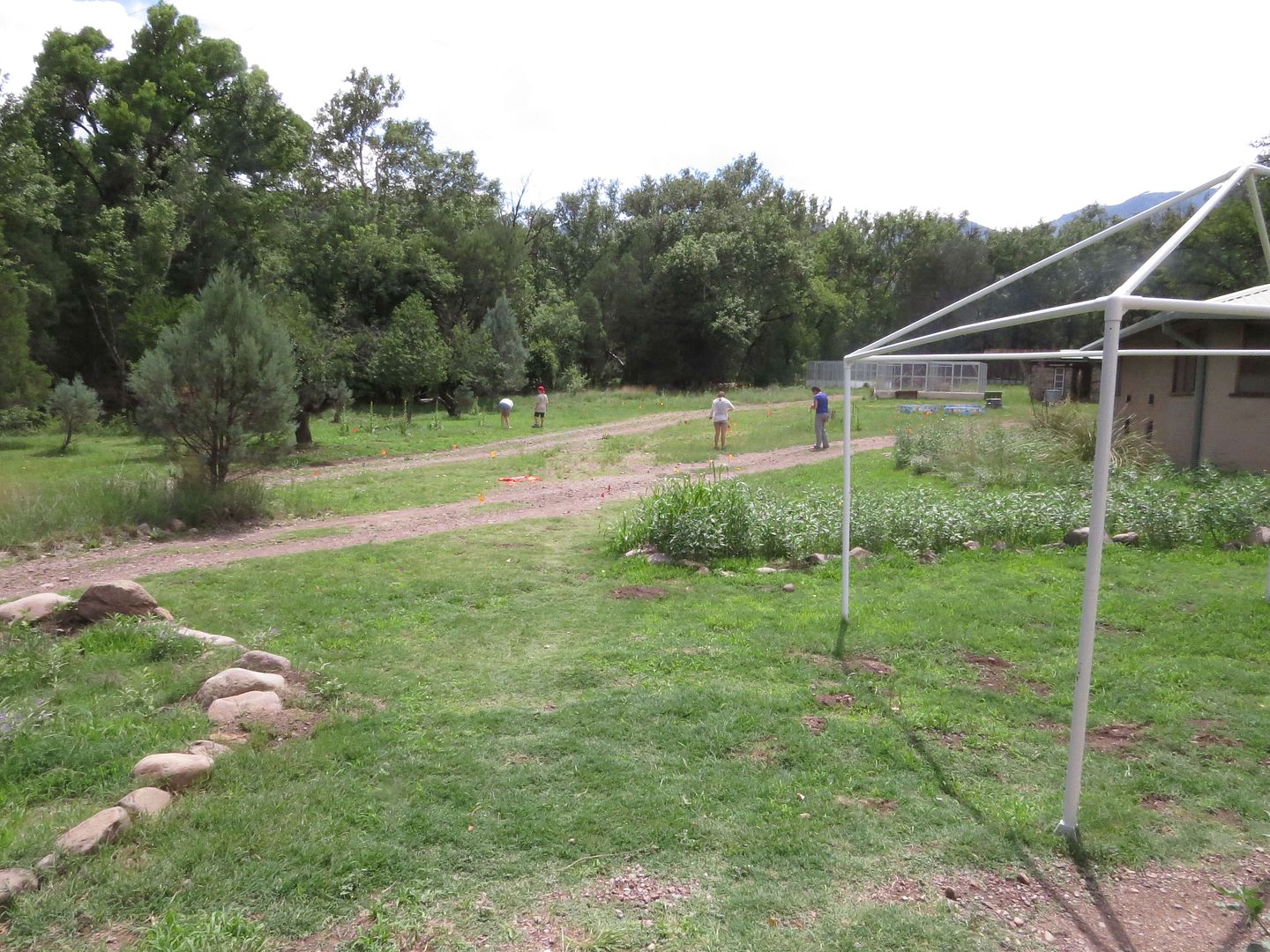
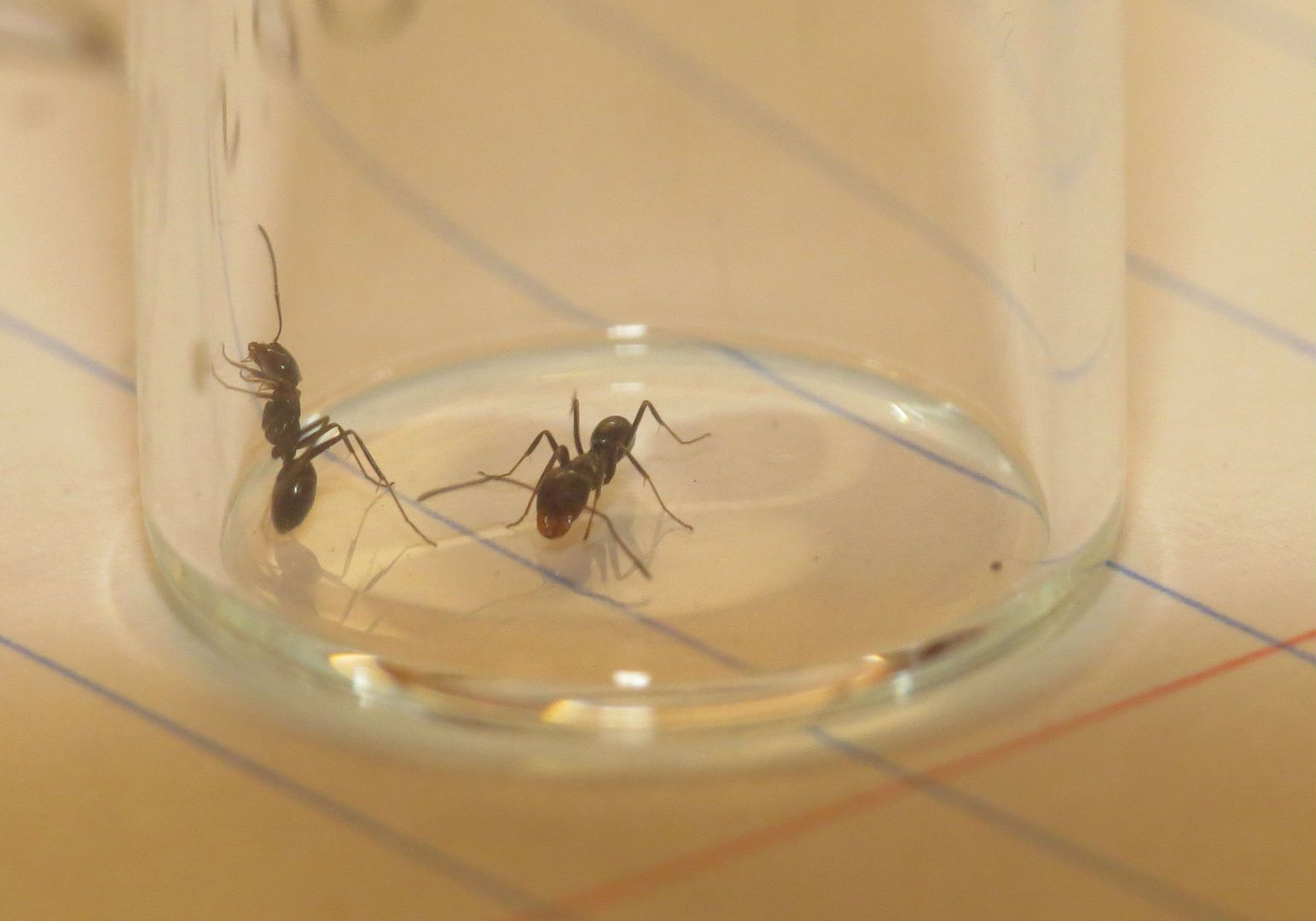
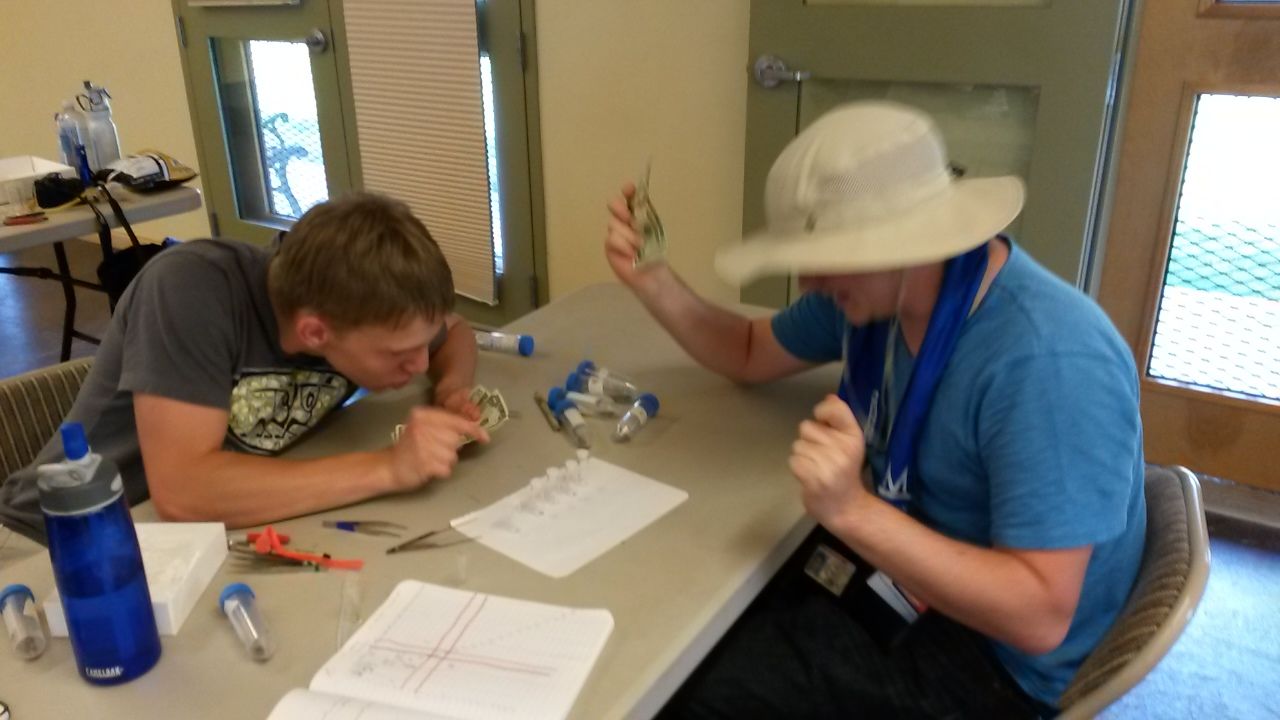
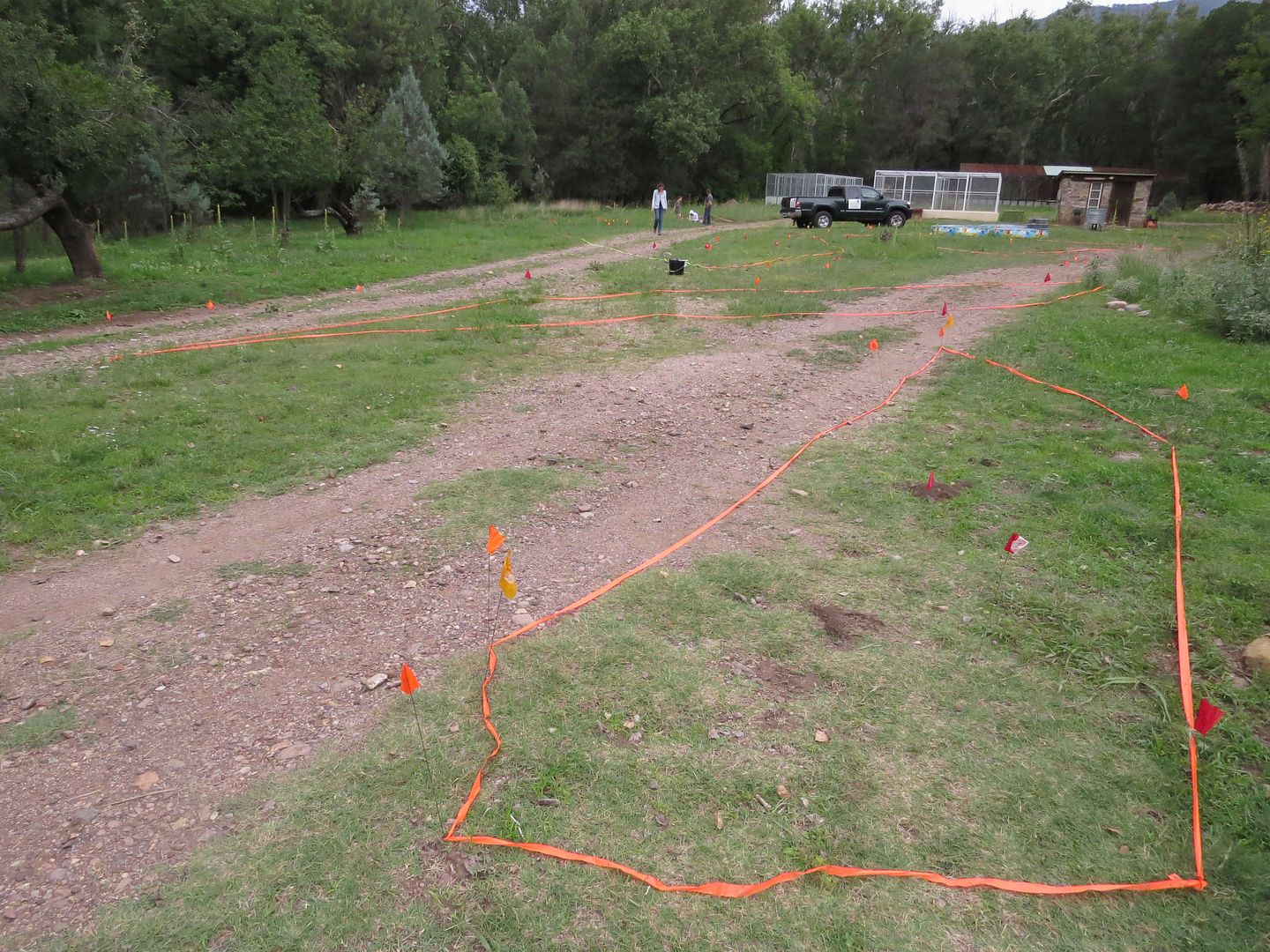
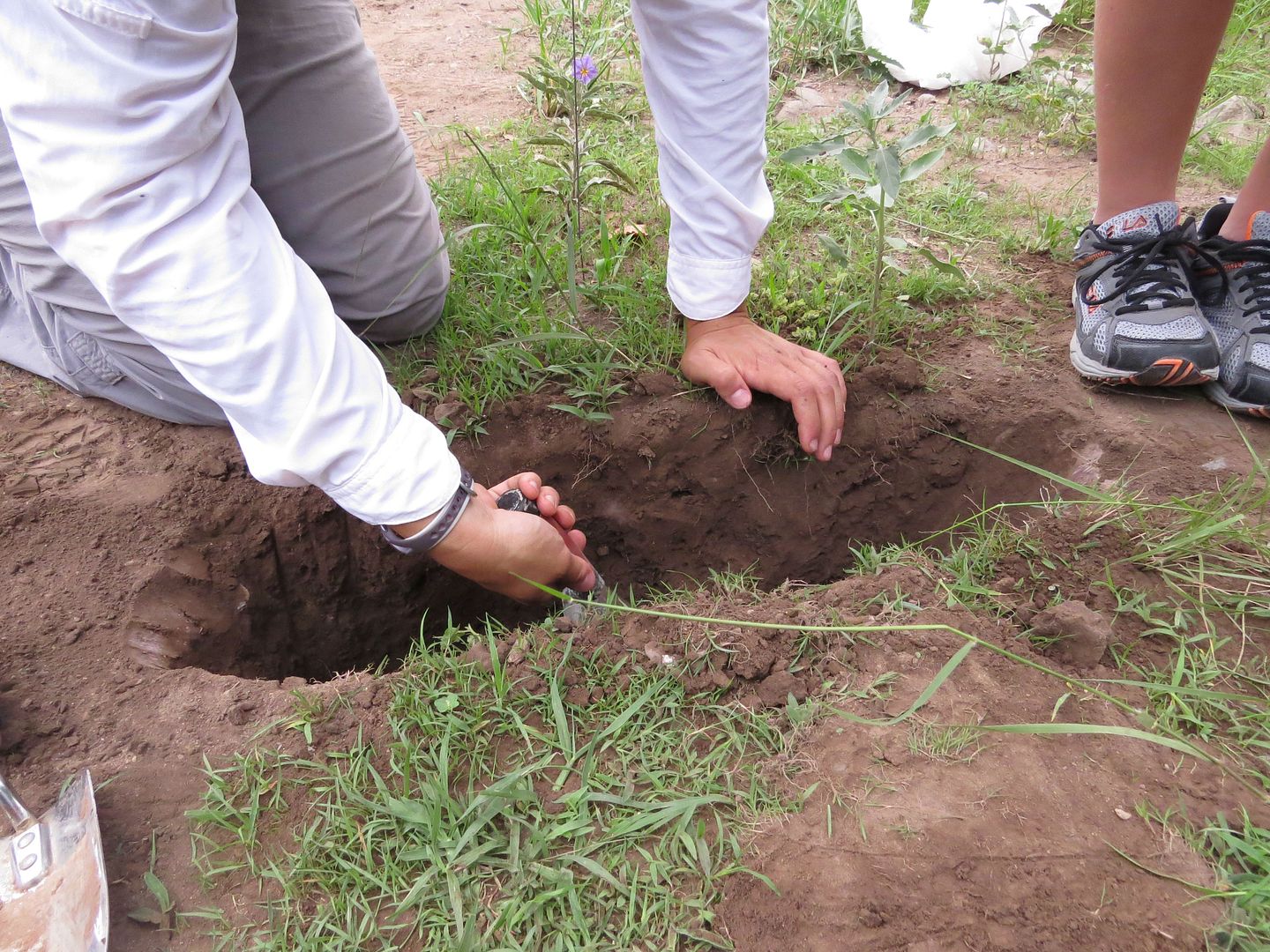
The station we stayed at had loads of colonies of them on the property. We spent a day flagging each of them, and then putting sets of workers together to see if they got along or not.

Workers from the same colony got along, those from different one almost murdered on another on sight.

Though time consuming, it's fun work.

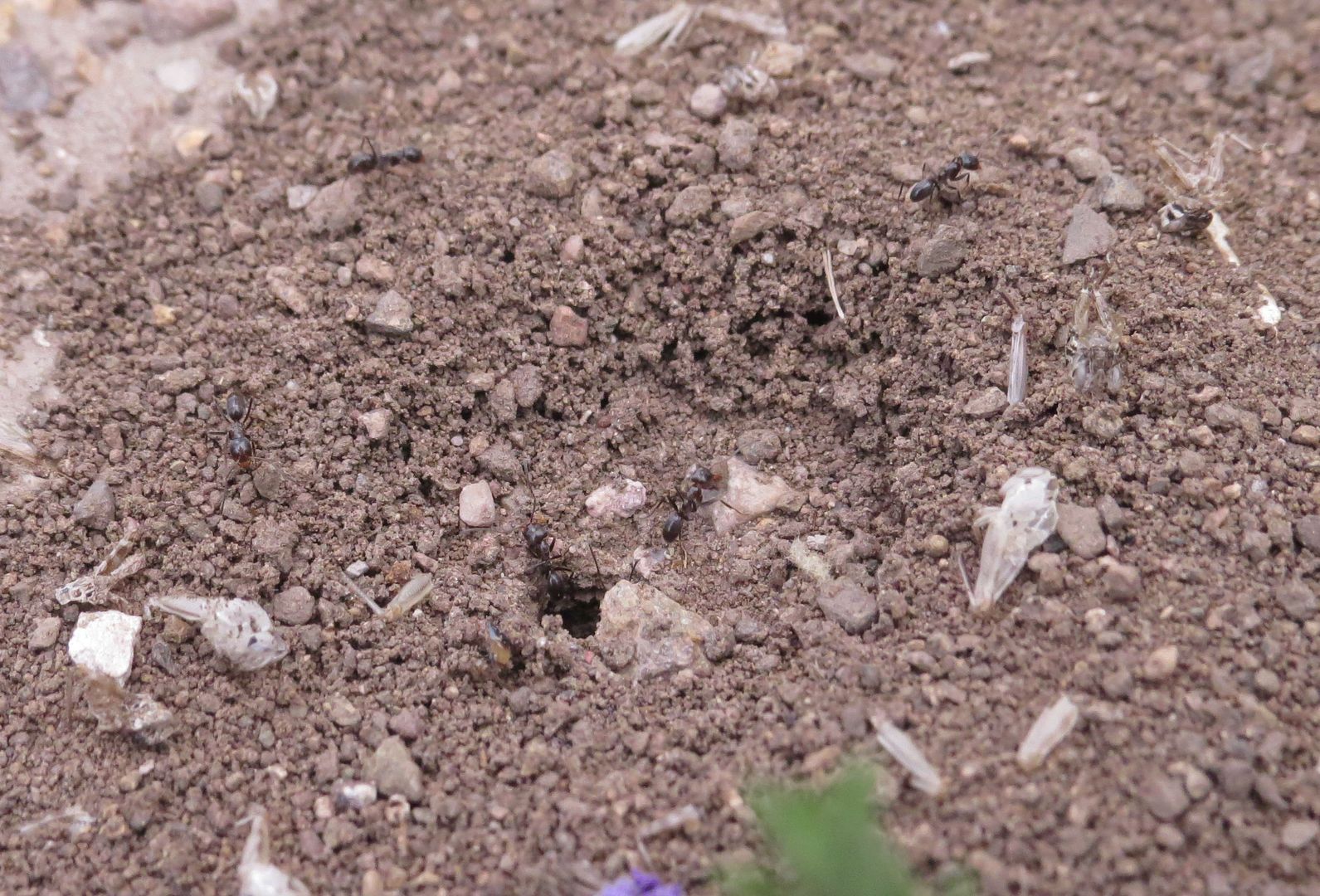
We found that the colonies had changed boundaries from the previous year, as well one of them had become massive in size (not in photo). Pictured above is a typical nest comprised of maybe 6 to 12 holes. The large colony crossed one of the trails here and was comprised of 26 holes.

We dug up one nest and found the general structure of one of their nests is simply one narrow tunnel leading down at a slight angle, leading through several galleries.

For time reasons we didn't get down below 3'. And it likely extends much deeper than that. Most of the ant nests in the area seem to go down 12' or so. How many queens they have, or if the ant hills are connected somehow underground are unknown. It's likely that these nests are not connected and there might be only one queen per hole, but also likely that in the winter the nests combine down into fewer holes. Perhaps queen number and or age help determine the number of satellite holes. 

That was the extent of our study. Future courses may continue the work.

Thursday, January 16, 2014

Certain Plants Compete for Ants

A new study came to my attention today titled "Competition as a Merchanism Structuring Mutualisms" by Robert J. Warren II1, Itamar Giladi2, and Mark A. Bradford3

I haven't read it fully yet however I think I got the gist. They setup two plots of Asarum arifolium (Wild Ginger) and Anemone americana (Hepatica), two plants that disperse their seeds via Myrmecochory. Basically a substance called elaiosome (ant food) is attached to the seed, the ants find the seeds and are encouraged to bring them back to the nest where they are planted. The authors point out that the Hepatica flowers earlier and produces smaller seeds than the Wild Ginger which flowers later and has slightly larger seeds. They suggest that larger seeds are always favored by the ants, and true enough larger seeds tend to have larger packets of elaiosome on them. Thus the Heptaica produces smaller seeds because it can get away with it and not have to compete with the larger seeds of the Wild Ginger.

This study could be expanded had they included Woodland Poppy and Trilliums which also follow this pattern, but Wild Ginger seeds are larger than Woodland Poppy... and then their argument falls apart completely when you include Violets which have seeds smaller than Hepatica. Twinleaf also has Trillium-sized seeds so there isn't a whole lot of support here.

We've already known that ants favor larger seeds because they plants produce better seeds and a higher quality of elaiosome on those that were pollinated better than others. Open a Trillium seed pod and you'll see some seeds are half the size of all the rest and even some that didn't even develop at all.


I'll read the rest of the study in full later on.


Tuesday, January 3, 2012

CCD Media Flood Warning

Core A, Runckel C, Ivers J, Quock C, Siapno T, et al. (2012) A New Threat to Honey Bees, the Parasitic Phorid Fly Apocephalus borealis. PLoS ONE 7(1): e29639. doi:10.1371/journal.pone.0029639

Yet another possible theory to CCD, one that NEEDS TESTING has come up as a possible cause of CCD. A parasitic fly, Apocephalus borealis, which typically uses bumblebees as hosts has been found to also use Honeybees as well. Their life cycles seem to overlap with that of CCD epidemics. Basically the fly injects eggs into the abdomen of the host and a few days later, I read, about 13 new flies burst out of the bee. While infected the host bee will continue flying at night in a daze, thus they don't return to the hive hive.

So there's lots of correlation here. The next step will be to find out how far spread these flies are and whether their populations are great enough to decimate whole fields of hives within their life cycle for the effected areas.

Wednesday, October 13, 2010

CCD is Not Caused by Pesticides

Why don't studies like This make the news?

"Overall, elevated expression of pesticide response genes was not observed."

This little sentance is all I would have needed to read. You see, I've been a firm believer that CCD was simply a pesticide issue for years now and no one was caring because it was likely happening on crops that don't use honey bee pollination, however the bees were still using the crop for food or water anyhow. When you have a pesticide like neonicotinoides out on the market that stay active for 9 months inside the plant, that sounds strong enough to wipe out a few hives to me.

So what that one sentance means is, insecticides are a separate problem and CCD has some other elusive cause. Those genes should have been active if pesticides were present. Seriously, you'd think a company like Bayer would be propagandizing the hell out of that study! Do they like being the bad guys?  

Going back to the study linking viruses and fungi to CCD I still have trouble understanding the findings in that lower chart. And my concerns still stand. Without knowing more it really does seem like something got to their samples and the virus fungi invasion is a result. Maybe they weren't feeding their samples and thats why so many of their control bees died? How great would it be if online studies included videos detailing their work? I need to start YouTube for scientific studies or something.

I would like to thank Alex Wild for setting the me straight. His blog at Myrmecos.net is where I found the study explaining the pesticide thing.

Monday, October 11, 2010

And Another Thing! (CCD New York Times Article)


And another thing! Why did 40% of their control die after 14 days. Each group was comprised of young worker bees 3 days old or younger (they can't fly at that age and are easy to handle). Honey bee workers normally live 30 to 60 days. Why did 40% of their control die after 14 days! Why is the difference between having one infestation over both at the same time only 10% after a 14 day period.

The article claims a hive can survive if they only have one of either the fungi or the virus. Their control should have had a survival rate above or around 90%, the virus and fungi separately should have been higher as well. It's hard to bounce back when more than half of the hive dies off after 14 days, worker bees aren't even foraging until day 12. What we're seeing here is clearly all of the groups have been contaminated with what ever causes CCD and the presence of the virus and or fungi just make it worse.

A friend sent this article to me earlier today.
What a Scientist Didn't Tell the New York Times About His Study on Bee Deaths


The Times  reporter who authored the recent article, Kirk Johnson, responded in an e-mail that Dr. Bromenshenk "did not volunteer his funding sources." Johnson's e-mail notes that he found the peer-reviewed scientific paper cautious and that he "tried to convey that caution in my story." Adds Johnson: The study "doesn't say pesticides aren't a cause of the underlying vulnerability that the virus-fungus combo then exploits...."
...
Underlying cause of bee deaths still unclear

Dr. Jennifer Sass, a senior scientist with the health group at the Natural Resources Defense Council, says that while the Bromenshenk/Army study is interesting, it fails to ask the underlying question "Why are colonies dying? Is it because they're getting weak? People who have HIV don't die of HIV. They die of other diseases they get because their immune systems are knocked off, making them more susceptible." In other words, pesticides could weaken the bees -- and then the virus/fungus combination finishes them off. That notion, however, is not explored in the new study.
...
The EPA has based its approval of neonicotinoids on the fact that the amounts found in pollen and nectar were low enough to not be lethal to the bees -- the only metric they have to measure whether to approve a pesticide or not. But studies have shown that at low doses, the neonicotinoids have sublethal effects that impair bees' learning and memory. The USDA's chief researcher, Jeff Pettis, told me in 2008 that pesticides were definitely "on the list" as a primary stressor that could make bees more vulnerable to other factors, like pests and bacteria.

Saturday, October 9, 2010

My Thoughts on Virues and Fungi cause CCD

Iridovirus and Microsporidian Linked to Honey Bee Colony Decline
Alright so it's been a few days since this came out. I have been reading it and have come to the conclusion that it's nothing too special. In short they took samples of bees from 2006 to 2009 (2010?) from CCD effected hives, and they've listed all the correlating combinations of viruses and fungi that seem to cause CCD. 

I'd be interested to know what the bees were pollinating? How were they coming into contact with these viruses and fungi spores? But unfortunately we probably don't know that much about the ones killing the bees in this case. 


We also observed Varroa mites in some, but not all of the CCD colonies.
Excuse me? You didn't find mites in all of the beehives? Okay either you're not looking hard enough or those hives recently re-queened or something. There are Varroa mites in every beehive! Drones which move freely from hive to hive (just droning on with their lives of one day mating or not) are just one way that Varroa mites enter the hive. Enlarged drone cells are often targeted by the mites too. 

These results support the correlation observed by the MSP data that suggests than an interaction between N. ceranae and an IIV-6-like virus may be involved in bee mortality.
Why isn't the bees immune system fighting back? 


I can see a definite drop here... but what is the correlation again? This chart seems to show that the Virus and the Nosema don't have to be together to cause CCD. It looks like they can kill bees well enough on their own.

Thursday, October 7, 2010

Viruses and Fungi Combination Linked to CCD

Jerry Bromenshenk is my new hero for the moment. A New York Times article today talked about the findings that a new study has found a link between a virus and fungi combination that is causing CCD. The article also mentions his using of honey bees to help detect land mines. Which shockingly enough has evidence to back it up. Read here! Detecting explosives with honey bees aside, here is the abstract to the scientific study linking viruses and fungi to CCD that the article is based on. 

Abstract 

Background

In 2010 Colony Collapse Disorder (CCD), again devastated honey bee colonies in the USA, indicating that the problem is neither diminishing nor has it been resolved. Many CCD investigations, using sensitive genome-based methods, have found small RNA bee viruses and the microsporidia, Nosema apis and N. ceranae in healthy and collapsing colonies alike with no single pathogen firmly linked to honey bee losses.

Methodology/Principal Findings

We used Mass spectrometry-based proteomics (MSP) to identify and quantify thousands of proteins from healthy and collapsing bee colonies. MSP revealed two unreported RNA viruses in North American honey bees, Varroa destructor-1 virus and Kakugo virus, and identified an invertebrate iridescent virus (IIV) (Iridoviridae) associated with CCD colonies. Prevalence of IIV significantly discriminated among strong, failing, and collapsed colonies. In addition, bees in failing colonies contained not only IIV, but also Nosema. Co-occurrence of these microbes consistently marked CCD in (1) bees from commercial apiaries sampled across the U.S. in 2006–2007, (2) bees sequentially sampled as the disorder progressed in an observation hive colony in 2008, and (3) bees from a recurrence of CCD in Florida in 2009. The pathogen pairing was not observed in samples from colonies with no history of CCD, namely bees from Australia and a large, non-migratory beekeeping business in Montana. Laboratory cage trials with a strain of IIV type 6 and Nosema ceranae confirmed that co-infection with these two pathogens was more lethal to bees than either pathogen alone.

Conclusions/Significance

These findings implicate co-infection by IIV and Nosema with honey bee colony decline, giving credence to older research pointing to IIV, interacting with Nosema and mites, as probable cause of bee losses in the USA, Europe, and Asia. We next need to characterize the IIV and Nosema that we detected and develop management practices to reduce honey bee losses.


So basically the viruses got on their cell phones and called the fungi, and were all like, "Yo, I'm inside a Bee! Why don't you come join me?" And the scientists (the stupid ones anyhow) were all like ... Cell Phones cause CCD!


Granted I had my own little theory, or at least I sided with the people saying it was neonicotinoid sprayed crops that sweat out the chemical in their sap. That has proven incorrect but at least it was more plausible a theory than putting a cell phone in a bee hive and calling them up.

---------------------------------------------------------------------------------------------------
Iridovirus and Microsporidian Linked to Honey Bee Colony Decline

Sunday, January 10, 2010

Paratrechina and Nylanderia

About a week ago a new scientific study came out on ants dealing with the reclassification of a widely dispersed genus. The Study, by John LaPolla, Seán Brady, and Steve Shattuck, examined a genus group and found reason to change what genus some species were placed.


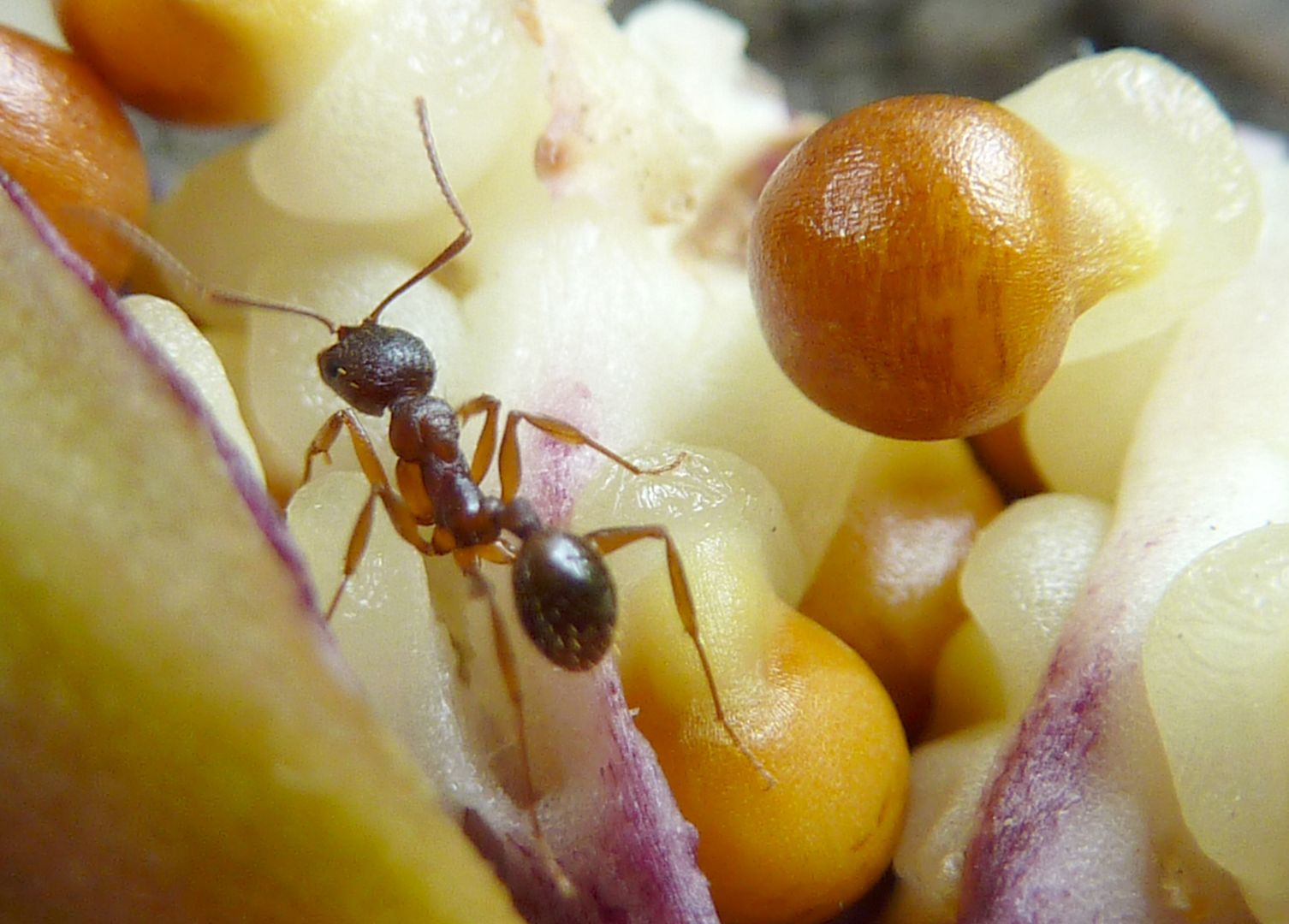
The "genus group" itself is modeled after ants with traits in common with our native Prenolepis imparis, the Winter Ant. They're also called the false honey ant because their commonly seen replete caste (the fat ants above that are not queens) resemble regular Honey Pot Ants, Myrmecocystus sp. But those are restricted to the south west US. P. imparis is far more commonly encountered. This genus is more diverse elsewhere in the world but our understanding of them today is that only one species occurs in the US. This isn't "uncommon," but it's suggestive that the varieties of this ant that we know of could one day be moved to species level.

The study probably effected the genus Paratrechina the most, at least for us in the US. The main species that described this genus was Paratrechina longicornis. As pointed out in the study though it had several traits unique to itself from other Paratrechina. Thus the other species it was paired with didn't really fit in the genus. For North America I'll point out it was also the most wide spread of the other species. This is why Paratrechina longicornis is now the only species remaining in the genus. All the other species were moved to another genus called Nylanderia.


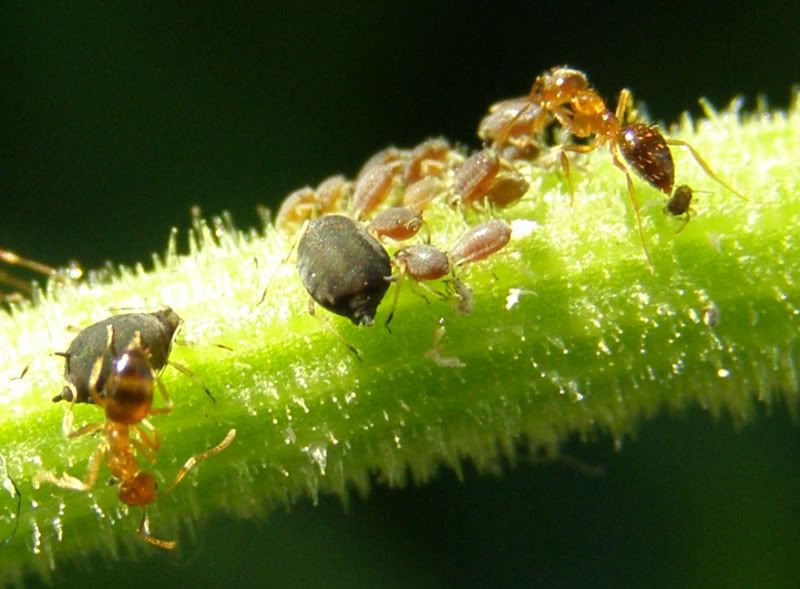
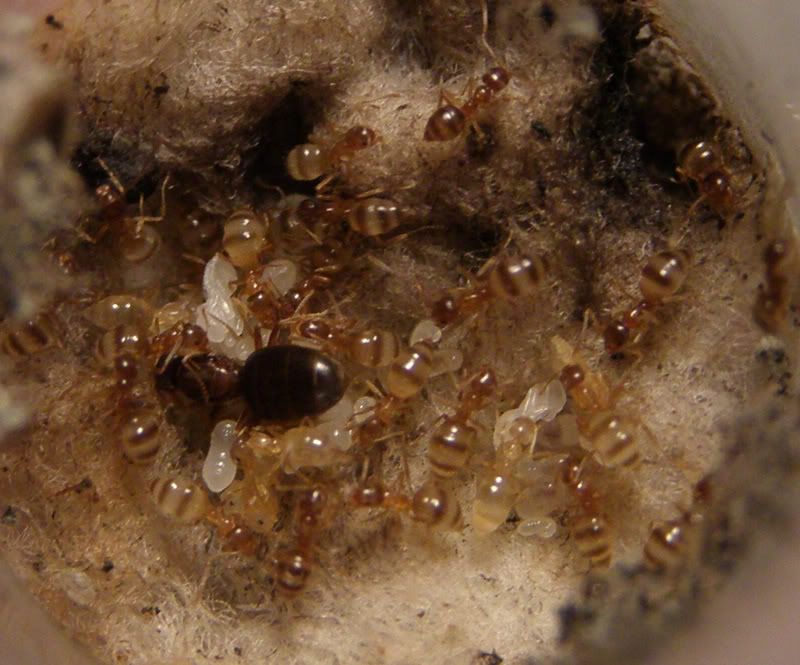
Paratrechina/Nylanderia are small inconspicuous ants. Pictured above we see the ants are about the size of a raspberry seed. This might be Nylanderia faisonensis but honestly this ant is so tiny it boarders on my ability to identify.


For the most part colonies go unseen. The most common encounter the average person has with this ant is likely through potted plants. A whole colony can easily move into a house plant or rummage through a greenhouse easily. They simply feed off of normal nectar sources from the flowers, or take advantage of the local aphid problem. Damaged fruit is another spot one might see this ant.


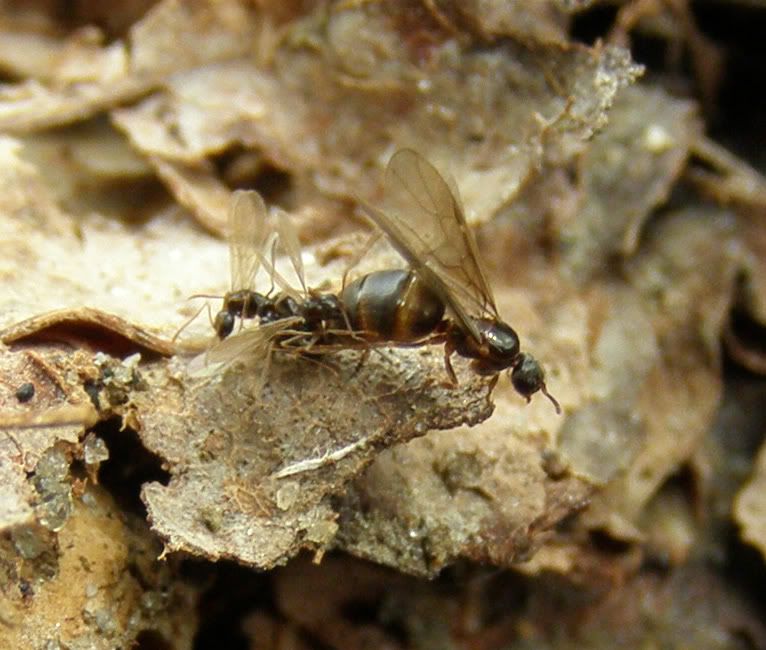
Nuptial flights, if you can call them that, occur in the spring time, April or May usually. Mating is commonly witnessed happening right on the ground. Here you can make out 2 or 3 males attempting to tackle a queen.


Colonies were easy to raise but are easy to get bored with. I never really gave this ant much attention but after reading this study I think I'll give them another shot.

For better images of these ant check out Alex Wild's gallery. Nylanderia, Paratrechina longicornis, Prenolepis imparis.