Showing posts with label Book. Show all posts
Showing posts with label Book. Show all posts
Saturday, November 2, 2013
Ghosts of Evolution (Video)
I've started reading a new book titled "Ghosts of Evolution" and found this creative way of promoting it. I'll report back once I've read it more thoroughly.
Thursday, April 18, 2013
Camponotus castaneus Waking Up

Along with having only one waist segment (note the ant in the lower left) Camponotus also have a domed mesosoma (thorax or middle section) with the three segments almost forming a smooth curve. This is the only color they come in too, the head is typically darker than the rest of the body but never black the way it is in C. americanus which also tends to have black all over it's body around joints especially.
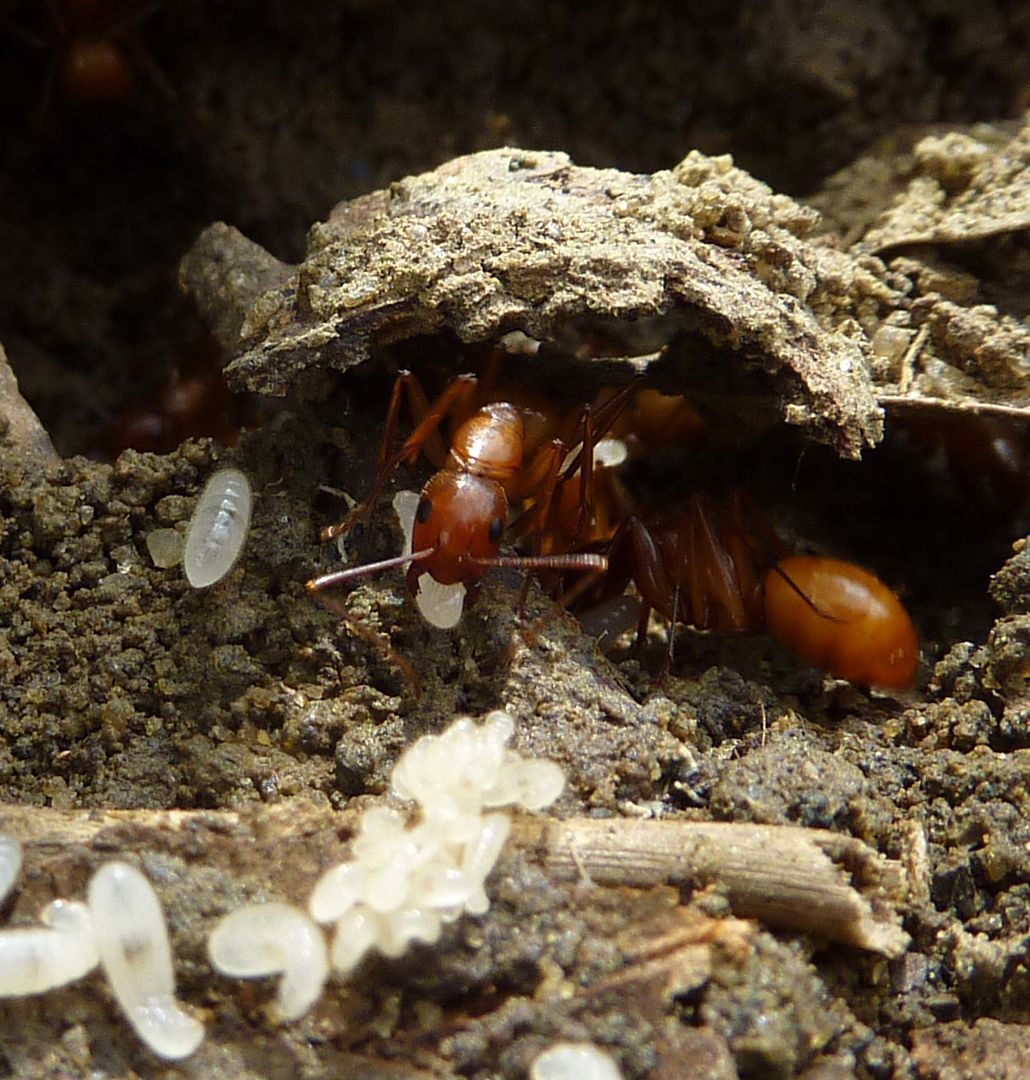
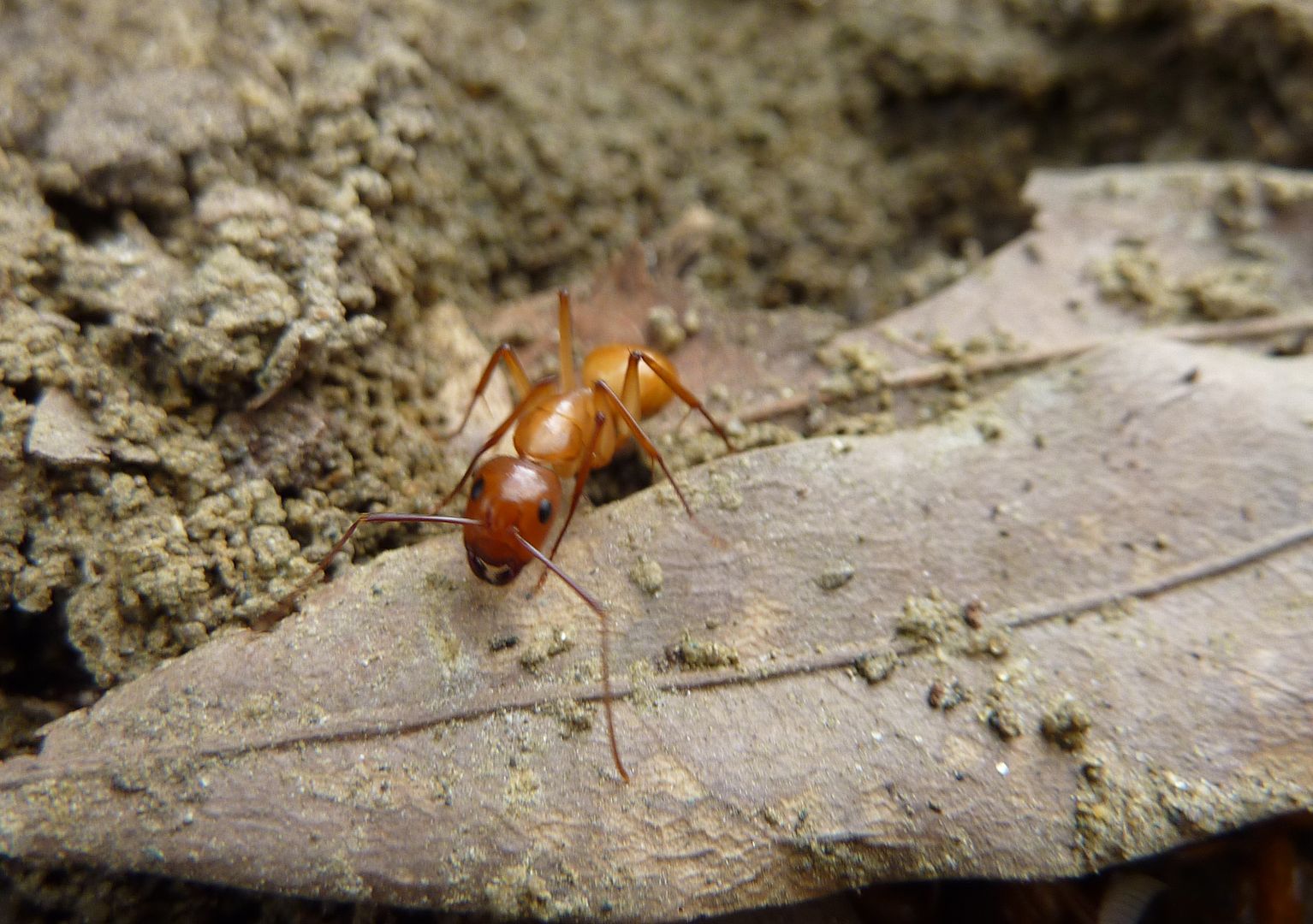
A Field Guide to the Ants of New England lists their common name as "The Chestnut Carpenter Ant"

Wednesday, March 6, 2013
The Annoying Process of Publishing a Book
So back in October and November I decided that I had enough photos, information, and creativity to start writing a book... and finish it this time! "Writing a Book" has been my answer to the question "So what are you doing?" for the past nine years or so. So it's great to finally start something and get it done to completing this time. That being said, I have some praise and complaints to dish out for the whole process.
If you go to Amazon.com, and scroll all the way to the bottom, you'll find something like "Self Publish With Us," and that takes you over to Create Space, which is what I used to self publish. My logic there was I wanted a physical copy of the book I wrote which was important to me. Barns & Nobel will only offer your book as a digital copy. Some other places are happy to publish your book too but you have to order your copies and sell them yourself.
So here's the process I went though.
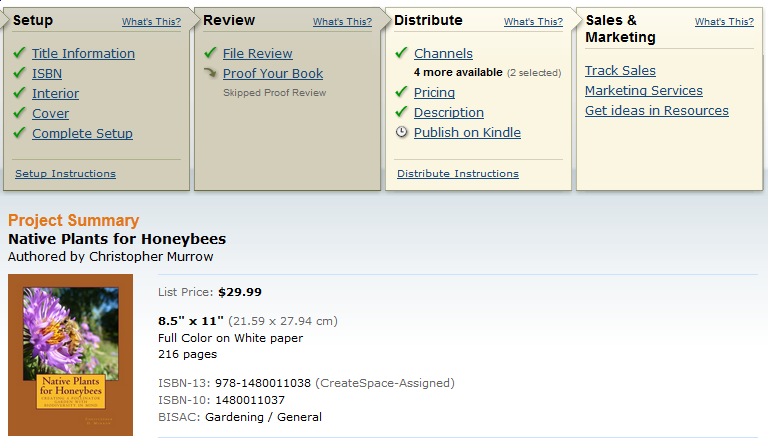 Fill out all your author and title information, get an ISBN, pick a size you want and you're ready to roll.
Once you have all that settled, spend however long it takes to type your book. Learn about adding Table of Contents, Graphs, and Page Numbers, which should all be standard in whatever typing program you're using.
Interior: Your file needs to be at least 24 pages (I think) in order to upload and preview. You'll probably be uploading and replacing the previous file a lot just to make sure things look right. This can take several minutes depending on how big your file is. You're then given a nice looking pdf preview with page turning animations that I really likes with Create Space. Here is where all the little flaws are pointed out. What was 4 by 6 inches in your typing program (Word, Office, etc...) might not be the same 4 by 6 in their format, and you may need to tweak things.
Something I got annoyed with was, I'd have a paragraph below my images, but because their format saw there was space after the image to fit a letter, they'd break up the first word in the sentance to put those letters beside the image and I don't know why. So "There are flowers..." would become
[PICTURE] "T
here are flowers..."
So you want to look out for that kind of stuff. Adding an [Enter] or enlarging the photo slightly made this go away.
Now here's the pain. You have to "fix" it in your file which might not have the same problem, and then upload it again. I would love to have been able to just fix it in their program so I wouldn't have to upload, but oh well.
Cover: For the cover Create Space has you covered. They have a wonderful program that I really enjoyed playing with. You just upload the picture you want, pick a few colors, and fill in the text boxes. I actually found this really enjoyable and easy. However, if you need to upload your file again, it assumes you might have changed the size format, so you need to sift through your cover again. This was a minor annoyance but not really a problem in the grand scheme of things.
File Review: So you think you're finished. You're all proofread, everything is the way you want it laid out, and it's "perfect". You're probably wrong, but that's where this step comes in. You submit your book to them, and they get back to you sometime a day later. One thing they caught with my book was for Author I had my middle initial in some places but not in others. Some things they fix for you but other things you're responsible for.
Proof Your Book: So you've been approved, Great! You get the final say in whether or not to go forward. I highly recommend buying a proof copy (this is usually an at cost price) before moving forward. This is a dramatic difference between reading a paragraph on your computer and holding it in your hands. I found I was far more aware of the paragraph overall when holding a physical copy than when I read it on my screen. As soon as it arrives, Get the red pen out, and go to town giving it a final read through. I thought I was already done by this point, but I kept finding maybe one mistake every few pages.
Also get a few friends and people who's opinions you trust to read it too. English teachers are especially valuable as they tend to remember all the little rules to everything. And hopefully they can give you a short sentance or two long review for the back cover.
Channels and Pricing: This is self explanatory. My book is on Amazon for $29.99. Unfortunately I went a little overboard with photos and the 216 pages at an 8 by 11 size drove up the cost. Had I written a novel say 4 by 6 and used fewer photos or made them all black and white, it would be cheaper for them to produce. Not surprisingly I make more money from the $9.99 Kindle version because it doesn't really cost anything to produce. Enabling the preview for both is done just after it's available. Getting it on the Kindle is submitted after it's published and available on amazon, though you can enable on or the other as you like.
If you go to Amazon.com, and scroll all the way to the bottom, you'll find something like "Self Publish With Us," and that takes you over to Create Space, which is what I used to self publish. My logic there was I wanted a physical copy of the book I wrote which was important to me. Barns & Nobel will only offer your book as a digital copy. Some other places are happy to publish your book too but you have to order your copies and sell them yourself.
So here's the process I went though.
Fill out all your author and title information, get an ISBN, pick a size you want and you're ready to roll.Once you have all that settled, spend however long it takes to type your book. Learn about adding Table of Contents, Graphs, and Page Numbers, which should all be standard in whatever typing program you're using.
Interior: Your file needs to be at least 24 pages (I think) in order to upload and preview. You'll probably be uploading and replacing the previous file a lot just to make sure things look right. This can take several minutes depending on how big your file is. You're then given a nice looking pdf preview with page turning animations that I really likes with Create Space. Here is where all the little flaws are pointed out. What was 4 by 6 inches in your typing program (Word, Office, etc...) might not be the same 4 by 6 in their format, and you may need to tweak things.
Something I got annoyed with was, I'd have a paragraph below my images, but because their format saw there was space after the image to fit a letter, they'd break up the first word in the sentance to put those letters beside the image and I don't know why. So "There are flowers..." would become
[PICTURE] "T
here are flowers..."
So you want to look out for that kind of stuff. Adding an [Enter] or enlarging the photo slightly made this go away.
Now here's the pain. You have to "fix" it in your file which might not have the same problem, and then upload it again. I would love to have been able to just fix it in their program so I wouldn't have to upload, but oh well.
Cover: For the cover Create Space has you covered. They have a wonderful program that I really enjoyed playing with. You just upload the picture you want, pick a few colors, and fill in the text boxes. I actually found this really enjoyable and easy. However, if you need to upload your file again, it assumes you might have changed the size format, so you need to sift through your cover again. This was a minor annoyance but not really a problem in the grand scheme of things.
File Review: So you think you're finished. You're all proofread, everything is the way you want it laid out, and it's "perfect". You're probably wrong, but that's where this step comes in. You submit your book to them, and they get back to you sometime a day later. One thing they caught with my book was for Author I had my middle initial in some places but not in others. Some things they fix for you but other things you're responsible for.
Proof Your Book: So you've been approved, Great! You get the final say in whether or not to go forward. I highly recommend buying a proof copy (this is usually an at cost price) before moving forward. This is a dramatic difference between reading a paragraph on your computer and holding it in your hands. I found I was far more aware of the paragraph overall when holding a physical copy than when I read it on my screen. As soon as it arrives, Get the red pen out, and go to town giving it a final read through. I thought I was already done by this point, but I kept finding maybe one mistake every few pages.
Also get a few friends and people who's opinions you trust to read it too. English teachers are especially valuable as they tend to remember all the little rules to everything. And hopefully they can give you a short sentance or two long review for the back cover.
Channels and Pricing: This is self explanatory. My book is on Amazon for $29.99. Unfortunately I went a little overboard with photos and the 216 pages at an 8 by 11 size drove up the cost. Had I written a novel say 4 by 6 and used fewer photos or made them all black and white, it would be cheaper for them to produce. Not surprisingly I make more money from the $9.99 Kindle version because it doesn't really cost anything to produce. Enabling the preview for both is done just after it's available. Getting it on the Kindle is submitted after it's published and available on amazon, though you can enable on or the other as you like.
Wednesday, February 13, 2013
"Native Plants for Honeybees" Now on Sale

A Brief Overall:
Is it Native?
The Evolution of Flowering Plants: How different flower shapes attract different pollinators. Some native bees will only use the pollen to certain plants to feed to their young, in a similar way that butterflies only lay their eggs on certain host plants.
Measuring Biodiversity: Butterfly Gardening, some of the other insects native plants attract, Leaf Beetles, Aphids, and their predators and parasites and such.
Ants: they make up 1/3 the total insects of the world by number (not species) so it only makes sense to talk about their relation with honeybees. Honeybee hives are often used by some species as nests, and the hives themselves are fountains of resources in many regards. I talk about the degrees in which ants interact with them. The topic of illegal trade is also brought up here.
Don't Waste Their Time: This is the best advise I can give to any gardener trying to get honeybees in their garden.
The Plant List: 95 pages of Food Plants, Flowering Trees, Spring Ephemerals, and Wildflowers honeybees use to get them through the year. Not all are commercially available but those that aren't are brought up for good reason. Most are available of course.
Book Recomendations and Native Plant Nurseries with emphasis on ones that allow you to fill up a shopping card and check out on your own. I hate nurseries that call you in person and ask for your credit info.
Wednesday, February 6, 2013
Coming to an Internet near you

Regrettably I was not able to add any gardening or honeybee related drinking games. And the thought of taking a shot every time you saw a bee or butterfly would quickly turn most readers into alcoholics.
Tuesday, March 20, 2012
I Bought "Owlet Caterpillars of Eastern North America"


By David L. Wagner, Dale F. Schweitzer, J. Bolling Sullivan &Richard C. Reardon.
I'm not sure I can review this book adequately because it follows the same format as Caterpillars of Eastern North America: A Guide to Identification and Natural History (Princeton Field Guides)
 by David L. Wagner. Generally it opens with important information, anatomy, how to trap, how to identify, that sort of thing; then it turns into page after page of information to each species! Basically this is a scientific key in book format!
I highly recommend buying "Caterpillars of Eastern North America" first if you don't already have it. "Owlet Caterpillars of Eastern North America" is almost 600 pages long and devoted entirely to expanding upon the 117 page chapter in "Caterpillars of Eastern North America." Caterpillars is a smaller, more compact novel sized book while Owlets is large and more text book like. Both have excellent pictures in them for identifying, but Caterpillars certainly has the more colorful and exotic of the bunch. Most of the Owlets are plane looking, either green or brown in color, and turning into rather bland moths.
This isn't really a kind of book one reviews, but if I have time I might devote a post to it. Normally when I find something out in the garden I don't know I'll grab Caterpillars of Eastern North America and try to identify it to Family, then Genus, and Species if I can.
Wednesday, January 4, 2012
NETWORKS FOR LIFE - Doug Tallamy 09/13/11
It's come to my attention that Doug Tallamy has done another talk and it's here on youtube. I recommending turning the volume up a little though as I found him to be very quiet in the talk. This man is a master of talking about biodiversity. Other than the volume issue this is a well edited talk.
I wish he'd write something else because "Bringing Nature Home" is his only real book, that he's been the sole author.
The most recent "The New American Landscape" is something he co-authored with maybe a dozen or so others. I intend to read it at some point.
Thursday, December 1, 2011
Lee Reich has a blogs
I've just learned that Gardening Author, Lee Reich, has a blog. And he was recently interviewed by the folks over at Growing a Greener World.
I've actually gone and seen Lee give a lecture in person. The topic was on native food crops and was the first time I learned about Persimmons, Paw Paws, and Lingon Berries. Also I had no idea we had native varieties of Strawberries, and Raspberries.
I've actually gone and seen Lee give a lecture in person. The topic was on native food crops and was the first time I learned about Persimmons, Paw Paws, and Lingon Berries. Also I had no idea we had native varieties of Strawberries, and Raspberries.
Thursday, November 17, 2011
Rambunctious Garden: Things I Disagree With
In my review of "Rambunctious Garden" by Emma Marris I got a comment by user Skr and I've decided to give this more attention as my reply started fleshing out into a small book. Overall I feel like everyone is enjoying this book but me so maybe I'm just stubborn. I don't mean this to single anyone out but I feel it's worthy of a topic in itself.
First off to Skr only: If you have a blog, or website (Flickr album?) you'd like me to list I'd be more than happy to include it. Also if you find you have a reply to this that turns into a short story of it's own I'd be happy to post it as a guest post. Should either be the case e-mail me at MrILoveTheAnts @ yahoo.com
Pound per pound insects have twice as much protein in them as other animal meats. They are the number one food item fed to baby birds, and are a favorite among reptiles, amphibians, fish, and so on. If you don't have an abundance of insects, it can send ripples through the food web.
I like to compare this to eating at the mall food court. Here we have an assortment of food cuisines to pick from but the average person doesn't eat them all. Personally I can't stomach most Mexican food, I'm afraid to try anything Asian, and I've never given Indian food any thought. Insects who typically only have a few weeks to get it right before they die have to lay their eggs in the right spot, or on the right plant, and they have to eat the correct diet for the simple fact that they can't eat anything else. In most cases this is only a hand full of plants, that are almost always in genera that they've closely evolved with.
An example Emma gives to support the benefit of nonnatives is Rodrigues island, found about 350 miles east of Mauritius island off the coast of Madagascar. It is in her book on page 97-98.
View Larger Map
This massive island was supposidly logged, and then supposidly replanted? To be perfectly honest I don't see how either could be done effectively. We're not talking about just an island so much as a small city. She might as well be talking about Hawaii again. Had her book included pictures it might have been apparent to everyone that she was talking about an island inhabited by people.
There are paved roads, houses, air ports, farms, mountains, what look to be beach side resorts. None of this was mentioned in her book. So this is no longer a simple matter of adding and subtracting trees. How many of these people have bird feeders? How many put out bird houses? When she talks about replanting does she mean the bustling agricultural farms scattered all over the island? Are these nonnative trees simply common landscaping plants I can find at my local nursery? She might as well be talking about where I live in New Jersey. We have fragmented forests of native trees, and all the clearings are landscaped with mostly nonnative plants. I even doubt the people who planted them put any thought into their origin.
Wikipedia seems to think the bird issue she mentions was due to over hunting and overgrazing by livestock, not so much logging. Regardless, the issue was habitat lose and we don't regain that with alien species. Emma doesn't seem to mention anything about their conservation efforts to maintain some of their remaining threatened species. Or the captive breeding program for her bat species she mentions. They were eating the fruit to some of the nonnatives such as rose apple, which these birds and bats were likely helping to spread around the island. She just assumes because the bat was eating the nonnative fruits that that's what saved the species. It's a fruit bat, I doubt it cars what it's eating so long as it's fruit.
She ends by saying, "The exotics turned out to help rather than hinder, but prejudice against them was so strong that instead of thanks, they are getting the ax." Correct, god forbid a society try to learn from it's mistakes and give conservation a chance in some attempt at a more predictable wilderness. Had they not over logged the forests to begin with they wouldn't have had any problems. Was that breeding program doing nothing for the bat population? For her to suggest that these nonnative trees were the only factor is misleading.
Further more, I would love to know the exact kind of efforts are being made to control the nonnatives. Because Rose Apple is a food crop I find it hard to believe that they'd totally ban it from the island, unless they've become an island of die hard conservationists, which is a theme she has been quoted as saying. What would make sense to me is that they clear it out from specific areas meant for conservation and still grow it as a viable crop, perhaps even make efforts to hinder it's spread by the animals somehow. You restore habitat by establishing and promoting what has historically grown and worked there to reestablish the norms that sustained it. Fruit and Nectar don't mean nearly as much as the indigenous insect populations and you get that by promoting the native food plants they evolved with.
She eventually follows up by talking about Pyura praeputialis, some sort of sea mussel from what I can gather, and how it's displacing Perumytilus purpuratus. However indigenous starfish and such have already taken a liking to the nonnative and it's looking like things are slowly coming back into balance. This is a 10 times better an example than what's going on in Rodrigues. The trouble I doubt the starfish and such that eat them care which mussel species they feed upon. Everything that supports her claim tend to be generalists who eat a broad range of foods.
In other chapters she talks about how cats and rats and sometimes snakes are awful on islands because they cause mass extinctions of bird populations.
So what is she talking about now? Nonnatives are good and bad sometimes? I really don't get what she's trying to say with this issue other than it's confusing.
I loved hearing about different conservation efforts around the world. For me that's the only real highlight and saving grace of this book. She kept concluding though that it's all a waste of time in the grand scheme of things. It really got annoying. If a nose fell off Mt. Rushmore I'd like to think someone would fix it.
Baselines at least give someone an idea of what standards need to be upheld. Every gardener has them even if their goals are short term and change from year to year. National parks happen to be more strict about them.
I am for a more generalized view of what's native but the idea of including plants that didn't evolve on the same continent is a silly idea. The only exception I make to this rule is with food plants I know I'm going to control and eat. I feel like if the whole world followed this rule we'd be in a lot better shape.
I don't scoff when people plant nonnative plants, but I feel something should be done about people who actively import them without permits.
First off to Skr only: If you have a blog, or website (Flickr album?) you'd like me to list I'd be more than happy to include it. Also if you find you have a reply to this that turns into a short story of it's own I'd be happy to post it as a guest post. Should either be the case e-mail me at MrILoveTheAnts @ yahoo.com
Skr said...
Marris argues that invasives generally cause very little damage and extinctions from invasives are rare. She cites studied that show that even on islands the biodiversity increases after the introduction of invasive plant species.I know I've changed the title of my blog to Biodiverse gardens but I feel like the term gets thrown around as though more of it is a mark of success. Incorporating species that cannot be digested, let alone recognized as food, by indigenous animals is counterproductive. Nonnatives often do nothing but take up space and can ruin the sense of place. Most herbivores are generalists and will give anything a nibble at least once. Marris focuses entirely on these larger animals to support her claims, but she completely ignores insect life though and they are fundamental to the food web. Without them they render non fruiting shade trees useless. There are 285 species of caterpillar that eat our native Maples, the imported Norway Maple only hosts significantly fewer. Among those mentioned are Leaf Rollers, Cankerworm, and Tent Caterpillars, all of whom are generalists eating a wide variety of tree species and have a preference for our native species. We can argue that 286 species of caterpillar are simply speeding up the process of mulch production but at least they double as bird food.
Pound per pound insects have twice as much protein in them as other animal meats. They are the number one food item fed to baby birds, and are a favorite among reptiles, amphibians, fish, and so on. If you don't have an abundance of insects, it can send ripples through the food web.
I like to compare this to eating at the mall food court. Here we have an assortment of food cuisines to pick from but the average person doesn't eat them all. Personally I can't stomach most Mexican food, I'm afraid to try anything Asian, and I've never given Indian food any thought. Insects who typically only have a few weeks to get it right before they die have to lay their eggs in the right spot, or on the right plant, and they have to eat the correct diet for the simple fact that they can't eat anything else. In most cases this is only a hand full of plants, that are almost always in genera that they've closely evolved with.
An example Emma gives to support the benefit of nonnatives is Rodrigues island, found about 350 miles east of Mauritius island off the coast of Madagascar. It is in her book on page 97-98.
View Larger Map
This massive island was supposidly logged, and then supposidly replanted? To be perfectly honest I don't see how either could be done effectively. We're not talking about just an island so much as a small city. She might as well be talking about Hawaii again. Had her book included pictures it might have been apparent to everyone that she was talking about an island inhabited by people.
There are paved roads, houses, air ports, farms, mountains, what look to be beach side resorts. None of this was mentioned in her book. So this is no longer a simple matter of adding and subtracting trees. How many of these people have bird feeders? How many put out bird houses? When she talks about replanting does she mean the bustling agricultural farms scattered all over the island? Are these nonnative trees simply common landscaping plants I can find at my local nursery? She might as well be talking about where I live in New Jersey. We have fragmented forests of native trees, and all the clearings are landscaped with mostly nonnative plants. I even doubt the people who planted them put any thought into their origin.
Wikipedia seems to think the bird issue she mentions was due to over hunting and overgrazing by livestock, not so much logging. Regardless, the issue was habitat lose and we don't regain that with alien species. Emma doesn't seem to mention anything about their conservation efforts to maintain some of their remaining threatened species. Or the captive breeding program for her bat species she mentions. They were eating the fruit to some of the nonnatives such as rose apple, which these birds and bats were likely helping to spread around the island. She just assumes because the bat was eating the nonnative fruits that that's what saved the species. It's a fruit bat, I doubt it cars what it's eating so long as it's fruit.
She ends by saying, "The exotics turned out to help rather than hinder, but prejudice against them was so strong that instead of thanks, they are getting the ax." Correct, god forbid a society try to learn from it's mistakes and give conservation a chance in some attempt at a more predictable wilderness. Had they not over logged the forests to begin with they wouldn't have had any problems. Was that breeding program doing nothing for the bat population? For her to suggest that these nonnative trees were the only factor is misleading.
Further more, I would love to know the exact kind of efforts are being made to control the nonnatives. Because Rose Apple is a food crop I find it hard to believe that they'd totally ban it from the island, unless they've become an island of die hard conservationists, which is a theme she has been quoted as saying. What would make sense to me is that they clear it out from specific areas meant for conservation and still grow it as a viable crop, perhaps even make efforts to hinder it's spread by the animals somehow. You restore habitat by establishing and promoting what has historically grown and worked there to reestablish the norms that sustained it. Fruit and Nectar don't mean nearly as much as the indigenous insect populations and you get that by promoting the native food plants they evolved with.
She eventually follows up by talking about Pyura praeputialis, some sort of sea mussel from what I can gather, and how it's displacing Perumytilus purpuratus. However indigenous starfish and such have already taken a liking to the nonnative and it's looking like things are slowly coming back into balance. This is a 10 times better an example than what's going on in Rodrigues. The trouble I doubt the starfish and such that eat them care which mussel species they feed upon. Everything that supports her claim tend to be generalists who eat a broad range of foods.
In other chapters she talks about how cats and rats and sometimes snakes are awful on islands because they cause mass extinctions of bird populations.
So what is she talking about now? Nonnatives are good and bad sometimes? I really don't get what she's trying to say with this issue other than it's confusing.
You completely missed the point of the first chapter.I don't deny I missed the point of the first chapter. As I wrote in my review I was ready to throw her book in the trash until chapter 2 or 3 came along and things took a dramatic up turn.
She was setting up the invasive argument by highlighting that species distribution is by chance and it's a matter of which species gets there first and these distributions can change radically over geologic timescales this making any baseline attribution completely arbitrary and without intrinsic value.
I loved hearing about different conservation efforts around the world. For me that's the only real highlight and saving grace of this book. She kept concluding though that it's all a waste of time in the grand scheme of things. It really got annoying. If a nose fell off Mt. Rushmore I'd like to think someone would fix it.
Baselines at least give someone an idea of what standards need to be upheld. Every gardener has them even if their goals are short term and change from year to year. National parks happen to be more strict about them.
Since you stopped halfway through the last chapter, you apparently missed the fact that she advocates for protection of biodiversity and native species, argues for increased plantings of native species especially through the elimination of lawns. She just thinks that becoming apoplectic because someone planted Pennisetum setaceum is a waste of valuable resources.Picking the book back up now I found that I'd left off at her suggested goal #6 of 7. So I wasn't that far from the end, it's just that chapter reads like an appendix. Encouraging people to plant native was an afterthought at best. She should have had more to say on it sooner in the meat of the book.
I am for a more generalized view of what's native but the idea of including plants that didn't evolve on the same continent is a silly idea. The only exception I make to this rule is with food plants I know I'm going to control and eat. I feel like if the whole world followed this rule we'd be in a lot better shape.
I don't scoff when people plant nonnative plants, but I feel something should be done about people who actively import them without permits.
Wednesday, October 5, 2011
Book Review: "Rambunctious Garden" by Emma Marris
"Rambunctious Garden" by Emma Marris starts out as an excellent read on conservation issues around the world, but then takes an odd turn halfway through that sadly never returns to it's former greatness. Leave it to a chapter on invasive species to ruin a good thing. I wish the format of the book were laid out somewhat differently. For starters there are no pictures, which is a real issue considering the author traveled around the world. Did she really not bring a camera? Images would have helped when she talks about some of these invasive plants from foreign places. Plants are otherwise only mentioned by common name, and I consider that to be a serious no no when writing to an informed audience. Also she presents information in an odd way, her voice is more of a reporter and I get the feeling this was intended to be a documentary at one point because it doesn't always work in a novel format. This laid back reporter tone only makes the abrupt switch in tone more noticeable come chapter 6.
So Here's How it Went:
By the end of chapter one I honestly wanted to throw this book in the trash. Her argument that conservation is an arbitrary thing is interesting but lacks sufficient evidence early on to be taken seriously. She comes off more as someone attending a tour of a nature preserve who raises their hand and goes, "Well a million years ago there was ice a mile high where we're standing ... what's that say about your conservation efforts?" She's almost rude about it. I'll admit I never thought about conservation in as broad an historic sense as she talks about, but why bring it up at all? She might as well have elaborated that in dinosaurs once walked the earth, or even further and said the earth used to not exist. What is your point?
Following the old librarian rule that you have to read at least to page 50 before you can stop reading, I pressed on. Halfway though chapter two things started falling into place. I was getting it. Her argument is hard to talk about without a few examples, and to my delight it feels like she gives you 100 of them all while telling the history of the conservationist movement. Chapters 2 through 5 are an absolute delight to read. She tells the formation of Yellow Stone, she travels around the world looking at different ideas and concepts of conservation, all of which is fascinating and each one worthy of it's own book. She talks about issues facing conservation, why picking some date out of the history books is arbitrary given the history of the earth so far, and she makes each point beautify.
To elaborate, in North America the general definition of what we consider to be native. Most conservationists agree anything living in North America before Christopher Columbus first stepped food here is native. However, at the time North America was currently inhabited by more Native Americans than there were people living in Europe. Smallpox devastated 95% of their population in the first 100 years of interaction with European settlers! During the time prior to European colonization, Native Americans were setting fires across the continuant to make prairie land to boost game populations, and had already driven several large mammals into extinction. These large mammals interacted with the plant life here differently, distributing seeds, shaping the land, and functioning in ecosystems in ways now lost to history. In essence some of our native trees aren't as abundant today as they should be because the beast eating and distributing their seeds have gone extinct. Generally humans have had their hands in everything, everywhere on earth, and this idea of a pristine wilderness is a delusion at best. When Yellow Stone was first formed they had to relocate people off the park land, not just Native Americans, small towns worth of people were kicked out of their homes!
For many examples she's delivering a level of detail that's just shy of being compared to that found in Guns, Germs, and Steel: The Fates of Human Societies.
 And one thing she makes clear is preserving this one glimpse of human history is a pipe dream at best. Issues like climate change are changing whole ecosystems, how much rain fall, the average temp, really drive home that at some point compromises have to be made. I wanted to read more about these complex issues facing so called pristine environments around the world! When one looks at the big picture we realize that the earth is still spinning, things are changing. What will the future ecosystem be in a given area? Sadly Chapter 6 comes along.
 Chapter 6: Learning to Love Exotic Species. This chapter really breaks up the rhythm. It's 13 pages long and too ambitious. It's also where her dangerously vague definition of what native is severely hurts her integrity. The broad overview of the world only helps to blur the lines even more. If we're talking about plants native to a continent or mountain range, then I'm all for it's introduction, spreading, and incorporation in any environment or ecosystem reasonably adjacent to it's native range. Sadly the author never makes any such claims, and she might as well be talking about the environmental benefits sterile double flowering cultivars would be if planted on the moon. She's trying to say 'nature is all around us and worth exploring and protecting regardless of where we find it, and where it is from,' fine okay I can buy that. But this is so different idea than, 'here are issues facing conservationists today.'
We open with a vague example of an island getting logged, and replanted with nonnative plant somewhat picked at convenience. These faster growing nonnative trees supposidly saved 2 species of bird and 1 species of bad, hallelujah. But that is all the information we're given, end of story, moving on, stop asking questions, nonnatives are great, thank you, okay you really want to know... magic beans, moving on. There isn't any citation for this example at all. Could the bats and birds fly off of the island? If that's the case then really I don't think anyone would have cared had the island simply eroded away. Where those three species the only thing worth studying on the island?
She addresses invasive species in such an idiotic way. She mentions several of them in a single paragraph, giving a sentance worth of them to each. And she writes they're really not that big a deal because: trying to weed them out is a waste of money. And that Invasive species only cause extinctions on islands, in lakes, or in fragmented forests. The rest is mostly a series of success stories where fast growing aggressive introduced species benefiting the environment or were a waste of money to get rid of in the first place ... by which she means birds nest in trees, and don't care what kind of trees they are. The problem here is that birds will also nest along sky scrapers in New York City. All her examples lack sufficient evidence that nonnatives are superior to natives. She directly sites examples in Doug Tallamy's "Bringing Nature Home
 " as success stories for her claim. Nonnatives being imported simply as erosion control. The problem being ignored here is not enough people are growing/supplying or using the native plants that were preventing the hillside from eroding in the first place. (Prairie Moon Nursery sells a variety of native seed mixes that could be used as opposed to planting nothing but nonnative Scotch Broom.)
 From here we find a series of examples where compromise turned out to be beneficial. Drilling nest holes into the sides of a cliff for birds so they have more places to reproduce and hopefully out compete the rats, for example. This is the kind of success story I don't mind becuase it's a cheap way to ignore (fix?) the problem of invasive rat species on islands. But these types of examples lack the sense of value and history conservationists try to preserve.
She goes on to support assisted migration. This is an interesting parallel here between intentionally introducing nonnative species. But that is hardly evidence that introduced species overall are beneficial to the environment. It's one thing to do it to save an endangered or threatened species, and quite another for mass marketed landscaping plants. The illegal pet trade and accidental introduction through human commerce are mixed in here someplace but not really addressed fully. Not that she needs to. Take your pick of life form and you can be sure someone's imported it.
Chapter 9: I think this is supposed to be read as an enlightening kayak trip down a river teaming with introduced species, factories polluting the waters, and conservation projects all going on at once. Besides reflecting the world as it is, I don't think this chapter had it's intended impact on me. Basically she comes to the conclusion that we have to incorporate nature into our lives.
The last chapter reads as a laundry list of goals one can have towards plants. I thought it was a waste of paper, got bored after goal #6 and stopped reading after that.
Forests are fragmented to the point that their ecosystems are islands. That's why invasive species are bad and people should be doing more to fight them, not ignore them! When someone tracks mud through your house you don't throw up your arms and never clean the mess. Perhaps comparing invasives would be better compared to a hotel infested with cockroaches. You'll never be rid of them unless everyone allows their apartment to be sprayed with insecticide. If one person refuses then the cockroaches have a safe harbor and eventually will infest the whole building again, it's hopeless. But this is such a limited view. We should ask, why is this species invasive? The answer is, as the author tries to say, it's because it's doing what it would normally be doing in nature. It's thriving in an environment where it's absolutely flourishing.
The difference between a nature preserve and your front lawn is competition. Your front lawn is doing everything land after a massive forest fire, mud slide, or volcanic eruption would do. It's a disturbed environment with lots of open spaces that need filling. Weather it's native or not, aggressive plant species are going to show up and try and fill those holes. The longterm process of succession is about to commence. As the author points out during the time of the book I liked, some of these trees live for 1,400+ years! Climate change has been found to interrupt some of these species and we find places where the oldest of these tree species are only ~700 years old.
Another issue that the author doesn't address is that there a coloration between the % of species and the % of land available. If we lose 1% of land then we lose 1% of the species there. Condoning nonnative species to establish, weather they're behaving aggressively or not, they eventually kick out other species. Often because native insects don't recognize them as palatable something is lost, weather it's the quantity of the insect, or the insect's prescience there entirely. The author seems to think insects and diseases will eventually catch up with them, either by importation or one of the indigenous species taking a liking to them suddenly. And that's true enough but that doesn't mean we should let it have free reign over the continent for 500 years or more waiting for it to happen. What's more such plants are not worth protecting as the author suggests! To be fair she's talking about trees in general, not aggressive species in particular; basically nature deserves protecting despite it's content of origin. What's lacking with this idea is standards, value, and any real vision. I guess that's what chapter 10's list of goals is trying to get at, but her treatment of nonnatives, and invasive plants especially, really cripples the idea in my mind. Imagine a nature preserve that's comprised of Kudzu blanketing over dead trees it's turned into topiary corpses.
Tuesday, September 13, 2011
Planned Reading: "Rambunctious Garden" by Emma Marris
This is my current interest. I'll be buying their book hopefully by the end of the month. The author, Emma Marris, was on KUOW's Greenday Gardening Panel earlier today; here is the direct link. Basically she takes an ecologist's point of view to gardening (and managing wildlife habitats?). She points out calling something native simply because it was growing at date X is arbitrary when we consider the millions of years of history before. Native Americans starting wildfires, driving large mammals to extinction, glaciers rampaging down the continent, etc...
Normally I'd brush this off as a boo hoo argument by the ornamental industry who have been pushing nonnatives on the average home owner since the dawn of time. However, Emma makes some surprisingly well thought out arguments. The problem, for me at least, is she sounds both smart or stupid at the same time. She encourages people to plant natives but also non-historically-native plants as long as they help pursuer a certain goal (look nice, birds, butterflies, pollinators, bugs, other wildlife). And this can be a stupid idea if someone has no idea what's native and what's not. The ornamental industry and most nurseries certainly don't make it easy to tell the difference. So the real beneficial gardens are only going to come from the people who've researched the topic of native plant. This movement could greatly benefit from a little education which might well be in her book, but this also contradicts her earlier point of just planting whatever helps you reach your goal. See what I mean by smart and stupid at the same time, for lack of a better term?
Her point of view seems to be so broad that it's almost impossible for her to be wrong on the top of what's right to plant where. Hopefully her book has lots of substance and personal touches as I'm looking forward to reading it sometime in the near future.
Saturday, August 20, 2011
Butterflies at Mt. Cube.
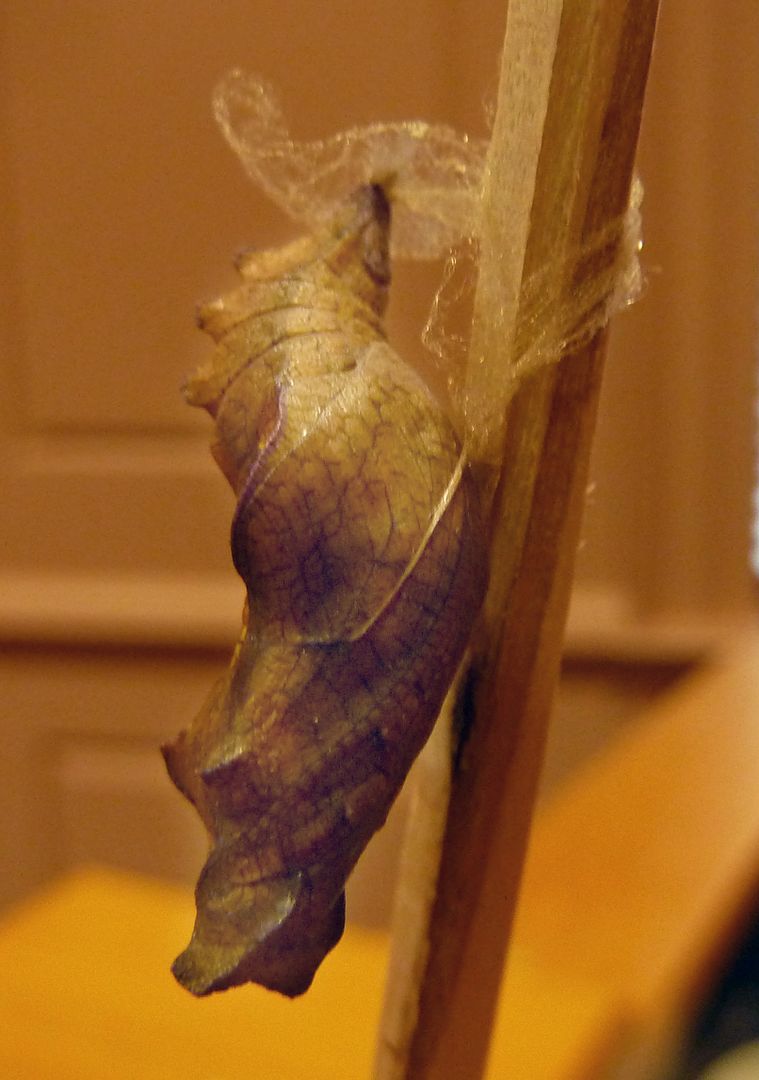 |
| A chrysalis to the Pipevine Swallowtail. |
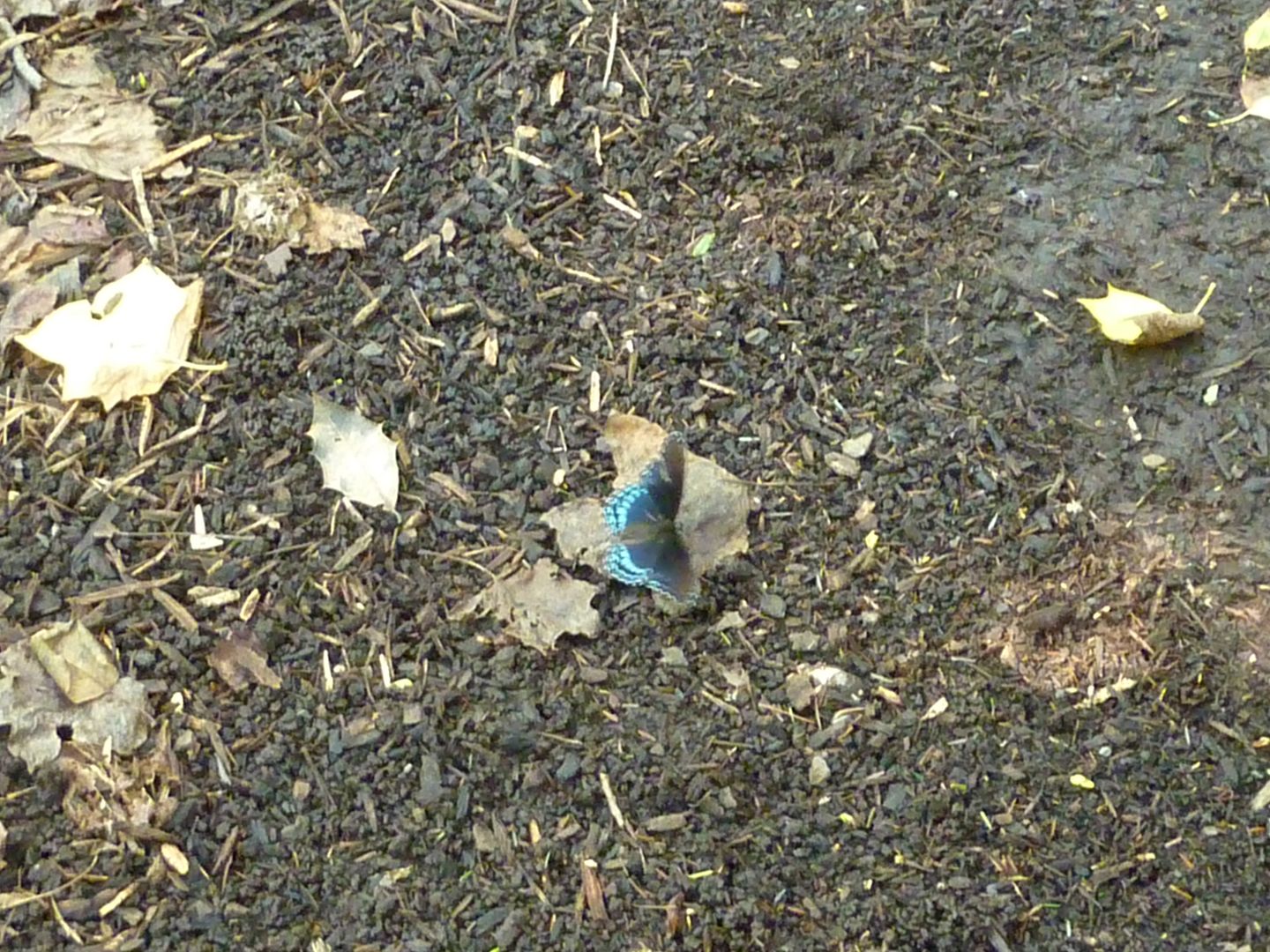
I had another exciting class at the Mt. Cuba Center today. This time the class was on Butterflies in Your Garden, which focused on the most common and showiest Lepidoptera you can see flying in the daylight hours. The lecture was well constructed but had a few omissions like Hummingbird Moths, Mourning Cloak, and Skippers as a whole. They were brought up and talked about as we chanced upon them during the tour though so that's fine. It's hard planning around nature.
The tour started with a bang as we went to the Round Garden. It's a circular pavilion with a rather nice pool in the middle
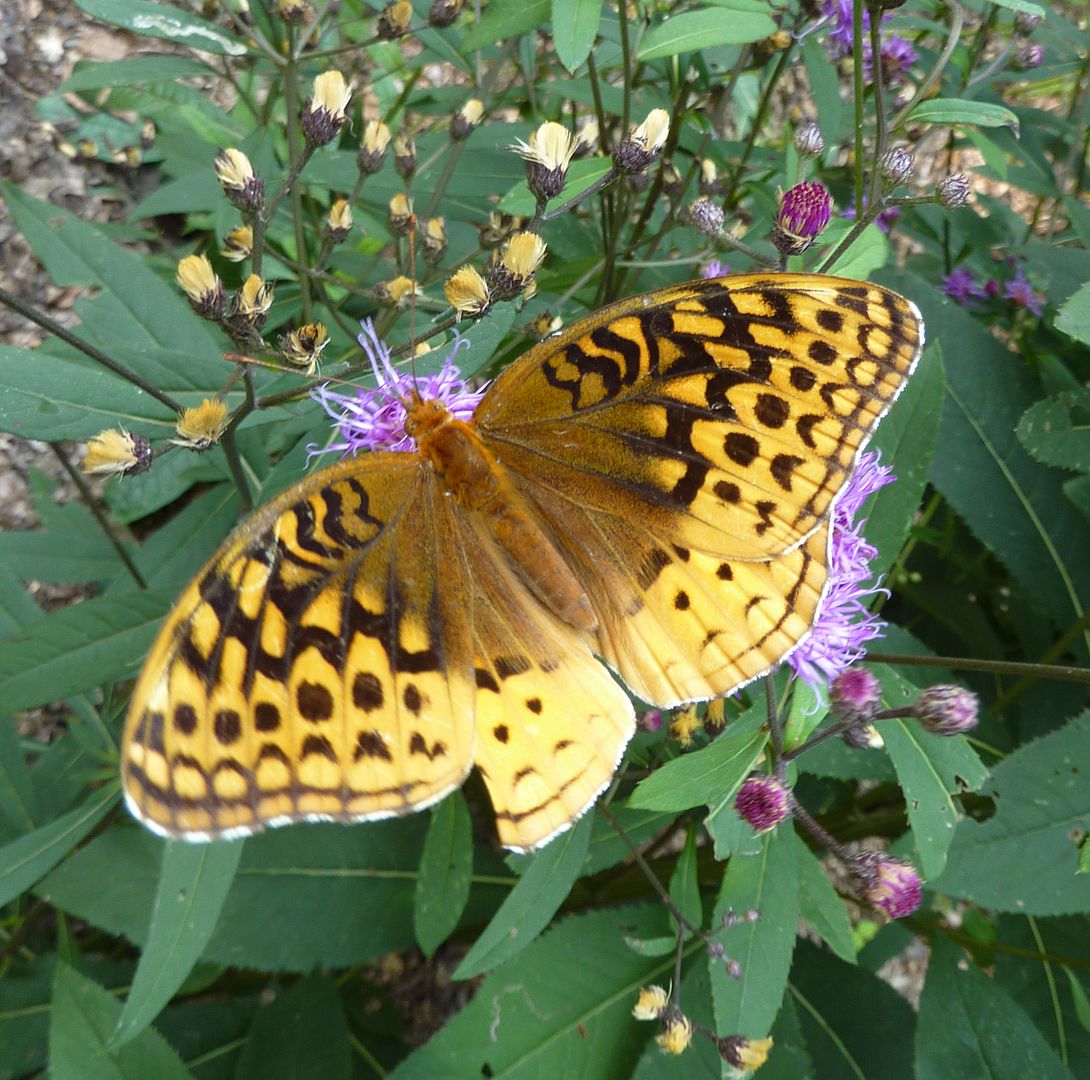
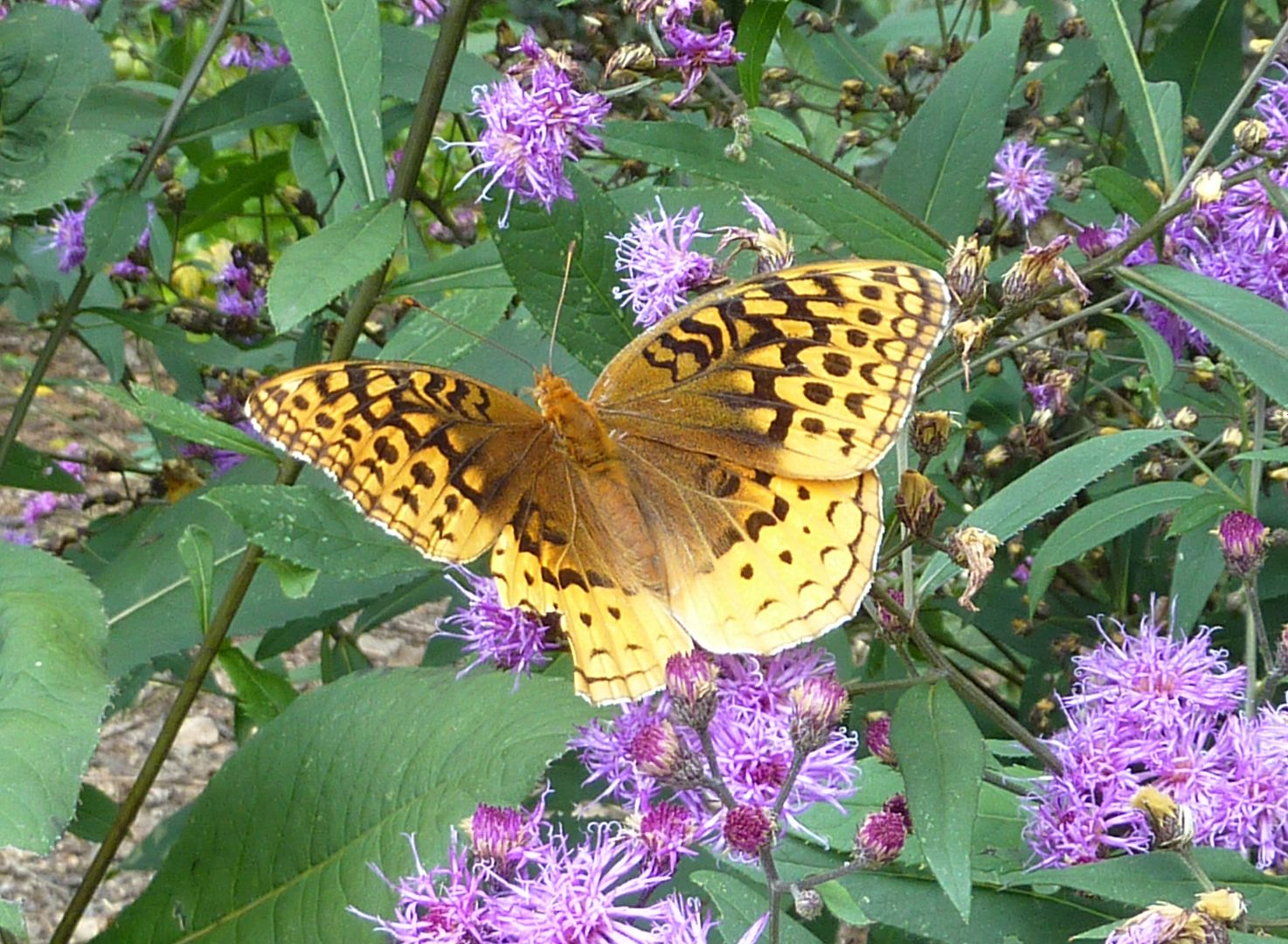
So to sustain a population of these it sounds like lots of violets spread around the garden are needed. I read in Caterpillars of Eastern North America: A Guide to Identification and Natural History (Princeton Field Guides)
 that caterpillars are nocturnal feeders with this species, and are usually found under logs and stones during the day. Be careful, as they're covered in thorns. They're said to be sizable creatures in the last instars and able to eat two whole violets in a day.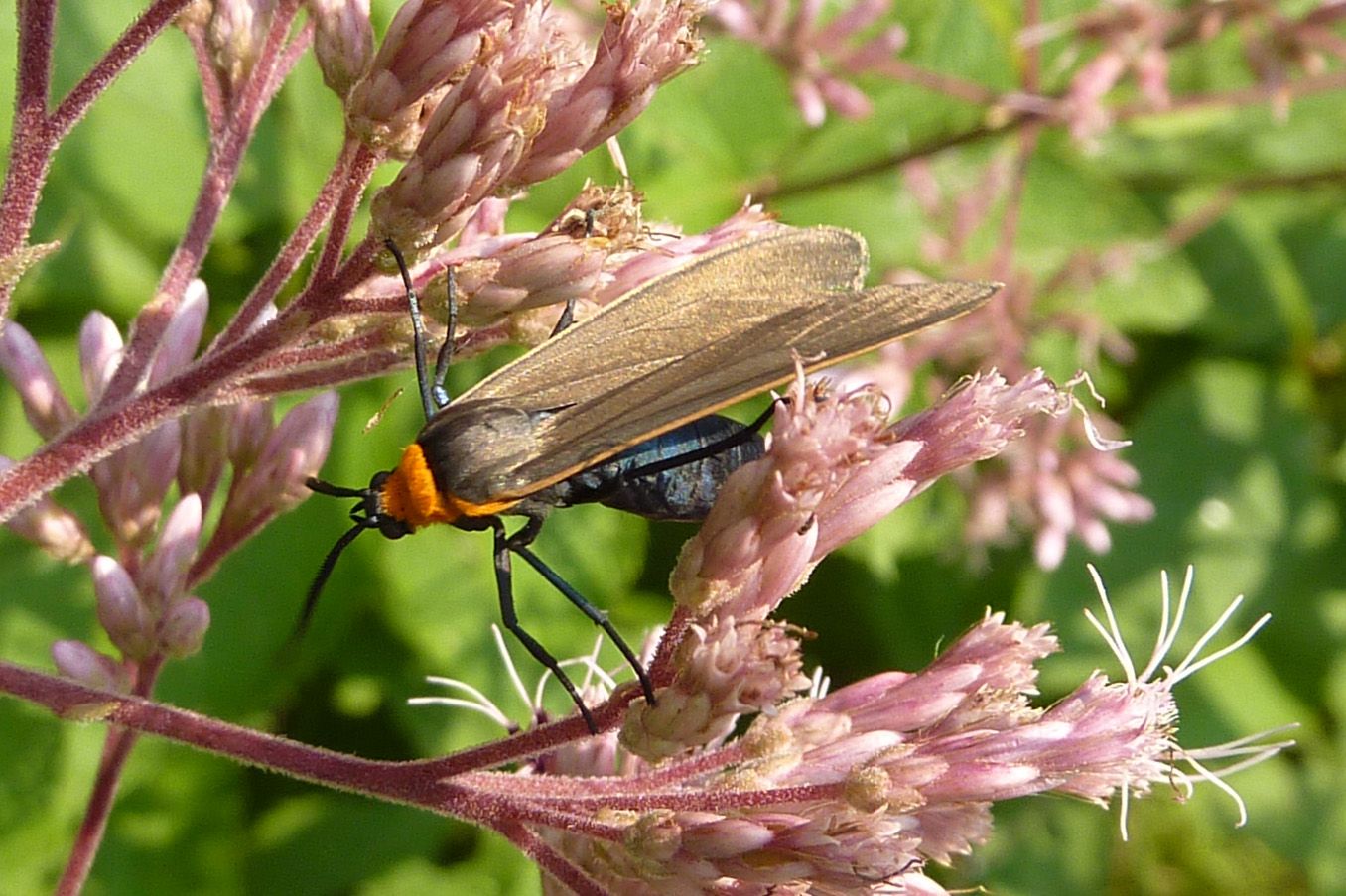

So that was my visit. :)
Tuesday, July 12, 2011
Meadow "Garden"
Earlier in the week I attended a course at the Mt. Cuba Center on Meadow Studies. First off I need to put a little disclaimer here; I made like 3 wrong turns getting there and arrived 10 minutes late for the class. I found the title of the course to be a little misleading but the description was accurate. It basically boiled down to "Hay here are some plants blooming now. Let's go look at them." And there's nothing wrong with that but I feel the tone was a little off for a class on meadows.
After reading books like The Ecology and Management of Prairies in the Central United States (Bur Oak Book) by Chris Helzer, who blogs by the way, I came into the course expecting things to be different.
Basically a healthy meadow consists of 150 to 300 plant species. The Mt. Cuba Center seems to run their meadow differently. I think it's correct to say they're trying to maintain a specific look rather than allowing it to go through a natural succession. Other than removing trees now and again I'd say they don't allow their plant species to change over time.
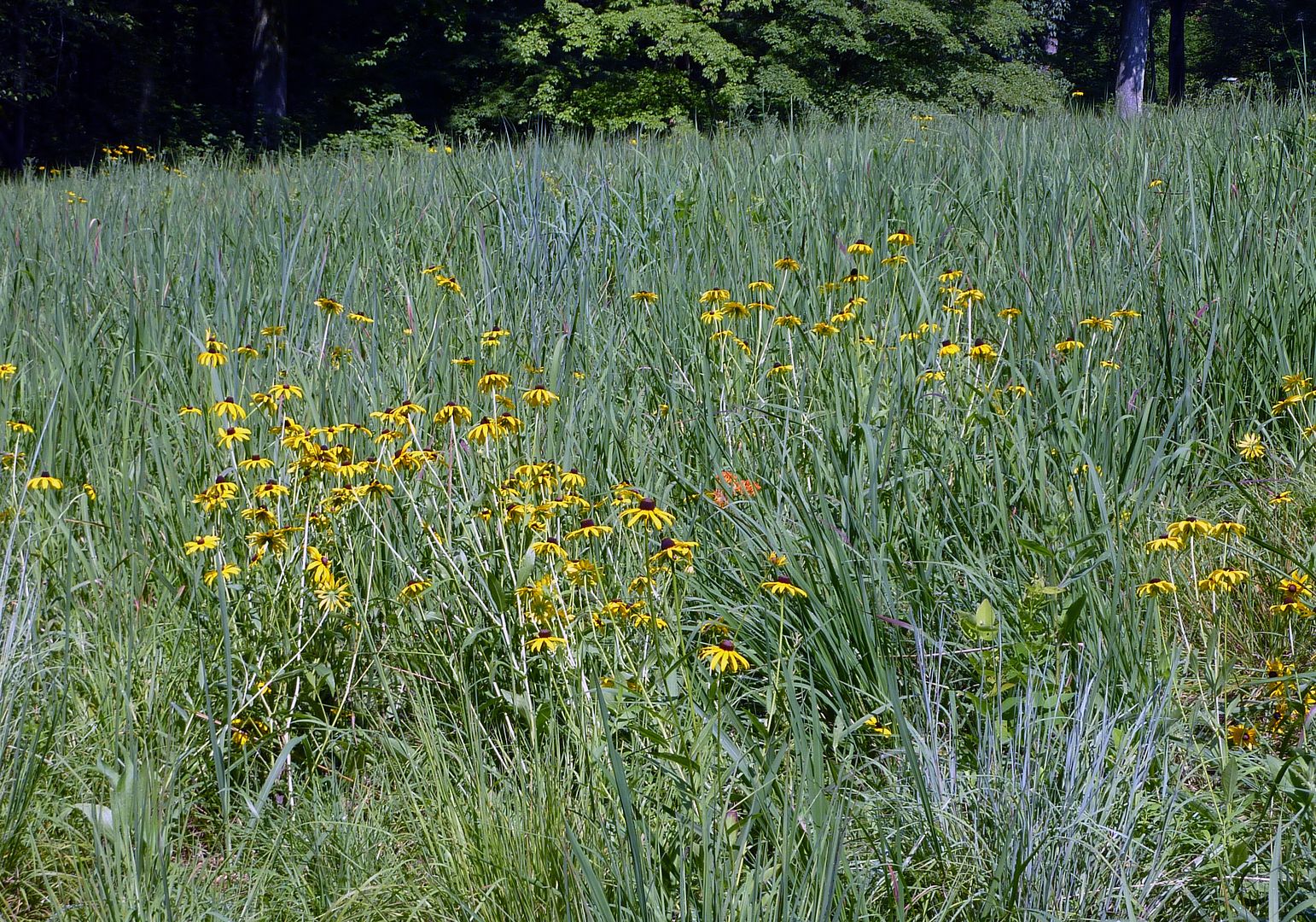 By design they favor grass species over forbs. Here you can see an abundance of Little Bluestem, Schizachyrium scoparium, which is a grass that ranges from blue-green to green in color. There were lots of other grass species present but only 4 or so were highlighted. To some people this might look boring but grasses really don't shine in the meadow until the autumn and winter. There is something so majestic and calming about watching a field of tall grasses sweep with the wind. When the sight takes up your entire field of vision there's nothing quite like being there in person. It really is something you have to see in person to appreciate; cameras do not capture the effect at all.
To comment on the tone of the course a little I noticed there was almost no talk of succession. The instructor mentions the Rudbeckia hirta, Black-eyed Susan, will reseed itself around but they didn't mention why. Again this leads me to believe they're more interested in maintaining a certain look as opposed to being a course on prairie preservation. There is a follow up course I'm attending next month so I might be wrong about this.
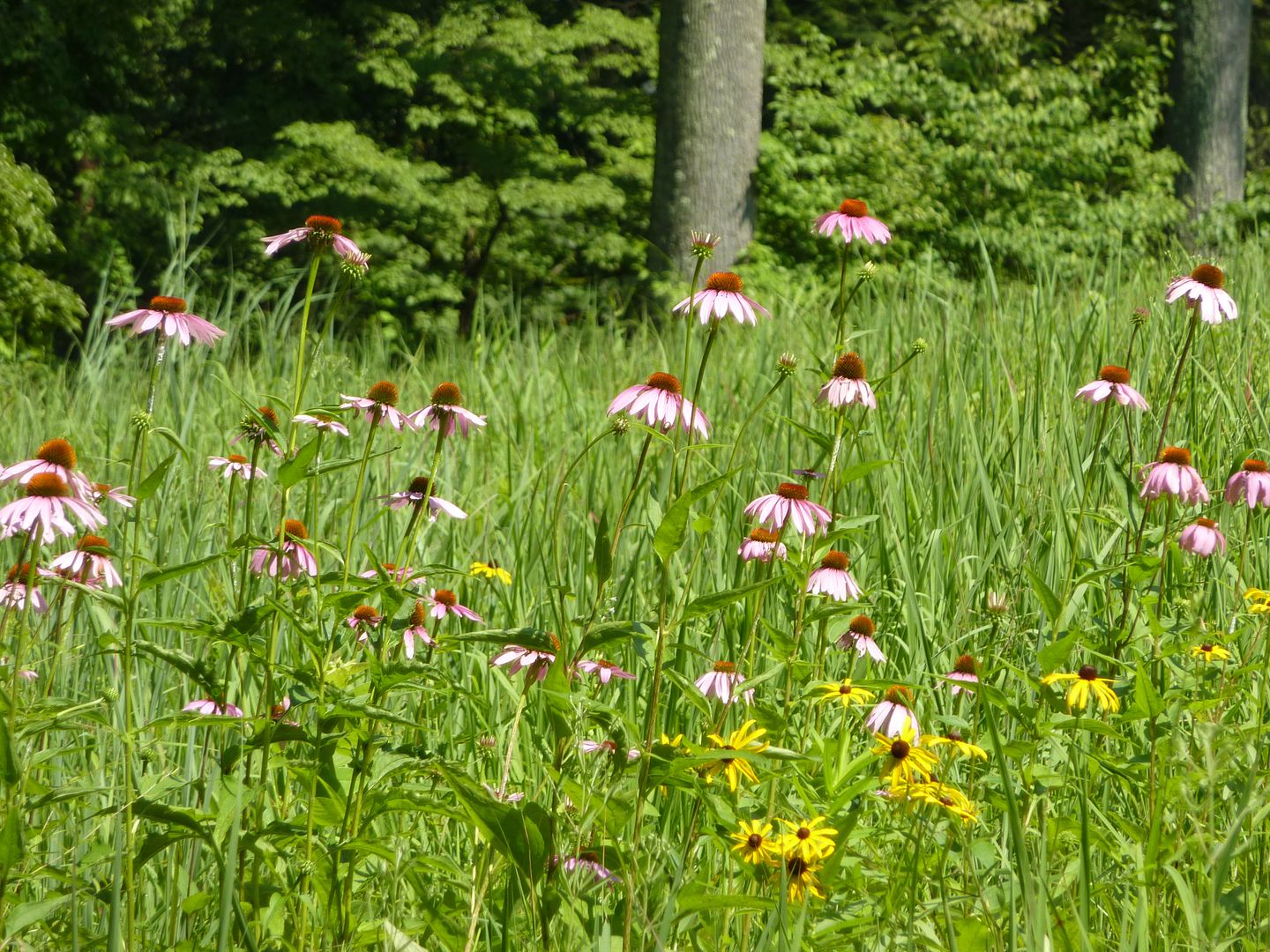 In truth things like Black-eyed Susan have seeds that germinate when in the sun. Thus they are a pioneer species. If a tree falls in the woods, their seeds will germinate. If there's lots of sun hitting the ground, their seeds will germinate. However, several years later this is unlikely the case. All the grasses and forbs in a meadow die back to the ground each year leaving lots of dead stems. Slowly but surely this abundance of organic matter shades out the seeds or prevents them from touching the soil. They're slowly replaced by things like Echinacea purpurea, Purple Coneflower, which are more perennial.
There was a discussion on installation of a meadow and some good pointers given by the instructor but this was only after someone asked about it. Not planting plugs to warm season grasses in the fall was among the smarter things mentioned. As these species only grow when the soil is warm they won't do anything in the fall or winter and typically die as a result.
I look forward to the second course next month. Again, I showed up 10 minutes late so there could be a whole discussion I missed. For a good read, if not a little boring though I recommend The Ecology and Management of Prairies in the Central United States (Bur Oak Book).
After reading books like The Ecology and Management of Prairies in the Central United States (Bur Oak Book)
by Chris Helzer, who blogs by the way, I came into the course expecting things to be different.Basically a healthy meadow consists of 150 to 300 plant species. The Mt. Cuba Center seems to run their meadow differently. I think it's correct to say they're trying to maintain a specific look rather than allowing it to go through a natural succession. Other than removing trees now and again I'd say they don't allow their plant species to change over time.
To comment on the tone of the course a little I noticed there was almost no talk of succession. The instructor mentions the Rudbeckia hirta, Black-eyed Susan, will reseed itself around but they didn't mention why. Again this leads me to believe they're more interested in maintaining a certain look as opposed to being a course on prairie preservation. There is a follow up course I'm attending next month so I might be wrong about this.
There was a discussion on installation of a meadow and some good pointers given by the instructor but this was only after someone asked about it. Not planting plugs to warm season grasses in the fall was among the smarter things mentioned. As these species only grow when the soil is warm they won't do anything in the fall or winter and typically die as a result.
I look forward to the second course next month. Again, I showed up 10 minutes late so there could be a whole discussion I missed. For a good read, if not a little boring though I recommend The Ecology and Management of Prairies in the Central United States (Bur Oak Book)
.
Tuesday, April 12, 2011
Mark Moffett @Google Talks Interview
Mark Moffett, author of Adventures Among Ants: A Global Safari with a Cast of Trillions
 , gives a short talk for @Google Talks a series devoted to just interviewing people. I'm not sure why Mark Moffette's book is rated 5 stars, as I found it a little much to read. He talks more about his experiences as a National Geographic photographer as he traveled the world photographing really interesting ants. The issue though is I don't think this reads well as a book but it works great in interviews and he's become something of the mascot of Myrmecology over the past few years.
Thursday, March 17, 2011
Resource Updates
I've just published a new tab up above called Identification and Distribution of Ants. In it I have listed almost all the known species of ants that can be found in North America as well as what region(s) they can be found. It is a work in progress and I'll eventually be going over each genus one by one as I have free time. My goal is to locate the studies that described each and every one of these species and find out what it was that made someone say "Oh Hah! This is a new species!" So eventually I'll post a little synopsis for each of these to act as a sort of home made key. If actual scientific keys exist online I'll be happy to link to those too. To say the least, this project will take several years to complete, and it's taken about two just to get here.
My species list is coming from the back of "Ants of North America: A Guide to the Genera" which is a great resource. The Online Catalog of North American Ants also lists a few species not featured in that book and has some good descriptions for some of the ants, but not all, and is notably lacking the subfamily Myrmicinae, the largest one in North America!
All species names will eventually be clickable and lead to their page on AntWeb.org which has some of the best scientific photographs of ants around. Bugguide.net and Alexanderwild.com and other sources are also occasionally linked to for images of live specimens, but neither have a complete list of ants. AntWeb.org is at least run by one of the authors of "Ants of North America" so the list and the website typically work well together. It is a shame however, that Ant Web doesn't have more information than it does. It's still a great resource all the same, and frankly some sciences would do better to create a similar resource for their field. EOL.org is getting there, and on the topic of ants even uses some of Ant Web's photos but not all.
My species list is coming from the back of "Ants of North America: A Guide to the Genera"
which is a great resource. The Online Catalog of North American Ants also lists a few species not featured in that book and has some good descriptions for some of the ants, but not all, and is notably lacking the subfamily Myrmicinae, the largest one in North America!All species names will eventually be clickable and lead to their page on AntWeb.org which has some of the best scientific photographs of ants around. Bugguide.net and Alexanderwild.com and other sources are also occasionally linked to for images of live specimens, but neither have a complete list of ants. AntWeb.org is at least run by one of the authors of "Ants of North America" so the list and the website typically work well together. It is a shame however, that Ant Web doesn't have more information than it does. It's still a great resource all the same, and frankly some sciences would do better to create a similar resource for their field. EOL.org is getting there, and on the topic of ants even uses some of Ant Web's photos but not all.
Sunday, March 13, 2011
Beneficial Herbacious Plants for mid-Atlantic Lepidoptera
Doug Tallamy's Bringing Nature Home: How You Can Sustain Wildlife with Native Plants, Updated and Expanded just keeps getting better and better. While I'm not sure about his most recent edition of his book, arguably the bible of our age, but his website now offers a key to herbaceous plants.
Here is an excerpt.
So it's sounding like I'm doing things right.
There is also a list for Woody Plants as well.
just keeps getting better and better. While I'm not sure about his most recent edition of his book, arguably the bible of our age, but his website now offers a key to herbaceous plants. Here is an excerpt.
This coming year I'll officially have 5 different species of Solidago, hopefully 5 Aster, 2 Sunflower, and 3 Eupatorium. Ipomoea is a neat idea, but really only 5 or so are native to the North East. I'll have to look into adding a few of those. Certainly I. lacunosa or I. hederifolia might make it into my garden. Carex isn't my favorite but it seems I'll have to look into them too. Frankly though I'd rather establish a patch of Irises though. Lupinus I've tried before, but I believe my soil is just to clay like for them to establish. The Violets here were a weed well before I started gardening. Geraniums will be on the list next year for sure, maybe even a fall planting. Rudbeckia I'm taking care of in Spring for sure.
Common Name Plant Genus Butterfly/moth species supported Goldenrod Solidago 115 Asters Aster 112 Sunflower Helianthus 73 Joe pye, Boneset Eupatorium 42 Morning glory Ipomoea 39 Sedges Carex 36 Honeysuckle Lonicera 36 Lupine Lupinus 33 Violets Viola 29 Geraniums Geranium 23 Black-eyed susan Rudbeckia 17 Iris Iris 17 Evening primrose Oenothera 16 Milkweed Asclepias 12 Verbena Verbena 11 Beardtongue Penstemon 8 Phlox Phlox 8 Bee balm Monarda 7 Veronica Veronica 6 Little bluestem Schizachyrium 6 Cardinal flower Lobelia 4
Learn more about the study from which these numbers were derived or download the complete list of data from this study (an Excel spreadsheet).
So it's sounding like I'm doing things right.
There is also a list for Woody Plants as well.
Monday, January 31, 2011
Preview: "The Ecology and Managment of Prairies in the Central United States" by Chris Helzer
This is a book I'm currently reading. I might get to seriously reviewing it in detail at a later date but for now I feel like I've read enough. Bare in mind I'm from New Jersey. The target audience of this book is people with a lot of land living in the Tallgrass prairie region of the US, and some of the mixed grass region farther west. This includes North and South Dakota, Nebraska, Kansas, Oklahoma, Missouri, Illinois, Wisconsin, Minnesota and Iowa... with a touch of Arkansas and Indiana in there. And you'd think it would be fascinating to hear how prairies differ in such a wide range. However what's missing from this book seems to be the author himself, Chris Helzer. That is a shame because I really enjoy reading his blog, The Prairie Ecologist.
The author warns people to use local plant guides rather than ones covering a broader region because they tend to be to vague. Ironically that's also the problem here as it reads like a series of essays. The methods of managing a prairie, their consequences, and factors are all discussed. But what's lacking are examples from the author's own experience. There are no stories or comments given by the author to demonstrate any of the points. And I feel these would have helped break up the monotony a little.
To be fair Haying, Mowing, Prescribed Fires, Grazing, Using Herbicides, and out right doing nothing at all, will all yield different results if done at different times of the year, in various combinations, and if repeated the next season or not; and these will effect different plants differently. But he says it's not important for anyone to be expected to identify 150 to 300 species of plant so long as there are that many species present. This is a complex process and Chris Helzer doesn't make it any less confusing. It's really hard to get an idea that doing any of this will do anything.
Here's an example. He discusses the use of haying or mowing to control weeds. (First off I he doesn't explain what haying is but I gather it's just like mowing but at a higher height and so that the plant cuttings are not returned to the soil. Non farmers might not know this.) He doesn't really offer any opinions on it. Doing it in the spring, summer, or fall can be both positive and negative to balancing grasses over forbs (non-woody flowering plants) as research has shown. He mentions the process over the summer and early fall time will likely kill grassland nesting birds or make them more vulnerable to predators. But this only seems to be a bad thing if you care about those birds.
Another gripe I have is the lack of species names. There's an appendix in the back that lists the species names to common names mentioned in this book. That's okay I guess, but it would be nice to know the genus and species name of plants like "Smooth Brome" when I come across it.
I don't want to discourage him from writing, I just wish this book read more like his blog.
The author warns people to use local plant guides rather than ones covering a broader region because they tend to be to vague. Ironically that's also the problem here as it reads like a series of essays. The methods of managing a prairie, their consequences, and factors are all discussed. But what's lacking are examples from the author's own experience. There are no stories or comments given by the author to demonstrate any of the points. And I feel these would have helped break up the monotony a little.
To be fair Haying, Mowing, Prescribed Fires, Grazing, Using Herbicides, and out right doing nothing at all, will all yield different results if done at different times of the year, in various combinations, and if repeated the next season or not; and these will effect different plants differently. But he says it's not important for anyone to be expected to identify 150 to 300 species of plant so long as there are that many species present. This is a complex process and Chris Helzer doesn't make it any less confusing. It's really hard to get an idea that doing any of this will do anything.
Here's an example. He discusses the use of haying or mowing to control weeds. (First off I he doesn't explain what haying is but I gather it's just like mowing but at a higher height and so that the plant cuttings are not returned to the soil. Non farmers might not know this.) He doesn't really offer any opinions on it. Doing it in the spring, summer, or fall can be both positive and negative to balancing grasses over forbs (non-woody flowering plants) as research has shown. He mentions the process over the summer and early fall time will likely kill grassland nesting birds or make them more vulnerable to predators. But this only seems to be a bad thing if you care about those birds.
Another gripe I have is the lack of species names. There's an appendix in the back that lists the species names to common names mentioned in this book. That's okay I guess, but it would be nice to know the genus and species name of plants like "Smooth Brome" when I come across it.
I don't want to discourage him from writing, I just wish this book read more like his blog.
Friday, January 21, 2011
Amy Sedaris: How to Build a Donut Birdfeeder
Amy Sedaris has written a book of crafts that show off her quirky sense of humor.
Saturday, October 9, 2010
Common Buckeye Sightng

Friday, July 2, 2010
How I Planted a Sweetshrub
Calycanthus floridus, a.k.a. Sweetshrub, gets it's name for the fruity scent of it's fair sized flowers. Google the thing and you'll find loads of people praising the scent and encouraging it's placement by the patio. I wonder if everyone's nose is working though because the one I apparently planted 3 years ago smells like rotting crab apples. It's very repelling, especially when the bloom first opens. It's pollinated specifically by tiny and fairly bland looking beetles. No Bees, and No Butterflies. It isn't even the host plant to any sort of Lepidoptera. It really has no place in my garden but I planted one anyway out of confusion years ago.
Native Plants of the Northeast: A Guide for Gardening and Conservation is a book I got about 3 years before. In it I first learned of the Buttonbush that I was later encouraged to buy from the book "Bringing Nature Home." Since then "Native Plants of the Northeast" has gotten a new front cover and perhaps been expanded upon, so I don't know if this still applies. Basically the species name for a Sweetshrub and that of a Buttonbush were printed right next to one another. While making a plant wish list I must have written down the wrong one and ordered a Sweetshrub instead.
Having never seen either plant in person it was quite the mistake to make. Both have leaves forming in pairs, both get to be about the same size, and the only thing to really alert me I'd planted the wrong thing was the stem color. Buttonbush has a red stem while Sweetshrub is quite green.
The Sweetshrub went into shock the first year and only produced new growth instead of growing on existing wood. Sweetshrubs don't like it to wet while Buttonbushes can tolerate being 4 feet of water. Sweetshrubs burn up a bit in full sun so I'd say they benefit from some partial shade. (Perhaps afternoon shade)? So I'd planted it in the full sun spot with almost no drainage in the yard, and no wonder the poor thing went into shock. The second year it reclaimed the wood thankfully. Finally we're on the third year and it's started flowering. From what I've seen on the internet they're nice looking shrubs at least.
It's not on my favorite list at all and I've since transplanted it. Besides some wilting on the first day it's taking the whole move really well. I expected some loss of flowers or leaves or for it to die all together. But really it's just doing great. It's still flowering even.
So that brings us to the second part of my story.
How I bought a Buttonbush.
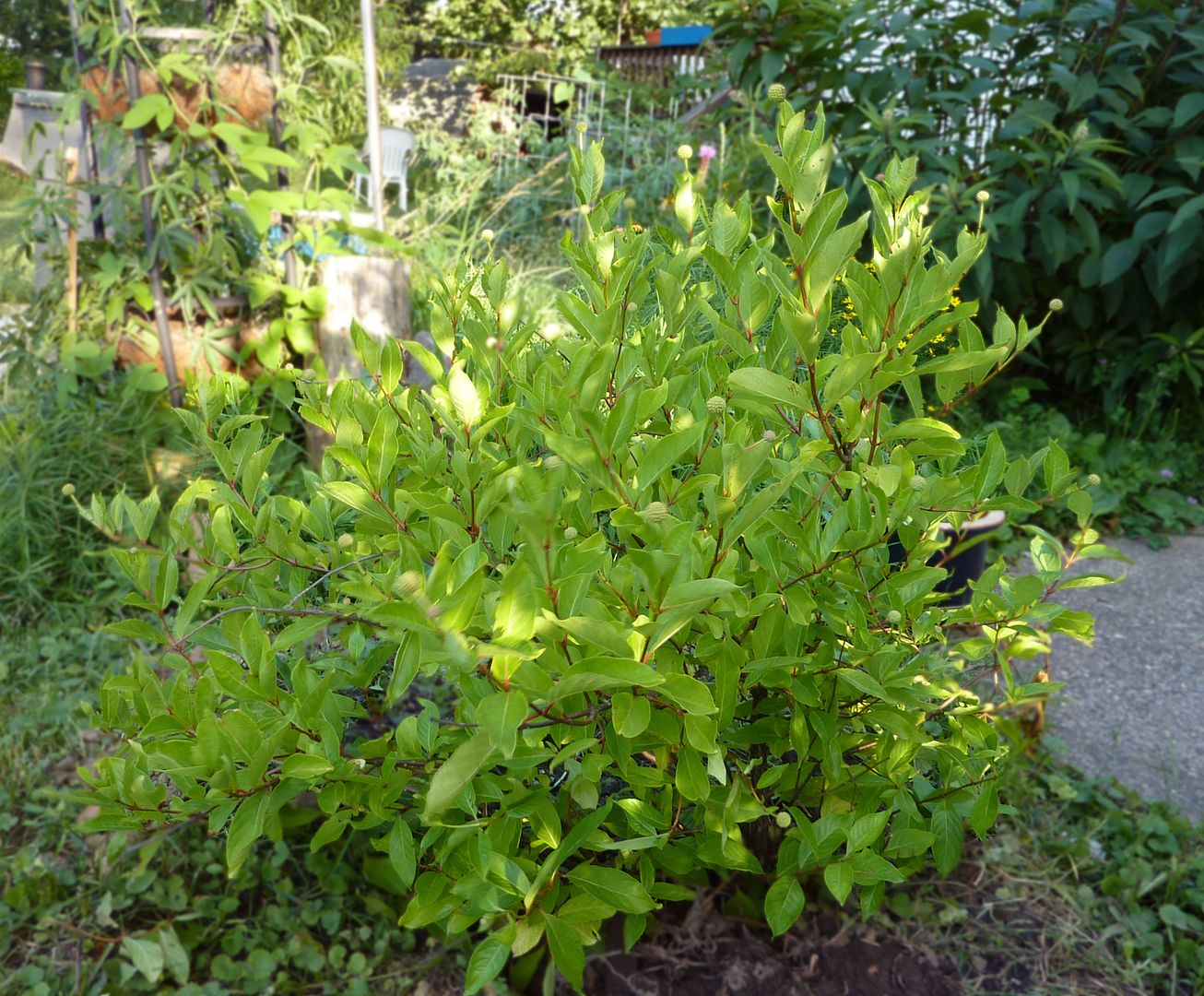 Earlier today I went to the nursery and bought one. The End.
 Popes is my favorite nursery. They have a huge selection of plants at mostly wholesale prices. I could start a landscaping business around that nursery and make a fortune with odd hard to find landscaping plants. The lady there was thrilled I wanted to buy one. Apparently it's not something people ask for often. Looking at the label she made probably explained why. It read "grows 25' tall and around." I pointed out the mistake; 10' is more accurate. She actually had one growing there on the property they'd planted about 10 years ago. We went over to it and sure enough it was only 4' tall and around.
So that was my feel good moment of the day. I recommended she treat it as though it were a native Butterfly Bush because it really is in many ways. The flowers occur in clumps, or in this case balls, they're tube shaped, and even lightly scented but not as pungent as a Butterfly Bush. They're more sweet smelling but not as strong, unfortunately. It's even the host plant to at least one Giant Silk Moth. I hope to prove how great of a plant this is when mine starts blooming real good.
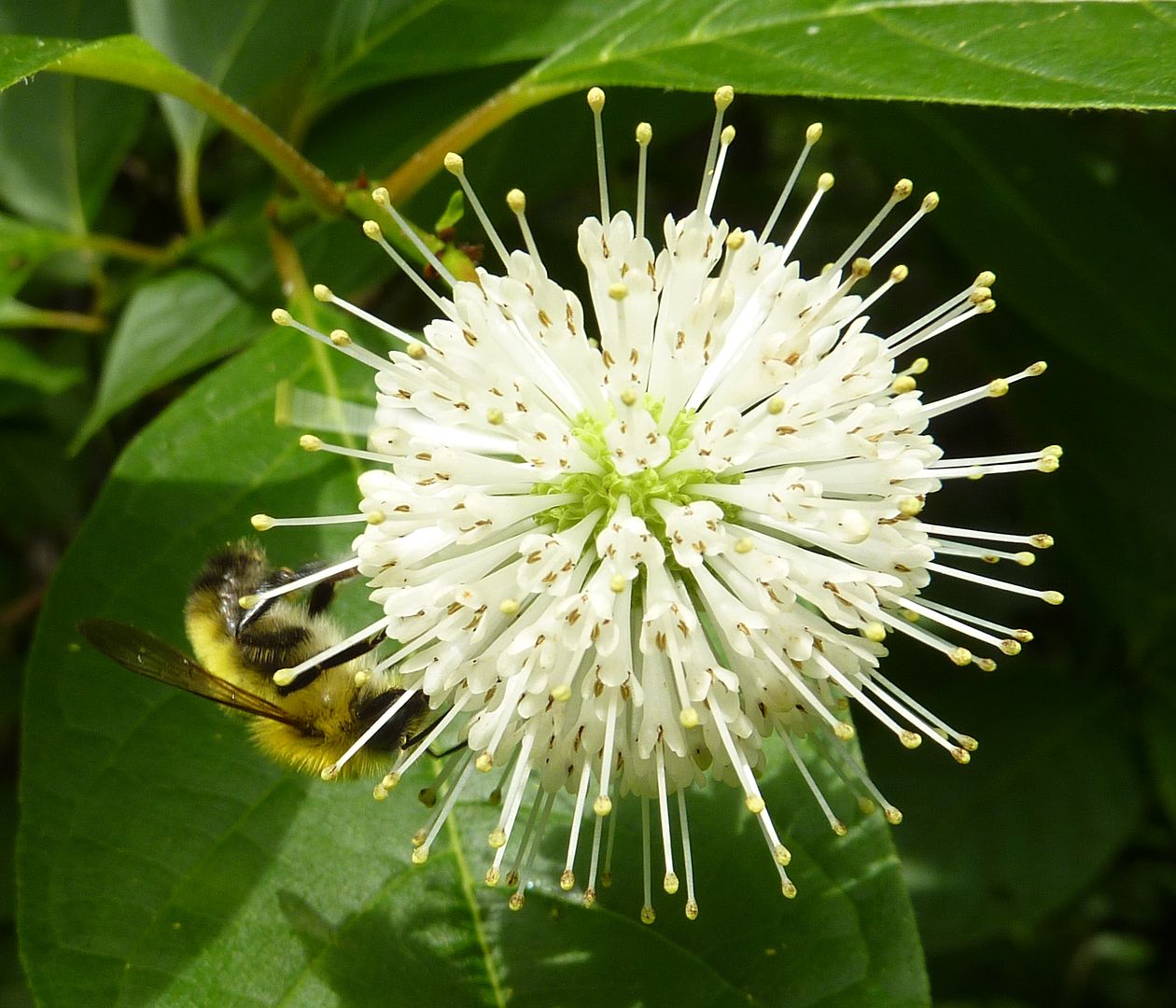 If nothing else it's great for the bees at least.
Native Plants of the Northeast: A Guide for Gardening and Conservation
is a book I got about 3 years before. In it I first learned of the Buttonbush that I was later encouraged to buy from the book "Bringing Nature Home." Since then "Native Plants of the Northeast" has gotten a new front cover and perhaps been expanded upon, so I don't know if this still applies. Basically the species name for a Sweetshrub and that of a Buttonbush were printed right next to one another. While making a plant wish list I must have written down the wrong one and ordered a Sweetshrub instead.Having never seen either plant in person it was quite the mistake to make. Both have leaves forming in pairs, both get to be about the same size, and the only thing to really alert me I'd planted the wrong thing was the stem color. Buttonbush has a red stem while Sweetshrub is quite green.
The Sweetshrub went into shock the first year and only produced new growth instead of growing on existing wood. Sweetshrubs don't like it to wet while Buttonbushes can tolerate being 4 feet of water. Sweetshrubs burn up a bit in full sun so I'd say they benefit from some partial shade. (Perhaps afternoon shade)? So I'd planted it in the full sun spot with almost no drainage in the yard, and no wonder the poor thing went into shock. The second year it reclaimed the wood thankfully. Finally we're on the third year and it's started flowering. From what I've seen on the internet they're nice looking shrubs at least.
It's not on my favorite list at all and I've since transplanted it. Besides some wilting on the first day it's taking the whole move really well. I expected some loss of flowers or leaves or for it to die all together. But really it's just doing great. It's still flowering even.
So that brings us to the second part of my story.
How I bought a Buttonbush.
So that was my feel good moment of the day. I recommended she treat it as though it were a native Butterfly Bush because it really is in many ways. The flowers occur in clumps, or in this case balls, they're tube shaped, and even lightly scented but not as pungent as a Butterfly Bush. They're more sweet smelling but not as strong, unfortunately. It's even the host plant to at least one Giant Silk Moth. I hope to prove how great of a plant this is when mine starts blooming real good.
Subscribe to:
Posts (Atom)