Showing posts with label Lasius. Show all posts

Saturday, September 16, 2017

This Week in Anting 09/16/2017


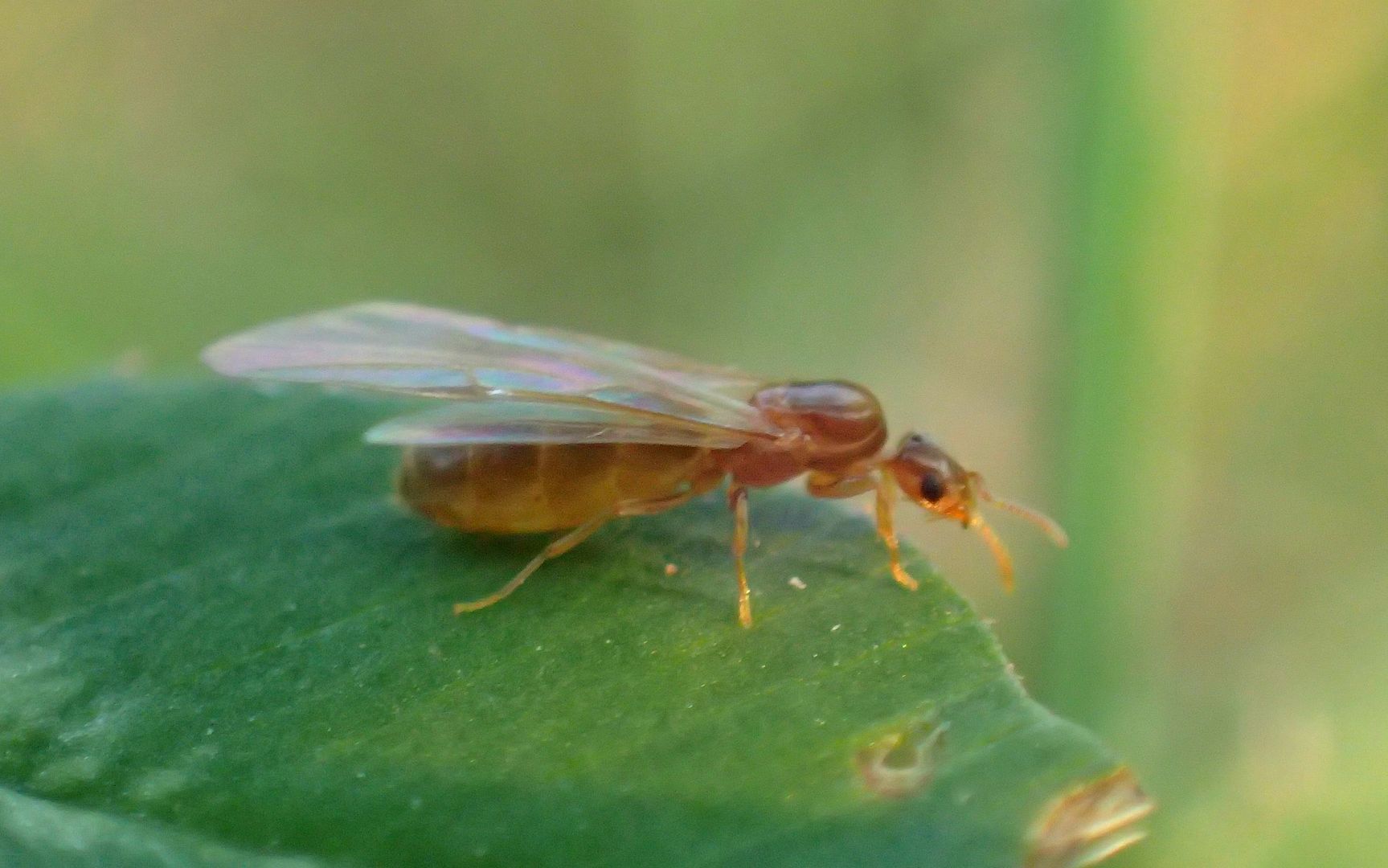
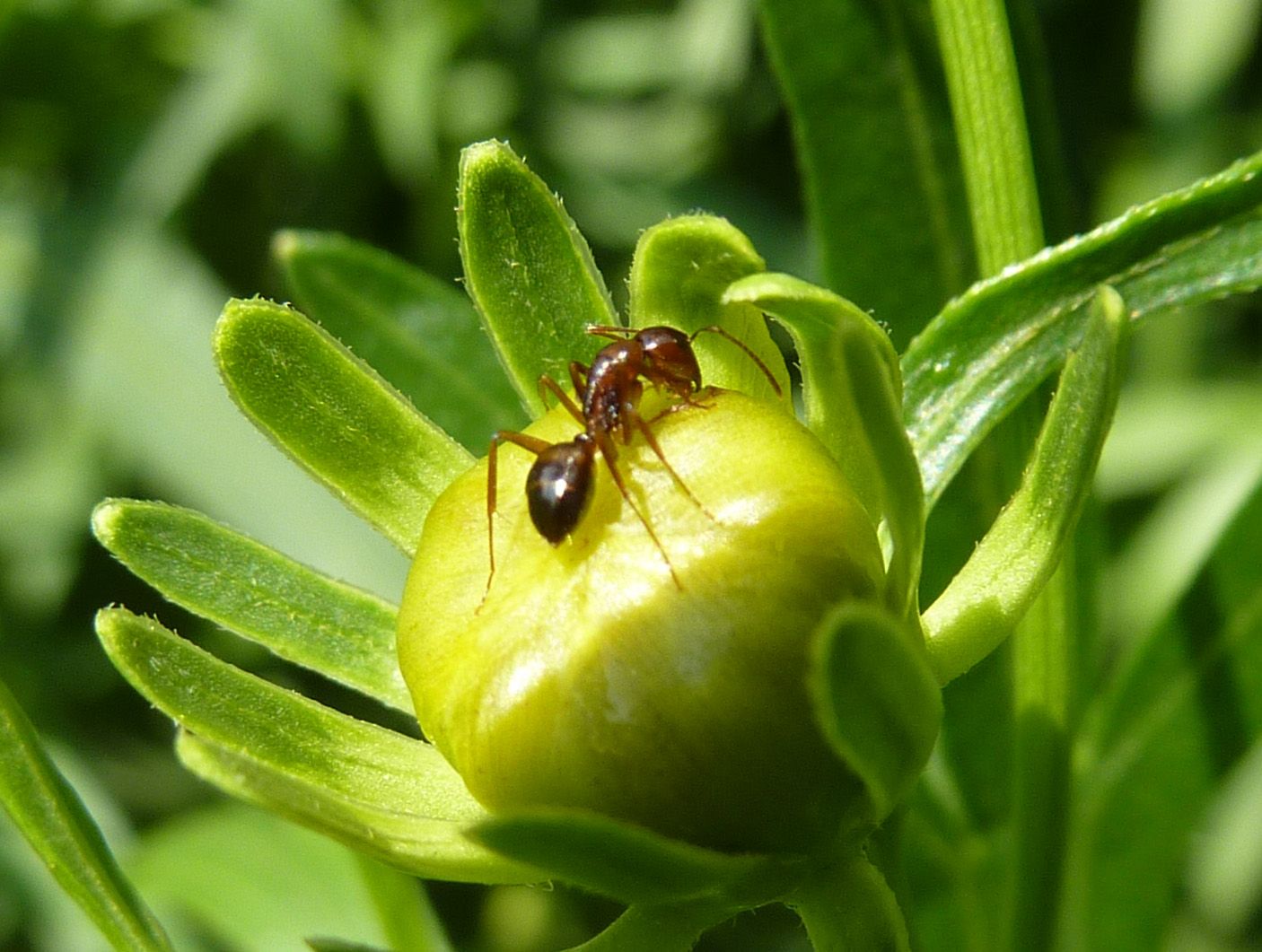
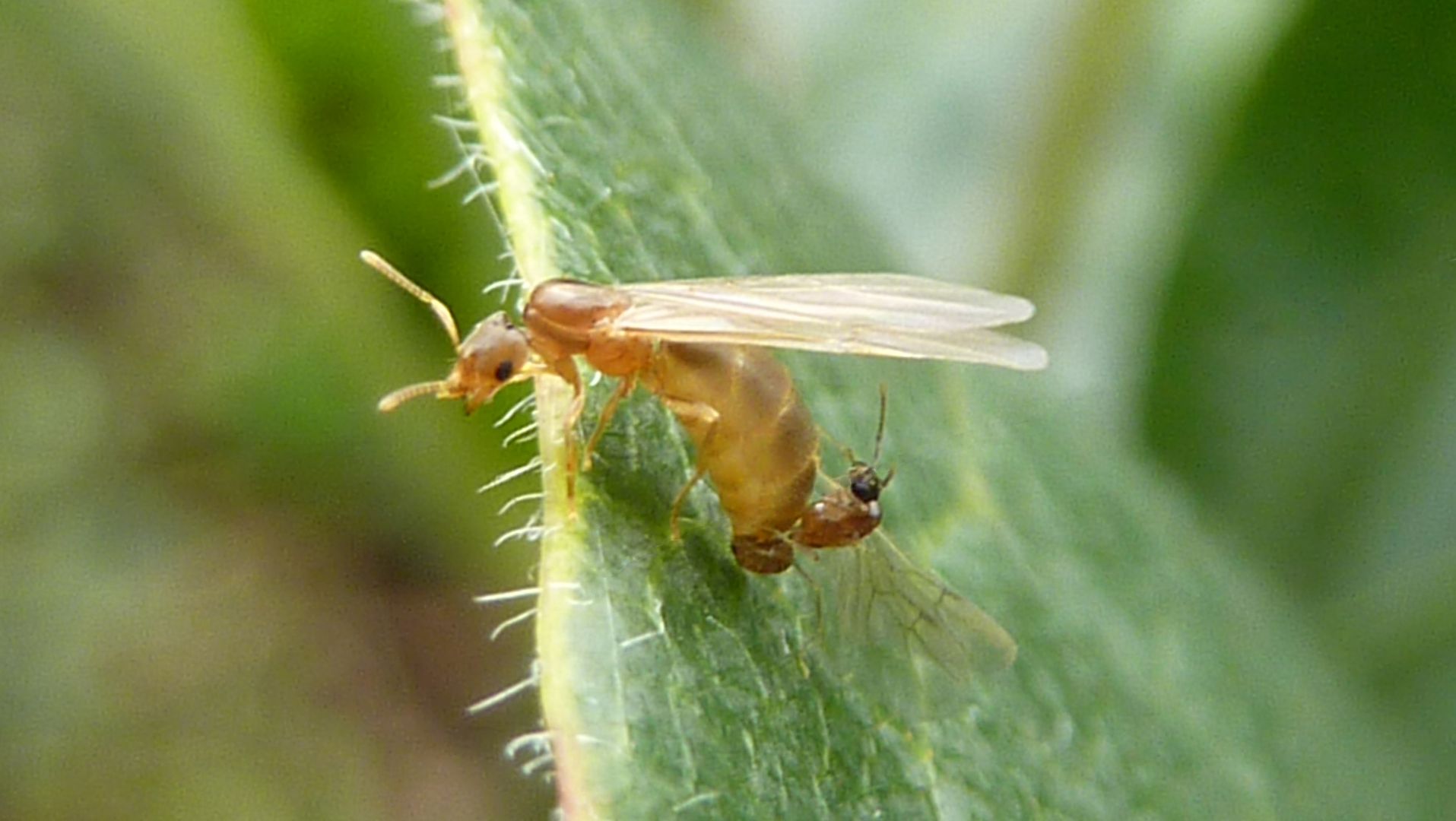
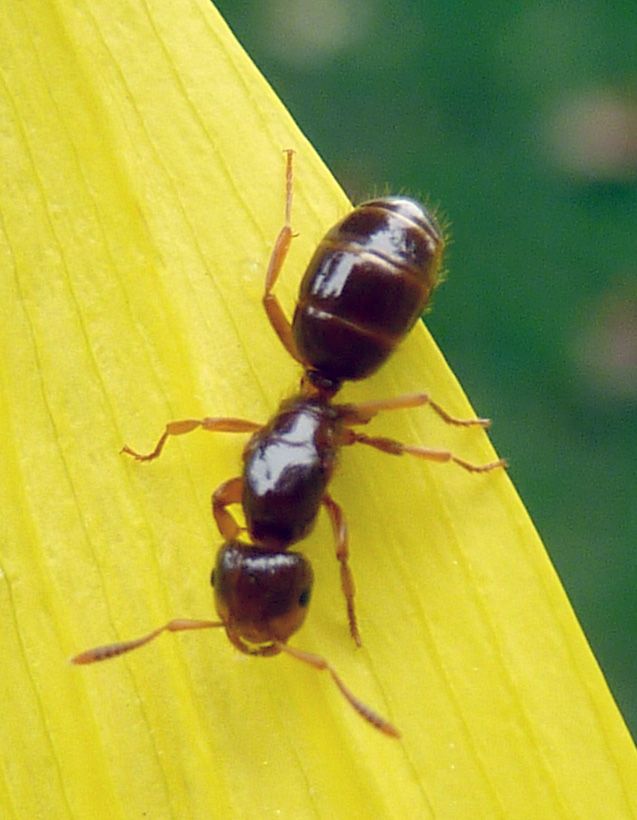
 This week I got to try PawPaws for the first time ever and Lasius neoniger flew! 

Asimina triloba is the northern most member of the custard apple family which is largely tropical. This is the only species native to the United States and one of the few host plants to the Zebra Swallowtail Butterfly. The flowers are pollinated by small vinegar flies and are supposed to require a second cultivar or genetically different tree of the same species in order to produce fruit.... but this is the only tree in my yard and probably the only tree in the whole county. It would seem this cultivar is semi-self fertile. The tree is roughly 12' tall and produced 12 sizable fruits though not on every branch that flowered. Presumably had there been a genetically different tree nearby it would have made even more fruit. (It's either 'Sunflower' or 'Pennsylvania Gold')

The smell is amazing when ripe or slightly damaged. The fruits perfume the air with a fragrance that leaves one assuming some sort of Banana and Orange factory has exploded somewhere. It's very potent and alerts the homeowners, hikers, and wildlife that the fruit is ready. 

The inside texture is somewhat gooey verging on vanilla pudding except for the fairly large and flat seeds with are like skipping stones or pebbles. The taste of a slightly unripe one is that of bananas with hints of cantaloupe (or musk melon as it's known in most of the world). A fully ripe one tastes more like a really sweet banana with a candy-like quality to them. It's a shame this fruit has such a short shelf life of about a day and a half because that's been the main reason it hasn't become main stream. (When they are for sale they can sometimes go for $15 a pound!)


 Fruit such as this is intended to be eaten by animals and carried away from the tree in the wild. If it just falls to the ground though it falls on other creatures to then remove the fruit and free the seeds within. Fungus and mold will do the job otherwise but may also destroy the seeds within.

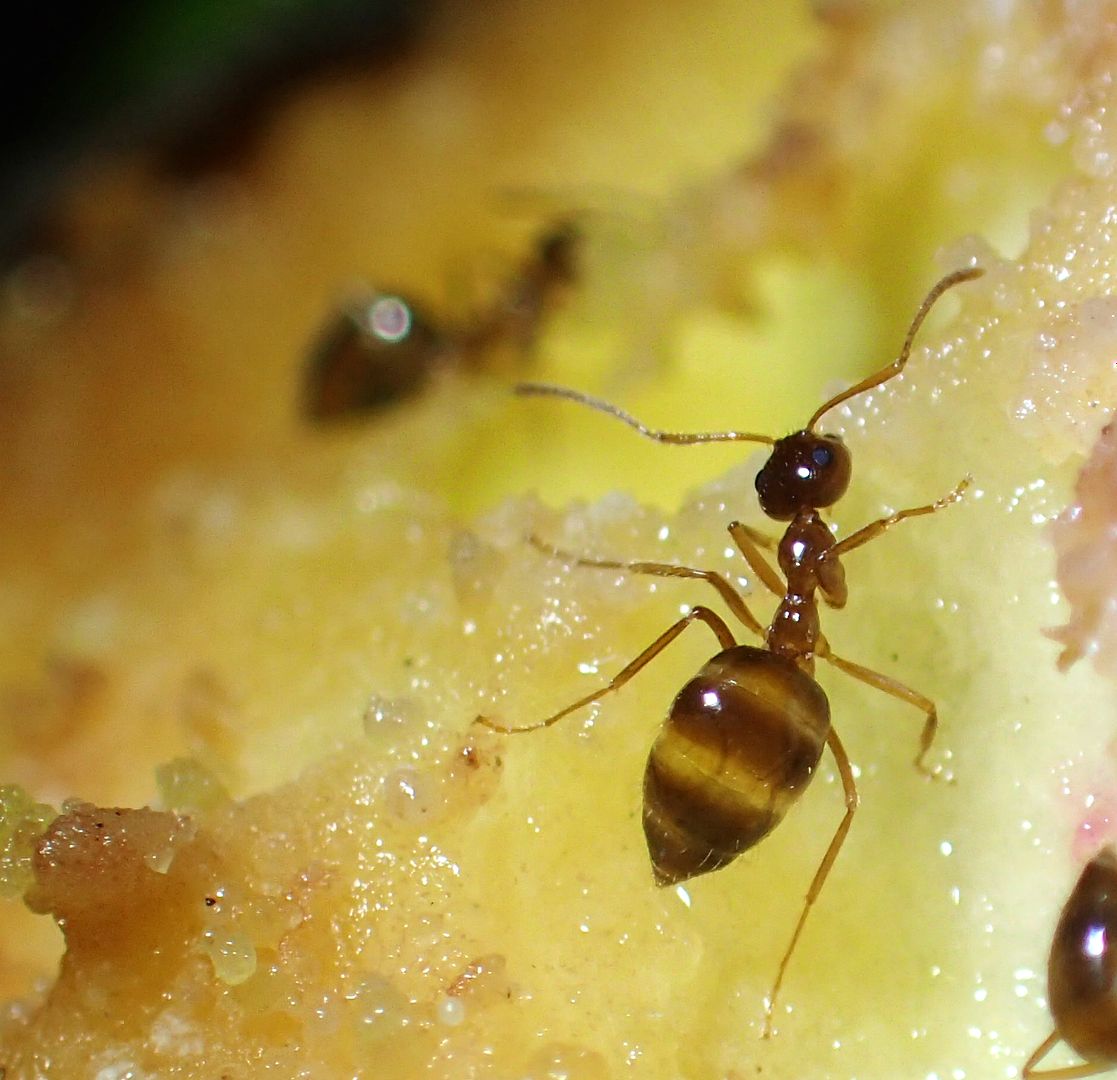
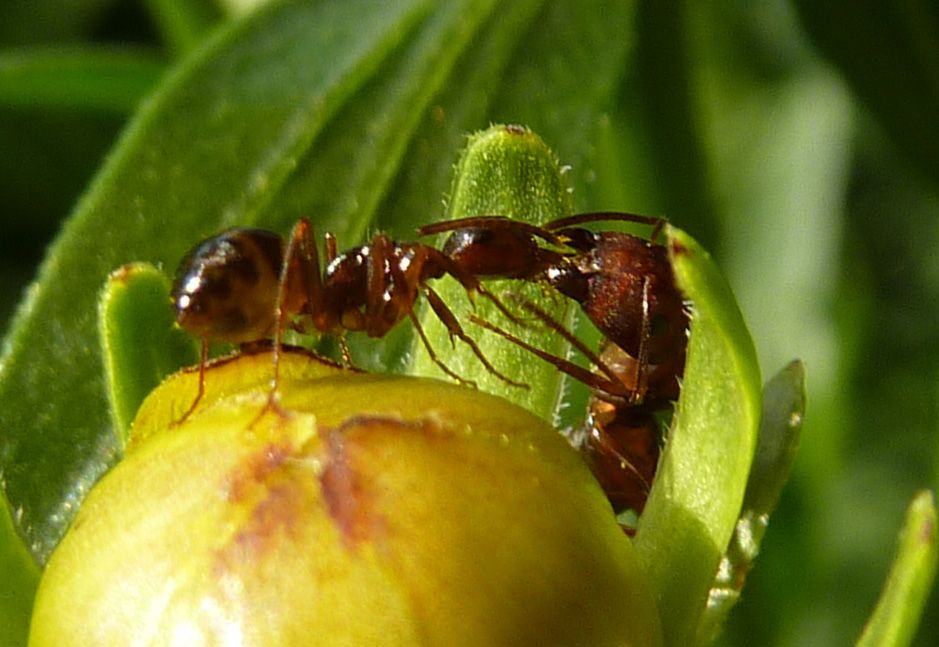
 Members of what must be a very happy Prenolepis imparis colony spent the day cutting up the fruit and hauling it home after most of the workers had engorged themselves on it.


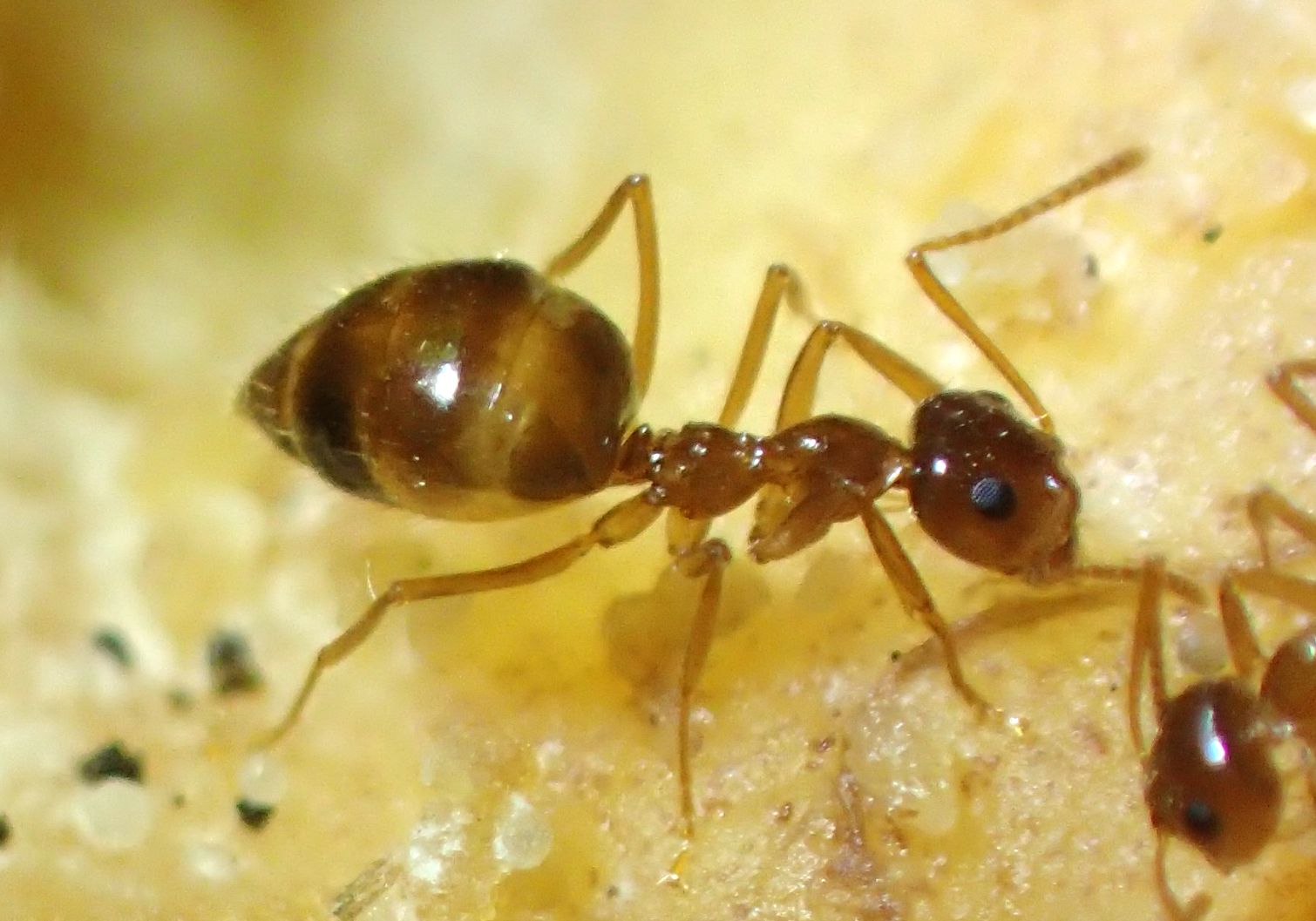
 A fairly decent anatomy pic showing off the acidopore, a slightly tuft of hairs at the tip of the gaster/abdomen. This is a key trait when identifying ants in the subfamily Formicinae and a conclusive way to tell them apart from members of Dolichoderinae.

 Another good anatomy shot. Here the tiny waist segment is clearly visible separating the gaster from the mesosoma.

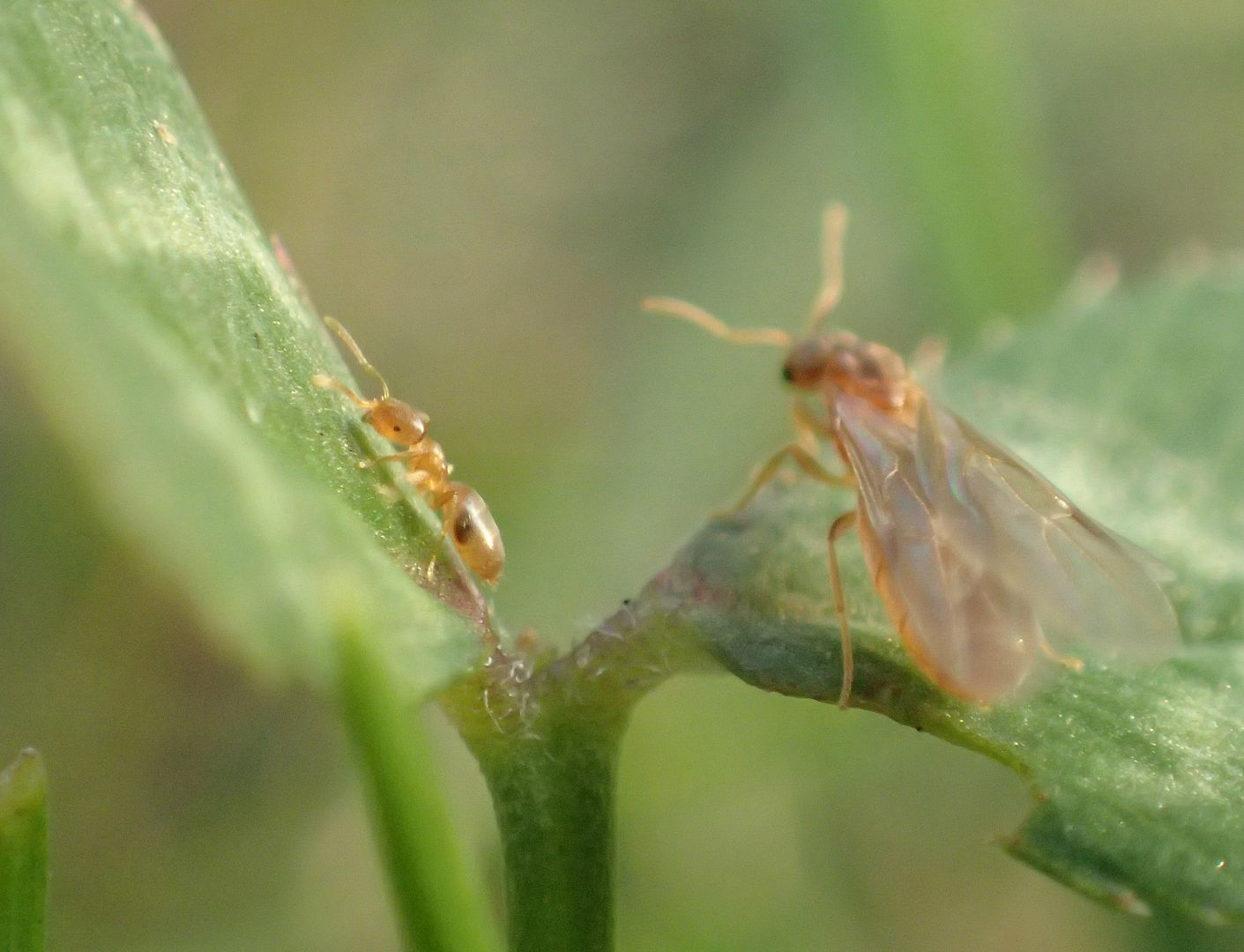
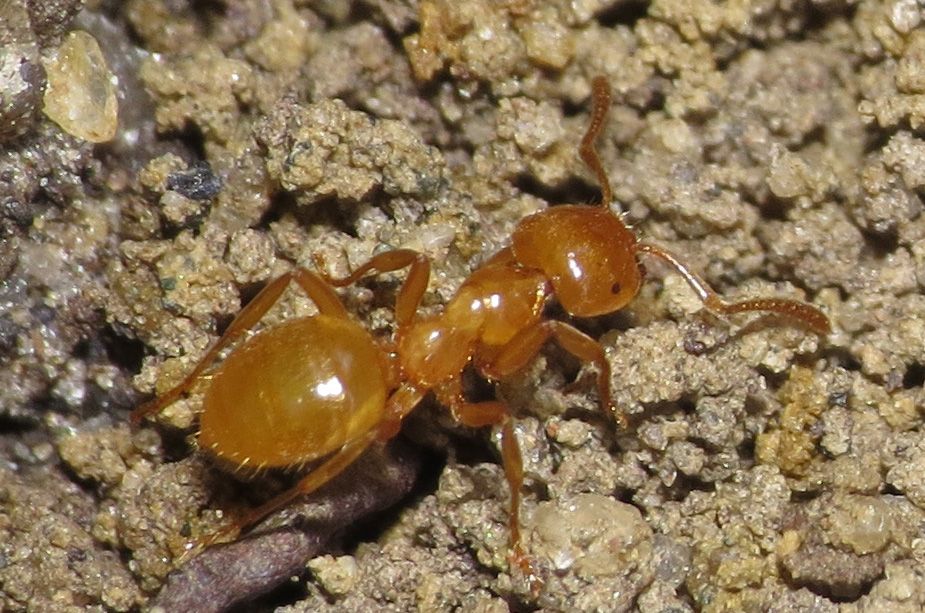
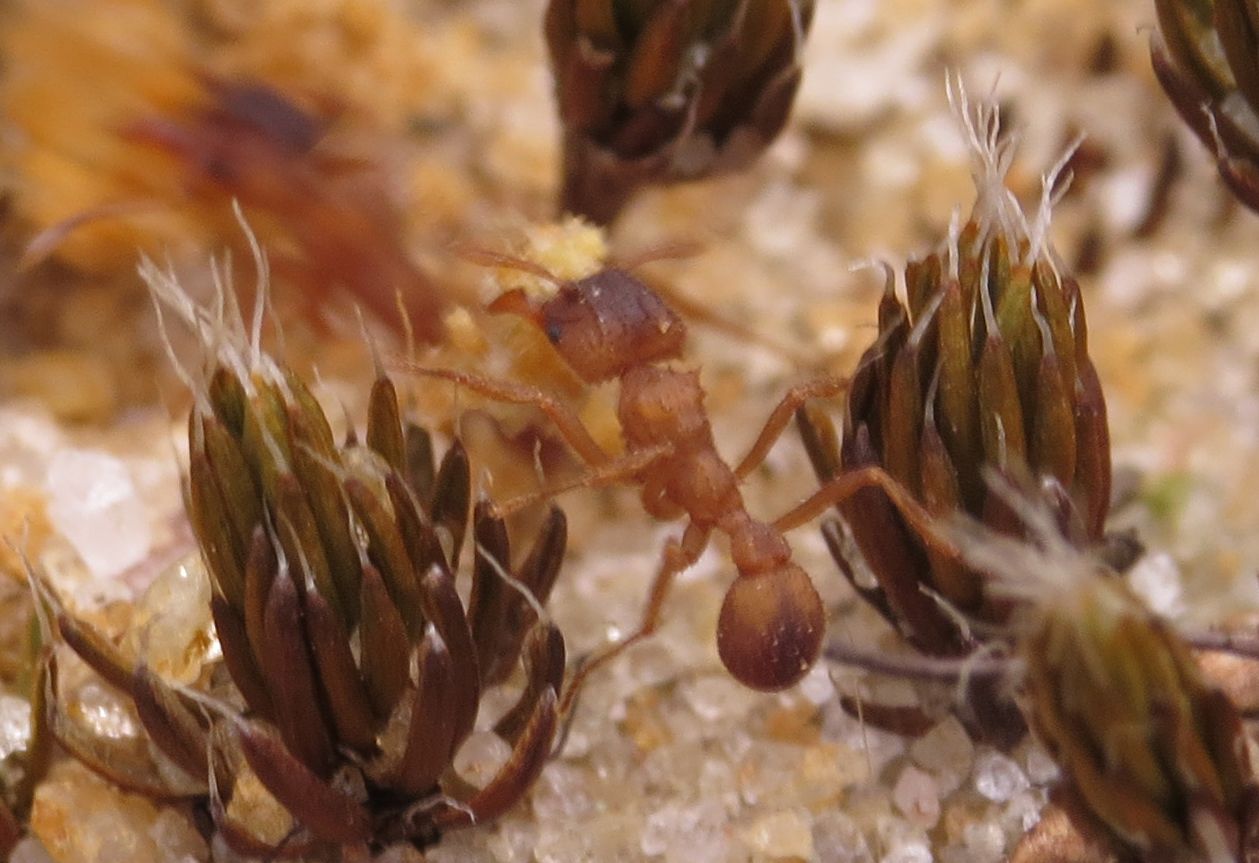
 Brachymyrmex dipilis was also flying that day. This is one of the smallest ants in the U.S.


Sunday, September 27, 2015

A Visit to Cape May, NJ

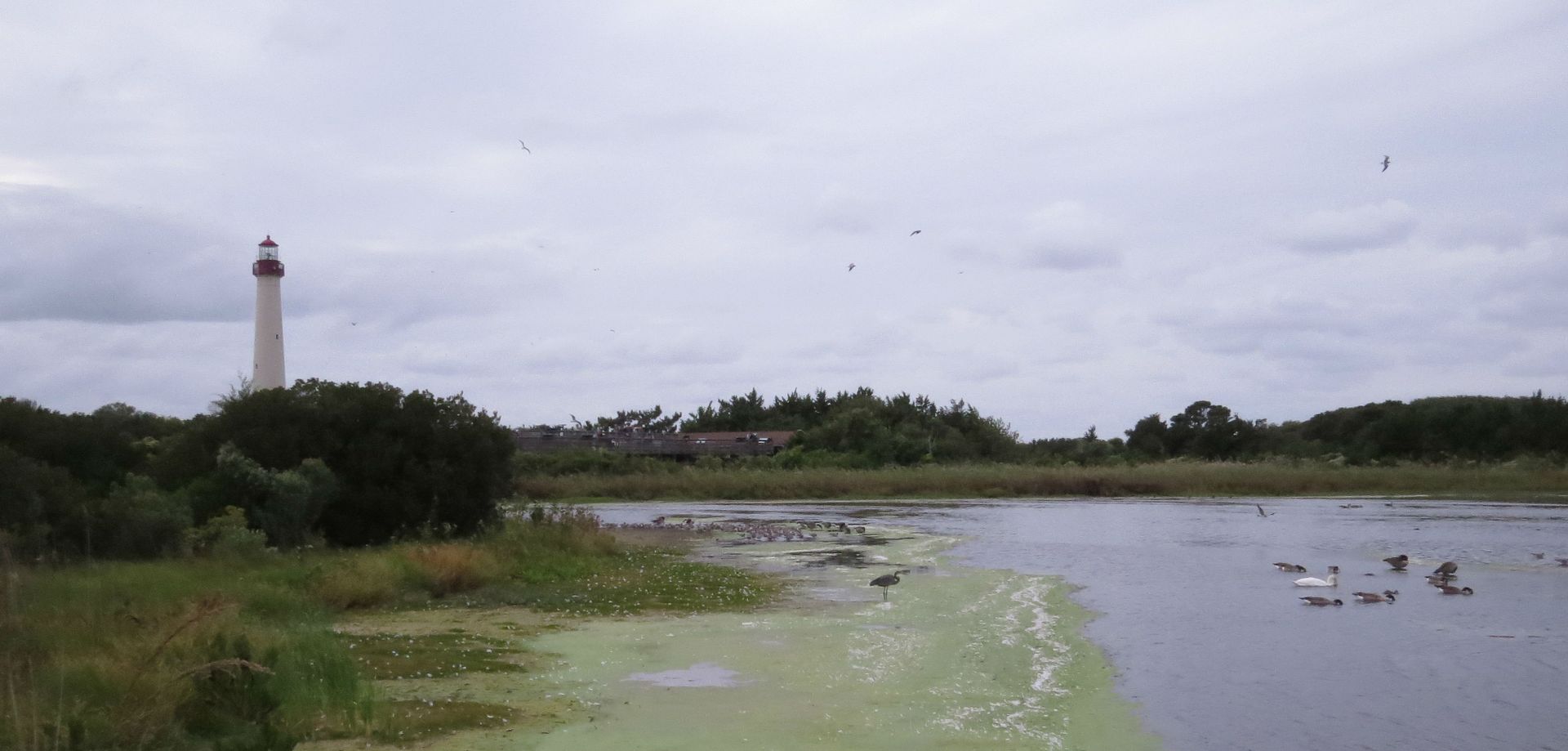
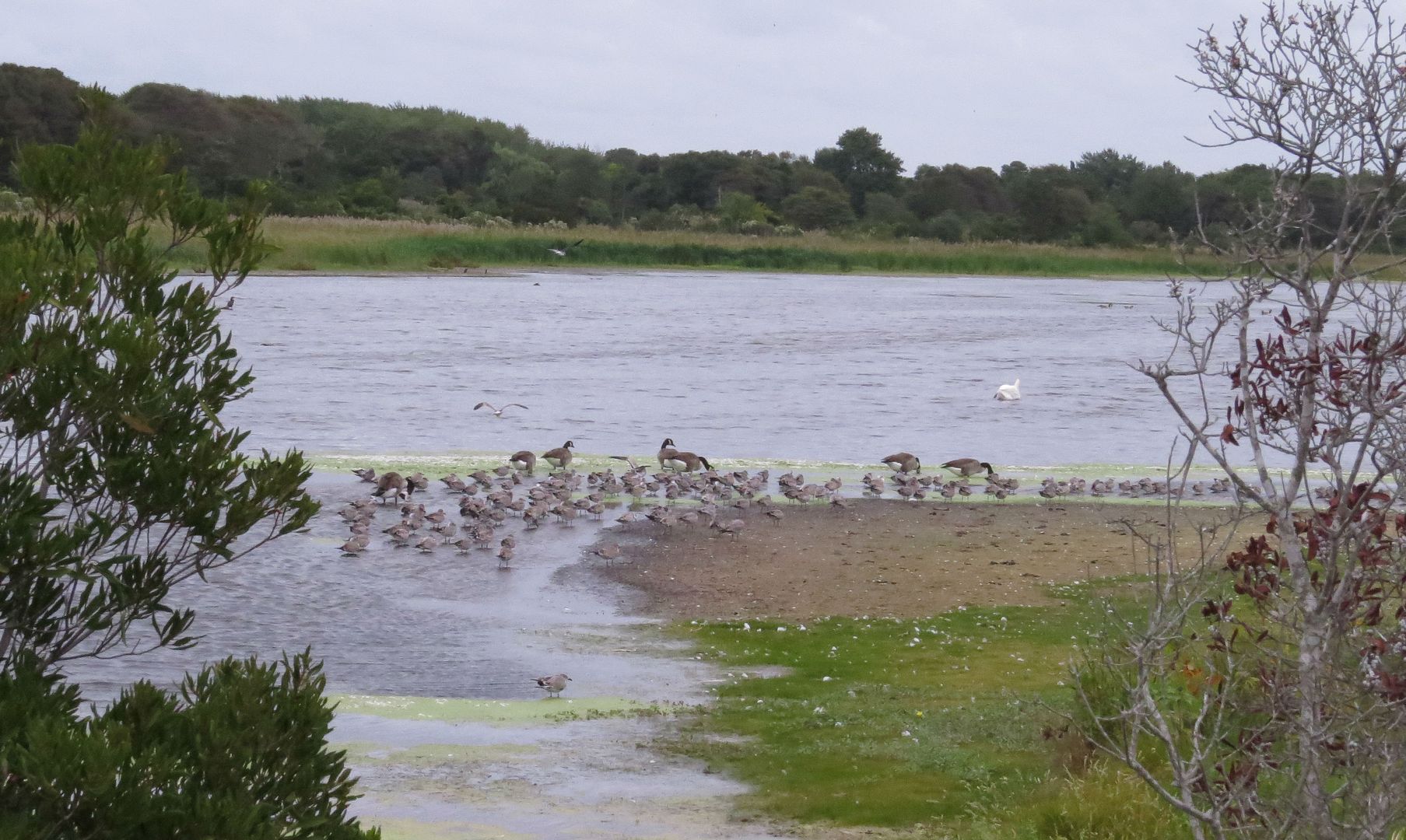
I drove down to Cape May yesterday. This is only an hour and a half from where I live in New Jersey. On one side of the dunes is a sprawling bird sanctuary, ponds, and platforms and docks which bird watchers can use to photograph the various sorts of birds that migrate through.

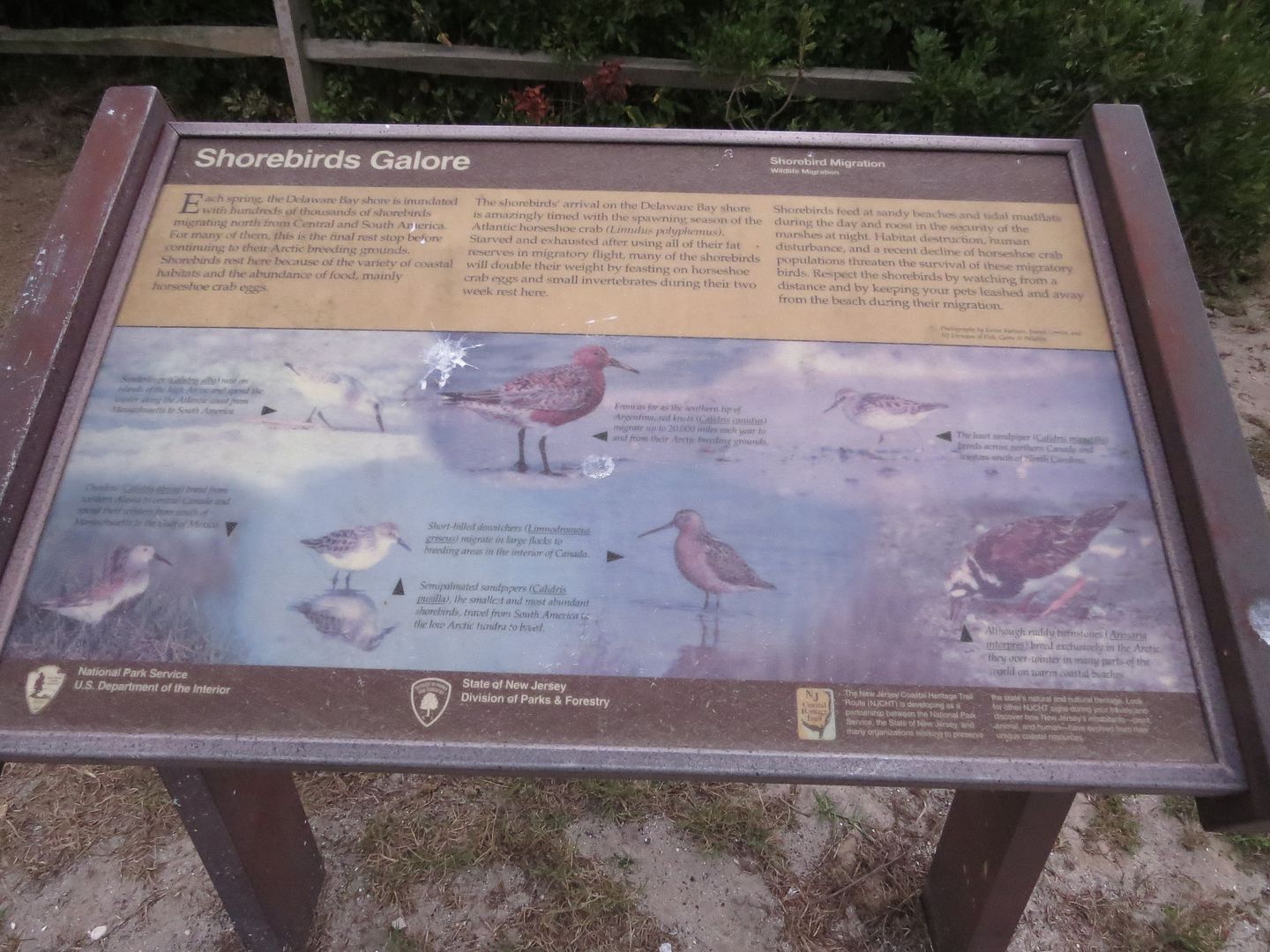
It's something of a birding hot spot in the country. I passed more than one tour in progress with lecturers discussing the different sorts of swans and herrings they were looking at. There's an informative sign that talks about the more exotic birds on the list, which the birds had shat on, along with my car.

I'm sure I got a picture of something exciting here, but birds really aren't my thing.

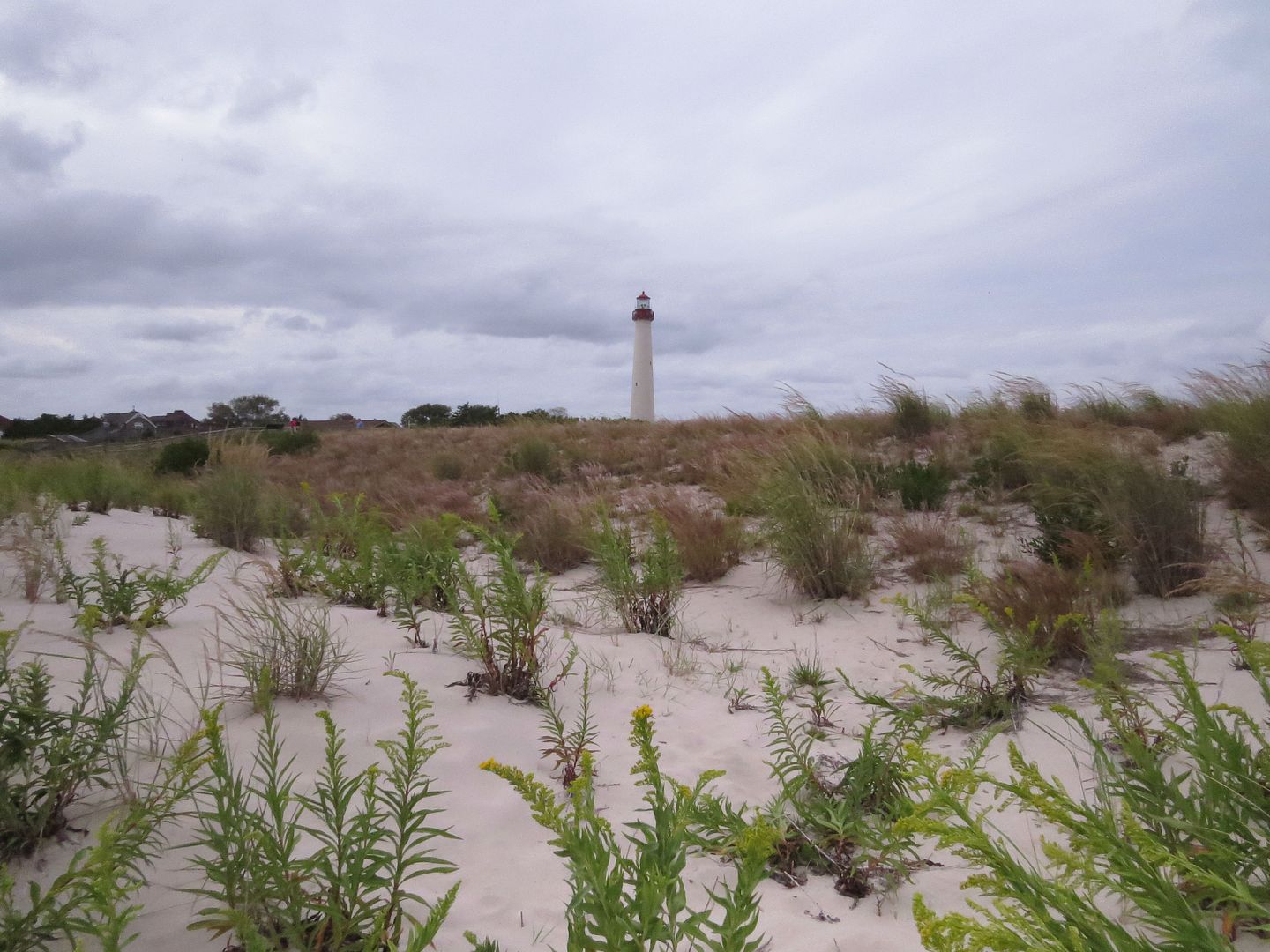
Just on the other side of the dunes there is a sandy beach with droves of seaside goldenrod planted for the Monarch migration. That's the reason I went down there but the day proved too cold and windy for butterflies to fly.

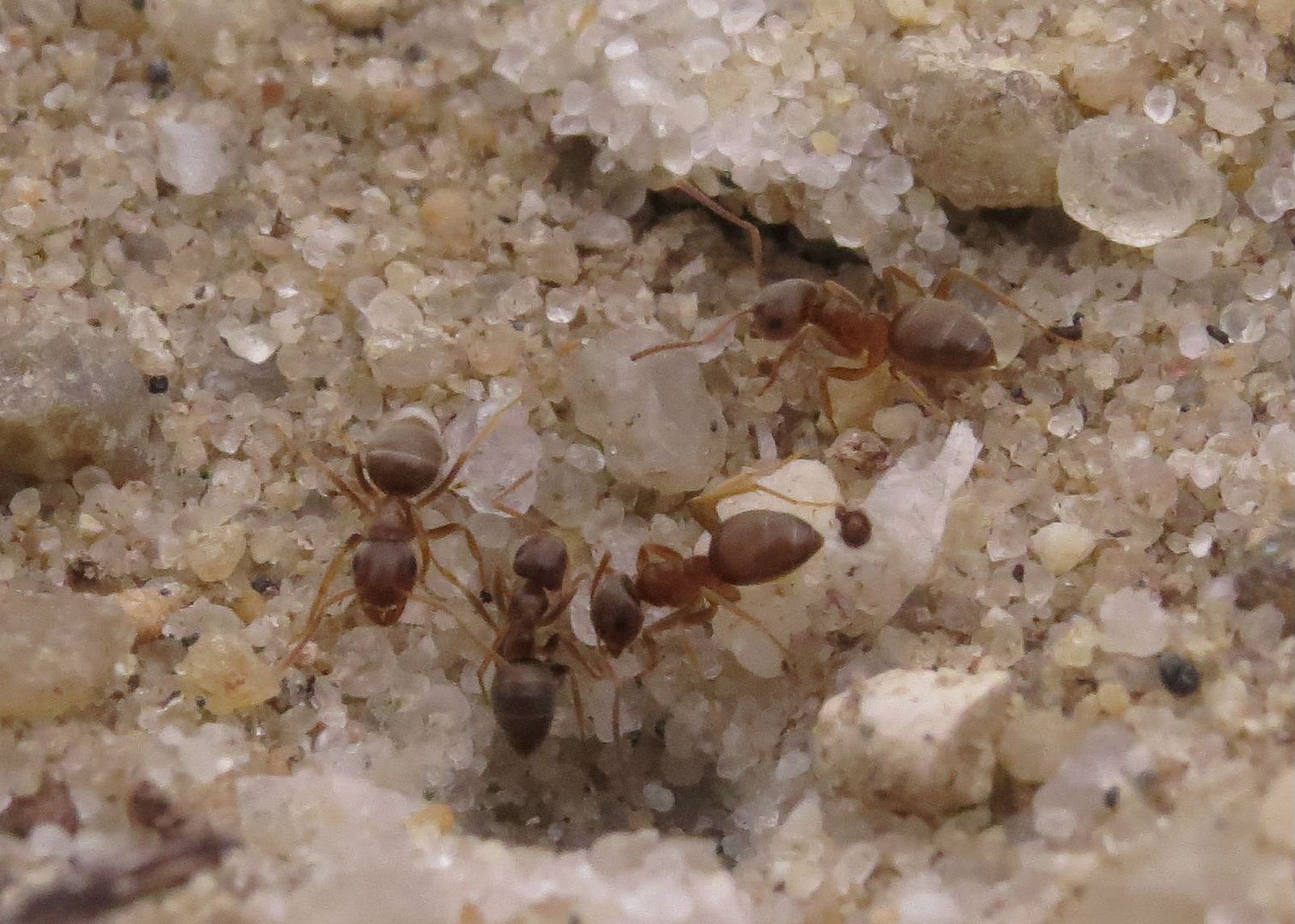
The day wasn't a total bust, as I found a few ants to photograph. This is the common Lasius neoniger, or Labor Day Ant, who's nuptial flights typically happen around Labor Day and in the afternoon no less, sometimes ruining BBQ's and the sport of golf across the US. They're otherwise a rather plane and common sort of ant that make small mounds wherever the soil tends to have some amount of sand to it and in full sun locations.

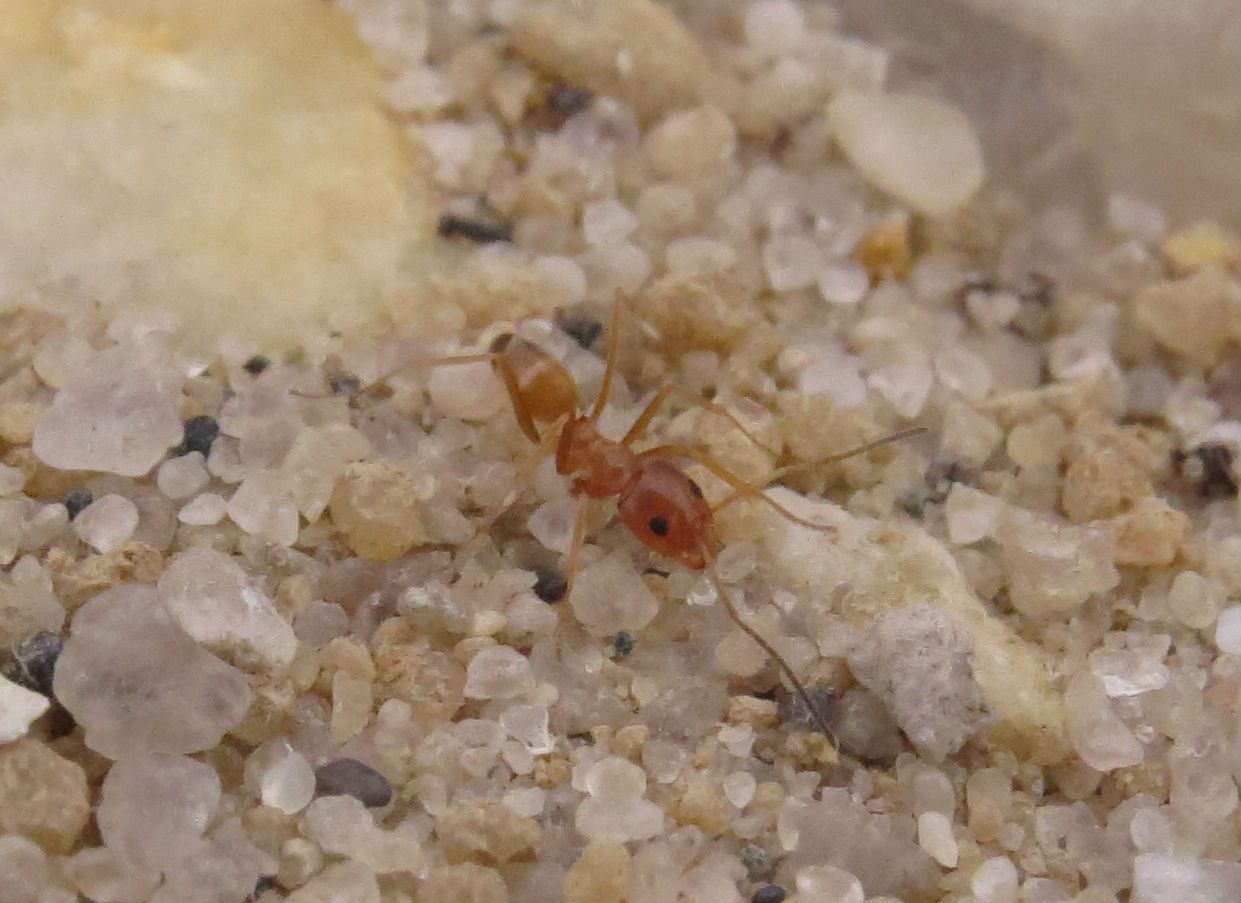
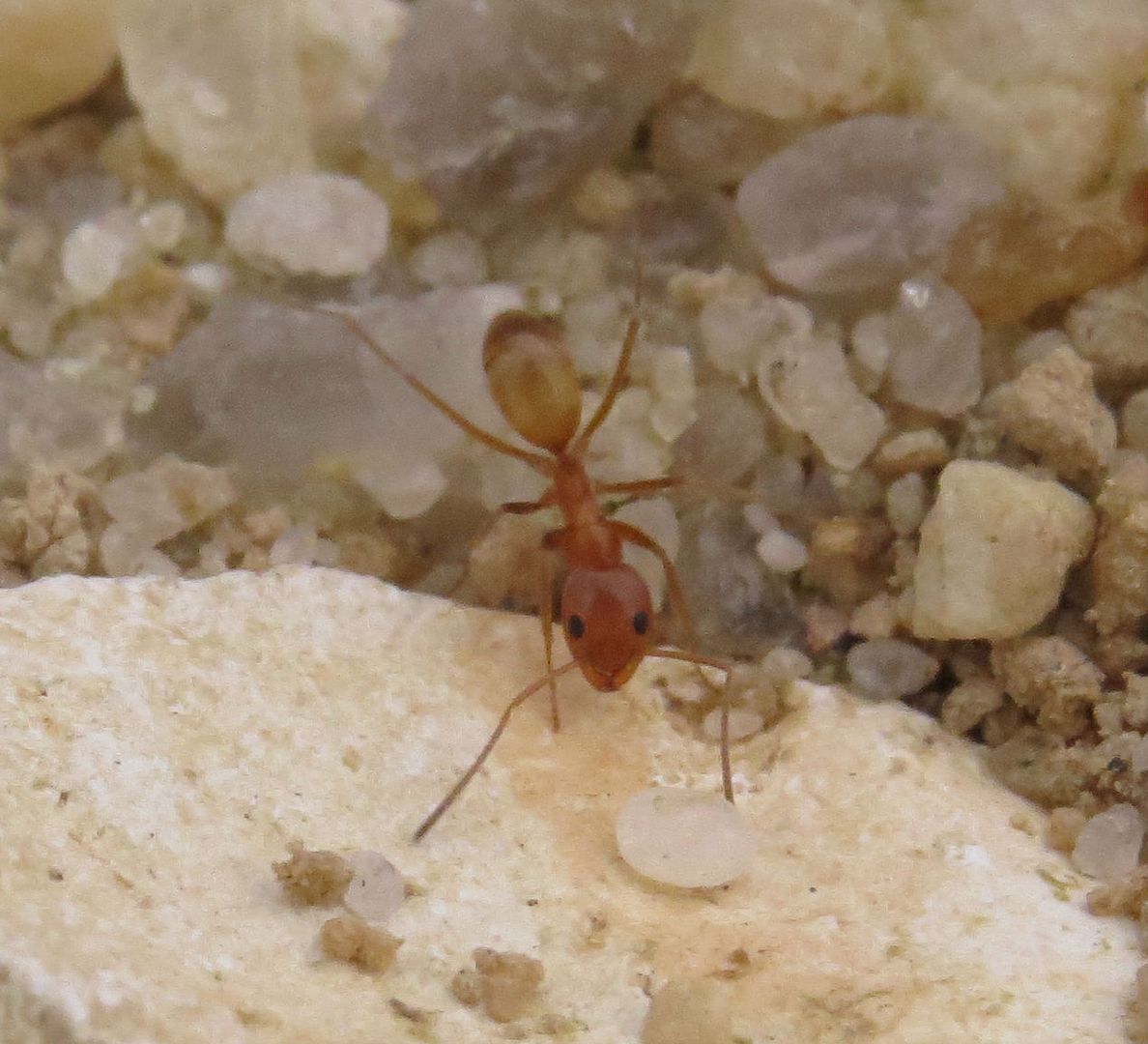
Also found, and slightly more interesting, was the population of Dorymyrmex bureni. This is a species at home to the state of Florida and South Carolina, but in recent years, it's worked its way up the coast and can now be found in New Jersey!

I believe it was first noticed by someone back in 2011 according to Bug Guide. Curiously the Citizen Science website School of Ants doesn't have a dot there yet, though I may have to fix that. Now that it's 2015 I can say the population there seems to be thriving as I found dozens of nests which outnumbered the indigenous Lasius neoniger. In past years though I've never known the beach line of Cape May to be abundant with ant colonies so this probably isn't an issue to worry about. Simply climate change allowing a species to push its range north.


Saturday, January 4, 2014

2013 Best of Ants

Well it has been a bustling year this one. I've just realized I took a tone of photos this year, perhaps even more than on previous years. Part of the reason was that I went to three major events where I took lots of photos, and partly because I bought a new camera with a cool new snap on lens.

My anting year started with an unusually early war between two Tetramorium colonies. We had a warm spring and wet year so the ant activity was good this year.

Here is a colony of Camponotus castaneus which seems to have moved on to a new location. I'm not sure where or why but one day they were there and the next they vanished. They didn't reappear at all later in the year either so that's a shame. I really like this species.

The flowers in my meadow garden were the best they've been yet, and many of the species I've chosen secrete extra floral nectar. Here a Camponotus subbarbatus worker is nectar scraping. Basically they just run their mandibles along the surface of the bud to squeeze out what has to be only a surface thick layer of carbohydrates.

You have to wonder if the nectar is worth the effort but apparently after a few hours of doing this they've collected enough to fill their social stomach. Eventually one of the major workers of the colony would check in on them and trophallaxis ensued. Major workers can hold more food so they're used mostly as storage ants.

One of my rare plants, Purple Milkweed, Asclepias purpurascens, finally flowered this year... only to have it's nectar robbed by Odorous House Ants, Tapinoma sessile. This ant is hands down the most notorious nectar thief because this particular milkweed is covered in hairs along the stem which are supposed to secrete a sticky goo to stop ants dead in their tracks. No one told this species that because they robbed out all the flowers.

Testing out my new camera I got an image of what I think is Lasius claviger. The hairs on the gaster are randomly spaced out and not in rows the way they are with Lasius interjectus

 On the NJ Ant Together this year we found a few colonies of Northern Fungus Growing Ants, Trachymyrmex septentrionalis.

They weren't very active so next year I'll try and hit the location sooner. There were a few out digging though.

This was a test for me to realize just how varied one species can be. This is Formica pallidefulva which I have in my yard, but didn't recognize it here. I'm so used to them being a coppery brass color that it never occurred to me that there could be populations with such an abrupt color difference. I'm told they get even darker the farther north you go.

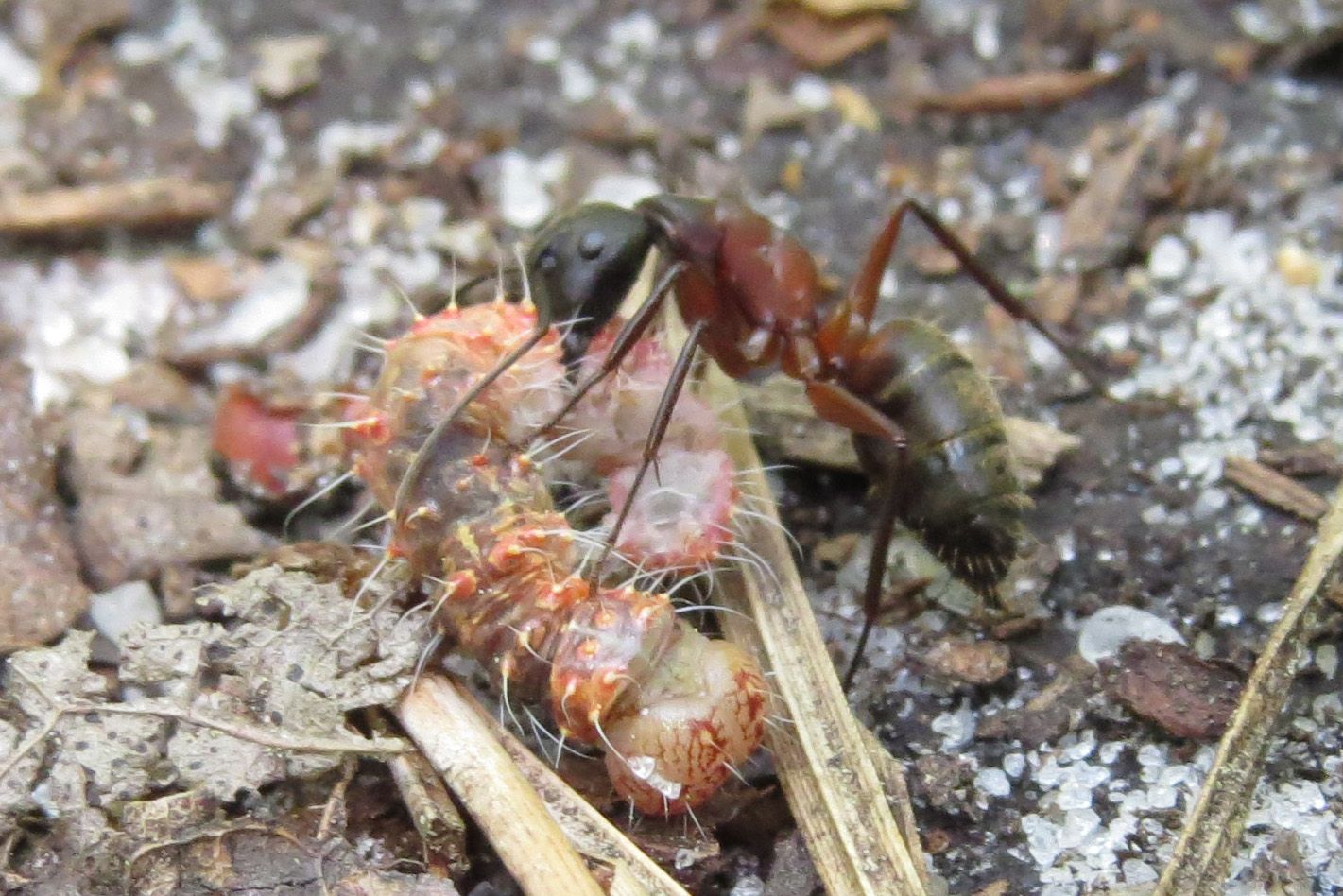
Their cousins live in considerably larger nests. Formic exsectoides for small super colonies in relatively well preserved woodland areas. I think the only thing preventing them from distributing farther is their appetite. In the short while we were there we watched them haul in caterpillars, cicadas, and wasps. 

Anywhere that you stepped on the ground, because our shoes disturbed the colony scent on the ground, the ants quickly swarmed the location. It didn't help that there were so many running along the ground that we couldn't help but step on them, thus releasing alarm pheromone.

Outside of their range there were a few foragers of Camponotus chromaiodes. Note the pubescence on the gaster as well as the dark shoulders (which is only consistent on the larger members of the colony). Formica forage during the day and the Camponotus take over at night.

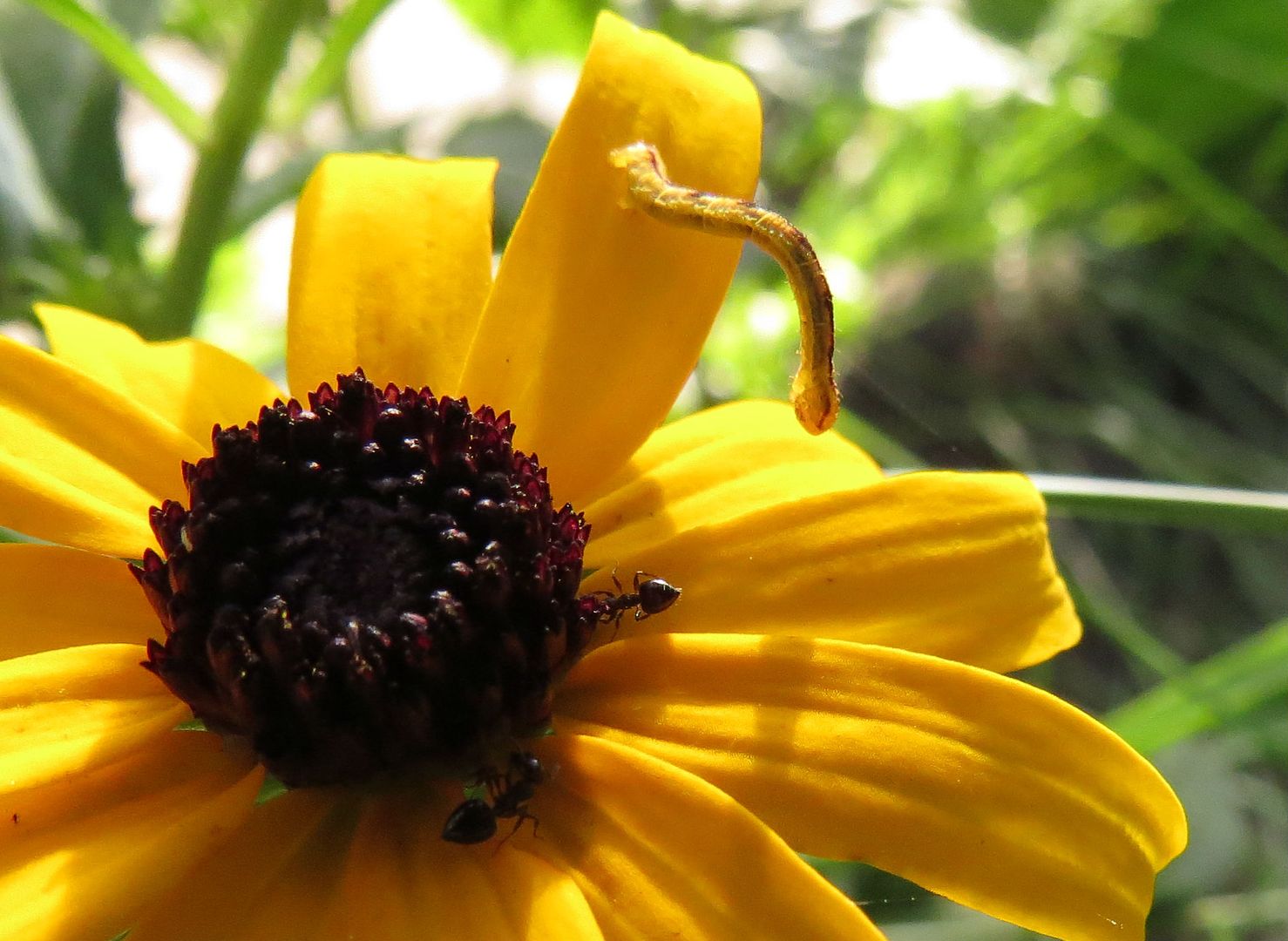
Crematogaster cerasi tending some sort of aphid which had a liking to this Rudbeckia flower. This was the first year I'd ever noticed aphids on Rudbeckia that weren't bright red and on the stems. These were actually green and some seemed to latch onto the seeds or various nodes where they were being developed. The caterpillar here is some sort of inchworm or possibly a looper. These normally feed on the flowers to these plants but was cautious about approaching this flower.

The last thing of anting for the year was observing another one of my rare plants Gentiana catesbaei. Other members of this genus keep the flower tightly closed and it's only through bumblebees forcing their way inside that they get pollinated. This species oddly keeps the flower open and invites everything on in. This also includes the ants. In this case it's the tiny Nylanderia faisonensis though they didn't seem all that interested in it really.

Saturday, October 19, 2013

Lasius claviger Flying Day and Night


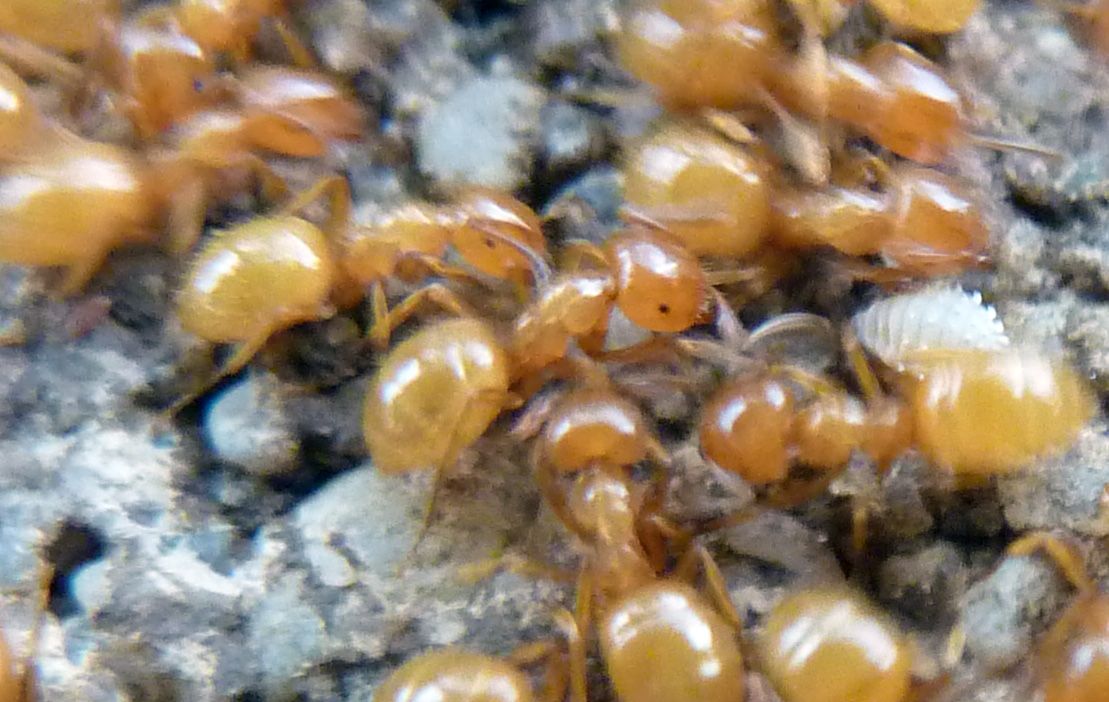
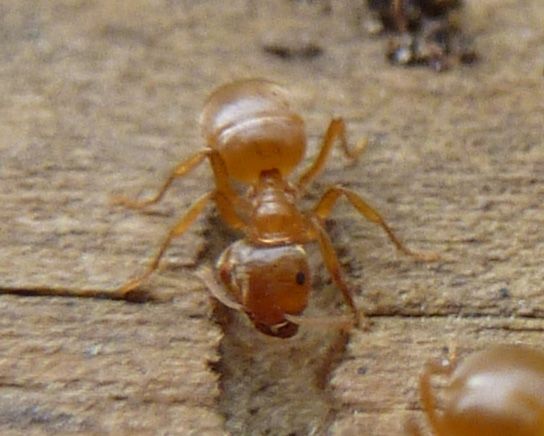
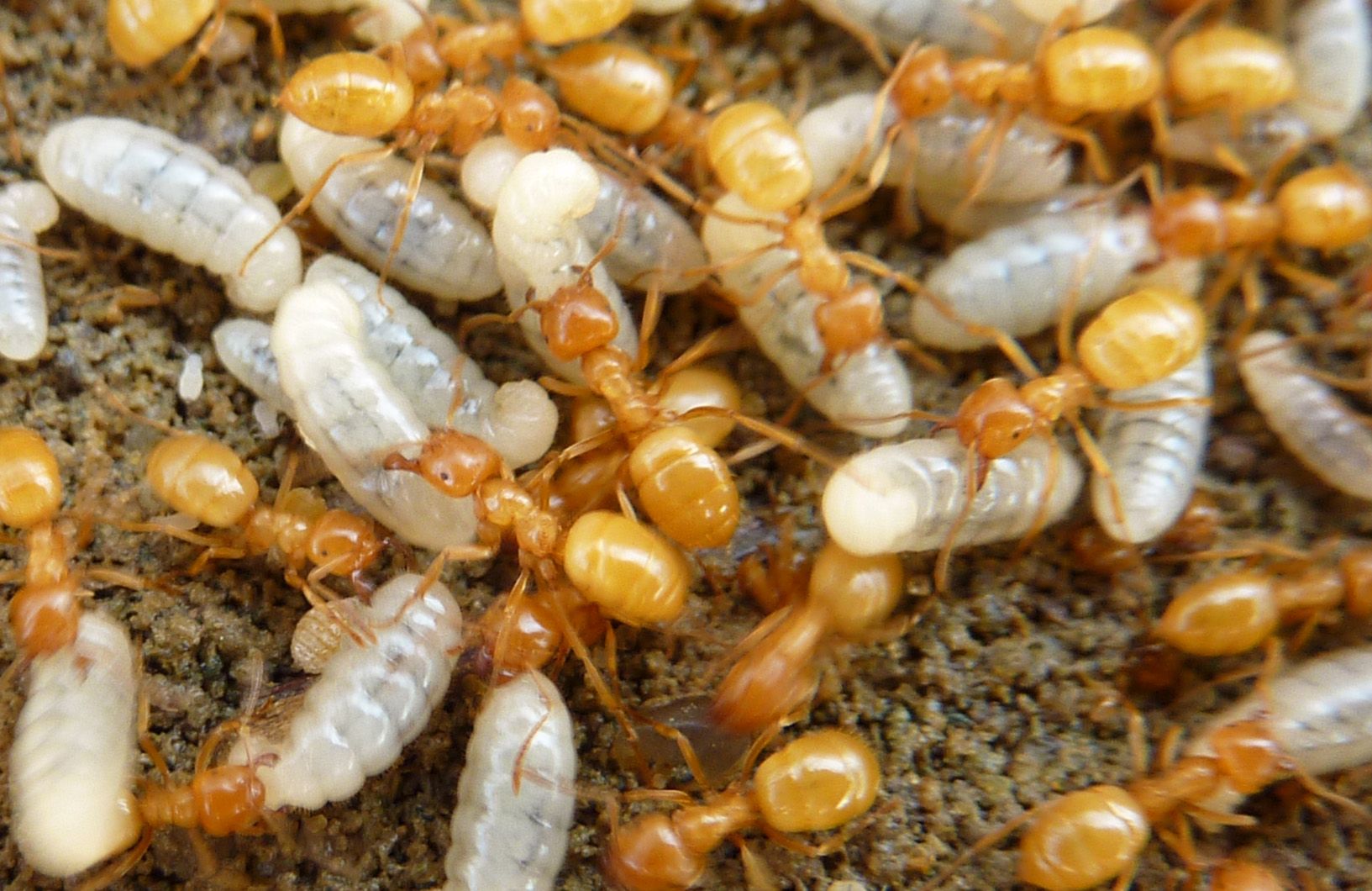
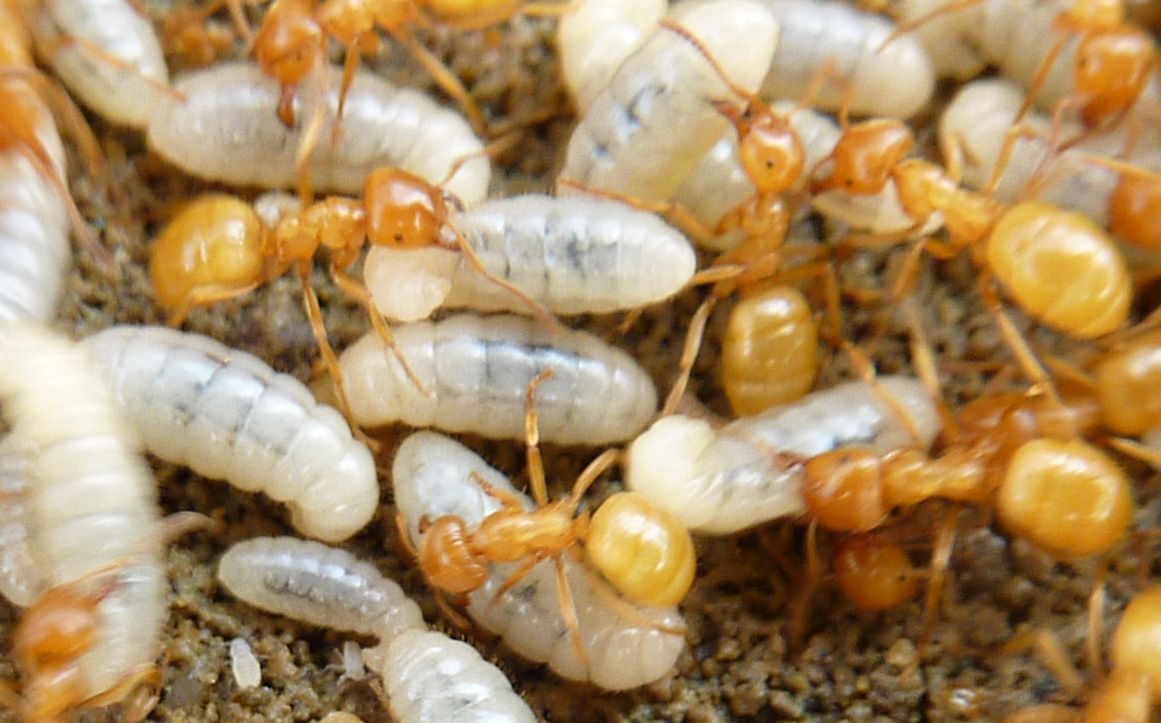
Lasius claviger is holding their nuptial flights this week. This is an ant few people tend to notice. Their workers are a pale orange color and colonies remain subterranean for almost the entire year. Workers farm root aphids and rarely venture to the surface.

This species is a social parasite, which means queens require a host colony in order to start a colony of their own. After mating they have to find a colony of Lasius neoniger, or Lasius alienus and replace its queens. The host workers then raise the L. claviger brood as their own and the colony becomes self sufficient from there. Because this has a low success rate, Lasius claviger has to send out 10 times as many queens and males each year as either of their hosts.


Nuptial flights take place in the afternoon, with swarms gathering at about 200' in the air. If you stand so that your head is just in the shade and look up at the sun, you can sometimes see the dazzling display of their wings darting about that high up. Once the sun goes down though, they get disoriented, and are drawn towards lights. In the video above I found millions of them gathered in the parking lot to a fast food restaurant. They were still trying to fly around the lights there, and even swarmed about inside the building.... of which I was apparently the only person who noticed. A friend of mine said just down the street there was another store that got swarmed much worse.


Friday, September 28, 2012

Lasius neoniger Nuptial Flight


My friend out in Indiana found a Lasius neoniger nuptial flight happening. They're called the Labor Day Ant because their mating season normally takes place around the same time. This video was taken two days ago so they're still finishing up. This is a common grassland ant found all over North America.


Queens in this genus will sometimes band together during the founding stage to better ensure a successful colony. Workers however, will only tolerate one queen in the nest so after 4 weeks or so they'll slowly start killing off the submissive ones. The advantage to a single queened colony is order. Workers will be better able to fatten up the reproductives produced from one queen as opposed to a multi queen nest which won't be able to feed their reproductives anywhere as well.

Thursday, September 27, 2012

Fall Flying Ants (Video)


Brachymyrmex depilis is among the easiest ants for someone to step right over in the garden. The genus contains some of the smallest ants in the world, though I don't know how this species stacks up to it. Alates are flying from the nests now and I particularly find them  right after its rained outside, though I've never located them exiting a colony. Their colonies are also pretty hard to spot. Something about their alates though is they are notorious for landing in pools of water and it's not an uncommon sight to find queens using expired males like a raft.

In contrast, Lasius claviger colonies are just as unseen over the year except for now. They're a social parasite of other Lasius species and produce 10 times as many alates as their hosts do to make sure successful colonies happen. In the afternoon hours colonies will erupt with tens of thousands of queens and males (usually favoring one gender heavily). Despite their numbers I've seen people walk right through thousands of them without even noticing. Sometimes I'll be in a field full of them, and people will walk up to me becuase I'm "doing something odd" and not even realize the ants even after they've started crawling up their legs, and landing on them.

Saturday, April 14, 2012

A Look at Two Lasius In My Yard

I was out in the garden today digging around to plant some 215 Liatris corms when I naturally started breaking into ant nests on accident. The two I'd like to focus on are species of Lasius that look very similar.

Lasius claviger is the slightly smaller of the two at about 3 or 4mm long. They're a brighter orange yellow color and their eyes are relatively small in comparison to their head.

Lasius umbratus is slightly larger at maybe 4 or 5mm long. They're not as bright looking but rather a richer shade of orange learning more toward brown than yellow. And their eyes are larger in comparison to their head. They're also slightly duller looking, and not as shiny as L. claviger.

Both species live almost entirely underground though I've noticed L. claviger sticks with soil nests wherever there are the roots to trees and large shrubs. While L. umbratus more often nest in mixed nests of rotting wood and soil, and I'd associate them more living along side termites. 

While all this is well and good, I've noticed there are perhaps 4 species in yard. What I'm calling L. umbratus is at least one species here, though maybe not L. umbratus itself, certainly something in the umbratus group. What I'm calling L. claviger however seems to have at least 3 forms. L. interjectus I'm sure is one and differs only in that the hairs along the gaster are more parted than the L. claviger. The third version is almost completely yellow, smaller looking, and more easily stirred into producing the citronella odor. I didn't encounter this one today but if I find them again I'll try and get pictures, key it out, and report back. They seem to be completely devoted to wet muddy clay soil though as I've never seen them when it's dry out.

Thursday, November 3, 2011

Worst Lasius claviger Flight Ever

Well I was holding onto these in favor of a more noticeable flight but it seems the heat of summer hindered the alate development some and now we have the snow. What is typically several dozen colonies in my yard sending out alates was only one this year, and it wasn't impressive at all.

Lasius claviger holds their nuptial flights at this time of year. Normally they have huge flights in the afternoon which are very noticeable. Their wings catch the afternoon sun in such a way that it becomes very apparent that they're flying around. Occasionally, when standing just in the shade if you were to look into the sun the effect of glowing wings can sometimes be viewed high above in the air.

As I said though weather conditions seem to be forcing these ants into either holding off on their flights or canceling them all together. It wouldn't surprise me to learn there was a rise of flights happening indoors as they sometimes do over the winter.

Friday, July 1, 2011

Identification and Distribution of Lasius

Here is a home made key to Lasius based on information found in the links above. Bare in mind this is my interpretation of the info and I've never seen half of these in person. I decided to focus on this genus because it seemed like everyone was finding either L. neoniger, alienus, flavus, claviger, or umbratus. As the first post of this topic shows though there are lots of species out there.

Identifying Lasius is surprisingly difficult. Species are broken up into four groups. Niger tend to be dark black brown workers and sometimes amber-orange in color. Flavus, Umbratus, and Claviger all have orange workers, and are almost completely subterranean. Within each group there seems to be a lot of hybridization but this doesn't seen to spread beyond the group they're in.

To determine which group the species is found two traits are vital. The first is the size of the eye compared to the size of the head! The second is the length of the maxillary palp which is located under the head and looks like an antenna. Both need to be viewed with a side view of the head.

Best by comparing workers I think.
Niger group all have large eyes compared to the head. They also have the longest maxillary palp.
Claviger group have small eyes compared to the head. They also have the shortest maxillary palp. It's said to be 3 segments long which is another way of saying it can not be seen with the naked eye! 
Flavus group have small eyes compared to the head (on par with Claviger). They have a short maxillary palp but unlike Claviger it's viable though tiny.
Umbratus group have large eyes similar to Niger group. The maxillary palp is said to be somewhere between Niger and Flavus in length.

Hopefully you're still with me. As said before species hybridization tends to be common. What's more some species have subspecies or varieties where Lasius you thought you knew has something crazy going on like no hair what so ever. You may be wondering if species can simply breed with one anther interchangeably what in the world keeps them pure? I don't have the answers for all of them species listed but can offer an example. Lasius neoniger is a common species that nests in fields, prairie, and open grassland areas. Step into the woods though and you start finding Lasius alienus which prefers to nest in logs, tree stumps, or mixed nests under dead wood. Hybrids occur in both forest and field but for the most part they hold their nuptial flights above areas where they would normally nest, thus swarms are mostly separate.


Before moving on knowing what a Seta Count is is important.

Seta Count - The number of Standing Hairs beyond the outline of the following: Anterior Scape Surface as viewed in line with the plane of funicular flexion, and the Outer Surface of the Fore Tibia as viewed in line with the plane of tibial flexion.

Standing Hairs - A hair with subdecumbent, suberect, or erect, i.e. forming an angle with cuticular surface of 45degrees or more.


Lasius Niger Group
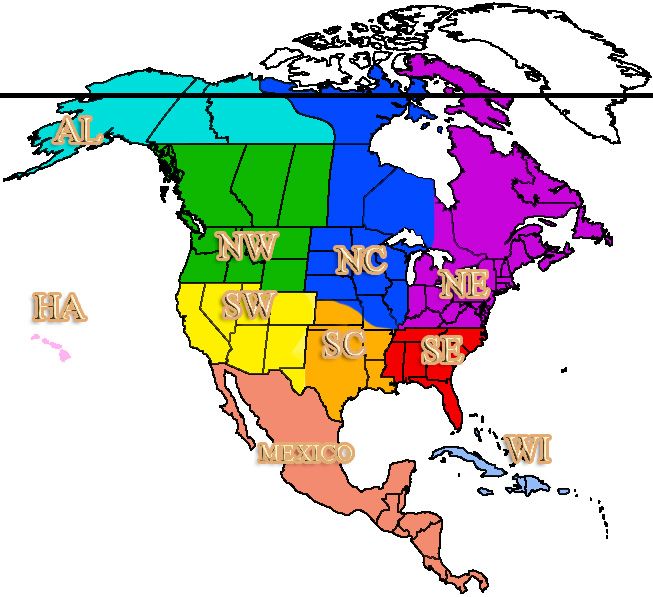
Lasius neoniger (2) SW, SC, SE, NW, NC, NE
This is the most common niger species found in the US. Found in fields nesting in open soil or under stones. Can hybridize with Lasius alienus. Workers tend to be brown in color with dark legs that are evenly colored. Scape and Tibiae are furry. Queens tend to have a velvet like sheen to the abdomen when viewed at certain angles, but this is consistent with other Lasius.

Lasius alienus (2) SW, SC, SE, NW, NC, NE
The most common niger species found in wooded areas. Found in woodland, nesting in soil, rotten logs, and stumps. Can hybridize with Lasius neoniger. Workers tend to be black with lighter legs, usually yellow in color. Seta Count is less than 40, usually less than 20 standing hairs. Queens seta count is never more than 10 and is usually 0.

Lasius niger (2) SW, NW, and Eastern Canada
It's unknown how the SW, and NW populations arrived, or did they originated there and spread to Europe and Asia where they're more common? Who knows. The Eastern Canada population only recently arrived from Europe within the last 50 years. (I know this by memory and am still looking for the source.)
Lasius alienus, and L. neoniger are subspecies of Lasius niger. Found in both forests and fields, they nest understones and in open soil. Workers tend to be black like L. alienus. Scape and Tibiae are furry like L. neoniger. Legs tend to be dark but yellow at joints, however I don't know how consistent this is. Queens are described as being similar to L. alineus but are covered in hair like L. neoniger. (One wonders if the SW, and NW population isn't just a hybrid between L. neoniger and L. alienus in need of it's own species name.)

Lasius crypticus (2) SW, NW, NC
Found in fields mostly but sometimes woodland. Nest under stones. Similar to L. pallitarsis but lacks the offset basal teeth which points toward the mouth, rather than toward the other mandible. Similar to Lasius neoniger but typically darker in color and not as hairy on the scape and tibiae. 

Lasius pallitarsis (2) SW, NW, NC, Alaska, Most of Canada.
Found in forests and fields, nesting under stones. Amber Brown in color out west but to similar to L. umbratus in the east to rely on color alone. Has an offset basal teeth which points toward the mouth, rather than toward the other mandible. A microscope is best for observe this. Scape tends to be free of hair. Legs tend to be lighter in color. Supposedly this species produces an odor but that hasn't been confirmed. What's really odd is the source mentioned the odor and also talked about umbratus species using them as a host. Niger group species aren't known to produce an odor and one would think for such a widely distributed species this would be an easy confirm or deny. They were being called by their former name though Lasius sitkaensis. (Assuming there is a population of them in Canada that produces the citronella odor unlike in the rest of it's range perhaps L. sitkanensis, or another name, should be reinstated for that group?)

Lasius sitiens SW
Found in forests and fields, usually at high elevations between 7000-8000 feet, give or take. Juniper shrubs and dry open places also describes their environment. Nest under stones. These are a subterranean forager (which is odd for the niger group but that's where they are) Eye's can be smaller and L. flavus like (also very odd for the niger group), but the maxillary palp doesn't lie. Scape and Tibiae and for that matter The Entire Body mostly lacking hair. 

Lasius xerophilus SW (New Mexico) Only found in New Mexico
Found nesting in sandy soil with small mounds. Similar to L. neoniger but they have more erect hair on the Tibiae.

Lasius emarginatus (2) NE (New York?)
A bicolored species native to the Mediterranean and middle European countries. The head and gaster are darker shades of brown while the mesosoma tends to be lighter more red toned or blood orange. They are similar to L. neoniger but L. neoniger isn't as darkly colored nor as strongly bicolored.


Lasius Flavus Group
Queens are niger group-like but are a tiny bit smaller and lighter in color.

Lasius fallax SW, NW, NC
This species isn't as common as L. flavus or L. nearcticus. Found in forest clearings where they nest under stones. Scape and Tibia have hair.

Lasius flavus (2) SW, SC, SE, NW, NC, NE
Found in forests and fields (though I want to say finding them nesting in fields is more typical of Europe where they make mounds too.) nest in soil under stones or fallen logs. Open sparsely covered ground is ideal. Scape and Tibia are reasonably free of erect hair. See paragraph below.

Lasius nearcticus (2) SW, SC, SE, NW, NC, NE
Found in dense woodlands. Nest in moist soil under stones or fallen logs. Thick leaf litter is a must. This is a subspecies of Lasius flavus. Scape and Tibia are reasonably free of erect hair.  

Lasius flavus and L. nearcticus are hard to tell apart in the western US. They hybridize with greater frequency out there. This doesn't happen as much in the eastern US. Head to head L. nearcticus tends to have a smaller eye compared to L. flavus who have similar sized heads. Lasius flavus's head also tends to narrow some at the mandibles while L. nearcticus doesn't do this as much. Supposidly L. flavus workers are polymorphic and L. nearcticus are monomorphic but I find this do not be true. Perhaps it's more accurate to say L. flavus is MORE polymorphic than L. nearcticus tends to be. This theme of Lasius nearcticus having longer traits (sometimes only by fractions of a millimeter) is consistent, but still makes the two species hard to tell apart. 


Lasius Umbratus Group
Queens have a smaller abdomen than Niger and Flavus group. These are social parasites of the Niger group. Some are more select than others.

Lasius umbratus (2) SW, SC, SE, NW, NC, NE
This is the most common and wide spread species in this group. Found in both forests and fields, nests under stones in rotting logs and in rotting stumps. Scape and Tibia are not very hairy. This ant is kind of the default model for four subspecies: minutus, speculiventris, subumbratus, and vestitus. They use Lasius alienus, neoniger, and niger as host species.

Lasius minutus NC, NE
Subspecies of Lasius umbratus. Found in sphagnum bogs, dry forests, or swampy fields. Nests in soil often with mounds or masonry domes. Lots of erect hairs all over the body except for the Tibiae which is mostly free of hair.
Queens supposidly share mimetic coloration with host species Lasius alienus. (Wheeler, W.M. 1917 : 167-176)

Lasius speculiventris (2) SC, SE, NC, NE (New Jersey)
Subspecies of Lasius umbratus. Found in forests and field. Nest under stones and in rotten wood. Abdomen is mostly free of hair. Scape and Legs have lots of erect hairs!
Queens might use Lasius minutus as a host along with other Lasius. This is interesting because L. minutus is itself a social parasite. (Kannowski, 1959b : 138-141 153-154)

Lasius subumbratus (2) SW, NW
Subspecies of Lasius umbratus. Found in forests and fields. Nests under stones and rotting logs. Replaces Lasius umbratus where found? Supposedly Scape and Legs have dense pubescence (thin layer of fuzz) and occasionally standing hairs. Ant Web specimens don't seem to have this though, at least not on the legs. The hairs must be very short if they do.

Lasius vestitus SW, NW
Subspecies of Lasius umbratus. Found in forests. Nests in rotting logs and stumps. Replaces L. umbratus where found. Scape and Tibia have lots of hairs. Abdomen is especially covered with lots of erect hairs!

Lasius nevadensis SW (Nevada) Only found in Nevada.
Found in open forests. Nests either under stones or in exposed soil. Scape and Tibiae have longer hair than L. umbratus. Not as shiny as L. vestitus. Has more hair than L. vestitus but less than L. subumbratus.

Lasius atopus SW (California) Only found in California.
Only found in California, nest in soil under stones. The Scape is very long for a Lasius extending well above the head. This is unique enough that that's all you need to know to ID this species.

Lasius humilis SW
Found in open woodland and moist fields. Nest under stones. Is found in what has been described as a mountain meadow. Workers are small and pale colored. 


Lasius Claviger Group
Queens are very similar to Umbratus group species but most produce a citronella odor.

Because Claviger used to be it's own genus (Acanthomyops) the language of identifying them is a little different. The Dorsum side of the Propodeum (top of the last thorax segment), and the Gula (underside of the head, behind the palp) are the main ones. A side view of the ant is best. Some Claviger species have Barbulated or Plumose hair. Barbulated hair means the hair has lots of barbs poking all along the hair. See the top of this ant's head. Plumose hair is similar to barbulated hair but the majority of the barbs at at the tips or top third of the hair, and the effect is greater. see here.

By far the most common two species found are Lasius claviger and Lasius interjectus.

Lasius claviger (2) SW, SC, SE, NC, NE
Found in forests and fields. Nest in soil, and rotting wood. Different from L. interjectus by having hair uniformly along the dorsum of the abdomen. Different from L. latipes by having less hair under it's Gula. Hybridization with Lasius latipes has been noted (Umphrey & Danzmann, 1998 : 431-440)

Lasius subglaber SW, SC, SE, NC, NE
Subspecies of Lasius claviger. Found in forests and fields. Nest in soil, in or under rotting logs and stumps. Mostly short or very little body hair. Gula is usually free of hair.

Lasius interjectus (2) SW, SC, SE, NW, NC, NE
Found in forests and fields. Nest in soil, under stones, rotting logs, and in stumps. Next to walls of buildings is also noted. Propodeum is very convexed. Differs from L. claviger in that hairs on abdomen fall in rows fallowing the tergites (plates that make up the abdomen). Gula has hair.

Lasius arizonicus (2) SW
Subspecies of Lasius interjectus. Found at high altitudes between 5000-8500 feet above sealevel. Nest understones. Easily recognized by almost completely lacking pubescence (thin layer of fuzz) and having a very shiny body. Hairs are very sparse on legs. Propodeum is very convex.

Lasius californicus SW
Subspecies of Lasius interjectus. Found under stones in mountains at mid levels. I couldn't find exact heights. Body hair is somewhat barbulated and is said to be related to L. colei. This is odd because L. colei isn't considered a subspecies of L. interjectus and yet both have the barbulated hair. Gula and Clypeus has 10 or so standing hairs each. Dorsum of gaster with fair amount of standing hairs.

Lasius coloradensis SW, NW, NC (No pictures found, sorry)
Subspecies of Lasius interjectus. Despite being a subspecies of L. interjectus, I read it's easier to confuse this with Lasius claviger. Workers have more body hair but it's shorter in length. L. claviger and L. coloradensis have divided distribution and are rarely found in the same locations.

Lasius mexicanus Mexico
Subspecies of Lasius interjectus. Found in woodlands at high elevations 7900-9000 feet above sea level. Nest under stones. Pubescence on abdomen is dilute to moderate. Hairs are long! Body is shiny. Propodeum is usually convex.

Lasius bureni NC (Wisconsin) Only Found in Wisconsin.
Long standing hairs on Gula. Shorter hairs on dorsum of abdomen. Said to be brown or "yellow-brown" in color. (If that's possible. They might be referring to the uneven color pattern on the head as seen in antweb's pictures.)

Lasius colei SW Only found in the New Mexico and Arizona area. Very uncommon.
Related to Lasius californicus. Body hair is barbulated. Gula and Clypeus have only 4 to 8 standing hairs each. Less hair on the abdomen than L. californicus.

Lasius creightoni SW (Utah) Only found in Utah.
Pubescence somewhat dense and whitish silver in appearance.

*
Lasius latipes (2) SW, SC, SE, NW, NC, NE
Found in open forests, and fields. Nest in soil, under stones, or at the base of stumps. Hair all over the body is long, numerous and evenly distributed. Queens are easily identified by their unusually thick legs and modest amount of hair all over their body. Hybridization between L. latipes and L. murphyi is one of the rare cases where a hybrid has been given a species name, L. pogonogynus. (Trager, "Advances in Myrmecology:" 405-417) Hybrids between claviger and with colordensis also occur but not enough to be given formal names.

Lasius murphyi (2) SW, SE, NW, NC, NE
Found in open forests, and forest edges. nest in sandy soil under or next to stones. Hair all over body is short. Standing Hairs mostly on propodeum. Queens are orange in color and have yellow fuzz on their face. After mating queens will boldly dive into colonies of Lasius neoniger, (maybe others) in an attempt to kill the resident queen. See Here, (2)

Lasius pogonogynus SW, SC, NW, NC, NE
Hybrid species between L. murphyi and L. latipes. Workers are exactly like L. latipes. Latipes has longer hair but that's not saying much. Queens have thick legs of L. latipes but lack the hair on the abdomen. Body hair is otherwise distributed similar to L. murphyi but much longer.
*

Lasius occidentalis SW, SC, NW, NC
Rarely found. Nest in dry soil under stones. Hairs on face has whisker-like effect occurring under the eyes and along the side of the head. Other Lasius have hair here too but the white color seems unique enough to this species.

Lasius plumopilosus SE, NC, NE
Nest under stones and in rotting logs. Lots of standing plumose tipped body hair.  

Lasius pubescens NC (Minnesota) Only found in Minnesota
Found in open forests. Nest in soil. Hair on Gula. Pubescence all over body.

The End

Sources

Cole, A. C., Jr. 1956a. Studies of Nevada ants. II. A new species of Lasius (Chthonolasius) (Hymenoptera: Formicidae). J. Tenn. Acad. Sci. 31: 26-27

Cole, A. C., Jr. 1958a. A remarkable new species of Lasius (Chthonolasius) from California (Hymenoptera: Formicidae). J. Tenn. Acad. Sci. 38: 75-77

Cover, S.P.; Sanwald, R. (1988) Colony Founding in Acanthomyops murphyi, a Temporary Social Parasite of Lasius neoniger. Advances in Myrmecology by James Trager, 405-417

Wheeler,W.M. The Temporary Social Parasitism of Lasius subumbratus Vierect. Psyche, 24, 166-176

MacKay, W. P.; MacKay, E. E. 1994. Lasius xerophilus (Hymenoptera: Formicidae), a new ant species from White Sands National Monument, New Mexico. Psyche (Camb.) 101: 37-43

Wilson, E.O. (955) A Monographic Revision of the Ant Genus Lasius. Bulletin of the Museum of Comparative Zoology, 113, 1-201

Wing M. W. (1968) Taxonomic Revision of the Nearctic Genus Acanthomyops (Hymenoptera:Formicidae). Memoirs of the Cornell University Agricultural Experiment Station, 405, 1-173.
Sunday, May 15, 2011

Some Aphid Guardians

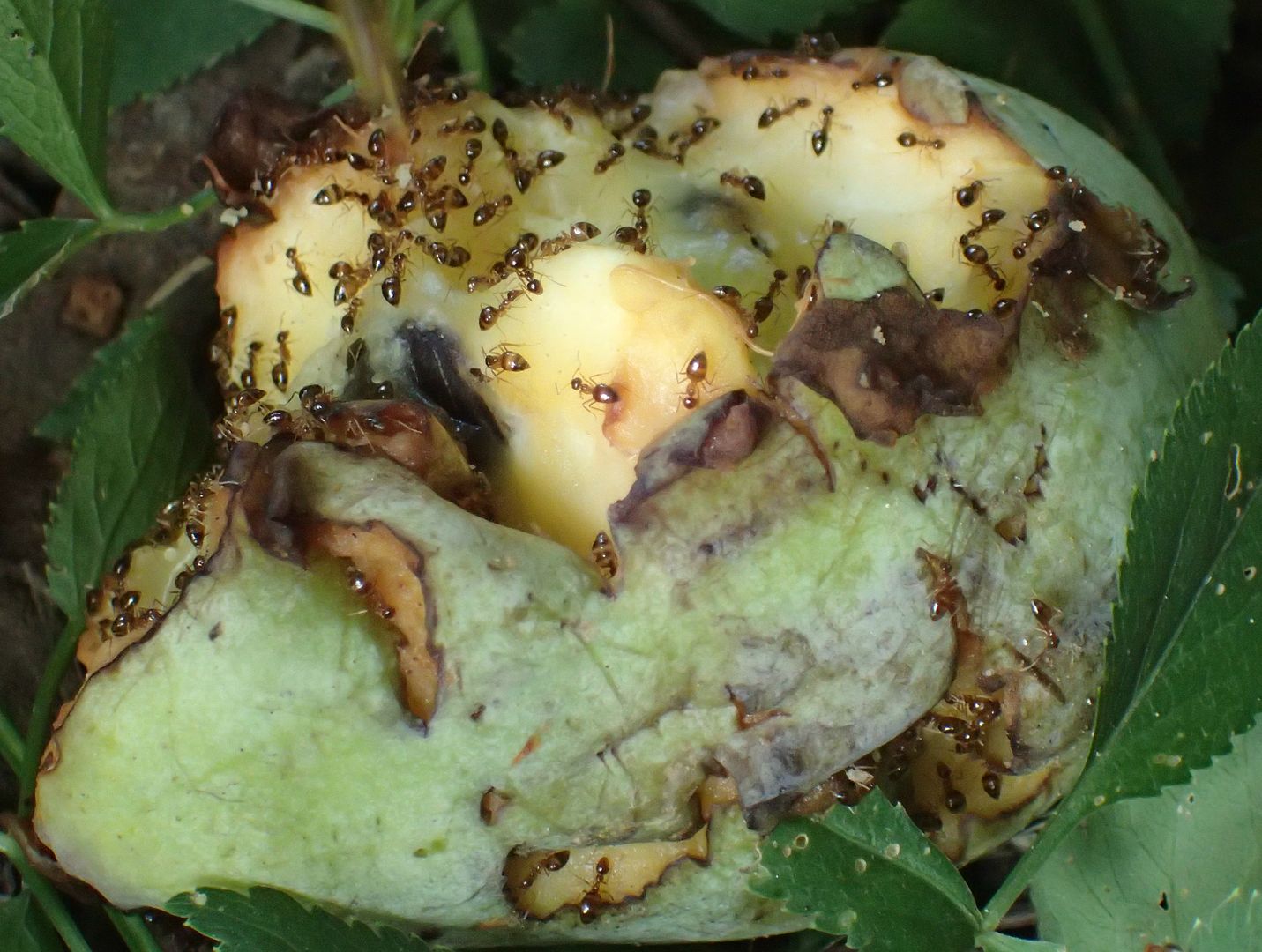
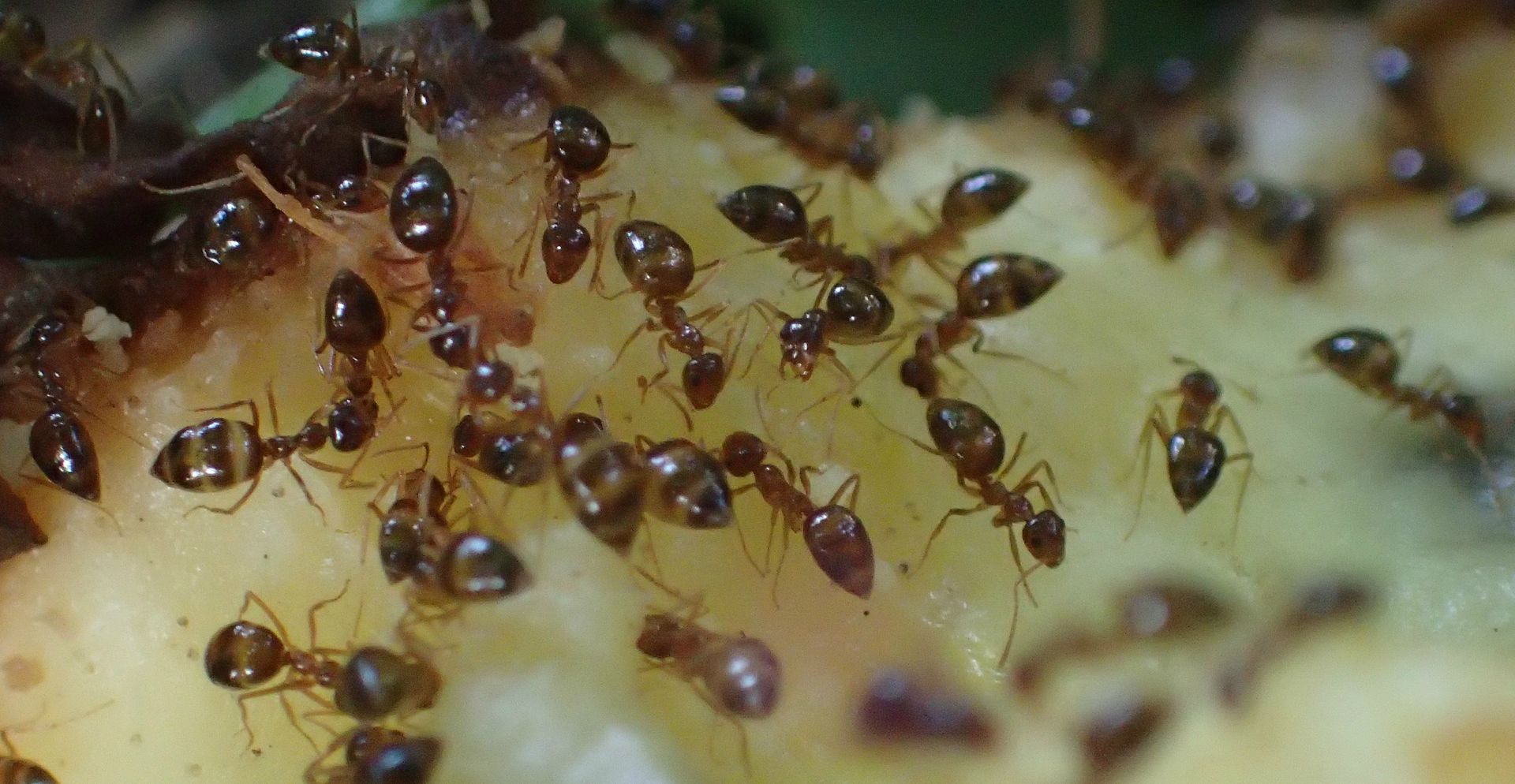
Formica subsericea (I think) either knowing the answer to a question I asked it, or clearly marking it's territory. By which I mean glaring at the camera and chasing me farther away from the precious aphid herds.
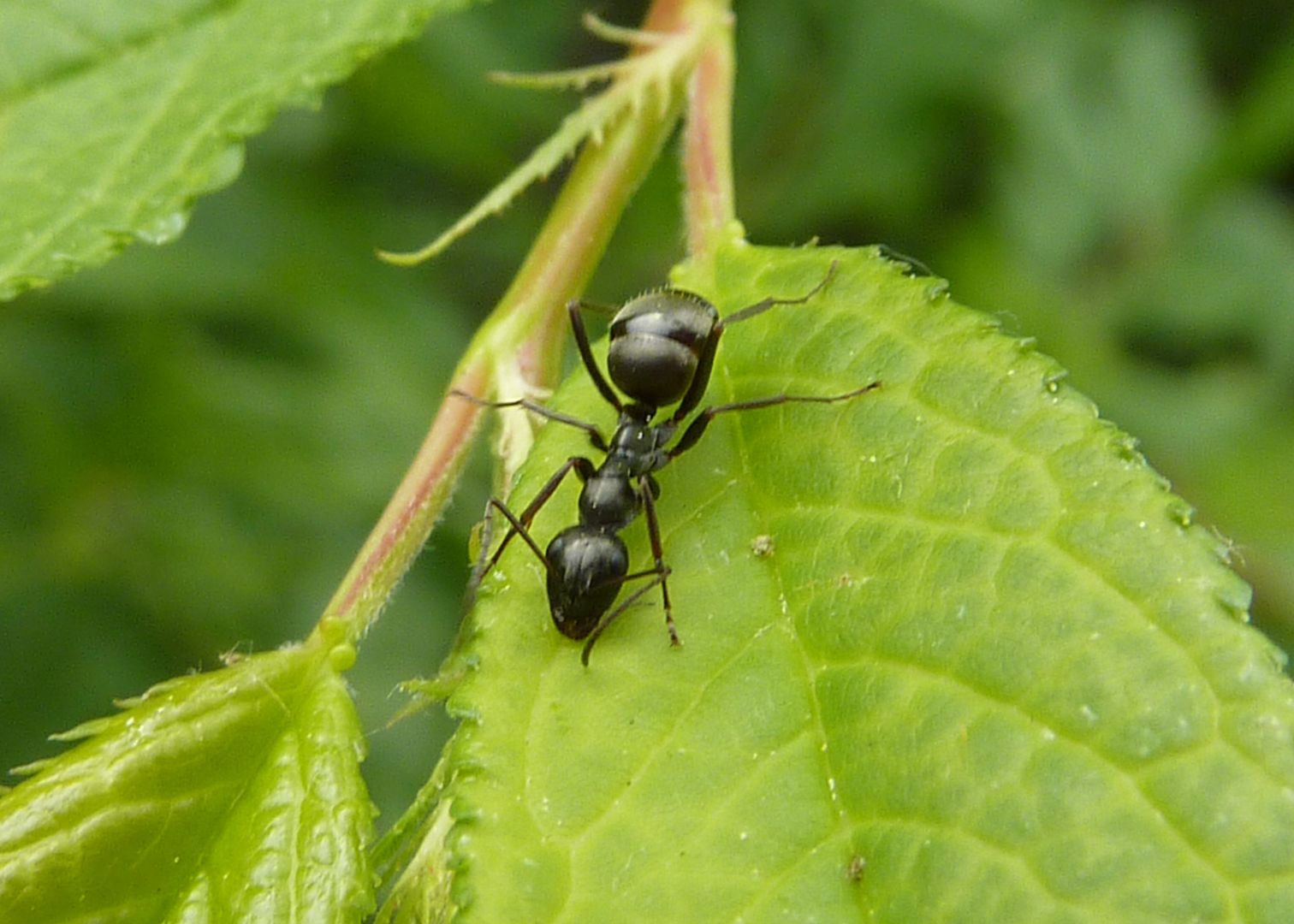
Aphids and other dew producing insects are finally becoming abundant enough to catch the attention of ants far and wide. Though some species prefer to collect the nectar second hand as tiny droplets drip down onto lower leaves. 

This ant attention benefits the plant because the ants drive away insect herbivores. Some plants do this naturally by producing extra floral nectar, which also discourages the ants from stealing it from the flowers.

The downside for the plant is they can't control the number of aphids. This can be a real problem for the plant but typically it only inhibits the production of new growth and doesn't cause as much damage as a veracious horde of caterpillars. Some caterpillars can completely defoliate a host tree twice over in a year. So having some ants crawling all over to discourage or even remove the problem of caterpillars greatly benefits the plant.


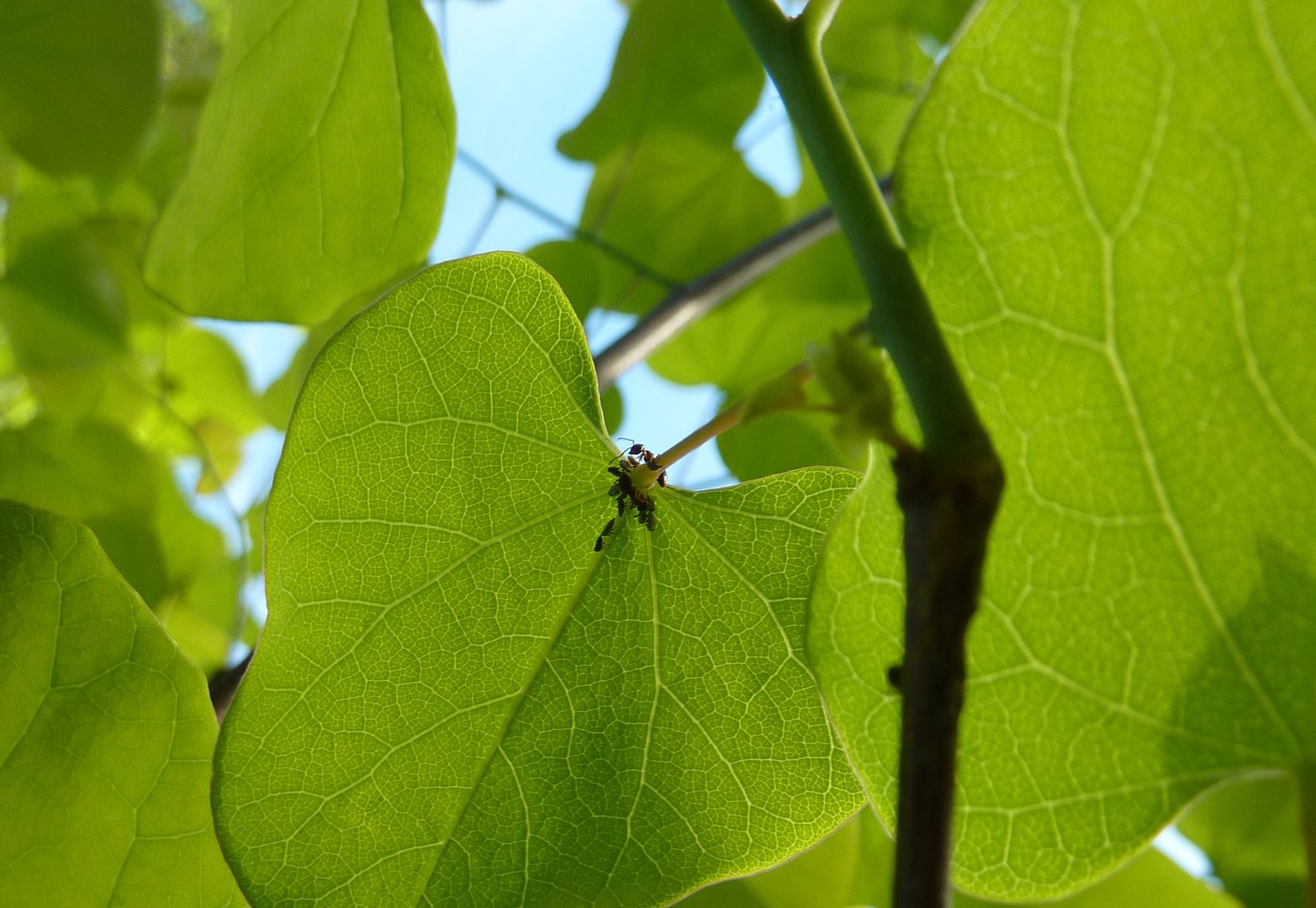
A Lasius alienus tending some aphids on an Eastern Redbud.

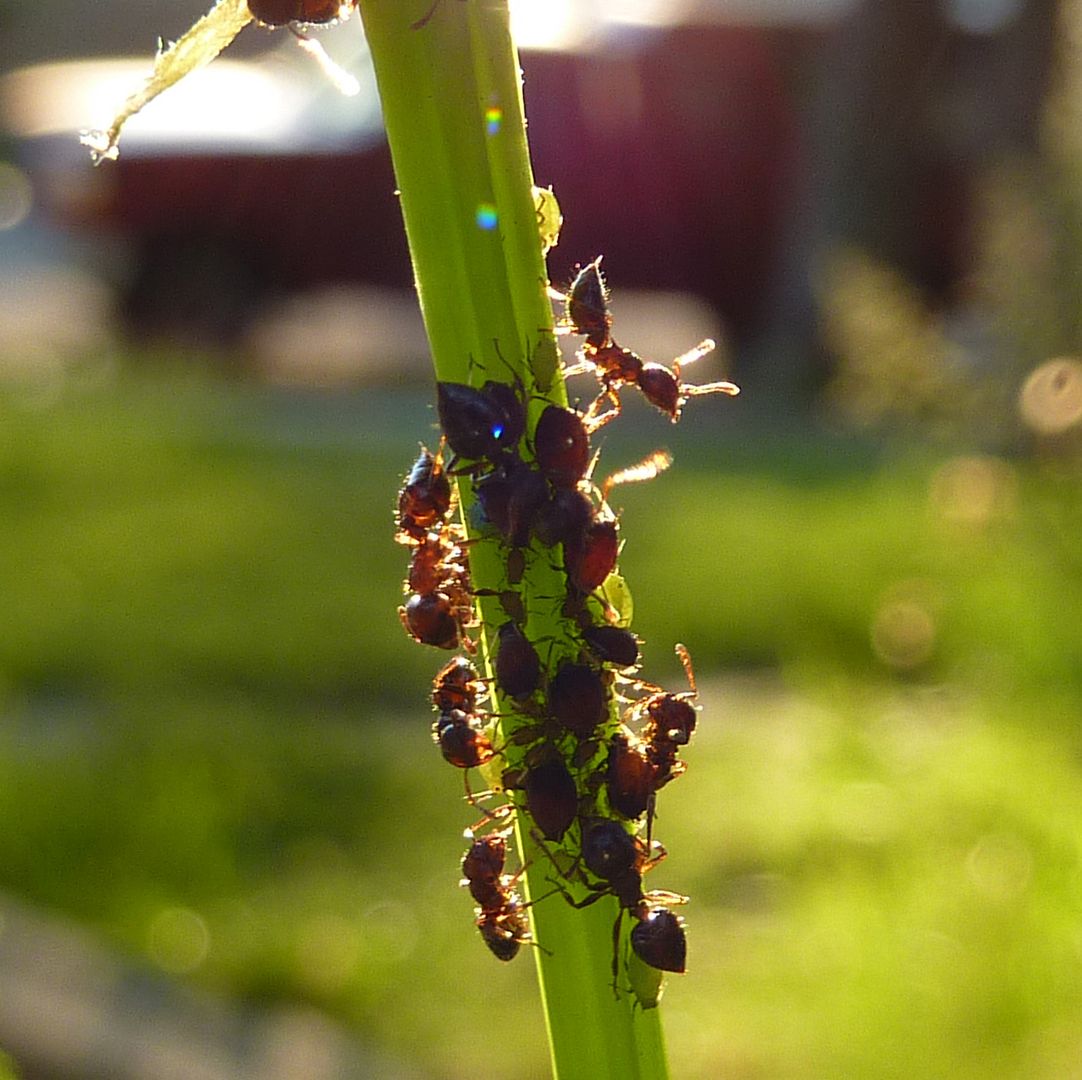
Crematogaster cerasi blanketing over aphids on the stem to a Viburnum.

Crematogaster cerasi blanketing over aphids on the stem to a Viburnum.
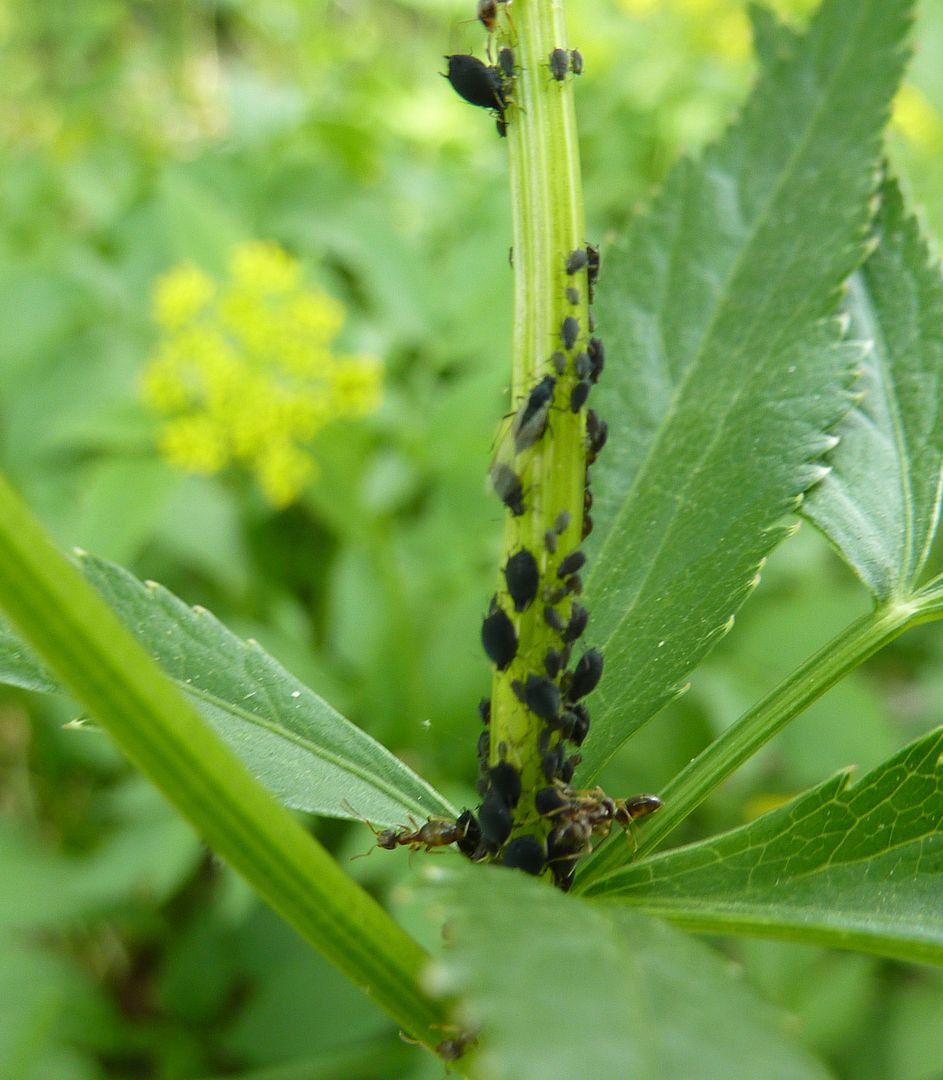
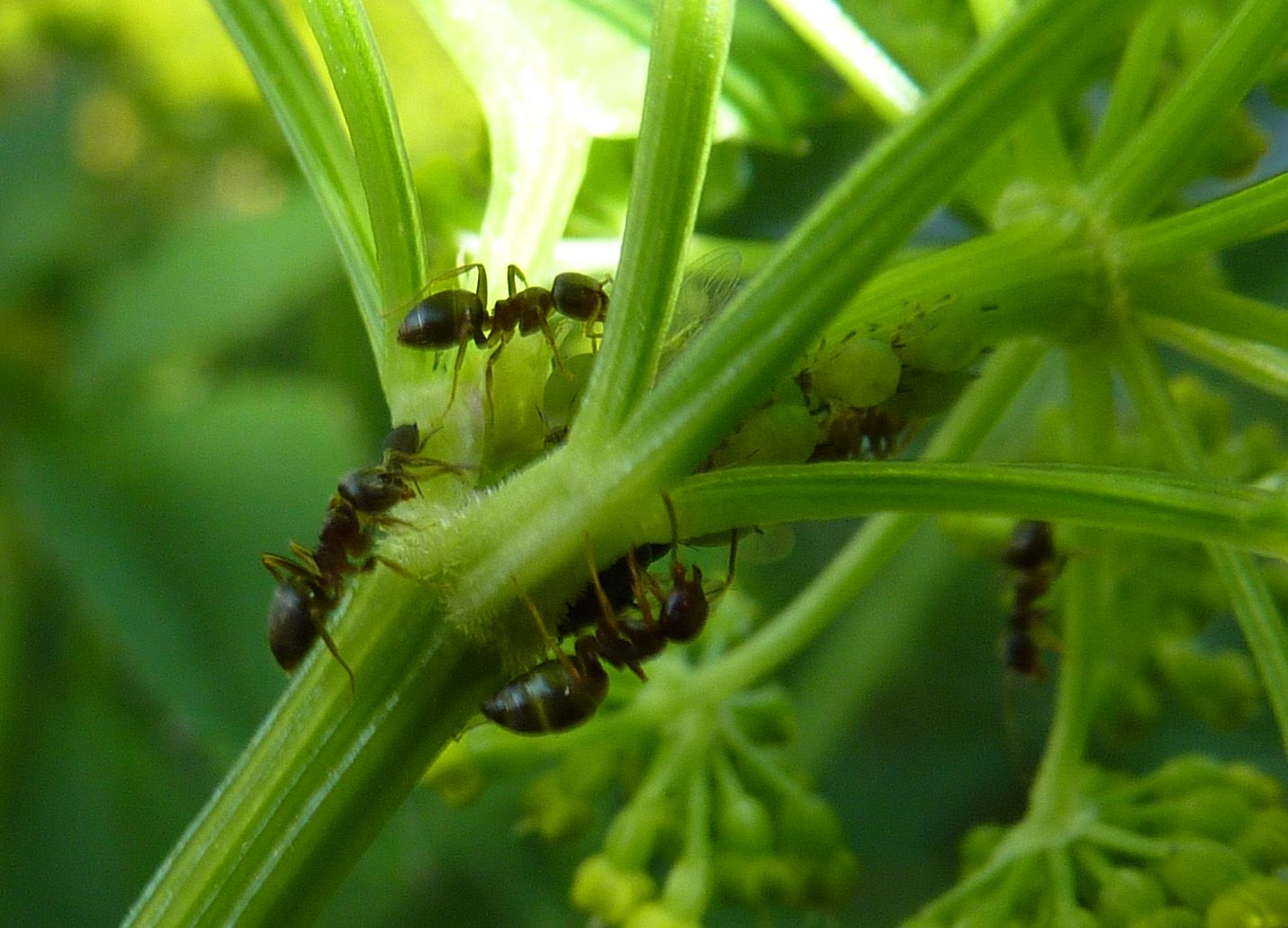
Tapinoma sessile tending aphids on the stem to a Golden Alexander.

Tapinoma sessile tending aphids on the stem to a Golden Alexander.

Wednesday, April 20, 2011

Ant Chat Episode 27: Ants and Wildflowers


A pairing of spring wildflowers and the ants I find around them. Even before planting all these wildflowers I already had a lot of ant diversity. So with this video I'm basically documenting the wildflowers I've planted around certain ant colonies and in the future I'll be noting any interest if at all.

I also open up one of my honey bee hives that didn't survive the winter and see what's lurking about. I am certain they died of starvation and not CCD.

Monday, April 11, 2011

Some Lasius interjectus

Sorry for no posts in a bit. I've been busy trying to finalize the design for my new garden. Now that most of the plants have showed up I feel I've procrastinated on that topic long enough. I'll hopefully post images of the design on paper as well as photographed in person. For now though here are some ant pictures I've taken while digging about.

These are Lasius interjectus. Though what makes them that species isn't apparent from these photos. First there is the smaller eyes in comparison to the head. As well as having a very diminished looking maxillary palp (an antenna-like structure that hangs below the mandibles). This puts them in the claviger group and I should state when I say diminished looking maxillary palp what I mean to say is it's really really hard to see with the naked eye. In books you'll read it's 3 segments long and even then it's dam near microscopic.

Had the eyes been larger as well as the maxillary palp more visible, 6 segments long and a whole lot easier to see, that would put them in the umbratus group. Again assuming the worker color leans more towards orange and not brown.

Both claviger group and umbratus group can produce a citronella odor when disturbed though it's more common for species in the claviger group. Something else I've noticed is they don't always produce the odor when disturbed, and I'm not sure why this is. I've opened the same colony time and time again and sometimes they get alarmed and freak out while other times they don't bother with it at all.

In the US the two most common claviger group species are Lasius claviger itself and Lasius interjectus. The main difference between these two as far as the workers are concerned is the arrangement of hairs on the gaster (abdomen). If they're messy and almost randomly placed all over then it's L. claviger itself. If the hairs are more neatly arranged in lines going left to right then it's L. interjectus as I've photographed above. You can sort of make this out by zooming in on the pictures above.

It's worth noting though that the US and Canada has about 30 or so species of Lasius that all have orange workers, all have queens that are social parasites (at least those not in the flavus group), and are all almost completely subterranean root aphid farmers. This is an excellent example of redundancy in nature. Getting a correct ID on these ants can be a living metaphor for splitting hairs.

Friday, October 15, 2010

Ants on the Aster Family

It's fall time and the last of the ant nuptial flights have been underway for a few weeks now. It's only appropriate that this happens with the last of the blooms too. 

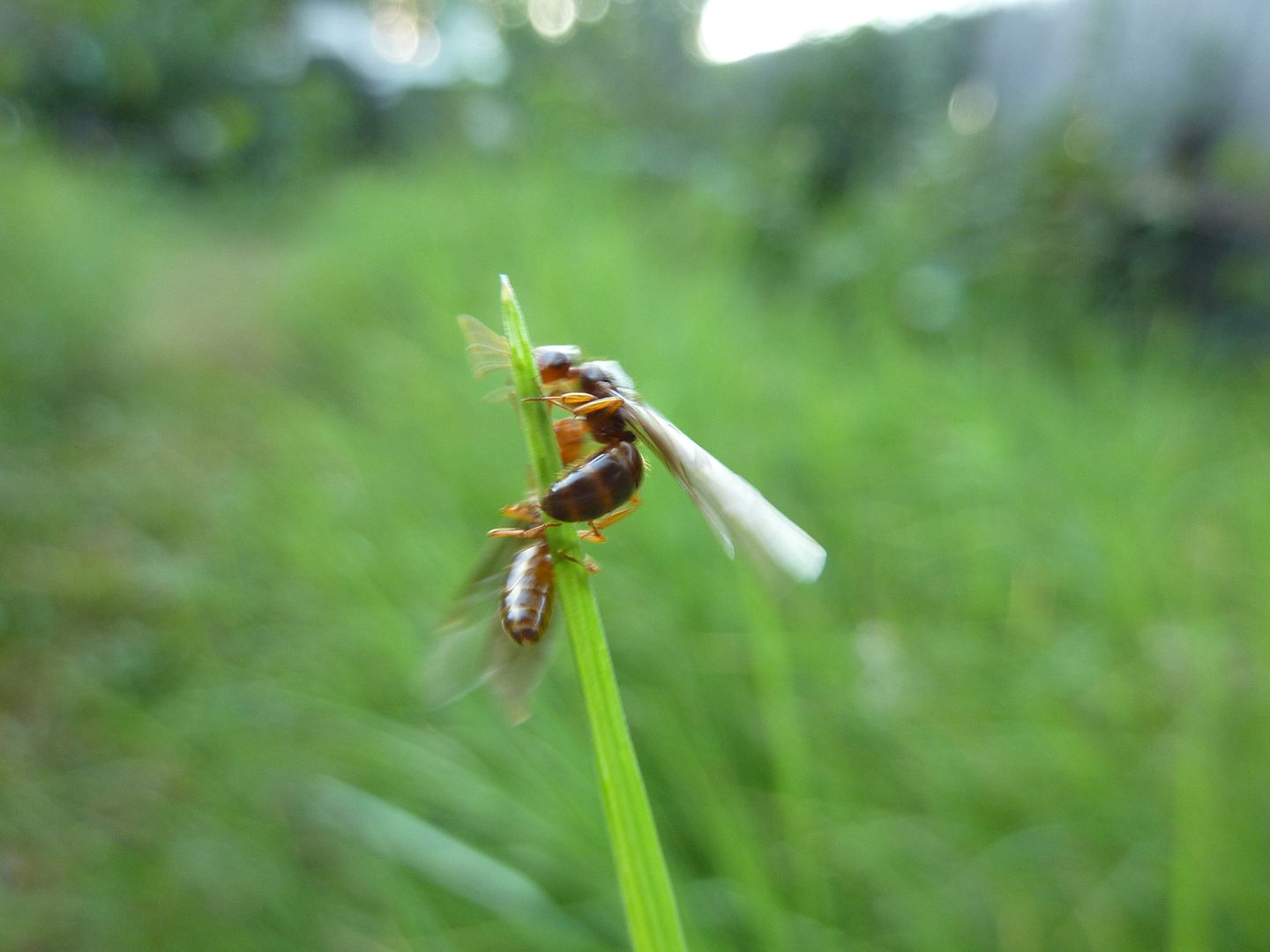
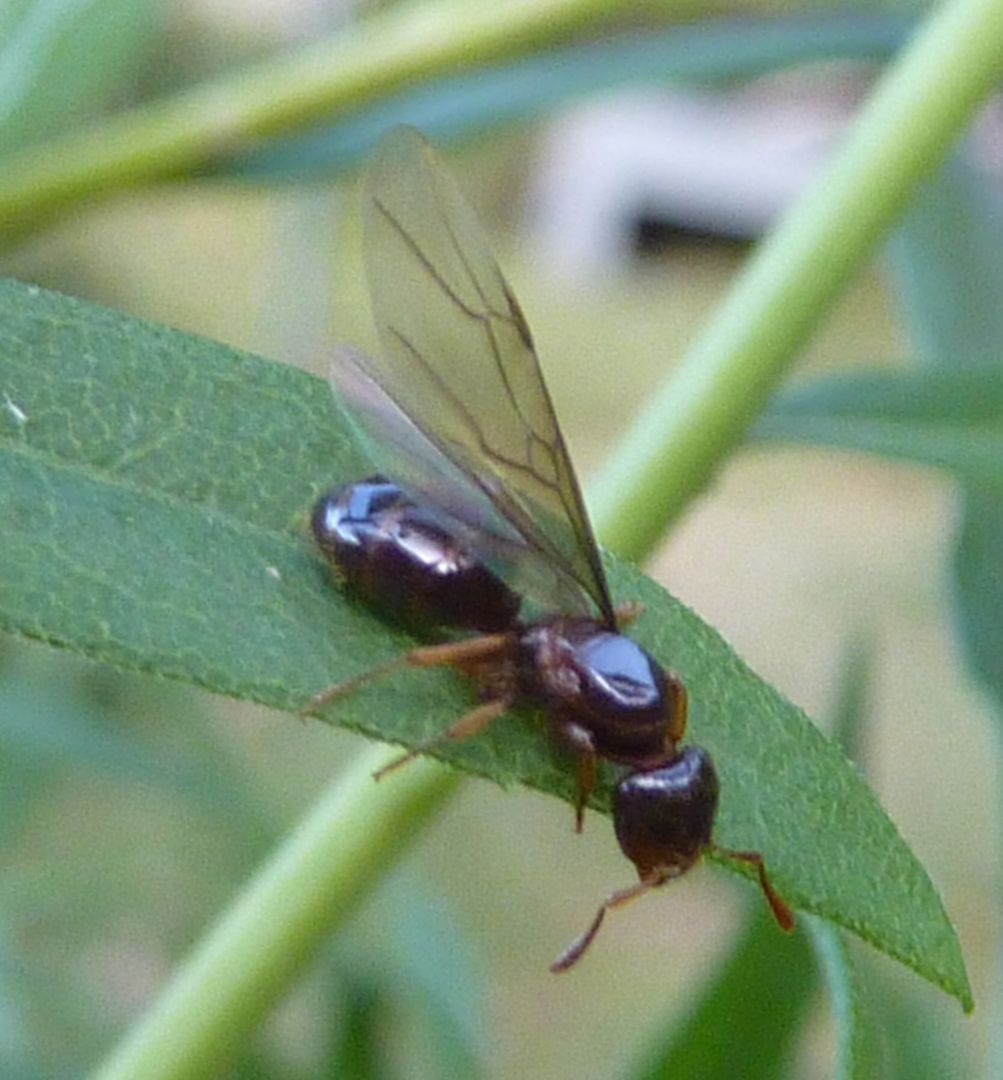
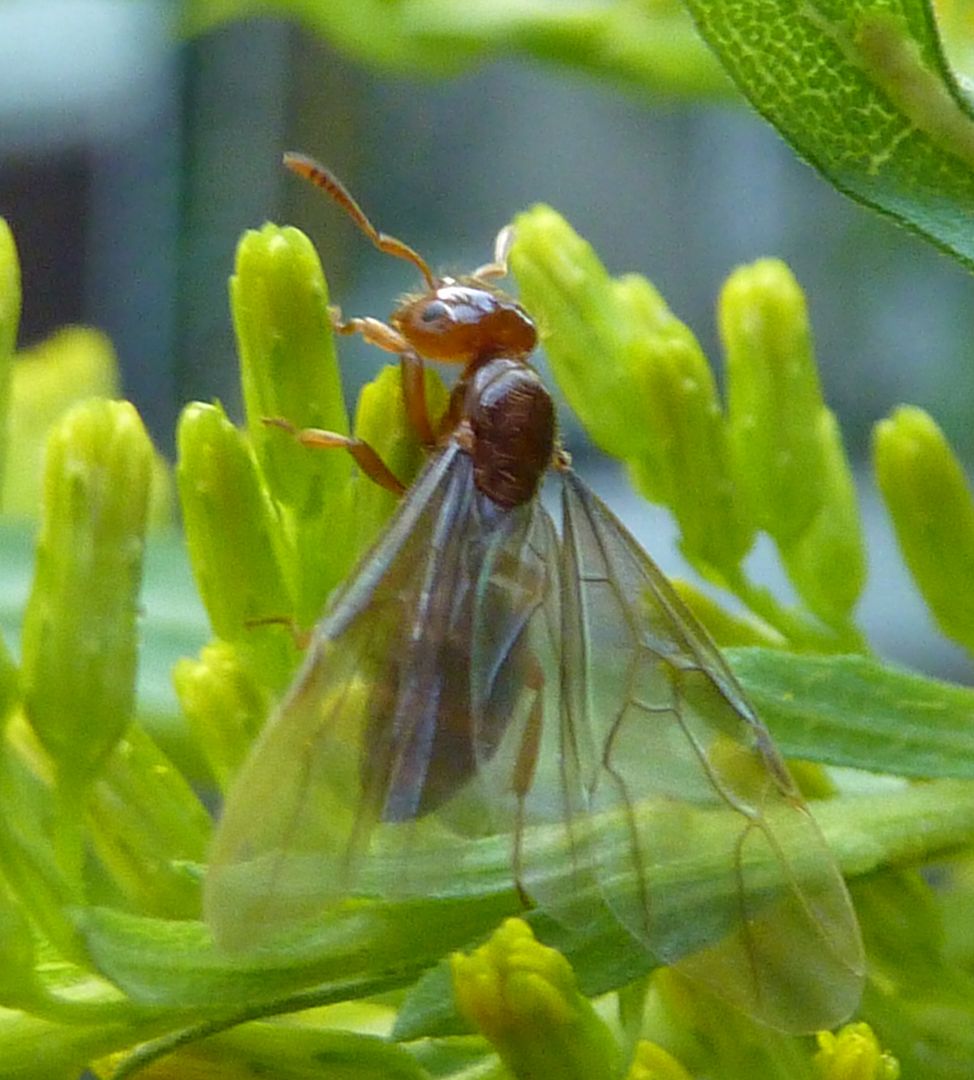
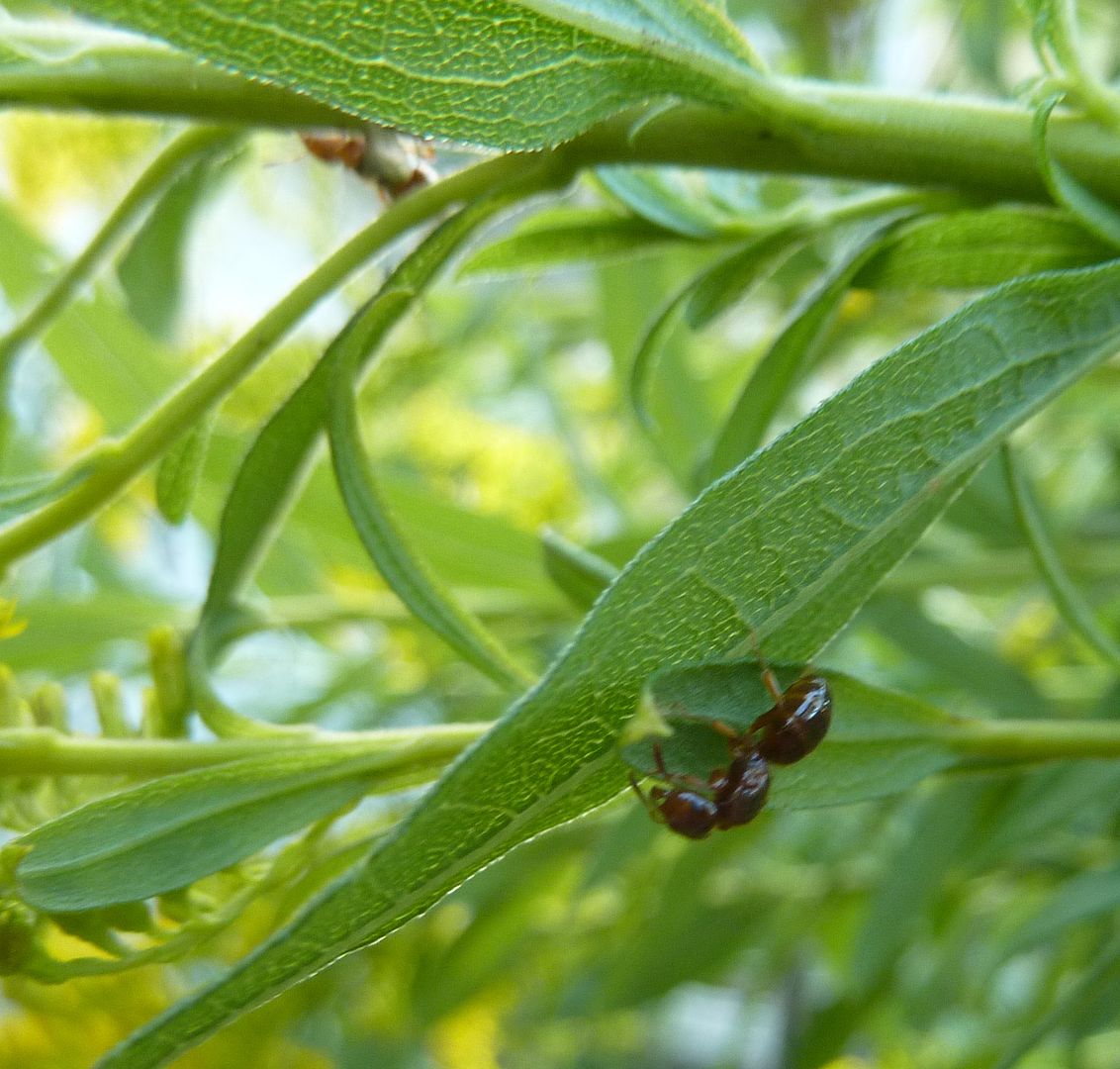
Lasius claviger and Lasius umbratus queens emerge from nests during the afternoon hours.

For some reason I find lots of them hanging out in goldenrod plants that are still in bloom, but only during the hours of the nuptial flight itself. Come darkness they disband and take to the ground looking for a host colonies.

I'm not sure what it is about goldenrod that attracts them so. This isn't the result of a colony under the plant and the queens simply trying to climb up high to take off. Many of the queens are stationary on the plant and have shed their wings.

The only thing I can come up with is they're attracted to the light scent the flowers give off. In case you're wondering this plant is Solidago gigantea. It's one of the tallest goldenrods in North America. Online sources say it gets up to 8' but I've seen it surpass 10' on some years.

So this got me thinking, maybe they're not attracted to just Goldenrods but perhaps other plants in the composite family.

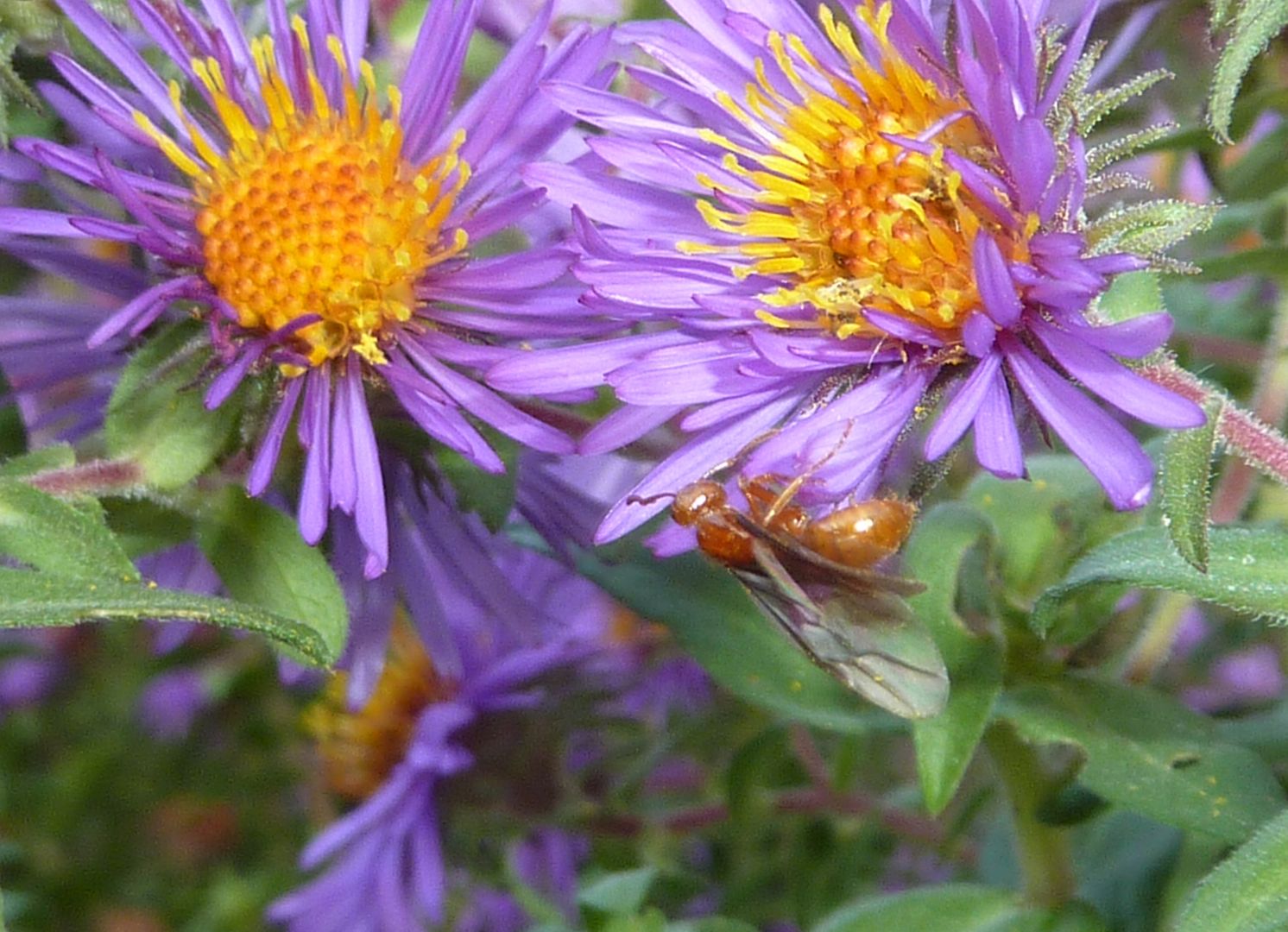
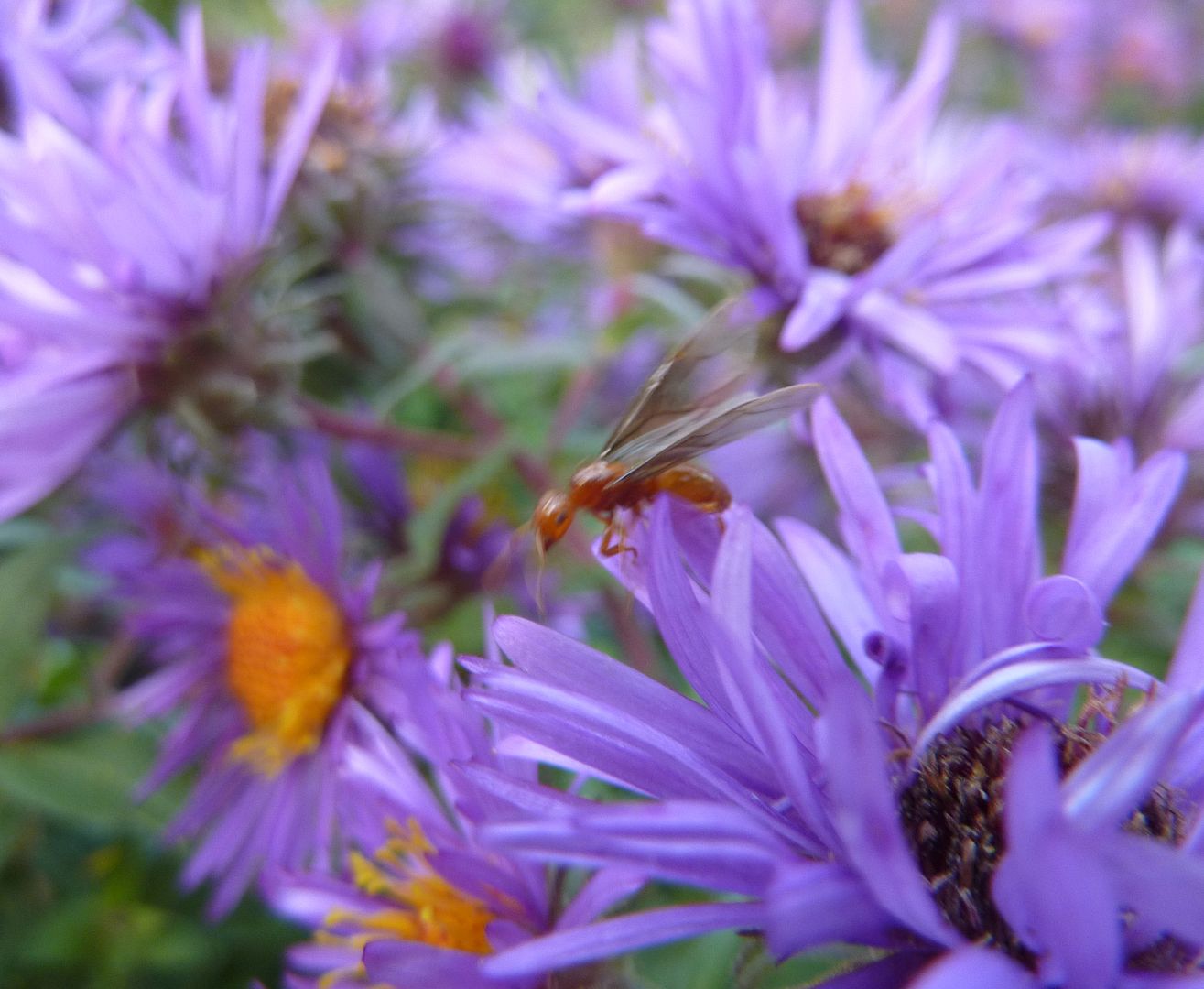
Sure enough upon inspecting my New England Aster I found a queen or two on the plant. However, I was only able to find two total.

And these were trying to take off. They were not being relatively stationary on the plant. So it's looking like they're only attracted to Goldenrods that are in bloom. I checked other plants as well and couldn't find them on anything else.