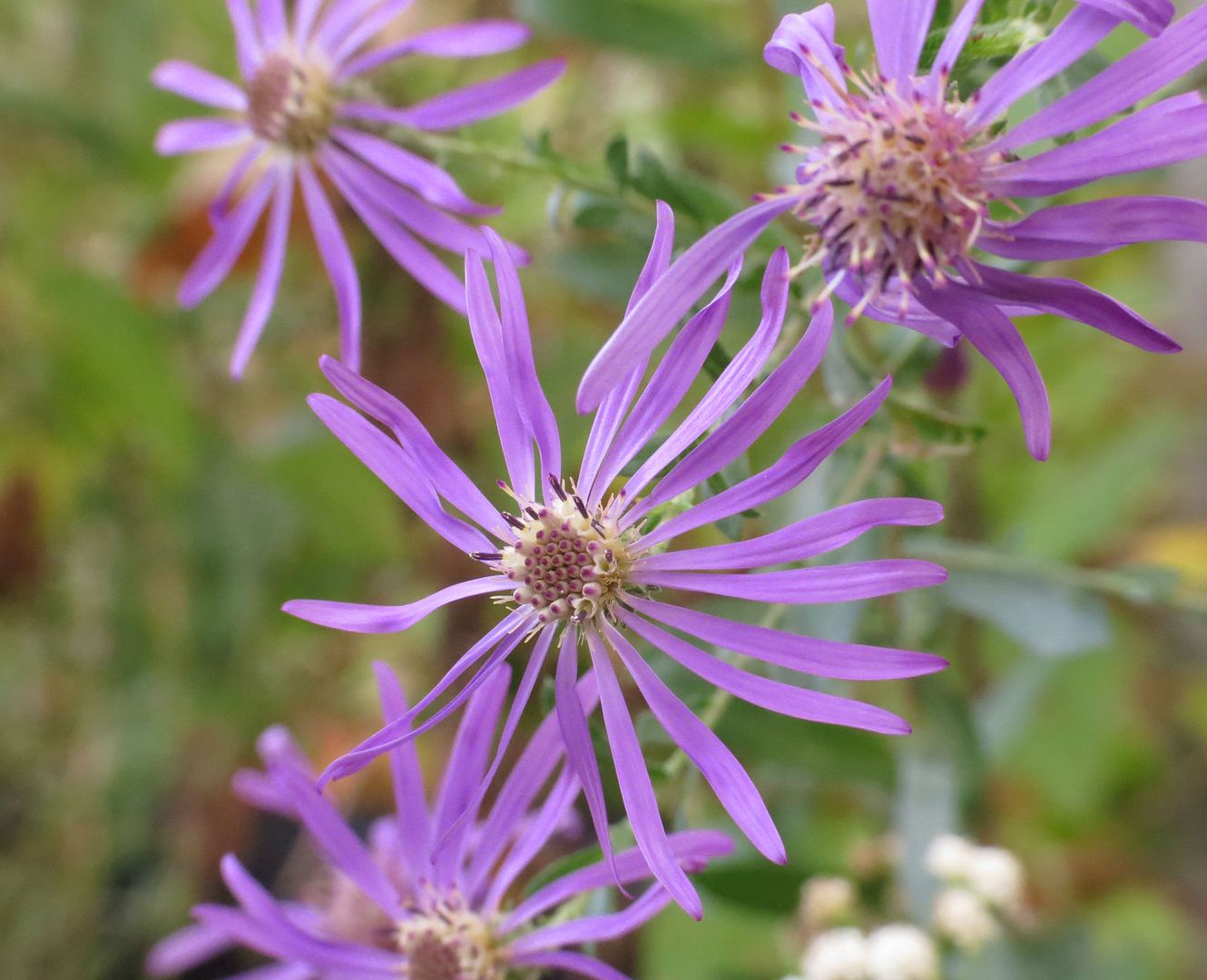
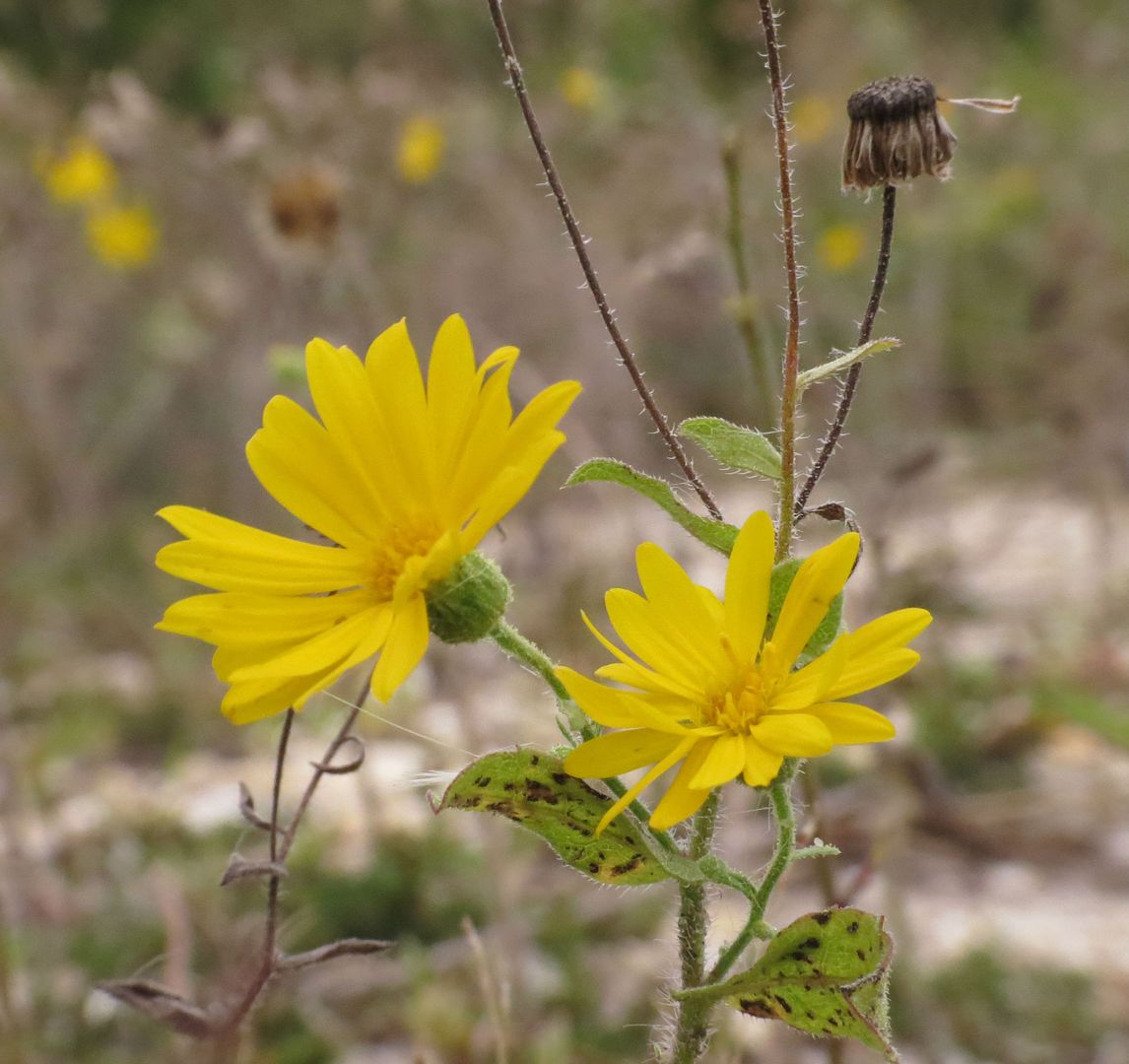
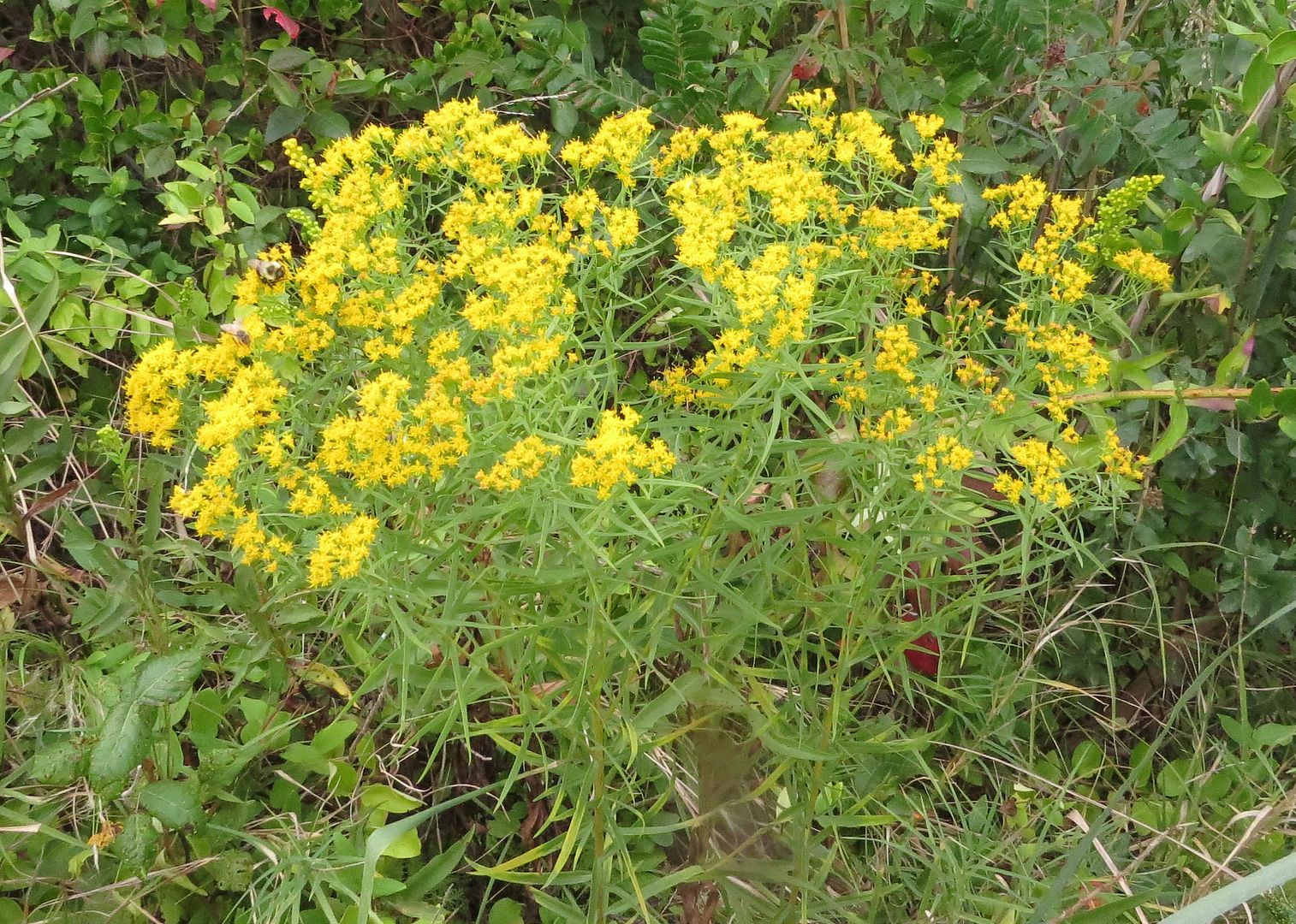
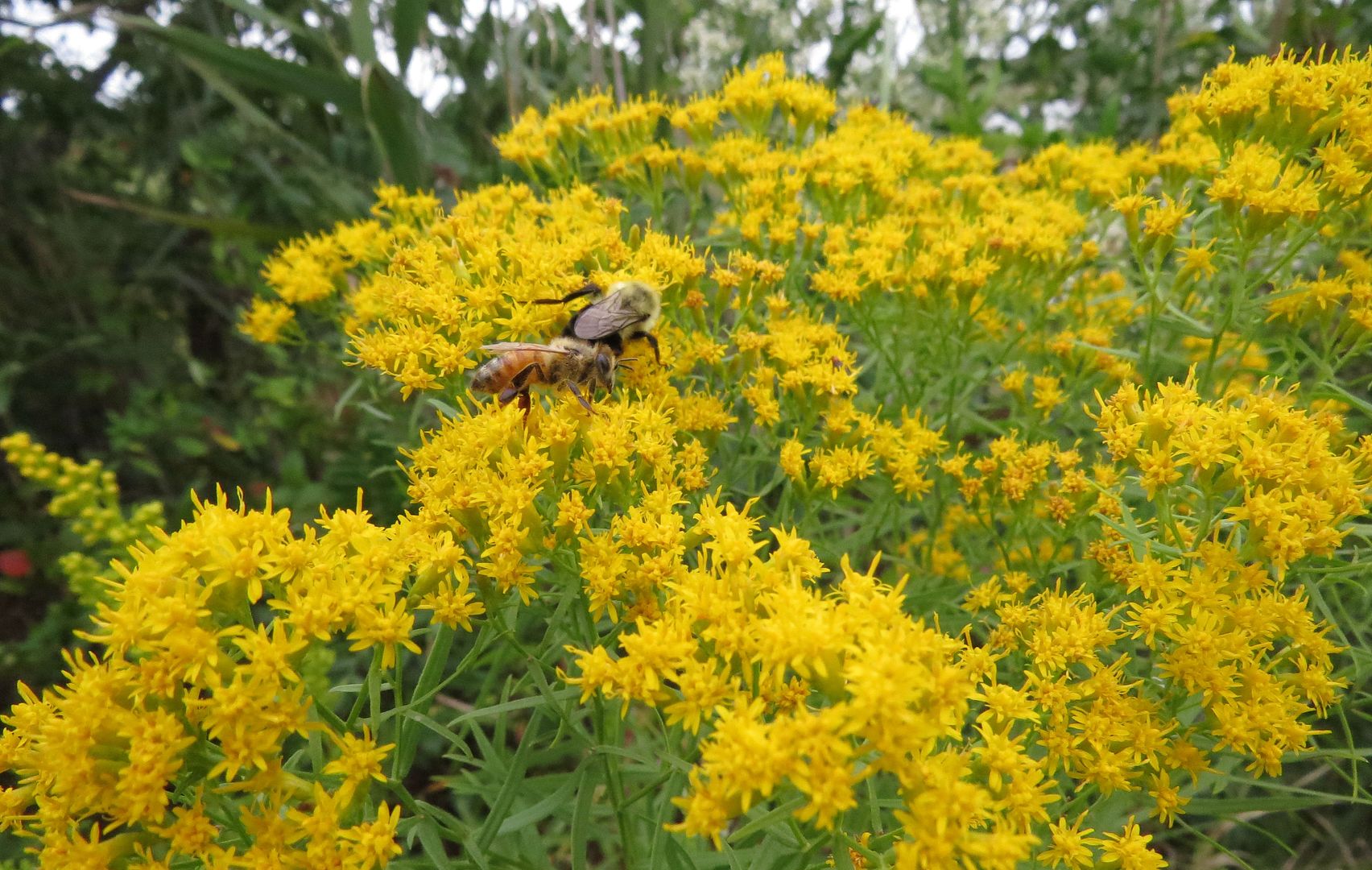
Symphyotrichum georgianum, is easily one of the latest flowering perennials in the temperate US. Both a failing and a highlight of this species is that they start blooming right after the trees have dropped a lot of their leaves. Goldenrod and other Asters are all usually past the half way mark in their bloom by the time this species even starts to flower. So a lot of the plant be beneath a pile of leaves leaving mostly just the flowers poking up among the fall color.
This is also an endangered species in the wild but nurseries are easily able to propagate it by seeds and cuttings, as I intend to do with the few plants I have in my yard.
The flowers themselves are a bit on the scraggly side but the overall size as well as the individually long florets in each flower disk makes them quite attractive.
As far as ecological benefits go, you're probably not missing much by having this species in your garden. While they are restricted to a few populations in the state of Georgia, the species is hardy from zones 5 to 9. The plants in my yard are really just prolonging the the lives of a few male bumblebees another week or two.
Older specimens can be quite floriferous, turning more bush-like, similar to but not quite like Aromatic Aster, Symphyotrichum oblongifolium. If you're going for a low bushy boarder of flowers though you should probably just plant S. oblongifolium, and really unless you have a nice population of New England Asters going, there isn't much reason to plant Georgia Aster. Everything that is going to over winter is pretty well fed already. But if you're still looking for something that flowers this late in the year then by all means give S. georgianum a try.
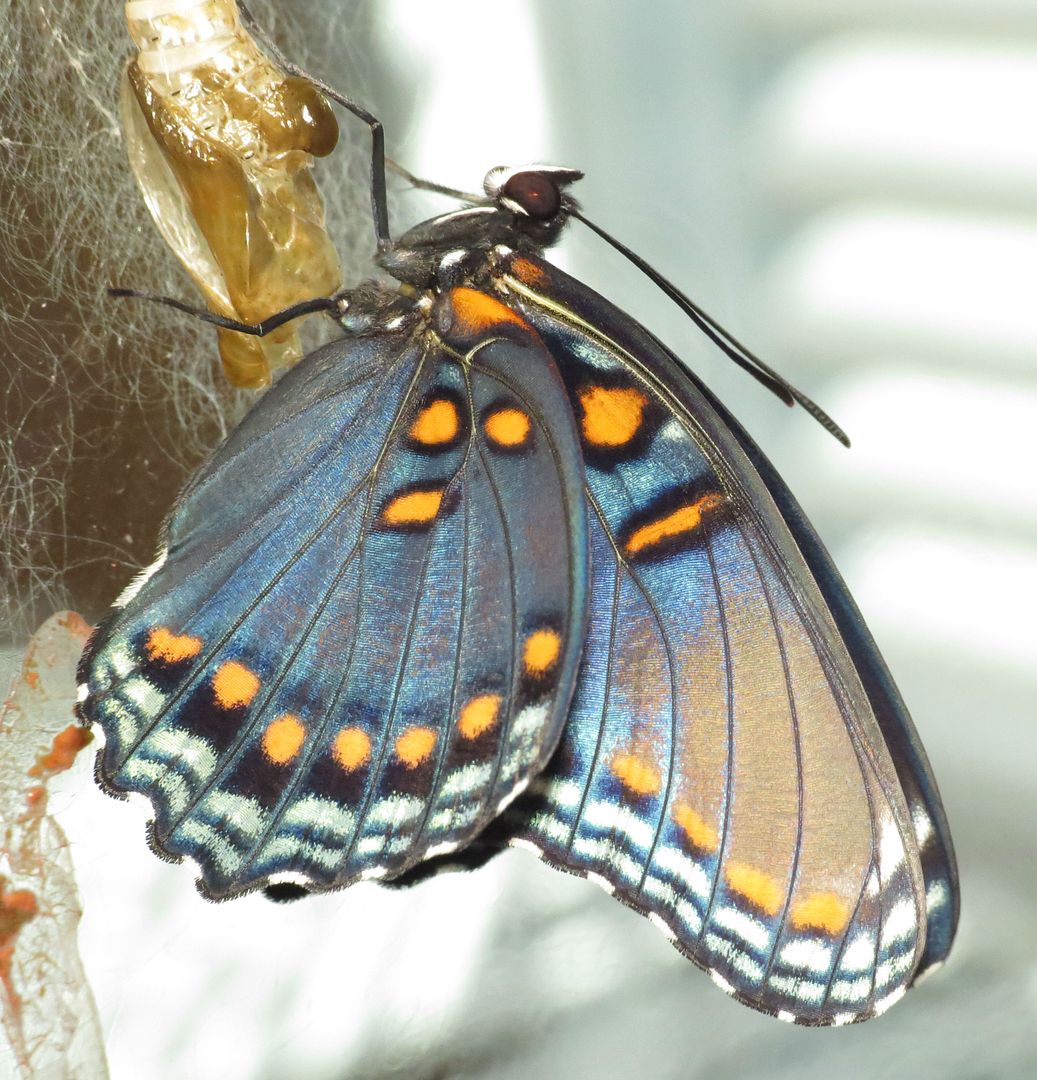
Well the Red Spotted Purple emerged, Limenitis arthemis. And it's bizarrely small, maybe 3 inches wide at most. I've heard of small generations of other Lepidoptera being born but it was always attributed to poor leaf quality, occasionally species having to eat leaves that had already fallen off of trees. I don't think that's what happened here. In the last two instars I was picking leaves fresh off the tree in groups of four to seven and the caterpillar consumed them all in one sitting. My only thought on this is either it's somehow beneficial to be smaller than typical during the winter months (when these dwarf versions tend to occur) and must be somehow triggered by either chemicals in the tree leaves it consumed and/or hours in the day.
I did notice the White Snowdrift Crabapple retained its leaves, and still has them on the tree even now, where as the native American Plum, Beach Plum and Black Cherry have all already dropped their leaves. It also had ripening fruit on it, so maybe it's just a result of hosting on Apples instead of Plums at this time of year. (They can use both).
I'm going to try and keep this one in captivity. We're well past the time to let them go for the year, and outside the only thing blooming is Goldenrod and Georgia Asters. The species does not migrate south and they do not over winter as adults, so there's zero chance of it surviving beyond a week. My intent is to keep this one as a specimen.
I got a picture of a honeybee having an awkward moment. Without explanation this bee clearly looks poisoned or diseased, but really though it was perfectly fine and I watched it working droves of flowers in my patch of Tall Goldenrod, Solidago altissima. It was a cool day though and in the shade I just so happen to get the perfect shot as she decided to roll off of the flower instead of make a perfect take off as she'd done hundreds of times before.
I actually moved the patch of Solidago altissima to a dryer part of my yard. It's actually much better behaved there, spreading slowly instead of each cane producing seven more the following year, and growing only 5' tall instead of 13'. I'll still need to thin it out but probably only once every five years instead of every other.
Seaside Goldenrod, Solidago sempervirens, is also flowering. And I realized what it is that I love about this species. It has petals! And you can clearly see them, whereas the common Goldenrod species all have small petals that are so scraggly they almost blend in with the anthers. Pictured above it's a day or two past its prime but you can still make out what I mean with the most recently opened blooms at the top. They remind me of Golden Ragwort, and in fact if you google this species you'll see a picture of Golden Ragwort actually comes up.
One thing I don't like about the plant is their habit of falling over. Each plant produces a series of stems that all grow too long and flop over under the weight of their own flower buds. You can see the one above arching over a branch to one of my Beach Plums.
Seaside Goldenrod is a new species to my yard. I have a few of them planted in the sand patch I made, along with the Beach Plum. Hopefully they survive the winter. Where I live in New Jersey I'm closer to Pennsylvania than the Jersey Shore or Pine Barrens, so I'm well inland on a plot that's almost entirely clay. This species grows happily in 100% sand at the beach and does not occur naturally anywhere away from the coast or adjacent bays. Beach Plum also occurs here and did survive in my yard from last winter so hopefully these plants will too. I have one planted in the meadow garden where the soil is almost entirely clay. Actually it's neat digging in the meadow now because I see the 7 or so years of decomposing organic matter there is slowly turning the soil more loose and loamy.
So I noticed the caterpillar seemed to make an abrupt jump in its development. I made an assumption that as long as the apple tree I found it on had leaves, then this caterpillar would happily eat them. What I forgot though was the average temperature and amount of day light were also factors.
Posing the question of when I should put this one in the fridge to over winter, I learned I should have done that a week ago when it was in the third instar. Apparently that is the instar that they go into hibernation. Unlike species who spend winter in the chrysalis stage, the number of hours in the day when the sun is shining as well as the temperature determine whether or not they should hibernate or move on to further instars and adulthood.
Tragically my caterpillar is well into its 5th instar and I'm told nothing will stop it now from developing into a chrysalis and emerge into an adult 7 to 10 days later. This species does not migrate and by then it will be late October or early November, when it is too cold to release, and the host tree (a White Snowdrift Crabapple) will likely have lost all its leaves. I suppose I will have to let it happen and keep the butterfly captive until it expires. I'll try and keep it alive by offering it pieces of rotting fruit, and eventually pin it I guess.
Speaking to its host plant for a moment. The little crabapples have turned orange and the birds are already eagerly pecking away at them. Lots of the leaves are now covered in damaged fruits as well a surprising amount of bird droppings. I wonder if actually having real bird crap around makes the disguise this caterpillar produces more or less convincing.
There are likely two or tree more Red Spotted Purple caterpillars on the tree, but as they're likely just in their third instar, I'll have to wait until the leaves fall off of the tree to look for them. My understanding is the "shed" they make by rolling a leaf around them with silk does not fall off of the host plant. If I find a few, I'll be sure to collect and store in my fridge until the tree leafs out and flowers the next year.
There are a couple of studies being done in the native plant world that have peaked my interest.
Native Cultivars vs. Native True Species
Kim Eierman interviews Doug Tallamy in his project to see if Native Cultivars hold up to their True Species counterparts. Basically they plant a cultivar in the middle of a ring of the true species specimens. This way it would unlikely for the insects to miss their host unless they were actively avoiding the cultivar.
Overall I don't think this will show any surprising results. Cultivars are often just clones of a particular species with the desirable traits. There may be one or two cases where one or two insects have lost a taste for a particular cultivar but I doubt there will be anything shocking to report from this.
Delaware Online is reporting the Mt. Cuba Center is starting a 20 year long study to compare different reforestation methods.
Mt. Cuba Center staff designed each test plot with a different
reforestation technique, including two plots which serve as controls for
the experiment: one left to natural forces to reforest itself, called
natural succession, and one planted with a commonly used technique,
orchard-style planting where trees are placed 10 feet away from each
other and the grass between them is mown regularly.
Other plots
have different combinations of planting densities and planting types: an
orchard-style planting with no mowing between trees; densely planted
canopy trees; orchard-style canopy trees and understory trees; and
densely planted canopy trees and understory trees.
It's an interesting question for sure, and I really hope their study goes without any acts of god. The article doesn't mention them using any evergreens or species that jump out at me as being fire resistant for example. Also wind storms and hurricanes seem to be becoming more common for the area, so here's hoping nothing like that happens. For a study that's going to take 20 years to complete it would be an awful shame if a Deer screwed it up.
I wonder with the plots that are not being mowed, whether they're planting into lawn or something more wild such as a meadow, and whether or not it would be beneficial to also have a plot with a meadow seed mix thrown down before hand to see if the tall grasses and wildflowers does anything to help or hinder the trees and shrubs.
The Red Spotted Purple, Limenitis arthemis, that I have in captivity has grown a bit since I last bothered to look at its container. It's been nibbling the same leaf in there for quite a few days now. I add a free leaf off the crab-apple tree its egg was laid upon ever few days. I also put a wadded up tissue that's soaking wet with water in the container so it doesn't dry out, though I'm not sure how necessary this is. I know ants are in danger of drying out so perhaps caterpillars have the same risk?
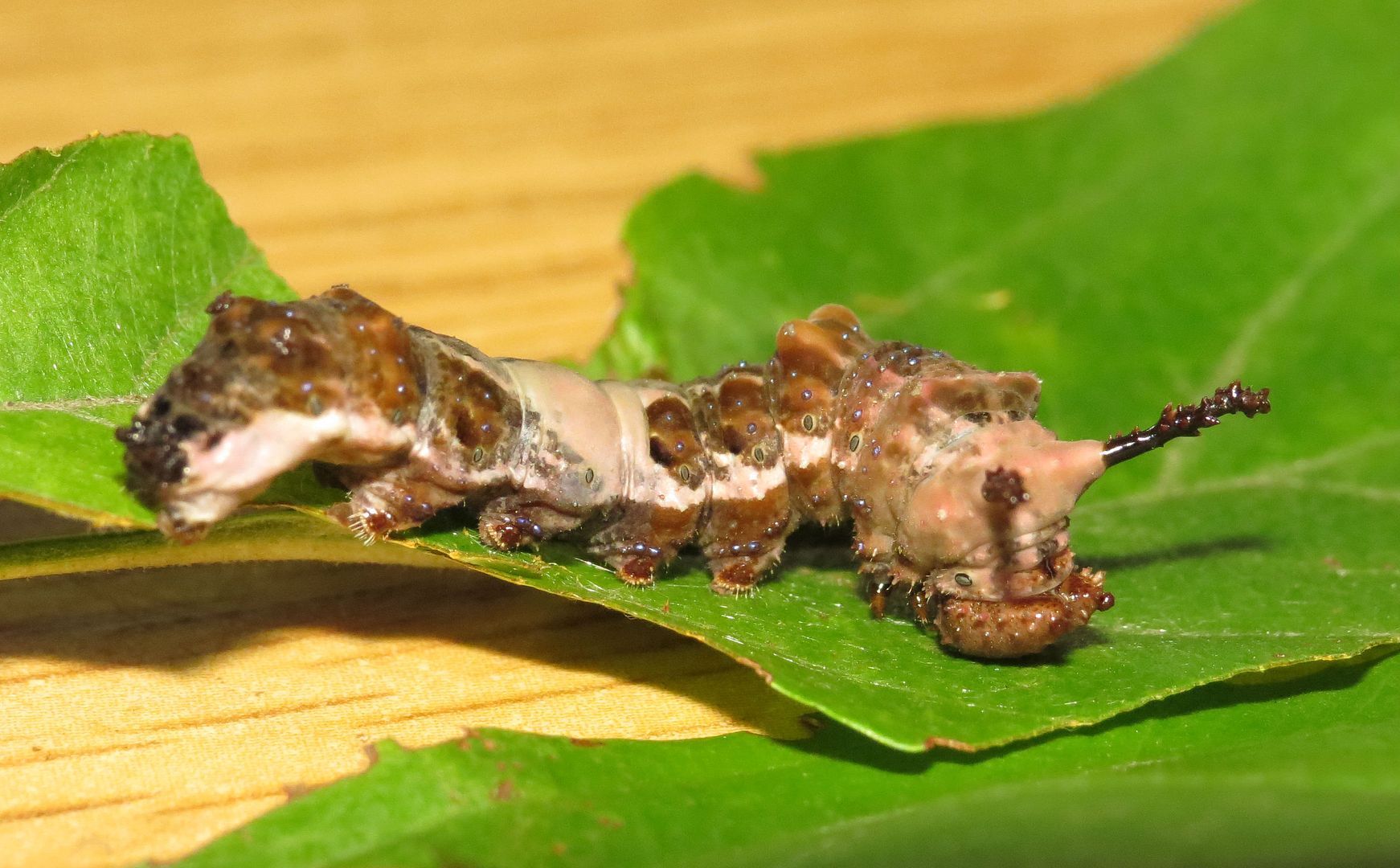
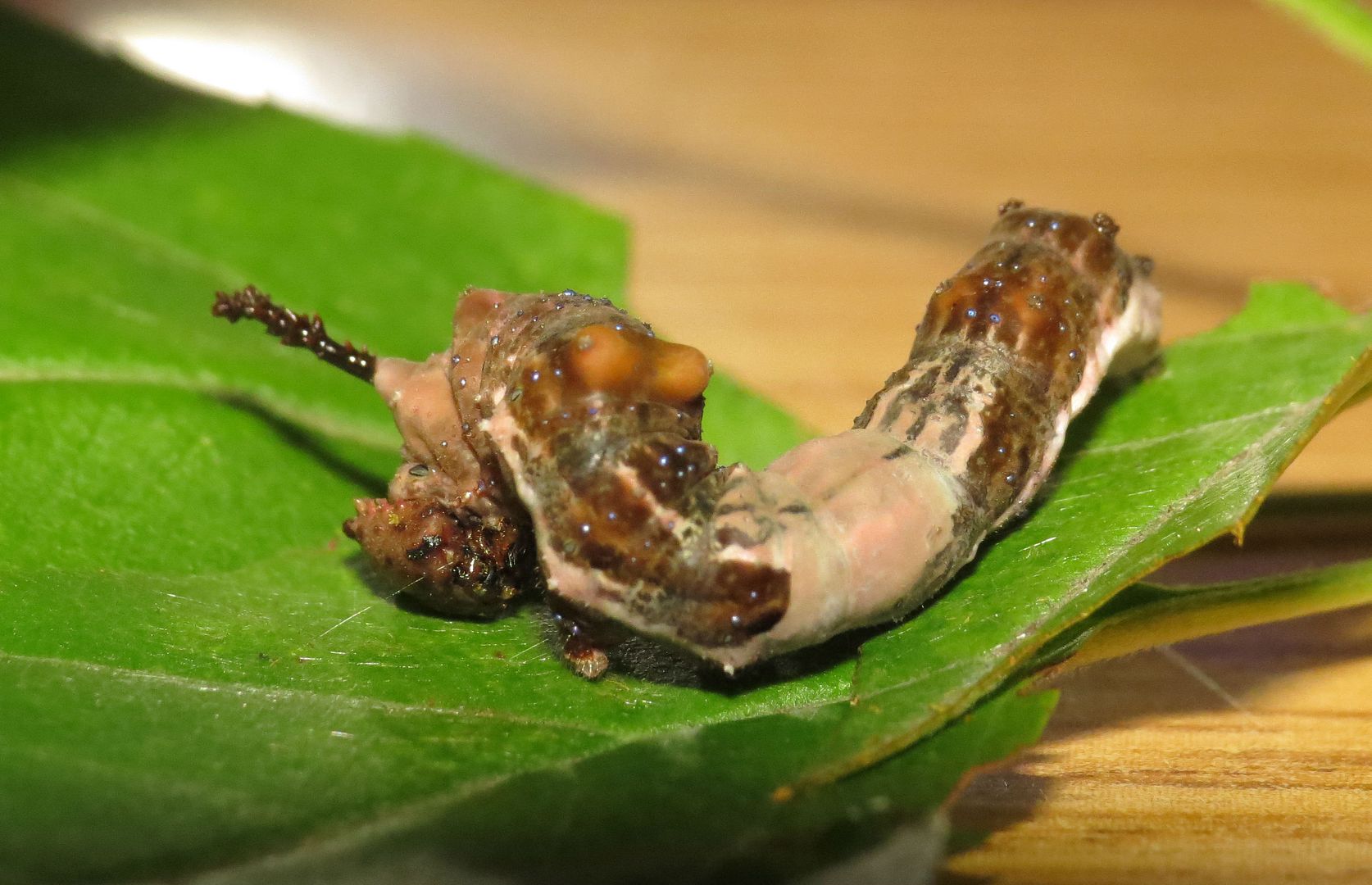
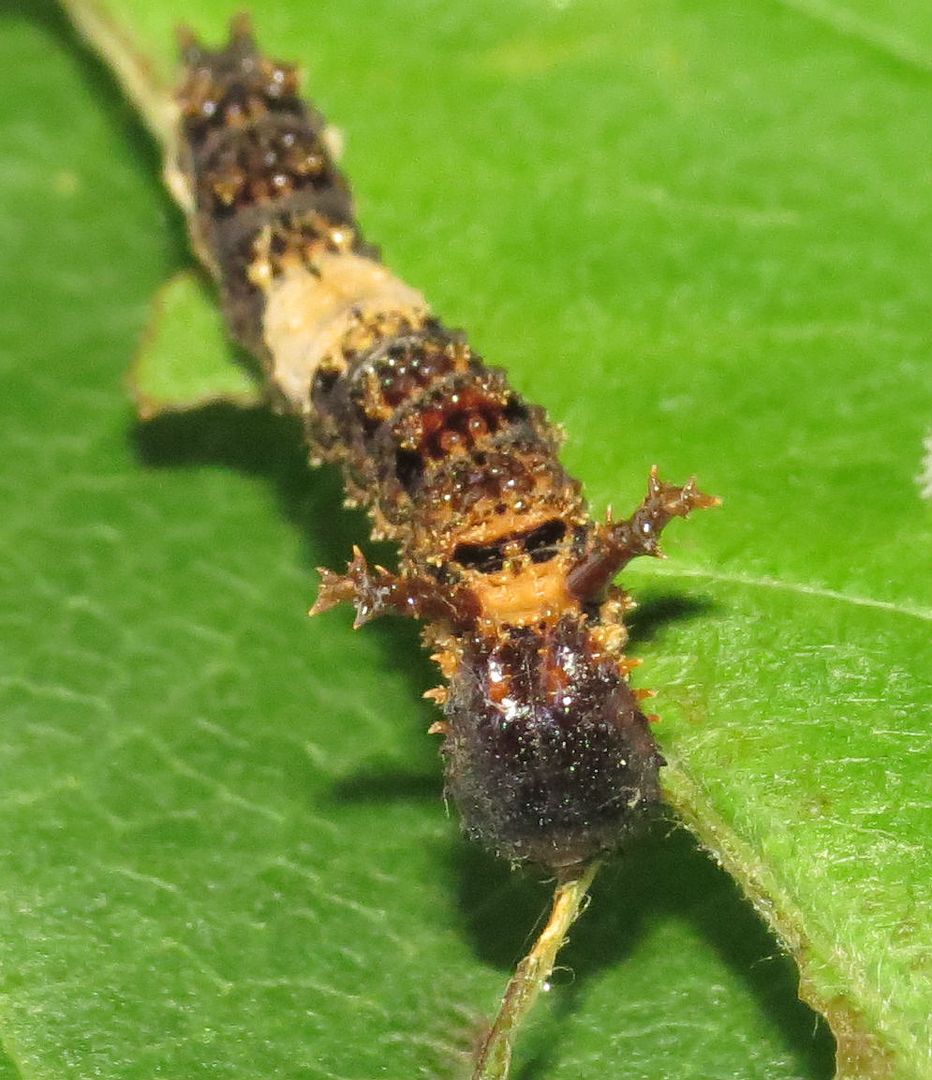
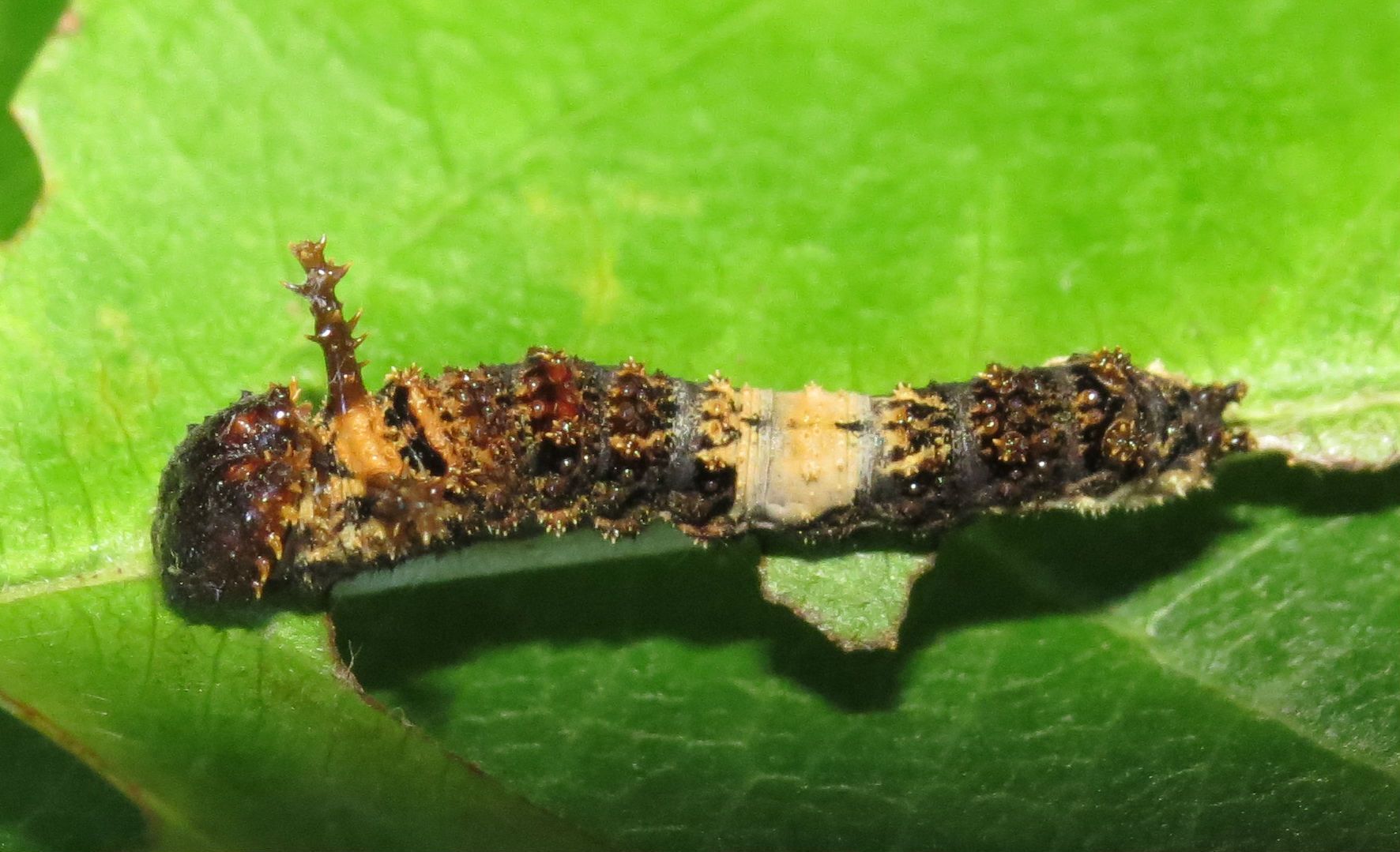
We're now in what I believe to be the third instar. It's no longer making a stick out of frass to hide on, which the younger instars do to escape ants. Instead more natural defenses are starting to develop. I suspect from here on, birds would be the primary predator over ants. Their coloration is starting to mimic that of bird droppings. So they've gone from hanging out on a poop stick, to looking like one!
And of course it's now sporting a lovely set of jagged horns. My understanding is the horns are hollow and intended to break apart in the bird's throat to, ideally, puncture a hole in the crop or wind pipe killing the bird dead. This probably doesn't happen when they're this small, but I can easily see some damage being done when they're bigger. Birds don't have teeth to chew them up first.
Remember adult birds rarely eat insects as their own food sources. Seeds and berries are the fuel of most adults while protein rich insects are important for baby birds. Would you feed something covered in thorns and looked like poop to your children? (Granted they're eating it half digested as you vomit it from into their mouth, but still someone has to do the initial eating!)
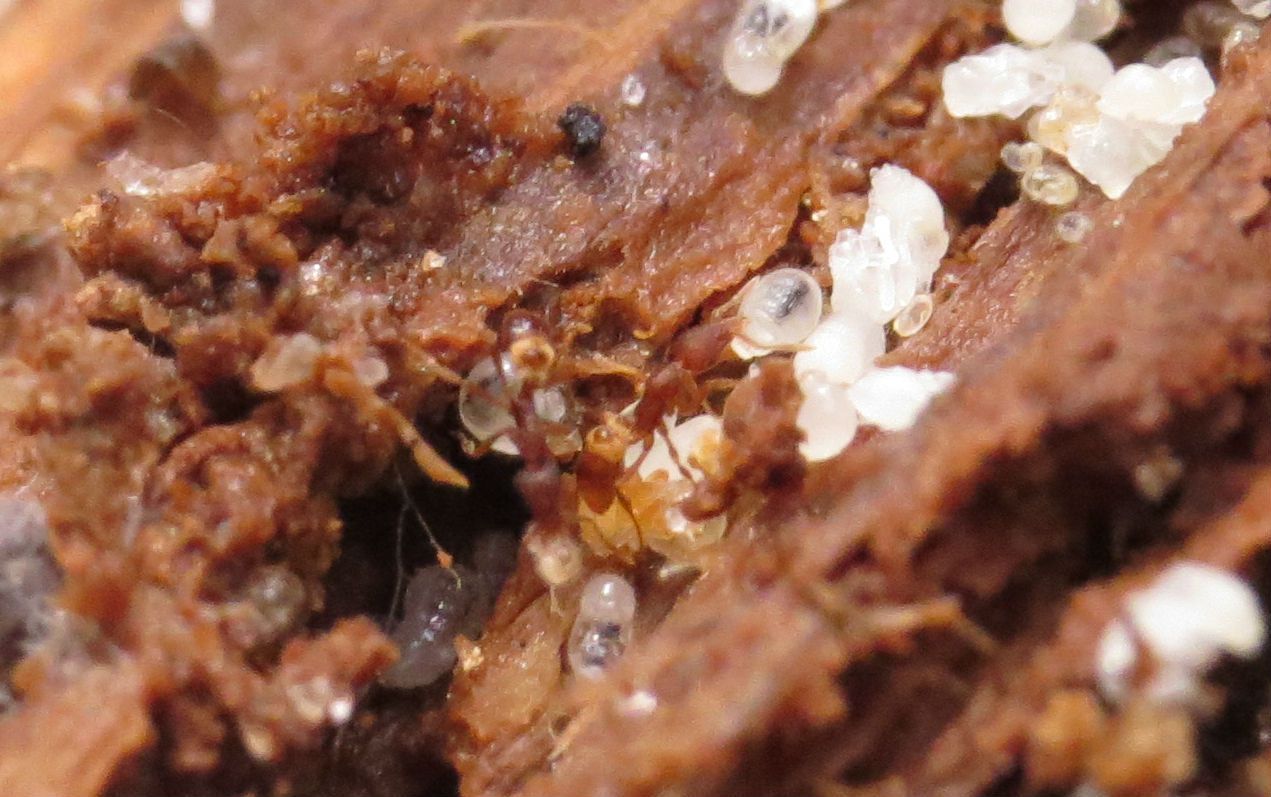
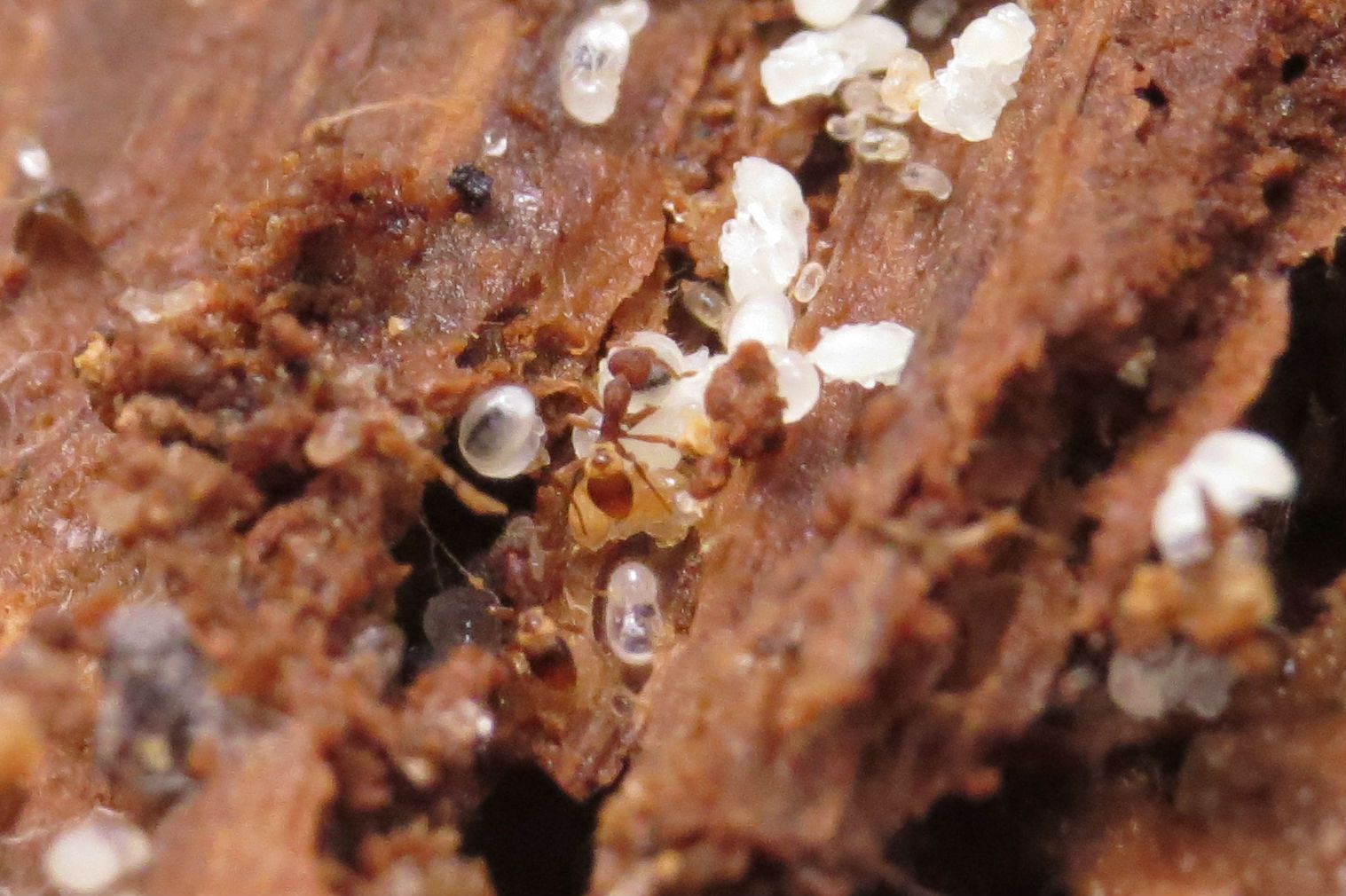
Strumigenys is a diverse genus in North America with almost 50 species. Despite this diversity though, the genus is almost exclusively encountered by Myrmecologiests and those in other scientific fields that involve sifting through leaf litter and dead wood.
They're so small that they're hardly noticeable, and they look so strange compared to other ants that most people would likely be confused that they were even looking at an ant.
For better close ups, here's a link to Ant Web's specimens, and Alex Wild's album of the genus. Notice the odd petal-like structures that cover the body. These are modified hairs which I believe are used help cloak the ants as they hunt. Some species in the genus have long mandibles similar to a Trap Jaw ant's. These are used to allow oils (and fungi?) which make the ant less noticeable while hunting.
They're primarily predators of springtails which are small, mite or termite-looking insects often found in decaying wood. Truthfully though these ants are more than happy to kill any sort of soft bodied invertebrate.
These ants require "cool" conditions in order to survive. In the wild they always nest inside the damp and decaying media within the hollow of a tree, or in a soggy log that's often well shaded and rotting. Other species are at home nesting in soil and leaf litter, but good luck finding those. Colonies do not make mounds of any kind, entrance holes are often cryptic at best, and populations tend to range around 200 individuals that could happily fit on a US. Quarter.
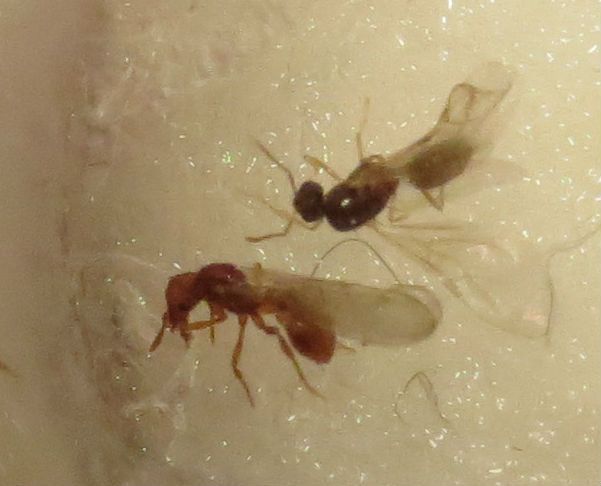
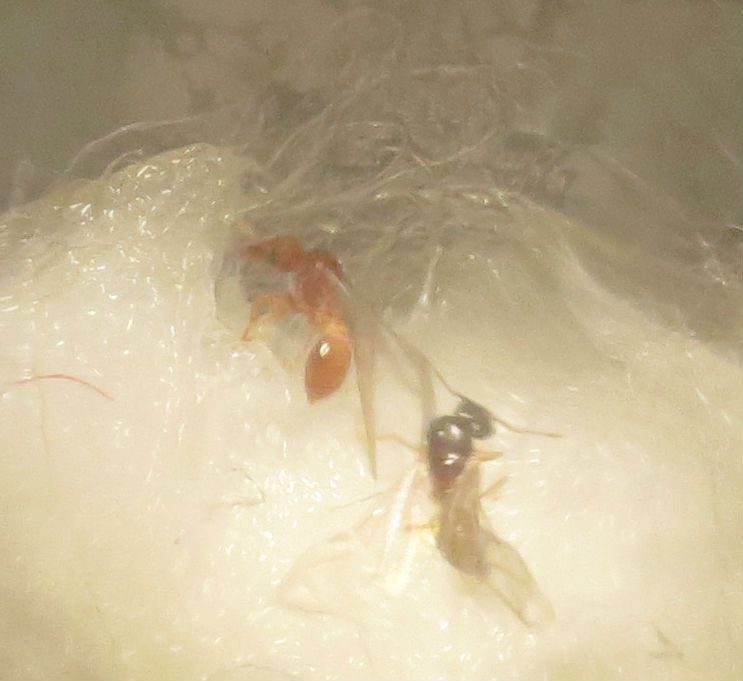
Curiously I discovered these ants hold nuptial flights in the day time but under specific conditions. Here in New Jersey it's the calm before the storm as Hurricane Joaquin moves up the coast. The sky has been solid grey clouds for as far as the eye can see for a few days now, and raining has been off and on. It's been cool out too, around 55F but on the day that it was still 77F I happen to find a few alates to this genus landing on my car.
Ants being attracted to bodies of water, parking lots full of cars, and other reflective surfaces isn't anything new, but the fact that this genus flies in the day time is! Everything about their nesting habits has been cold and shaded, and it's entirely possible to accidentally kill them if they get too much sun. So I find it odd that they wouldn't hold nuptial flights at night.
Regrettable I couldn't locate a colony sending alates into the air. Their colonies are just too hard to find. But I was successful in catching a queen and male. I've no idea if she managed to mate or not (leaning towards no) and it's rare for ants to mate in captivity, especially after being collected. All the same, I'll give her a shot and see if she's able to produce any workers. If not then I'll have to store her in alcohol and eventually pin her for my collection.
Also happening with Caterpillars this autumn, I'm attempting to raise a
Red Spotted Purple or two. I eyed a female out in the yard laying eggs,
curiously on two nonnatives, which the caterpillars seem to be eating. A
Snowdrift Crab Apple but they're in the genus Malus so I'm doubt native
or not really matters in that case. The other was a Japanese Weeping
Cherry, but that's also a Prunus so maybe that doesn't matter as much?
Still though I don't see Tiger Swallowtails or Silk Moths laying on the
tree so I'm sure the native Black Cherry is the superior host plant. In
the short amount of time I've had the sapling Black Cherry I can say
I've already found way more caterpillars on it than the ornamental
Weeping Cherry.
In the wild Red Spotted Purples always lay eggs towards the tip or ends
of leaves. Ideally it's the tip but I've seen some of the more spiky
edged host plants confuse them when laying and eggs are off center to
the side.
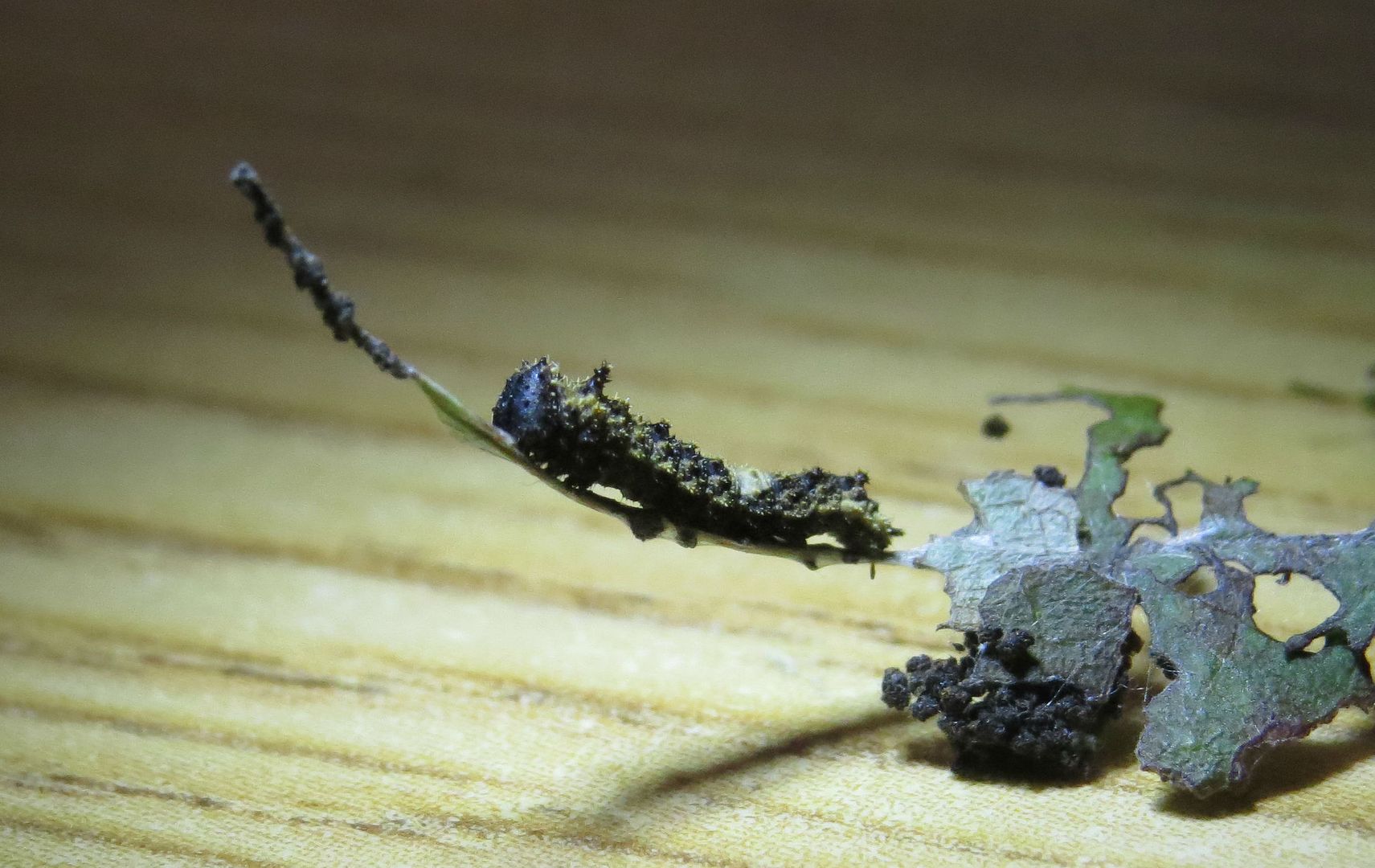
Upon hatching, what seems like 7 days later, the caterpillar begins constructing a "stick" or poll out of its own frass and silk which it hangs out on so ants don't eat them.
Funny enough EcoBeneficial interviewed Doug Tallamy about this topic. I have the same Lepidoptera species laying eggs on my Black Cherry sapling, but because I have a happy colony of Camponotus subbarbatus living in a log to that flower bed, my tree still has all its leaves! Every leaf on this plant has a nibble taken out which I would characterize as standard first instar caterpillar bites. But nothing beyond that! No branches stripped, no missing leaves, no half munched bites taken out of the leaves. Because I have this ant colony foraging on the tree, the caterpillars never make it beyond the first or second instar. Even the Red Spotted Purples don't seem to live long enough to make their first poo stick.
After making the poo stick, they're free to feed on the leaf little by little and always have something to run back to.
A complication with keeping this species in captivity is that they over winter in the caterpillar stage. In the wild they spin silk around a leaf or two to build a "shed" that they nestle into until the tree leafs out again next spring. (Perhaps consuming the flowers in the case of apple trees?)
So a friend suggested to me to keep them in the fridge when all the leaves fall of the tree. Hopefully that will be enough get them to survive the winter and I can continue to photograph their life cycle next spring.
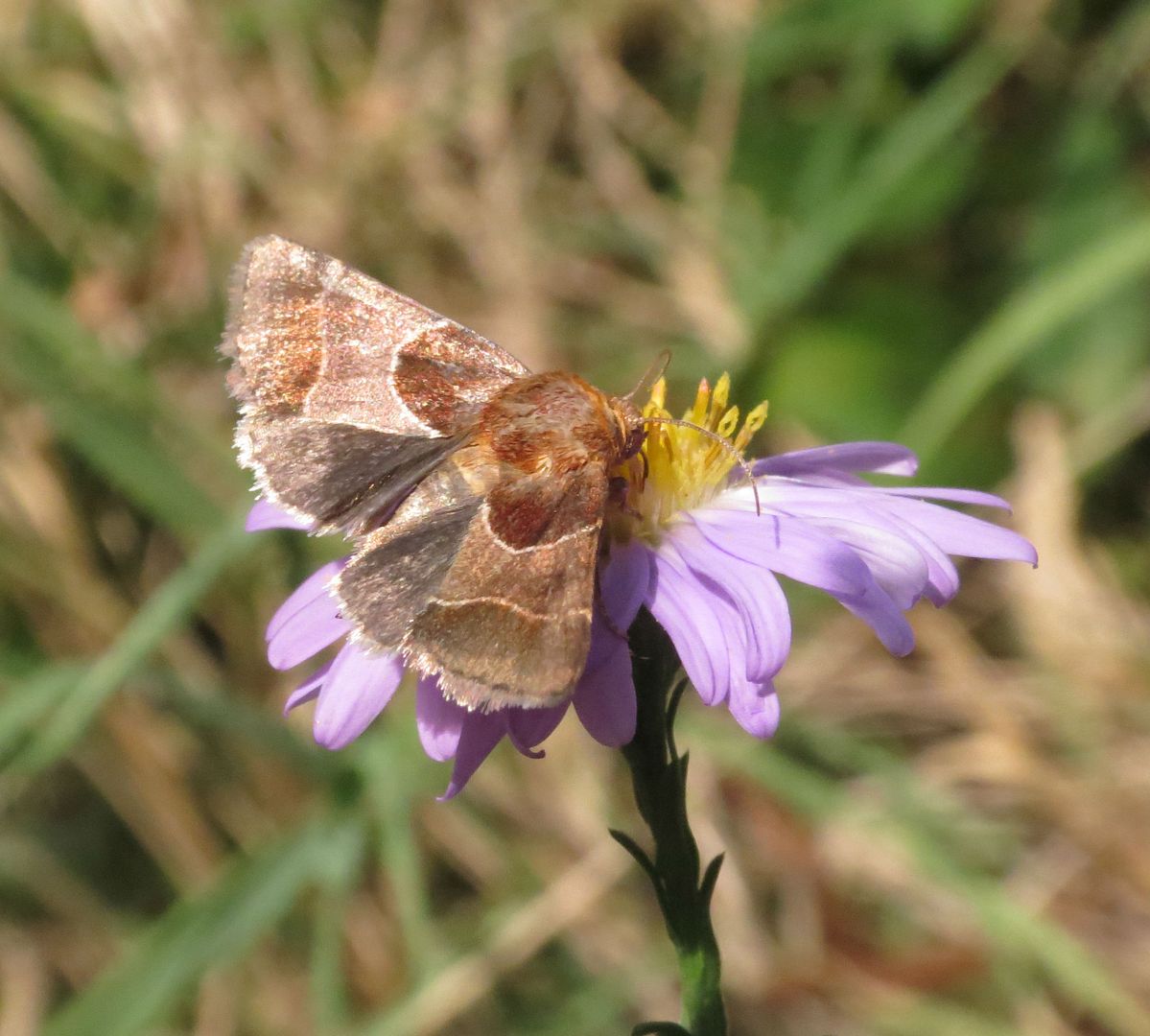
Also out in the garden I found an Arcigera Flower Moth, Schinia arcigera, which is a daytime flying moth that lays its eggs in the flowers to members of the Aster family. They nectar on open flowers but lay the eggs into the buds that have not opened.
It was a little hypnotic just watching this one hover about the asters. She took a liking to the Aster 'October Sky' which has become my favorite cultivar I think. I should really find another Aster cultivar that has a slightly different color to it so I can mix and match.
Also saw this one on the False Indigo Bush. I had to prune off the bulk of the foliage to this plant because it was top heavy and going to tip over. It's already sent up a new stem that's just as tall as the old growth was. A friend who operates the Shaw Nature Preserve in Missouri says he cuts them to the ground each year after flowering. In nature he tells me it's common for them to become top heavy and fall over, often snapping the stem/trunk completely. It seems evolutionary this species is stuck between being a soft wooded tree and a herbaceous perennial.
Despite the lack of Monarchs visiting my yard this year I did manage to raise one. Actually it was two but more on that later.
Where I am in New Jersey, we typically don't see Monarchs until August when they're already on their way south. I find them in meadows and natural lands but rarely see them in May or June when Monarch Watch lists sightings of them here. Really the Milkweed here doesn't even emerge from the soil until early May anyhow, but even then August is a more standard time to see them in the yard. I believe this is because they either follow the Delaware river up, or cross it and hug the coast of NJ. Then as they populate over the summer they move more inland finding different fields and gardens with milkweed to lay eggs and start up populations.
Milkweed this year seemed to be sold out from all the local nurseries until mid July. I finally got my hands on a few plants around that time and sure enough the nursery was having issues with Monarchs laying eggs on their supply. They kept having to relocate the caterpillars onto a patch of common milkweed around the back. Naturally I was willing to help by buying the plants that had caterpillars on them already. I moved the cats to the more established plants I already had growing in my garden and one of them became large enough to house in a cage.
I usually let them feed outside until they're in their last instar. Then I move them into closed containers with milkweed leaves inside. I would have raised more but wildlife got the three or four others over night.
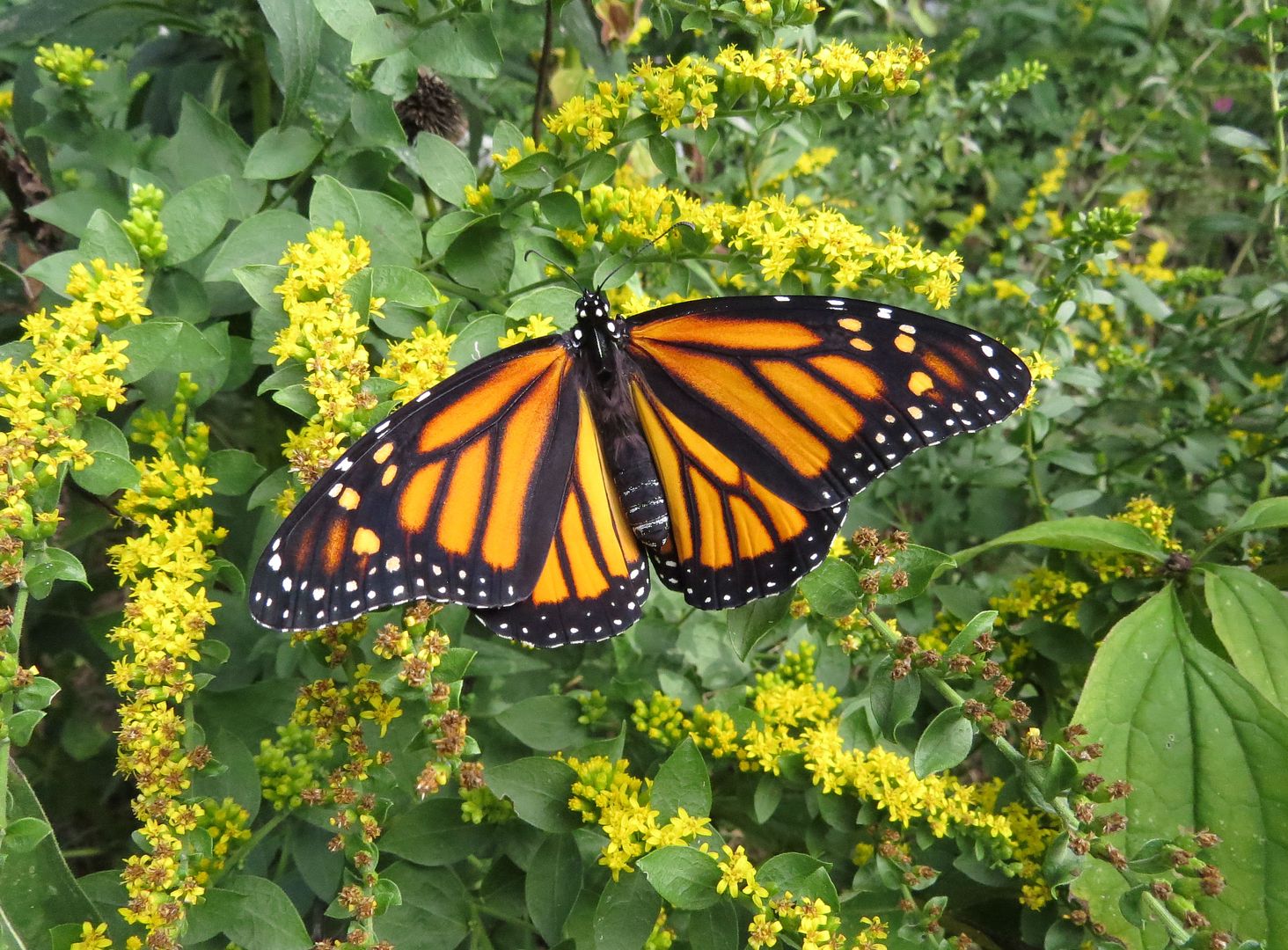
The first emerged earlier last week. They're easy to pose at that stage. They don't seem to feed at all until several hours have passed, usually after their first flight. To fly after emerging they require about an hour of sun bathing. I took the opportunity to place her on a few different plants for pictures.
These are all plants I know they enjoy nectarine on such as Goldenrod, Asters and Sunflowers. She didn't bother feeding from any of them.
There is a preference for Mexican Sunflowers but the Maximilian would have to do.
I would added to this a few pictures of the second Monarch I raised, but I ended up giving it to my sister-in-law. Her father is terminally ill and I remembered the time I first saw a Monarch emerge from its chrysalis, how it brought me to tears watching something so beautiful come to life and fly away. I wanted her to experience that kind of joy because I felt she needed it.
The chrysalis came from an Aster 'October Sky' I bought from a nursery in Delaware. I was at the register buying the plant when I said "Holy crap, this one comes with a Monarch!" eyeing the chrysalis hanging off a plant stem. The nursery grows milkweed but I didn't notice any Monarchs on them and the plants were well away from the milkweed table, so this was a welcome surprise.
A few days ago this was the picture she sent me. It took off just moments later I'm told and she was grateful that she got to see it.
Also flower in Cape May were the wonderful Maryland Golden Asters, Chrysopsis mariana. They grow in nutrient depleted, salt rich, sand, which not many other plants can tolerate.
They grow all year long as a green, simple looking sort of weed, until finally they seem to push all their energy into the flowers which continue to bloom and seed well after the rest of the plant looks to be dead or dying. There's a patch of these at the Mt. Cuba Center, which is much larger now than what's pictured their website, still looks to be green and growing when in flower. I'm not sure if they did something special to the soil but they looked to be healthier when grown in rich meadow soil. Though I know for some plants they will add sand so it's better able to survive the winter. I don't believe this is where Maryland Golden Aster would naturally be found in nature. They would likely get out competed by other plants.
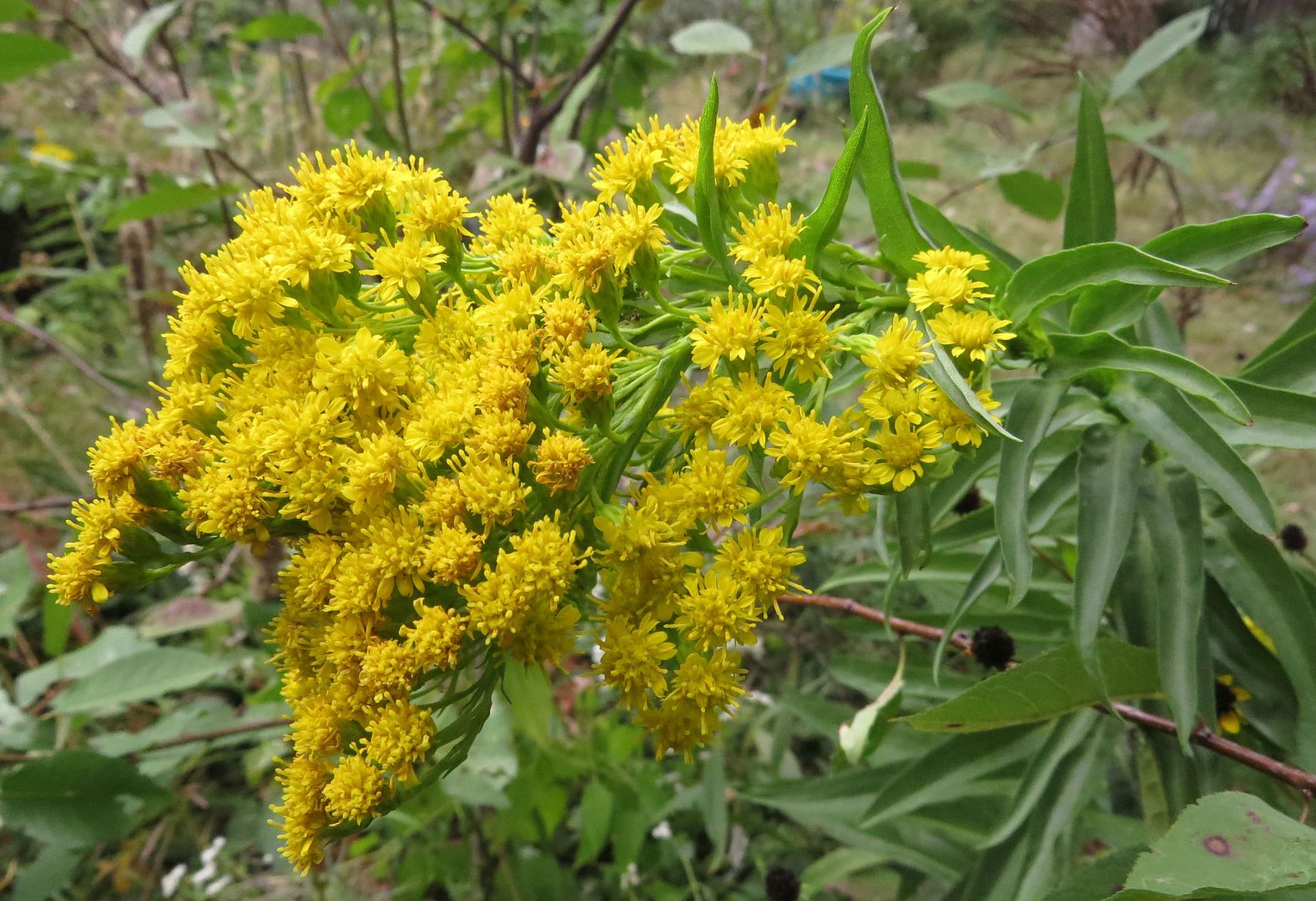
Also flowering were several different types of Goldenrod. Seaside Goldenrod is usually the showiest but the leaves on this one caught my eye this year. I'm at a loss to say what species this is, either Solidago tenuifolia or Solidago graminifolia, leaning toward the former. Growing in the bog where the soil is rich with sand and salt, however these conditions might make them look different than specamins growing in clay and without the added salinity.