Tuesday, March 25, 2014
Some Men Just Want to Watch the Whole World (Prescribed) Burn
This is the most bad ass thing I've ever seen.
Monday, March 24, 2014
Some Early Flowers
I saw a "meme" the other day... Basically it's a single picture usually with a sentence or caption to convey a quick thought. This one showed a whole bunch of different types of flowers and most of them had an X over them because they weren't native. This was intended to tell people to plant native plants for pollinators over nonnatives. But there was no rhyme or reason to what they'd crossed out. The only two they hadn't crossed out was the New England Aster and Sunflowers, and while these were the only two natives on the list, they hardly feed pollinators adequately through the year. I'd say the earliest either of them would flower was in July.
 One of the plants crossed on was the Crocus. This is a nonnative bulb native to the mountains in northern Europe and Asia. To be perfectly honest, I don't know why they crossed it off. It's good to be a purest about natives and all but if your goal is pollinator diversity then surely planting anything that's pollinator friendly would work. What they should have done was listed a bunch of invasive plants with natives or even mixed flowers from around the world that aren't invasive and crossed out the bad ones.
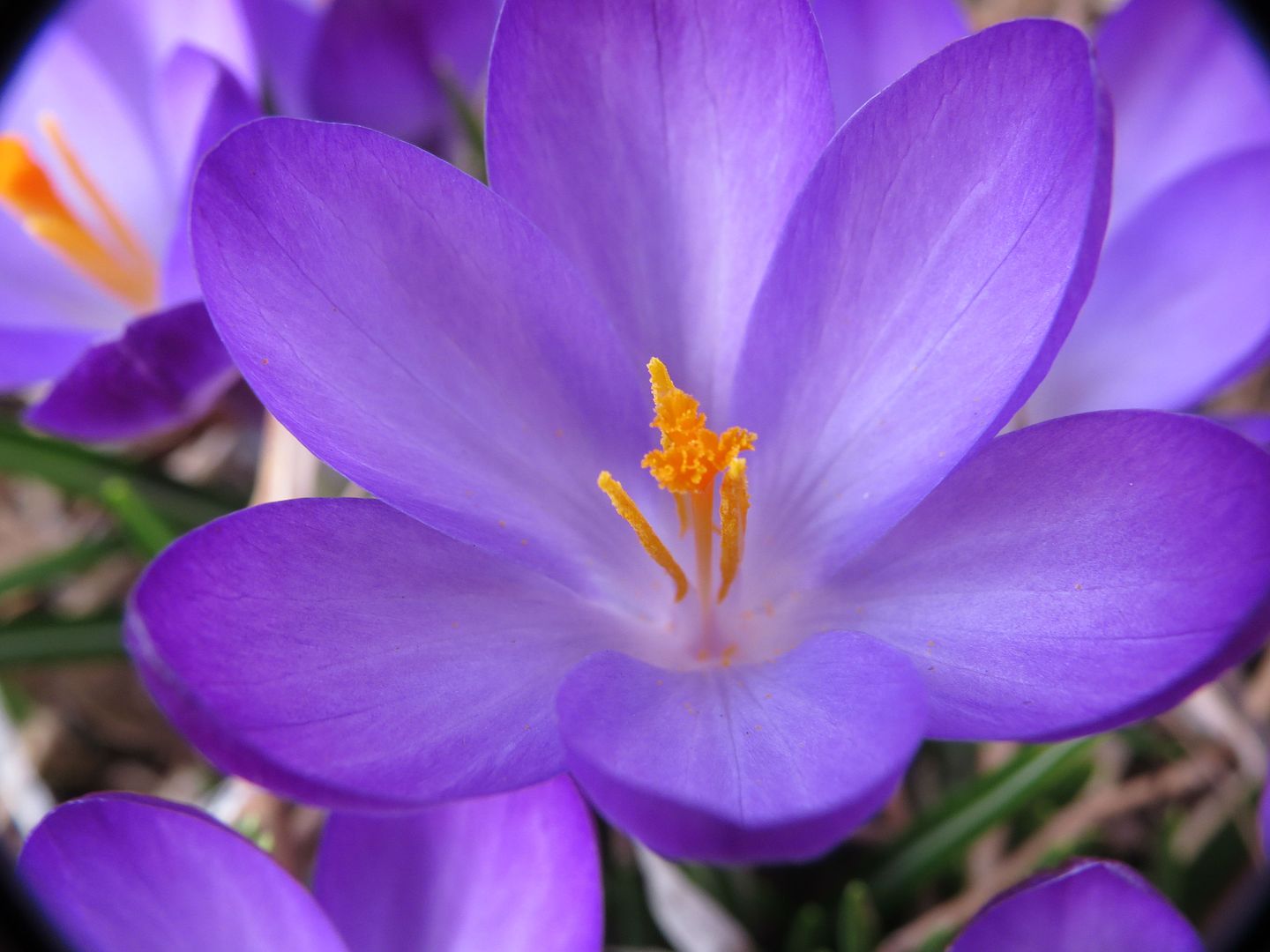 Crocuses on their own are not invasive, barely reproduce by seed, and take forever to form a clump. What's more they're easier to grow and flower earlier than most of our native ephemeral. They're a bright source of pollen for honeybees on the warmer days of later winter into spring, and don't crowd out other plants. They can actually be planted right in your lawn and allowed to spread modestly. After flowering they form a low clump of grass that later dies back in the summer.
 Natives blooming at this time are few and far between. Symplocarpus foetidus, Skunk Cabbage, is flowering out in the wetter parts of forests now but flies visit their foul smelling flowers more often than bees.
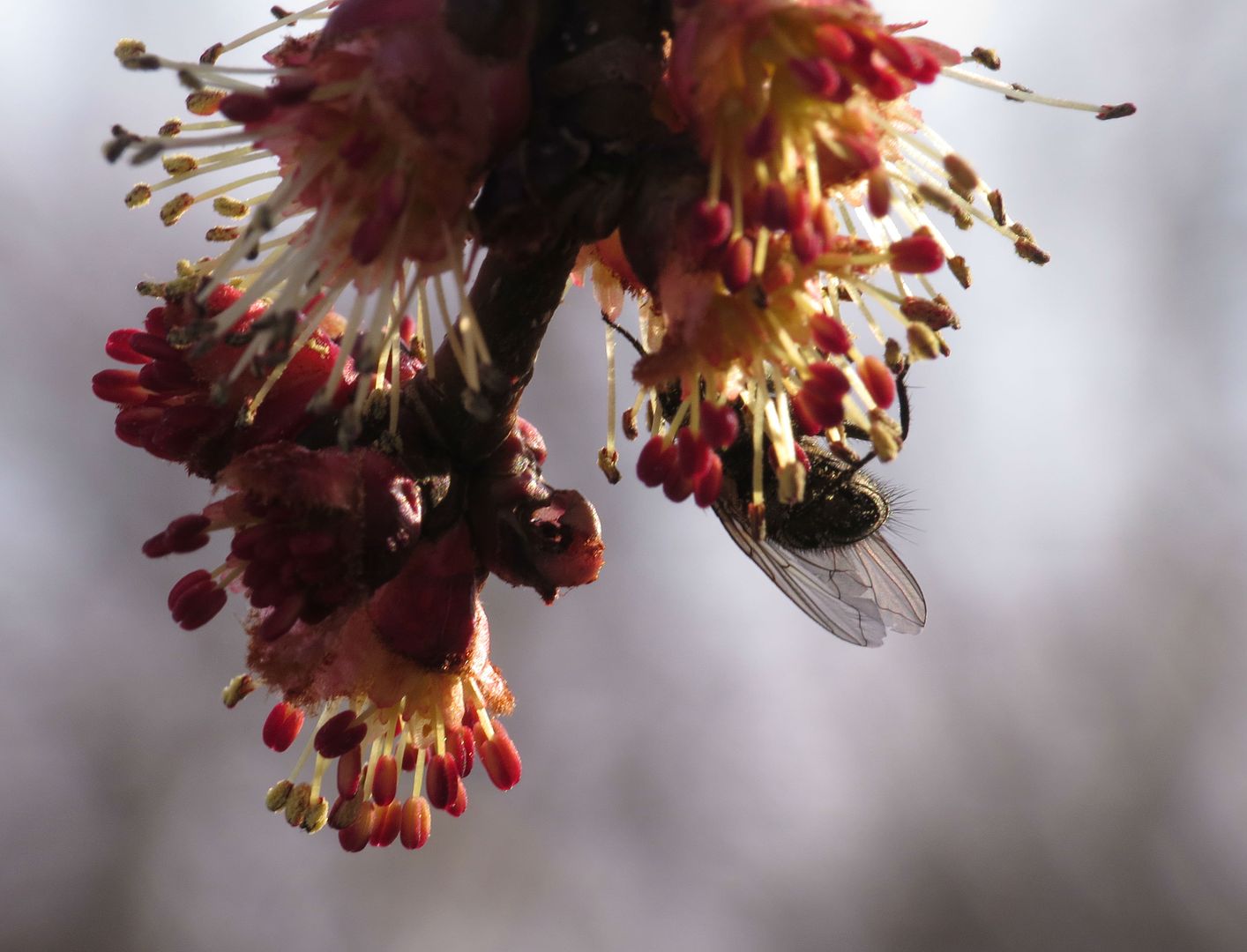 The earliest Maples, Acer sp, have also started flowering and will become the main source of early nectar in the coming weeks. Here I managed to find a common house fly pollinating the blooms on a low branch. There were a few bees about too but their images came out even worse than this one.
Willows, Salix sp, have also been flowering for a few weeks now but are only a source of pollen. Most shrubs in the genus are wind pollinated but insects can't help but collect it anyway.
So when it comes to pollinators we shouldn't be crossing plants off the list just because they're not native. The only ones that should be avoided are ones that are invasive, or perhaps double flowering and cultivated into sterility.
Native alternatives to Crocuses would be either Pasque flower (native to the mid-west) or Hepatica, but neither are flowering at this time as far as I know.
Willows, Salix sp, have also been flowering for a few weeks now but are only a source of pollen. Most shrubs in the genus are wind pollinated but insects can't help but collect it anyway.
So when it comes to pollinators we shouldn't be crossing plants off the list just because they're not native. The only ones that should be avoided are ones that are invasive, or perhaps double flowering and cultivated into sterility.
Native alternatives to Crocuses would be either Pasque flower (native to the mid-west) or Hepatica, but neither are flowering at this time as far as I know.
Monday, March 10, 2014
Flowers and the Flowershow


My hives seems to have survived the winter, and they were bringing in all sorts of pollen. Despite off and on snow storms (with some more on the way even!) crocuses and some willow trees have started to flower. Snowdrops are also in bloom here but not as abundant as the others. I see maple tree buds are starting to swell so it's good to see spring is coming.

 |
| Balls? |
 |
| Knitting needles with doughnuts? |

The theme was "Articulture" which combine the thrill of art with the boredom of wandering an art museum. But it lacked the history and signatures of the great minds that helped create. Art museums tend to be laid out in a specific way, grouping like-pieces together from parts of the world or periods in history. It's interesting to see in the older pieces how subdued and orange-like the reds are because no one knew how to make the ruby red lipstick shades we have today. It was somehow more practical to use real gold instead of yellow at the time too. No one knew how to draw three dimensional spaces yet and portraits were generalized, almost caricature-like. Eventually we see more colors coming into play, and portraits start to look more and more like people. Sadly there wasn't a whole lot of that going on except for one area in the back.


Show me Dutch Wave, Cottage Style Garden, Naturalistic Style and turn that into a painting so it doesn't just look like another landscape.
It was an okay theme this year, just not fully envisioned to its potential or perhaps taken in more by the idea of modern art. Paintings as a commodity, a speculative bubble waiting to burst just as the Tulip craze did so many years ago.
Tuesday, February 25, 2014
Dutch Tulip Mania
This is a neat documentary about how Tulips have driven people crazy throughout history. Can you imagine a single tulip bulb more expensive than your house? As I'm going to the Philadelphia International Flower Show later this week I figure I should probably brush up on my bulbs.
Friday, February 21, 2014
Urban Forestry 13: The Role of Urban Forests in Biodiversity Restoration
I found this video earlier today and thought I'd share it here. This is the short version of Doug Tallamy's lecture. I know he can talk for longer and he keeps your attention just as well. He's also a magnificent bird photographer though it doesn't show that well in this particular lecture.
Thursday, February 13, 2014
Romantic Ants
The folks that produce The Brain Scoop have another exciting video, this time on ants.
Thursday, February 6, 2014
Monarch Butterfly Updates
Alright so Monarch numbers are in for the year thanks to the folks over at Monarch Watch.... and they are dreadful looking.
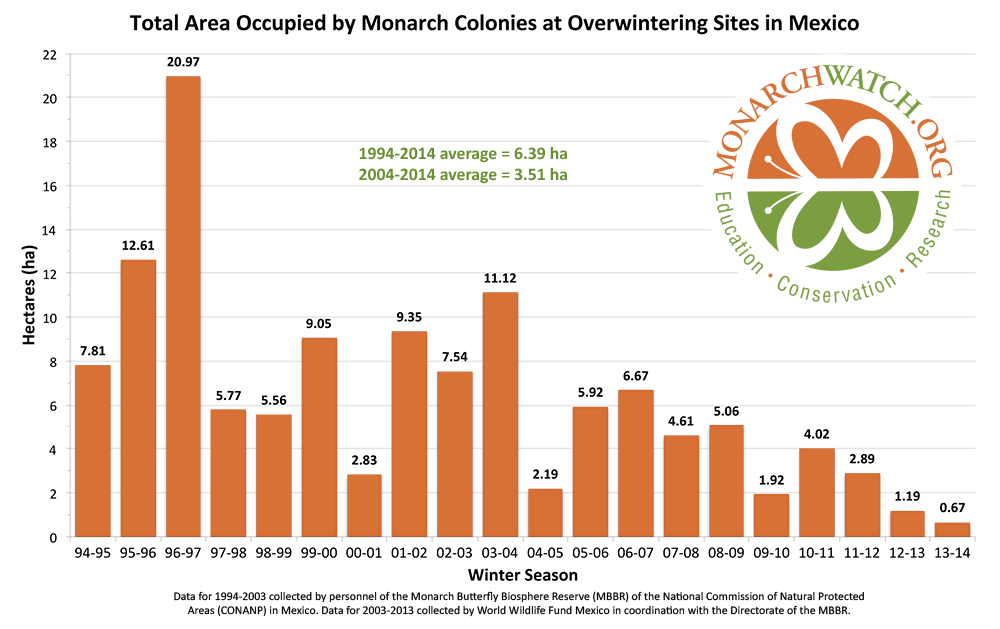 It's uncommon to see winged insects fall off a cliff, but there you have it.
So with this news I've been seeing a lot of "How You Can Help The Monarch Butterfly" lists out there. One of which is from Journey North which I'd like to run through right now.

#1. Plant Native Milkweed. This goes without saying. Although, the jury is still out on planting Tropical Milkweed which some say causes the migrating females to lay eggs when they should be heading to Mexico. That being said I sure see a lot of conservationists including the folks at Monarch Watch growing that species. It's a fast growing annul that's good for the spring and summer, but come August they should probably be torn down.
#2 Provide Nectar Plants. I highly recommend Meadow Blazingstar, Liatris ligulistylis, and New England Asters, Symphyotrichum novae-angliae and generally any of the late flowering Goldenrod species, Solidago. On the nonnative front I've seen them on Zinnias and Mexican Sunflowers. Butterfly Bush is also a hotspot but should not be grown near wetland ares! They can shade out whole communities of carnivorous plants and orchids when they escape into the wild.
#3 Avoid Pesticides.... Duh... Though to this point, a lot of people are confused on the issue of neonicotinoids. I personally believe they're safer because farmers don't have to spray every week and/or after it rains. That being said, it has been found that the pesticide does end up in the nectar and pollen more than previously thought. However, I don't think it's being used on anything that the Monarchs are feeding from, nor should it. Corn and Soy aren't exactly on top of that list. The real issue here is the fact that you can buy these chemicals at just about any hardware store. This class of pesticides is far too powerful to trust the general public and landscaping companies with. Continued in #5 below.
#4 Report your Monarch Observations. There are a number of apps and social groups you can do this with. Journey North has one that covers more than just Monarchs.
#5 Limit Mowing. There is a 1 to 1 ratio with number of species vs. habitat. So when you eliminate dead zones such as lawns you increase the carrying capacity of the number of species. Milkweed though is an exception because it's host more than just Monarch Butterflies. Milkweed Beetles, two types of true bugs, Oleander aphids, and if you're farther south in the US you get the Queen and Soldier Butterfly too. Not to mention they're rich with nectar.
Going back to elaborate the point in #3, A big problem with carrying capacity is the use of monoculture whether it's grass in your lawn, or corn in your field. The folks at Monarch Watch keep talking about Round-Up Ready crops that eliminate common milkweed from fields... but I think the bigger issue is that they've greatly expanded the fields! Gone are the hedgerows that used to separate the property lines of family farms. Even if you were to plant nothing but milkweed eventually the parasites and diseases would eliminate most of the species the rely on that plant. Diverse communities of crops and flowering plants are best. There should be emphasis on native plants where applicable, though of course food crops don't have to be native so long as they're not invasive.
But more to the point of just Not Mowing in General. Uncut lawns look awful unless they're uniformly planted with particular types of grasses and wildflowers, which your average lawn does not have. Rather than not mow, consider installing a meadow, or planting a garden. Even if you are using the store bought perennials from Asia you can buy at any nursery, you're still providing more food in the way of pollen and nectar and potentially seeds and fruit for the environment. Native plants are always best because they're 40 times more likely to host the 11,000 plus species of Lepidoptera (moths and butterflies) we have in North America.
#6 Avoid Pesticides... again. They list this twice but on a community basis now. Lots of landscaping companies will use a generic "weed & feed" and other chemicals that might not be necessary.
#7 Support Beneficial Farming Practices. As I said above, diversity is key. I'm not a huge fan of "organic" but more power to you if you do. A lot of crops, even when planted in diverse fields still get pests, and a lot of invasive plants and insects simply can not be controlled without chemicals.
#8 Build Community Support. Get the neighbors involved... or start a blog like I did. I'm a member of the New Jersey Native Plant Society and I'm a strong advocator of pretty much everything the Mt. Cuba Center does. Chances are your state has a native plant society of its own, or space in a public library that's just itching for you to start one.
#9 Contribute to Conservation Efforts. This is self explanatory.
So with this news I've been seeing a lot of "How You Can Help The Monarch Butterfly" lists out there. One of which is from Journey North which I'd like to run through right now.
#1. Plant Native Milkweed. This goes without saying. Although, the jury is still out on planting Tropical Milkweed which some say causes the migrating females to lay eggs when they should be heading to Mexico. That being said I sure see a lot of conservationists including the folks at Monarch Watch growing that species. It's a fast growing annul that's good for the spring and summer, but come August they should probably be torn down.
#2 Provide Nectar Plants. I highly recommend Meadow Blazingstar, Liatris ligulistylis, and New England Asters, Symphyotrichum novae-angliae and generally any of the late flowering Goldenrod species, Solidago. On the nonnative front I've seen them on Zinnias and Mexican Sunflowers. Butterfly Bush is also a hotspot but should not be grown near wetland ares! They can shade out whole communities of carnivorous plants and orchids when they escape into the wild.
#3 Avoid Pesticides.... Duh... Though to this point, a lot of people are confused on the issue of neonicotinoids. I personally believe they're safer because farmers don't have to spray every week and/or after it rains. That being said, it has been found that the pesticide does end up in the nectar and pollen more than previously thought. However, I don't think it's being used on anything that the Monarchs are feeding from, nor should it. Corn and Soy aren't exactly on top of that list. The real issue here is the fact that you can buy these chemicals at just about any hardware store. This class of pesticides is far too powerful to trust the general public and landscaping companies with. Continued in #5 below.
#4 Report your Monarch Observations. There are a number of apps and social groups you can do this with. Journey North has one that covers more than just Monarchs.
#5 Limit Mowing. There is a 1 to 1 ratio with number of species vs. habitat. So when you eliminate dead zones such as lawns you increase the carrying capacity of the number of species. Milkweed though is an exception because it's host more than just Monarch Butterflies. Milkweed Beetles, two types of true bugs, Oleander aphids, and if you're farther south in the US you get the Queen and Soldier Butterfly too. Not to mention they're rich with nectar.
Going back to elaborate the point in #3, A big problem with carrying capacity is the use of monoculture whether it's grass in your lawn, or corn in your field. The folks at Monarch Watch keep talking about Round-Up Ready crops that eliminate common milkweed from fields... but I think the bigger issue is that they've greatly expanded the fields! Gone are the hedgerows that used to separate the property lines of family farms. Even if you were to plant nothing but milkweed eventually the parasites and diseases would eliminate most of the species the rely on that plant. Diverse communities of crops and flowering plants are best. There should be emphasis on native plants where applicable, though of course food crops don't have to be native so long as they're not invasive.
But more to the point of just Not Mowing in General. Uncut lawns look awful unless they're uniformly planted with particular types of grasses and wildflowers, which your average lawn does not have. Rather than not mow, consider installing a meadow, or planting a garden. Even if you are using the store bought perennials from Asia you can buy at any nursery, you're still providing more food in the way of pollen and nectar and potentially seeds and fruit for the environment. Native plants are always best because they're 40 times more likely to host the 11,000 plus species of Lepidoptera (moths and butterflies) we have in North America.
#6 Avoid Pesticides... again. They list this twice but on a community basis now. Lots of landscaping companies will use a generic "weed & feed" and other chemicals that might not be necessary.
#7 Support Beneficial Farming Practices. As I said above, diversity is key. I'm not a huge fan of "organic" but more power to you if you do. A lot of crops, even when planted in diverse fields still get pests, and a lot of invasive plants and insects simply can not be controlled without chemicals.
#8 Build Community Support. Get the neighbors involved... or start a blog like I did. I'm a member of the New Jersey Native Plant Society and I'm a strong advocator of pretty much everything the Mt. Cuba Center does. Chances are your state has a native plant society of its own, or space in a public library that's just itching for you to start one.
#9 Contribute to Conservation Efforts. This is self explanatory.
Friday, January 31, 2014
EcoBeneficial Interview: Dr. Doug Tallamy In His Garden on the Importanc...
Kim Eierman has a rather nice Youtube channel and website, EcoBeneficial where she interviews Doug Tallamy in a number of videos. Above is the longest of them so far but there are others where Doug walks around his garden a little showing off different native plants and caterpillars.
Monday, January 27, 2014
Sunday, January 19, 2014
Vanilla Ice Goes Amish
I just found out that this was a thing.
There is an alarming amount of people who "live off the grid" but also have their own TV shows.
There is an alarming amount of people who "live off the grid" but also have their own TV shows.
Subscribe to:
Posts (Atom)