Thursday, March 2, 2017
Thursday, February 23, 2017
Thursday, February 16, 2017
Sunday, January 22, 2017
The Plant List, So Far
Around this time each year I start to form a plant list. I don't bother with a whole lot of seeds except for annuals like Sunflowers and filler annuals I like more for sentimental reasons and color. The focus is more on plugs and bare roots, often things that will flower in late summer and autumn.
Phlox 'jeana'
I don't have actual photos of this cultivar, but I was at the Mt. Cuba Center in the fall where they're currently doing a trial run of basically all the true species and cultivars on the market today. They said of all of the verities available this one had twice as many butterflies on it compared to all the rest. They noted the flowers were smaller than most other Phlox which likely makes it easier for the butterflies to work, but other factors like nectar quality and fragrance probably also play a roll. A failing might be that it's otherwise fairly average besides. Flowering wise I'm told other verities did better at offering blooms later int he year so it's still good to diversify. I'm looking forward to their complete trial when it's released in the next year or two.

Ironweed, Vernonia angustifolia 'Plum Peachy'
This perennial turns into a bush of purple flowers in late summer.
I tried planting it in the autumn once but it failed to survive the winter. I think if I plant it in the spring it will have a better chance of establishing.
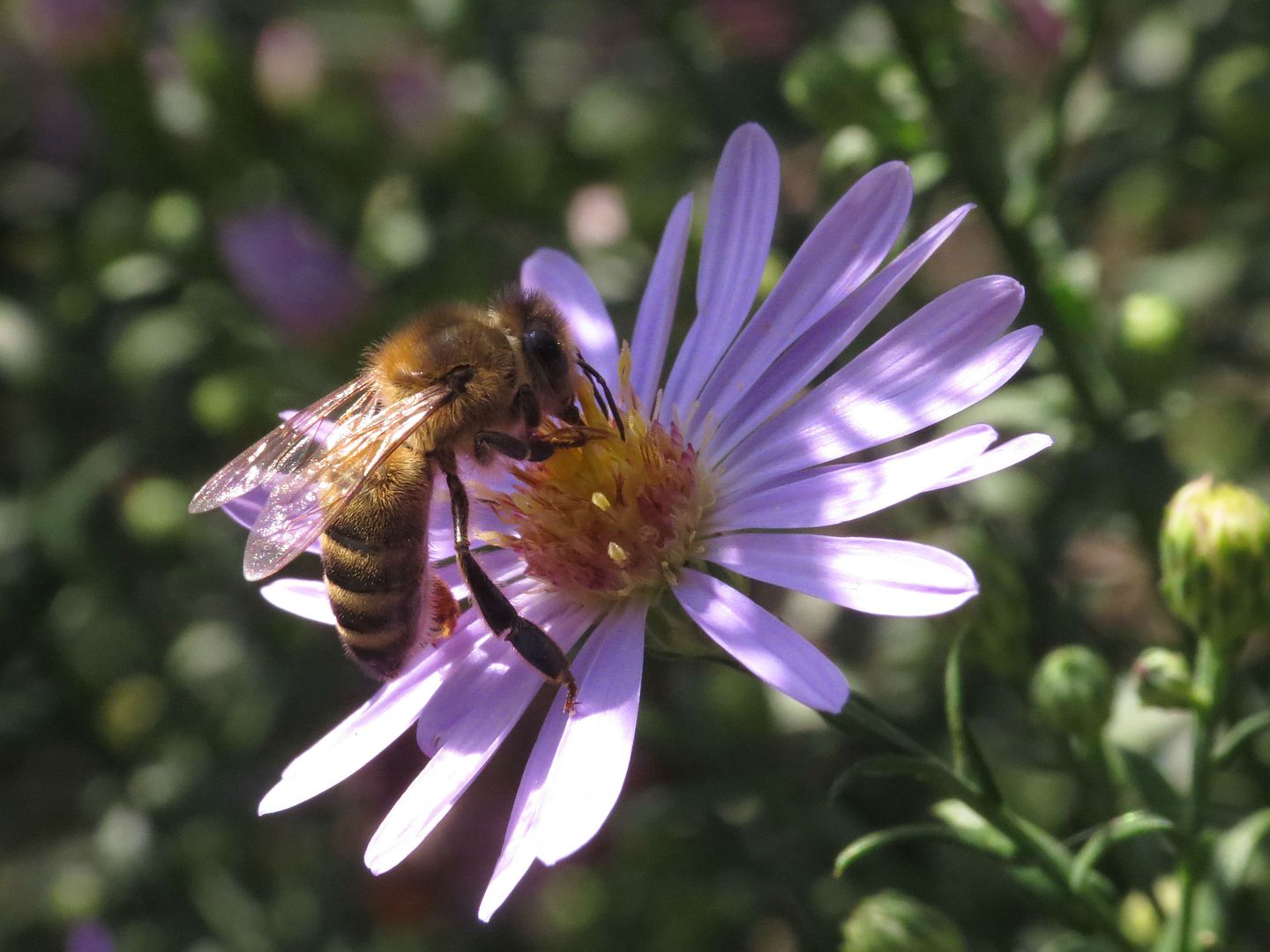
Aster leavis, 'Bluebird' (actually this is Symphyotrichum leavis but no one seems to care.)
My picture really doesn't do this plant any justice. I have a few planted and love them all, sadly they're not in the most photogenic of places. The one I have nest to a tree with a bird feeder next to it so the squirrels are always snapping the stems off the thing. Even with several dozen stems snapped though it still manages to impress me with tall pyramids of flowers. The perfect compliment to Showy Goldenrod.
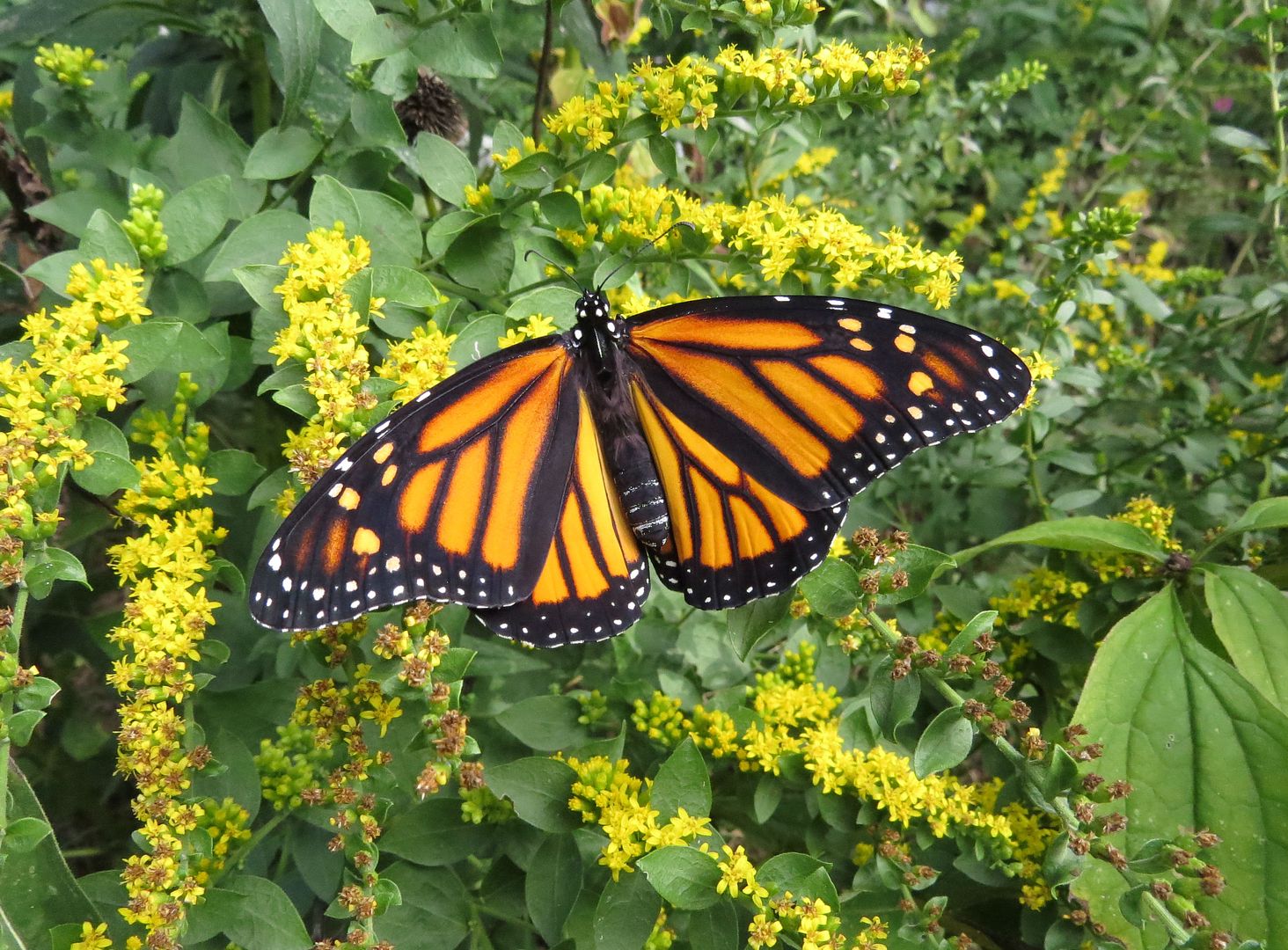
Cliff Goldenrod, Solidago drummondii
I bought this plant from some random nursery online and didn't expect much of it. Now that it's established I'm surprised it's not more popular. A failing, if you can call it that, is it forms a rosette of leaves with a couple dozen stems arching out in all directions. The stems tend to get a little long and arch all the way to the ground. I think it's because of the soil I'm growing it in though, too rich. In nature I believe this is meant to be a rock garden plant (hence the name) where the soils tend to be nutrient deprived.
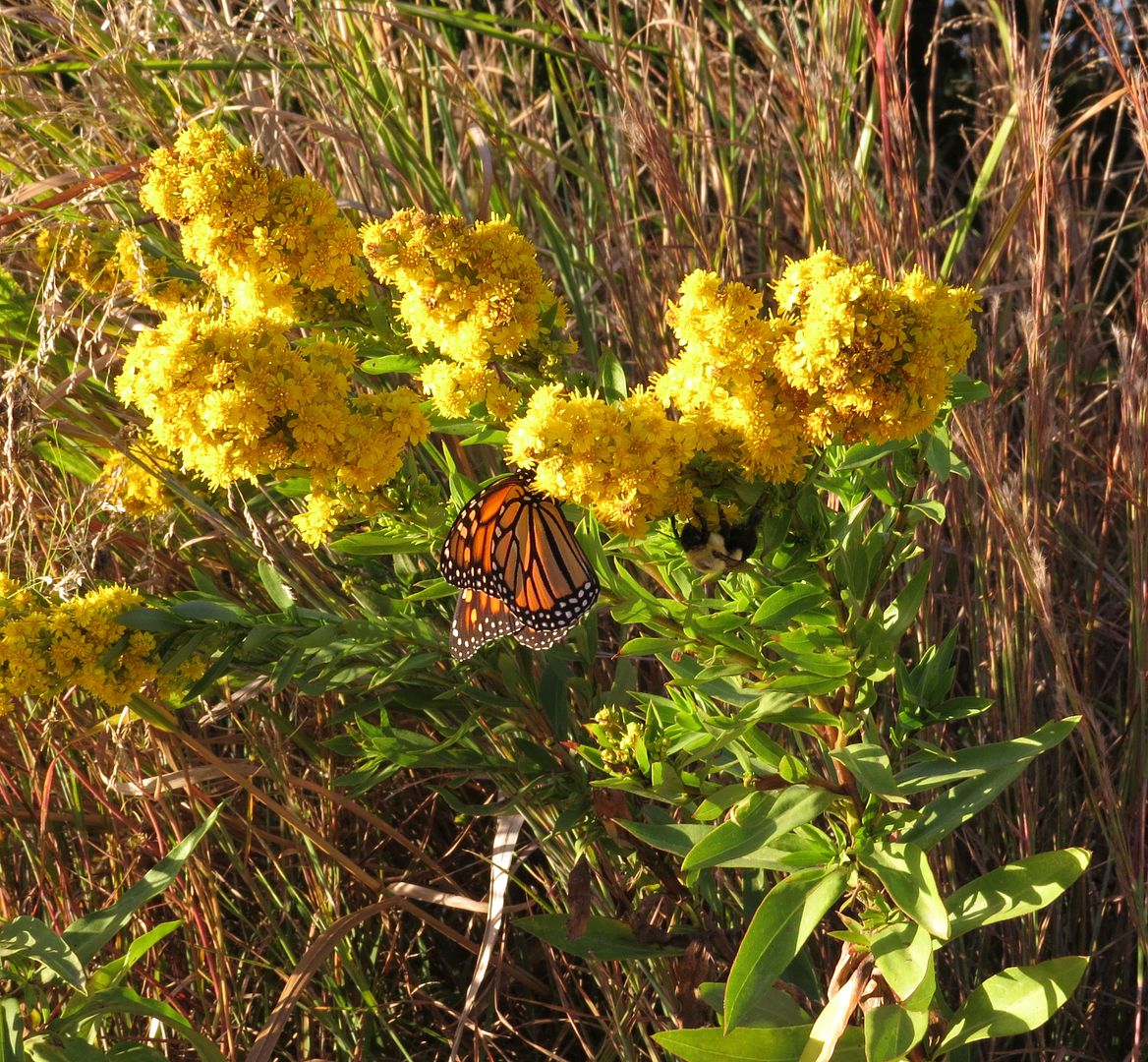
Stiff Goldenrod, Solidago rigida, Actually what's pictured above is Seaside Goldenrod but the two species look similar. They still have broad leaves at the bottom, but Stiff Goldenrod has more flat top flower heads.
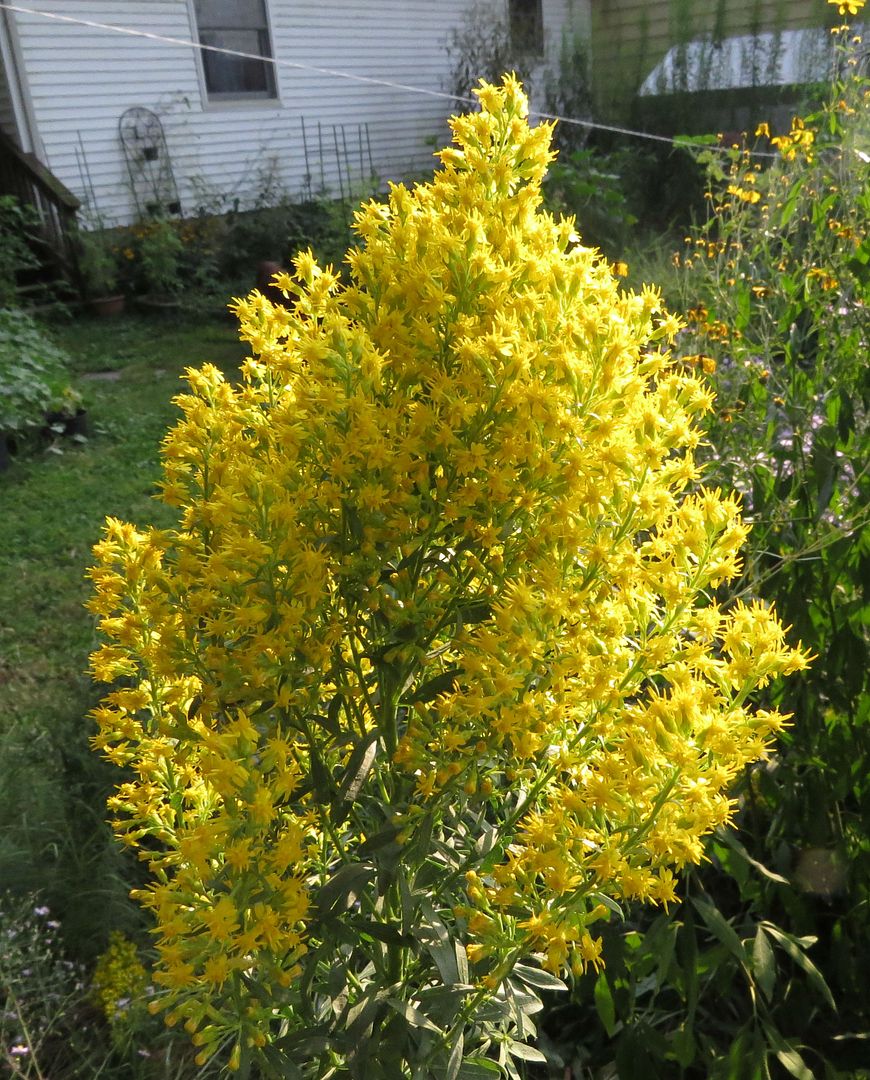
Showy Goldenrod, Solidago speciosa
This plant lives up to its name very well.... when it grows right. I bought it because I needed plants for my meadow garden which is dry clay but after flowering great for two years the plants slowly petered out. It's either a short lived perennial or benefits from slightly wetter conditions. Whatever the case I'm willing to give it another chance, perhaps in a more formal setting.
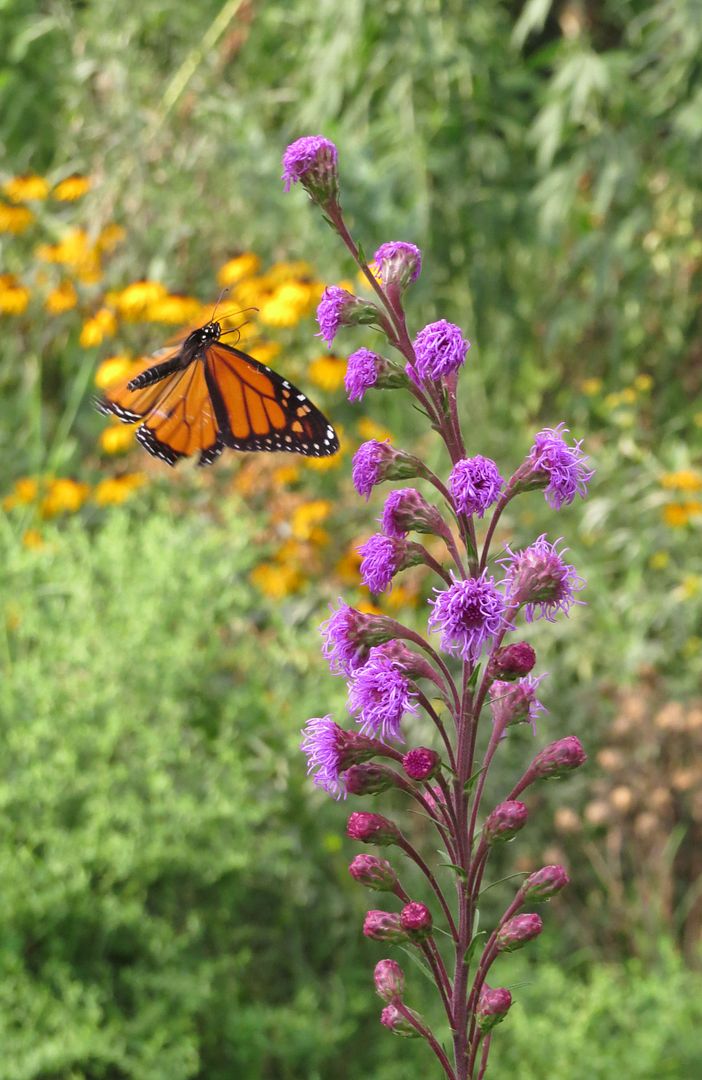
Meadow Blazing Star, Liatris ligulistylis
Same issue as the Showy Goldenrod. I plant these in the Meadow Garden and they do great for two years (being a biannual) but don't reseed on their own. I do have one that has lasted the test of time but it's planted next to our pond. So I'm thinking if I plant more of them in slightly wetter locations, they'll do better.
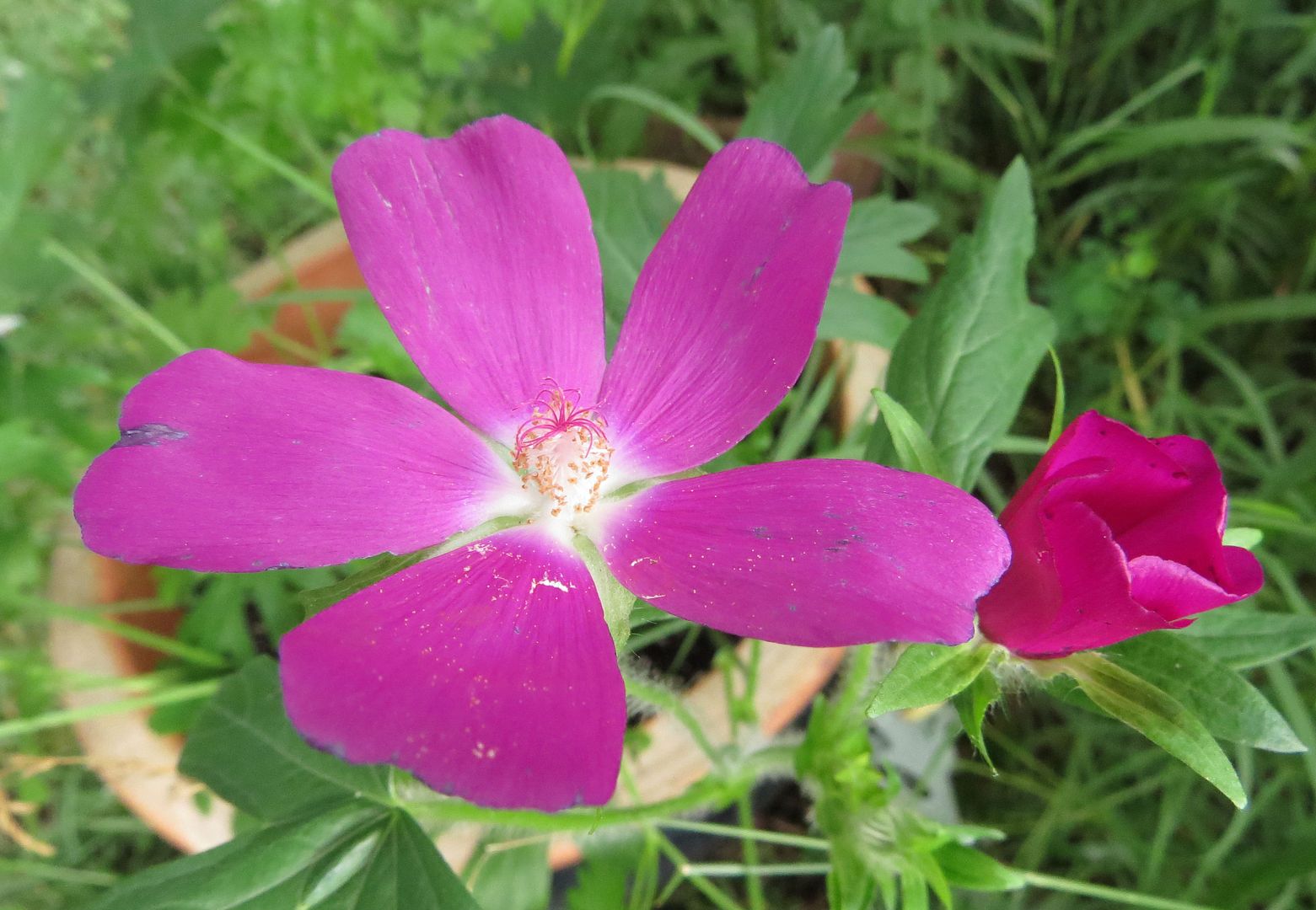
Bush's Poppy Mallow, Callirhoe bushii
This is a fantastic burst of color. Originally I was against planting these because it's not really a true meadow plant, at least not a plant everyone instantly thinks of when they think of a short grass prairie. Their distribution threw out the US is somewhat limited as well (to the point of being threatened in the wild). Something I noticed about the plant though is that they do well in dry conditions.... making it the perfect candidate for my meadow garden where few other natives seem to be able to establish.
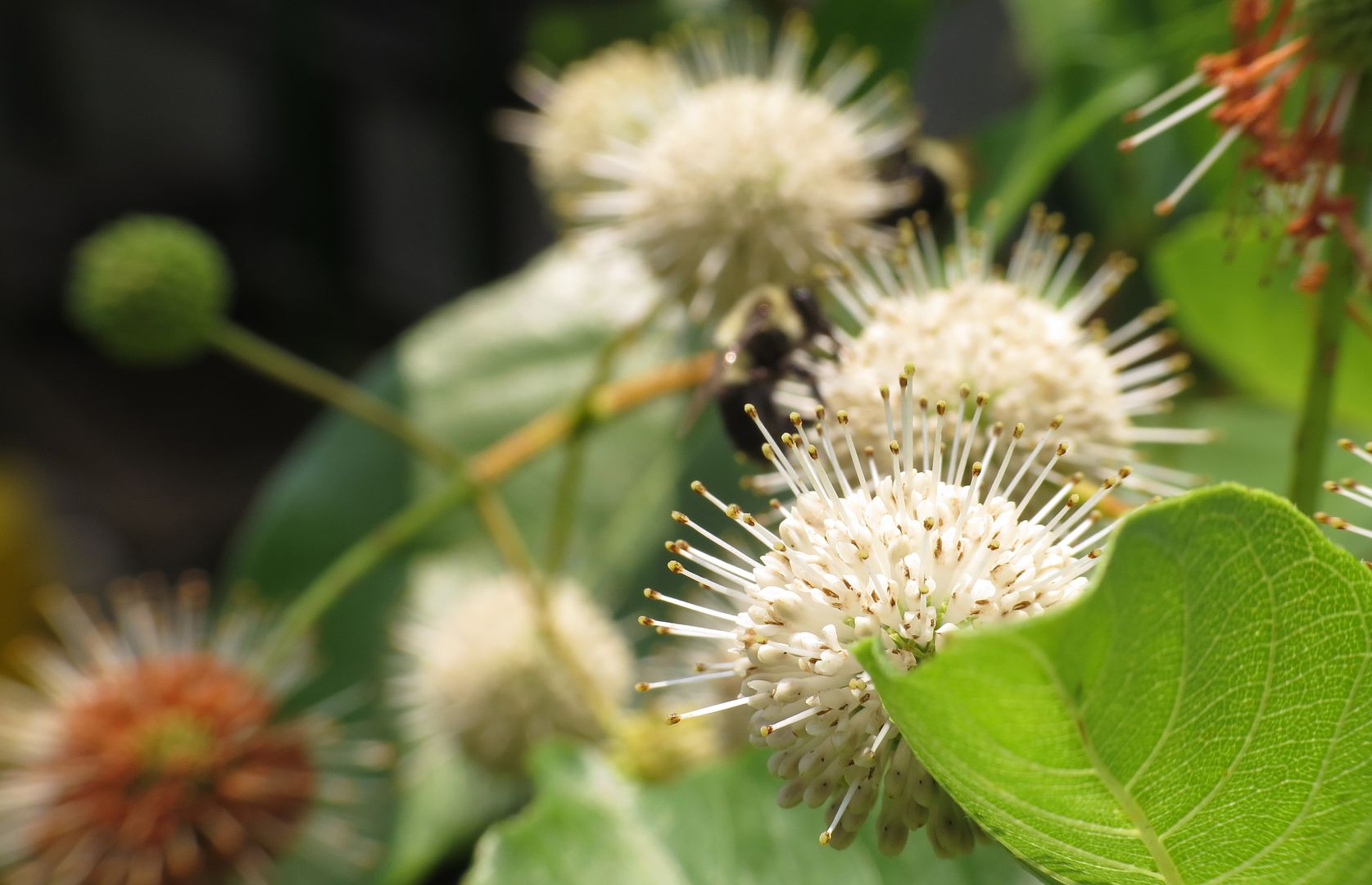
I'm also tempted to buy a second Button Bush. The one I currently have is doing okay, but has a dead limb or two I need to cut out. Also I saw it advertised for in an actual garden brochure I got in the mail. This species is rarely sold and I'd like to support that. I would liken it to Butterfly Bush in terms of attention but it has a far more limited bloom time.
Phlox 'jeana'
I don't have actual photos of this cultivar, but I was at the Mt. Cuba Center in the fall where they're currently doing a trial run of basically all the true species and cultivars on the market today. They said of all of the verities available this one had twice as many butterflies on it compared to all the rest. They noted the flowers were smaller than most other Phlox which likely makes it easier for the butterflies to work, but other factors like nectar quality and fragrance probably also play a roll. A failing might be that it's otherwise fairly average besides. Flowering wise I'm told other verities did better at offering blooms later int he year so it's still good to diversify. I'm looking forward to their complete trial when it's released in the next year or two.
Ironweed, Vernonia angustifolia 'Plum Peachy'
This perennial turns into a bush of purple flowers in late summer.
I tried planting it in the autumn once but it failed to survive the winter. I think if I plant it in the spring it will have a better chance of establishing.
Aster leavis, 'Bluebird' (actually this is Symphyotrichum leavis but no one seems to care.)
My picture really doesn't do this plant any justice. I have a few planted and love them all, sadly they're not in the most photogenic of places. The one I have nest to a tree with a bird feeder next to it so the squirrels are always snapping the stems off the thing. Even with several dozen stems snapped though it still manages to impress me with tall pyramids of flowers. The perfect compliment to Showy Goldenrod.
Cliff Goldenrod, Solidago drummondii
I bought this plant from some random nursery online and didn't expect much of it. Now that it's established I'm surprised it's not more popular. A failing, if you can call it that, is it forms a rosette of leaves with a couple dozen stems arching out in all directions. The stems tend to get a little long and arch all the way to the ground. I think it's because of the soil I'm growing it in though, too rich. In nature I believe this is meant to be a rock garden plant (hence the name) where the soils tend to be nutrient deprived.
Stiff Goldenrod, Solidago rigida, Actually what's pictured above is Seaside Goldenrod but the two species look similar. They still have broad leaves at the bottom, but Stiff Goldenrod has more flat top flower heads.
Showy Goldenrod, Solidago speciosa
This plant lives up to its name very well.... when it grows right. I bought it because I needed plants for my meadow garden which is dry clay but after flowering great for two years the plants slowly petered out. It's either a short lived perennial or benefits from slightly wetter conditions. Whatever the case I'm willing to give it another chance, perhaps in a more formal setting.
Meadow Blazing Star, Liatris ligulistylis
Same issue as the Showy Goldenrod. I plant these in the Meadow Garden and they do great for two years (being a biannual) but don't reseed on their own. I do have one that has lasted the test of time but it's planted next to our pond. So I'm thinking if I plant more of them in slightly wetter locations, they'll do better.
Bush's Poppy Mallow, Callirhoe bushii
This is a fantastic burst of color. Originally I was against planting these because it's not really a true meadow plant, at least not a plant everyone instantly thinks of when they think of a short grass prairie. Their distribution threw out the US is somewhat limited as well (to the point of being threatened in the wild). Something I noticed about the plant though is that they do well in dry conditions.... making it the perfect candidate for my meadow garden where few other natives seem to be able to establish.
I'm also tempted to buy a second Button Bush. The one I currently have is doing okay, but has a dead limb or two I need to cut out. Also I saw it advertised for in an actual garden brochure I got in the mail. This species is rarely sold and I'd like to support that. I would liken it to Butterfly Bush in terms of attention but it has a far more limited bloom time.
Monday, January 2, 2017
2017 Project Goals
Due to setbacks this past year I wasn't quite able to get out any new ant or bee related videos, at least not of a decent length. I have footage but it's not really enough to call an episode and barely enough to call a segment of something bigger. So for this up coming year I hope to get more footage on a variety of topics to flesh out these segments.
A Video of Wildflowers
I grow a number of these in my yard and they're beautiful though my yard isn't the prettiest setting for a video, hence a lot of my macro heavy photos of them. I'll also likely be visiting the Mt. Cuba Center for more material on this. I may even title the video Wildflowers of the Mt. Cuba Center because that place has been nothing but brilliant inspiration.
Another thing I'd love to do one year is set out baits at the Mt. Cuba Center to see what species of ants they have in the woodland gardens. They are technically gardens but mostly planted as a woodland setting in sweeps to look somewhat natural. So it's not really simulating a garden but also not really simulating nature as we'd find it; it's something all its own in a lot of places. So I think that would be neat do a quick survey of. (I doubt they'd let me chop into logs and things for the more cryptic hunting species but these don't have much to do with "living" plants anyway.)
More Myrmecochory updates.
My wildflowers has been flourishing the past couple of years with small patches of it growing to look slightly Mt. Cuba-esque. Several new plants have started to sprout as a result of ants planting the seeds. It will only truly be rewarding for me when some of these plants make it to a flowering age, such as the very young Trilliums that have started coming up but we're still a few years off from that.
Exploring A Rotting Stump.
Almost a decade ago we had a Norway Maple chopped down and reduced to a waste high stump. It's now teaming with life including some rather hard to find ant species. I'd love to film more of this and do a video about it to show you all.
Lastly over this past year I started walking my dog at a different time of day. And I found out that just by doing that I was finding all sorts of ant species having nuptial flights, often with queen ants and males landing directly on me. One thing about the hobby a lot of people don't seem to get is just how easy it can be to find a queen ant. I'll admit though it does take some devotion. I might get a new point and shoot camera just for this task.
Anyway those are my 2017 goals. I hope I'm able to bring them all of them to life in the coming year.
A Video of Wildflowers
I grow a number of these in my yard and they're beautiful though my yard isn't the prettiest setting for a video, hence a lot of my macro heavy photos of them. I'll also likely be visiting the Mt. Cuba Center for more material on this. I may even title the video Wildflowers of the Mt. Cuba Center because that place has been nothing but brilliant inspiration.
Another thing I'd love to do one year is set out baits at the Mt. Cuba Center to see what species of ants they have in the woodland gardens. They are technically gardens but mostly planted as a woodland setting in sweeps to look somewhat natural. So it's not really simulating a garden but also not really simulating nature as we'd find it; it's something all its own in a lot of places. So I think that would be neat do a quick survey of. (I doubt they'd let me chop into logs and things for the more cryptic hunting species but these don't have much to do with "living" plants anyway.)
More Myrmecochory updates.
My wildflowers has been flourishing the past couple of years with small patches of it growing to look slightly Mt. Cuba-esque. Several new plants have started to sprout as a result of ants planting the seeds. It will only truly be rewarding for me when some of these plants make it to a flowering age, such as the very young Trilliums that have started coming up but we're still a few years off from that.
Exploring A Rotting Stump.
Almost a decade ago we had a Norway Maple chopped down and reduced to a waste high stump. It's now teaming with life including some rather hard to find ant species. I'd love to film more of this and do a video about it to show you all.
Lastly over this past year I started walking my dog at a different time of day. And I found out that just by doing that I was finding all sorts of ant species having nuptial flights, often with queen ants and males landing directly on me. One thing about the hobby a lot of people don't seem to get is just how easy it can be to find a queen ant. I'll admit though it does take some devotion. I might get a new point and shoot camera just for this task.
Anyway those are my 2017 goals. I hope I'm able to bring them all of them to life in the coming year.
Sunday, January 1, 2017
I Survived 2016
Well this has probably been the worst year in recent memory.
On A Personal Level:
My grandfather passed away over the summer and I found myself saying things I never thought I would have. Things like "I don't want to stay for the whole funeral. I was there when they pulled the plug on him on that's more than several of my cousins can say." To put that into context I was just going to pay my respects to my grandmother and graciously then leave. Instead what happened was I was lined up with other family members and had to shake hands over three-hundred friends of the family including a couple dozen servicemen and fire fighters. To enter the parking lot you had to drive under two ladder truck with the American flag hanging between them. There were two chaplains who each had something to say, neither wishing to graciously step down as both had been tremendous friends with my grandfather. The only odd moment came when it was time for two military personnel to preform the flag ceremony. They were a man of color and a women which was presumable intentional, though that wasn't the odd part. He'd been cremated so there was no casket for the flag to be laid upon before hand, thus it was already folded... so a room of 300 plus people watched two military personal unfold a flag, then fold it back up again.
At the reception I had to face a grim realization. When I posted the details of my grandfather's funeral on Facebook it received 91 likes and an uncounted number of comments of support and condolences.. of whom only one person attended from my social circle. Oddly enough it was the one person who I made the above statement to. He saved me a seat and stayed with me the whole night. He took pictures of everything and even tried to get some of his friends to stop by.
On A Political Level:
Hopefully four years from now we'll be able to look back and laugh. You know, like that time the president made fun of cripples and grabbing women inappropriately. Not that Hillary Clinton was any prize. She offered nothing more than what Bernie Sanders wasn't offering in spade. And my friends were personally screwed over by the DNC for supporting Bernie and getting his name on the ballet. WHY they were even invited to Hillary's announcement celebration only to be kicked out by seat fillers simply because they went to use the rest room just shows how stupid political parties can get.
In a nut shell, no matter who the president is, they are virtually powerless to do anything without the Senate and House of Representatives under the control of the same political party. Even if Bernie Sanders had won the Democratic ticket and won the election, I don't believe for one second that he could have done half the stuff he promised he would do. Hillary Clinton may not have been perfect but at least the crap being said about her sounded like something that would happen to a politician.
I don't understand the E-mail controversy and hope not to. I know this sounds odd but I really don't care about the content of her E-mails. The fact that her E-mails were able to be leaked in the first place is the Red Flag that makes her unfit to be president. Whether it was just spam she was receiving or the nuclear launch codes, this shouldn't be getting out there. On the other hand though I was hearing people saying things like "She is directly responsible for the deaths of ...." however many people died. No, that would be like saying anyone who gets hacked is directly funding terrorism.
Anyway the election is over and Donald Trump is president which may or may not have been because Russia hacked the system, or maybe more likely Facebook algorithms keep people trapped inside of social network vacuums. Now that the election is over it's WAY more apparent to me. All the people who were writing those articles to push the buttons of people to get them to click their articles didn't know how to write actual news so they're still harping on the same old issues. I've made it a habit to remove these sources from my Facebook feed. It's really odd turning on CNN and hearing them report on Trump saying something that actually sounded like he'd make a great leader, instead of articles saying what he Tweeted at 4:00am.
Lastly, it was made clear to me that that gun ownership is a religion and I will treat it as such in the future.
On A Personal Level:
My grandfather passed away over the summer and I found myself saying things I never thought I would have. Things like "I don't want to stay for the whole funeral. I was there when they pulled the plug on him on that's more than several of my cousins can say." To put that into context I was just going to pay my respects to my grandmother and graciously then leave. Instead what happened was I was lined up with other family members and had to shake hands over three-hundred friends of the family including a couple dozen servicemen and fire fighters. To enter the parking lot you had to drive under two ladder truck with the American flag hanging between them. There were two chaplains who each had something to say, neither wishing to graciously step down as both had been tremendous friends with my grandfather. The only odd moment came when it was time for two military personnel to preform the flag ceremony. They were a man of color and a women which was presumable intentional, though that wasn't the odd part. He'd been cremated so there was no casket for the flag to be laid upon before hand, thus it was already folded... so a room of 300 plus people watched two military personal unfold a flag, then fold it back up again.
At the reception I had to face a grim realization. When I posted the details of my grandfather's funeral on Facebook it received 91 likes and an uncounted number of comments of support and condolences.. of whom only one person attended from my social circle. Oddly enough it was the one person who I made the above statement to. He saved me a seat and stayed with me the whole night. He took pictures of everything and even tried to get some of his friends to stop by.
On A Political Level:
Hopefully four years from now we'll be able to look back and laugh. You know, like that time the president made fun of cripples and grabbing women inappropriately. Not that Hillary Clinton was any prize. She offered nothing more than what Bernie Sanders wasn't offering in spade. And my friends were personally screwed over by the DNC for supporting Bernie and getting his name on the ballet. WHY they were even invited to Hillary's announcement celebration only to be kicked out by seat fillers simply because they went to use the rest room just shows how stupid political parties can get.
In a nut shell, no matter who the president is, they are virtually powerless to do anything without the Senate and House of Representatives under the control of the same political party. Even if Bernie Sanders had won the Democratic ticket and won the election, I don't believe for one second that he could have done half the stuff he promised he would do. Hillary Clinton may not have been perfect but at least the crap being said about her sounded like something that would happen to a politician.
I don't understand the E-mail controversy and hope not to. I know this sounds odd but I really don't care about the content of her E-mails. The fact that her E-mails were able to be leaked in the first place is the Red Flag that makes her unfit to be president. Whether it was just spam she was receiving or the nuclear launch codes, this shouldn't be getting out there. On the other hand though I was hearing people saying things like "She is directly responsible for the deaths of ...." however many people died. No, that would be like saying anyone who gets hacked is directly funding terrorism.
Anyway the election is over and Donald Trump is president which may or may not have been because Russia hacked the system, or maybe more likely Facebook algorithms keep people trapped inside of social network vacuums. Now that the election is over it's WAY more apparent to me. All the people who were writing those articles to push the buttons of people to get them to click their articles didn't know how to write actual news so they're still harping on the same old issues. I've made it a habit to remove these sources from my Facebook feed. It's really odd turning on CNN and hearing them report on Trump saying something that actually sounded like he'd make a great leader, instead of articles saying what he Tweeted at 4:00am.
Lastly, it was made clear to me that that gun ownership is a religion and I will treat it as such in the future.
Tuesday, September 20, 2016
Late Summer Anting
For personal reasons this year I decided not to have an official "Ant Together." The short story is that my grandfather unexpectedly passed away during the peak month that we would have had one. I found myself in this odd state of mine where I just wanted to skip everything required of me and not volunteer for certain family obligations... thus it stood to reason that I shouldn't be doing other things either such as holding events.
Though the truth is as much as I like to promote the New Jersey Ant Together as a big annual thing, it's never escaped being a simple hiking trip with like minded individuals. And maybe it should stay as a simple get together in future.
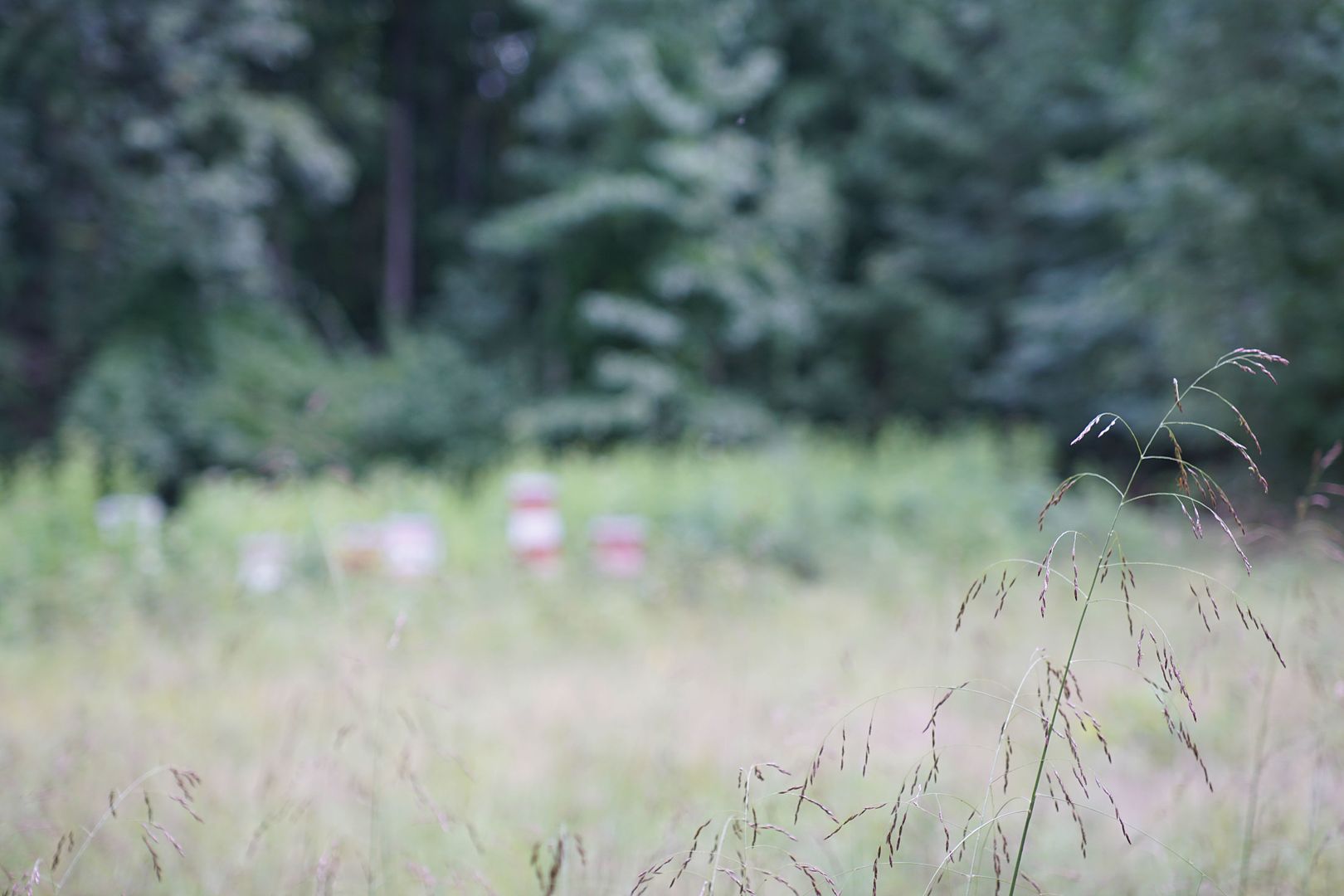 I did manage to get a trip in thanks to my friend Matt coming back for a visit. He's attended every Ant Together I've ever done so it was good to get some in while he was back home. Our hunting ground of choice was the Rancocas Nature Center where we held our first one.
This was not our most productive trip, mostly owing to the fact that I forgot my shovel (Doh!), but we still had fun. Our first visit there five years ago we had come across colonies of Polyergus, Stigmatomma, and Strumigenys which was pretty good for our first time! Polyergus are specialist slave making ants of the common Formica genus, that are only found in certain fields. Stigmatomma are a type of "Dracula Ant" which specializes on hunting down centipedes for food. The term Dracula Ant comes from their habit of feeding on their own larva through non-lethal cutting. Strumigenys are cryptic, often hard to find, specialist on soft bodied arthropods... basically miniature Trap-Jaw Ants. None of which we found on our trip owing to the fact that it was very late in the summer.
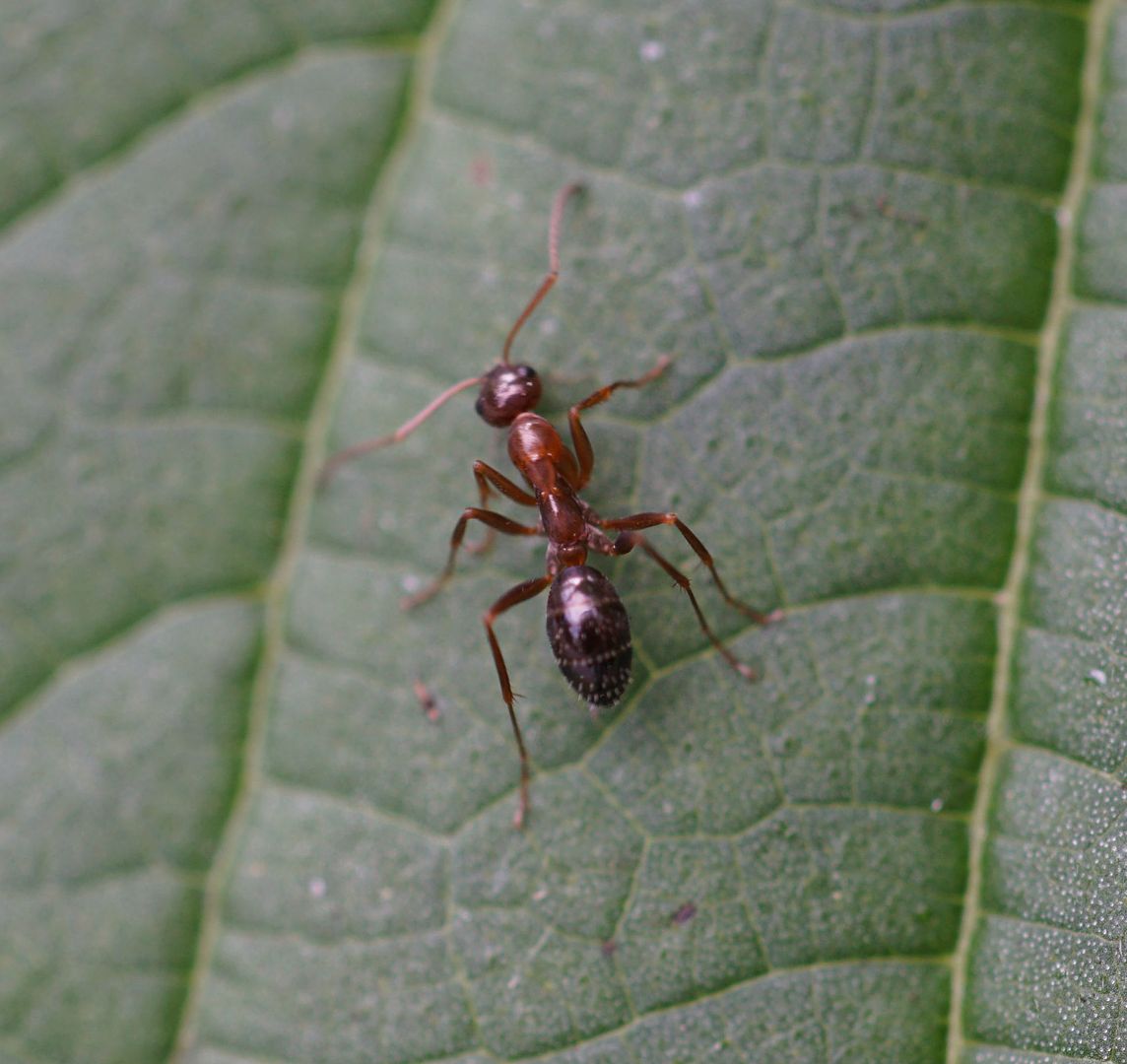 Formica incerta, very similar looking to Formica pallidefulva, differing primarily by the amount of facial hair. The two species often live in the same fields together and prefer not so lush lawn or scrub habitats. Colonies tend to be small typically around 2,000 to 10,000 ants. Queen number varies with these two species, I believe because some colonies are in the habit of allowing new queens to return to the nest after mating. The colonies then divide after that. It's likely this behavior came about from the presence of other slave making Formica and Polyergus species, perhaps even becoming more common when these threats are around.
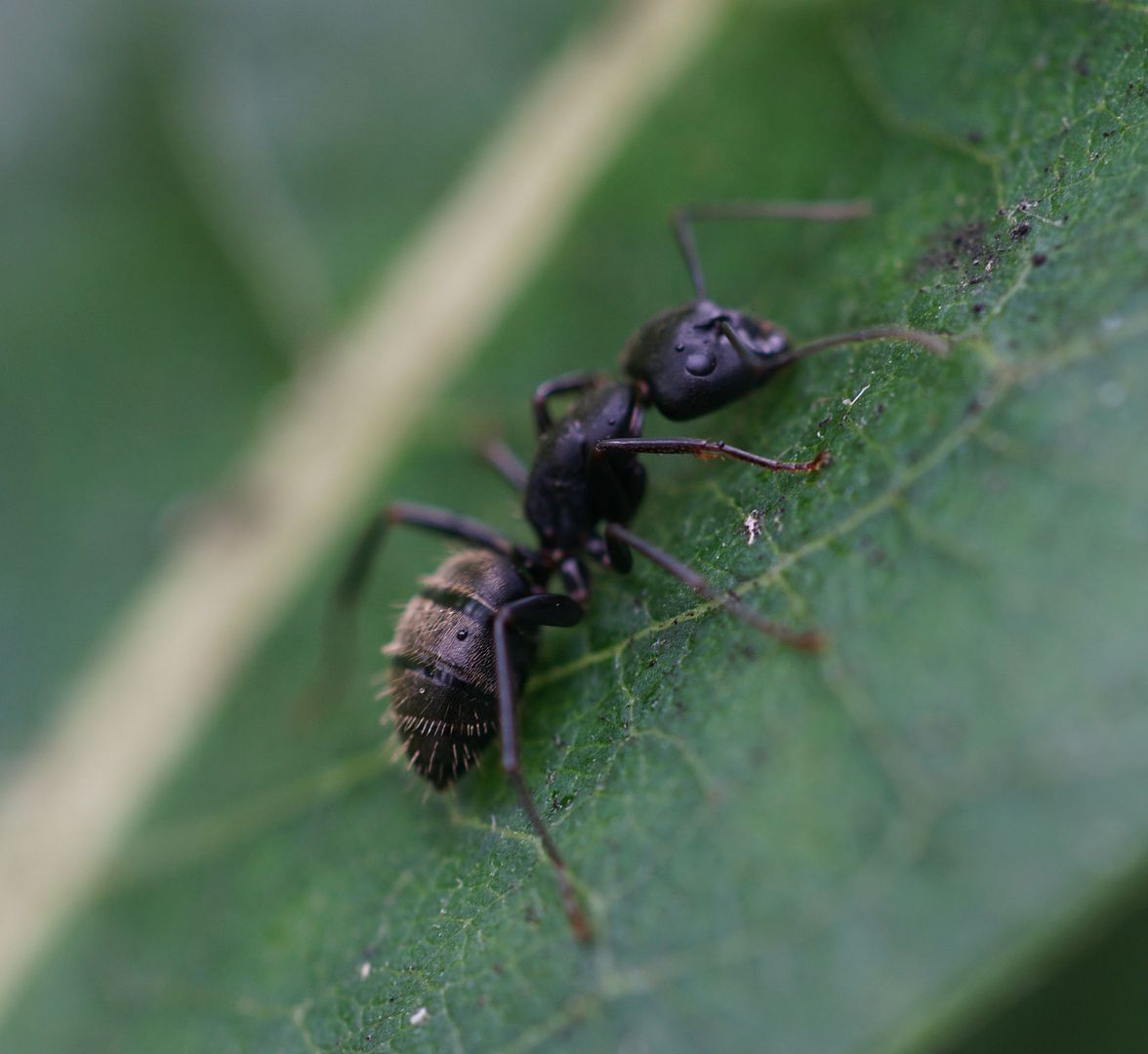 Camponotus pennsylvanicus The Eastern Black Carpenter Ant, is easily identified by its large size, ~8 to 15mm. They are solid black color in color, though sometimes the legs with hue dark brown or red, more so in queens than workers. Also they have large amounts of hair on the gaster (abdomen), that's usually brown or gray in color. Colonies are strictly Monogyne/Oligegyne where they only tolerate one queen at a time; the Oligegyne comes from the fact that occasionally colonies have two egg laying queens in them... this is a temporary situation at best and likely comes from a situation where a new queen was brought back into the nest on accident. The new queen is "safe" as long as she's not in the same satellite nest as the mother queen of the colony. These situations usually resolve themselves each winter when colonies reduce the number of satellite nests retreating into one or two locations.
 Crematogaster cf. cerasi. This likely is Crematogaster cerasi from their habit of sometimes building shed-like structures over the aphids and leaf hoppers they tend. Crematogaster species otherwise tend to be difficult to identify because of how similar most of them look and needing to count the number of hairs on parts of the body from multiple workers to get a range. This colony likely only has one queen but grows to be enormous in size. Locally they're known for having extensive foraging trails and satellite nests established basically in any dead wood structure or hollow cavity they can find. Despite this they're not really a structural pest.
The genus Crematogaster is easily identified because their waste segment connects to the upper half of the gaster, where as every other ant genus in the world connects to the lower half, or to both with a wide surface area. Their gaster is also considered "heart-shaped." The reason for this upper connection to the gaster is so they can more easily flick venom onto enemies or "sting" venom in an overhead like action as a scorpion would go to sting. Their stinger is said to be soft and flexible, like a hair so really they're not so much injecting venom as painting it on.
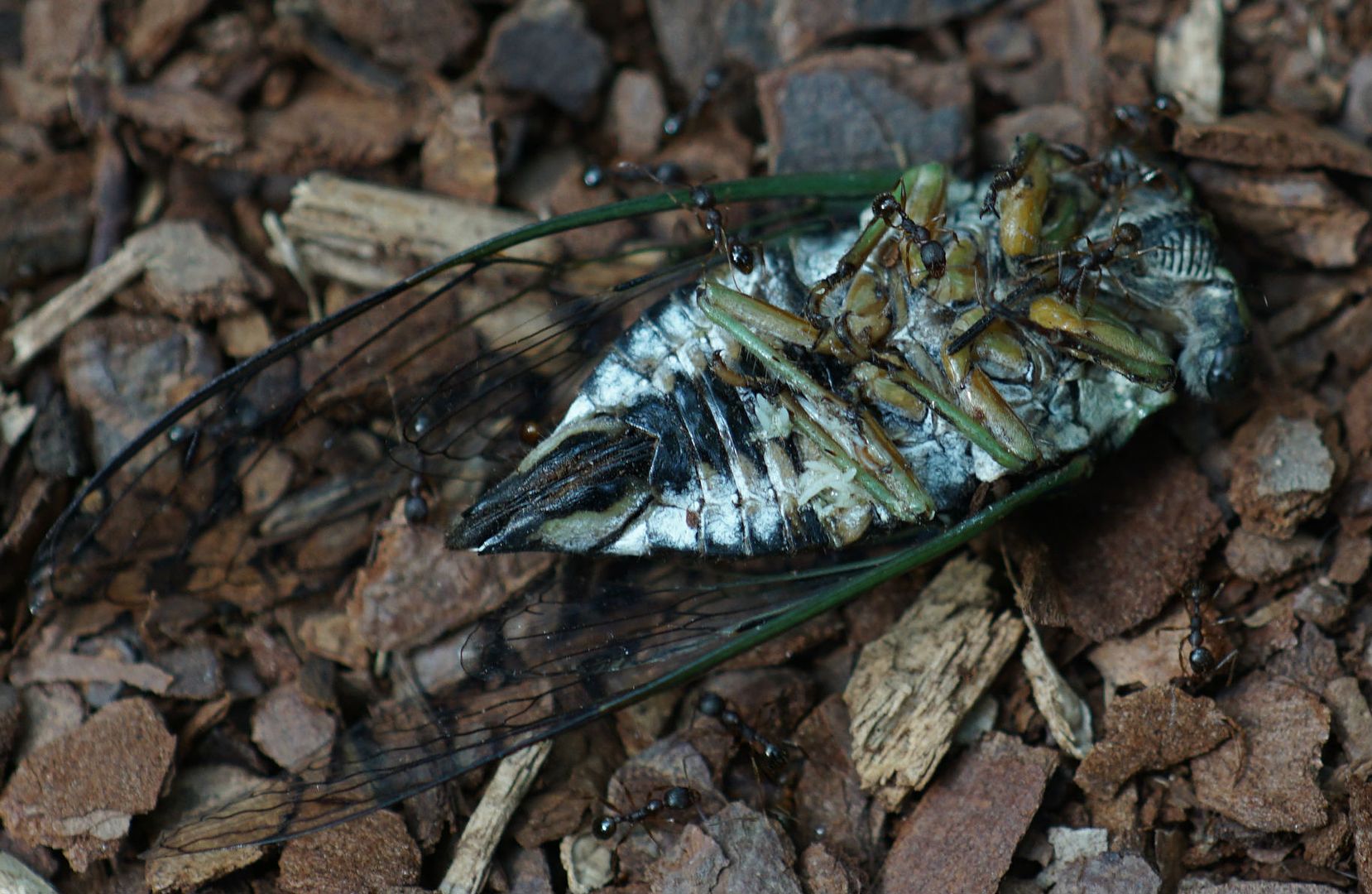 Aphaenogaster is a true genus of scavengers in the forests of the North East. Now that it's late summer the Dog Days Cicada's are dropping like flies and the ants are cashing in. It's been said that ants keep the forest floor clear of dead insects and it's uncommon for a carcass to go more than 5 minutes without being discovered by an ant.
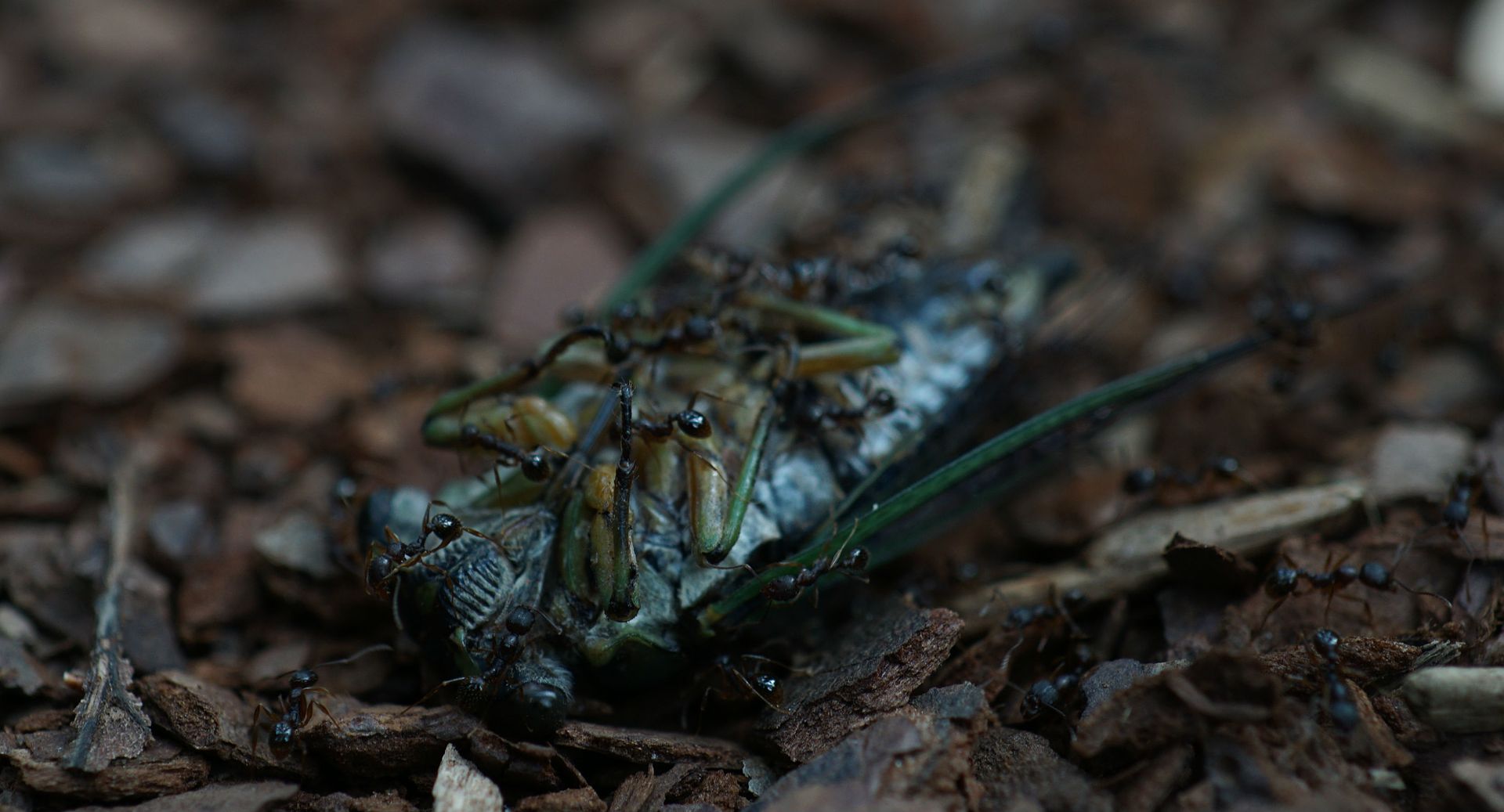 Discovery is one thing though. Dismantling and hauling it away might take a day or two. These were ripping at the soft parts first and eventually managed to remove the legs. I did not stay to watch anything more.
 While we didn't come across any slave making Polyergus, we did chance upon a colony of slave making Formica. This is either Formica pergandei or rubicunda. I didn't collect any specimens, so we'll likely never know what they are unless I go back sometime. This doesn't matter much though as both species tend to live exactly the same way. F. pergandei has 1 - 4 hairs under the head, while F. rubicunda always has 4. F. rubicunda is also more in the habit of having dark patches on the head and thorax. There are other slight differences but this is the kind of stuff that taxonomists nit pick about for hard identifications.
 This is a good photo of the waste segment, looking head on, which is the light orange heart-shaped part before the black gaster. But this is also a bad photo of the "clypeal notch" which is the front section on the head between the mandibles. Trust me there is a notch there; it's visible in other photos I took of these ants. Unfortunately none of these were good enough photos I felt worth uploading and showing. I mention the notch because Formica is the largest ant genus in North America and it's the defining characteristic that narrows it down to those two species.
Members of the Sanguinae group of Formica HAVE to have host ants within the colony to do the work for them. They are obligated slave makers. Other species of Formica found in the Exsecta, Rufa, and Microgyna groups might use host colonies to found new nests, but after that host species are no longer needed. In fact the Formica exesectoides mounds we like to visit in Turkey Swamp Park rarely use host species. They've move beyond the need for them, allowing new queens from their own colony back into the nest to form a massive super colony within the forest.
 These do require slaves though and we chanced upon, I believe starting out on a raid.
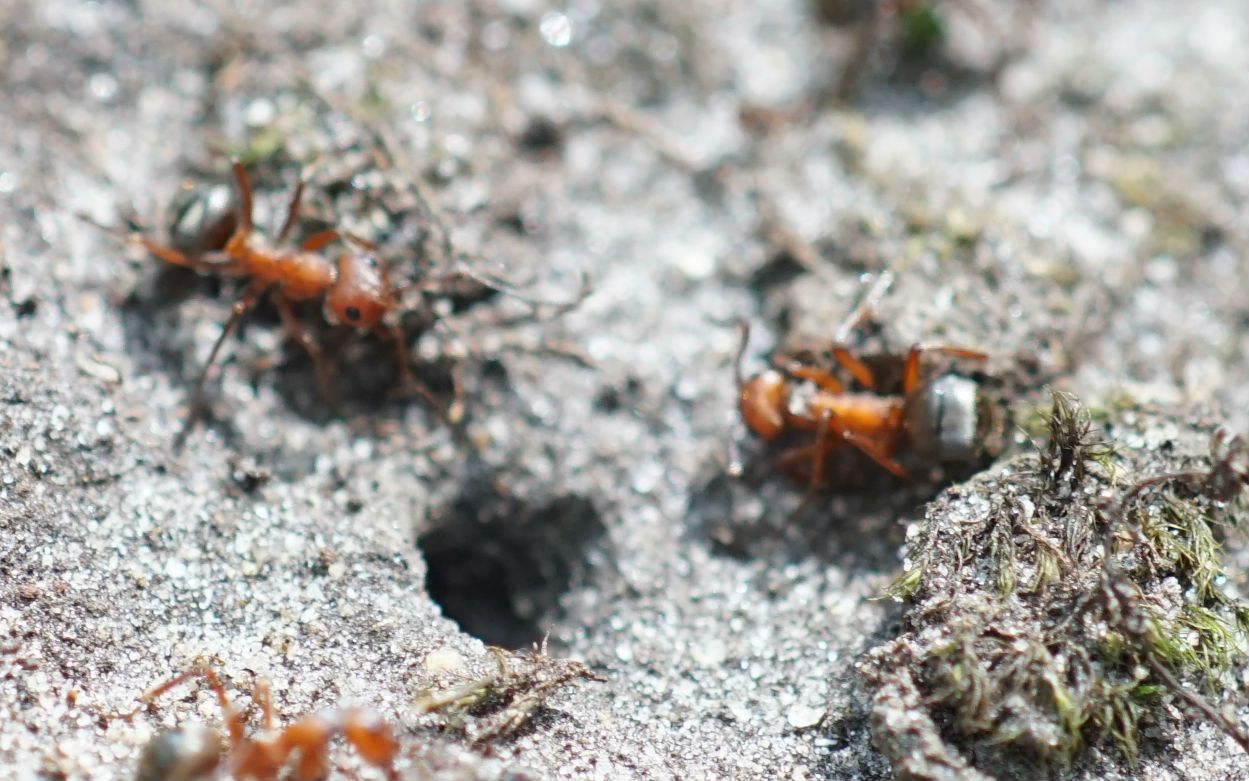 They would pull up individuals of their own species out of the nest and then began running along a trail to a host colony I believe to be either Formica fusca or subsericea. They would then run into the nest, grab a cocoon of one of their hosts and bring it back. None of which I got any good photos of :(
Though the truth is as much as I like to promote the New Jersey Ant Together as a big annual thing, it's never escaped being a simple hiking trip with like minded individuals. And maybe it should stay as a simple get together in future.
This was not our most productive trip, mostly owing to the fact that I forgot my shovel (Doh!), but we still had fun. Our first visit there five years ago we had come across colonies of Polyergus, Stigmatomma, and Strumigenys which was pretty good for our first time! Polyergus are specialist slave making ants of the common Formica genus, that are only found in certain fields. Stigmatomma are a type of "Dracula Ant" which specializes on hunting down centipedes for food. The term Dracula Ant comes from their habit of feeding on their own larva through non-lethal cutting. Strumigenys are cryptic, often hard to find, specialist on soft bodied arthropods... basically miniature Trap-Jaw Ants. None of which we found on our trip owing to the fact that it was very late in the summer.
The genus Crematogaster is easily identified because their waste segment connects to the upper half of the gaster, where as every other ant genus in the world connects to the lower half, or to both with a wide surface area. Their gaster is also considered "heart-shaped." The reason for this upper connection to the gaster is so they can more easily flick venom onto enemies or "sting" venom in an overhead like action as a scorpion would go to sting. Their stinger is said to be soft and flexible, like a hair so really they're not so much injecting venom as painting it on.
Members of the Sanguinae group of Formica HAVE to have host ants within the colony to do the work for them. They are obligated slave makers. Other species of Formica found in the Exsecta, Rufa, and Microgyna groups might use host colonies to found new nests, but after that host species are no longer needed. In fact the Formica exesectoides mounds we like to visit in Turkey Swamp Park rarely use host species. They've move beyond the need for them, allowing new queens from their own colony back into the nest to form a massive super colony within the forest.
Saturday, September 17, 2016
Late Summer Mt. Cuba Center Visit
I was at the Mt. Cuba Center last weekend for a little late summer photo stroll. Here are a few of the sights I saw.
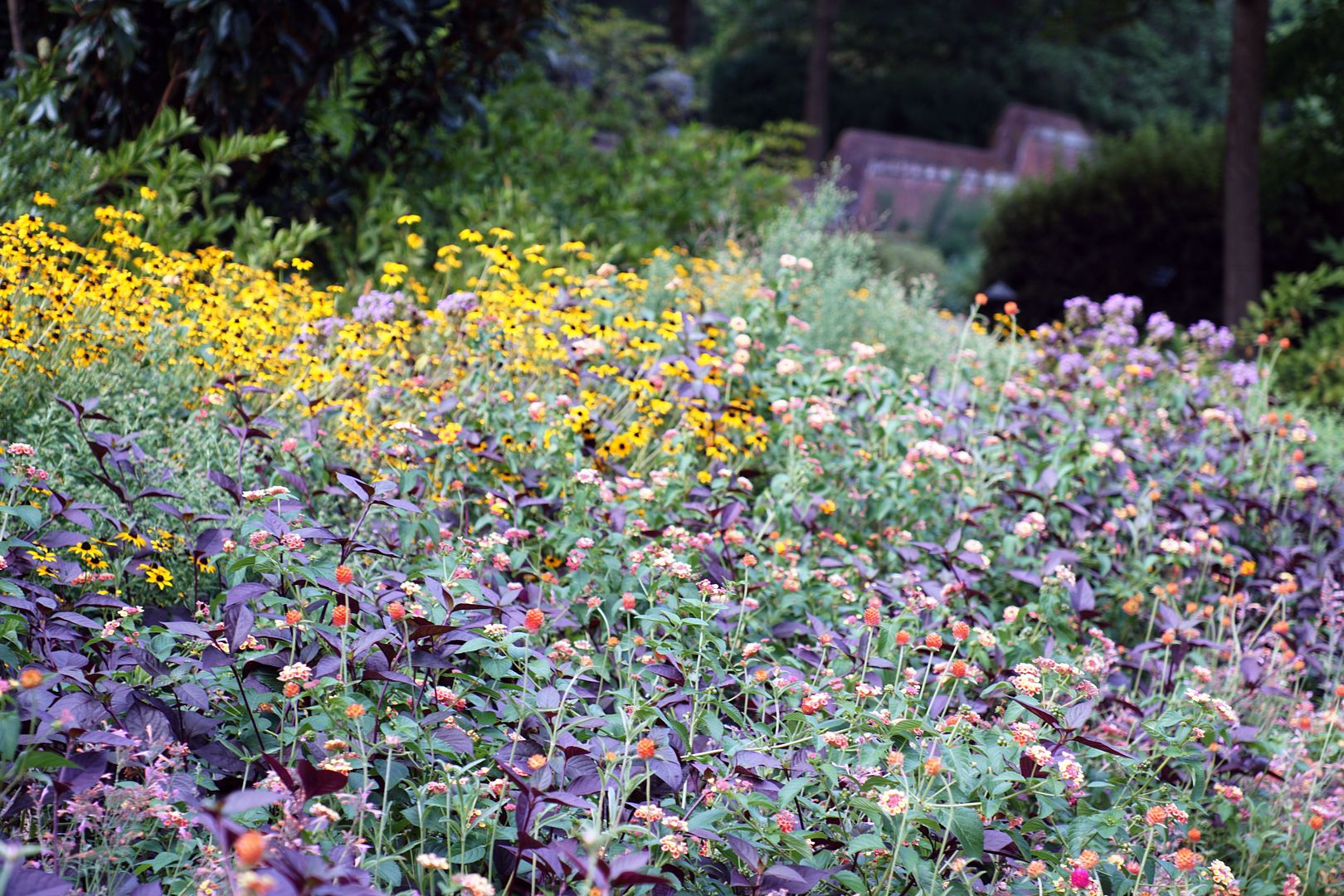 The round garden perhaps off from the main house is a dazzling array of color now, though perhaps a little busy for some. While it's comprised of mostly nonnative annuals, it serves as a bustling stop for an assortment of butterflies who's host plants are all around some ~650 acres of fairly well kept wilderness and native plant gardens.
 I'm not sure what the purple plant is but it's foliage contrasts well with the brightness of the Lantana in bloom among other flowering plants. Here some skippers flutter about. Among them were an assortment of Swallowtails, Monarchs, and Fritillary Butterflies that proved too quick for me to photograph.
 Elsewhere in a native flower bed the Swallowtails were a bit more cooperative. Here two Tigers sip at an Ironweed, I believe the cultivar is Vernonia angustifolia 'Plum Peachy' which is like 'Iron Butterfly' but about twice as tall.
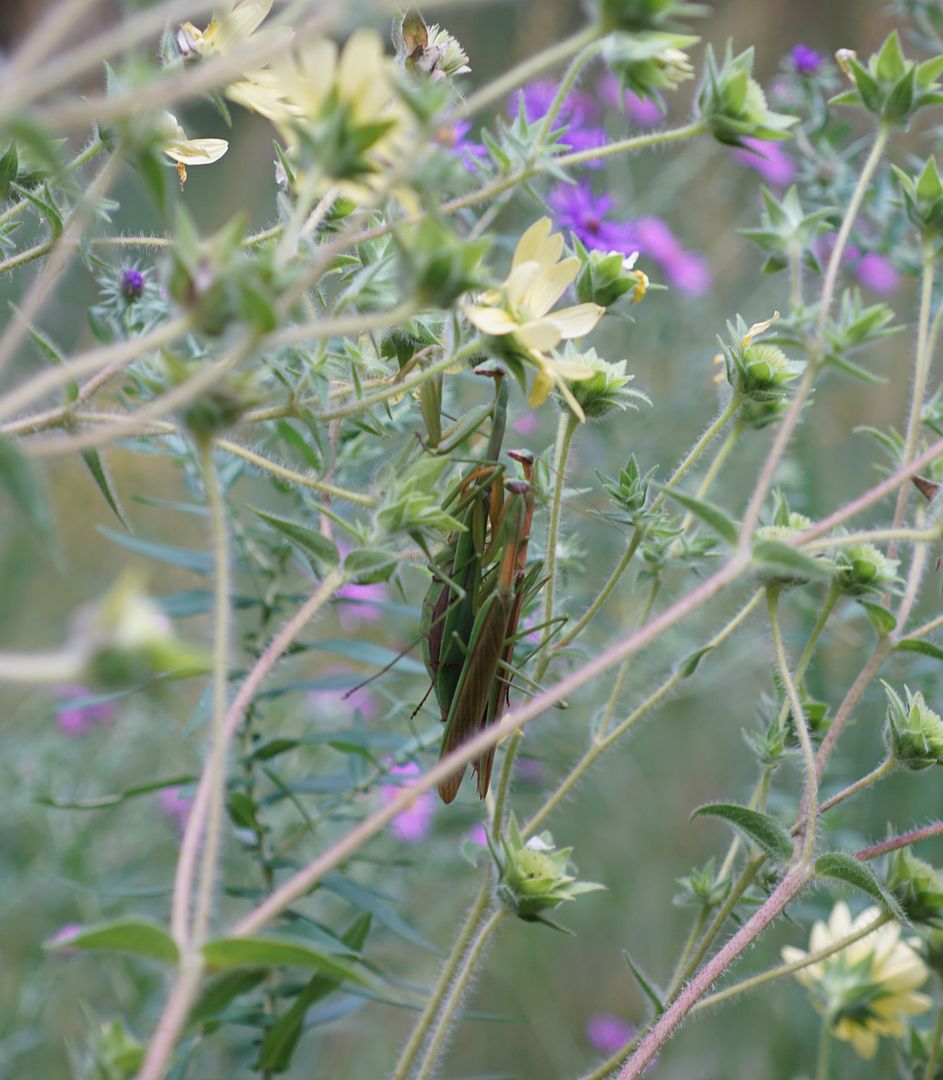 Praying Mantises were abound in the meadow garden. Not only were females laying eggs but also in the act of mating... some with more than one partner courting them at the same time.
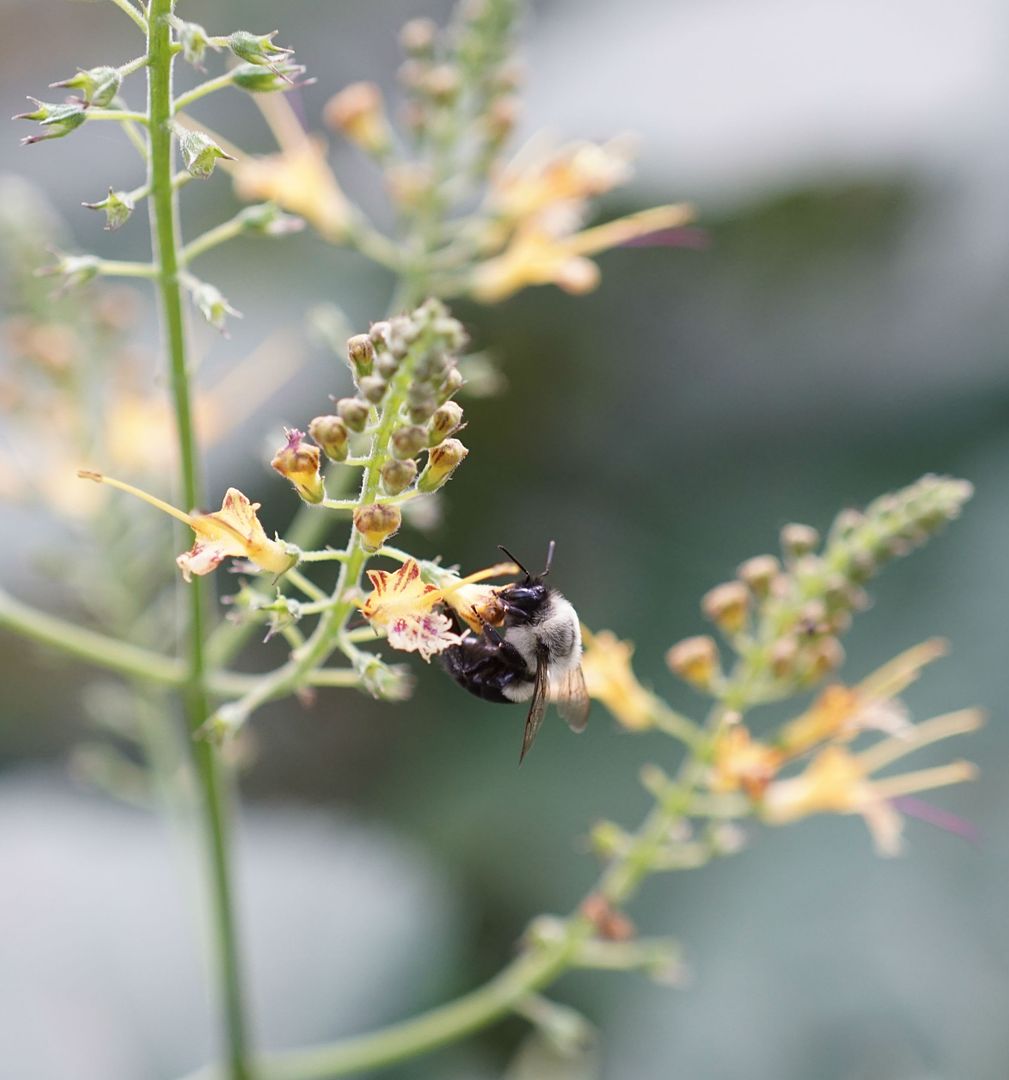 Though the woodland was filled with an assortment of Woodland Asters, I found the Richweed, Collinsonia canadensis, to be particularly interesting.
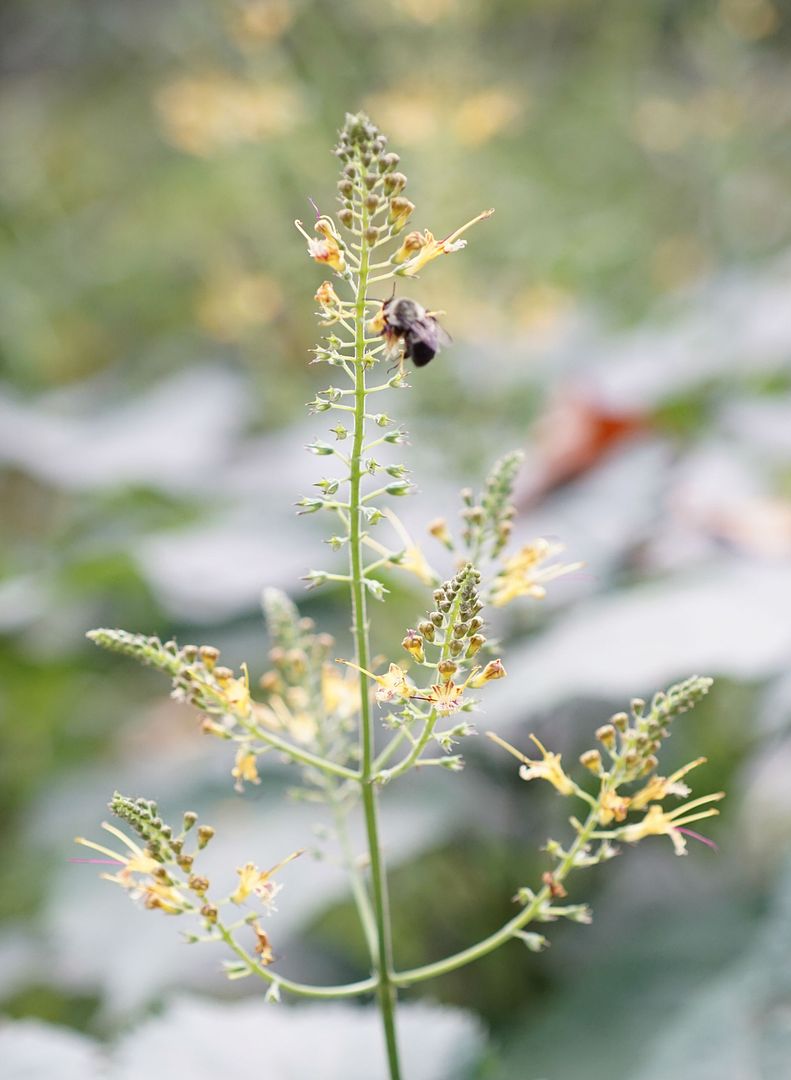 Though common in woodland areas across the eastern United States, it's not something a lot of people stop to look at.
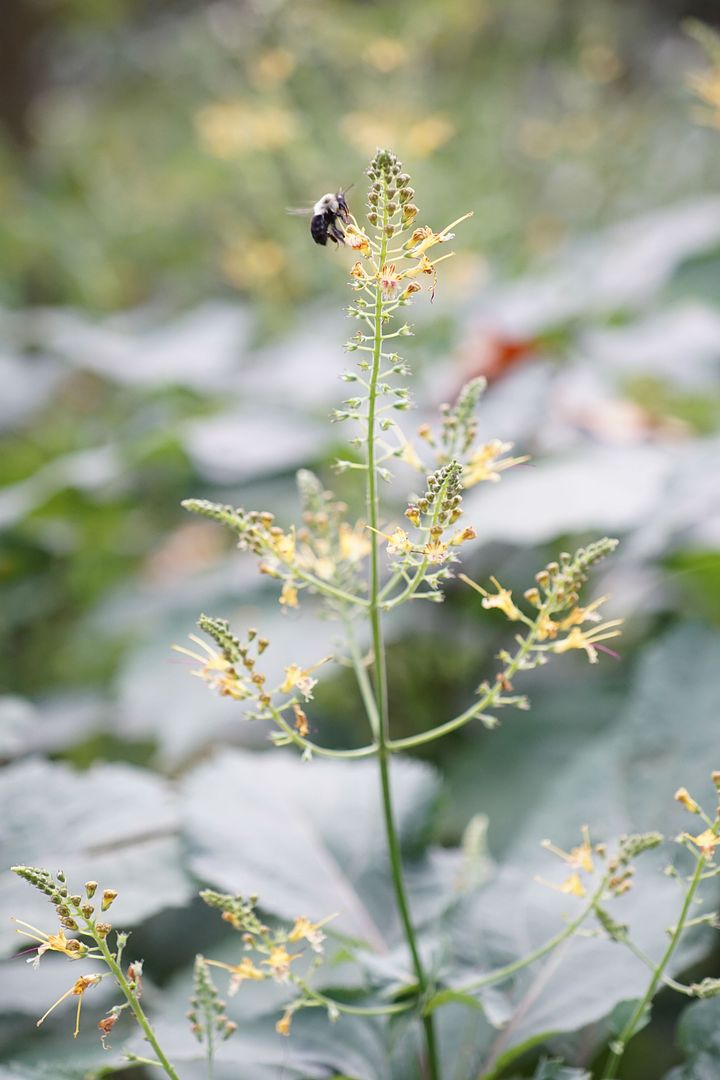 Part of the issues that it's not a more mainstream plant is likely due to the large leaves of the plant, compared to the fairly delicate flower stalks that come above. The flowers are small and not entirely noticeable either. I actually walked past the patch of these plants twice before I even noticed it. It's plants like this where interesting leaves or flower shapes from cultivation would benefit to get it sold and brought into the main nursery trade.
Saturday, July 30, 2016
Some Uncommon Ants In My Yard
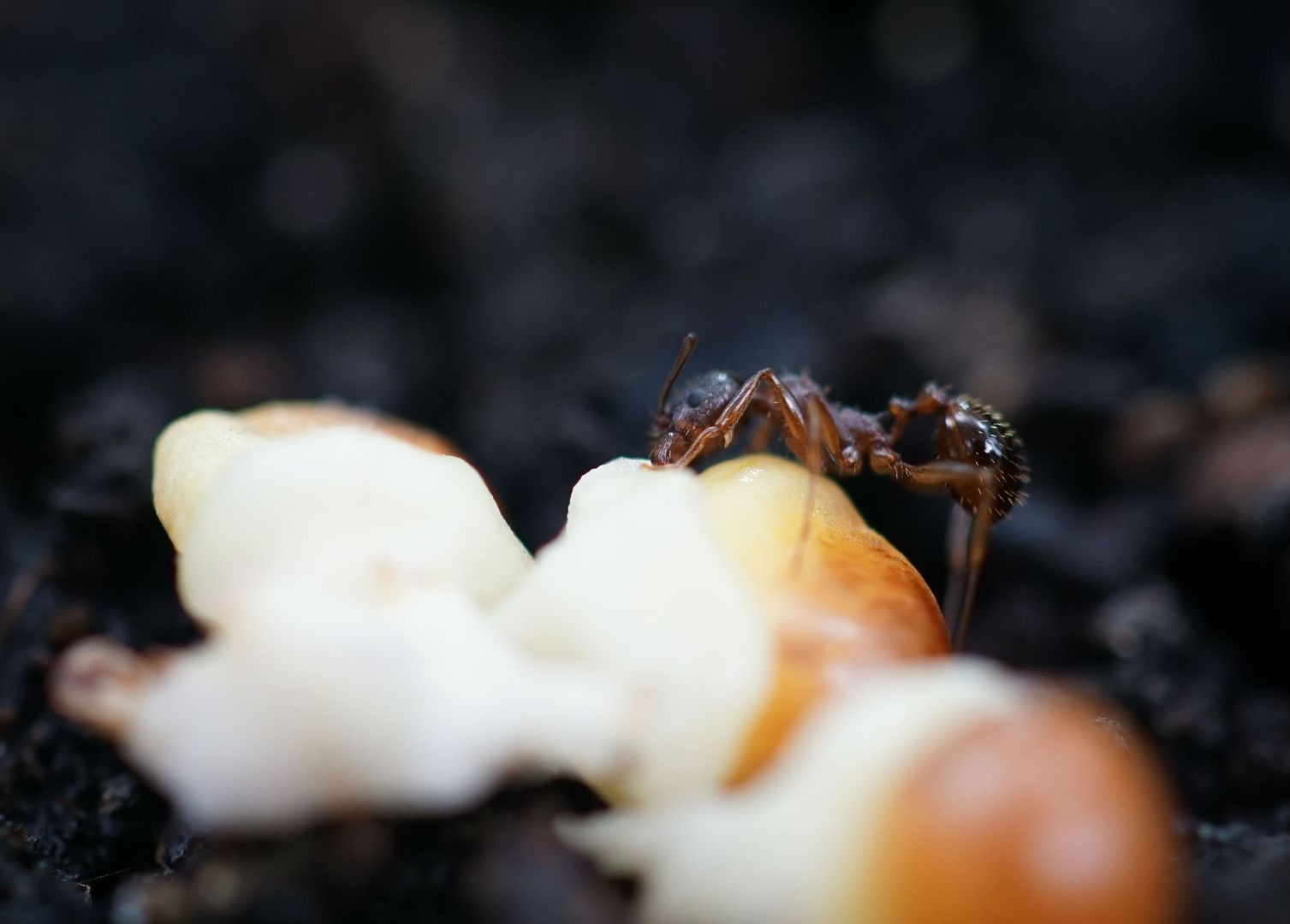
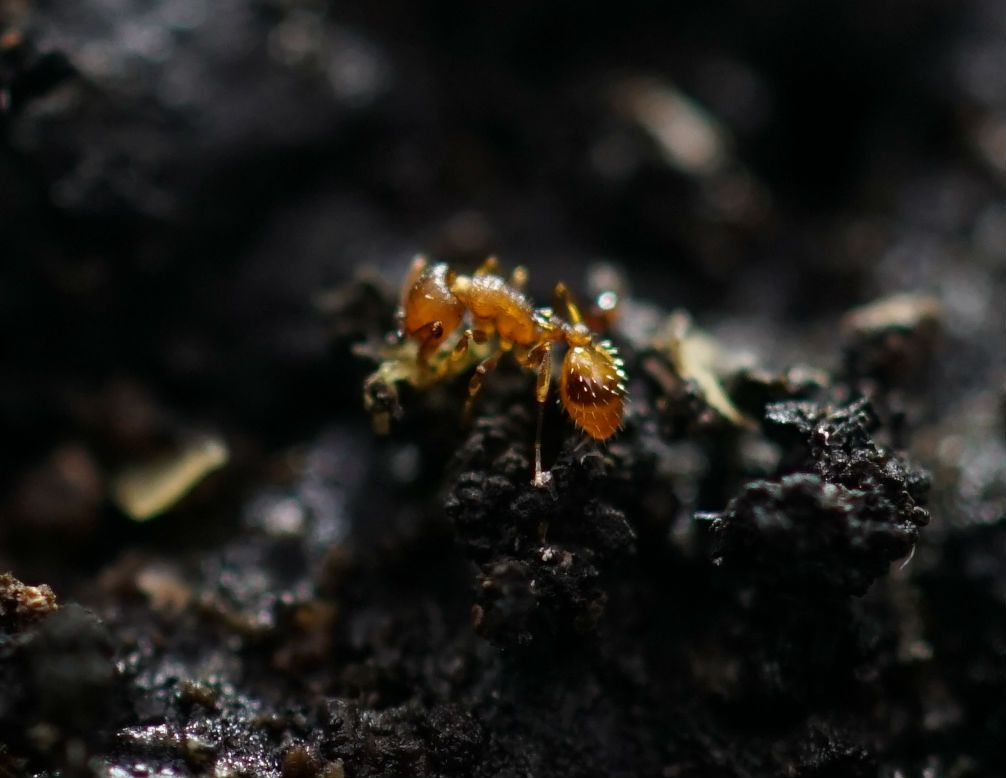
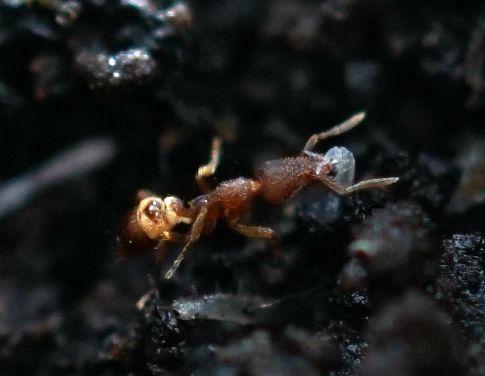
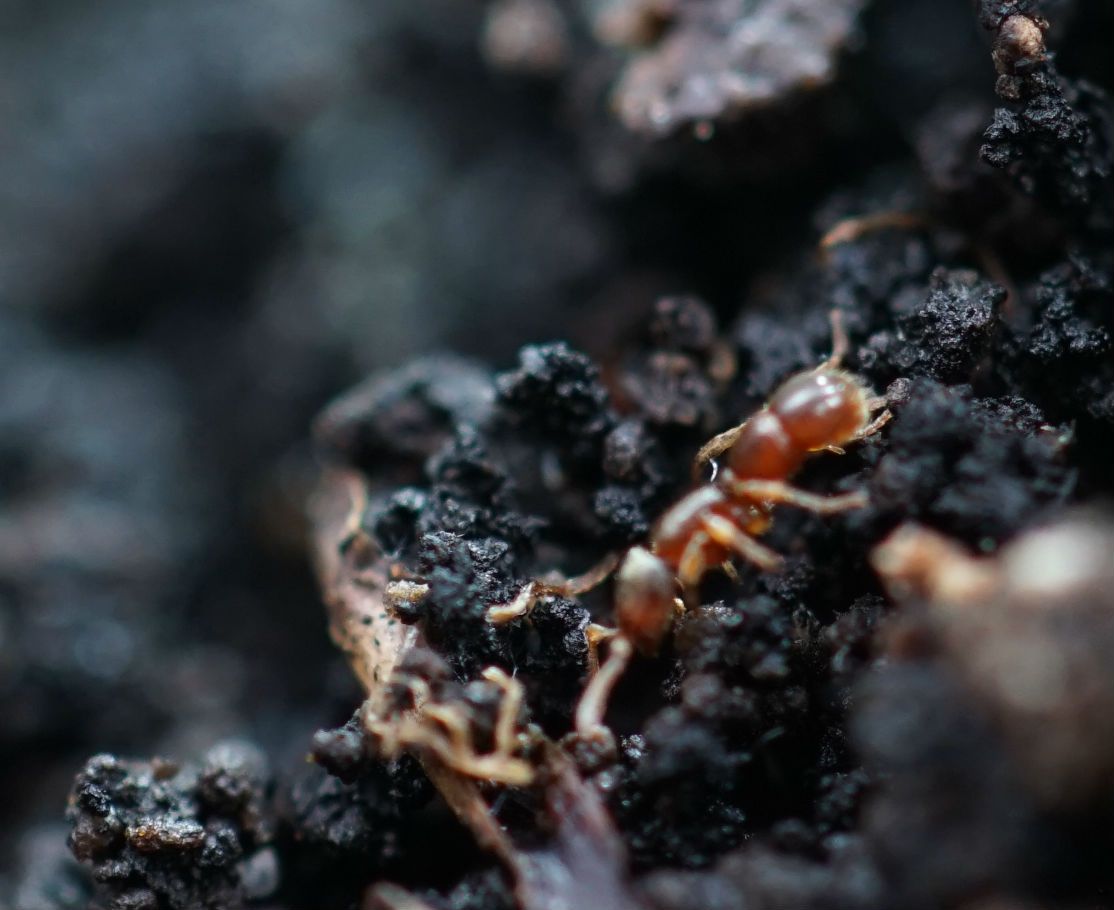
It's nice knowing these uncommon ants can still be found in my yard, because this is the first time in several years that I've seen either in my yard. Now I know where to look!
Wednesday, July 20, 2016
Myrmecochory: Ant Plant Seed Dispersal
It's that time of the year again. This is probably my favorite part about native plant gardening because it combines so many of our loved spring ephemerals with ants.
Ants are largely overlooked by gardeners despite being the most common insect (by number). Part of the reason gardeners don't appreciate ants is likely because they are generalist foragers. So it doesn't matter a whole lot what plants are growing in a garden, native or non; if you have soil and dead wood, chances are ants live in your yard.
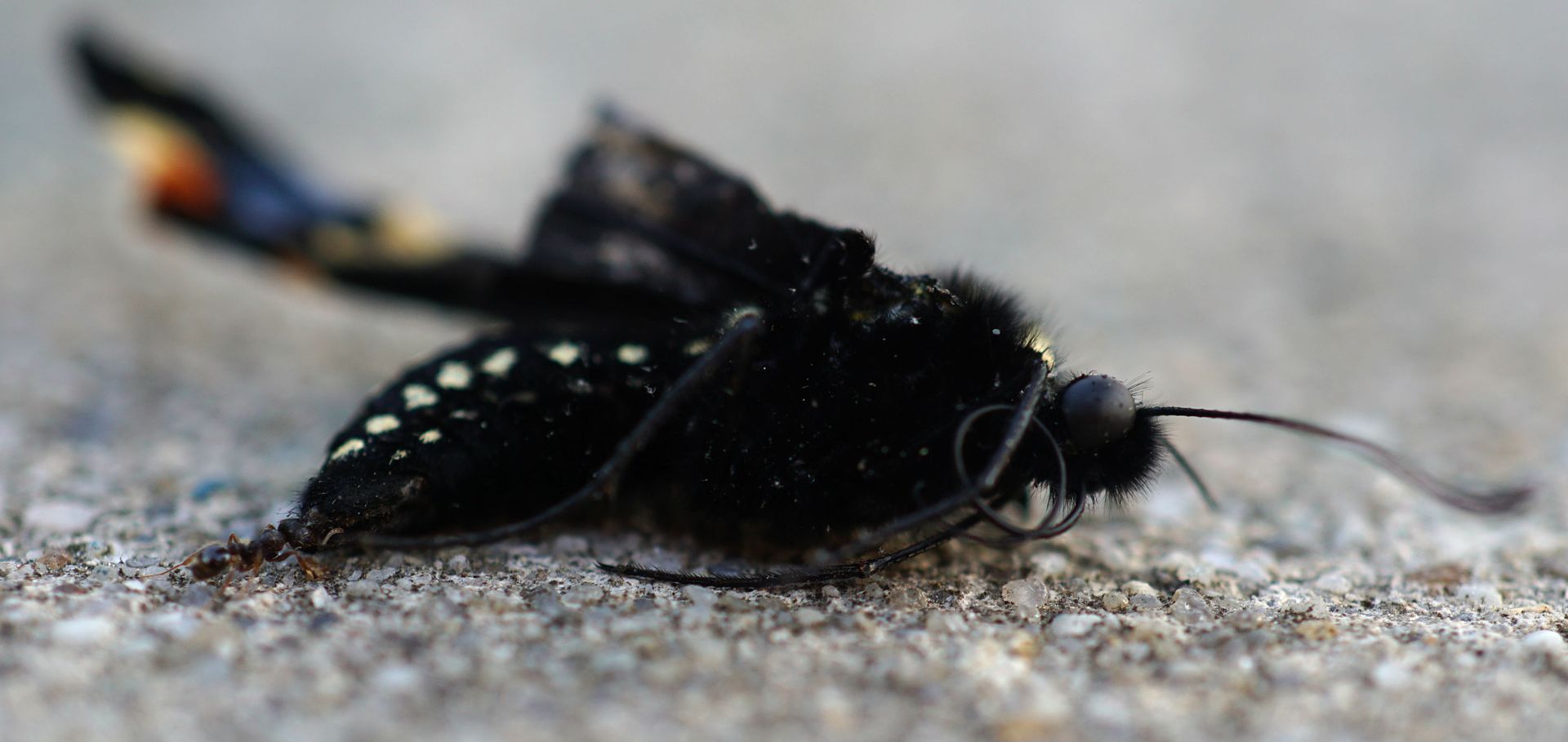 They play a vital role in removing dead insects. So after those big pretty swallowtail butterflies are done laying their eggs and visiting the flowers in your garden, ants are more than happy to collect, dissect, and consume their expired carcass. Though on the other hand, ants are also happy to remove butterfly eggs from host plants and often kill early instars to a lot of species. Ants don't forage equally on certain plants though, so it can depend on what's nesting near the tree/plant. Many caterpillars have defenses against ants too, but they're not always effective.
I have a Hackberry sapling that's about as tall as me right now. My dream is to someday see some Hackberry Emperors using it as a host plant. Every year though I got out there and find ants (Lasius alienus, Camponotus pennsylvanicus, C. chromaiodes, C. nearcticus, C. subarbatus, Temnothorax curvispinosus and Nylanderia faisonensis) foraging on the tree. They're mostly doing what's called nectar scraping where they wonder the plant licking and scraping the surface of the leaves to collect the small amounts of sweet sap that bleeds out of the leaves with the changing temperature of the day. The foraging power of 1 ant colony is enough to put a dent in the number of Lepidoptera eggs on a sapling; this one has 7 different species and likely multiple colonies of each constantly foraging on it, so I won't likely be seeing any Hackberry Emperors for several years.
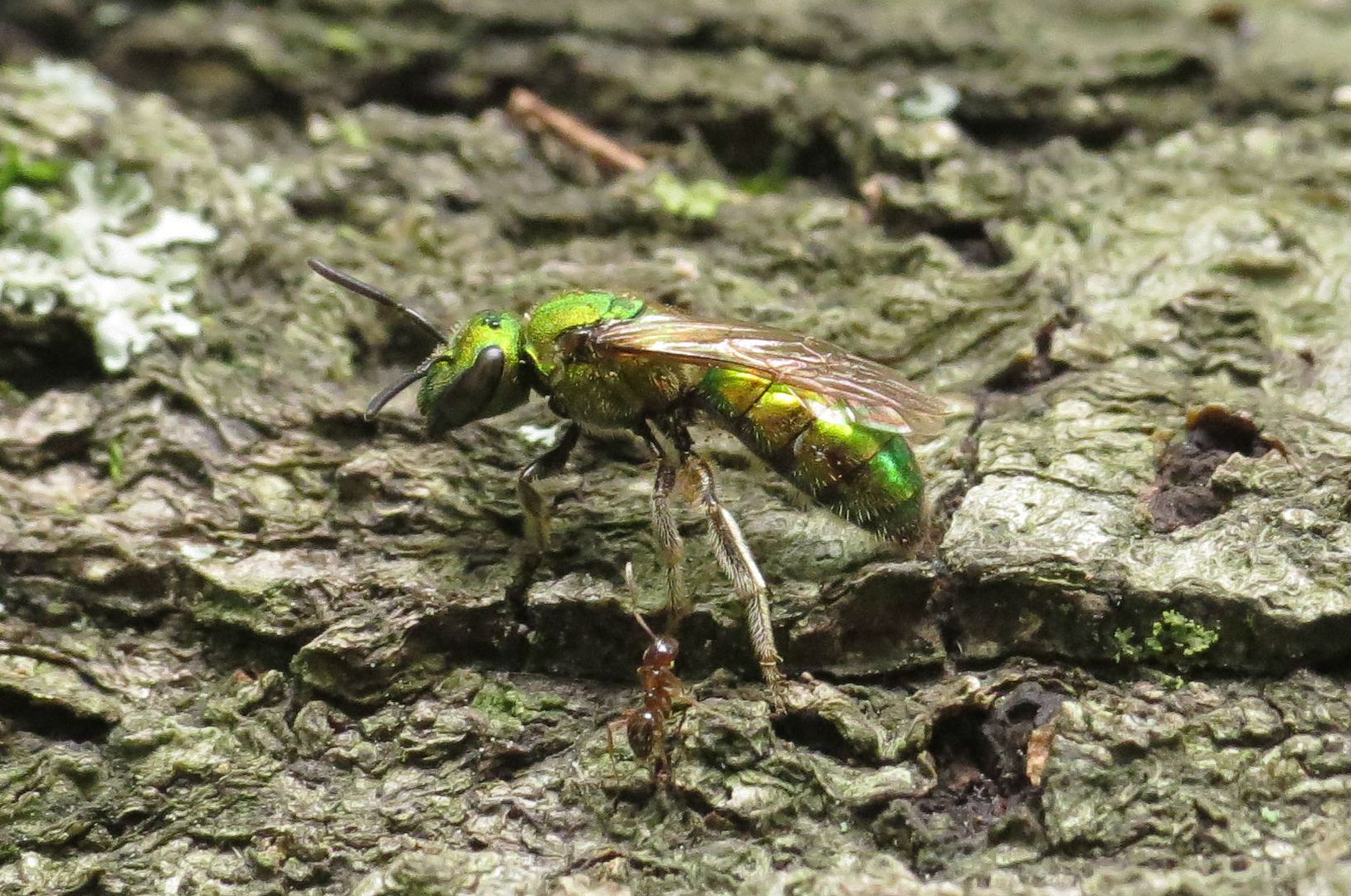 To a lesser degree, ants also think pollinators are delicious. They're mostly an issue with solitary bees, usually ground nesting or mason bee nests when discovered by ants. Ants typically don't dig into structures in search of food though, so as long as the burrows or tubes are properly secured with mud the developing bee larva should be safe.
My favorite thing ants do in the garden is called Myrmecochory, or ant plant seed dispersal. Even here though ants can be considered annoying. Let's say you paid $20 for a rare Trillium species, looking to start a clump of them over the next decade, which is how long many Trilliums take to flower from seed. Often though Trillium seeds have the annoying habit of walking away from the plant thanks to packets of "Elaiosome," a lipid rich substance on the seed, attracting ants to come and carry them home.
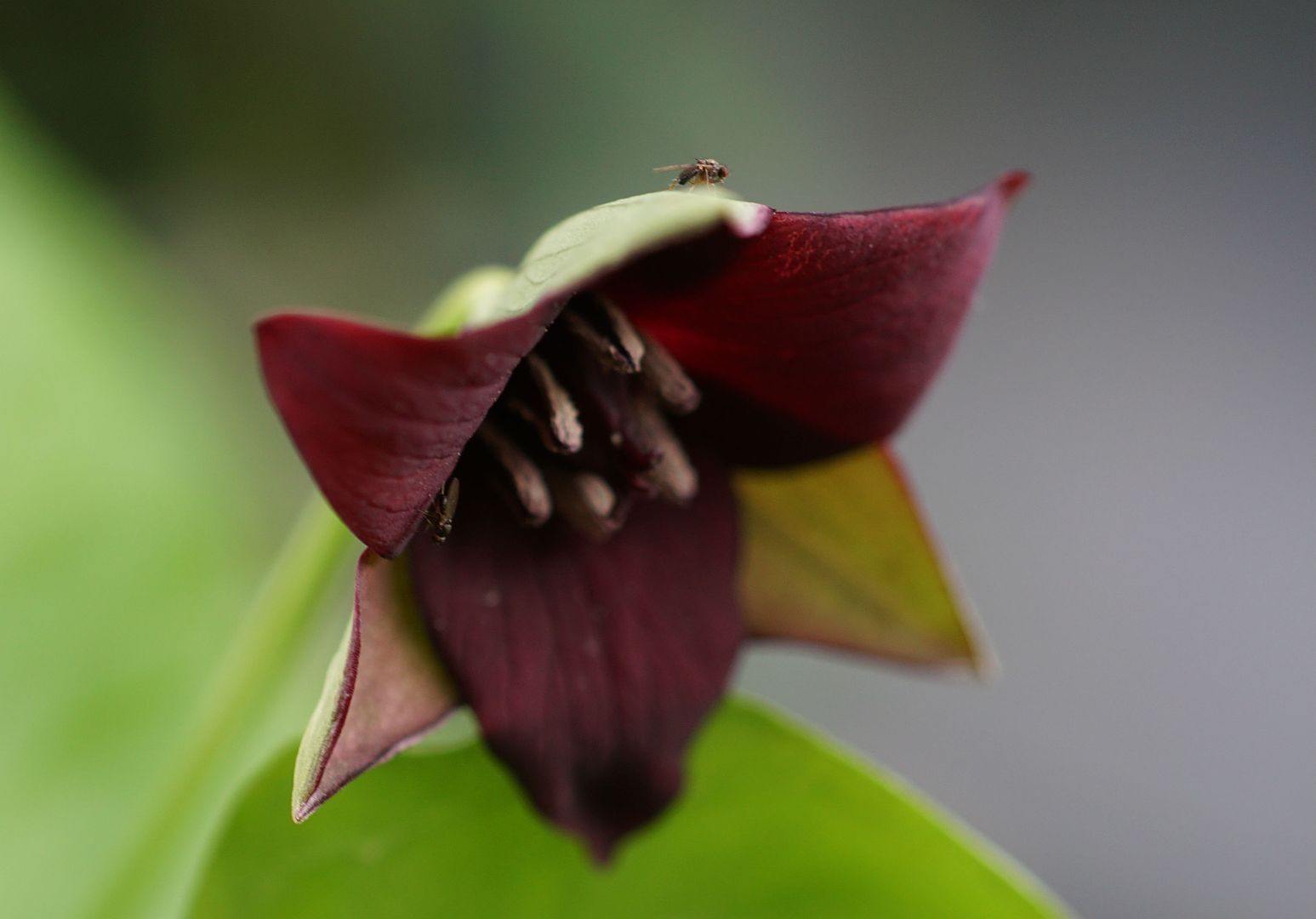 This is Trillium vaseyi, (I believe), which is pollinated by Vinegar Flies and other sorts of carrion insects. Note Vinegar Flies are sold in pet stores as "Fruit Flies" because that sounds better than Vinegar Flies. True Fruit Flies consume fresh fruit and tune delicious apples and berries into balls of maggots. Vinegar Flies target foods that have already spoiled, drawn in by the fermenting smell of yest, cider and dead fish, which is what this flower smell like.
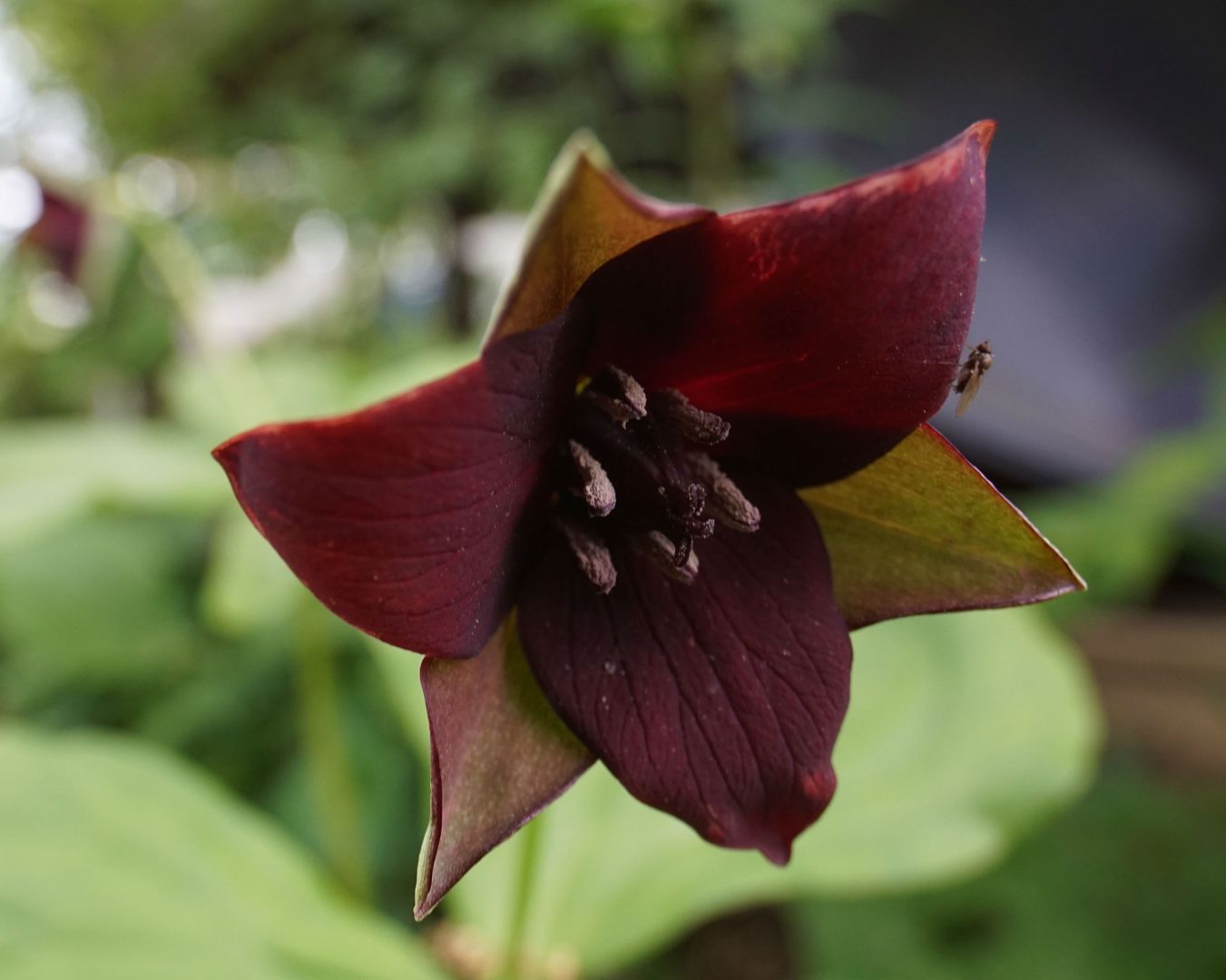 Lots of Trilliums are either pollinated by carrion insects or bees. In my garden this particular Trillium species isn't quite ready to produce seeds yet, though they flower every year. A rabbit or some other critter trampled through the Trillium garden and snapped the stems to the two plants of this species so I've yet to get photograph them. Fortunately I have 8 other Trillium species in my garden!
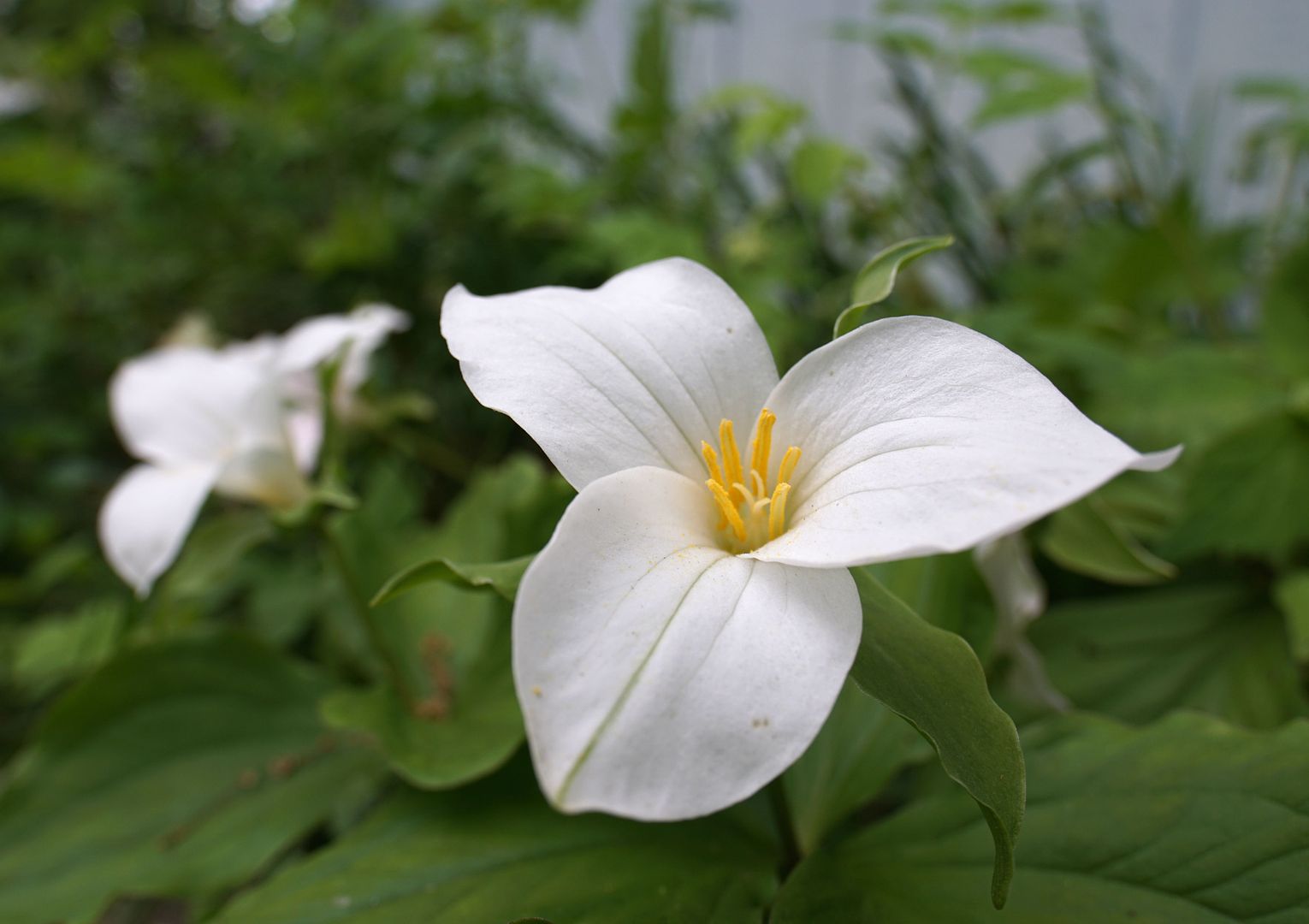 Trillium grandiflorum! This is by far the most common and easily recognized Trillium species. It's pollinated by bees and while I never witnessed any bees visiting my flowers I have seen honeybees visiting them in other gardens when planted in sufficient numbers. I'm certain Bumblebees and others must visit them on occasion too. Currently I have a clump of about 9 plants of flowering age. Each of which has a few off shoots underneath that will reach flowering age in years to come. I may even need to divide a few in a year or two.
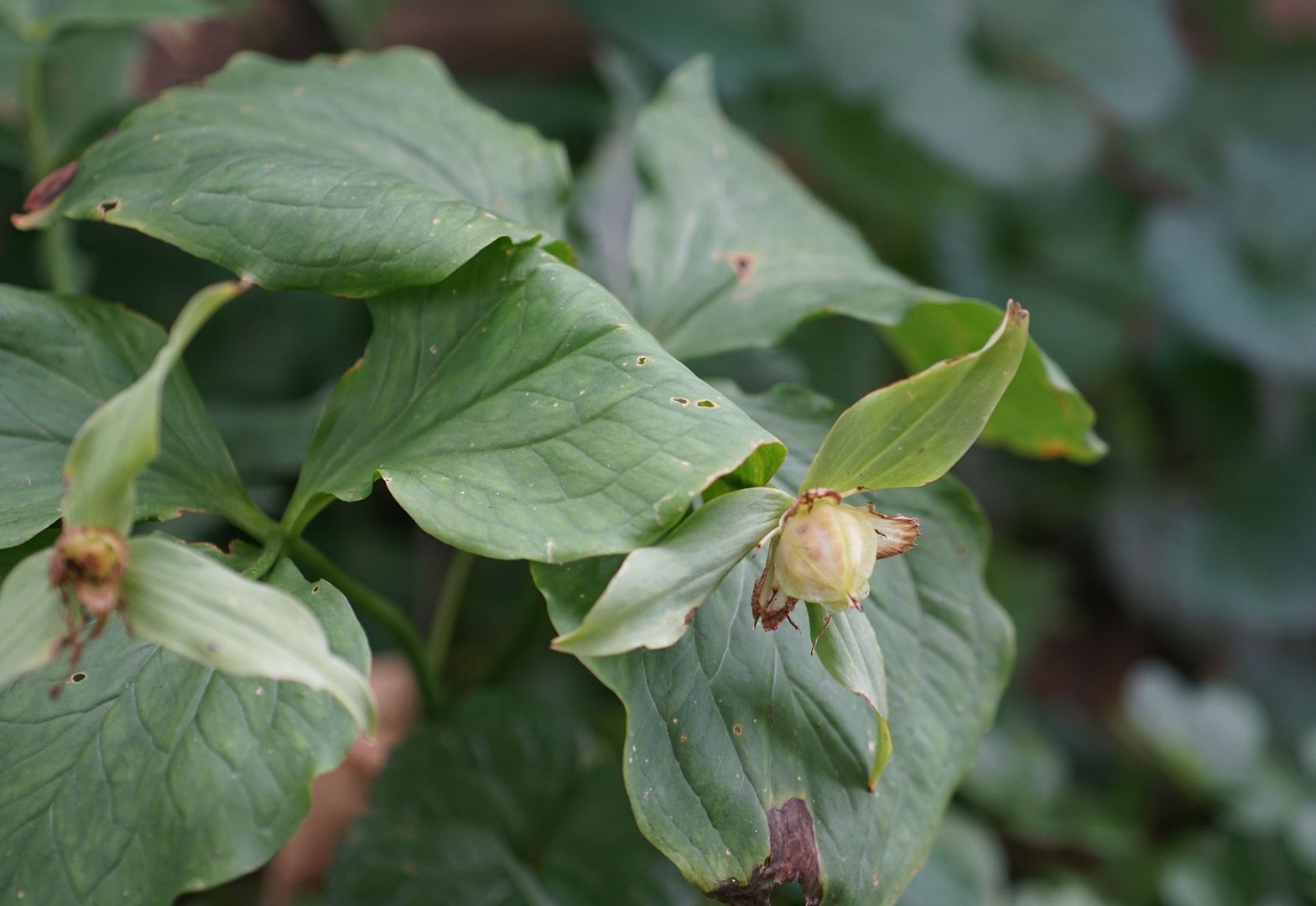 Admittedly things like Twinleaf, Violets, Blood Root, Hepatica, Woodland Poppy, and Bleeding Hearts have already dropped their seeds for ants to disperse. Trilliums are latest ephemeral plant in North America to drop their seeds as many of the ones I've mentioned are already dormant.
Note how the leaves to the plants photoed above are singed at the tips. If you don't water your plants, they will fry right up and abort the seedpod entirely. You can plant Trilliums in full sun and they'll grow happily but probably won't produce seeds because of how much sun they get. You can compensate for this by adding water but there's only so much watering can do. It's best to plant them in the shade with a small amount of mulch and a low ground cover growing underneath such as Hepatica or Stone Crop. I like to water the roots to mine basically every time I walk past with the hose, or once every other day. Just put the water to the stem and count to 10 for each plant. Even doing this though won't guarantee success. Note the plant to the left didn't bother producing a seedpod at all. Of 9 plants only 2 didn't make seedpods, lack of pollination is likely the issue. Some that did make seedpods made smaller than average ones.
 You can tell a Trillium pod is ripe when you can see the seeds right through the pod. Another thing to look for is a change in color. Some go from green to purple, others go from purple to green, some ends up as bright red, depending on the species. Seeing these changes, and especially seeing the seeds within, mean you're within 2 weeks of the seeds being ripe. Seeds should be hard, like unpopped popcorn. The longer you wait the more likely the pod will become damaged, where ants, wasps, birds, and rodents will make off with the seeds. I've found seedpods completely hollow inside thanks to a small puncture hole allowing ants to gain entry.
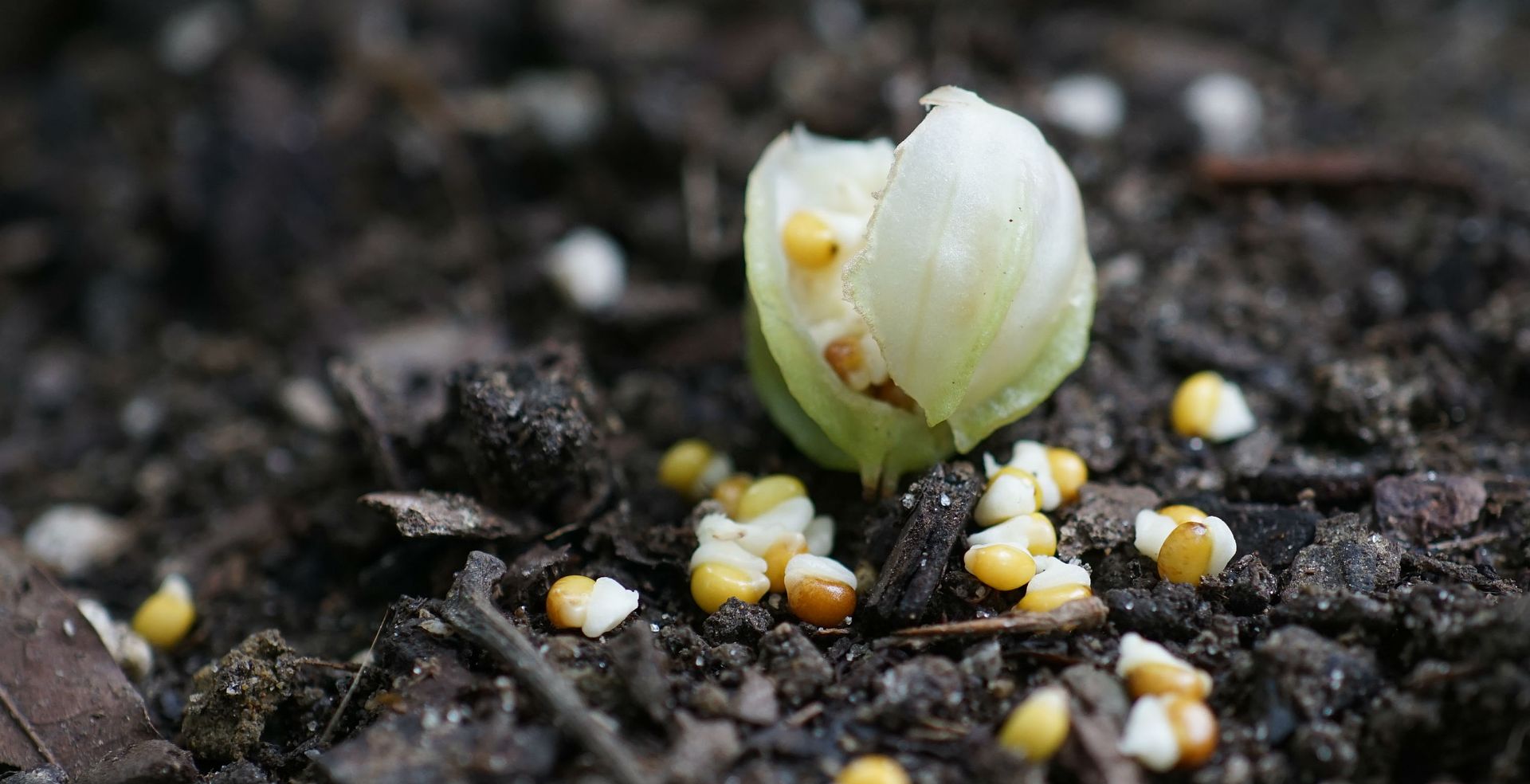 Ants planting the seeds is not necessary for germination! This is just how the plants disperse their seeds in the wild. For gardeners looking to start a bed of these, I'd say go ahead and crack open a pod or two and just dump the seeds out in a shallow ditch and plant them yourself. Ideally the elaiosome should be removed before doing this, however that stuff is really effing on there!!! You can't just cut it off or take your finger nail to it. The risk is sometimes a kind of mold or fungus grows on the elaiosome and may kill the seed... I've never seen this happen to an extreme degree though. Maybe let the seeds dry out for two hours before planting.
 Personally I like letting the ants carry the seeds off. The consequence here is that I get Trillium seedlings coming up in the lawn and in unwanted places. These are easy enough to transplant when I notice them, but determining what species they are can't be done for many more years!
Shortly after a pod has become damaged, ants will more than likely find the seeds. Here a pavement ant, Tetramorium caespitum, has chanced upon the mother load.
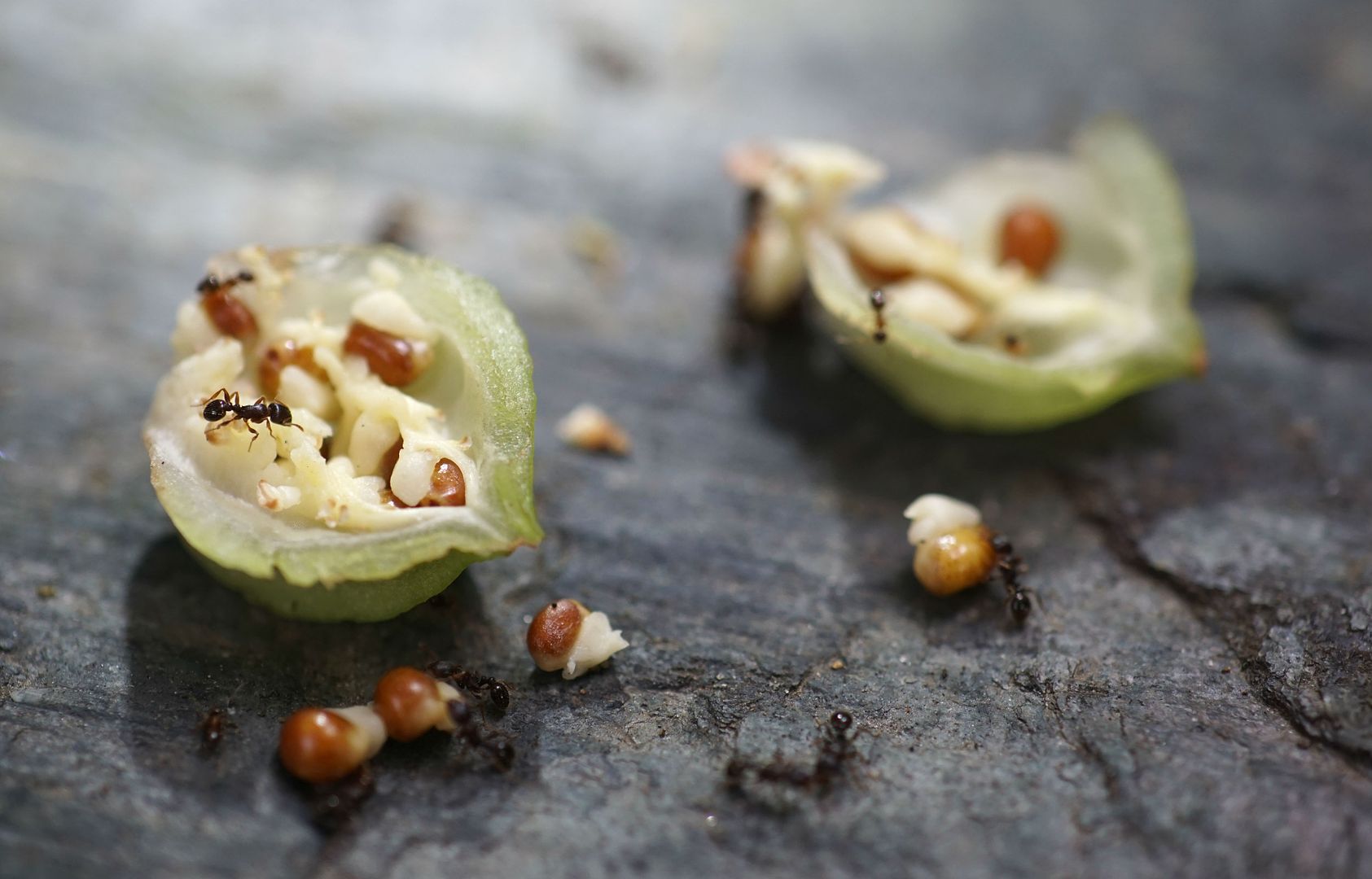 Because dirt doesn't make for a thrilling background, I took the liberty of placing a seedpod on one of the stepping stones of my garden.
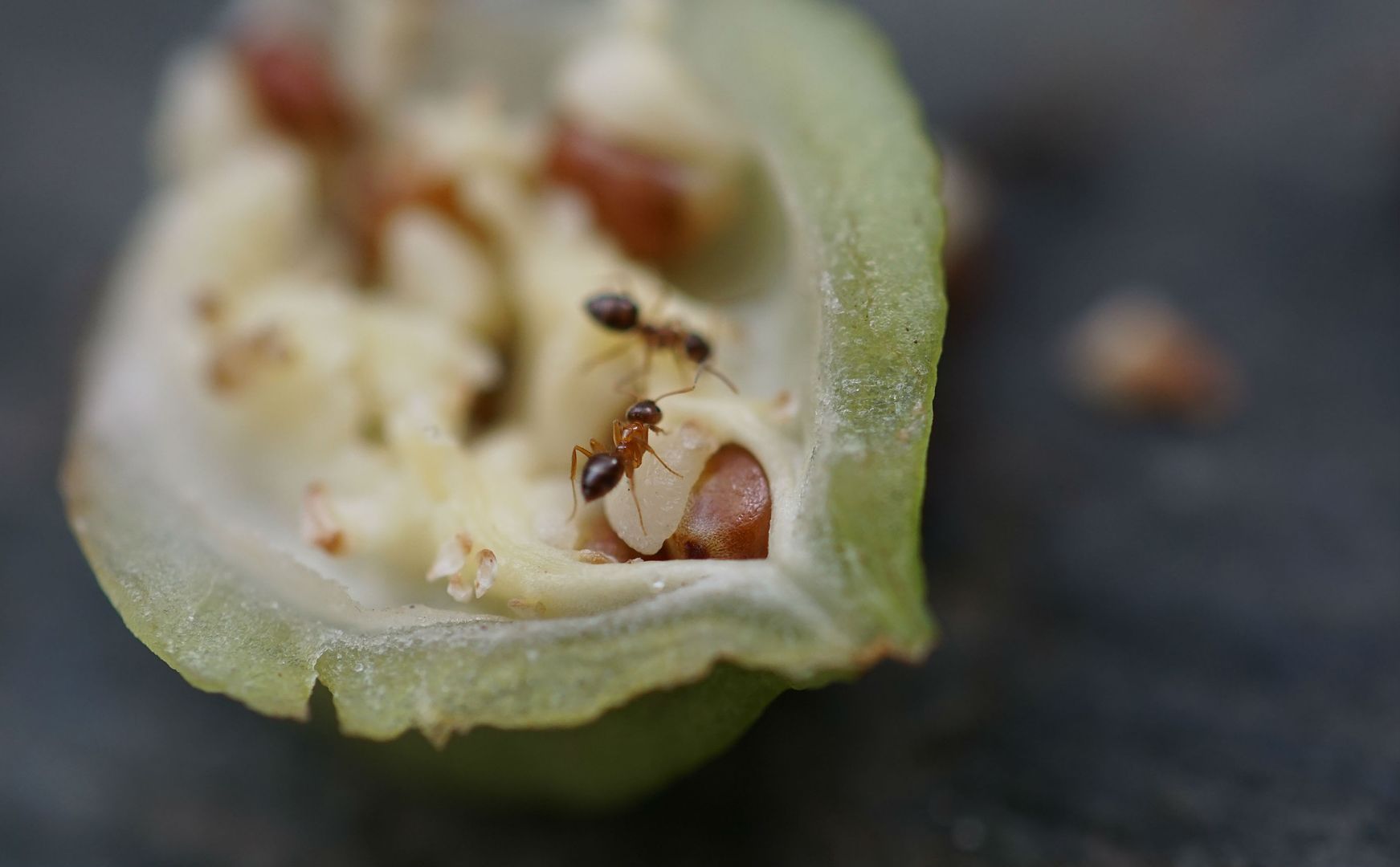 Nylanderia faisonensis is a nonnative woodland species that's slowly been invading areas rich in leaf litter. Nylanderia is a genus of tramp ants which are accidentally imported all over the world. Not all ants are ideal at planting seeds, and this is one of them. The ants are too small to carry the seeds anywhere, so instead of dispersing them as the plant wanted, the ants simply feed on the elaiosome where they found the seed.
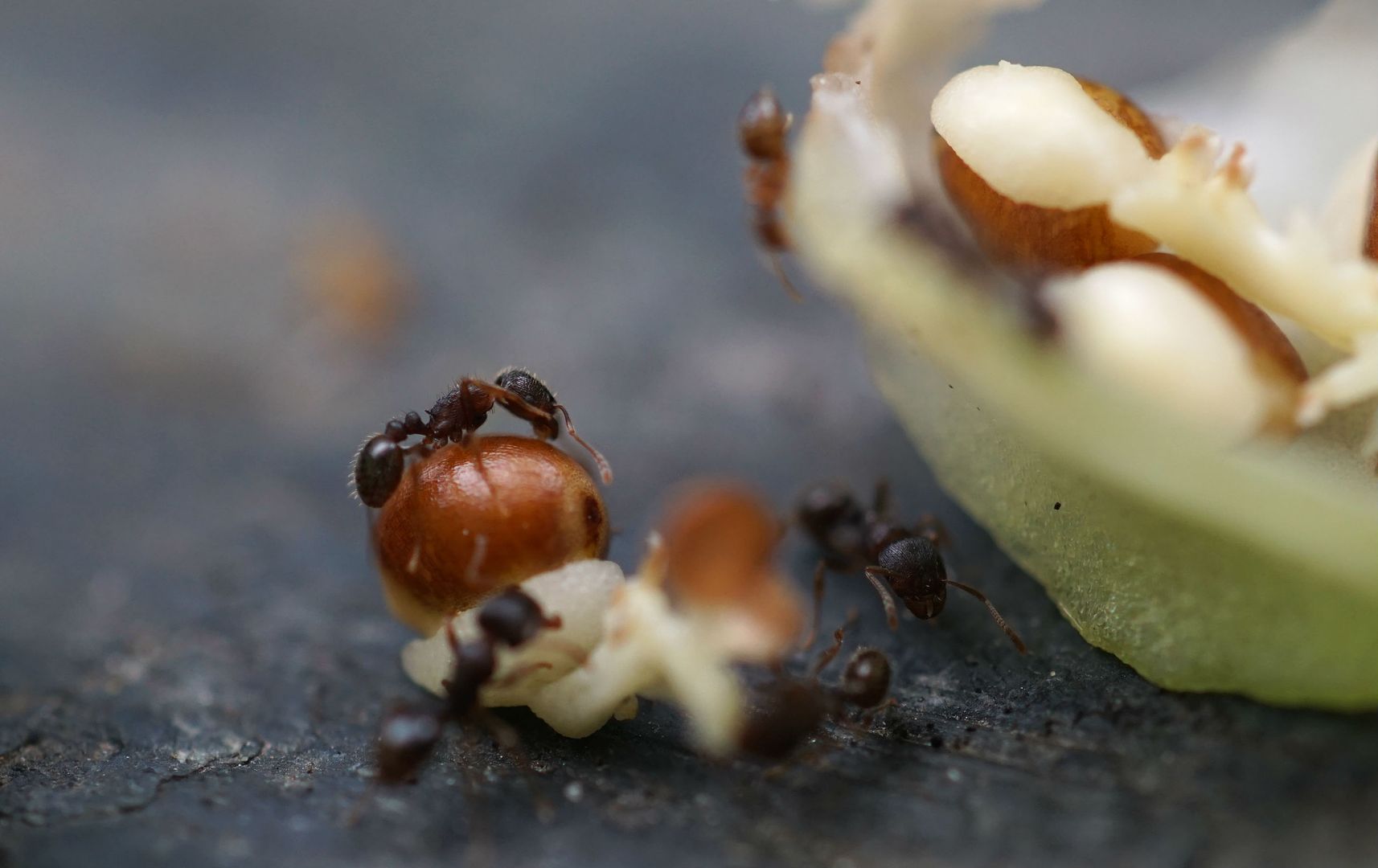 Tetramorium caespitum, Pavement Ants, do a better job but also are not native. Studies have been coming out finding that Nonnative Ants tend to favor the seeds to Nonnative Plants. In this case the Tetramorium were more than happy to disperse these seeds for me. (My yard also lacks any nonnative plant that has elaiosome on the seeds.)
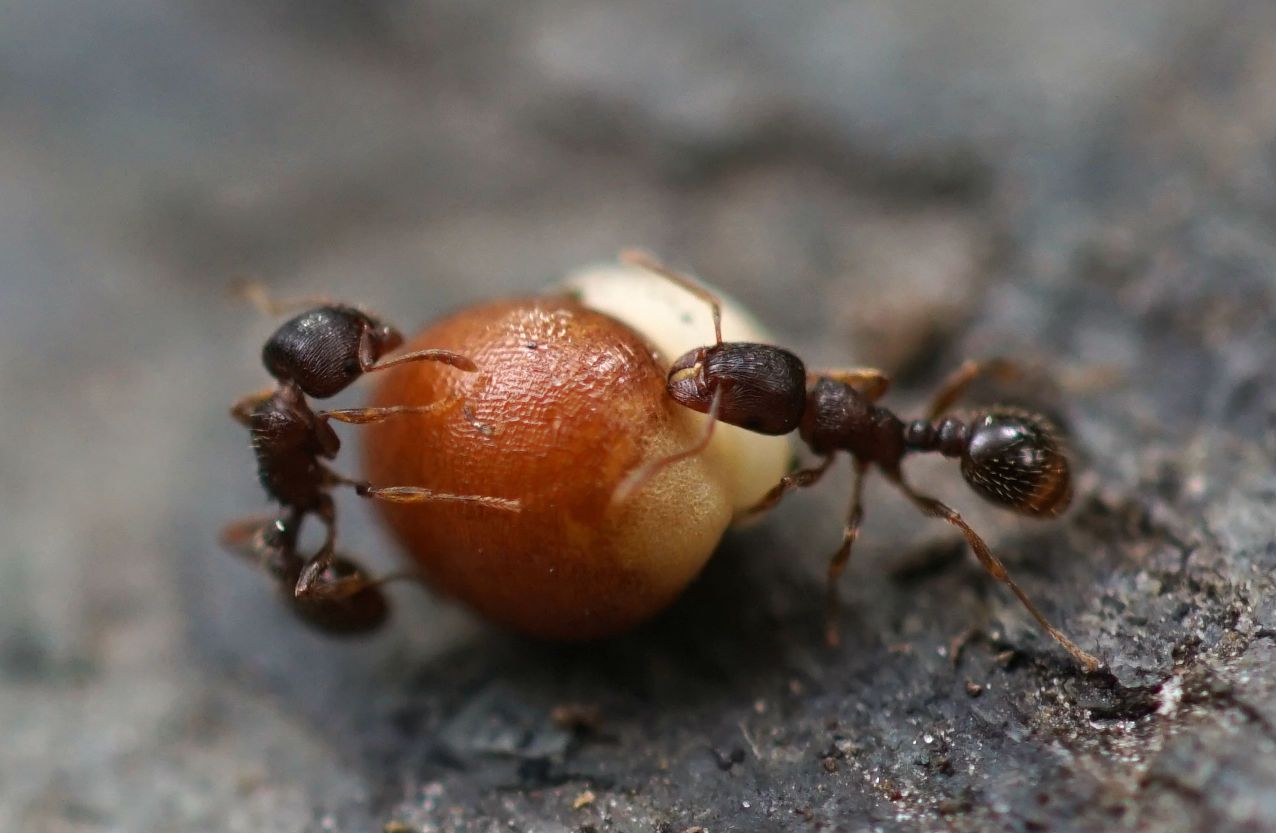 Another risk facing Trillium seeds is the ants eating the seed along with the elaiosome. Trillium seeds tend to be rock hard for the first two years then soften up as they go to germinate. They are said to produce a fowl smell which is probably meant to encourage ants to move their nest elsewhere!
The ideal ant genus to be doing this seems to be Aphaenogaster which form abundant colonies of ~2000 ants throughout woodland settings. They're also very much in the habit of changing their nest location, so as the colonies move around they leave seed banks behind where plants like Trilliums tend to grow. There used to be a colony of Aphaenogaster rudis under this stepping stone which is why I picked it, sadly it seems the colony has moved on.
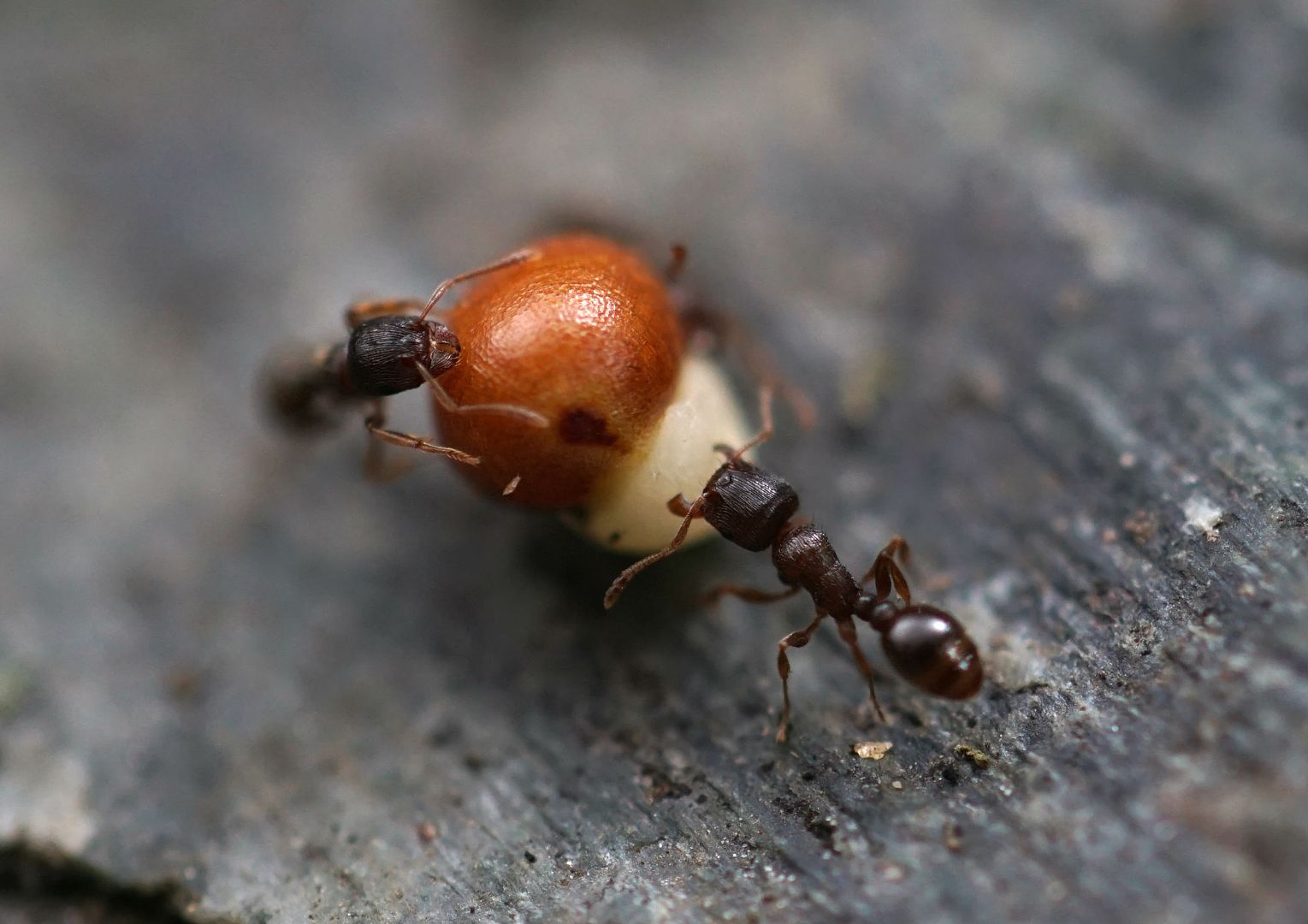 Two Pavement Ants trying to carry a Trillium seed home.
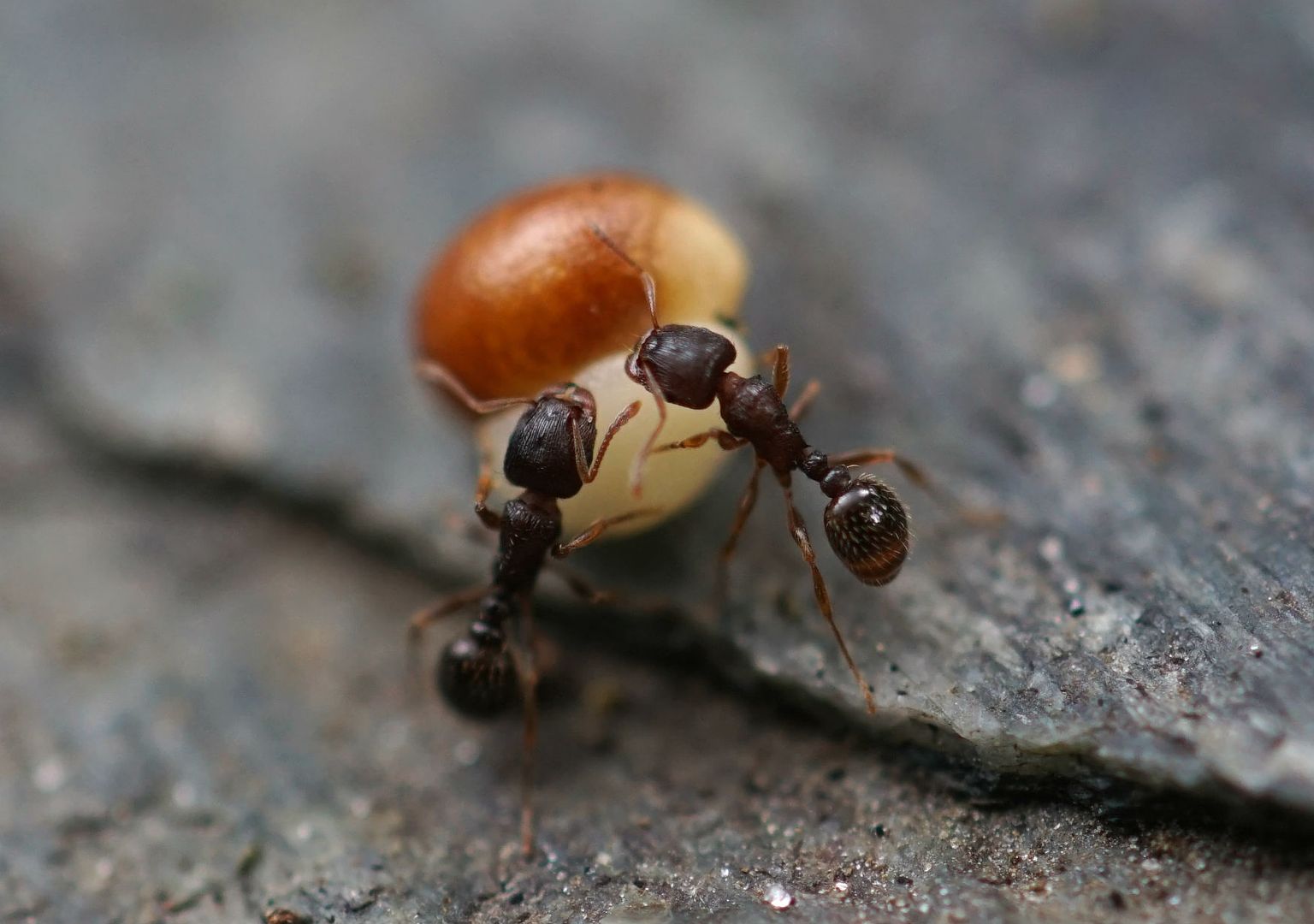 These ants are just big enough to handle the seed, though it still takes two of them to move it. Sometimes ants will actually give up after carrying the seeds a few feet. The seed is still dispersed from the parent plant but slightly at risk of being eaten by a rodent. Trilliums naturally grow best where there is plenty of leaf litter decomposing, and it's likely in these kinds of settings such discarded seeds are still successful.
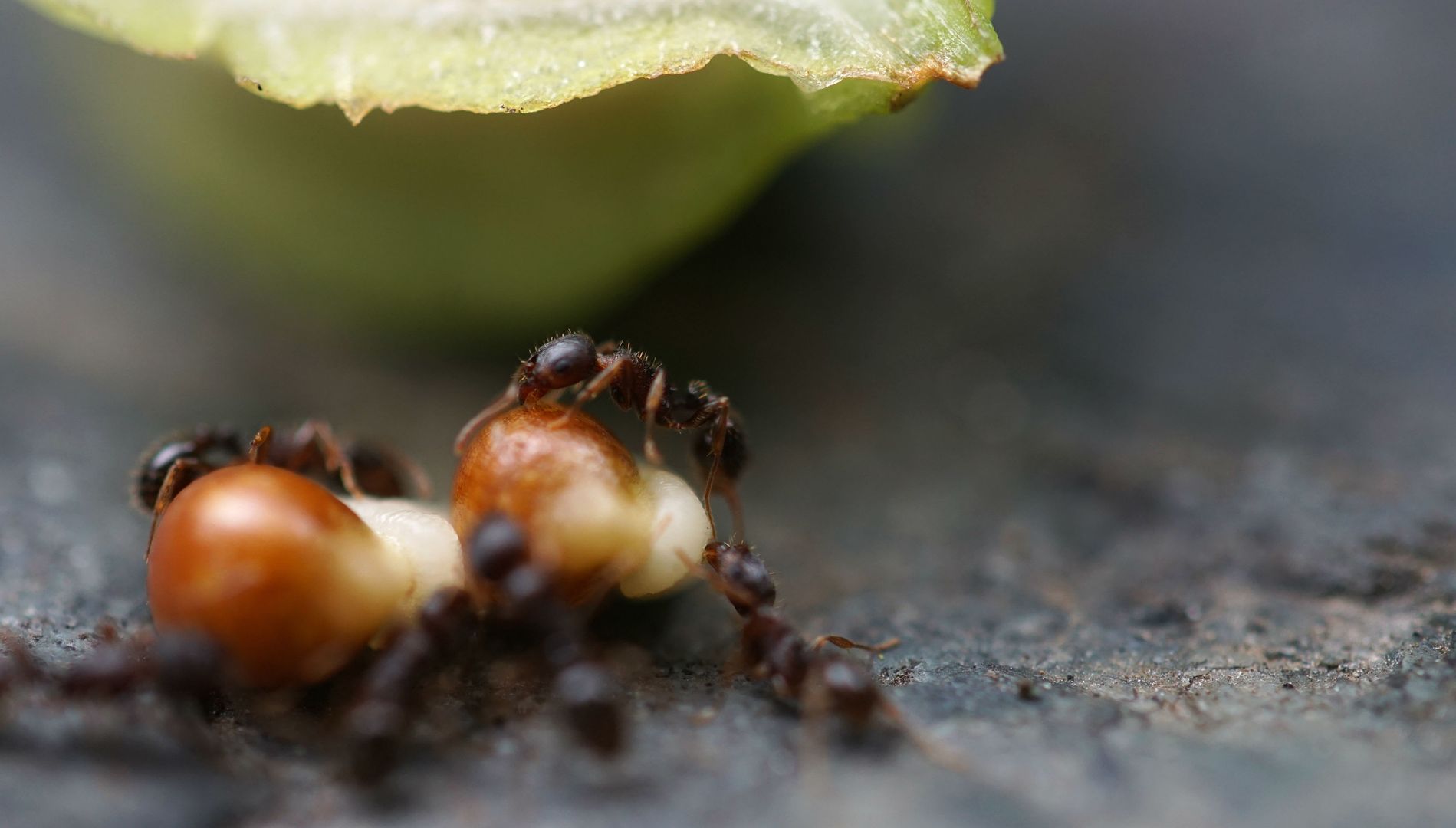 I love this shot.
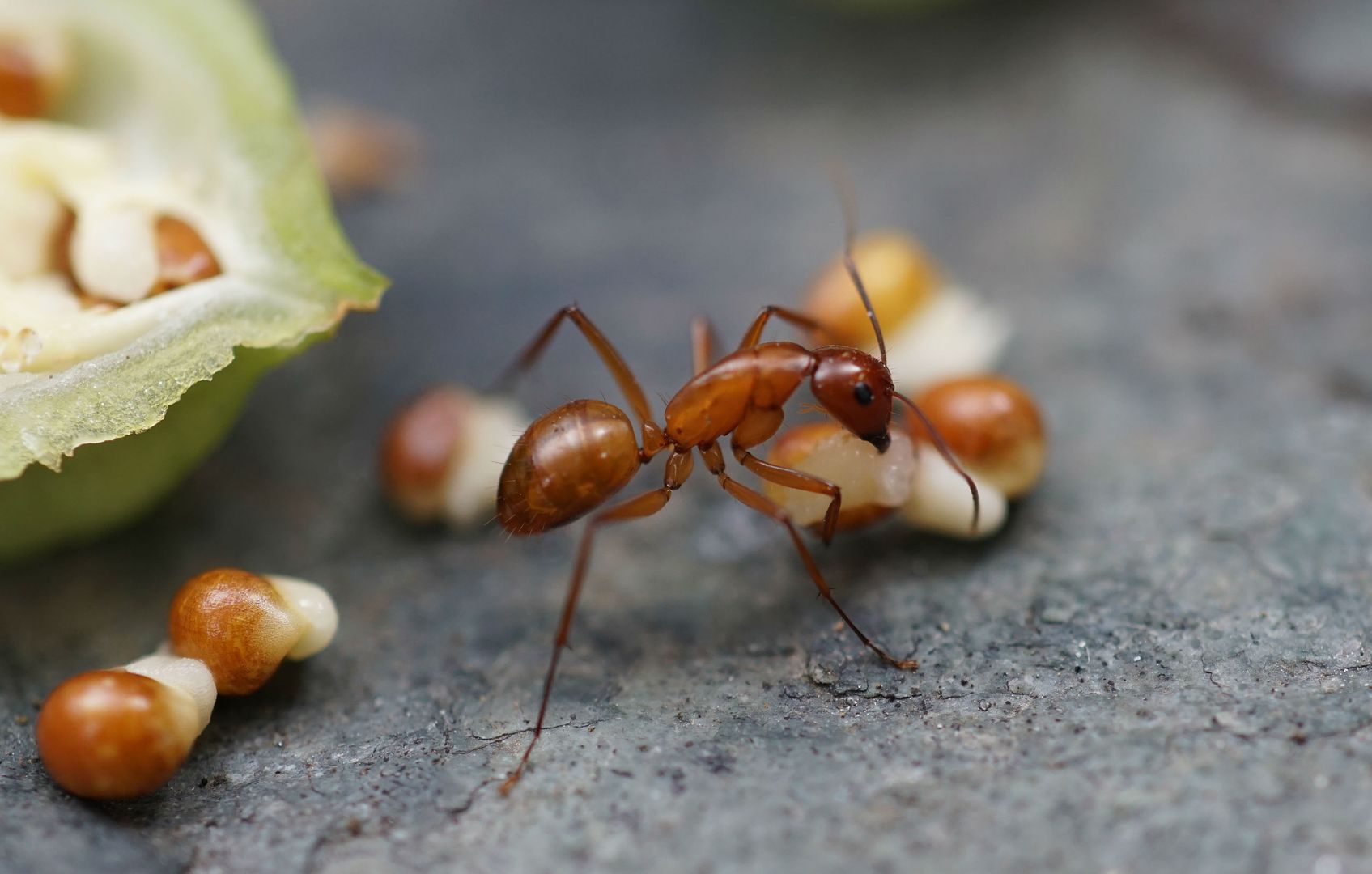 The larger, ground nesting, Camponotus castaneus does a great job of dispersing seeds too. In the past I had assumed the seeds might get lost 4' underground where these ants like to nest. As it turns out though after bringing the seeds home, they're discarded a short while later, once the elaiosome has dried up typically. While the seeds may not be planted, they are dispersed and left in the colony midden pile (trash heap) which is still better than nothing.
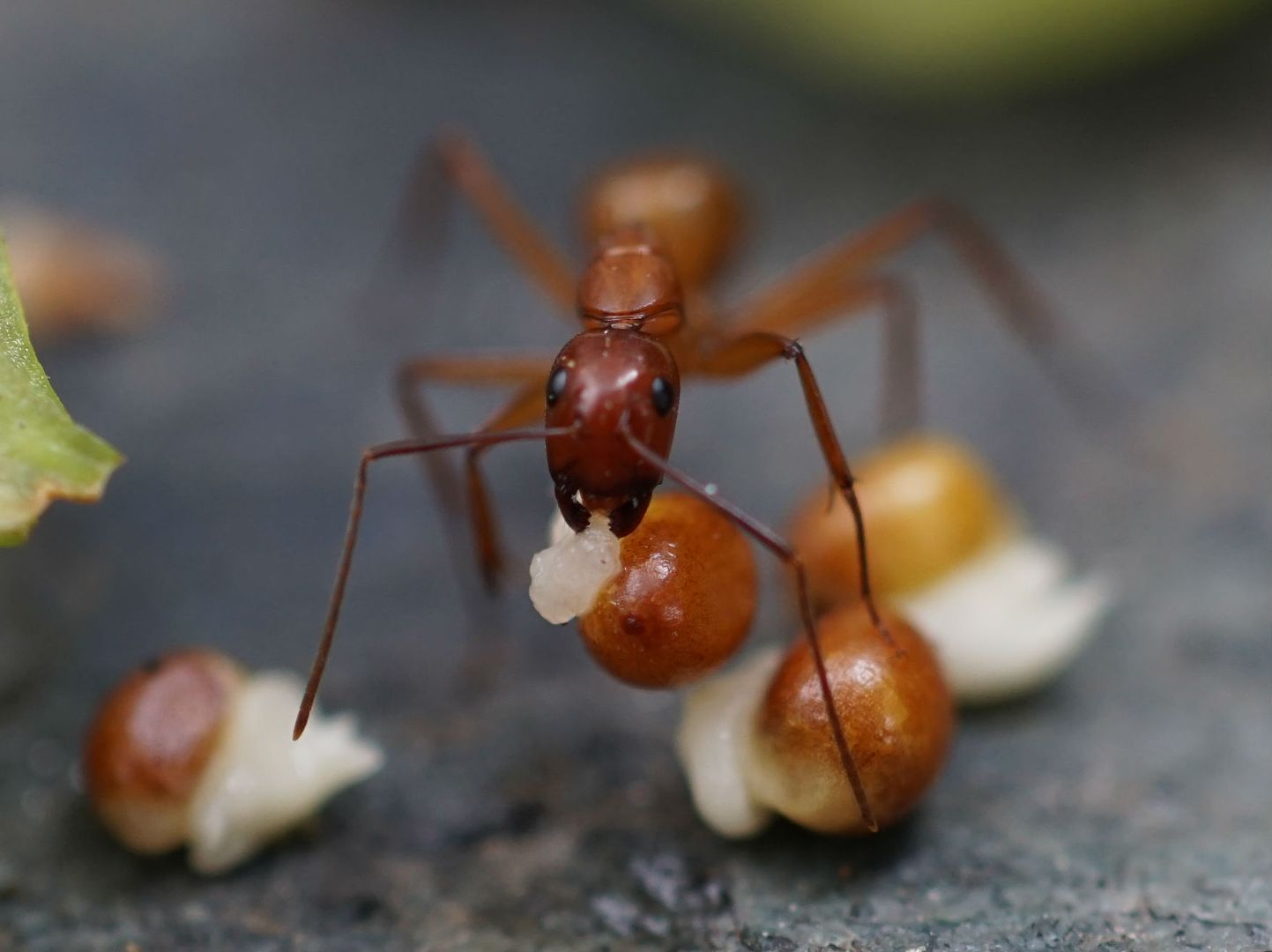 These are one of the most elegant ants in my opinion and I love their chestnut brown and orange color tone.

Ants are largely overlooked by gardeners despite being the most common insect (by number). Part of the reason gardeners don't appreciate ants is likely because they are generalist foragers. So it doesn't matter a whole lot what plants are growing in a garden, native or non; if you have soil and dead wood, chances are ants live in your yard.
I have a Hackberry sapling that's about as tall as me right now. My dream is to someday see some Hackberry Emperors using it as a host plant. Every year though I got out there and find ants (Lasius alienus, Camponotus pennsylvanicus, C. chromaiodes, C. nearcticus, C. subarbatus, Temnothorax curvispinosus and Nylanderia faisonensis) foraging on the tree. They're mostly doing what's called nectar scraping where they wonder the plant licking and scraping the surface of the leaves to collect the small amounts of sweet sap that bleeds out of the leaves with the changing temperature of the day. The foraging power of 1 ant colony is enough to put a dent in the number of Lepidoptera eggs on a sapling; this one has 7 different species and likely multiple colonies of each constantly foraging on it, so I won't likely be seeing any Hackberry Emperors for several years.
My favorite thing ants do in the garden is called Myrmecochory, or ant plant seed dispersal. Even here though ants can be considered annoying. Let's say you paid $20 for a rare Trillium species, looking to start a clump of them over the next decade, which is how long many Trilliums take to flower from seed. Often though Trillium seeds have the annoying habit of walking away from the plant thanks to packets of "Elaiosome," a lipid rich substance on the seed, attracting ants to come and carry them home.
Note how the leaves to the plants photoed above are singed at the tips. If you don't water your plants, they will fry right up and abort the seedpod entirely. You can plant Trilliums in full sun and they'll grow happily but probably won't produce seeds because of how much sun they get. You can compensate for this by adding water but there's only so much watering can do. It's best to plant them in the shade with a small amount of mulch and a low ground cover growing underneath such as Hepatica or Stone Crop. I like to water the roots to mine basically every time I walk past with the hose, or once every other day. Just put the water to the stem and count to 10 for each plant. Even doing this though won't guarantee success. Note the plant to the left didn't bother producing a seedpod at all. Of 9 plants only 2 didn't make seedpods, lack of pollination is likely the issue. Some that did make seedpods made smaller than average ones.
The ideal ant genus to be doing this seems to be Aphaenogaster which form abundant colonies of ~2000 ants throughout woodland settings. They're also very much in the habit of changing their nest location, so as the colonies move around they leave seed banks behind where plants like Trilliums tend to grow. There used to be a colony of Aphaenogaster rudis under this stepping stone which is why I picked it, sadly it seems the colony has moved on.
Subscribe to:
Posts (Atom)